
The Boat That Never Arrives
You are standing in front of it, and you cannot explain why you will not move. There is no violence here, no dramatic gesture, no sublime terror of the kind that sends people backing away from a canvas. The painting is quiet in the way that certain rooms are quiet after someone has left them permanently. You look at the white figure standing in the prow of a small boat, draped in cloth that does not quite read as clothing or as shroud, facing away from you, facing what you are only beginning to understand is a destination rather than a place. The oarsman behind this figure rows with the particular economy of someone who has made this crossing before and will make it again, and the water is so still it holds the cliffs like a mirror holds a face. You have not moved in four minutes. A group of tourists passes behind you and their voices dissolve before reaching your ears. You are somewhere else, or rather you have recognized somewhere else as a place you already knew.

Arnold Böcklin painted Die Toteninsel five times between 1880 and 1886, each version a deliberate restatement that is not quite a repetition, the way certain obsessions return not because they were unresolved but because they demanded to be inhabited from slightly different angles. The first version emerged in Basel, executed for Marie Berna, a widow who had requested a picture to dream over, which is itself a commission unlike any other in the history of modern painting — not a patron seeking prestige, not a church seeking doctrine, but a grieving woman seeking a room for her grief to live in. Böcklin gave her something that would eventually hang in museums across five cities, reproduced on the walls of Sigmund Freud’s consulting room in Vienna, on the desk of Vladimir Nabokov’s imagination, in the private quarters of Adolf Hitler, a painting that crossed every ideological and psychological border of the twentieth century while remaining essentially untranslatable.
The physical facts of the image are few and strangely resistant to exhaustive description. A rocky island rises from dark water, its cliffs carved into what might be tomb entrances, its heights crowned with Italian cypress trees so black they read less as vegetation than as vertical silences. The cypresses — historically planted in Mediterranean cemeteries because their roots grow downward rather than outward, disturbing no graves — perform their symbolic function without announcing it, the way the most effective symbols always work by pretending to be merely themselves. The white figure stands motionless in a flat-bottomed boat, and this stillness inside the motion of rowing generates the painting’s central tension: arrival is imminent and arrival is impossible, the boat perpetually crossing water that offers no resistance and no conclusion.
What Böcklin understood, perhaps without theorizing it, was that the imagination of death is not really an imagination of ending. It is an imagination of threshold, of the moment before which retains its before-quality forever. The Greeks built this understanding into their mythology with far less mercy than Böcklin extends it — Charon’s ferry was a one-way crossing with a clear terminus. But the painting refuses the terminus. The island receives no one while you watch. The oarsman rows and will row. The threshold holds.
Across the five versions, small details shift. In some, the coffin lying flat in the boat’s hull is clearly visible; in others it recedes into shadow. The time of day migrates between a pale-grey dawn and a greenish dusk that cannot be one thing or the other. The water changes temperature. But the white figure never turns, never arrives, and it is this structural refusal that keeps you standing where you are, because something in you has always known that the dead do not depart so much as they assume a permanent elsewhere, present in the specific gravity of their absence.
A Commission Born from Grief
You are standing in a gallery in Basel sometime in the 1880s, and a reproduction of a painting stops you before you have fully decided to look at it. You have not lost anyone recently. You are not in mourning. And yet something in your chest tightens in a way that feels strangely familiar, like recognizing a language you were never taught.
Marie Berna came to Arnold Böcklin in the spring of 1880 as a young widow, draped in the particular exhaustion of recent grief, and her commission was arguably one of the strangest requests ever made of a living painter. She did not ask for a portrait of her dead husband, did not ask for a religious scene of resurrection, did not ask for comfort in any recognizable form. She asked, in terms that have since passed into the mythology of Western art, for “a picture to dream by.” The phrase is almost too perfect, as if grief had finally found language precise enough for what it actually needs, which is not consolation but atmosphere — a container large enough to hold the weight of absence without explaining it away.
What Böcklin brought to that request was not professional distance. By 1880, he had buried twelve of his fourteen children. The arithmetic alone is staggering — twelve small deaths, twelve intervals of watching a body that had been inside your body become inert — and it produces in the imagination a kind of cumulative disfigurement that no single loss can replicate. Friedrich Nietzsche, who knew Böcklin personally and wrote about him with an almost uncomfortable admiration, understood that prolonged proximity to death does not make a person philosophical in the comfortable sense. It makes them allergic to surfaces. The painter who produced the first version of The Isle of the Dead was not a man translating grief into symbol. He was a man for whom the membrane between the living and the dead had been worn so thin it had become essentially transparent.
What happened next is the part that deserves more unsettling scrutiny than it typically receives. The painting was reproduced. Then reproduced again. By the early twentieth century, photographic prints of it hung in parlors, studies, and waiting rooms across Europe and Russia. Sigmund Freud owned a copy. Lenin owned a copy. It appeared in bourgeois apartments alongside clocks and ferns, which means that a vision born from the specific ruin of one man’s private life became a kind of decorative grammar for an entire civilization’s relationship with mortality. The original commission — intimate, grief-soaked, made for one woman’s sleepless nights — had been metabolized into wallpaper.
This is the process that sociologist Georg Simmel, writing in 1907 in his essay on the philosophy of money and the tragedy of culture, identified as the fundamental violence of modernity: the moment a living expression detaches from the body that produced it and begins circulating as an object, it does not merely travel — it transforms. It becomes available to be felt without being understood, consumed without being inhabited. Millions of people looked at Böcklin’s white-robed figure standing in a black boat among dark cypresses and felt something genuine and real. But what they felt had been industrialized. Their tremor was authentic; its cause had been stripped of context.
The darker implication is that grief itself became, through this painting, a purchasable posture. To hang The Isle of the Dead in your home in 1895 was not only to acknowledge death but to perform a certain cultivated relationship with it — to signal that you were the kind of person who could sit with darkness, who had the interior life to appreciate it. Max Klinger made an engraving cycle responding directly to Böcklin in 1884. Sergei Rachmaninoff composed a symphonic poem from the image in 1909. The mourning had become a genre, and genres, by definition, belong to everyone and no one.

The Nineteenth Century’s Relationship with Dying
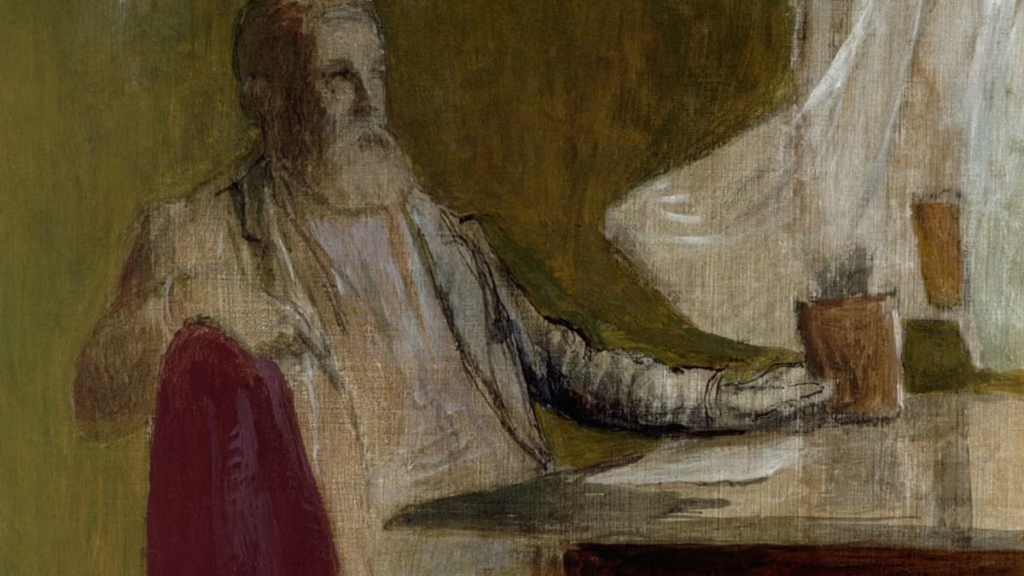
You stand in a photograph taken sometime around 1880, though you are not in it — your grandmother is, or someone’s grandmother, propped upright in a chair with her hands folded and her eyes shut, dressed in the finest clothes she owned, which is to say the clothes she was buried in three days later. The photographer has arranged the light carefully. There is nothing accidental about this image. Someone paid for it.
The practice of postmortem photography was not a morbid curiosity confined to the eccentric fringes of Victorian society. Between roughly 1840 and 1910, it was a mainstream, commercially viable industry across Britain, Germany, the United States, and much of Western Europe. Infants especially were photographed after death because, for many families, death was the only occasion that held still long enough for the camera’s long exposure times to capture a face. The image was often the only image. Grief had become something you could frame and hang on a wall, something with a price, something that required aesthetic decisions about composition and shadow and the arrangement of flowers.
Philippe Ariès, in his monumental 1977 study published in English as The Hour of Our Death in 1981, mapped the slow mutation of Western attitudes toward mortality across a thousand years, and what he identified in the nineteenth century was not a civilization confronting death more honestly than its predecessors, but one constructing an elaborate theatrical substitute for a faith it could no longer fully inhabit. The Reformation had already fractured the Catholic machinery of intercession — the masses for the dead, the indulgences, the purgatorial economy that gave survivors something active and transactional to do with their grief. By the time Darwin published On the Origin of Species in 1859, the theological floor had shifted under an entire culture’s feet. The response was not stoicism. It was décor.
The mourning protocols of the Wilhelmine and Victorian bourgeoisie were, by any reasonable measure, extraordinary in their specificity and duration. A widow in England was expected to wear full black crape for two years, then progress through half-mourning grays and mauves according to a calendar that was social law as much as personal feeling. Entire industries fed this demand: Courtauld’s became one of Britain’s most profitable textile manufacturers largely on the strength of mourning fabric. Jay’s Mourning Warehouse on Regent Street operated for decades as a department store dedicated exclusively to bereavement. Grief had its own economy, its own supply chain, its own aesthetic vocabulary — and that vocabulary was rigorous, codified, and public in a way that had almost nothing to do with private suffering.
What Ariès recognized, and what the postmortem photographers and the mourning warehouses confirm from the outside, is that aestheticization is what happens when a culture loses its metaphysical confidence but retains its emotional need. Beauty steps into the space that theology vacates. If you cannot say with certainty where the dead go, you can at least ensure they are surrounded by beauty when they leave — beautiful caskets, beautiful photographs, beautiful paintings of beautiful islands where beautiful white figures stand at the prow of boats moving toward shores lined with cypress trees so dark they absorb the light. The painting does not replace the prayer. But it performs a similar function in the nervous system of a person who no longer knows whether the prayer was ever heard.
This is the century that produced Böcklin, and it produced him not despite its obsession with death but through it. He was painting into a hunger that had no other adequate form. The German Romantic tradition from which he emerged — Caspar David Friedrich’s lone figures on clifftops, the sublime as a confrontation with human smallness — had already established the visual landscape as a site for existential reckoning rather than mere topography. Böcklin inherited that grammar and pushed it somewhere colder, somewhere the sublime had curdled into something closer to dread dressed in the clothes of serenity.
Why Dictators Dreamed of This Island
You are sitting in a waiting room in Vienna, sometime before the world ends for the first time, and on the wall across from you hangs an image of dark water, a silent boat, a figure draped in white moving toward a rock that does not welcome and does not refuse. You have come to be interpreted, to have your interior life excavated and labeled, but before any of that begins, you are already being prepared — by the image, by the stillness it imposes, by the feeling that what you are about to confess has already happened somewhere unreachable.
Sigmund Freud kept Arnold Böcklin’s print in his Vienna waiting room not as decoration but as a kind of threshold object, a visual antechamber that softened the boundary between the social self and whatever lived underneath it. Freud understood that certain images do not communicate meaning — they suspend the defenses that prevent meaning from arriving. The painting worked on his patients before he did. What is more unsettling is that the same image, in a different decade, in a different city, performed an entirely different psychic function for men who were not interested in being interpreted at all.
Vladimir Lenin kept a reproduction of the same painting in his Kremlin office during the early years of Soviet power, years defined by the organized application of death as political instrument. There is no record of what Lenin said about it, which is itself significant — some objects are kept precisely because they cannot be spoken about, because speech would dissolve the particular silence they create. A revolutionary who had theorized history as an impersonal force, who had subordinated individual conscience to the logic of the collective, chose to place before himself, daily, an image whose entire grammar is personal, solitary, unrepeatable: one figure, one boat, one crossing.
Adolf Hitler owned a copy — not a reproduction but an actual painted version, one of the five Böcklin produced between 1880 and 1886. He acquired it in 1933, the same year he assumed the chancellorship, and it traveled with him. The convergence of these three men around a single image is not a coincidence to be explained by taste or cultural fashion, though the painting’s extraordinary popularity in the German-speaking world between 1890 and 1930 created a kind of ambient permission for obsession. What the convergence actually reveals is a shared need that ideology cannot satisfy: the need for a destination that requires no argument.
Every system of power, no matter how total, generates an internal remainder — a residue of personal mortality that the system cannot absorb, cannot collectivize, cannot defer through doctrine. The dictator, precisely because he has placed himself at the origin of historical necessity, finds himself uniquely exposed to the fact that necessity will eventually run through him. The island in Böcklin’s painting is not paradise and it is not punishment. It offers something more seductive than either: pure arrival, a place that exists after the exhaustion of justification. No one in that boat is explaining themselves. The white figure does not owe the cypresses a reason.
Ernst Jentsch, writing in 1906 on the psychology of the uncanny, identified intellectual uncertainty about whether something is alive or dead as a primary generator of dread — a framework Freud would later absorb and redirect. The painting operates precisely inside that uncertainty. The cypresses are too still for the living and too vertical for the dead. The island neither receives nor rejects. It simply persists in a light that belongs to no particular hour, and this is what makes it habitable to the imagination of anyone who has built their life around the refusal of limits — because limitlessness, pursued long enough, produces its own peculiar exhaustion, a craving not for more power but for a shore where power is simply no longer the question being asked.
Freud’s Waiting Room and the Death Drive
You have been in a waiting room before — not a medical one, not exactly, but one of those interior pauses where the noise of wanting something has simply stopped, and the absence itself feels almost preferable to whatever was wanted. No urgency, no grief, just a peculiar readiness. The body still breathing but something in it already tilted toward rest, the way a gyroscope slows not into collapse but into a kind of sovereign stillness.
Sigmund Freud spent the years following the First World War trying to account for a pattern that pleasure-seeking alone could not explain. In Jenseits des Lustprinzips, published in 1920, he named what his patients had been demonstrating for years without naming it themselves: a compulsion that drove them not forward into satisfaction but backward, repetitively, toward an earlier state. His argument was precise and disturbing. Every living organism carries within it a drive toward the inorganic condition that preceded its existence — not a wish for violence, not a romance with extinction, but a pull toward the zero-point, toward the absolute reduction of internal tension that once, before life complicated everything, simply was. He called this the Todestrieb, and even his closest colleagues found it excessive, a conceptual overreach born of wartime despair. What they missed was that the concept had already been painted.
Arnold Böcklin completed the first version of Die Toteninsel in 1880, four decades before Freud’s text. The painting does not depict death as event — no struggle, no wound, no grief rendered in expression. What it renders is the gravitational state Freud would later be forced to theorize: the world after tension has been removed, where the organism has found its way back to silence. The white-draped figure in the boat does not mourn. The figure stands with the stillness of something that has already arrived at what the living spend their entire lives circling. Böcklin did not illustrate a concept. He made visible a condition of the psyche that clinical practice would only later force into language.
The political and cultural climate of late nineteenth-century Europe was saturated with a specific exhaustion — not the exhaustion of poverty or labor, though those were present, but the exhaustion of modern selfhood, of the bourgeois individual required to maintain coherent desire across an increasingly fragmented world. Schopenhauer’s influence on German intellectual culture by the 1870s and 1880s was not academic; it was atmospheric. The Will, in his formulation, was not liberating but tyrannical, an endless engine of striving that offered no terminus. The fantasy of the inorganic was not morbid escapism in this climate. It was a logical response to the exhaustion of being a wanting thing.
What Freud observed in his consulting room on Berggasse 19 in Vienna were people who returned, compulsively, to the site of their own unpleasure. Soldiers replaying the trauma of trenches in their sleep. Patients reconstructing in their relationships the same dynamics that had already destroyed them. He could not fit this into a simple economy of pleasure and pain. The Todestrieb was his theoretical concession to the evidence — that something in the organism seeks not gratification but cessation, not the height of experience but its reduction to a flat, tensionless ground. And the painting had already mapped that ground: cypresses that have always been there, rock that does not erode in any emotional sense, water with no horizon of escape, a destination that is also an origin.
Five versions of the painting exist, produced between 1880 and 1886, each a slight recalibration of the same internal geometry. That compulsion to return — to paint the same image again without repeating it, to approach the same threshold from a different angle — is not incidental to its subject matter.
A vision curated by a filmmaker, not an algorithm
In this video I explain our vision
Silence as a Structural Argument
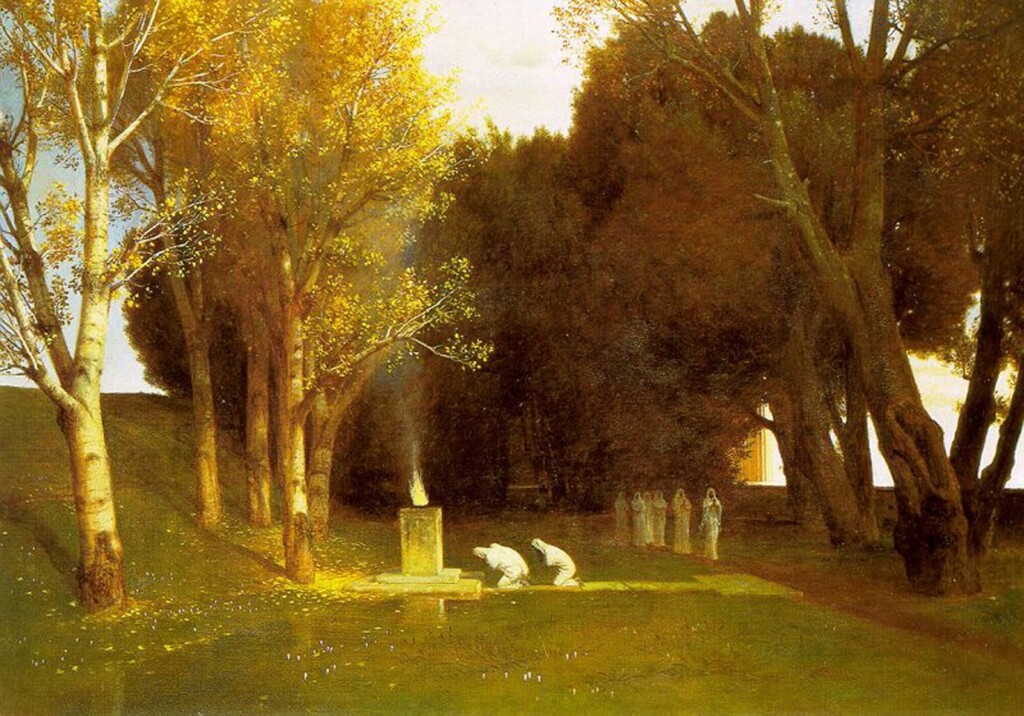
You are standing at the edge of something that does not invite you in. The boat moves, but there is no sound you can attach to its movement — no creak of oar, no slap of water against wood, no breath from the standing figure in white. Böcklin has constructed an image that the eye enters the way a body enters cold water: slowly, with the recognition that something irreversible is beginning.
The cypresses are not decoration. In every version Böcklin produced between 1880 and 1886 — five canvases, each a slight revision of the same essential grammar — those trees perform a closing function. They rise above the rock face and seal the upper portion of the frame with a finality that is structural, not symbolic. The sky does not continue behind them in any meaningful sense. They are a wall made of living matter, and the fact that they are living makes the enclosure more disturbing, not less. Growth here has been recruited into the service of terminus.
The water in the foreground reflects almost nothing. This is a choice so precise it amounts to a philosophical statement. Water in painting is conventionally a mirror — it doubles the world, confirms its presence, extends its light. Böcklin’s water refuses this. It absorbs. What lies beneath the surface of that flat, dark expanse is not visible and is not meant to be, and the effect is that the world above the waterline begins to feel provisional, slightly unreal, as though it too might be absorbed if it waited long enough.
Arthur Schopenhauer argued in The World as Will and Representation, published in its full form in 1844, that music occupies a unique position among the arts precisely because it does not represent the world — it enacts the force that drives the world forward. Every other art form, in his account, gives us ideas, which are themselves already at one remove from the blind striving he called the Will. Music alone bypasses representation entirely and speaks as that striving speaks: directly, urgently, without mediation. It is the sound of wanting before wanting has an object. What Böcklin produces is the systematic negation of this. His painting is an image from which the Will has been evacuated. Nothing in it strains toward anything. The boat does not seem to want to arrive. The figure does not seem to want to disembark. The cypresses do not grow toward light in any way the eye can register as movement. This is not tranquility. Tranquility is what remains when desire has been satisfied. What remains here is what desire looks like when it has been spent entirely.
The white-draped figure standing in the boat has attracted enormous speculation, but what matters formally is posture: the figure faces away. It does not look back at whoever — whatever — watches from outside the frame. This refusal of the returned gaze is not evasion; it is the painting’s most economical assertion. The world of the living is organized around the face turned toward you, the acknowledgment, the relational loop of seeing and being seen. Here that loop is broken at its source. The figure does not complete the circuit because it has moved into a register where that circuit no longer applies.
Böcklin was working at a historical moment when the very mechanisms of attention were being theorized. Robert Vischer coined the term Einfühlung in 1873 to describe the way a viewer projects bodily sensation into a visual form — how the eye feels the weight of a stone, the resistance of a surface, the tension of a curve. The Isle of the Dead exploits this projection and then collapses it. You lean toward the image with your full nervous system and find that the image does not lean back. The empathetic loop, usually automatic, finds nothing to complete itself against — and in that absence, something else begins.
The Copies and the Compulsion to Reproduce
You do not return to a painting five times because you are satisfied with it. You return because it has not yet said what it needs to say, or because you suspect it said something once, in a particular arrangement of light and stone and water, that you cannot locate again. Between 1880 and 1886, Arnold Böcklin produced five distinct versions of the same composition, and the repetition itself is a kind of confession — not of failure, but of obsession, which is a different animal entirely.
The first version, completed in 1880 and now held in Basel, was commissioned by the art dealer Fritz Gurlitt and established the essential grammar: the white-robed figure standing in the boat, the dark cypress sentinels, the rock face with its tomb-cut hollows, the water holding everything in suspension. That same year, Böcklin produced a second version for Marie Berna, a widow who had asked him for a painting that evoked the land of shadows — and this version, currently in New York’s Metropolitan Museum, introduced the white coffin laid in the prow, a detail so precisely funereal it seems less like an addition than a correction, as if the first version had been too subtle about what it was actually depicting. By 1883 he had made a third version, now in Berlin, and this one introduced moonlight — a tonal shift that moves the image from dusk into something more theatrical, more consciously nocturnal, as if Böcklin were testing whether darkness could deepen what twilight had only suggested. The 1884 Leipzig version and the 1886 New York version followed, each carrying minor deviations in the coloration of rock, the density of foliage, the precise posture of stillness that the white figure holds in its standing vigil.
Walter Benjamin argued in 1935, in his essay on the work of art and mechanical reproduction, that the copy destroys the aura — that singular, unrepeatable presence that belongs to an original object in its specific time and place. The logic is clean and seductive. But Böcklin dismantles it from the inside, because here the hand making each copy is the same hand that made the original, and that hand kept returning not to distribute the image but to recover something it believed was still trapped inside it. This is not reproduction in Benjamin’s industrial sense. It is something stranger: an artist who became the first mechanical reproducer of his own vision, not because the market demanded it, but because the image refused to be finished. Each version is less a copy than an attempt — another approach to a shore that kept receding.
What compels a painter to re-enter the same composition across six years is worth sitting with, because it does not belong to craft or commerce alone. Böcklin was not iterating toward a final, perfected form the way an engineer tolerates prototypes. The differences between versions are too small to suggest improvement and too deliberate to suggest negligence. The moonlight in the Berlin version does not make the image better; it makes it different, which means Böcklin understood that he was not correcting the previous painting but interrogating it. He was asking whether the truth of the image depended on its lighting, its season, its chromatic register — whether the thing he felt when he first conceived it could be stabilized, anchored, made to stay.
This is a very particular kind of psychological relationship to one’s own work, one that sits uncomfortably close to what Freud would later call the compulsion to repeat — the drive to return not to pleasure but to something unresolved, something that did not discharge itself the first time and so keeps pressing forward into new occasions. The painting was not a product Böcklin made and released. It was a problem he inherited from himself, renewed each time he picked up the brush, as though the isle kept sinking just before he could reach it.
What the Living Go There to Find
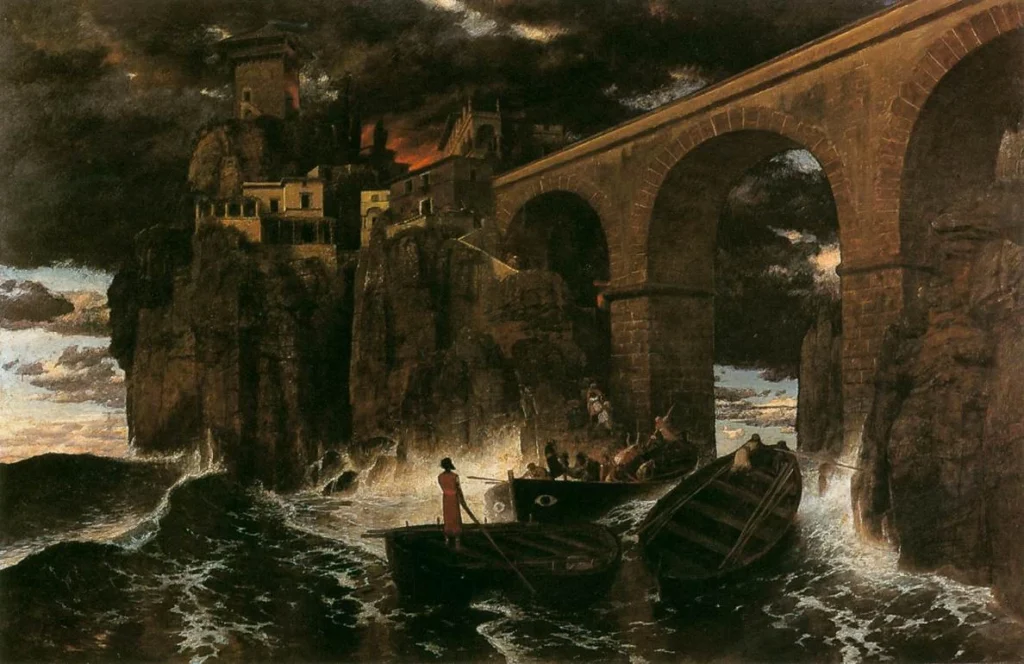
She is sitting on the floor of a room that still smells like the hospital, and the reproduction is tacked to the wall at a slight angle because no one has straightened it, and no one will. It came with the apartment, left by someone who lived there before and apparently could not take it with them, or did not want to. She has been looking at it for eleven minutes without realizing she was looking at it. This is not aesthetics. This is something else entirely.
The dominant framework for understanding grief in the Western world was codified by Elisabeth Kübler-Ross in her 1969 work On Death and Dying, derived from interviews with terminally ill patients and almost immediately misapplied to everyone who had ever lost anything at all. Five stages: denial, anger, bargaining, depression, acceptance. The model was never intended as a universal sequence, but it became one through sheer cultural repetition, absorbed into self-help books, hospital pamphlets, and the quiet social expectations of anyone watching someone they loved fall apart. Grief, the framework implied, was a problem with a trajectory. You moved through it. You arrived somewhere on the other side. The stages gave mourning the architecture of recovery, which meant that anyone who refused to recover was, implicitly, failing.
What the painting on that slightly tilted wall refuses, absolutely and without apology, is the premise of passage. There is no movement in Böcklin’s composition that carries the eye toward resolution. The boat does not dock. The white figure does not turn around. The cypress trees do not thin into open sky. The grammar of the image is arrival without aftermath, and that grammar matches something in the experience of loss that no stage-based model can accommodate: the state in which you are not denying, not bargaining, not depressed in any clinically meaningful sense, but simply located somewhere that ordinary time does not reach. Not stuck. Not failing. Simply present in a place that has its own atmosphere and its own rules.
There is a difference between grief as event and grief as territory, and the nineteenth century understood this in ways that the twentieth-century therapeutic turn actively suppressed. The Romantic tradition from which Böcklin drew, by 1880 already a rearguard action against the rising confidence of industrial progress, had no interest in mourning as a phase. Schopenhauer, whose ideas saturated the European cultural atmosphere of Böcklin’s working life, understood suffering not as an obstacle to happiness but as the fundamental texture of conscious existence, and the only honest response to it was not resolution but clear-eyed habitation. The philosopher’s 1818 argument in The World as Will and Representation was not a counsel of despair but of lucidity: that to pretend suffering could be conclusively exited was to build your life on a lie that would eventually collect what it was owed.
The woman on the floor is not reading Schopenhauer. She is not reading anything. But something in the proportions of that painted water, those vertical trees, that horizontal silence, is organizing her attention in a way that feels, oddly, like relief. Not the relief of being comforted. The relief of being accurately described. The painting does not tell her that this will pass. It does not arrange its elements into a before and an after. It simply presents a place where the condition she is in has been given form, scale, and a kind of dignity that the language of stages, with its implicit promise of graduation, has never been able to offer. This is what certain images do when they outlast the cultural moment that produced them: they become portable environments, capable of receiving whoever arrives carrying something too heavy to name, and holding them there without insisting that they leave.
🪦 Death, Dream, and the Gaze Beyond the Veil
Arnold Böcklin’s Isle of the Dead stands at the crossroads of mourning, myth, and the painted unconscious. The works gathered here explore the same threshold: where death becomes image, memory becomes ritual, and the dream of finitude takes on symbolic form.
Memento Mori: History and Meaning
Memento mori is the artistic and philosophical tradition that transforms the awareness of death into a creative and moral force. From skulls on baroque canvases to the vanishing light of a candle, these images share with Böcklin’s painting the same funereal gravity and the same invitation to contemplate what lies beyond the visible. Understanding this tradition means grasping the cultural soil from which the Isle of the Dead grew.
GO TO THE SELECTION: Memento Mori: History and Meaning
Vanitas in Art: Symbolism and Meaning
Vanitas painting is one of the most powerful visual languages ever developed for meditating on the ephemeral nature of human existence. Like Böcklin’s isle, vanitas compositions construct an atmosphere of suspended time, where beauty and decay coexist in uneasy silence. Exploring this genre reveals how Western painting has long sought to make mortality not merely thinkable but hauntingly visible.
GO TO THE SELECTION: Vanitas in Art: Symbolism and Meaning
Light in Painting: History and Symbolism
Light in painting is never merely a technical element: it is a theological and psychological force that shapes the emotional world of a composition. In Böcklin’s Isle of the Dead, the cold, spectral luminosity filtering between cypress trees and stone transforms the scene into something between vision and dream. Tracing the history of light as symbol illuminates why certain painted atmospheres feel irreducibly sacred and irreducibly mournful.
GO TO THE SELECTION: Light in Painting: History and Symbolism
Must-see Movies about the Afterlife
Cinema has returned obsessively to the afterlife as both metaphysical question and dramatic landscape, much as Böcklin returned five times to repaint his isle of the dead. These films explore what lies beyond the boundary of the living with the same mixture of dread and longing that animates the Swiss painter’s most famous canvas. Watching them alongside Böcklin’s image creates a dialogue across media about how human imagination refuses to let death be simply an ending.
GO TO THE SELECTION: Must-see Movies about the Afterlife
Discover Cinema That Dwells in the Beyond
If Böcklin’s funereal dreamscapes have stirred something deep in you, Indiecinema is the streaming platform where that feeling finds its moving-image home. Explore independent and art-house films that dare to look at mortality, mystery, and the invisible with the same uncompromising gaze as the great visionary painters.
👉 EXPLORE THE CATALOG: Watch Indie Films in Streaming
A vision curated by a filmmaker, not an algorithm
In this video I explain our vision

