
Defining the Dutch Angle: Camera Geometry and Psychological Function
The Dutch angle, also known as the canted angle or oblique shot, is one of the most immediately recognizable and technically specific tools in the cinematographer’s arsenal. Unlike a tilt, which repositions the camera along its vertical axis to look up or down at a subject, or a pan, which sweeps horizontally across a scene, the Dutch angle operates along what engineers and cinematographers alike refer to as the roll axis, or z-axis. The camera is physically rotated so that its horizontal plane no longer aligns with the horizon of the real world. The result is a frame in which vertical lines — doorframes, walls, human figures — lean at an angle, and the floor and ceiling of any given space appear to slope away from the viewer’s expected orientation. This seemingly simple geometric intervention carries an enormous amount of narrative and psychological weight.

To understand why this deviation produces such a powerful effect, one must consider how deeply conditioned the human eye is to horizontal equilibrium. The brain continuously cross-references visual input with the vestibular system, which governs balance and spatial orientation. When we observe a level horizon, we feel grounded. When that horizon tilts, even in a two-dimensional image projected onto a flat screen, the nervous system registers an almost involuntary sense of wrongness. The Dutch angle exploits this perceptual reflex with surgical precision. It does not merely suggest that something is amiss within the story; it encodes that suggestion directly into the geometry of the frame itself, bypassing intellectual interpretation and landing straight in the body of the viewer.
Within the broader language of mise-en-scène, the Dutch angle constitutes a deliberate disruption of frame balance. Classical compositional theory — drawn from painting, photography, and the earliest grammar of cinema — prizes the stable horizontal as a sign of order, control, and readability. Characters positioned within a level frame occupy space in a way that feels natural and coherent. The axis of action, that invisible line along which the spatial logic of a scene is organized, depends on a shared, stable reference plane to remain legible. When the camera rolls off that plane, the axis of action does not disappear, but it becomes destabilized. The viewer must work slightly harder to read spatial relationships, to gauge distances between characters, and to assess the physical environment. That extra cognitive effort is not accidental; it is the whole point. The director is engineering a small but significant degree of perceptual labor, and that labor produces unease.
The degree of the tilt itself is a critical variable. A modest canted angle of five to ten degrees produces a subtle, creeping discomfort — the kind the viewer may not consciously identify but will nevertheless feel as a vague atmospheric disturbance. A more aggressive tilt of twenty-five to forty-five degrees announces itself openly, functioning almost as a declarative statement about the instability of the scene or character being depicted. Directors must calibrate this range with care, because an over-applied Dutch angle risks sliding from genuine psychological menace into visual absurdity. The shot carries inherent expressive power, but like any strong spice in cooking, excessive use overwhelms rather than enhances.
From a purely technical standpoint, achieving the Dutch angle requires either mounting the camera on a head that allows roll adjustment, or physically rotating the entire camera body within its mount. On set, this adjustment is often achieved using a fluid head with a roll axis control, or through a dedicated tilt-roll mechanism. The lens remains unchanged; the focal length, aperture, and depth of field are all unaffected. What changes is exclusively the rotational orientation of the imaging plane relative to the world. This means that the Dutch angle is, at its core, an extraordinarily economical device. No additional lighting setup, no lens swap, no complex blocking is required. The meaning is generated entirely through geometry.
It is this economy — this capacity to transform the psychological atmosphere of a scene through a single rotational adjustment — that has made the Dutch angle a recurring and enduring element of film grammar across more than a century of cinema.
The Dutch Angle in Practice: Scene-by-Scene Analysis Across Film History
Carol Reed‘s The Third Man remains the definitive masterclass in sustained Dutch angle deployment, a film in which the canted frame is not an occasional flourish but a governing visual logic. Reed and cinematographer Robert Krasker tilted the camera with extraordinary consistency throughout the postwar Vienna locations, often working at angles between fifteen and thirty degrees. The choice of high-contrast, deep-focus photography on wide lenses — frequently a 25mm or wider — amplified the distortion effect, making the cobblestone streets and bombed-out archways feel actively hostile to the human figures navigating them. In the iconic sewer chase sequence, the tilt combines with low-angle placement and expressionist shadows to ensure that even when Harry Lime is in flight, the geometry of the frame refuses him any stable footing. Reed was pursuing something precise: a visual equivalent of moral corruption that the audience could feel before consciously identifying it. The Dutch angle here functions as a diegetic lie detector, marking every space Lime inhabits as fundamentally untrustworthy.
Tim Burton brought an entirely different tonal register to the technique in Batman, where the canted frame becomes an instrument of theatrical excess rather than psychological dread. Burton and cinematographer Roger Pratt employed the Dutch angle almost exclusively for scenes involving the Joker, reserving the level horizon for Gotham’s civilian world. The effect is a visual grammar of opposition: normalcy is horizontal, chaos is diagonal. In the Flugelheim Museum sequence, the camera tilts sharply as Jack Nicholson‘s Joker parades through the gallery, and crucially, Burton pairs the angle with a longer focal length — closer to 50mm — which compresses the space and crowds the Joker against his own environment even as he appears to command it. The tilt is also edited in rhythm with the source music, the cuts landing on beats, so that the Dutch angle becomes almost choreographic. Burton was building a character whose psychology is inseparable from spectacle, and the camera’s refusal to stand upright is the cinematic declaration that this figure operates outside the grammar everyone else inhabits.
Park Chan-wook’s Oldboy uses the Dutch angle with surgical restraint, which makes each deployment disproportionately powerful. For most of the film, Park and cinematographer Chung Chung-hoon maintain rigorously composed, level frames, even during scenes of extraordinary violence — the long-corridor hammer fight, for instance, is shot with almost clinical frontality. The tilt is reserved for moments of cognitive collapse, when Oh Dae-su confronts information that restructures his entire understanding of reality. The degree of tilt is deliberately moderate, rarely exceeding twenty degrees, which keeps the distortion within the register of unease rather than overt stylization. The lenses tend toward medium-wide focal lengths that keep the character in environmental context, ensuring the viewer feels the world tilting around the protagonist rather than the protagonist being extracted from it. The restraint is the strategy: because the canted frame is scarce, it carries the accumulated weight of every level shot that preceded it.
Stanley Kubrick deployed the Dutch angle in A Clockwork Orange as a component of Alex DeLarge’s subjective authority, a camera perspective that aligns the viewer uncomfortably with a narrating sociopath. Kubrick and cinematographer John Alcott combined the tilt with extremely wide lenses — often 9.8mm Kinoptik lenses that produce significant peripheral distortion — so the canted frame carries a dual optical aggression. In the home invasion sequence, the camera tilts to match Alex’s performative energy, and the editing rhythm is brisk and percussive, cutting on movement rather than on dialogue. The tilt angle is aggressive, sometimes approaching forty-five degrees during the most operatic moments of violence. Kubrick’s purpose was to deny the viewer the comfort of the observational distance that a level frame implies. The Dutch angle here becomes a mechanism of complicity, implicating the audience in Alex’s perspective precisely because the camera has adopted his physical and moral posture. Across all four directors, what emerges is a consistent technical truth: the degree of tilt, the focal length, and the editing rhythm are never arbitrary — they are the argument the director is making about whose reality the frame belongs to.

Evolution and Contemporary Usage: From Expressionism to Genre Convention
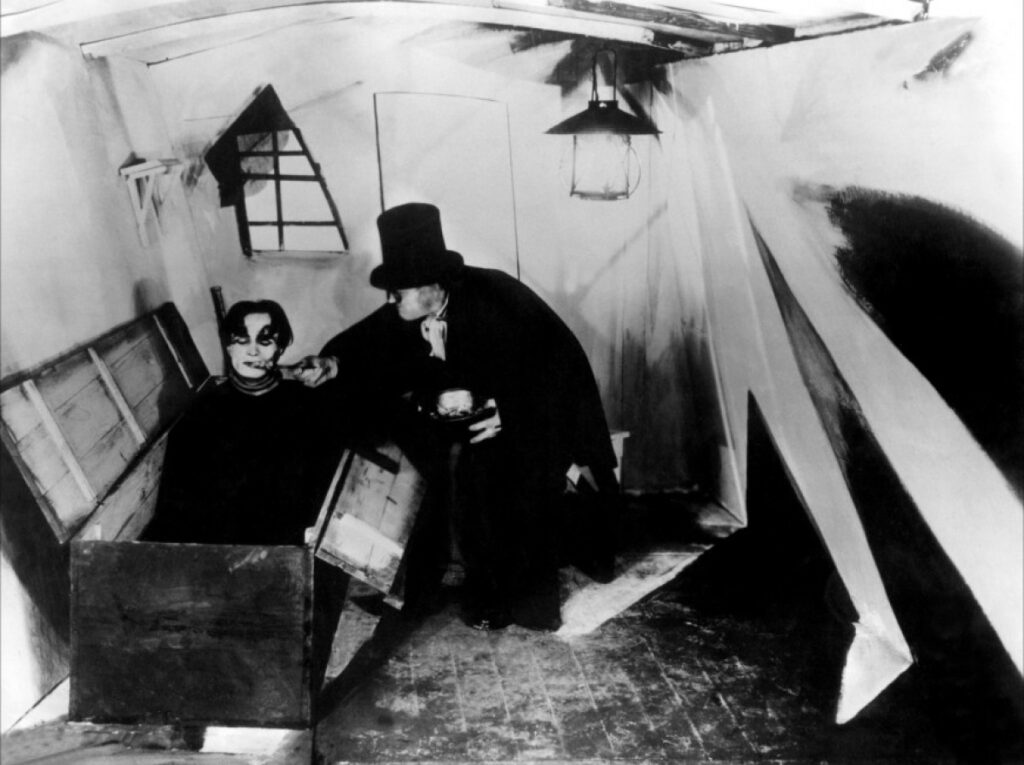
The Dutch angle did not arrive fully formed into cinema’s vocabulary. It emerged from a specific cultural and aesthetic crisis — the psychological turbulence of post-World War I Germany — and its journey from that origin point to its current status as a near-universal genre shorthand constitutes one of the most instructive case studies in how cinematic technique travels, mutates, and occasionally exhausts itself.
German Expressionism established the tilted frame as an instrument of genuine ontological disturbance. In The Cabinet of Dr. Caligari (Robert Wiene, 1920) and Nosferatu (F.W. Murnau, 1922), the canted angle was inseparable from an entire visual philosophy built on distorted architecture, exaggerated shadow, and the externalization of psychic states. The tilt was not a decorative flourish but a structural commitment — the entire world of the film was warped, not merely a single compositional choice within it. This gave the technique an authenticity of purpose that later applications would struggle to replicate. The angle meant something because everything around it meant something in the same register.
When German émigré directors carried their visual sensibilities into classical Hollywood during the 1930s and 1940s, the Dutch angle migrated with them into the noir tradition. Directors like Fritz Lang adapted the technique to more naturalistic environments, embedding moments of radical tilt within otherwise conventional cinematographic grammar. This created a productive tension: the disruption of the frame carried greater force precisely because it violated a surrounding visual normalcy. The technique had learned restraint, and restraint gave it power. A single canted shot in The Big Heat (Fritz Lang, 1953) communicates a corruption of moral order through contrast — the viewer registers the deviation because the film has established a baseline from which to deviate.
The European New Wave of the late 1950s and 1960s approached the tilted frame with a different disposition — ironic, self-conscious, and at times playful. Directors such as Jean-Luc Godard were less interested in deploying the Dutch angle for psychological effect than in interrogating the very conventions that had made it a signifier of menace. The technique became available for quotation, for citation, for analytical dismemberment. This intellectual distance marked an important transition: the Dutch angle was now old enough to have a history, and that history could itself become subject matter.
Genre cinema absorbed the technique most voraciously, and in doing so began the process of its dilution. The superhero blockbuster era — particularly the Burton-era Batman films and their immediate descendants — deployed canted angles with a frequency that approached self-parody. When every scene of heightened drama receives the same tilted treatment regardless of its specific narrative function, the angle loses its capacity to signal anything. The viewer habituates, and what was once a marker of psychological rupture becomes visual wallpaper. This is the central risk of any technique elevated to formula: frequency destroys selectivity, and selectivity is the precondition for meaning.
Contemporary directors who use the Dutch angle effectively tend to be those who have internalized this lesson. Alfonso Cuarón, David Fincher, and Park Chan-wook employ the tilted frame with an almost clinical precision, reserving it for moments where the narrative logic genuinely demands a disruption of spatial orientation. Fincher in particular treats the canted angle as a late-deployed instrument — a cinematographic escalation that arrives only after the film has established considerable visual stability, ensuring that the deviation registers as deliberate rather than habitual.
Perhaps the most sophisticated contemporary usage involves subverting the technique’s conventional associations entirely. A director who applies the Dutch angle to a mundane domestic scene, or who withholds it from an obviously menacing sequence where convention would demand it, uses the audience’s own genre literacy as a tool. The expectation becomes the instrument.
What the full arc of the Dutch angle reveals is a truth applicable to all cinematic technique: formal devices derive their meaning not from inherent properties but from context, contrast, and the intelligence with which they are deployed. The tilted frame remains as capable as it ever was of communicating disorder and dread — provided the filmmaker first establishes the order against which the tilt can register as a genuine violation.
🎥 The Art of the Camera: Angles, Gazes & Composition
The Dutch angle is just one tool in the vast visual language of cinema. Understanding how filmmakers use shots, movements, and composition reveals the deeper grammar behind every image on screen. Explore these related articles to sharpen your eye for cinematic storytelling.
A Guide to Scene Composition and Auteur Mise-en-Scène
Just as the Dutch angle is a deliberate compositional choice, auteur mise-en-scène is the art of making every visual element in the frame speak. This guide explores how directors shape meaning through the precise arrangement of space, objects, and figures. A perfect companion for understanding why a tilted camera is never an accident.
👉 GO TO THE SELECTION: A Guide to Scene Composition and Auteur Mise-en-Scène
The Writing of the Gaze: A Guide to Camera Movements in Auteur Cinema
Camera movements and unconventional angles like the Dutch plan share the same fundamental purpose: to guide the viewer’s emotional and narrative experience. This guide breaks down the techniques that define auteur cinema’s most expressive visual gestures. Reading it alongside the Dutch angle reveals how disorientation can be choreographed with precision.
👉 GO TO THE SELECTION: The Writing of the Gaze: A Guide to Camera Movements in Auteur Cinema
The Grammar of the Gaze: Meaning of Shots in Cinema
Every shot in cinema carries a specific weight, and the Dutch angle is a prime example of how framing shapes meaning. This exploration of the grammar of the gaze provides essential context for decoding the psychological charge of tilted, low, or high-angle shots. It is a foundational read for anyone wanting to understand visual rhetoric on screen.
👉 GO TO THE SELECTION: The Grammar of the Gaze: Meaning of Shots in Cinema
Analysis of the Point-of-View Shot in Cinema
The Dutch angle often works hand-in-hand with point-of-view shots to immerse the audience in a character’s unstable or menacing perspective. This analysis of the POV shot examines how subjectivity is constructed through the camera’s eye. Together, these two techniques form a powerful toolkit for conveying paranoia, tension, and psychological unease.
👉 GO TO THE SELECTION: Analysis of the Point-of-View Shot in Cinema
Recognizing techniques like the Dutch angle transforms the way you watch films — and independent cinema is where these visual experiments truly come alive. On the Indiecinema streaming catalog, you will find bold, auteur-driven works that push the boundaries of cinematic language. Dive in and discover films that dare to see the world at a different angle.
👉 EXPLORE THE CATALOG: Watch Indie Films in Streaming
Conclusion
The Dutch angle is, at its core, a confession. When a director tilts the camera off its horizontal axis, the frame itself becomes an unreliable narrator, admitting to the audience that the world being depicted has slipped beyond the reach of order and reason. It is one of the few compositional tools in cinema where the formal gesture and the emotional content are completely inseparable. The tilt is not decoration. It is diagnosis.
What makes this technique endure across more than a century of filmmaking — from the expressionist shadows of Weimar Germany to the hyper-kinetic grammar of contemporary streaming television — is precisely its directness. Unlike subtler tools of visual rhetoric, the canted frame makes no apologies for its intent. It speaks in a register that bypasses analytical thought and lands somewhere closer to the nervous system. Audiences who have never read a word of film theory will still feel the unease a Dutch angle produces, which is perhaps the most eloquent argument for why directors continue to reach for it.
The risk, of course, is always excess. Used without discipline, the tilt collapses from expressive grammar into visual noise, signaling intensity without earning it. The directors who have wielded it most effectively — Carol Reed, Terry Gilliam, Orson Welles — understood that the Dutch angle derives its power from contrast, from the memory of what a level horizon feels like. Master the straight line first. Only then does the tilt mean something.
A vision curated by a filmmaker, not an algorithm
In this video I explain our vision

