
The Skin Has No Mask
You are sitting across from someone who is looking at you. Not the way people look at you at dinner, or in a meeting, or even in the particular tenderness of early love. This is something different. This person is looking at the way the light catches the fold of skin beneath your chin, at the asymmetry you have spent your whole adult life learning not to notice in mirrors, at the specific gravity of your flesh where it yields to the chair. You become aware of your body as a fact rather than as a self. The experience is not violent, exactly, but it is close to something that has no polite name.

Lucian Freud looked at people this way for over six decades, and then he painted what he saw.
What he saw was not what portraiture had historically agreed to show. The painted portrait, from its aristocratic origins through its bourgeois democratization, operated on an implicit contract: the subject surrenders a number of hours, the artist produces a likeness, and the likeness is understood to be a negotiated document. You bring your status, your dignity, your preferred angle. The painter brings technique and, crucially, a shared investment in a flattering outcome. Hans Holbein made Henry VIII enormous with power. Velázquez made Philip IV magnetic despite everything. Reynolds made merchants look like Roman senators. The entire Western tradition of the painted portrait is, at its structural core, a collaboration in self-presentation, a social performance rendered in oils.
Freud dismantled this contract without announcing he was doing so. He simply refused to honor it.
The refusal was not ideological in any programmatic sense. He did not write manifestos or belong to movements, despite the accident of being loosely associated with what critics called the School of London. His refusal was temperamental, almost predatory. He was the grandson of Sigmund Freud, a biographical fact that journalists reached for with such reflexive eagerness that Lucian spent much of his life batting it away, though the psychoanalytic inheritance is genuinely hard to dismiss when you stand in front of his canvases. Sigmund had argued, in The Interpretation of Dreams in 1899, that the self we present to the world is a kind of elaborate defense, a secondary revision imposed over something rawer and less manageable. What Lucian painted was, consistently, the thing beneath the revision.
The flesh in his work does not behave the way flesh behaves in paintings by people who are being tactful about flesh. It sags. It pools. It maps a specific history of sleeping in a specific position, of decades of a specific diet, of gravity working on a particular skeleton over a particular number of years. His paint itself participates in this — loaded, slow, built up in passages that have the density of biological matter. The art historian Robert Hughes, who wrote about Freud with both precision and genuine passion, described his surfaces as having the quality of skin that has been lived in rather than merely worn. The distinction is everything. Skin that has been lived in carries information that the conscious self has not chosen to broadcast.
This is what made, and continues to make, his work so profoundly uncomfortable for so many viewers. Not the nudity, though the nudity helps to strip away the usual defensive layer of clothes-as-social-signal. What disturbs is the specificity. The bodies in Freud’s paintings are not bodies in the generic sense that academic tradition understood the nude — they are not arrangements of ideal form or philosophical propositions about beauty. They are this person, on this particular afternoon, in this particular state of being alive and subject to time. The discomfort you feel is the discomfort of recognition, and it arrives before your critical apparatus has time to intercept it.
The Mirror and the Rascal
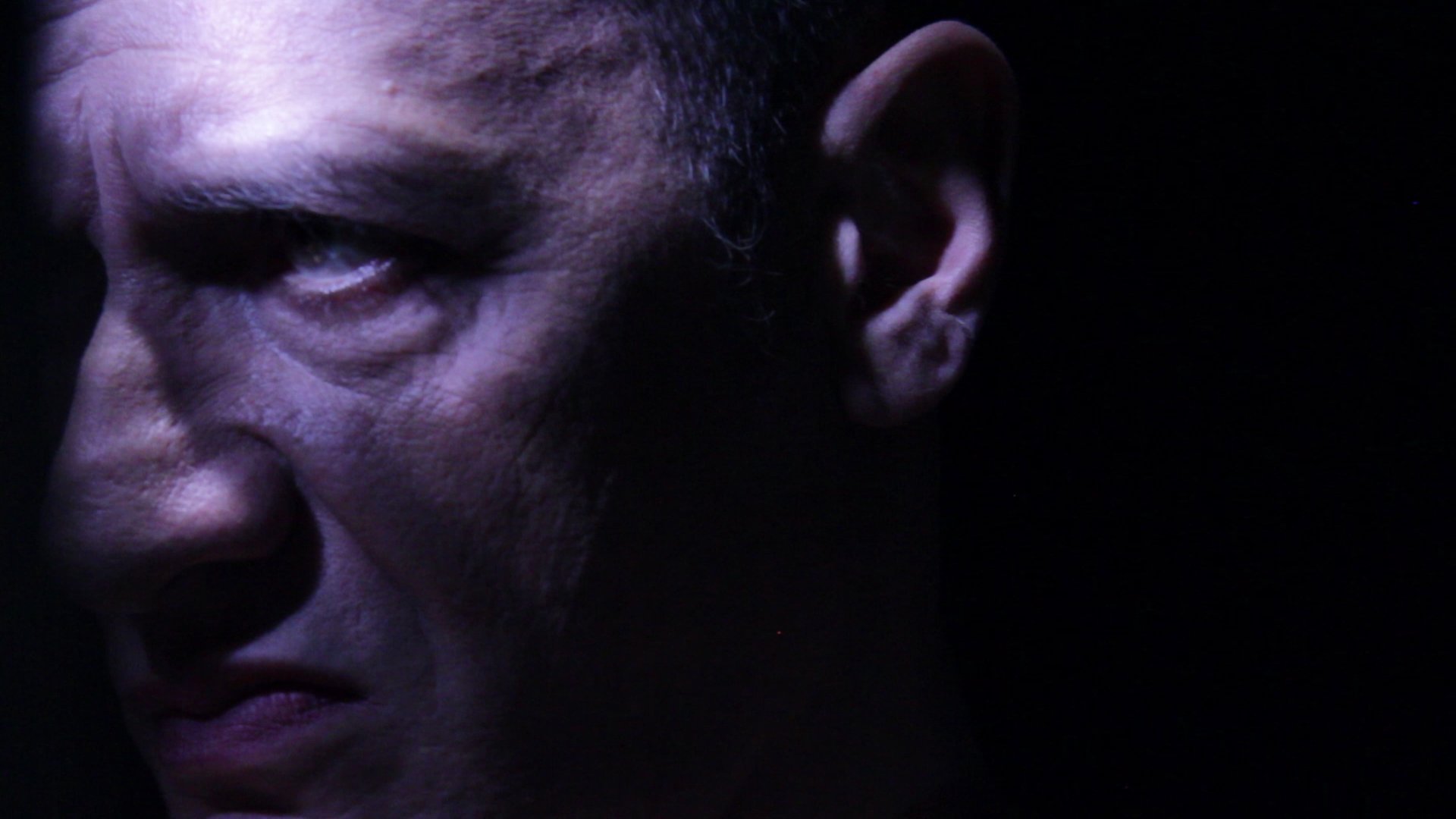
Drama film, by Valerio De Filippis, Italy, 2019.
The mirror and the rascal is an experimental film based on the tragedy "Richard III" by William Shakespeare. It tells the delirium of contemporary power in an author's reinterpretation of cinema, video art and music. The protagonist, Richard Duke of Gloucester, brother of King Edward IV, through a long series of crimes eliminates all the obstacles that stand between him and the throne of England.
Valerio de Filippis, a well-known painter who has been following his research path for a long time, investigating the relationship between light, corporeality and the psyche. The mirror and the rogue and the cinematographic equivalent of Valerio De Filippis' painting, his figurative style is in fact very recognizable looking at his paintings. But cinema is a new way where the artist can also be involved as an actor and performer, with an original mix between acting and singing. Staging the dark side of the human soul, the film is a surreal and disturbing interpretation of a great classic. The director says: "The first suggestion was musical: I was interested in transforming the text of Shakespeare's tragedy Richard III into notes. I love cinema and at a certain point I felt that the time had come to combine research on the image of painting to my love for cinema and music. When the film is finished I realize that I have remained faithful to painting: every frame of the film appears to me like a painting: the same light, the same colors, the same atmosphere ". The mirror and the rascal is a kind of psychoanalytic session that the painter does while hiding behind the mask of Richard III. Behind this ferocious and unscrupulous character we find a path of self-analysis by De Filippis, who is mainly interested in the more violent and turbid aspects. An experimental film in which, with great courage, the author gets involved completely, fragmenting the images in an unconventional montage, which is at the same time a flow of consciousness and spectacle.
LANGUAGE: English
SUBTITLES: Italian
Born Into the Weight of a Name
He was born in Berlin in 1922, into a household where the very air carried the pressure of an extraordinary lineage. Not the pressure of expectation in the ordinary sense — not the quiet tyranny of a father who wants his son to become a doctor or a lawyer — but something stranger and more pervasive. The name he carried was already a system of thought, a method, a revolution in how human beings understood themselves. Sigmund Freud had by then published “The Interpretation of Dreams” more than two decades earlier, in 1900, and had spent those intervening years dismantling the Enlightenment’s confidence that the self is transparent to itself. The grandfather had built an entire architecture of the invisible. And into that architecture, the grandson was simply born.
What does it do to a child, to grow up inside a name that already means something before you have done anything at all? There is a particular kind of inheritance that works not through direct instruction but through atmosphere — through the texture of conversations overheard, through the gravity that gathers around certain figures in a room. Sigmund was not an abstraction to Lucian. He was a presence, a man with specific hands and a specific silence, and when the family fled Berlin in 1933 as the National Socialists consolidated power, eventually settling in London, that presence traveled with them. Lucian was eleven years old. He arrived in England carrying two things simultaneously: the refugee’s acute perception of surfaces — how people hold their bodies when they are performing belonging — and the psychoanalytic family’s deep suspicion that surfaces are never the whole story.
What Sigmund had argued, across decades of clinical work and theoretical writing, was that the body betrays what the mind conceals. The symptom, in his framework, is a kind of speech — the flesh articulating what language has been forbidden to say. In “Three Essays on the Theory of Sexuality,” published in 1905, and throughout the case studies that followed, he mapped the body as a terrain of repressed truth, a landscape where desire and dread leave their marks in gesture, in paralysis, in the involuntary. The talking cure was premised on this: that if you listen carefully enough, the body will tell you what the conscious mind has buried.
Lucian heard this. And then he inverted it entirely.
He did not want to make the body speak. He wanted to make the body visible — irrefutably, uncomfortably, undeniably visible — without translating it into anything else. Where his grandfather’s method moved from the physical symptom toward the verbal interpretation, toward meaning, toward narrative, Lucian’s moved in the opposite direction. He pushed meaning back into the flesh. He refused the redemption of explanation. The body in his work does not signify something beyond itself. It simply is, with all its mass and its mortality and its absolute refusal to be made dignified by interpretation.
This is not a rejection of psychoanalysis so much as its radicalization. If Sigmund’s insight was that the unconscious speaks through the body, Lucian’s counter-proposition was that painting could reach that same depth without the detour through language. The canvas becomes the couch, the brush replaces the associative chain, and what emerges is not a story about repression but repression itself — visible, pigmented, three-dimensional in its emotional weight. Erik Erikson, who wrote extensively on identity and the developmental consequences of displacement in “Childhood and Society” in 1950, might have recognized in Lucian’s trajectory something familiar: the refugee child who develops an almost preternatural sensitivity to the gap between what bodies show and what they conceal.
The name Freud, then, was not a burden Lucian spent his life escaping. It was a lens he spent his life refracting — turning it away from the consulting room and toward the studio, away from the spoken word and toward the painted skin.

Exile as a Condition of Seeing
There is a particular quality of attention that belongs only to those who have arrived somewhere without being summoned. You notice the weight of a door handle, the specific gray of a particular street at four in the afternoon, the way strangers hold their bodies in a queue — details that belong are invisible to those who have always been there, absorbed into the background noise of familiarity. The exile sees because they cannot afford not to. Perception becomes a survival mechanism before it becomes an aesthetic one.
Lucian Freud was six years old when his family left Berlin in 1933, the year the National Socialist machine began its systematic dismantling of Jewish civil life. Ernst Freud, his architect father and son of Sigmund, moved the household first to London, reading the political situation with a clarity that many of his contemporaries fatally lacked. The boy who would become one of the most forensically attentive painters of the twentieth century arrived in England carrying the particular burden of the displaced: the knowledge, however inarticulate in a child, that belonging is not a given but a negotiation, and one that can be revoked without warning.
Georg Simmel, writing in 1908 in his essay on the stranger within his broader sociological work “Soziologie,” described this figure not as someone passing through but as someone who has arrived and stayed, yet carries within them the quality of potential departure. The stranger, Simmel argued, sees with a peculiar objectivity — not the coldness of indifference, but the lucidity of someone who has no stake in confirming what others need to believe. They are close enough to observe, distant enough to see. This is not a metaphor for Freud’s condition. It is a structural description of it.
London absorbed him and refused him simultaneously, as cities do with those who come to them from elsewhere. He naturalized as a British citizen in 1939, the same year the war began, the same year the country he had come from and the country he had come to faced each other across the machinery of catastrophe. The timing is not incidental. Belonging to England was formalized at precisely the moment England itself was under existential pressure, which means that his citizenship and his foreignness were born in the same breath. He would spend the following decades in the streets, studios, and rooms of London — Paddington in the early years, the increasingly fractured urban world of post-war reconstruction — painting that city’s bodies as though the act of looking were both an act of possession and an acknowledgment that full possession was impossible.
What displacement does, if it does not destroy, is calibrate the eye. The psychoanalyst and cultural theorist Julia Kristeva, in her 1988 work “Strangers to Ourselves,” traced the foreigner’s condition as one of perpetual internal division — a self that cannot merge entirely with the world it inhabits, and therefore maintains an involuntary critical distance from it. For Freud, this distance translated directly onto the painted surface. His figures do not relax into their backgrounds. They do not belong to the rooms they occupy. They exist in a state of faintly uneasy presence, as though the space around them could not quite confirm their right to be there. This is not a stylistic choice. It is a phenomenological truth transposed into paint.
There is a scene — a man arriving in a foreign city, moving through streets that do not recognize him, his gaze scanning faces with the heightened alertness of someone for whom the environment has not yet become habitual, perhaps never will. The gaze itself is the thing. Not what it rests on, but the manner of its resting: provisional, exacting, without the sedative of assumption. This is what Freud carried from Berlin to London at the age of six, and never lost.
Paint as a Form of Aggression
There is a moment when you realize that a painting is not showing you a body but doing something to it. Not representing flesh but pressing into it, folding it, insisting on its weight with a kind of focused hostility that has nothing to do with admiration or desire. You stand in front of one of the large late nudes and feel, before any thought arrives, that something aggressive has occurred here. Not violence in the crude sense. Something more patient and therefore more disturbing.
In the 1940s the paint was thin, almost reluctant. The early portraits had the quality of close observation pushed to its limit, every hair on a forearm rendered with a precision that read less like tenderness than like surveillance. The sitter could not escape the eye. But the technical means were still restrained, still within a tradition that trusted the line to carry meaning, that believed contour could tell the truth about a person. What shifted over the following decades was not Freud’s desire to see more clearly but his conviction that clarity of a different kind was required, one that line alone could never produce. By the 1970s and definitively through the 1980s and 1990s, the brush was loaded to the point of excess, the paint dragged and piled and scraped until the surface of the canvas had its own topography, its own resistance. The impasto did not illustrate flesh. It was the argument that flesh makes about itself.
Maurice Merleau-Ponty, writing in The Visible and the Invisible in 1968, proposed that the body is not an object among objects but the very medium through which a world becomes accessible, irreducible to any system of signs that would translate it into something else. Flesh, for Merleau-Ponty, is not matter waiting to be spiritualized. It is already its own kind of meaning, dense and self-sufficient, refusing the metaphors that culture keeps trying to impose on it. When you see those late canvases, the rolls of skin across a stomach, the collapsed weight of a thigh pressed against a mattress, the blueish pooling of blood beneath pale surface, what Merleau-Ponty was describing in philosophical language is happening in paint. The flesh refuses metaphor. It stays exactly what it is.
Across the city, in the same decades, another painter was reaching a structurally similar conclusion by a different route. Where Freud’s aggression was archaeological, pressing down through layers to find what could not be denied, the other worked with a kind of convulsive smearing, figures dissolved at their edges into pure velocity, bodies caught in the act of becoming something no longer classifiable as human or inhuman. Two projects that never fully converged but that shared a refusal, an absolute rejection of the idea that paint should prettify or console or translate experience into something more bearable than it actually is. London in the postwar decades had produced a particular kind of aesthetic severity, perhaps because the city itself still carried the unprocessed memory of what bodies look like when they have been subjected to systematic destruction. The beauty of classical figuration was no longer available without irony, and neither of these painters was interested in irony as a solution.
What Freud’s technical evolution actually enacts, if you follow it from decade to decade, is the gradual elimination of every painterly habit that allows the viewer to remain comfortable. The thinness of the early work still permitted a kind of aesthetic distance. The loaded brush of the late work does not. You are not looking at a representation of human vulnerability. You are standing in front of the thing itself, constructed from oil and pigment but no less insistent for that. Paint as substance, not symbol. Meat rendered as meat, which means rendered without mercy toward either the subject or the person standing in front of it.
The Subjects Who Stayed
There is a particular kind of exhaustion that does not show on the face but lives somewhere deeper, in the shoulders, in the way the jaw loses its intention, in the subtle collapse of the body when it has been held in one position for so long that holding becomes its own form of forgetting. This is what the canvas catches. Not the person as they arrived, composed and present, but the person as they became after hours had stripped away every performance they brought into the room.
Freud’s sittings were not sessions. They were occupations. A single painting could consume hundreds of hours across months, sometimes years. The woman reclining on the institutional sofa, vast and luminous, her sleep so total it seems less like rest than surrender, did not arrive that way. She arrived with a body she carried through the world, and what the painting records is what remained after the carrying stopped. Sue Tilley, who held that pose across some three hundred and fifty hours of work, did not simply model. She endured. And endurance, when it is painted by someone watching that closely, becomes indistinguishable from confession.
Susan Sontag, writing about photography in 1977, argued that to photograph someone is to have a certain power over them — to participate in their mortality, their vulnerability, their mutability. The photograph, she wrote, is a thin slice of space and time, and collecting photographs is collecting the world. But paint is something else. Paint is not a slice. It is an accumulation, a layering of time that refuses to pretend the moment was instant. What Freud did with time was not capture it but metabolize it, transforming duration itself into substance. The paint thickens because the looking never stopped.
The young woman sitting with a white bull terrier pressed against her thigh in 1951 has an expression that critics have sometimes called melancholy and sometimes called blankness, but both words miss the quality that makes the portrait so difficult to look away from. She is not performing an emotion. She is what happens to a face when performance becomes impossible to sustain. Her hands, her posture, the slight forward tilt of her head — these are not chosen attitudes. They are what was left. Freud’s first wife, Kitty Garman, sat for him repeatedly in those early years, and the paintings from that period carry a strange doubling: the intimacy of a known body and the exposure of someone who cannot leave because leaving would mean failing a contract they signed without reading its terms.
This is where portraiture reveals what it pretends to conceal. The painter asks you to stay, and you stay because you trust, or because you are flattered, or because the attention feels like love. And then the hours accumulate, and the attention turns out to be something more demanding than love — it is study, which is a form of possession that does not require affection. Freud himself acknowledged that he wanted his subjects at their most undefended. He did not want the face they showed the world. He wanted the face the world had not yet seen, which meant he needed to wait until they forgot he was looking.
The Naked Portrait series extends this logic until it becomes almost unbearable. These are not nudes in any classical sense. There is no idealization, no compositional mercy, no flattering light. There is only the body as it exists under the specific conditions of prolonged observation — a body that has been looked at for so long it has stopped caring about being seen. That distinction matters enormously. To be seen is to remain aware of the seeing. To stop caring about being seen is to give something up that you cannot take back.
What the subjects left behind was not vanity. It was the boundary between private and witnessed. And Freud painted exactly the moment that boundary dissolved.
A vision curated by a filmmaker, not an algorithm
In this video I explain our vision
The Body as Social Confession

There is a particular kind of looking that has nothing to do with desire. You know it when it happens to you — standing in a doctor’s office, half-dressed, while someone takes notes about what your body has become. The clinical gaze strips away the story you tell yourself in bathroom mirrors. It does not flatter, and it does not condemn. It simply records.
This is the quality that radiates from the large sleeping figure stretched across a battered sofa, arms folded over her chest, flesh spreading with the unselfconscious authority of something that simply exists without apology. She is not posed for consumption. She is not displayed for reassurance. She is documented — and that word, documentary, carries the full weight of what Freud was doing across five decades of painted bodies. The painting is not a provocation aimed at bourgeois comfort. It is something more unsettling than provocation. It is evidence.
When that canvas sold at Christie’s in May 2008 for £17.2 million, setting a record for a living artist at the time, the conversation that erupted in newspapers and cultural columns almost universally framed the price as commentary on the painting’s transgression. Reviewers reached for words like unflinching and confrontational, as though size and honest flesh were inherently aggressive acts. But this framing reveals more about the critics than about the work. Pierre Bourdieu, in Distinction, published in 1979, spent five hundred pages mapping precisely this mechanism — the way aesthetic taste functions not as personal preference but as social sorting, as a system of inclusions and exclusions that reproduces class structure through the language of beauty. What bourgeois aesthetics demands of the female body, of any body, is legibility as aspiration. The body must signify effort, discipline, the successful management of biological reality. It must encode its own social position through the visible signs of its control over itself.
What Freud painted was the opposite of management. He painted what Bourdieu would have recognized as the body that has not performed its cultural duties — the body that carries its years openly, that shows the specific marks of specific labor, the fat distributed not by negligence but by biology and time and the particular demands of a particular life. This is not neutrality. It is a form of radical honesty that the aesthetic contract finds almost impossible to process. The violence that Bourdieu describes is not physical but symbolic — it is the quiet, constant pressure to make your body conform to a visual language that was invented by and for a specific social class, and which naturalizes that class’s relationship to physicality as universal taste.
Freud’s paint surface makes this visible with peculiar force because of how he built it — the slow accumulation of pigment over months, the texture that becomes almost geological, so that you are simultaneously looking at skin and looking at the record of time spent looking at skin. A man in a narrow room, holding a brush, staring at another human being with an attention so total it borders on the obsessive, and then transferring that attention into matter. The result is a surface that does not smooth. It does not idealize. It does not select. It includes the capillaries, the asymmetries, the particular way gravity has negotiated with this specific body over this specific number of years.
What the mirror would show, if mirrors were honest, is exactly this. But mirrors are not honest — they are designed for the instantaneous, the glancing, the self-correcting moment. They offer you a frame to step into and adjust yourself within. Freud’s canvases offer no such frame. They are the sustained gaze that normal social life has agreed to suppress, the looking that lasts long enough to see past the performance of the body into what the body actually is — a document of everything that has happened to it, written in flesh, irrevocable and utterly specific.
Intimacy Without Tenderness
There is a particular kind of attention that masquerades as love. You have felt it, perhaps, in the presence of someone who watches you so completely that you begin to feel both chosen and devoured, both seen and catalogued. This is not a metaphor for something Lucian Freud resembled. This is precisely what he was.
He fathered at least eleven children by multiple women, a number that requires a moment to sit with not because of its scale as scandal but because of what it reveals about the architecture of his desire. These were not casual abandonments. Several of his children grew up in the same city, sometimes overlapping unknowingly in the same social circles of postwar London bohemia, that tight constellation of painters and poets and gamblers and drinkers who orbited Soho and the Colony Room Club as though the world outside held no legitimate claim on their time. Freud was present in that world with an intensity that was almost theatrical. He gambled compulsively, running up debts that required painting on commission when he would have preferred otherwise, playing cards with an aristocratic recklessness that suggested money was interesting only when it was at risk. He lived, in other words, at the same pitch of extremity that his canvases demanded.
John Berger, writing in Ways of Seeing in 1972, argued that the relationship between the painter and the painted in Western art had always been a relationship of power disguised as appreciation. The one who looks defines the one who is looked at. The one who is looked at is remade by that gaze, reshaped according to the observer’s needs, frozen into an object of contemplation while the observer retains the freedom to walk away. Berger was talking about the tradition of the nude in European painting, but he was also, without knowing it entirely, describing the specific gravitational field that surrounded Freud in his studio and in his life.
His intimacy was a form of study. The people who came close to him — the lovers, the mothers of his children, the friends who sat for him across sessions that stretched into months and years — all entered a relationship in which the terms were never entirely symmetrical. To be loved by Freud was to be observed by him. To be in his company was to be, in some fundamental sense, material. This is not a condemnation. It is a recognition of something that the romantic tradition has always preferred to obscure: that the creative impulse and the consuming impulse are sometimes the same impulse wearing different names.
His children who later spoke about him described a man of extraordinary charm and near-total unavailability, present in flashes of devastating attention and then simply absent in ways that were not angry or cruel but simply complete, as though once a study was finished the subject could be released. The painter Leigh Bowery, who sat for him in the early 1990s in sessions that produced some of the most arresting large-scale works of that decade, once described the experience of being in Freud’s studio as feeling simultaneously like the most important person in the world and like furniture. Both things were true. Neither cancelled the other.
What Berger’s framework illuminates, when laid against Freud’s biography rather than his canvases, is that the question of who holds the gaze is never settled by gender or role or even by who is holding the brush. Freud gave his subjects an extraordinary kind of scrutiny. He also gave himself the same scrutiny, sitting before mirrors with the same merciless attention he turned on others. But the painter is always the one who decides when the looking stops. The subject simply waits to be released, or learns, slowly, that release was never part of the arrangement.
What Lasts When the Body Insists
There is a particular exhaustion that comes from being looked at honestly. Not admired, not assessed, not desired — but seen, in the way that admits no flattery and offers no escape. Most of us spend considerable energy ensuring that kind of gaze never quite lands on us. We arrange ourselves in favorable light, literally and otherwise. We choose the angles. We manage the distance. Lucian Freud spent sixty years refusing to let anyone in his studio do any of that.
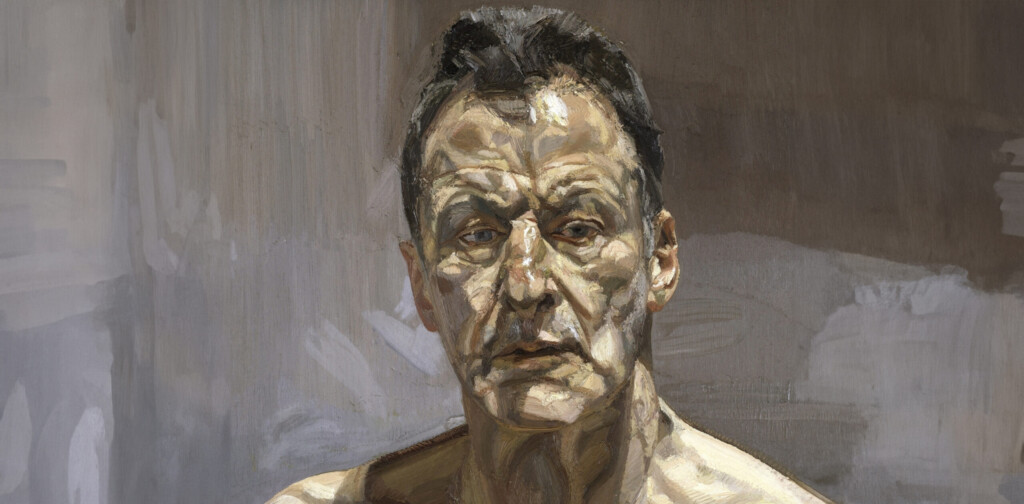
By the time he painted himself in 2005, surprised mid-work by a naked woman pressing her face against his clothed leg, something had shifted in the work that was not decline but rather a kind of clarification. The painting does not flatter him. He appears startled, slightly ridiculous, the brush still in his hand, the woman’s body enormous and pale against his dark trousers. What strikes you is not the eroticism, which is minimal, but the power dynamic, which is entirely subverted. The man who spent decades demanding nakedness from others is here caught, observed, made vulnerable by the very proximity he always controlled. The body that presses against him is not offering itself. It is insisting on itself. There is a difference, and Freud knew it, and painted it anyway.
Merleau-Ponty argued in his Phenomenology of Perception, published in 1945, that the body is not an object we inhabit but the very medium through which we encounter the world — not a vessel for consciousness but consciousness itself, extended and material. What Freud did, without ever reading phenomenology in public or caring to, was to paint exactly that philosophical claim into flesh. His figures are not souls trapped in meat. They are not metaphors for longing or status or the passage of time. They are the thing itself. The fat, the hair, the pooled blood beneath skin pressed against a mattress — these are not signs pointing elsewhere. They are the destination.
This is what made him so uncomfortable to the twentieth century’s dominant modes of seeing. Clement Greenberg’s formalism wanted painting to be about painting. The conceptualists wanted art to be about ideas. The market wanted surfaces that could be sold as luxury objects carrying cultural weight. Freud wanted none of it. He wanted the specific weight of a specific person on a specific afternoon, their skin carrying the history of every night they hadn’t slept and every meal they’d eaten and every fear they hadn’t named yet. By the time he was painting Benefits Supervisor Sleeping in 1995, the monumental figure of Sue Tilley occupying the canvas with an authority that embarrassed everyone who tried to frame it as transgressive or grotesque, he had long since stopped caring whether the century could accommodate what he was doing.
He left a canvas unfinished when he died in July 2011. He had been working until near the end, which was not unusual for him — he worked through illnesses, through age, through the physical difficulty of standing for the hours the work demanded. The unfinished painting is not a tragedy. It is simply where the work stopped. There was no final statement, no retrospective wisdom, no tidying of the philosophical threads. Just pigment on canvas, a figure partially resolved, the rest still waiting.
What remains, across the whole of that body of work, is a question that does not announce itself as a question. It operates more like an afterimage. You leave a room where his paintings hang and you are, for some time afterward, unable to look at a human body — your own included — with the old comfortable distance. The abstractions we use to manage embodiment, the language of the soul, of transcendence, of identity as something worn lightly and revised at will, all of it becomes briefly, stubbornly unavailable, and in that gap something true and unignorable presses its full, specific, unapologetic weight against you.
🎨 Flesh, Memory, and the Painted Gaze
Lucian Freud’s unflinching portraiture stands at a crossroads of psychology, art history, and the raw physicality of paint. The following articles explore the broader world of figurative art, the philosophy of the body, and the painters whose lives and obsessions most closely resemble his own restless vision.
Henri Matisse: Life and Works
Henri Matisse, like Freud, spent a lifetime obsessively interrogating the human figure through paint, transforming studio intimacy into monumental artistic statements. His late works with paper cutouts reveal how an aging artist can reinvent his own language without abandoning the sensual core of his vision. Studying Matisse’s life and evolution offers a vital counterpoint to Freud’s darker, more abrasive approach to the flesh.
GO TO THE SELECTION: Henri Matisse: Life and Works
Caravaggio: Life and Works
Caravaggio revolutionized Western painting by insisting on the raw, unidealized body as the true subject of art, a conviction that resonates deeply with Lucian Freud’s own practice centuries later. His use of real people from the streets as models for sacred figures scandalized contemporaries in much the same way Freud’s clinical nudes disturbed postwar sensibilities. Both painters refused the comfort of beauty, demanding instead an honest confrontation with physical reality.
GO TO THE SELECTION: Caravaggio: Life and Works
Erwin Panofsky: Life and Iconology
Erwin Panofsky’s iconological method provides essential tools for decoding the layers of meaning embedded in painted images beyond their surface appearance. Understanding how art historians read symbolic content, psychological intent, and cultural context illuminates why Freud’s portraits are so much more than mere likenesses. Panofsky’s framework helps us ask the right questions when standing before a Freud canvas.
GO TO THE SELECTION: Erwin Panofsky: Life and Iconology
Goya’s Black Paintings: Meaning and Analysis
Goya’s Black Paintings represent one of the most radical acts of personal artistic confession in Western art history, driven by psychological extremity and a refusal to perform beauty for public approval. In this sense they form a natural parallel to Lucian Freud’s late monumental nudes, which similarly transform private obsession into universal statements about mortality and the body. Both bodies of work demand that the viewer endure, rather than simply admire, what they see.
GO TO THE SELECTION: Goya’s Black Paintings: Meaning and Analysis
Watch Art Come Alive on Indiecinema
If the world of painters, bodies, and obsessive visions has stirred your curiosity, Indiecinema streaming offers a rich selection of independent and documentary films dedicated to artists, their lives, and the mysteries of creative process. Step beyond the canvas and discover cinema that sees the world with the same uncompromising intensity as Lucian Freud himself.
👉 EXPLORE THE CATALOG: Watch Indie Films in Streaming
A vision curated by a filmmaker, not an algorithm
In this video I explain our vision

