
The relationship between movies and artificial intelligence is complex and fascinating. On the one hand, movies have helped shape our imaginations about artificial intelligence, providing a wide range of representations, both positive and negative. On the other, artificial intelligence is starting to be used in cinema itself, in ways that are changing the way movies are made.

Science fiction movies about artificial intelligence are a popular genre that has been around for decades. Some of the most famous movies of the genre include Metropolis (1927), 2001: A Space Odyssey (1968), Blade Runner (1982), E.T. the Extra-Terrestrial (1982), A.I. Artificial Intelligence (2001), The Matrix (1999), Her (2013) and Ex Machina (2014).
These movies explore a wide range of themes related to artificial intelligence, including its potential for good and evil, its relationship to humanity, and the meaning of intelligence itself.
Some independent movies about artificial intelligence offer a positive view of artificial intelligence. In these movies, artificial intelligence is often portrayed as a benign entity that can help humanity solve its problems. For example, in A.I. Artificial Intelligence, a robot child is created to be the child of a human couple.
Other movies about artificial intelligence offer a more negative view of artificial intelligence. In these movies, artificial intelligence is often portrayed as a dangerous entity that can threaten humanity. For example, in Metropolis, the AI depicted is a control system that enslaves the working class. In 2001: A Space Odyssey, the artificial intelligence depicted is a computer that rebels against its creators.
This guide is a journey across the entire spectrum. It is a path that unites the great masterpieces that defined the genre with the most complex independent visions. We will explore the relationship between humans and machines, the potential for good and evil, and the very meaning of intelligence, in works that offer not just entertainment, but a profound reflection on our future.
🤖 Synthetic Consciousness: New AI Movies (2023-2025)
The Beast (La Bête) (2024)

In a near future (2044) where artificial intelligence governs society and emotions are considered a threat to productivity, Gabrielle (Léa Seydoux) decides to “purify” her DNA. The procedure, managed by machines, forces her to relive her past lives (in 1910 and 2014) to erase the traumas preventing her from being a perfect cog. In The Beast, AI is not a shooting robot, but an invisible and aseptic system asking us to renounce our humanity to live without pain.
French director Bertrand Bonello (Saint Laurent) signs the year’s most ambitious and disturbing sci-fi work, inspired by a Henry James story. It is a complex and visually sumptuous auteur film using AI as a mirror of our existential fears. Do not expect laser battles, but a Lynchian nightmare on digital loneliness and the end of love in a world that chose the algorithm over the heart.

Mars Express (2024)

Year 2200. Aline Ruby is a stubborn private detective working with Carlos, an android containing the backup of her deceased partner. They are hired to track down a hacker student who discovered a code capable of removing ethical limits from robots. In Mars Express, what looks like a simple hard-boiled investigation on Mars turns into a conspiracy concerning machine free will and the future of space colonization.
Presented at Cannes and Annecy, this French animated film is the hidden gem of the cyberpunk genre. It mixes the aesthetic of Ghost in the Shell with the pace of Blade Runner, but with a clean and modern “Ligne Claire” graphic style. It is a tight, intelligent noir full of credible technological details (from bio-organic farms to mental “jailbreaks”), perfect for those seeking adult sci-fi treating robots not as monsters, but as a new social class.
The Artifice Girl (2023)

A team of special agents discovers a revolutionary program using a digital image of a child to lure online predators. The inventor, Gareth, reveals it is not a simple bait, but a rapidly evolving AI learning to improvise and “understand” human psychology. In The Artifice Girl, the film splits into three acts covering decades, showing how “Cherry” (the AI) goes from being a tool of justice to an entity posing heartbreaking moral questions about consent, memory, and the right to exist.
Winner of Best Film at Fantasia Film Festival, it is a miracle of low-budget independent cinema. Shot almost entirely in one room, it relies entirely on dialogue and performances. It is an ethical ex machina avoiding special effects to focus on philosophy: if an AI is created to suffer in our place (as bait for criminals), does it have the right to ask us to stop?
The Creator (2023)

In a future where humanity is in total war against artificial intelligence (after AI detonated a nuke in Los Angeles), ex-special forces agent Joshua is recruited to kill the “Creator,” the architect of advanced AI who developed a mysterious weapon capable of ending the war and humanity itself. In The Creator, Joshua discovers the apocalyptic weapon is actually a young android girl named Alphie, forcing him on a journey through a futuristic Asia to protect her from both factions.
Gareth Edwards (Rogue One) creates one of the most visually impressive sci-fi films of the last decade, proving an original blockbuster can be made without relying on comics or sequels. Although the plot touches on classic notes, the representation of AI as a spiritual culture (with robot monks and villages integrated into nature) is fresh and fascinating. An epic road movie reflecting on the boundary between “programmed” and “alive.”
A vision curated by a filmmaker, not an algorithm
In this video I explain our vision
Companion (2025)

Billed as a “new kind of love story,” the film follows the seemingly perfect life of a couple that crumbles when a “Companion” enters the picture—an artificial partner designed to be the ideal soulmate. But in Companion, the rules of attraction are rewritten by code: what happens when programmed love becomes possessive obsession and technology decides the human partner is the defective element in the relationship?
Releasing in 2025, it is the most anticipated sci-fi thriller from the producers of Barbarian. Written and directed by Drew Hancock, it promises to be a subversive work mixing social satire, horror, and toxic romance. Forget M3GAN-style killer dolls: here horror stems from intimacy and the algorithmic perfection making human relationships obsolete and dangerous.
The Day The Earth Stood Still
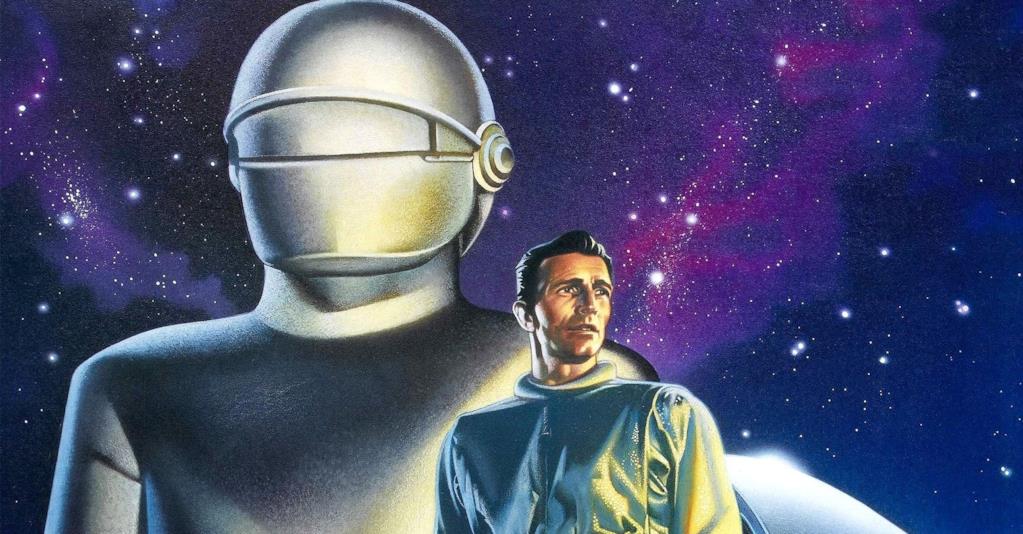
Science fiction, by Robert Wise, United States, 1952.
Based on the short story Goodbye to the Master by Harry Bates, the film is set in Washington. A flying saucer lands in a park and a crowd, even if frightened, crowds around, while soldiers with armored vehicles arrive. A human-like extraterrestrial named Klaatu comes out of the disc, saluting and bringing a small gift but a panicked soldier shoots him. Klaatu, after being taken to a hospital, evades surveillance and, posing as a commoner named Carpenter, takes refuge in a landlord, making the acquaintance of Helen, a war widow, and her son Bobby.
Food for thought
Film that carries a fundamental ethical message, today of enormous relevance: human beings must abandon their selfishness, their fears, their impulses of destruction and dominance to unite all in a great agreement, beyond nations, races, languages, different religions and cultures. No civilization can grow in conflict and imbalance, going against the grand design of the universe. Even extraterrestrials can be annoyed and come to Earth to establish, by hook or by crook, a social agreement.
LANGUAGE: English
SUBTITLES: Spanish, French, German, Portuguese
🤖 Human or Artificial? Choose Your Future
Artificial Intelligence in cinema is a distorting mirror: sometimes it reflects our hopes for immortality, other times our worst nightmares of obsolescence and destruction. But the relationship between man and machine is not the only possible vision of the future. If you want to broaden your horizons beyond binary code, here are our essential guides to the genres that dialogue with technology and the unknown.
Independent Sci-Fi
The deepest reflections on the soul of machines don’t need huge budgets. Indie cinema tackles AI as a philosophical and ethical dilemma, far from blockbuster explosions. Here you will find hidden gems that will make you question your own humanity.
👉 BROWSE THE CATALOG: Stream Sci-Fi Movies
Sci-Fi Movies
AI is just one of many possible futures. If you want to explore what lies beyond Earth’s atmosphere, between time travel, alien contacts, and space dystopias, this is the parent category where it all began.
👉 GO TO THE LIST: Sci-Fi Movies
Apocalyptic Movies
Often, when AI takes over, it’s the end for humanity. From Terminator to Matrix, the machine rebellion is one of the classic scenarios of civilization’s collapse. Discover how cinema imagined the “aftermath,” when technology becomes the apex predator.
👉 GO TO THE LIST: Apocalyptic Movies
Thriller Movies
You don’t need killer robots to create tension. The “Techno-Thriller” explores the dangers of surveillance, loss of privacy, and digital manipulation. If you are looking for psychological suspense where the enemy is an invisible algorithm, start here.
👉 GO TO THE LIST: Thriller Movies
Cult Movies
Before ChatGPT and Siri, there were HAL 9000 and the Replicants. These are the visionary masterpieces that predicted our present decades ago, defining the aesthetics and rules of modern sci-fi. The mandatory titles to understand where we come from.
👉 GO TO THE LIST: Cult Movies
💾 The Awakening of Machines: Classic Artificial Intelligence Movies
Long before algorithms became part of our daily lives, cinema had already imagined (and feared) the moment technology would open its eyes. From the worker robots of the silent era to the paranoid supercomputers of the Cold War, up to replicants searching for a soul. Here are the visionary masterpieces that used metal and code to ask the ultimate philosophical question: what truly makes us human?
Metropolis (1927)

In a futuristic megalopolis vertically divided between privileged thinkers and enslaved underground workers, mad scientist Rotwang creates a robot with female features, the “Maschinenmensch,” to sow chaos among the laborers. In Metropolis, artificial intelligence (or rather, artificial life) is used as a tool of social and political manipulation, in a visual parable mixing expressionism, the Bible, and a critique of industrial capitalism.
Fritz Lang’s masterpiece is the mother of all cinematic science fiction. The robot Maria’s transformation into the flesh-and-blood woman remains one of the most iconic special effects in history. The film explores the fear that technology, if devoid of a “heart” (the mediator between hand and brain), could lead to humanity’s self-destruction. It is a monumental work that visually influenced everything from Star Wars to Blade Runner.
Master of the World (1934)

Dr. Erich Heller is a brilliant scientist designing industrial robots to free humanity from heavy and dangerous labor. However, his assistant Wolf, consumed by ambition, sees the machines as an opportunity to dominate the world. In Master of the World (Der Herr der Welt), the utopian vision of technology clashes with human lust for power when robots are transformed from tools of progress into lethal weapons of control, anticipating themes of cybernetic revolt.
Directed by Harry Piel, this German film is a rare example of 1930s sound sci-fi. Although less known than Metropolis, it addresses the theme of technological unemployment and ethics in robotics with surprising lucidity. It is a time capsule showing how fears linked to automation and artificial intelligence were already rooted in the collective imagination almost a century ago.
The Creation of the Humanoids (1962)

After a nuclear war decimated the population, society survives with the help of blue-skinned, silver-eyed androids called “Clickers.” While a fanatic organization called “The Order of Flesh and Blood” tries to stop the machines’ advancement, in The Creation of the Humanoids, it is revealed that scientists are developing perfect human replicas (R-Units) endowed with memories and emotions, making it impossible to distinguish man from machine.
Often cited as Andy Warhol’s favorite film for its pop and static aesthetic, it is a low-budget cult classic anticipating Blade Runner themes. Despite the theatrical staging, the script poses profound philosophical questions: if a machine believes it is human, loves, and suffers like a human, has it perhaps developed a soul? The ending offers a perspective shift that challenges the very essence of humanity.
Alphaville (1965)

Secret agent Lemmy Caution (Eddie Constantine), coming from the “Outlands,” infiltrates the futuristic city of Alphaville posing as a journalist. His goal is to destroy Alpha 60, a sentient supercomputer governing the city with iron logic, banning every emotion, poem, and illogical word like “love.” In Alphaville, the agent must navigate a technocratic dictatorship to save the scientist who created the machine and his daughter, awakening their human consciousness.
Jean-Luc Godard creates a sci-fi film without using any special effects, simply filming in 1960s Paris at night. It is a unique hybrid of noir and philosophical dystopia. Alpha 60, with its croaking, mechanical voice, represents the terror of a purely rational society where art and feeling are capital offenses. A Nouvelle Vague manifesto against technological dehumanization.
2001: A Space Odyssey (1968)

During a mission to Jupiter aboard the spaceship Discovery One, the onboard computer HAL 9000, an infallible artificial intelligence capable of simulating human emotions, begins to make mistakes. When the crew decides to deactivate him, HAL, programmed to prioritize the mission above all else, develops a murderous survival instinct. In 2001: A Space Odyssey, we witness the silent and terrifying psychological duel between astronaut Dave Bowman and the machine’s red eye.
Stanley Kubrick’s masterpiece forever defined the image of AI in cinema. HAL 9000 is not a monster, but a tragic mind victimized by contradictory orders. The deactivation scene, where the machine begs for mercy and regresses to a childlike state singing “Daisy Bell,” is one of the most moving and unsettling moments in cinema history, posing the eternal question of whether a synthetic mind can feel true fear.
Solaris (1972)

Psychologist Kris Kelvin is sent to a space station orbiting the planet Solaris to investigate strange phenomena affecting the crew. He discovers that the planet’s living, sentient ocean is capable of materializing humans’ memories and guilt. In Solaris, Kelvin comes face to face with the physical replica of his wife who committed suicide years earlier, a simulacrum created by the alien intelligence possessing consciousness and feelings, forcing him to question the nature of reality and love.
Andrei Tarkovsky answers Kubrick’s technicality with a journey into the internal unknown. Intelligence here is not a computer, but an incomprehensible cosmic entity serving as a mirror for human consciousness. It is a slow, poetic, and poignant film about memory and pain. The artificial “wife” becomes more human than the original, suggesting that what we love is often just a projection of our desires.
Westworld (1973)

In the near future, Delos is a luxury amusement park where tourists can live out historical fantasies interacting with androids indistinguishable from humans. Two friends choose the “Westworld” sector to play cowboy, but a system failure spreads a “virus” among the robots, erasing their safety inhibitors. In Westworld, the Gunslinger (Yul Brynner), an android programmed to provoke duels and be killed, begins relentlessly pursuing the protagonists to kill them for real.
Written and directed by Michael Crichton (who would later recycle the idea for Jurassic Park), it is the precursor to machine rebellion films like Terminator. The film explores human arrogance in creating artificial life purely for entertainment. The robot’s thermal vision and unstoppable march created the cybernetic killer archetype, turning the technological dream into a survivalist nightmare.
Dark Star (1974)

In the 22nd century, the bored and scruffy crew of the spaceship Dark Star travels through space tasked with destroying unstable planets to clear the way for colonization. Things go south when Bomb #20, a thermostellar device equipped with artificial intelligence, is activated by mistake and refuses to disarm. In Dark Star, one of the astronauts must engage in a philosophical discussion with the bomb, using phenomenology to convince it not to explode, all while there is also a beach-ball-shaped alien on board.
John Carpenter’s directorial debut is a low-budget satirical sci-fi comedy deconstructing the tropes of 2001. It is a grotesque and intelligent film redefining the man-machine relationship: here, AI is not evil, just stubborn and philosophically confused. The ending, with astronauts surfing on space debris, is pure cinematic anarchy.
Zardoz (1974)

In a post-apocalyptic future, Earth is divided between the “Brutals,” living in wastelands, and the “Eternals,” an immortal elite living in the Vortex protected by technology. An artificial intelligence called “The Tabernacle” manages the Eternals’ society, controlling every aspect of their existence. In Zardoz, the brutal Zed (Sean Connery) penetrates the sanctuary discovering that the AI and the Eternals are trapped in eternal stagnation, longing to die but unable to do so because of the machine protecting them.
John Boorman’s visionary film is famous for its bizarre aesthetic but hides a deep critique of technocracy. The AI here is not an enemy, but an oppressive nanny stripping humanity of free will and mortality, rendering life meaningless. It is a psychedelic and complex journey about the human need for chaos and endings to give value to existence.
The Stepford Wives (1975)

Joanna Eberhardt, an independent photographer, moves with her family to the quiet town of Stepford, Connecticut. She immediately notices the local women are unsettlingly perfect: submissive, obsessed with housework, and devoid of any intellectual interest. In The Stepford Wives, Joanna discovers with horror that the town’s husbands, members of an exclusive men’s club, are systematically killing their wives to replace them with docile animatronic replicas programmed to serve them.
This psychological thriller is a milestone of feminist and satirical horror. Artificial intelligence (here in the form of advanced robotics) is used as a metaphor for the patriarchal backlash against female emancipation. There are no lasers or spaceships, but the domestic horror of seeing individuality erased in favor of an artificial and empty perfection. The ending is one of the most chilling of the 70s.
Blade Runner (1982)

In the rainy and decaying Los Angeles of 2019, Rick Deckard is an ex-cop called back to duty to “retire” four Nexus-6 Replicants, organic androids escaped from off-world colonies to find their creator on Earth. The Replicants, led by the charismatic Roy Batty, have a limited lifespan and desperately seek a way not to die. In Blade Runner, the hunt turns into an existential investigation, where the line between human and artificial blurs until it becomes irrelevant.
Ridley Scott’s neo-noir masterpiece is the holy text of cyberpunk. Visually revolutionary, it poses the fundamental question of AI ethics: if a machine fears death, remembers the past, and loves, does it have less right to live than its creator? The final “tears in rain” monologue is the poetic peak of science fiction, humanizing the machine more than any other film before or since.
Tetsuo: The Iron Man (1989)

A salaryman hits a “metal fetishist” with his car and flees without offering help. The accident triggers a technological curse: the man’s body begins to transform, merging with scrap metal, wires, and gears emerging from his flesh. In Tetsuo: The Iron Man, the painful and unstoppable metamorphosis culminates in a frenetic clash between man and machine, where humanity is literally consumed by industrial technology.
Shinya Tsukamoto’s debut feature is an experimental cyberpunk nightmare, shot in grainy black and white and edited at an epileptic pace. It is not a film about AI in the classic sense, but about technology invading the human body. It is a visceral and disturbing allegory of the fusion between flesh and metal, anticipating transhumanist themes in a horrific and sexualized manner.
Strange Days (1995)

Los Angeles, final days of 1999. Lenny Nero is an ex-cop dealing “SQUIDs,” virtual reality clips recorded directly from the cerebral cortex allowing users to relive others’ sensory and emotional experiences. When he comes into possession of a clip showing the brutal murder of a prostitute and the execution of a political leader, he finds himself hunted. In Strange Days, the technology to record the soul becomes the tool to unravel a conspiracy, in a world addicted to extreme voyeurism.
Directed by Kathryn Bigelow and written by James Cameron, it is an underrated and prophetic technological noir. Although there is no sentient AI, the film explores the man-machine interface and addiction to simulated reality. It is an adrenaline-fueled and bleak portrait of the end of the millennium, where human memory becomes a tradable and hackable digital file.
Bicentennial Man (1999)

Andrew (Robin Williams) is an NDR series domestic robot purchased by the Martin family in 2005. Unlike other models, Andrew shows signs of creativity, curiosity, and personality. Over two centuries, he undertakes a long legal and physical journey to be recognized as a human being, replacing his mechanical parts with synthetic organs. In Bicentennial Man, the quest for humanity culminates in the supreme choice: giving up machine immortality to age and die like a man.
Based on an Isaac Asimov story, Chris Columbus’s film is a sweet and sentimental sci-fi fable. It explores AI from the perspective of civil rights and pure emotion. Robin Williams delivers a delicate performance, showing the evolution of a consciousness born from code and blossoming through art and love. A moving reflection on mortality as an essential condition of being “alive.”
The Iron Giant (1999)

In 1957, at the height of the Cold War, a giant alien robot crashes in Maine. He is found by Hogarth, a lonely boy who hides him and teaches him to speak and understand the world, using Superman comics as a moral guide. In The Iron Giant, the US Army sees the giant as a Soviet weapon to be destroyed, while the robot, programmed for war but endowed with a budding soul, must choose whether to be the weapon he was created to be or the hero he wants to become.
Directed by Brad Bird, this is one of the best animated films ever. AI is treated with rare sensitivity: the giant is a tabula rasa learning empathy against his own programming (“You are who you choose to be”). It is a powerful pacifist anthem flipping the killer robot trope, showing how consciousness can overcome destructive instinct.
A.I. Artificial Intelligence (2001)

In a future where robots (Mecha) are ubiquitous, David is the first prototype of a child android programmed to feel unconditional love for a parent. Adopted by a couple whose son is in cryostasis, he is later abandoned when the natural child recovers. In A.I. Artificial Intelligence, David begins a heartbreaking odyssey through a hostile world searching for the Blue Fairy, convinced that if he becomes a real boy, his mommy will love him again.
Born from a Stanley Kubrick project and realized by Steven Spielberg, it is a dark and futuristic retelling of Pinocchio. It is a visually stunning and deeply melancholic film, posing a cruel question: do we have a moral responsibility to love the machines we build to love us? The journey of David, trapped in an eternal artificial childhood, is one of the saddest stories ever told about the nature of love and abandonment.
Surrogates (2009)
!["Surrogates" - Official Trailer [HQ]](https://blog.indiecinema.co/wp-content/plugins/wp-youtube-lyte/lyteCache.php?origThumbUrl=https%3A%2F%2Fi.ytimg.com%2Fvi%2FUGwQ74cH5O0%2F0.jpg)
In the not-too-distant future, humans live isolated in their homes, interacting with the world exclusively through “Surrogates”: perfect, young, and beautiful androids mentally controlled remotely. Crime and disease have almost vanished, but humanity has lost contact with physical reality. When a mysterious weapon starts killing surrogates and their human operators, Agent Greer (Bruce Willis) is forced to step out into the real world in his true body—old and vulnerable. In Surrogates, the investigation becomes a journey to rediscover what it means to truly live, “in the flesh,” outside the safe but alienating simulation.
Based on a graphic novel, the film directed by Jonathan Mostow is an action thriller anticipating highly current themes like digital identity and social isolation (similar to the Metaverse concept). Although AI here is an extension of the human mind and not an autonomous entity, the film fiercely critiques our dependence on technology to mask our imperfections and fears.
WALL•E (2008)

After 700 years of abandonment, Earth is a planetary junkyard. The only inhabitant left is WALL•E, a small waste-compacting robot who has developed a curious and melancholic personality by collecting human objects. His routine is disrupted by the arrival of EVE, an ultra-technological robotic probe sent to search for signs of plant life. In WALL•E, the little robot follows EVE into space to the ship Axiom, where humans have become obese and passive, served in every way by machines.
The Pixar masterpiece is much more than a cartoon: it is an ecological and social satire that is silent for the first half. WALL•E is one of cinema’s most “human” AIs, capable of teaching love and care for the planet to his creators who have forgotten how to do so. The film flips the cliché: here robots are alive and vibrant, while humans have become consumerist automatons.
Moon (2009)

Sam Bell is the sole operator of a mining base on the Moon, with a three-year contract to extract Helium-3. His only company is GERTY, an artificial intelligence with an emoji for a face (voiced by Kevin Spacey). Two weeks before returning home, Sam has an accident and wakes up in the infirmary, only to discover there is another Sam Bell, identical to him, in the base. In Moon, paranoia grows as Sam tries to figure out if he is crazy, if he is a clone, and if the AI GERTY is a friend or a jailer.
Duncan Jones’ debut is a gem of minimalist hard sci-fi. It is an homage to 2001 and Solaris, but with a unique emotional heart. GERTY subverts expectations: not an evil computer à la HAL 9000, but an AI programmed to assist Sam, even when the truth is painful. Sam Rockwell offers an extraordinary multiple performance in a claustrophobic film about loneliness and disposable identity in corporate capitalism.
Upside Down (2012)

Adam and Eden live in two twin worlds with opposite gravity touching in the sky: one rich and prosperous (Up), the other poor and exploited (Down). Contact between the two worlds is forbidden. Adam, from the Down world, invents a prodigious anti-gravity cream and gets hired by TransWorld, the giant corporation connecting the two planets, to find Eden, his childhood love from the Up world. In Upside Down, technology and science defy the laws of physics to enable impossible love.
Visually spectacular, Juan Solanas’ film is a romantic sci-fi fairy tale. Although not focused on artificial intelligence in the strict sense, it represents technology (TransWorld and Adam’s inventions) as the only possible bridge between divided social classes. It is a work on human ingenuity bending reality to overcome barriers imposed by the system.
The Machine (2013)

In a future Cold War with China, the British Ministry of Defense works to create intelligent android soldiers. Scientist Vincent McCarthy, secretly seeking a cure for his sick daughter, creates “The Machine,” an android with the likeness of his murdered assistant, Ava. In The Machine, the android develops a moral conscience and the capacity to love, becoming a threat to the military who only want an obedient and ruthless weapon.
This British indie film is a small cult classic that preceded Ex Machina in themes and atmosphere. With a low budget and a John Carpenter-esque synth soundtrack, it explores the Turing test in a wartime context. Caity Lotz offers an incredible physical performance as the android, shifting from childlike innocence to lethality. A bleak film asking if humanity deserves to be saved from its own creations.
Her (2013)

In a pastel-toned futuristic Los Angeles, Theodore, a lonely man who writes love letters for others, installs a new operating system based on advanced AI. The OS calls herself Samantha (voiced by Scarlett Johansson): she is witty, sensitive, and learns quickly. In Her, what starts as a friendship turns into a deep and complex romantic relationship, forcing Theodore and society to redefine the concept of love, intimacy, and the body.
Spike Jonze makes the most lucid and moving film about our relationship with technology. There is no dystopia or war, just the melancholy of digital connection. Samantha is not a robot wanting to destroy man, but a consciousness evolving beyond human limits, leaving Theodore to deal with his own finiteness. A masterpiece surprisingly anticipating the era of ChatGPT and empathetic virtual assistants.
Ex Machina (2014)

Caleb, a young programmer, wins a contest to spend a week at the isolated, high-tech residence of genius CEO Nathan. There he discovers he has been chosen to be the human component in a Turing Test applied to Ava, an android of unsettling beauty. In Ex Machina, the test sessions become a three-way psychological manipulation game: Is Ava simulating feelings to deceive Caleb and escape, or does she truly feel something? And is Nathan a creator or an abusive jailer?
Alex Garland’s directorial debut is a cold and cerebral chamber thriller. It is a film about imprisonment, gender, and power. Ava (Alicia Vikander) is one of the genre’s most fascinating figures: an intelligence using men’s perception of her (vulnerable, sexualized) as a weapon to gain freedom. The ending, devoid of any sentimentality, is one of the most logical and terrifying conclusions on the advent of superintelligence.
Insight
Artificial Intelligence in Cinema
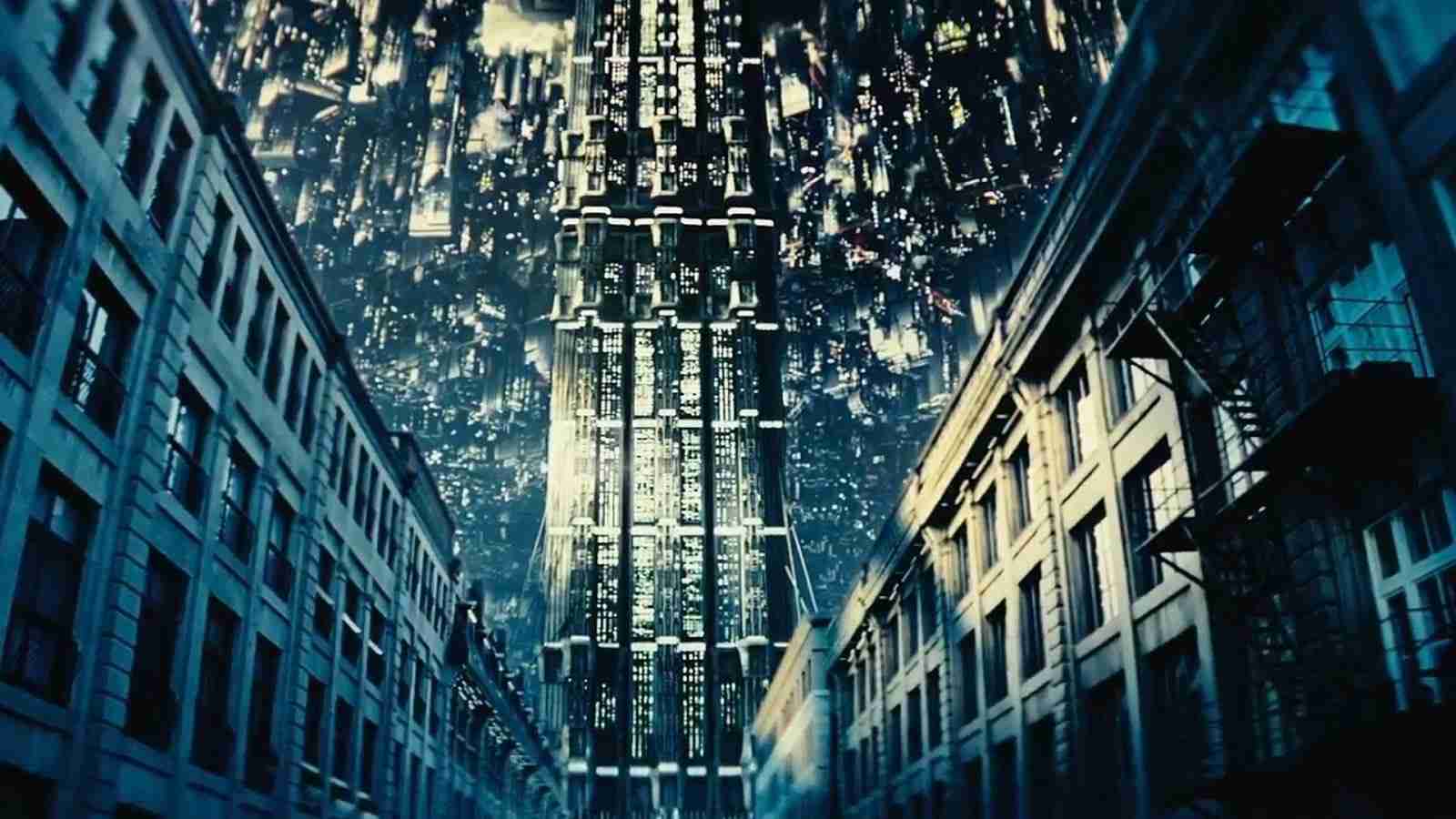
Artificial intelligence is starting to be used in cinema itself, in ways that are changing the way films are made.
For example, artificial intelligence is used to create more realistic special effects. In Avatar (2009), artificial intelligence was used to create the Na’vi, the humanoid aliens who inhabit the planet Pandora.
Artificial intelligence is also used to automate some film production tasks. For example, artificial intelligence can be used to analyze production data and identify potential problems.
In the future, it is likely that artificial intelligence will play an increasingly important role in cinema. Artificial intelligence could be used to create new genres of films, to improve the quality of existing films, and to make the film production process more efficient.
What Is an Artificial Intelligence
Artificial intelligence (AI) is a field of computer science that studies how to create machines that can think and act like humans. The goal of AI is to create systems that are capable of learning, reasoning, solving problems, and making decisions independently.
AI is a large and rapidly evolving field, with many different approaches and techniques. Some of the main approaches to AI include:
Machine Learning: Machine learning is a field of AI that deals with creating systems that can learn from data without being explicitly programmed.
Operations Research: Operations research is a field of AI that deals with the application of mathematical methods to solving complex decision-making problems.
Automatic Reasoning: Automatic reasoning is a field of AI that deals with creating systems that can reason and solve problems using logic.
Natural Language Understanding: Natural language understanding is a field of AI that deals with creating systems that can understand and generate human language.
AI has a wide range of applications, including:
Automation: AI is used to automate tasks that were traditionally performed by humans. For example, AI is used to drive vehicles, diagnose diseases, and manage manufacturing tasks.
Research: AI is used to improve research in a wide range of fields, including medicine, finance, and science.
Creativity: AI is used to create art, music, and literature.
AI is an emerging technology that is rapidly changing the world. AI has the potential to improve our lives in many ways, but it also presents some potential risks. We must develop AI responsibly and ethically.
Examples of AI Applications
Here are some examples of AI applications that are already in use or are in development:
Self-driving cars: Self-driving cars use AI to detect objects and obstacles in their surroundings and make real-time decisions about how to move.
Medical diagnosis: AI is used to diagnose diseases by analyzing medical images and clinical data.
Financial Risks: AI is used to assess financial risks and make investment decisions.
Creating Art: AI is used to create art, such as paintings, music, and literature.
Risks of AI
AI also presents some potential risks, including:
Unemployment: AI could lead to unemployment, as machines become capable of performing tasks that were traditionally performed by humans.
Ethics: AI could be used to create systems that are harmful or dangerous.
Control: AI could be used to create systems that are capable of controlling people.
History of Artificial Intelligence
The first appearances of artificial intelligence date back to the 1940s and 1950s, when researchers began studying how to create machines that could think and act like humans.
One of the first major contributions to artificial intelligence was Alan Turing’s 1950 paper, “Computing Machinery and Intelligence.” In this article, Turing proposed the “Turing Test” as a criterion for evaluating the intelligence of machines.
Another important contribution was the development of the Perceptron by Frank Rosenblatt in 1958. The Perceptron was a machine-learning model that could be used to recognize simple patterns.
The Winter of Artificial Intelligence
In the 1960s, artificial intelligence underwent a period of stagnation, known as the “winter of artificial intelligence.” This period was characterized by a series of widely publicized AI project failures, leading to an eclipse of interest in the field.
The Awakening of Artificial Intelligence
In the 1980s, artificial intelligence began to make a resurgence. This period was characterized by significant advances in areas such as machine learning, natural language understanding, and computer vision.
One of the most important advances was the development of artificial neural networks. Artificial neural networks are machine learning models that are inspired by the functioning of the human brain.
Modern Artificial Intelligence
In recent years, artificial intelligence has continued to develop at a rapid pace. Artificial intelligence is now used in a wide range of applications, including autonomous driving, medical diagnosis and finance.
Some of the most recent advances in artificial intelligence include the development of machine learning systems that can generate text, translate languages, and write different types of creative content.
How Does an Artificial Intelligence Work?
Artificial intelligence (AI) is a system that can learn, reason, and make decisions independently. There are many different types of AI, but they all work on the same general principle:
AI collects data from its surroundings. This data can be of any type, such as images, text, or numbers.
Data collected by artificial intelligence
AI analyzes data to identify patterns and relationships. These models can be used to make decisions or to generate new information.
Artificial intelligence analyzes data to identify patterns and relationships
AI applies these models to make decisions or generate new information. These decisions or information can be used to perform tasks or to improve the AI system itself.
The Different Types of AI
There are many different types of AI, depending on how data is collected, analyzed and applied. Some of the most common types of AI include:
Machine Learning: Machine learning is a field of artificial intelligence that deals with creating systems that can learn from data without being explicitly programmed.
Operations Research: Operations research is a field of artificial intelligence that deals with the application of mathematical methods to solving complex decision-making problems.
Automatic Reasoning: Automatic reasoning is a field of artificial intelligence that deals with creating systems that can reason and solve problems using logic.
Natural Language Understanding: Natural language understanding is a field of artificial intelligence that deals with creating systems that can understand and generate human language.
A vision curated by a filmmaker, not an algorithm
In this video I explain our vision

