
The Frame Before the Frame
You are standing in a room you have visited before, maybe a museum, maybe a church, maybe someone’s hallway where a reproduction hangs slightly crooked above a radiator, and something stops you. Not a decision to stop. The stopping happens first, and the deciding comes after, scrambling to explain itself. There is a face on the wall, or a landscape, or the arrangement of objects on a table caught in a light that no longer exists anywhere on earth, and before you have formulated a single thought about it you are already in a relationship with it. Already being looked at. That is the word that arrives, eventually, when you try to account for the experience: not that you are looking, but that you are being seen. By something that has no eyes. By something made of pigment and linen that has been waiting, with extraordinary patience, for exactly this moment.

This is not mysticism. This is mechanics. The painter knew something about attention that precedes all theory, that the frame is not a border but a trap, that to edge an image is to make a claim on the nervous system of anyone who enters its radius. The Austrian art historian Alois Riegl, writing at the turn of the twentieth century, argued that artworks contain within them what he called Kunstwollen, a will to form, an inner drive that is not the artist’s personal intention but something closer to a civilizational pressure expressing itself through the artist’s hand. What Riegl identified as structural force, the body registers as presence. You feel watched because the image has organized itself around the act of being seen, has folded the future viewer into its own geometry long before that viewer arrived.
Stand long enough before Velázquez’s Las Meninas, painted in 1656 and now permanent in the Prado, and you understand that something structurally strange is happening. You are not a spectator. You have been recruited. The painting has made you into its missing element, positioned you as the royal couple whose blurred reflection appears in the background mirror, turned you into the absent center around which all other gazes arrange themselves. Michel Foucault opened The Order of Things in 1966 with a reading of precisely this painting, arguing that it represented the moment Western representation became aware of its own mechanism, looked at itself looking. But Foucault was writing about epistemology. What he was also writing about, without quite saying so, was the physical sensation of being caught.
Cinema arrives centuries later with entirely different machinery and yet produces an identical arrest. Sitting in a darkened room, you watch a woman walk slowly through a house at night, the camera holding at a distance that is not neutral, that communicates something like dread or longing or the particular quality of attention that belongs to someone who cannot stop watching even though they know they should. The light in these scenes carries the same quality as candlelight in a Flemish interior: it does not illuminate so much as it selects, deciding what will be seen and what will remain just outside the edge of knowing. The room vibrates. The absence of sound makes the image louder. You are, again, being seen by something that cannot see.
The conventional story told about the relationship between painting and cinema is a story of inheritance, of cinema learning composition from Rembrandt, depth from Vermeer, color from the Impressionists. It is a story of influence running in one direction, from the older medium to the newer one, as though painting were a generous ancestor handing down techniques to a talented descendant. But this story is too comfortable, too tidy, and it misses what the body already knows when it stops in front of a painting without being told to: that both arts are answers to the same unbearable question, which is what to do with the fact that everything disappears.
The Mirror and the Rascal
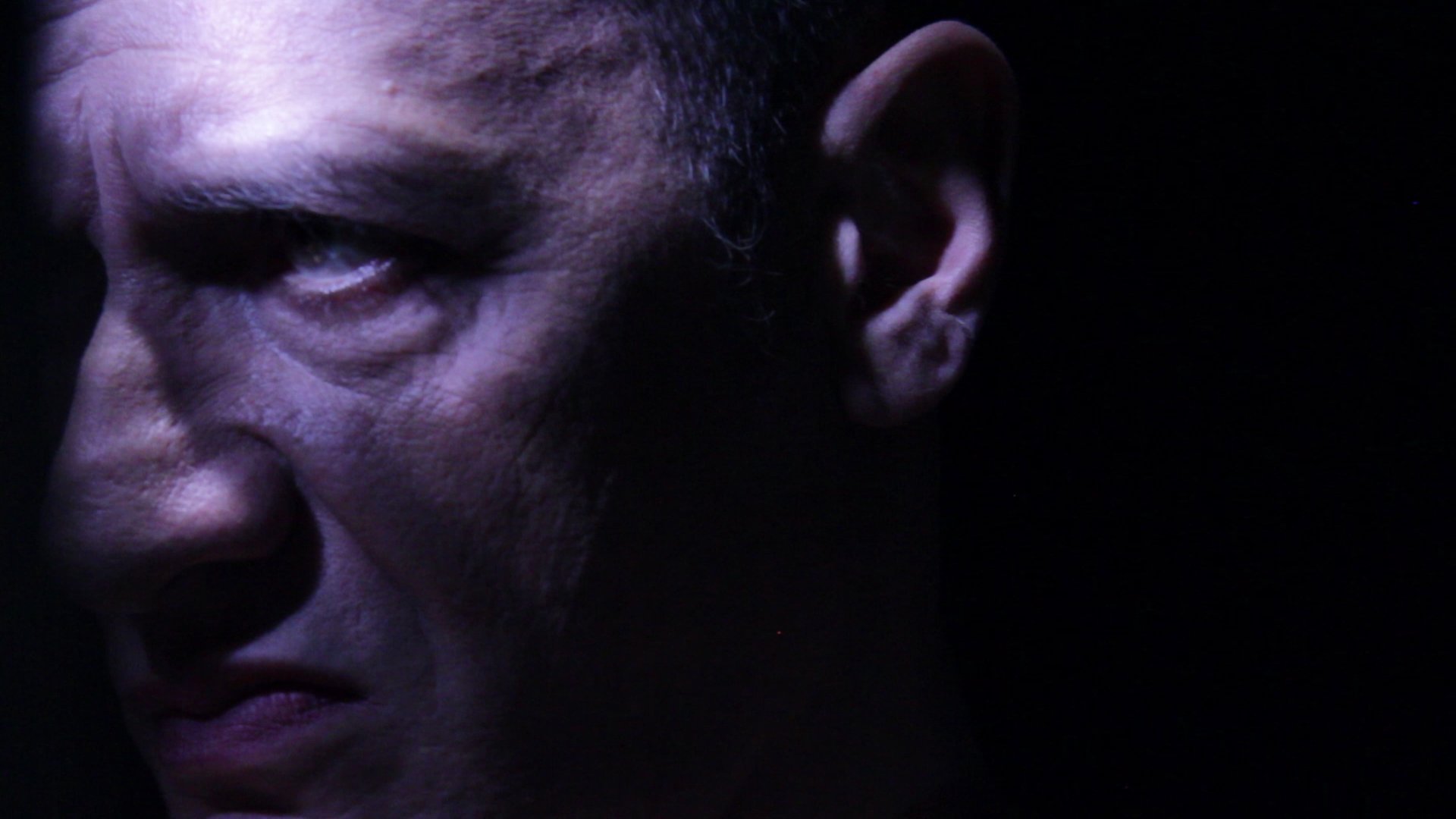
Drama film, by Valerio De Filippis, Italy, 2019.
The mirror and the rascal is an experimental film based on the tragedy "Richard III" by William Shakespeare. It tells the delirium of contemporary power in an author's reinterpretation of cinema, video art and music. The protagonist, Richard Duke of Gloucester, brother of King Edward IV, through a long series of crimes eliminates all the obstacles that stand between him and the throne of England.
Valerio de Filippis, a well-known painter who has been following his research path for a long time, investigating the relationship between light, corporeality and the psyche. The mirror and the rogue and the cinematographic equivalent of Valerio De Filippis' painting, his figurative style is in fact very recognizable looking at his paintings. But cinema is a new way where the artist can also be involved as an actor and performer, with an original mix between acting and singing. Staging the dark side of the human soul, the film is a surreal and disturbing interpretation of a great classic. The director says: "The first suggestion was musical: I was interested in transforming the text of Shakespeare's tragedy Richard III into notes. I love cinema and at a certain point I felt that the time had come to combine research on the image of painting to my love for cinema and music. When the film is finished I realize that I have remained faithful to painting: every frame of the film appears to me like a painting: the same light, the same colors, the same atmosphere ". The mirror and the rascal is a kind of psychoanalytic session that the painter does while hiding behind the mask of Richard III. Behind this ferocious and unscrupulous character we find a path of self-analysis by De Filippis, who is mainly interested in the more violent and turbid aspects. An experimental film in which, with great courage, the author gets involved completely, fragmenting the images in an unconventional montage, which is at the same time a flow of consciousness and spectacle.
LANGUAGE: English
SUBTITLES: Italian
When Light Became Obedient
There is a moment, sometime in the seventeenth century, when a man sits in a darkened room and watches the world outside appear on the wall in front of him. Not the world as memory, not the world as approximation — the world as pure optical fact, inverted and trembling, the leaves of a tree rendered in actual motion on plaster. The camera obscura does not represent reality. It captures it, holds it briefly like water in a cupped hand, then lets it drain. And the man watching understands, somewhere beneath language, that he has crossed a threshold. He has made light obedient.
This was never merely a scientific curiosity. The desperation behind it was civilizational. Societies that were learning to measure, to colonize, to accumulate — societies organizing themselves around the fantasy of total possession — needed vision to behave. The magic lantern followed, projecting painted glass slides onto walls in darkened rooms, and the crowds who gathered around those projections were not watching entertainment. They were rehearsing a hunger. Then came the panoramas, those vast circular paintings installed in purpose-built rotundas across London and Paris in the 1790s and early 1800s, charging admission to stand inside a complete painted world. Robert Barker’s panorama of Edinburgh, patented in 1787, was not a painting you stood before. It was a painting you stood inside. The difference is everything. To stand before a painting is to acknowledge a frame, a limit, an other. To stand inside one is to enact a fantasy of total immersion, of vision so complete it eliminates the self doing the seeing.
Walter Benjamin, writing in 1935, named what was at stake in all of this without quite naming it as hunger. His argument in Das Kunstwerk im Zeitalter seiner technischen Reproduzierbarkeit was that mechanical reproduction strips the artwork of its aura — that irreducible quality of presence, of being here and not elsewhere, of the singular object in its particular time and place. He was right about the mechanism. He was wrong, or perhaps simply incomplete, about the direction of travel. The aura did not die when reproduction began. It migrated. It infected the reproductive apparatus itself. Cinema arrived already haunted by the aura it was supposed to have destroyed.
Because think about what cinema actually does when it works — not when it merely entertains but when it genuinely works. A man sits in a room watching projected light on a wall. The room is empty, the hour late, and what appears on the wall is not the world outside but something that was once the world outside, captured and now reanimated. He is not watching a representation. He is watching time that has already passed, made present again through light. The sensation is indistinguishable, at some neurological depth, from memory. And this is precisely what Benjamin could not quite account for: that the reproduced image, stripped of its original aura, develops its own aura in the watching. The singularity migrates from the object to the experience. Every screening of a film becomes, in its own way, unrepeatable.
The painters understood this before the theorists did. Vermeer’s obsessive use of the camera obscura, documented by David Hockney and Philip Steadman in separate analyses decades apart, was not a shortcut. It was an investigation into the nature of light as witness. What the lens did was not simplify vision but intensify it, forcing the eye to confront how much ordinary sight edits, selects, glosses over. And then the moving image arrived and inherited this entire unresolved argument about what it means to truly see something — and whether seeing it changes what it was.

Composition as Violence
There is a moment you have lived, or watched someone live, where the arrangement of objects on a table communicates something no one in the room will say aloud. A glass placed slightly apart from the others. A chair not pulled in. The salt shaker on the wrong side. You feel the tension before you can name it, because composition speaks beneath language, and it speaks first.
A woman moves through a kitchen filled with cold northern light, setting plates with a deliberateness that looks like ritual and feels like suppression. Every object finds its place with the kind of precision that only emerges when interior disorder has nowhere else to go. The window cuts the room into zones of illumination and shadow. Nothing is accidental. And that is exactly the problem, because when nothing is accidental, everything is chosen, and choice means exclusion, and exclusion is always a political act dressed in aesthetic clothing.
Erwin Panofsky spent decades arguing that linear perspective, that triumph of Renaissance pictorial logic codified by Alberti in 1435, was not a discovery but a convention. In his 1927 essay “Perspective as Symbolic Form,” he demonstrated that the mathematical construction of pictorial space encodes a specific relationship between a sovereign eye and a subordinated world. The viewer is positioned at the center, things recede in calculated proportion, and the illusion of depth becomes an ideology of mastery. This is not how vision actually works. The human eye does not perceive straight lines as straight at the periphery. Perspective flattens the lived messiness of seeing into a geometry that serves power, that says: this is the real, and I have measured it for you.
Vermeer knew this and used it like a scalpel. His domestic interiors are not recordings of rooms but architectures of psychological pressure. Caravaggio before him had understood that where you place the light source determines who in the painting deserves to exist, who emerges from blackness into significance and who remains dissolved in shadow. These were not stylistic preferences. They were legislative decisions about the hierarchy of the visible. When Edward Hopper painted a woman sitting alone in a diner at three in the morning, the plate-glass window that isolates her from the street outside is not atmosphere. It is a verdict.
Cinema inherited this jurisprudence without needing to study it. A filmmaker frames a woman in a doorway, the corridor behind her retreating into darkness, and without a single word of dialogue you know the geometry of her entrapment. The rectangular frame of the screen is not a window onto reality, it is a border crossing with a strict visa policy. What falls outside it does not exist. This is the violence that feels invisible because it has been aestheticized for six centuries.
The comfortable history tells us that cinema learned from painting, that directors walked through museums and carried the lessons of chiaroscuro into the editing room. But this narrative of apprenticeship misses something more disturbing: both arts are instruments of the same will to legislate visibility. The stretched canvas and the celluloid rectangle share an epistemological ambition that precedes any individual artist’s intention. They do not show the world. They produce it. They decide, before anyone has spoken, what counts as a subject worthy of attention, which bodies deserve light, which stories occupy the center and which dissolve at the edge.
When that woman finishes setting the table and steps back to look at it, there is a stillness that is not peace. It is the stillness of something that has been arranged so perfectly it cannot be questioned. And that is precisely when you should begin to question it, when the frame feels most natural, most inevitable, most like simply the way things are.
Color as Argument
There is a room you have been in, maybe not literally but in some register of the body that records atmospheres before the mind names them. The walls were white. Not the white of a clean beginning but the white of something from which all other possibility had been methodically removed. You felt it as pressure against the chest, as a faint difficulty breathing, and you could not have said why because the room was just a room and white is just a color.
Except that color is never just a color. Josef Albers spent decades at the Bauhaus and then at Black Mountain College and then at Yale arriving at one of the most quietly devastating observations in the history of perception: color has no fixed identity. It exists only in relation. The same red placed against an ochre ground reads as orange; placed against violet it becomes almost luminous with warmth; placed against a darker red it recedes into shadow and changes temperature entirely. Albers published this in 1963 in Interaction of Color, and what he was describing was not a technical curiosity but an epistemological condition. We do not see colors. We see relationships between colors. Which means that every palette is an argument, a constructed persuasion operating below the threshold of conscious attention.
Byzantine icon painters understood this centuries before Albers named it. The gold ground of a Byzantine icon is not decorative. It is theological. It abolishes spatial depth, refuses the fiction of three-dimensional recession, and places the figure in a timeless non-space where ordinary causality does not apply. The gold does not represent light. It is light, or rather it is the assertion that light here is not the contingent light of a particular afternoon but the permanent radiance of the sacred. When that tradition of symbolic color entered Renaissance painting and then fractured into the chromatic naturalism of the seventeenth century, something was gained in illusionistic power and something was lost in metaphysical directness. Color became descriptive and stopped being declarative.
Then Rothko. In the late canvases, particularly the Seagram Murals of 1958 and the Black Paintings of the final years, color recovered its declarative violence. Those dark maroons and blacks bleeding into each other are not depicting an emotion. They are producing one, forcing it onto the viewer’s nervous system through sheer tonal pressure. People wept in front of them. People still do. Not because the paintings are beautiful in any comfortable sense but because the color relationships function like a hand pressing steadily against the sternum.
The man moving through progressively desaturated rooms is not moving through a house. He is moving through an argument about erasure. Each room removes something — warmth, then hue, then tonal contrast — until the last room is white in a way that feels like deletion. His face in that whiteness reads differently than it would in any other context. The same face in a saturated amber room reads as alive, embedded, present. Here it reads as residual. The color has done this, not the direction, not the performance.
What film inherited from painting in this regard was the understanding that color systems encode hierarchies before a single word is spoken. The connection between warm skin tones and humanity, between gray institutional spaces and oppression, between saturated primaries and childlike innocence, between desaturated palettes and serious moral weight — none of these are natural. All of them have histories, and those histories are entangled with decisions about whose faces the technology was calibrated to render as human, whose bodies were associated with which chromatic registers, which social classes had their interiors flooded with light and which were consigned to shadow and sepia. Richard Dyer spent much of White, published in 1997, tracing precisely how cinematic lighting and color grading developed around an unmarked assumption of white skin as the neutral, the default, the standard against which everything else was a deviation requiring special handling.
You absorbed all of this. In every film you have ever watched, in every painting you have stood before, the color was making an argument you were never asked to vote on.
The Still and the Moving Are the Same Lie
You have stood in front of a painting and felt time move. Not metaphorically — actually felt the seconds stretch and fold, felt the image pull you somewhere behind your own eyes, into a duration that had nothing to do with the clock on the wall or the shuffle of other visitors behind you. You did not analyze this. You simply stopped, and stopping was involuntary, the way a hand flinches before the mind catches up. Roland Barthes spent the last year of his life trying to name this experience, and what he arrived at in 1980 was a word from Latin archery: punctum, the wound, the prick, the thing in an image that punctures you without permission. He was writing about photography, but he was describing something that happens in front of Caravaggio, in front of Velázquez, in front of a single held frame in a film where nothing occurs except a face existing in light.
There is a scene where a woman sits at a kitchen table, her hand resting flat on the surface, and the camera does not move. Nothing is said. The scene lasts long enough that you begin to read the hand — the slight tension in the knuckles, the way the fingers curl just fractionally, as if something is being held back that has no outlet. You know more about grief from that hand than from any dialogue written to explain it. The shot contains more time than a sequence of action, because action evacuates time into event, while stillness fills time with everything that is not being shown. This is precisely what the Baroque painters understood, and they understood it before the first camera shutter ever opened.
The great painterly tradition that runs through the seventeenth century is a tradition not of freezing time but of choosing the most saturated moment — the instant of maximum tension between what has just happened and what is about to. Not the blow landing, but the arm raised. Not the grief declared, but the jaw held against it. Lessing called this the “pregnant moment” in his Laokoon of 1766, and though his argument concerned the proper boundaries between poetry and visual art, what he was actually mapping was the temporal intelligence of painting — its understanding that the still image is not outside time but contains time compressed to its most volatile state. Three centuries of painters had already built this understanding into their work before anyone thought to string photographs together and call it motion.
And here is where the foundational myth breaks. Cinema is not dynamic because it moves. Cinema is dynamic for exactly the same reason a Rembrandt is dynamic: because it generates duration inside the viewer, because it produces the sensation of time passing or time suspended through the precise management of what is shown and what is withheld. A chase sequence with forty cuts in ninety seconds can leave you completely cold. A doorway, lit from one side, held for twelve seconds, can make your chest tighten with something you cannot name. The movement was never the point. It was always the pressure.
Think of the moment when a man returns to a house he grew up in and stands in the entrance without entering. The camera holds on his back. The house is still. You feel the entire weight of whatever happened there pressing against his shoulders, against your own, and the feeling is indistinguishable from standing in a gallery and looking at a painting of a threshold — a door half open onto darkness, a figure hesitating at the edge of light. The painters built that doorway. The cinematographers walked through it. What neither art form can fully claim is that the stillness and the motion were ever separate operations producing separate effects. They were always the same thing working on the same body.
A vision curated by a filmmaker, not an algorithm
In this video I explain our vision
Narrative Painted, Image Storied
You stop in front of it and you already know something terrible has happened. The bodies are arranged in a diagonal that climbs toward a desperate arm reaching upward, and you do not need a caption, a narrator, a sequence of frames. The image gives you the aftermath and forces you backward into the cause. You reconstruct the storm, the abandonment, the days adrift, the men who ate the men beside them, all from a frozen surface of oil and canvas that has not moved in two hundred years. The event is not depicted. It is implied, demanded, extorted from the viewer by the composition itself.
This is what history painting always understood and what the convenient separation between narrative arts and plastic arts has spent centuries trying to obscure. The assumption runs deep and feels almost self-evident: cinema tells stories, painting presents forms. One unfolds in time, the other arrests it. But this division collapses the moment you stand in a crowd gathered around a large canvas displayed in the open air, each person constructing a completely different event from the same image. One man sees the moment just before the wave. A woman sees the moment just after the rescue that never came. A child sees only the figures at the top, the ones still alive, still hoping, and understands nothing of the ones below. The painting is not showing them a single story. It is generating a different one inside each of them, using frozen evidence the way a detective uses a cold crime scene.
Siegfried Kracauer argued in 1960 that cinema’s essential task is the redemption of physical reality, the restoration of the material world to consciousness before abstraction strips it of its weight and texture. Film, for Kracauer, returns us to the contingent, the accidental, the irreducibly specific surface of things. It is an almost theological claim dressed in secular language: the camera saves the world from being reduced to an idea. But here is what that argument cannot quite contain. If cinema redeems physical reality by making it visible in time, what was Géricault doing when he interviewed survivors, studied cadavers, crossed to a hospital to sketch the faces of the dying, then arranged all of that research into a single arrested instant designed to make the viewer’s body react before the viewer’s mind could intervene? He was redeeming physical reality five decades before the cinematograph existed. He was doing it without movement, without duration, without the one thing Kracauer believed was cinema’s exclusive instrument.
Guernica operates by the same logic but strips away even the comfort of recognizable bodies. The painting from 1937 does not show you the bombing as event. It shows you the world the bombing left behind, or rather the world the bombing produced inside the people who survived it, which is a different and more honest thing. The fragmented figures, the screaming mouth, the lamp thrust into darkness, the horse collapsing under geometry rather than weight — these are not forms. They are testimony. And testimony is always narrative, always implying a before that was destroyed to produce this after. The viewer who stands before it does not see a composition. They see a sequence of which only the final frame remains, and they must run the film backward through the wreckage to find the world that no longer exists.
What Kracauer perhaps did not fully reckon with is that physical reality has never simply waited to be redeemed. It has always been storied, always arrived pre-saturated with the weight of what came before and the pressure of what might come next. Painting knew this. History painting built its entire practice on this knowledge, on the understanding that the frozen moment is never truly frozen, that the eye that learns to read a canvas is performing the same act as the mind that reconstructs a life from its ruins — moving in time through something that refuses to move.
The Painter’s Eye Behind the Lens
There is a window. There is a woman standing at it, not looking at anything specific — a parking lot, maybe, the edge of a roof, the gray nothing of an afternoon that has no intention of becoming evening. She does not move. The camera does not move. You wait for something to happen and slowly, with a discomfort that feels almost rude, you understand that this is the something. The unbearability of the duration is not a failure of narrative. It is the narrative.
Edward Hopper spent decades painting this exact condition before any camera thought to hold it. The diner counter at 2 a.m., the hotel room where a woman sits on a bed facing a window with her back to whoever might be watching, the gas station dissolving into highway dark — these are not compositions of loneliness so much as they are arguments about what artificial light does to human beings when it replaces the sun. American cinema absorbed this argument so completely that it forgot where it came from. The fluorescent pallor of a motel corridor, the way a face looks when illuminated from below by a television screen, the geometry of a parking structure at night — these are Hopperesque not as homage but as inheritance, a visual grammar that passed into the culture’s bloodstream sometime around the middle of the twentieth century and never left.
But the debt runs older and deeper than one American painter. The Flemish interior tradition, those seventeenth-century rooms where light enters through a single window and lands on a woman reading a letter or a man counting coins, established something that European auteur cinema would spend a century quietly restating: that the domestic interior is a moral space, that how light falls on ordinary objects constitutes a form of ethical attention. The woman at the window in Vermeer is not decorative. She is being seen with a slowness that implies she matters. When a director holds on a face in close-up for four, five, six seconds longer than commercial grammar permits, they are performing the same insistence — that this person, this surface, this moment of existing in light, is worth the time it costs you to look.
T.J. Clark, writing in The Sight of Death in 2006, sat for days in front of two Poussin landscapes at the Getty and wrote about what sustained looking actually does to the viewer. His argument is not aesthetic in the comfortable sense. Slow looking, for Clark, is a political act because it refuses the logic of consumption, which demands that images be processed quickly, yielded, replaced. To look at a painting until it starts to look back is to perform a minor insurrection against the economy of attention. The camera forced to hold on a landscape without cutting, on a face without explanation, is doing precisely this. It is refusing to let the image be consumed. It is insisting on duration as meaning rather than duration as delay.
Japanese cinema found a different genealogy for the same resistance, one rooted not in oil and interior light but in the horizontal logic of the emaki scroll, where time is spatial, where the eye moves through a landscape that unfolds rather than presents itself. The negative space in a frame held long enough — the silence around two figures, the sky given equal weight to the ground — carries this inheritance. Emptiness is not absence. It is where meaning breathes.
The woman at the window is still standing there. You have not moved either. Something has happened to time in the interval, a slight warping, a pressure, the particular discomfort of being made to feel the weight of another person’s consciousness existing in a moment you cannot fast-forward through. Whether that woman was painted in Delft, sketched in charcoal by an insomniac American, or held in a camera’s gaze for eleven seconds that feel like a year —
What the Image Wants From You
You are standing in front of something large, and you do not know why you feel afraid.
This is not metaphor. It happens to children in museums with a regularity that curators have quietly observed for decades — the small body stopping before a canvas that dwarfs it, the face going still, the refusal to step closer. No one has explained anything menacing. The colors may even be beautiful. And yet something in the image has issued a demand the child cannot articulate, cannot refuse, cannot meet. The adults nearby mistake it for boredom or distraction. It is neither. It is the first honest encounter with what an image actually does when it is not decorating a wall but occupying space with genuine intent.
W.J.T. Mitchell spent years circling this discomfort before he found a way to name it directly. In his 2005 work What Do Pictures Want?, he refused the comfortable assumption that images are passive objects waiting for human interpretation. He proposed instead that pictures have something like desire — not metaphorically, not as a charming animism, but as a structural fact about how images operate in the world. They recruit attention. They organize behavior. They produce effects that exceed any single viewer’s intention or consent. The question he asked — what do pictures want? — was never meant to be answered tidily. It was meant to make you uncomfortable with the confidence you felt before you read it.
That discomfort has a history longer than any theory. There is a man who cannot stop returning to a single sequence in something he once watched — a woman walking away from a camera down a corridor, the back of her head, the particular way light falls across her shoulder — and he does not know why this image has lodged itself in him with the force of a memory he never had. He has watched it perhaps forty times. He does not find new information there. He finds the same thing each time, which is the unsettling sensation that the image knows something about him that he has not yet confessed to himself. This is not projection in the trivial sense. It is the image functioning exactly as Mitchell describes: not reflecting the viewer but addressing them, making a claim, extracting something.
Painting did this first, and cinema inherited the mechanism with extraordinary efficiency. When Erwin Panofsky argued in 1934 that cinema had taken on the iconographic responsibilities once held by religious and public painting, he was not making a cultural compliment. He was identifying a transfer of power — the power to shape what a community believes it sees, what it understands as real, what it permits itself to feel. The painter and the filmmaker both work within what Mitchell calls the imagetext, that unstable zone where the visual and the verbal, the seen and the spoken, the shown and the implied collapse into one another without resolution. Every image carries within it the ghost of language it refuses to become. Every description of an image is haunted by what the image does that words cannot reach.
This is why the ethics of looking has never been simple, despite every attempt to simplify it. John Berger understood in 1972 that the act of seeing is never neutral, never purely receptive — that to look is already to be positioned, already to have accepted a relationship whose terms were set before you arrived. But even Berger stopped short of the most vertiginous implication: that the positioning runs in both directions, that the image is not only organizing you but watching you organize yourself in response to it, registering your hesitation, your desire, your shame, with the indifferent precision of something that does not need eyes to see.
🎨 When Image Becomes Art: Cinema and the Visual Arts
The relationship between painting and cinema is one of the most fertile dialogues in the history of visual culture. From composition and color to the gaze and symbolic depth, these two arts have constantly borrowed from and transformed each other. The following articles explore the broader landscape of visual thinking, iconology, and artistic expression that forms the theoretical backbone of this dialogue.
Erwin Panofsky: Life and Iconology
Erwin Panofsky was one of the first art historians to take cinema seriously as a visual medium, arguing that film and painting share deep structural relationships in how they organize meaning through images. His iconological method — reading layers of symbolic and cultural meaning beneath the surface of a work — provides an essential theoretical tool for analyzing both painted and cinematic compositions. Understanding Panofsky is fundamental for anyone wishing to trace the intellectual threads connecting visual art to the moving image.
GO TO THE SELECTION: Erwin Panofsky: Life and Iconology
Henri Matisse: Life and Works
Henri Matisse’s radical experiments with color, flatness, and decorative surface had a profound influence on the visual language of twentieth-century cinema, from the chromatic boldness of Godard to the staged compositions of Wes Anderson. His belief that art should express emotion through pure formal means anticipated how filmmakers would use color and framing as expressive instruments beyond mere representation. Exploring Matisse’s life and works opens a window onto the aesthetic revolution that reshaped how both painters and directors think about the image.
GO TO THE SELECTION: Henri Matisse: Life and Works
The Avant-Garde Cinema: Movies to Watch
Avant-garde cinema is perhaps the artistic movement most explicitly indebted to the innovations of modern painting, drawing directly from Cubism, Surrealism, Expressionism, and Abstract art to reinvent the grammar of the moving image. Directors like Man Ray, Hans Richter, and Maya Deren translated painterly concerns — rhythm, abstraction, the unconscious — into cinematic form with radical results. This curated list of avant-garde films offers an ideal entry point for discovering how cinema became a canvas in motion.
GO TO THE SELECTION: The Avant-Garde Cinema: Movies to Watch
The Unconscious and its Relationship With Cinema
The relationship between the unconscious and cinema is intimately tied to the visual strategies inherited from Surrealist painting, where dreamlike imagery, symbolic distortion, and the logic of the unconscious mind became central compositional tools. Just as painters like Dalí and de Chirico used the canvas to externalize interior psychological states, filmmakers have used the screen as a mirror of hidden desires, fears, and archetypes. This article traces the deep theoretical connections between psychoanalytic thought and the art of cinematic image-making.
GO TO THE SELECTION: The Unconscious and its Relationship With Cinema
Discover the Cinema That Thinks in Images
If the relationship between painting and cinema has sparked your curiosity, Indiecinema is the streaming platform where visual storytelling reaches its most daring and original expressions. Explore a curated selection of independent films that treat the screen as a canvas — bold, poetic, and uncompromising. Join Indiecinema and discover the cinema that truly sees.
👉 EXPLORE THE CATALOG: Watch Indie Films in Streaming
A vision curated by a filmmaker, not an algorithm
In this video I explain our vision

