
The Weight of a Stone You Cannot Name
You have stood in front of a building and felt something you could not explain. Not admiration, not aesthetic pleasure in any clean sense — something older than that, something that moved through the sternum before the mind had a chance to intercept it. Maybe it was a cathedral in a northern city, the stone blackened by centuries of weather, the arches pulling your gaze upward in a movement that felt less like looking and more like being lifted. Maybe it was a crumbling palazzo beside a canal, its façade half-eaten by salt and time, the plaster falling away in patches to reveal the brick beneath like skin pulling back from bone. You stood there and something in you recognized it — not the style, not the period, not the name of the architect you half-remembered from some forgotten course — but the thing itself. The weight. The intention fossilized into matter. You felt, without being able to say it, that someone had wanted something here. That this stone had been placed by a hand that believed the placement mattered.

This is where John Ruskin begins. Not in the library, not in the lecture hall, not in the pages of a theory of aesthetics — but exactly there, in that wordless arrest in front of a wall. He understood, with a clarity that took him thousands of pages to adequately circle, that you already know what he is going to tell you. You have always known it. Architecture is not decoration applied to function. It is not the pretty wrapping around a useful box. It is moral testimony. It is the record, pressed into stone and wood and glass, of what a civilization believed about labor, about beauty, about the relationship between the human hand and the human soul. And you feel this before anyone explains it to you, because your body is older than your education.
Ruskin was born in London in 1819, into a family prosperous enough to travel and cultured enough to look carefully at what they saw. His father was a sherry merchant with serious aesthetic sensibilities; his mother was devoutly evangelical. The combination produced in the son a sensibility simultaneously rapturous and morally urgent, incapable of separating the beautiful from the true, the aesthetic from the ethical. By the time he published the first volume of Modern Painters in 1843, at twenty-four years old, he had already begun to articulate what would become the central claim of his life’s work: that how we make things reveals who we are, and that beauty — real beauty, not prettiness — is always a symptom of something deeper, something that has to do with the conditions under which the making occurred.
The Stones of Venice, which appeared in three volumes between 1851 and 1853, is his most sustained attempt to demonstrate this through a single city, a single civilization, a single material. Venice had been obsessing him since his first visit in 1835, when he was sixteen and stood before the Ducal Palace and felt precisely that shift in the chest that you have felt, that you are feeling again now as you read this. He returned, measured, drew, sketched, climbed scaffolding, pressed his face close to capitals and cornices, tried to understand not just what he was seeing but why it was doing what it was doing to him. What force was passing through the stone into his body. What contract had been signed, centuries before his birth, between the craftsman and the material, and what that contract revealed about the society that had demanded and received this work.
The answer he arrived at was not comfortable. It never is, when someone tells you what you already know.
Venetian Arcanum
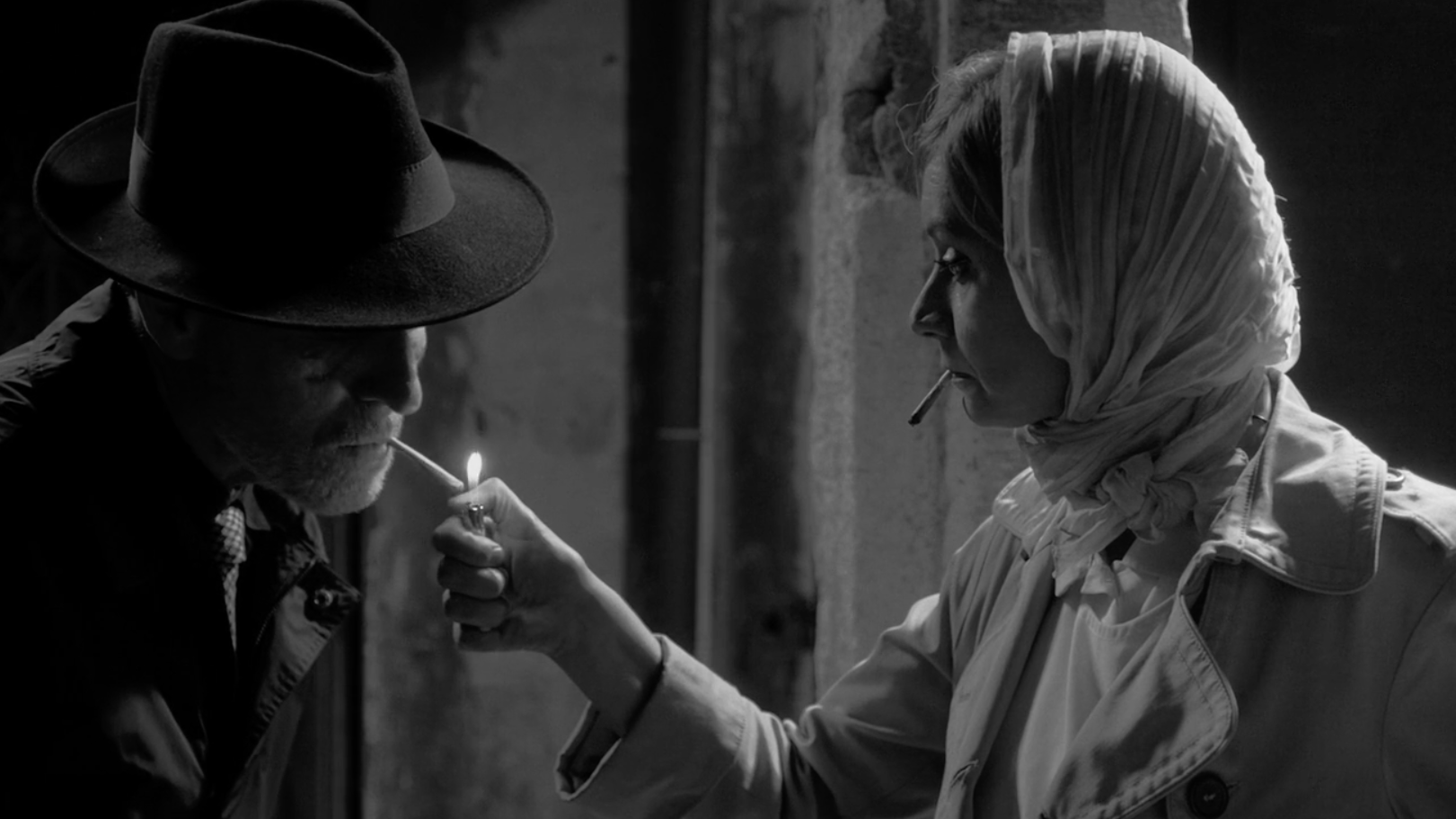
Thriller, by Serge Turgeon, Italy, 2025.
In Venice, a mysterious presence appears once every century or two, haunting the canals and hidden corners of the city. Driven by a sense of destiny, a woman decides to search for it. Following its elusive traces, she is drawn deeper and deeper into the city’s arcane secrets. Reality and myth begin to blur, and Venice itself transforms into a labyrinth of dangers.
LANGUAGE: Italian
SUBTITLES: English
A Victorian Who Refused to Behave Like One
You know someone like this. You may have been someone like this. The person who reads everything, understands everything, can describe the precise quality of afternoon light falling across a stone wall with more accuracy and feeling than most people bring to their entire emotional lives — and who nonetheless stands in a room full of other people with the faint, persistent sensation of having arrived on the wrong planet. Not unhappy exactly. Not broken. Simply elsewhere, always, even when physically present.
John Ruskin was born in 1819 into a household of considerable comfort and considerable pressure. His father sold sherry. His mother, Margaret, conducted her son’s education with the focused intensity of someone who believed she was shaping a prophet. She made him read the Bible aloud, entire books of it, repeatedly, until the cadences of the King James translation became the cadences of his own thinking. She kept him from rough play, from ordinary children, from the casual bruising that shapes a person into someone who can tolerate the world’s indifference. She gave him beauty and language and almost nothing else. This is not a simple thing to say about a mother. It is simply what happened.
At Oxford, he won the Newdigate Prize for poetry in 1839 and produced the kind of early work that announces a sensibility rather than a talent — the difference being that sensibility cannot be trained or improved, only refined or destroyed. He studied geology. He traveled to the Alps with his parents. He wrote letters home so precise and observant they read now like early drafts of everything he would later become. He did not belong at Oxford in the way that useful men belong to institutions, the way men who become lawyers or administrators or bishops belong. He belonged to it the way a visiting scholar belongs — with gratitude and slight bewilderment, already half-absent.
Then came Euphemia Gray, known as Effie, whom he married in 1848. The marriage lasted six years and was annulled in 1854 on grounds of non-consummation. The official explanation given by Ruskin’s lawyers — that he had been repelled by discovering his wife’s body was not as ideal as he had imagined — has been analyzed, disputed, and psychologized ever since. What matters here is not the legal record but the shape of the thing. A man who had spent his entire formation learning to perceive beauty as an intellectual and spiritual category, who had been raised to experience the world through the elevation of its forms rather than their physical reality, found himself across a bed from an actual human being. Warm, wanting, real. And the gap between the ideal and the present body was not a failure of desire. It was a failure of translation. He had no vocabulary for it. The entire apparatus of his education had given him everything except the capacity to be simply, clumsily, imperfectly there.
Erik Erikson wrote about the particular damage done by an identity constructed entirely around achievement and perception — the person who develops extraordinary outer sophistication while the inner capacity for intimacy remains at an early, unresolved stage. Ruskin’s is not a story about repression in the Victorian sense, about prudishness or moral terror. It is a story about what happens when beauty becomes a system of defense. When the ability to see, to classify, to articulate replaces the ability to feel without immediately translating the feeling into language.
Effie left him and married the painter John Everett Millais, with whom she had eight children. Ruskin continued writing. The productivity is almost unseemly in retrospect — lectures, pamphlets, multi-volume studies, letters, diaries. As though the work were filling something. As though the sentences, accumulating year after year, were building a structure large enough to live inside.
He had already begun The Stones of Venice. He needed somewhere to go.

Venice Before the Book: What He Actually Saw
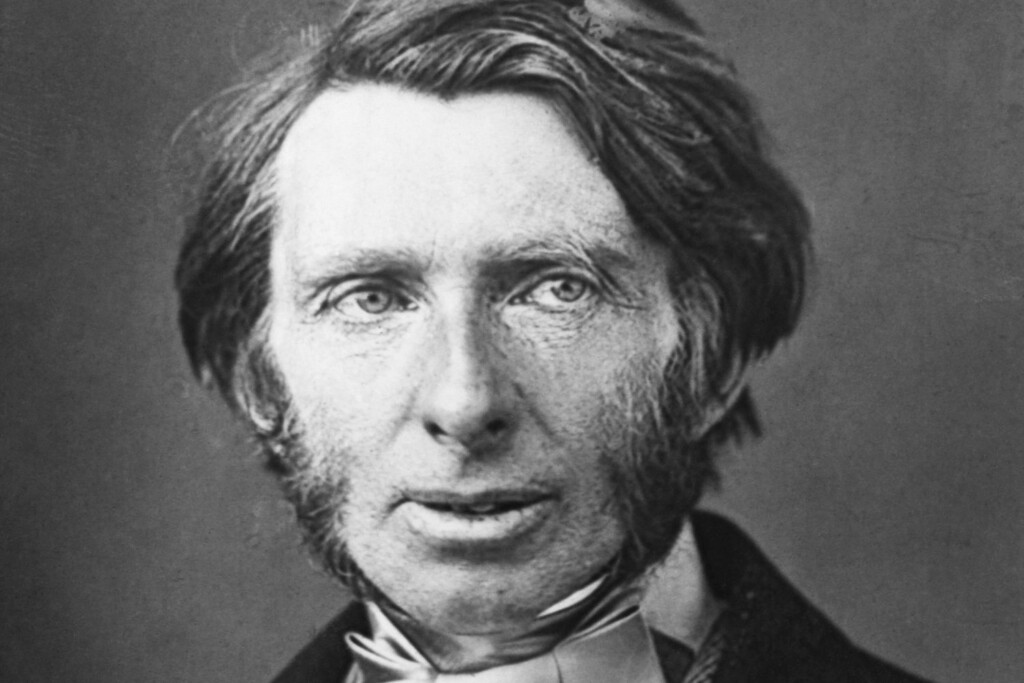
He arrived with a measuring tape. Not metaphorically — literally, a linen tape, coiled in his coat pocket, the kind a tailor uses to fit a jacket. The city was still marked by the Austrian bombardment of 1849, the failed revolution exhaled through cracked plaster and scorch-marked facades, and here was this thin Englishman at dawn, climbing whatever scaffolding he could find or improvise, pressing his face against a carved capital as if listening for a heartbeat. The gondoliers watched him. The locals watched him. Everyone watched him with the particular bewilderment reserved for someone who behaves as though an emergency is underway that no one else can see.
He measured cornices at first light because the raking angle of early sun revealed the depth of carving that midday would flatten into shadow. He brought daguerreotypes — the technology was barely a decade old, still alchemical and slow — and used them not as souvenirs but as instruments, fixing in silver nitrate what his hand could not sketch quickly enough before the light shifted. Effie, his wife, was set to copying details while he worked structural elements, a domestic division of labor that was also, in its way, an index of desperation: one person was not enough to document what was disappearing faster than any single set of eyes could register.
This is what needs to be understood before a single sentence of his argument is considered. There is a man who moves through a dying city and notes its pulse in millimeters. He crouches in corners that tourists pass without slowing, puts his thumb against the groove of a chisel mark made six centuries earlier, and understands — in the way you understand something only through the body, not the mind — that the person who made this mark was working freely. Not executing a specification. Deciding. You can feel the difference between a hand that was given a template and a hand that was given permission. Ruskin could feel it through stone.
The three volumes of The Stones of Venice appeared between 1851 and 1853, and they were the product of this physical obsession organized into argument. They are long in the way that exhaustion is long — not padded, but saturated, the prose of a man who has seen too much to be economical. The first volume alone runs to nearly five hundred pages before Venice has been properly entered. He needed that space not for decoration but because the theoretical foundation had to bear enormous weight: the entire moral history of European labor, the question of whether beauty is ever separable from freedom, the possibility that a civilization can be read in its moldings the way a physician reads a face.
Think of someone who carries a notebook into a condemned building, sits in the cold, and draws every crack in the plasterwork while the demolition crew waits outside. The crew thinks he is sentimental. He thinks the crew does not understand that the cracks are the document — that what has failed and where it has failed tells you everything about how it was built and why, which tells you everything about the people who built it and what they were permitted to be. He is not mourning. He is conducting an autopsy with the urgency of someone who believes the diagnosis might still save something alive somewhere else.
This is the epistemology of Ruskin’s Venice: that proximity is argument, that measurement is moral act, that the man on the scaffolding at dawn is not indulging an aesthetic preference but performing something closer to forensic science. The book that emerged from those cold mornings in a scarred and occupied city was not a travel memoir. It was evidence.
The Gothic as Revolutionary Argument
There is a moment when you are watching someone make something with their hands — a potter, a stonemason, a seamstress who learned from her mother — and you notice the slight irregularity in the finished object. A lip that tilts fractionally. A seam that curves where geometry would demand a straight line. And your instinct, trained by two centuries of industrial aesthetics, is to read that irregularity as error, as the thing falling short of its ideal. Ruskin spent the central chapter of his life trying to tell you that this instinct is not natural. It was manufactured. And the factory that manufactured it was not in Birmingham or Manchester. It was in fifteenth-century Florence.
His argument in The Stones of Venice, particularly in the essay “The Nature of Gothic” published in 1853, is deceptively simple in its statement and almost incomprehensible in its implications. Gothic architecture is morally superior to Renaissance architecture because it permitted the craftsman to be imperfect. The Renaissance, with its demand for geometric regularity, its submission of every carved surface to the mathematician’s ideal, had effectively enslaved the worker’s hand before the machine existed to replace it. The irregular capital, the asymmetric foliation, the column that does not quite match its neighbor — these were not failures of medieval craft. They were the visual record of a human being who was still free to think while working.
This is not a sentence that reads as revolutionary, and that is precisely the trap. Ruskin’s Victorian readers received it largely as aesthetic preference, as the refined opinion of a man who liked pointed arches and found classical symmetry cold. They did not receive it as the political indictment it was. Because what Ruskin was describing — the reduction of human making to the mechanical execution of a pre-designed template — is exactly what happens to a woman on an assembly line in the 1930s who tightens the same bolt nine hundred times in a shift and returns home at night unable to move her fingers without pain. The geometry was imposed before the machinery arrived. The degradation of thought from work happened first in marble, and only later in steel.
Hannah Arendt drew a distinction that Ruskin had already felt in stone: the difference between labor, which is cyclical and leaves nothing behind, consumed as fast as it is produced, and work, which makes a world, which creates objects that outlast the body that made them. The Gothic craftsman was working in Arendt’s sense — making a world, leaving a trace that bore the pressure of his particular hands and the particular morning of his particular life. The Renaissance worker, compelled to subordinate every gesture to the architect’s geometric ideal, had been converted into something closer to labor — repetitive, self-erasing, leaving only the surface that the design had already predetermined. The hand becomes invisible. The man disappears into the perfection.
There is a scene — and it has replayed in different forms across different centuries, in workshops and factories and open-plan offices — where someone is shown a completed task and told it is wrong not because it failed to function but because it deviated from the prescribed form. The deviation was minimal. The object worked perfectly. But the form was not followed, and so the worker must do it again. What is being erased in that correction is not an error. It is a thought. It is the moment when a human intelligence, encountering the material reality of the thing being made, made a small decision that the template had not anticipated. Ruskin understood that destroying that moment — multiplied across thousands of workers and millions of stones — was not quality control. It was the systematic demolition of what made work human.
The aura of a handmade thing, if we want to use that language, is simply the accumulated record of those small decisions. You feel it when you hold something made by someone who was allowed to think.
The Nature of Gothic: The Chapter That Became a Manifesto
There is a man in a small workshop in Kyoto who has been making the same kind of wooden comb for forty years. Not the same design repeated with variation. The same comb, the same wood, the same slow scraping of the blade along the grain, his hands moving with a precision that has nothing mechanical about it precisely because it is entirely embodied. A machine could produce ten thousand combs in the time it takes him to finish one. The combs would be smoother. They would be indistinguishable from each other. And something would be gone from the world so completely that most people would never notice its absence, because they never had a name for what it was.
Ruskin had a name for it. He had several, and he arranged them in the second volume of The Stones of Venice, in the chapter he called “The Nature of Gothic,” with the methodical patience of a man who knows he is not writing art criticism but something closer to a moral indictment. The argument is simple enough to state and almost impossible to fully absorb: you cannot have beautiful buildings in a society that degrades the people who build them. Aesthetic poverty and human poverty are not analogous conditions. They are the same condition, seen from different angles.
What Ruskin noticed in Venice, studying the carved capitals and the uneven spacing of the arches, was imperfection used as evidence. The rough-hewn faces on the stone, the slight asymmetries in a column’s proportion, the way a mason’s chisel had wandered fractionally from the prescribed line — these were not failures of craft. They were the signatures of free hands, the visible record of individual judgment being exercised in real time. A worker who was allowed to think, even for a moment, even within narrow constraints, left traces of that thought in the material. A worker who was not allowed to think left nothing of himself at all, because there was nothing of himself in the object.
This is what William Morris understood when he took this chapter and reprinted it as a standalone pamphlet through the Kelmscott Press in 1892, distributing it to workers and socialist reading groups across England. Morris was not misreading Ruskin. He was completing the thought that Ruskin had started but pulled back from, the way a man might lean over a precipice and then straighten up. Ruskin wrote it as art criticism. Morris understood it as a declaration of class war, and he was right, because the two things were never actually separable. To say that beautiful work requires free workers is to say that the industrial system producing unfree workers is also producing ugliness as a structural necessity, not as a regrettable side effect.
Marx, writing Capital in 1867, nine years after the second volume of The Stones of Venice appeared, described alienated labor as the condition in which the worker’s activity becomes alien to him, an external force he does not control, a product that confronts him as something hostile. What Ruskin was describing in the Gothic capital, in the wandering chisel line, was the opposite of this: work in which the worker’s interiority remains present in the object after the worker is gone. The comb made by a single pair of hands for forty years carries inside its grain something that cannot be separated from the consciousness that made it.
The chapter is full of specific observations that keep dragging the argument back to the physical. Ruskin describes the way Gothic architecture tolerates and even celebrates what he calls “changefulness” — the deliberate variation in ornament that prevents any two sections of a building from being identical. He notes the “savageness” of Northern Gothic, its roughness, its willingness to leave the stone unpolished, and reads in this roughness not a failure of refinement but a refusal to demand perfection from men.
A vision curated by a filmmaker, not an algorithm
In this video I explain our vision
What Venice Was Actually Telling Him

The water moves the way memory moves — not in straight lines, not toward anything in particular, carrying instead the residue of what happened here. You stand at the edge of a vaporetto platform and the city is right there, inches from the surface, its facades flushed with the particular pink-gold light that photographers spend entire careers trying to reproduce without ever quite managing it. And yet what you feel, if you allow yourself to feel it honestly, is not beauty exactly. It is something closer to what you feel looking at a very old face — the beauty and the ending braided together so thoroughly that you cannot separate them without losing both.
That is what Ruskin was actually doing, and it was not romantic and it was not nostalgic, whatever the popular myth would have you believe. He arrived in Venice with measuring tapes and notebooks and the disposition of a forensic examiner, climbing scaffolding, pressing his palm against masonry, counting the precise curve of arches the way a physician counts a pulse. He published the first volume of The Stones of Venice in 1851, and the timing was not incidental. That same year, in London, the Crystal Palace rose in Hyde Park — a cathedral of iron and plate glass celebrating industrial manufacture as the apex of human civilization. Joseph Paxton‘s structure covered nearly a million square feet and housed more than thirteen thousand exhibitors. Britain was not merely prosperous; it believed itself to have arrived at the destination history had been moving toward all along. Ruskin handed them Venice’s death certificate and asked them to look at their own name on the document.
His argument was archaeological but the implications were moral. At its thirteenth-century height, Venice had been what he called a republic of collective craft — its architecture expressing not individual ambition but a shared civic faith, the hand of the stonecutter left visible in the finished surface because that hand was understood as meaningful, as part of the structure’s honesty. The imperfection was the signature of a living human being who believed his work mattered. Then the Renaissance arrived, bringing with it what Ruskin understood as a catastrophic seduction: the prioritization of surface over structure, of virtuosic individual genius over the unnamed communal labor that had built the Ducal Palace stone by stone across generations. The ornament became separated from the function it once served. The building began to lie.
There is a figure who understands this kind of seeing — who moves through a dying city not as a tourist cataloguing beautiful things but as someone watching a civilization explain its own collapse in real time. He stands in a gondola at dusk and the facades on either side of the canal are peeling and luminous and utterly indifferent to whether he understands them or not. The city does not perform its decay; it simply continues it. What he recognizes, and what makes him unable simply to appreciate the beauty and move on, is that the collapse did not begin with the flood waters or the tourist economy or the neglect of foundations. It began the moment the builders stopped believing that the work mattered beyond its appearance. From that moment, the rest was only a matter of time and water.
Ruskin understood, as Alexis de Tocqueville had understood a decade earlier in Democracy in America — published in two volumes between 1835 and 1840 — that the most dangerous corruptions are the ones that arrive in beautiful clothes. Tocqueville worried about what he called the soft despotism that democracies generate not through tyranny but through comfort, through the slow abdication of civic will dressed as individual freedom. Ruskin was diagnosing the aesthetic equivalent: the moment a culture learns to love the surface of a thing so completely that it forgets there was ever anything underneath it, and begins, methodically, systematically, to build hollow.
The Madness That Was Not Madness
There is a particular kind of exhaustion that has nothing to do with sleep. You can spend eight hours unconscious and wake into it like stepping into cold water. It is the exhaustion of sustained attention in a world that has collectively decided not to pay it. Ruskin knew this exhaustion in his body before he ever named it in his notebooks, and by 1878, when the first serious breakdown arrived, the surprise was not that it happened but that it had taken fifty years.
The episode itself was violent and hallucinatory. He emerged from it diminished in ways that would never fully repair. What followed over the next two decades was a rhythm of partial recoveries and collapses, each one leaving less behind, until Brantwood on Coniston Water became less a retreat than a perimeter — the outermost edge of what he could still manage. He died there in January 1900, having spent his final years largely unable to write, the man who had produced perhaps the most sustained single-handed critique of Victorian civilization reduced to short letters and silence.
The temptation, and it is a temptation that has proven almost irresistible to biographers, is to read this as the story of a fragile personality finally overwhelmed by its own sensitivity. The eccentric, the obsessive, the man who loved a young woman with a devotion that twisted into catastrophe — all of it arranged into the familiar portrait of someone constitutionally unsuited to the world. But this reading does something very convenient. It locates the pathology inside Ruskin rather than in the relationship between Ruskin and the conditions he inhabited.
R.D. Laing argued in The Divided Self, published in 1960, that what we call madness is often the only sane response available to someone trapped in an insane set of demands. Not metaphorically sane — actually, structurally rational, given the inputs. The person who breaks down is frequently the one who has been receiving the most accurate signal about a situation that everyone else has learned to tolerate by ceasing to fully perceive it. The breakdown is not the failure of the mind. It is the mind’s refusal to complete one more act of self-betrayal.
Think about what it means to spend fifty years seeing. Really seeing — the labor conditions inside the buildings you are praising, the human cost encoded in every ornament, the violence underneath the surface of prosperity. Think about the peculiar social contract this violates, the one that Erving Goffman spent his career anatomizing: the agreement, never spoken, to manage what is visible, to perform normality by collectively editing out what normality depends on concealing. Goffman showed in Stigma, published in 1963, that social life is organized around the management of information — who sees what, who is permitted to name what, whose perception is ratified as real and whose is reclassified as excess, eccentricity, illness.
Ruskin’s perception was never ratified. It was endured, celebrated selectively, monetized occasionally, and fundamentally refused. He was permitted to write beautifully about Gothic stone. He was not permitted to mean it when he said that the men who had produced it were more fully human than the men assembling goods in a Lancashire mill. When he insisted on meaning it, the category available to absorb that insistence was not prophet, not economist, not historian. The category was difficult. Then, eventually, unwell.
There is a scene — a man standing in a room full of people who are laughing, and he cannot understand what is funny, and the longer he stands there the more his inability to laugh reads to the room as aggression, as accusation, until his face becomes the problem rather than whatever he was looking at. His clarity becomes the disruption. His stillness becomes the threat. The room does not ask what he sees. The room asks him to stop seeing it.
What that costs, neurologically, accumulated over decades, is not a poetic question. It is a medical one.
The Stones Are Still Falling
The water is still rising. Not metaphorically — the acqua alta readings in Venice have increased in frequency by more than four hundred percent since the mid-twentieth century, and the MOSE barrier system, finally activated in 2020 after decades of corruption-laden delays and nearly six billion euros spent, functions as exactly the kind of technological patch Ruskin would have recognized as the architectural equivalent of restoration: it saves the appearance of the thing while leaving the underlying condition untouched. The lagoon is not the problem. The lagoon is the symptom. The problem is what has been decided, over roughly a century and a half, about what Venice is for.
The population of Venice’s historic center has fallen from around 175,000 in the postwar period to fewer than 50,000 today, and the trajectory is not stabilizing. What remains is largely a service apparatus for thirty million annual tourists, a ratio so inverted that the city no longer functions as a place where human beings organize their lives but as a set whose inhabitants are incidental to its operation. The last gondola workshops, the last glassblowers practicing techniques Ruskin watched and documented in 1851, the last mask-makers who learned the craft from someone who learned it from someone — these are not disappearing because demand has vanished. They are disappearing because the buildings they once worked in have been converted, one by one, into short-term rental inventory, and the craftsmen cannot afford to remain in the city whose identity they constitute. This is not irony. It is logic. It is the market completing a sentence that industrial capitalism began in the 1840s, and Ruskin was already reading aloud to anyone who would listen.
His question was never sentimental. It was structural. When he argued in The Stones of Venice that the Renaissance had introduced a division of labor into architectural ornament — separating the man who designed from the man who carved, reducing the carver to a machine executing instructions — he was not mourning a lost aesthetic. He was identifying a specific mechanism by which a civilization alienates itself from its own making, and proposing that the quality of what a society builds is not decorative data but diagnostic. The ugliness is the information. It tells you what a society actually values, beneath what it claims to value. Karl Marx, writing in the same decade, arrived at the structural analysis from the opposite direction: the commodity conceals the labor that made it, and in that concealment lies the foundation of a particular kind of social blindness. Ruskin arrived at the same blindness from the surface of a wall, from the roughness of a cut stone, from the presence or absence of a mistake made by a human hand that was free enough to make it.
A woman walks through the Cannaregio district on a Tuesday morning in November, after the tourist season has thinned, and the streets carry a particular quality of silence that feels less like peace than like absence. The shuttered windows, the empty campo, the alimentari that closed three years ago — she is not walking through a ruin in the traditional sense. She is walking through a building still standing, still photographed, still cited in UNESCO reports as a site of outstanding universal value, and she is walking through its erasure simultaneously. Both things are true at once, which is the specific condition Ruskin spent his life trying to make visible.
To stand before a building and truly read it — not its style, not its period, not its influence on subsequent architecture, but the actual quality of attention that went into its making — is to read a society’s confession about what it believed mattered. The stones of Venice are still standing. They are still saying the same thing they were saying in 1851, and in 1177, and in the slow Byzantine centuries before that. The confession has not changed. Only our willingness to hear it has.
🏛️ Art, Beauty, and the Critique of Modern Civilization
John Ruskin’s passionate defense of Gothic architecture and Venetian craftsmanship opens onto a vast intellectual landscape where art, ethics, and civilization intersect. These related articles trace the same questions across different thinkers: what does beauty demand of us, and what does its loss reveal about society?
Medieval Art: History and Meaning
Medieval art was not merely decorative but constituted a comprehensive vision of the cosmos, humanity, and the sacred — precisely the tradition Ruskin sought to recover for a disenchanted modern world. Understanding the symbolic grammar of medieval visual culture is essential to grasping why Ruskin found in it a moral and spiritual vitality absent from industrial production. This article traces the history and meaning of an artistic world that Ruskin never stopped defending.
GO TO THE SELECTION: Medieval Art: History and Meaning
Cultural Heritage Restoration: History and Methods
The question of how to preserve, restore, and relate to inherited architectural beauty is one Ruskin placed at the very center of his thought, arguing famously against restoration in favor of respectful conservation. The history of cultural heritage restoration reveals how contested and philosophically rich these questions remain, from Ruskin’s polemics to modern UNESCO standards. This article offers an essential counterpart to Ruskin’s own uncompromising positions on the life and death of buildings.
GO TO THE SELECTION: Cultural Heritage Restoration: History and Methods
Alois Riegl: Life and Theory of Conservation
Alois Riegl, the great Viennese art historian, developed a theory of conservation that both echoed and diverged from Ruskin’s foundational ideas about the value of age and patina in architecture. His concept of ‘age-value’ transformed how the Western tradition thinks about monuments, memory, and the passage of time inscribed in stone. Reading Riegl alongside Ruskin illuminates the deep philosophical stakes hidden within seemingly technical debates about preservation.
GO TO THE SELECTION: Alois Riegl: Life and Theory of Conservation
Spengler’s The Decline of the West: Analysis
Spengler’s monumental analysis of cultural decline shares with Ruskin a sense that civilizations carry within their art and architecture the signs of their spiritual health or decay. Where Ruskin lamented the Gothic’s displacement by industrial ugliness, Spengler constructed a vast morphology of cultures rising and falling through their expressive forms. Together, these two thinkers frame a tradition of cultural pessimism that remains urgently relevant to any reading of Ruskin’s work.
GO TO THE SELECTION: Spengler’s The Decline of the West: Analysis
Discover Independent Cinema on Indiecinema
If these ideas about beauty, civilization, and the moral weight of art resonate with you, Indiecinema is the streaming platform where cinema meets depth. Explore a curated selection of independent and artistic films that ask the same questions Ruskin asked of the stones of Venice — and dare to answer them through moving images.
👉 EXPLORE THE CATALOG: Watch Indie Films in Streaming
A vision curated by a filmmaker, not an algorithm
In this video I explain our vision

