
The Crack in the Wall You Cannot Stop Looking At
You pass it every day. The building on the corner of the street you have walked down a thousand times, the one with the facade that has been losing its plaster in slow, deliberate chunks since before you can remember. There is a crack running from the second-floor window down toward the foundation, branching at the bottom like a river delta frozen in stone. You have never stopped to examine it. And yet you have looked at it every single time. Something in you registers it with an attention that bypasses conscious decision, the way you register a scar on a face you know well, or the way silence sounds different in a room where someone has recently died.

What you feel in that glance is not nostalgia, exactly. It is not sadness either, though sadness is somewhere nearby. It is closer to a kind of pressure — the sense that something is ending in installments, that the world is being subtracted from itself grain by grain, and that you are a witness to this subtraction without having consented to the role.
And then, almost immediately, the impulse arrives. Fix it, or leave it alone. These two instincts feel opposites, but they are not. They are the same anxiety dressed in different clothes. The one who wants to restore the building and the one who wants to preserve it exactly as it is are both refusing, in their own way, to let time do what time does. Both are reacting to the same unbearable fact: that things change, that change is damage, and that damage is eventually death, including yours.
The plaster falls. The fresco beneath the whitewash of a provincial church shows through in patches — a blue robe here, a hand there, an eye looking back at you from the sixteenth century with an expression that cannot be named. Workers arrive with scaffolding and the intention of making it whole again. You watch them and something in you recoils, though you could not explain why to anyone, including yourself. Because what they are removing, in the act of restoring, is precisely the evidence of everything that happened between then and now. They are erasing history to restore an image of history. There is something vertiginous in this, once you let yourself see it clearly.
This is the crack in the wall that Alois Riegl spent his life staring at. Not the literal crack, but the philosophical one — the fissure that opens up the moment you ask what it is, exactly, that makes an old thing valuable. Is it the original intention of its maker? The accumulated experience of the centuries it has survived? The pure fact of its age, independent of its beauty or its meaning? And if all three of these values exist simultaneously, what do you do when they contradict each other, when restoring one means destroying another?
These are not questions that belong to art history, though Riegl was an art historian. They belong to everyone who has ever stood before something falling apart and felt the pull in two directions at once. They belong to the urban planner who must choose between a medieval quarter and a housing development. To the conservator who holds a fragment of ancient pigment in her hands and knows that cleaning it will also, in some molecular sense, alter it forever. To you, standing at the corner, watching the plaster fall, aware that your watching changes nothing and yet somehow feels necessary.
Riegl called these competing forces a struggle between values. He mapped them with a precision that still disturbs, because once you understand the map, you cannot pretend the territory is simple. And the territory is never simple. The crack keeps growing. The eye in the fresco keeps looking.
A Man Born Into an Empire Already Dying
He was born in 1858 in Linz, in a city that had not yet decided what it was — provincial enough to feel the weight of tradition, close enough to Vienna to sense the trembling of a world about to rearrange itself. The Habsburg Empire at that moment was not dying in the dramatic sense, not yet bleeding openly, but something in its architecture of certainty had already begun to crack. You could hear it in the way officials spoke of permanence. You could see it in the monumental building projects that Franz Joseph commissioned across Vienna — the Ringstrasse, that enormous stage set of neo-Gothic and neo-Renaissance facades built between the 1860s and 1880s — the frantic construction of a civilization that somewhere already knew it was building its own memorial.
Riegl grew up in this atmosphere the way a child grows up in a house where the adults never argue but where the silences at dinner say everything. He studied law and history in Vienna, then philosophy, then art history, arriving finally at the Kunsthistorisches Institut with the particular intensity of someone who has circled the question many times before daring to name it. In 1886, he began working at the Austrian Museum of Art and Industry — what we would today call the Museum of Applied Arts — where he spent the better part of two decades cataloguing textiles, carpets, metalwork, objects that official culture had always placed below painting and sculpture in the hierarchy of the worthy. This was not an accident. There is something significant in the fact that the man who would later write the definitive theoretical text on how societies value their monuments began his career among objects that most of his contemporaries considered marginal.
His 1893 book Stilfragen, translated as Problems of Style, already announced his method: historical forms do not imitate nature, they carry within them an autonomous inner drive, what he called Kunstwollen — the will to art, the immanent creative impulse of an age that expresses itself through visual form whether or not any individual artist intends it. The concept was scandalous in its implications. It removed the genius from the center of history and replaced him with something more impersonal, more structural, something that resembled less a biography and more a geological force. Heinrich Wölfflin would develop adjacent ideas, and Erwin Panofsky would later argue with Riegl’s framework, but neither fully absorbed the strange melancholy that ran beneath Riegl’s system — the sense that forms arise, fulfill themselves, and become obsolete not because of failure but because of an internal logic no one controls.
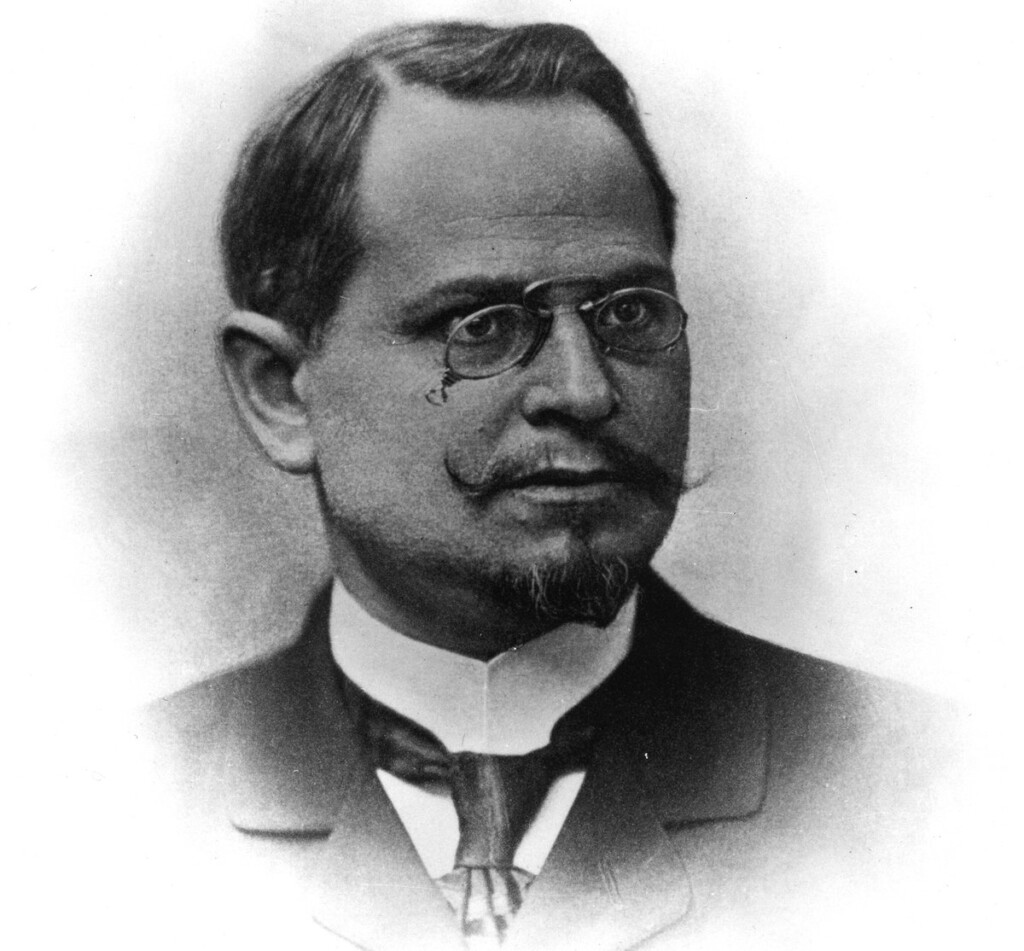
By the time he published Der moderne Denkmalkultus in 1903, he was a man in his mid-forties, recently appointed as a professor at the University of Vienna, already suffering from the illness that would kill him two years later. The text was written at official commission, a practical document intended to reform Austrian conservation law, yet what emerged was something far stranger: a philosophical meditation on why human beings preserve things at all, what they are actually preserving when they preserve them, and whether the act of conservation might itself be a form of self-deception dressed in the language of duty. It arrived, this text, from a man who had spent his professional life among the residues of other civilizations, in an empire that was constructing neoclassical facades over its own structural fractures.
There is a particular quality of perception available only to those who live inside decline without being destroyed by it — who can observe the process clearly because they belong to it entirely. Riegl had that quality. His theory of monuments was not a theory about the past. It was a precise description of the present he was standing in, rendered in the only language serious enough to contain it.

What We Mean When We Call Something Old
You walk past a crumbling wall every morning. It is not beautiful, not particularly old by any grand civilizational measure, not marked by a plaque or celebrated in any guidebook. And yet something in you registers it — a kind of weight, a density of time that the glass facade across the street does not carry. You do not know why you slow down in front of it. You do not need to know. The wall is doing something to you that no one planned for it to do.
This is precisely the distinction that occupied Alois Riegl in the years before his death, and which he articulated with surgical precision in his 1903 treatise Der moderne Denkmalkultus: sein Wesen und seine Entstehung — The Modern Cult of Monuments: Its Character and Its Origin. The work is short, bureaucratic in its occasion (it was written as a legislative introduction for the Austrian Central Commission for the Research and Preservation of Art and Historical Monuments), and radical in its implications. Riegl drew a line through the entire history of preservation thinking, and the line divided monuments into two categories that were not aesthetic but ontological: intentional monuments and unintentional ones.
An intentional monument is something built to be remembered. A triumphal arch, a funerary column, a war memorial — objects whose entire material purpose is to secure a place in collective memory, to outlast the moment and speak to future generations. The intention is inscribed in the stone. The monument knows what it is. The unintentional monument, by contrast, never asked to be preserved. It was a warehouse, a city gate, an aqueduct, a stretch of paving. It was built to function, not to endure as symbol. And yet here it stands, centuries later, reclassified by us as heritage, draped in the language of irreplaceable value.
What Riegl understood, and what makes this distinction so quietly devastating, is that the act of designation is not a recognition of something already there. It is a creation. When a committee, a government, a cultural institution decides that a building or an object has historical value and must be preserved, it is not discovering a pre-existing quality embedded in the matter. It is performing an ideological act — choosing what story to tell, whose past to privilege, which debris of time deserves to be called memory and which deserves to be called rubble.
The philosopher Paul Ricœur, writing in Memory, History, Forgetting in 2000, would later describe this operation in terms of selective commemoration: the archive, he argued, is never innocent, because to archive is always also to exclude. What Riegl had seen in 1903, before the language of ideology was even available in its modern form, was that the same mechanism operated in stone and brick. Every monument we declare unintentionally worthy of preservation is a monument to our present prejudices, our contemporary anxieties about what is disappearing, our need to anchor ourselves against a modernity that moves too fast for comfort.
There is a sequence — a man returns to a village he left decades ago, and everything he expected to find changed has remained, and everything he expected to remain has been demolished. The shock is not nostalgia. It is the exposure of how arbitrary the logic of preservation is, how it responds not to the intrinsic dignity of things but to the political and economic forces that happened to surround them at the moment of decision. What survived did not survive because it was more valuable. It survived because someone with power found it useful that it survive.
Riegl was not cynical about this. He was precise. He believed that understanding the manufactured nature of heritage value was the precondition for managing it honestly — that you could not build a serious theory of conservation on the fiction that value was simply there, waiting to be found.
Age-Value and the Seduction of Ruin
There is a particular kind of person who, when something breaks, cannot throw it away. Not out of sentimentality in the ordinary sense, not because they are afraid of loss or change, but because they recognize something in the broken thing that was not visible before it broke. A crack in a ceramic bowl reveals the grain of the clay. A rusted hinge shows the exact pressure of a thousand openings. The worn patch on a wooden floor marks the place where a body stood every morning, reaching for something.
Alois Riegl understood this recognition as a philosophical problem, not a psychological quirk. In his 1903 treatise Der moderne Denkmalkultus, he named it Alterswert, age-value, and insisted it was not merely an aesthetic preference for the picturesque or the antique. Age-value was something more unsettling: the claim that the visible marks of time, the stains, the fractures, the slow dissolution of surface, were themselves a form of meaning that no restoration could produce and no perfect preservation could protect. Meaning, in this case, was indistinguishable from entropy.
Think of a woman who returns to a house she left decades ago. The house is half-collapsed. The roof has fallen inward over one room, and the room is now open to the sky, filled with a kind of vertical light that rooms never receive when they are intact. She walks through what remains of the kitchen, and she does not think of rebuilding. She thinks: this is what it looked like from the inside. The decay has performed a kind of surgery on the structure, exposing its skeleton, its logic, its bones. To restore it would be to lie. The truth of the place lives precisely in its incompleteness.
Riegl was careful to distinguish age-value from historical value. Historical value is about information, the intact object as a document of a specific moment. Age-value has no interest in intactness. It belongs, he argued, to a different relationship between the human observer and time itself, one that is almost involuntary, pre-rational, rooted in what he called the Naturempfinden, a feeling for nature that modern people experience when they see the cycle of growth and decay reflected in damaged objects. We do not need to be educated to feel it. A child knows the pathos of a broken toy more deeply than a scholar knows the pathos of a fragmented inscription.
Walter Benjamin, writing his vast unfinished Passagenwerk through the 1930s until his death in 1940, arrived at something similar from a completely different direction. His concept of the dialectical image — Dialektisches Bild — proposes that historical truth does not live in continuity but in rupture, in the moment when a fragment from the past collides with the present with such force that both are illuminated. Benjamin did not trust the smooth narrative. He trusted the ruin, the citation, the thing torn from its context and made to speak in its incompleteness. “It is not that what is past casts its light on what is present, or what is present its light on what is past,” he wrote in the Passagenwerk, Convolute N, “rather, image is that wherein what has been comes together in a flash with the now to form a constellation.”
A man sits in the rubble of a relationship. Not metaphorically — literally in a room where someone else’s objects remain because there was no clean ending, no agreement about who takes what. He does not move them. Months pass. He begins, almost without noticing, to arrange his life around the gaps they create. The gaps have become structural. To remove the objects now would not be a restoration. It would be an amputation of the shape that his grief has quietly learned to inhabit.
This is what Riegl saw in the aged monument: not a failure to survive intact, but a record of everything that survival costs.
The Restorer’s Hand as an Act of Violence
There is a moment most people have lived without naming it. You return to something you loved — a room, a face, a place — and it has been repaired. The crack in the wall is filled. The peeling paint is fresh. The thing that was breaking is now whole. And you stand there, not relieved, not grateful, but hollowed out, as if something that belonged to you has been quietly removed while you weren’t watching. The fixing has unmade it. What you loved was not the object in its ideal form. What you loved was the object as it had become — marked, imperfect, saturated with time you had actually lived through.
This is the wound at the center of conservation theory, and it is older than Riegl. It has a name, and the name is Eugène Viollet-le-Duc. The French architect and theorist who spent his career restoring medieval cathedrals and fortifications — Carcassonne, Notre-Dame, Vézelay — gave this wound its most seductive articulation when he wrote, in 1854, that to restore a building is to reestablish it in a complete state that may never have actually existed at any given moment. Read that again. May never have actually existed. He was not hiding anything. He stated openly that restoration was the completion of an imagined ideal, a projection backward into history of something that history itself never produced. The restorer, in this logic, is not a guardian of what was. He is the author of what should have been. He stands over the past with a pencil and corrects it.
Riegl found this position not just theoretically wrong but ethically violent. And the violence is precise: it is the violence of certainty applied to something that has no obligation to be certain. When you smooth away the variations that centuries left on a stone surface — the discolorations, the biological crusts, the small collapses — you are not recovering history. You are replacing it with your own imagination of history, which is something entirely different. The Alterswert, the age-value that Riegl theorized in his 1903 work Der moderne Denkmalkultus, is not a sentimental preference for ruins. It is a philosophical claim: that the passage of time itself constitutes a form of meaning that cannot be reconstructed, only preserved or destroyed. Time does not produce errors. It produces evidence. And the restorer who “corrects” that evidence is not saving the monument — he is committing what might be called a temporal forgery.
Think of a man who inherits his mother’s handwriting in the margins of her books. The letters are irregular, sometimes illegible, pressed too hard or too faint depending on what she was feeling that day. He loves those marks with a love he cannot entirely explain. Then someone offers to have them professionally transcribed, cleaned up, made readable. And he says yes, because clarity seems like a form of respect. What he holds afterward is accurate. It contains the same words. It contains nothing of her. He has, in the name of preservation, performed an erasure so complete it could pass for care. The object still exists. The memory it carried does not.
Viollet-le-Duc would have called this progress. Riegl would have called it loss without remainder. The difference between them is not stylistic — it is ontological. One believes the past is a draft to be edited. The other believes it is a text that has already been written, definitively, by forces that no human hand has the authority to revise. Patina is not decay. Fragmentation is not failure. The break in the marble is the marble’s autobiography, and the restorer who fills it in — however skillfully, however lovingly — is not completing the sentence. He is replacing it with his own.
A vision curated by a filmmaker, not an algorithm
In this video I explain our vision
Newness, Commemoration, and the Politics of What Gets Saved

There is a building that looks brand new. Its stone has been cleaned, its facade restored, its proportions made perfect again — and something about it unsettles you in a way you cannot immediately name. It is too smooth. It has lost the particular heaviness that old things carry, that faint gravity of having survived something. Alois Riegl would have understood the discomfort precisely, because he had already named the tension you are feeling before you were born.
Alongside Alterswert, Riegl identified two other value categories that pull heritage in opposite directions. Newheitswert — newness-value — is the satisfaction we derive from materials that appear intact, uncompromised, finished. It is the pleasure of a surface that has not yet surrendered to time. Erinnerungswert — commemorative value — is something structurally opposed: the worth that accumulates precisely because time has passed, because a thing bears witness to its own duration. The building that has been scrubbed clean has gained newness-value and shed commemorative value simultaneously. The restoration is also a small erasure. This is not a paradox Riegl resolves. He presents it as a constitutive tension in how societies relate to their own past — irresolvable, perpetually requiring negotiation.
But negotiation by whom? This is where the philosophy becomes a politics, and where the politics becomes uncomfortable to examine honestly.
The UNESCO World Heritage List, established in 1972 under the World Heritage Convention, currently recognizes over 1,100 sites across more than 160 countries. The distribution is not neutral. Europe and North America account for a disproportionate share of inscriptions, with Italy alone holding more designated sites than the entire African continent combined for much of the list’s history. The criteria used for inscription — authenticity, integrity, outstanding universal value — were written in a specific cultural language, emerging from specific conservation traditions rooted in the Enlightenment and its colonial extensions. What counts as a monument worth saving, what counts as heritage at all, is a question that carries the fingerprints of whoever was in the room when the definitions were made.
Pierre Nora, writing in his monumental project Les Lieux de Mémoire, published across the 1980s and 1990s, drew a distinction that cuts to the center of this problem. He separated lived memory — the kind that circulates through communities, bodies, rituals, daily practices, the kind that needs no institution to survive — from institutionalized memory, which is what gets constructed precisely when lived memory begins to die. The archive is built when the village elder is no longer there to remember. The monument is erected when the generation that experienced the event has almost entirely passed. Institutionalization is, in Nora’s framework, a symptom of loss rather than a guarantee of continuity.
This means that what gets saved is never simply what is most important. It is what gets saved by the people who control the apparatus of saving. Colonial administrations in the nineteenth and twentieth centuries preserved certain ruins in Egypt, in India, in West Africa — and destroyed or simply ignored others. They decided which past was worth institutionalizing, which commemorative value deserved to be locked in stone. The civilizations they were busy dismantling had their own hierarchies of memory, their own distinctions between what should be tended and what should be allowed to dissolve back into the earth.
Riegl’s Erinnerungswert does not ask us to preserve everything. It asks us to recognize that the impulse to preserve is always also an act of interpretation, always a decision about whose continuity matters. The smoothly restored facade does not lie, exactly. But it tells only one version of the story — the version in which survival looks like perfection, in which the past has been successfully administered into the present, with nothing lost that anyone in power was willing to count as a loss.
The Monument That Was Never Meant for You
There is a particular cruelty in returning to a place you loved as a child and finding it perfect. Not ruined, not changed beyond recognition, but perfect — repainted, repointed, every crack filled, every surface sealed against further time. You walk through it and feel something close to grief, though nothing has been taken from you in any way you could defend in an argument. The walls are intact. The proportions are the same. And yet the thing that made it yours — the damp stain in the corner that looked like a running horse, the place where the plaster had fallen away to reveal an earlier layer beneath, the specific texture of decay that your hands knew — all of that has been erased in the name of preservation. The monument has been saved. You have been quietly evicted from it.
This is the philosophical wound that Riegl opens in Der moderne Denkmalkultus and never quite closes. He identifies, with extraordinary precision, that the modern cult of monuments arises not from an excess of historical consciousness but from its collapse. Communities that carry the past organically in their living practices, in their rituals, in their embodied knowledge of how things were made and why, do not need conservation legislation. They maintain what matters because it is woven into who they are. It is only when that thread breaks — when industrialization, urbanization, and the acceleration of social time sever the living transmission of collective memory — that the monument becomes necessary as an institution. The museum, the conservation charter, the protected heritage zone: these are not signs of cultural health. They are prosthetics fitted to a culture that has lost the use of its own historical limbs.
Svetlana Boym, writing a century after Riegl in The Future of Nostalgia published in 2001, gives this crisis a vocabulary that sharpens the blade. She distinguishes between restorative nostalgia and reflective nostalgia, and the distinction is not merely academic. Restorative nostalgia wants to rebuild the lost home, to fill the gaps, to make the wound disappear. It is, in Boym’s terms, a nostalgia that does not know itself as nostalgia — it believes it is recovering truth rather than constructing a consolation. Reflective nostalgia, by contrast, dwells in the gap, lingers in the ruins, and understands that the longing itself is the meaning, not its satisfaction. The restored facade that erases all evidence of what happened is a monument to restorative nostalgia. It does not remember. It denies that there was ever anything to remember.
A man walks through the rooms of his childhood home, now a heritage property, guided by a woman in period dress who explains the history of the architecture. Every room has been returned to its original state. He listens carefully. He has the sensation of being shown photographs of someone else’s family. The place is historically accurate and personally inaccessible. The past has been cleaned until it belongs to everyone, which is another way of saying it belongs to no one.
Riegl understood this paradox at some level, even if he did not frame it in these terms. His concept of Alterswert — age value — was precisely an argument for keeping the wound visible. The crack, the stain, the weathered surface: these are not defects in the monument. They are its meaning. They are the evidence of time having passed, which is the only evidence that time ever existed at all. To restore is to replace that evidence with an assertion. To conserve, in Riegl’s truest sense, is to resist the temptation to make the past comfortable, to allow the monument to remain what it actually is: a place where something has happened that cannot be undone, and where the inability to undo it is the most honest thing the monument has left to offer.
What Decay Knows That We Have Forgotten
There is a building you pass every day that is slowly disappearing. Not dramatically, not in the way that makes the news, but in the patient, indifferent way that stone absorbs moisture and mortar surrenders to frost. You have stopped seeing it. Or rather, you see it so completely that you no longer notice what it is doing, which is dying, incrementally and without apology, in full public view.
Riegl saw it. That was perhaps his most uncomfortable gift: the capacity to look at decay not as failure but as information, not as something that had happened to an object but as something the object was actively doing, continuing to do, would do until there was nothing left to do it with. His unfinished manuscript, the pages found on his desk after his death in June 1905, circles this problem with the urgency of someone who knows they are running out of time to articulate what they have spent years approaching. He never completed the argument. The manuscript ends where the thought was still forming, which is perhaps the most honest thing a thinker can leave behind.
Freud, writing to Romain Rolland in 1929, used Rome as the central image for understanding how the mind retains everything it has ever experienced, all historical layers coexisting simultaneously beneath the surface of the present. The Palatine hill, the medieval churches built on Imperial foundations, the baroque facades over Renaissance courtyards, none of it truly gone, all of it still present in a kind of impossible superimposition. Freud meant this as a model of psychic life, of how we carry every version of ourselves without resolution. But the image also illuminates Riegl’s problem with uncomfortable precision: if preservation is the attempt to arrest one layer and declare it definitive, it is also a denial that the other layers exist, that the building was something before it was what we have decided to save, that it will be something after.
The will to preserve is also a will to control time. This is not a side effect of conservation practice; it is its hidden engine. When we stabilize a ruin, we are not saving it from time so much as refusing to accept what time has already decided about it. We are imposing permanence on something constitutively mortal, which is to say we are doing to objects exactly what we cannot stop ourselves from doing to people, to relationships, to versions of ourselves we have outgrown but refuse to release. Freud would have recognized the mechanism immediately: it is the structure of melancholia, the refusal to complete the work of mourning, the insistence on keeping the lost thing present because its absence is intolerable.
Riegl intuited this without naming it in Freudian terms, because the vocabulary was not yet available to him, or because he was approaching it from the opposite direction, from objects rather than from grief. His age-value, that aesthetic quality produced precisely by the evidence of time’s passage, was not a consolation for loss. It was an argument that loss was itself a form of meaning, that what erodes is telling you something that the intact surface cannot. The crack in the stone is not the absence of the wall; it is the wall’s autobiography.
What he left unfinished in those final pages was perhaps not an argument so much as a question he could not bring himself to answer directly: whether the most faithful relationship to an object of the past might be the one that allows it to continue becoming what time intends it to become, even if what time intends is its eventual disappearance. Whether there is a form of respect for the past that looks, from the outside, exactly like abandonment, and whether we have ever truly been willing to consider what we lose when we refuse to let anything be lost.
🏛️ Between Memory, Form, and the Weight of Time
Alois Riegl’s thought on conservation invites us to reflect on how cultures preserve, interpret, and transform their artistic heritage across centuries. The articles gathered here explore the historical and aesthetic contexts that shaped the objects Riegl spent his life studying and protecting. Each path leads deeper into the labyrinth of European art history and philosophical inquiry.
Medieval Art: History and Meaning
Medieval Art: History and Meaning offers an essential panorama of the visual culture that Riegl himself analyzed with revolutionary eyes, reconsidering the so-called ‘decline’ of late antique form as a purposeful stylistic evolution. Understanding medieval imagery means grasping the very material that conservation theory was built to protect. This article traces the symbolic and historical forces that gave medieval objects their enduring cultural value.
GO TO THE SELECTION: Medieval Art: History and Meaning
Romanesque Art: History and Characteristics
Romanesque Art: History and Characteristics explores one of the pivotal moments in European artistic development, a period whose monuments became central objects of nineteenth-century heritage debates. Riegl’s concept of Kunstwollen, or artistic will, finds vivid illustration in the robust, spiritually charged forms of Romanesque sculpture and architecture. Engaging with this tradition sheds light on why preservation became an urgent cultural imperative in Riegl’s era.
GO TO THE SELECTION: Romanesque Art: History and Characteristics
Romanesque Architecture: History and Main Examples
Romanesque Architecture: History and Main Examples brings into focus the monumental structures that nineteenth-century restorers and conservationists, including the generation Riegl critically engaged, sought either to preserve or dangerously ‘complete.’ The tension between authentic historical patina and interventionist restoration lies at the heart of Riegl’s theoretical legacy. This article provides the architectural grounding necessary to appreciate why his ideas still resonate in contemporary heritage practice.
GO TO THE SELECTION: Romanesque Architecture: History and Main Examples
Medieval Sculpture: History and Iconography
Medieval Sculpture: History and Iconography delves into the three-dimensional artistic tradition that Riegl analyzed in his landmark studies on late Roman art and its transformations. Sculpture, with its tangible materiality and visible aging, sits at the very center of debates about the ‘age-value’ that Riegl identified as a key criterion for conservation. Exploring this article enriches our understanding of how form, time, and cultural memory intersect.
GO TO THE SELECTION: Medieval Sculpture: History and Iconography
Discover the Cinema That Thinks
If these ideas about time, beauty, and cultural memory have stirred something in you, Indiecinema streaming is the place to follow that thread further. Our catalog gathers independent and auteur films that question how we see, remember, and preserve the world around us. Come explore a cinema that, like Riegl, dares to look at the past with entirely new eyes.
👉 EXPLORE THE CATALOG: Watch Indie Films in Streaming
A vision curated by a filmmaker, not an algorithm
In this video I explain our vision

