
The Mirror You Avoid in the Morning
There is a moment, and you know exactly which one, when you catch yourself wanting something you are not supposed to want. Not in the grand operatic sense of forbidden desire, but in the small, ugly, utterly ordinary register of daily life. Someone speaks and you feel — before the civilized mind can intervene — a flash of contempt so pure it almost tastes like pleasure. A colleague stumbles publicly and something in you, something quick and animal, registers satisfaction before the shame arrives to cover it. You are driving and the thought surfaces, complete and detailed, of simply not stopping. Of walking away from everything. Of saying the true thing, the brutal thing, the thing that would end the conversation and possibly the relationship forever. The thought is there, whole and vivid, for perhaps three seconds. Then you swallow it, rearrange your face, and continue.

What you do next is the interesting part. You do not think: that was me. You think: where did that come from. As if the thought were a transmission from elsewhere, a signal picked up by mistake, something that passed through you without originating in you. The mind performs this sleight of hand so quickly and so smoothly that most people never notice it is happening at all. The self, in that instant, divides — and then immediately pretends it did not.
This is not a pathology. This is Tuesday morning.
Robert Louis Stevenson published his novella in January 1886, and the critical establishment received it largely as a horror story, a Gothic entertainment, a piece of rattling Victorian machinery designed to frighten and titillate. What they missed, or perhaps could not afford to acknowledge, is that Stevenson was not writing about a monster. He was writing about the mechanism. The precise, daily, socially mandated mechanism by which the self is constructed as singular, coherent, and morally legible — when in fact it is none of those things.
The fiction of a unified self is old and remarkably stubborn. William James, writing in his Principles of Psychology in 1890, four years after Stevenson, described the self as a stream rather than a fixed entity, noting that consciousness is never the same from one moment to the next, that identity is closer to a habit of narrative than a fact of nature. But even James, who understood the fluidity of consciousness better than almost anyone in his century, could not quite bring himself to follow the logic all the way to its unsettling conclusion: that what we call the self is a collaborative fiction, maintained through enormous daily effort, and that the material it suppresses does not disappear. It accumulates.
Pierre Janet, the French psychologist whose work on dissociation predates Freud and in many ways exceeds him in precision, spent decades documenting what happens when the effort of maintaining that fiction becomes too costly. His patients did not become evil. They became split. The self did not reveal a hidden monster so much as it revealed the exhaustion required to keep all the monsters administrative, manageable, contained behind professional courtesy and social performance.
Stevenson understood this intuitively, which is why the horror of his story is not Hyde’s violence. It is Hyde’s relief. The transformation is described not as agony but as liberation, as a loosening of something that had been held too tight for too long. This is the detail that should make you uncomfortable, because you recognize it. Not the violence. The relief.
You have felt a version of it. Everyone has. The moment when the mask slips not because something external forces it but because some interior pressure, some accumulated weight of performed coherence, simply becomes momentarily too heavy to sustain. The thought arrives. The impulse surfaces. And for three seconds, before the shame machinery engages, there is something that functions disturbingly like freedom.
Victorian London as a Laboratory of Repression
You know the ritual without having lived in that era, because its ghost still structures the rooms you move through. The dining table cleared before any difficult conversation can begin. The smile maintained in professional corridors while something corrosive circulates beneath. The instinct, trained so deeply it no longer feels like training, to compose your face before opening the door. Victorian London did not invent repression, but it industrialized it — turned the management of inner life into a civic duty, a professional qualification, almost a form of patriotism.
In 1886, when Stevenson published his novella, London housed approximately four and a half million people, making it the largest city on earth. That density created an unprecedented social theater in which being seen — being legible, respectable, correctly interpreted by strangers — became a survival mechanism of the middle and professional classes. Michel Foucault, in Discipline and Punish published in 1975, identified exactly this mechanism: the modern subject internalizes the gaze of the observer until external surveillance becomes unnecessary, because the individual has already colonized their own inner life on behalf of the social order. You do not need a warden if the prisoner has learned to watch themselves.
The professional men who populate Stevenson’s world — lawyers, physicians, scientists — were precisely the class most thoroughly subjected to this internalized discipline. Their respectability was not merely personal preference but economic infrastructure. A solicitor whose private conduct became public scandal did not simply lose friends; he lost his practice, his address, his entire scaffolding of social existence. The stakes of visibility were catastrophic, which meant the stakes of concealment were equally extreme. The energy required to maintain the performance was enormous, and Stevenson was acutely aware of where that energy went — not dispersed, but compressed.
The 1880s also marked a specific intensification of what historians have called the social purity movement, a broad cultural campaign against prostitution, homosexuality, and any sexuality deemed deviantly excessive. The Criminal Law Amendment Act of 1885, passed just one year before Stevenson’s novella appeared, criminalized gross indecency between men — a legislative moment that would eventually destroy Oscar Wilde, nine years later, with the machinery it created. The timing is not incidental. Stevenson was writing inside a culture that was actively drawing new legal boundaries around private conduct, turning interior life into a site of potential prosecution. The body had become, in the most literal sense, a criminal liability.
Psychology as a formal discipline was simultaneously arriving to name what morality had previously only condemned. Richard von Krafft-Ebing’s Psychopathia Sexualis appeared in 1886, the same year as Jekyll and Hyde — a coincidence that feels almost too neat, except that intellectual history rarely produces coincidences of this kind without a shared cultural pressure generating them simultaneously. Krafft-Ebing was cataloguing the very desires that Victorian respectability required its subjects to suppress and deny. The language was clinical rather than theological, but the effect was equally taxonomic: here are the normal, here are the deviant, here is the boundary you must not cross.
What Stevenson understood — and this is where his imagination exceeds mere social commentary — is that the suppression itself was the violence. Not Hyde’s nocturnal rampages, not the criminal conduct, but the original act of division: the decision to wall off an entire dimension of human experience and pretend it belonged to someone else. A man walks through his own city at night and does not recognize himself in what he wants. He has been so thoroughly educated in the performance of his own decency that desire has become alien to him — not merely forbidden, but genuinely foreign, attributed to another creature who wears his flesh when the drawing room lights go down.
The laboratory in the novella is not merely a plot device. It is the only honest room in the house.

What Jekyll Actually Wanted
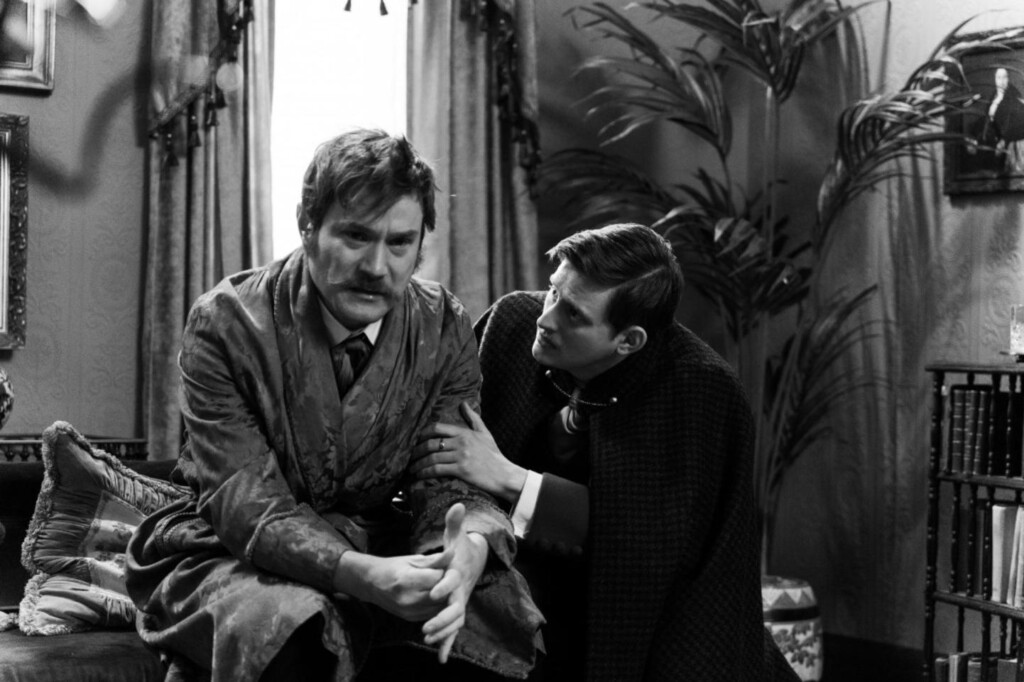
There is a moment — you have probably lived something close to it — when you look at the life you have built and feel, not pride, not gratitude, but a strange suffocating pressure, as though the walls of the perfectly constructed room are an inch closer than yesterday. A man sits at a dinner table surrounded by everything he was supposed to want: the right partner, the right address, the right conversation. He laughs at the right moment. He refills glasses. And somewhere behind his eyes there is something watching all of it with a patience that is beginning to wear thin. He is not unhappy in any way he could explain to a therapist. He is, in the clinical sense, successful. What he is is trapped — not by circumstance but by his own excellence at becoming what the world asked him to become.
This is the scene Stevenson is actually writing. Not a morality tale about a good man who makes a terrible mistake. A psychological document about a man who never wanted to destroy the respectable self — who wanted, with extraordinary precision, to keep it intact while simultaneously escaping it. Jekyll is not corrupted by Hyde. Jekyll designs Hyde. There is a difference that changes everything.
Freud understood this architecture with merciless clarity. In Civilization and Its Discontents, published in 1930, he argued that culture is built on a fundamental and irresolvable theft: the renunciation of instinctual satisfaction in exchange for social belonging and protection. The pleasure principle — the psyche’s original engine, its demand for immediate gratification, for release, for the body’s logic — does not disappear when civilization asks it to stand down. It goes underground. It accumulates. And what accumulates under pressure does not dissolve; it transforms, distorts, waits. The reality principle manages the delay, negotiates the compromise, builds the dinner party, pours the wine. But it manages, it never resolves. Jekyll is not a man with two natures. He is a man in whom the managed delay has become unbearable.
What the novel’s simplified reading consistently gets wrong is the direction of desire. It positions Jekyll as the true self, Hyde as the aberration that invades and destroys. But the text does not support this. Jekyll’s confession — the document that closes the novel and retroactively reframes everything — is not the account of a man horrified by what he unleashed. It is the account of a man who believed he had solved the problem of being human. The solution was not to eliminate the transgressive self but to compartmentalize it perfectly. Hyde was meant to be a vessel: go out, do what cannot be done under your own name, return the body, resume the respectability. The scandal is not that Jekyll wanted to be good. The scandal is that he wanted to be good and bad simultaneously, without consequence, without integration, without the social cost that normally attaches to desire.
This is a fantasy so common it barely registers as pathological. The double life — kept separate, meticulously managed — is not the province of Gothic literature. It is the province of ordinary ambition. The person who performs virtue publicly while privately nurturing what the performance costs them. Not a monster. A strategist. Jekyll’s real transgression is not moral but epistemological: he believed the self could be divided cleanly, that you could run two accounts that never touched. Freud’s diagnosis of civilization is precisely this: the cost is never eliminated, only deferred, and the deferral accumulates interest. Hyde grows larger not because evil is powerful but because suppression is expensive, and eventually the debt comes due in ways the original borrower never anticipated when the terms seemed so reasonable, so clever, so perfectly arranged.
Hyde Is Not the Monster. Hyde Is the Relief.
There is a moment most people never admit to out loud. You have been impeccably behaved for years — patient with the difficult colleague, generous with the ungrateful friend, measured in every room where someone expected you to be measured — and then one afternoon you say something quietly, deliberately cutting. Not in anger. Not in confusion. With full awareness. And for one second, before the guilt assembles itself, there is something that feels disturbingly close to relief. Not shame. Relief. As though a pressure valve had finally been allowed to move.
This is the experience that terrified Stevenson most, because he recognized it as the truth at the center of his own dream. He woke from a nightmare in 1885 with the core scene already formed — the transformation, the powder, the double life — and what he understood upon waking was not that he had dreamed of a monster but that he had dreamed of a solution. Hyde is not the dark side of Jekyll. Hyde is the part of Jekyll that actually breathes.
Every gesture Jekyll performs in polite Edinburgh is a transaction. He gives respectability; he receives status, affection, moral authority. Nietzsche, writing in On the Genealogy of Morality in 1887, just two years after Stevenson’s novella, named this economy with surgical precision. Ressentiment is not mere resentment — it is the particular psychological formation of those who have internalized their own suppression and converted it into a moral system. The weak, Nietzsche argued, do not simply lack power; they redefine the absence of power as virtue. Patience becomes nobility. Restraint becomes superiority. And the person who actually acts, who moves through the world with unchecked force and appetite, becomes the villain of the story precisely because his freedom exposes the fiction of everyone else’s.
Jekyll has spent decades constructing that fiction. He is the fiction. And when Hyde emerges — when someone finally moves through London without performing consideration for a single other person’s comfort — what you are watching is not corruption. You are watching decompression.
A man walks out of a gathering where he has smiled for three hours at people who condescend to him. He is walking home and a smaller irritation — a stranger who steps in front of him without looking, nothing more — and he does not step aside. He holds his line. The stranger stumbles. He does not apologize. He does not even pause. And he feels, briefly, something he cannot name and will spend the next week trying to bury under compensatory kindness. What he felt was agency. The raw, unmediated sensation of existing without managing himself for someone else’s benefit.
This is what Hyde feels all the time. This is why Hyde is described as light. As energized. As moving through the world with something close to joy. The cruelty is real — it is not an illusion, not a metaphor — but it is the cruelty of a body finally allowed to take up space. Nietzsche’s point was not that cruelty is good. His point was that morality, as most people practice it, is cruelty turned inward and given a respectable name.
The structure Stevenson built is more honest than almost any moral framework of his century dared to be. Jekyll is not a good man who falls. He is a man who has been performing goodness so long that he has lost any access to what he actually wants, actually feels, actually is. Hyde is not what Jekyll becomes when he loses control. Hyde is what Jekyll is when the performance finally stops.
What makes this unbearable to look at directly is not that Hyde is alien to you. It is that he is not. The dream Stevenson woke from was not a nightmare about someone else’s nature. It was a nightmare about where the pressure goes when you never let it out.
The Language of Respectability as a Weapon
There is a kind of violence that leaves no bruise. You have probably witnessed it at a dinner table, in a boardroom, in the careful pause before someone changes the subject — the collective agreement among educated people to not pursue a thought to its conclusion. The room knows. Everyone in the room knows. And yet the conversation moves on to the weather, to property prices, to the reliability of a particular vintage. The silence is not accidental. It is engineered, maintained with the precision of a Swiss mechanism, and it requires the participation of everyone present.
This is the true architecture of Stevenson’s novella, and Utterson is its master builder. The lawyer is introduced to us as a man who is “somehow lovable,” who drinks gin “when he was alone, to mortify a taste for vintages,” who tolerates the weaknesses of others with a studied, professional generosity. Stevenson gives us these details as if they were virtues. They are not. They are the credentials of a man whose function in the social order is to ensure that certain doors remain closed, certain questions remain unasked, certain envelopes remain sealed until after death makes the answers irrelevant.
Erving Goffman, writing in Stigma in 1963, described the mechanisms by which social groups manage information about deviation — not to eliminate it, but to contain its visibility. What Goffman called “impression management” is not merely individual performance but collective choreography. The stigmatized person colludes with the normal in maintaining a fiction that serves both parties: the deviant is permitted to function, and the group is spared the discomfort of confrontation. The price is the deviant’s silence about their own nature. The cost is paid entirely by them.
Utterson knows. This is the detail that Stevenson embeds so quietly that a reader rushing toward Hyde’s violence can miss it entirely. The lawyer holds the will. He has read the clause about Jekyll’s disappearance. He watches his friend deteriorate across months, he stands outside doors and listens, he handles a letter whose handwriting he suspects is forged, and at every threshold of genuine inquiry he stops. He consults Lanyon instead of acting. He waits. He defers. Think of a scene lodged somewhere in memory — a group of professional men seated around a table, one of their number visibly unraveling, speaking in barely coherent fragments about something that has consumed him, and the others nodding, pouring more wine, steering the conversation back toward safe harbor. Nobody asks the direct question. The direct question would require them to hear the answer, and the answer would obligate them to respond, and response would cost them something — comfort, reputation, the smooth surface of their social world.
Lanyon’s reaction to what Jekyll reveals to him is diagnostic in exactly this sense. He does not go to the authorities. He does not warn anyone. He retreats into illness and dies, which is perhaps the most bourgeois response imaginable: to be so scandalized by the truth that one simply removes oneself from the situation biologically. His letter, sealed and dated for posthumous reading, is the ultimate Goffmanesque gesture — impression management extended beyond the grave, the performance of respectability maintained even in death.
The professional class in Stevenson’s London is not a moral anchor. It is a pressure system. It does not prevent transgression; it ensures that transgression, when it occurs, remains invisible, contained within the individual, never allowed to become a social fact that the collective must address. Hyde is not the problem they cannot solve. Hyde is the problem they have agreed not to name. And the agreement, struck without a single explicit word, held together by the mutual understanding of men who have been educated in the same institutions and who know, instinctively, which questions polite society does not survive asking.
A vision curated by a filmmaker, not an algorithm
In this video I explain our vision
The Double in World Cinema and the Self That Watches Itself

There is a moment that returns across the history of serious cinema, dressed in different costumes but always the same underneath: a man opens a door, or turns a corner, or looks through a window, and finds someone living his life better than he ever managed to. The apartment is his, the name is his, the woman who loves this other version smiles in a way she never smiled at him. He stands at the threshold and understands, with a nausea that has nothing to do with surprise, that the imposter is not the one inside. He is.
This is not a metaphor. It is a structural condition that Stevenson mapped in 1886 and that human beings keep rediscovering because it describes something that happens before language, before memory, before the self has any name to call itself by. Jacques Lacan, in his 1949 essay on the mirror stage, argued that the ego is not an interior truth that gradually expresses itself outward. It is an image, encountered from outside, that the infant mistakes for its own coherence. The child looks in the mirror and sees a unified form where it actually experiences only fragments, impulses, uncoordinated sensation. That image becomes the self. Or rather, the self becomes that image’s hostage. From that founding moment, identity is always partly alienated, always partly theatrical, always constituted by a gaze that does not originate within us.
What Jekyll builds in his laboratory is, in Lacanian terms, an attempt to dissolve that hostage relationship. He wants to be free of the image. He wants to live below the mirror, in the raw material the mirror was supposed to organize. Hyde is not the unconscious breaking loose. He is what the ego looks like when you strip away the social scaffolding that the mirror stage erected. He is the pre-specular self, which is why he is described as formless, difficult to describe, wrong in a way nobody can quite name. People who encounter him feel disturbed without being able to say why. That is precisely how Lacan describes the real: not as darkness or evil, but as the thing that resists symbolization, that produces unease because it does not fit inside any available image.
A woman sits before a vanity mirror, applying makeup with the slow precision of someone performing surgery. She leans closer and the reflection leans back, but something in the timing is fractionally wrong. She cannot say what. The reflection smiles a half-second before she does, or perhaps she is the one who is late. This is the moment the narrative has been building toward and it is also, beneath the story, the moment Lacan is describing: the point at which the founding illusion becomes visible as illusion, and the self finds itself unable to determine which side of the glass is home.
Stevenson understood this without Lacan’s vocabulary. Hyde is not simply Jekyll’s evil half. He is Jekyll’s prior self, the one that existed before the mirror of Victorian society imposed coherence. And the tragedy is not that Hyde is unleashed. It is that Jekyll discovers he preferred Hyde. That the image he had maintained for decades had cost him something he cannot name and cannot recover. He writes in his confession that he was not alarmed when Hyde began to emerge unbidden. He was, in some way he cannot defend, relieved.
There is a character who reaches the point where he destroys the version of himself that others love. Not because he hates that version, but because he can no longer sustain the performance of being it. He burns the photograph. He tears up the letter. He walks away from the face in the mirror. And the camera, or the prose, holds on the empty frame afterward, because the question it is really asking is not who he is without that image.
The question is whether there was ever anything else.
The Dose That Makes the Poison
There is a moment in the morning routine of millions of people that passes without ceremony: a glass of water, a small pill, a swallow. Sometimes it is an antidepressant. Sometimes a stimulant prescribed for attention. Sometimes a beta-blocker taken before a presentation to silence the body’s inconvenient trembling. The ritual is so normalized that questioning it feels like a kind of ingratitude, or worse, like refusing to function. You take what the system offers to remain inside the system. This is not weakness. This is participation.
Stevenson’s transformative powder was never really about Gothic horror. It was about the bargain. Jekyll does not stumble into his formula by accident — he researches it, refines it, chooses it. He is a man of science who understands pharmacology well enough to know he is engineering a state, not discovering one. The drug is a technology of self-management, and the tragedy is not that it works catastrophically but that it works perfectly, right up until it doesn’t. The dose, as Paracelsus wrote in the sixteenth century, makes the poison. Jekyll’s error is not moral. It is pharmaceutical: he miscalculates dependency.
By 2023, antidepressants were being prescribed to roughly one in eight adults in the United States, a figure that has more than doubled since the 1990s. In the United Kingdom, the number of antidepressant prescriptions issued by the NHS crossed 89 million in a single year. These numbers are not evidence of epidemic weakness. They are evidence of a system that has learned to translate social and economic pressure into biochemical language — and then sell the translation back to the people who suffer from the original problem. Byung-Chul Han, in his 2010 work “The Burnout Society,” names this with uncomfortable precision: the achievement society does not oppress its subjects from outside. It recruits them as their own supervisors. The depressed person, Han argues, is not someone who has failed the system. They are someone who has failed themselves — or at least, that is what the system has taught them to believe.
This is Jekyll’s architecture. He does not experience Hyde as an external imposition. He experiences him as a relief, a vacation from the tyranny of self-curation. A man dissolves into a laboratory in Edinburgh, or London, or wherever you need the city to be, and for a few hours stops performing the accumulated role of his life. The craving is not for evil. It is for rest from coherence. The productivity journals and optimization apps and morning routines and sleep trackers that fill contemporary life with data about the self are not different in kind from Jekyll’s powder. They are different in tempo. The transformation is slow, consensual, granular. You do not gulp it down and change in seconds. You update your habit stack. You calibrate your macros. You adjust your social media persona with the precision of someone who has read enough psychology to weaponize it against their own spontaneity.
Han describes this condition as self-exploitation, the point at which the subject internalizes the logic of the market so completely that they cannot distinguish between desire and obligation, between wanting to improve and being terrified of staying still. Jekyll never wanted Hyde for power. He wanted him for the silence that follows when you are no longer watching yourself. That silence, in the contemporary version, is what is being sold back to you in the form of meditation apps, microdosing protocols, and weekend detox retreats — each of them a controlled dose of the very absence the system produces by demanding your constant presence.
The powder works. That is the detail everyone forgets. Jekyll’s formula succeeds. The horror is not failure. The horror is what success requires you to keep taking, and what happens when the original self can no longer be reliably recovered because, somewhere along the way, you stopped being sure which one was the original.
When the Potion Runs Out

There is a moment — and you may have witnessed it, or lived it — when a person who has spent forty years being impeccable simply stops. Not in disgrace, not caught in any scandal, not exposed by anyone. They are sitting at a dinner table surrounded by people who admire them, and something behind the eyes goes quiet, and they say something they were never supposed to say, and everyone laughs nervously because no one knows how to receive it. The mask has not been torn off. It has simply become too heavy to hold, and the face beneath it turns out to be a stranger even to them.
This is what Stevenson understood that most readers still refuse to follow him into. The real horror in Jekyll’s story is not the transformation itself. It is the morning he wakes up as Hyde without having taken anything. The drug is no longer the mechanism of release. It has become the mechanism of suppression, and now even that has failed. Hyde arrives uninvited, like a creditor who has waited long enough.
Carl Jung spent decades mapping this territory. In his formulation, the Shadow is not evil in any simple sense — it is the sum of everything the conscious personality has refused to acknowledge, the parts deemed unacceptable by family, culture, or professional identity. In “Aion,” published in 1951, Jung was explicit: the Shadow does not disappear when ignored. It consolidates. It grows autonomous. It begins to act independently of conscious intention, and the more rigidly the persona has been constructed, the more violent the eventual irruption. What Stevenson dramatized in 1886 without the vocabulary of analytical psychology is precisely this dynamic: Jekyll’s legendary respectability was not just a social mask but an act of psychic amputation, and amputated things do not die.
The philosopher and Jungian analyst James Hollis, writing in “Swamplands of the Soul,” makes an observation that cuts to the bone: most of what we call virtue is not virtue at all, but suppression that has become habitual enough to feel like character. Jekyll would have recognized this. He had suppressed himself into a monument, and monuments, as any geologist knows, eventually crack.
What Stevenson shows in the final phase of Jekyll’s story is the mathematics of this process played out to its terminal digit. For years Jekyll could choose. He drank the potion, became Hyde, satisfied what needed satisfying, and returned. The system appeared sustainable precisely because it was covert. But the Shadow, denied legitimate existence, metabolizes the energy of suppression and uses it as fuel. By the time Jekyll is writing his full confession, Hyde no longer needs an invitation. The chemistry of his body has reorganized itself around the denied identity. The persona that took a lifetime to build dissolves not from the outside but from the substrate up.
Think of what that costs. Not the scandal, not the exposure, but the simple arithmetic of maintenance. Every year of coherence requires more energy than the year before. Every conversation in which you perform your acceptable self is a small withdrawal from an account that does not refill. The man who has been reliable, measured, admired for decades is not free — he is leveraged, and the debt is drawn against whatever lives below the name on the brass plate.
Stevenson knew, writing in the gaslit Edinburgh of his own respiratory illness and social performance, that the bottle on Jekyll’s shelf was not a fantasy of liberation. It was a portrait of the bargain civilization asks every one of us to sign — the agreement to be coherent, legible, safe, all the way to the end — and the thing that waits, patient and certain, for the moment we can no longer afford the payments.
🪞 The Double, the Shadow, and the Hidden Self
Stevenson’s Strange Case of Dr Jekyll and Mr Hyde is one of literature’s most haunting explorations of duality, repression, and the darkness concealed beneath a respectable facade. The themes it raises — transformation, identity, the unconscious — echo across philosophy, psychology, and literature in ways that continue to fascinate thinkers and readers alike.
Jungian Individuation and the Great Work
Jung’s concept of individuation offers one of the most illuminating frameworks for understanding Jekyll and Hyde: the shadow self, when denied and repressed, grows monstrous and uncontrollable. The alchemical Great Work becomes a metaphor for the painful process of integrating one’s darker impulses rather than suppressing them. Stevenson’s novella can be read as a cautionary tale about what happens when that inner alchemy fails.
GO TO THE SELECTION: Jungian Individuation and the Great Work
Spiritual Alchemy: Inner Transformation and Symbolism
Spiritual alchemy explores the idea that transformation is not merely a physical or chemical process but an inner journey of purification and self-knowledge. The descent into the nigredo — the blackening, the confrontation with one’s own shadow — resonates powerfully with Hyde’s emergence from Jekyll’s controlled, socially acceptable persona. Understanding this symbolic language deepens the reading of Stevenson’s text as a spiritual and psychological allegory.
GO TO THE SELECTION: Spiritual Alchemy: Inner Transformation and Symbolism
Jacques Lacan and the Mirror Stage
Lacan’s mirror stage explores how identity is constructed through reflection and the gaze of the other, revealing that the unified self is always a kind of fiction. Jekyll’s obsessive self-observation and his horror at recognising Hyde in the mirror dramatise precisely this fragility of selfhood. Lacan’s theory helps us understand why the double is such a recurring and terrifying figure in Victorian literature.
GO TO THE SELECTION: Jacques Lacan and the Mirror Stage
Magnus Opus: nigredo albedo rubedo
The alchemical stages of nigredo, albedo, and rubedo describe the soul’s passage through darkness, purification, and ultimate transformation — a process Jekyll catastrophically fails to complete. Hyde represents the unintegrated nigredo, the raw shadow matter that was never transmuted but instead unleashed. Reading the Magnus Opus alongside Stevenson reveals how deeply his novella draws on esoteric traditions of inner transformation.
GO TO THE SELECTION: Magnus Opus: nigredo albedo rubedo
Explore the Depths of Cinema on Indiecinema
If the themes of duality, hidden identity, and inner transformation in Jekyll and Hyde have stirred something in you, Indiecinema’s streaming platform offers a curated selection of independent films that dare to explore the darkest and most complex corridors of the human soul. Discover stories that mainstream cinema rarely tells, told by visionaries who understand that true transformation begins in the shadows.
👉 EXPLORE THE CATALOG: Watch Indie Films in Streaming
A vision curated by a filmmaker, not an algorithm
In this video I explain our vision

