
The Smell of Cut Grass and the Weight of Your Schedule
You are halfway down a forest path when it happens. Not a thought, not a decision — just a sudden arrest of the whole mechanism, the chest opening slightly, the shoulders dropping an inch without being asked. The trees here are old enough that the light comes through in pieces. The ground smells of something that has been decomposing for a thousand years and in decomposing has become the richest thing you have ever walked on. You do not know the names of most of what surrounds you. You do not need to. Your nervous system is doing something your calendar cannot schedule, your productivity app cannot measure, your employer cannot invoice. For approximately eleven seconds, you are simply a mammal in a forest, and it is enough.

Then the phone buzzes.
Not a disaster, not an emergency — a notification, a small digital tap on the shoulder reminding you that somewhere else needs you more than here does. You look at the screen. The forest does not disappear, but something in your attention does. The shoulders return to their habitual elevation. The chest re-closes its small parenthesis of peace. You keep walking, but now you are walking through the forest rather than in it, which is an entirely different kind of movement, one that produces data about exercise rather than anything the body might call nourishment.
What happened in that fracture is not small. It is, in fact, one of the oldest arguments in Western philosophy wearing the disguise of an inconvenient Tuesday afternoon.
Jean-Jacques Rousseau understood something in 1755 that we have spent nearly three centuries trying to disprove and failing. In his Discourse on the Origin of Inequality, he proposed something so structurally offensive to the project of civilization that it has never entirely been forgiven: that the progress of society and the suffering of the human being are not opposite forces pulling against each other, but the same force moving in one direction. That what we call advancement — property, hierarchy, comparison, ambition — does not add itself onto a pre-existing human happiness, but rather systematically dismantles the conditions under which that happiness was possible in the first place. The forest path and the buzzing phone are not a contrast between nature and technology. They are an illustration of a cost that gets paid invisibly, continuously, in the currency of the body’s most basic knowing.
The caricature of Rousseau‘s argument — and every important idea eventually becomes its own caricature — is the Noble Savage: the idea that primitive humans were serene, uncomplicated beings living in frictionless harmony with the world, and that we should all put down our laptops and return to foraging. This is not what Rousseau said. It bears repeating because the misreading has become so total that even people who consider themselves educated about his work often argue against the caricature rather than the actual position. Rousseau was not a primitivist. He did not believe return was possible or even desirable. What he believed — and what the Discourse argues with systematic, almost merciless precision — is that the social contract as actually practiced, as opposed to the idealized version, produces a human being estranged from themselves in ways they cannot see and therefore cannot contest.
The smell of cut grass after rain. The specific quality of silence in a room when everyone has finally left. The way the body relaxes in water without being asked to. These are not nostalgia. They are data. The organism reporting on conditions under which it was, for a long evolutionary stretch, designed to function — and registering, in the gap between those conditions and the present ones, something that has no name in the language of economic productivity but that the chest knows immediately and exactly.
The weight on your schedule is not incidental to this recognition. It is the argument.
Slow Life
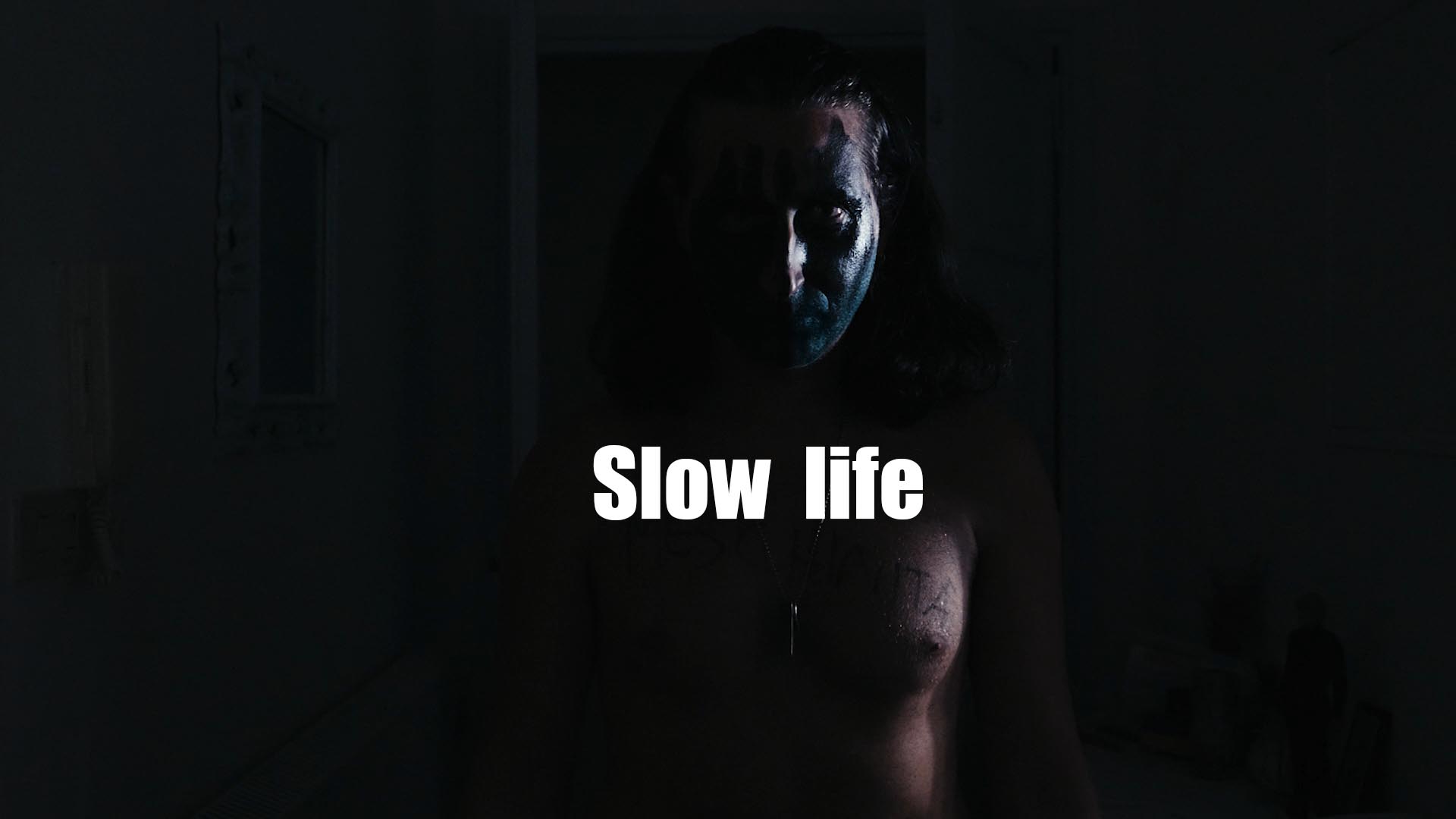
Drama, comedy, thriller, by Fabio Del Greco, Italy, 2021.
Lino Stella takes a period of vacation from his alienating job to devote himself to relaxation and his passion: drawing comics. But he did not foresee certain disturbing elements: the intrusive administrator of the building where he lives, the postman who delivers crazy fines and tax bills, an overbearing security guard, a very enterprising real estate agent, the old lady downstairs who raises the feline colony of the condominium. These characters will make his vacation hell.
Food for thought
The larger a social group is, the more rules and bureaucracy are needed, which often do not respect the individual. You have to learn to live with annoying people, but sometimes the social pressure and arrogance can become intolerable. The only laws that always come to our aid are the laws of Nature.
LANGUAGE: Italian
SUBTITLES: English, Spanish, French, German, Portuguese
What Rousseau Actually Said, and Why Everyone Gets It Wrong
Pick up any introductory philosophy textbook published in the last century and you will almost certainly find Rousseau described as the man who believed primitive humans were noble savages living in harmony with nature, uncorrupted and pure. The description feels complete. It feels like it explains something. It also happens to be wrong in nearly every particular.
The phrase “noble savage” does not appear in Rousseau’s writing. Not once. The expression has a longer, more complicated genealogy — it surfaces in John Dryden‘s 1672 heroic play, travels through colonial literature, and eventually adheres to Rousseau’s name like a barnacle, until the misattribution becomes so repeated it acquires the texture of fact. What this tells us is not simply that intellectual history contains errors. It tells us that the distortion was useful to someone, and that its persistence serves a function that accuracy would not.
What Rousseau actually argues in the Discourse on the Origin of Inequality, published in 1755, is considerably stranger and more demanding than the myth allows. His natural man is not noble. He is not particularly admirable. He is not striding through ancient forests with a dignified bearing and a moral compass pointing toward truth. He is, in Rousseau’s own description, closer to an animal than to a citizen — solitary, unreflective, driven by two fundamental impulses: self-preservation and a natural aversion to witnessing suffering in others, which Rousseau calls pitié. That second impulse is crucial, because it does not require reason, does not require language, and does not require society. It precedes all of those things. It is pre-moral in the technical sense — it operates before any framework of obligation exists.
The natural man is not noble because he is savage. He is, in a very precise sense, innocent because he is not yet social. He has not yet developed the capacity to compare himself with others, which means he has not yet developed vanity, envy, or the craving for distinction that Rousseau calls amour-propre. This distinction — between amour de soi, the healthy love of one’s own existence, and amour-propre, the corrosive need to be seen as superior — is the conceptual heart of Rousseau’s entire argument, and it is precisely what the “noble savage” reduction erases. The myth collapses the difference between a being who is pre-social and one who is somehow anti-social but virtuous, and in doing so it transforms Rousseau’s structural critique of civilization into a sentimental preference for wilderness.
The philosophical work that distortion performs is not innocent. By caricaturing Rousseau as a romantic primitivist, it becomes possible to dismiss the Discourse without engaging with what it actually demonstrates: that inequality is not natural, that it has a history, and that this history is inseparable from the development of property, language, and the institutions that consolidate the advantages of those who arrived first. His argument is closer to a genealogy of domination than to a hymn to the forest. Friedrich Nietzsche would later use the genealogical method to opposite ends, but the structural move — asking not what something is, but how it came to be — is already fully present in Rousseau in 1755, more than a century before the Genealogy of Morality appeared.
The misreading also conveniently makes Rousseau easy to mock. If he believed humans were once noble savages, then the rejoinder writes itself: go live in a cave, abandon your medicine, renounce your books. The caricature neutralizes the argument before the argument can be heard. And so the question that should unsettle anyone who benefits from existing arrangements — why does inequality feel natural when it is in fact constructed, recent, and contingent? — gets buried under a cartoon image of a philosopher who never existed, defending a position he never held.

Amour de Soi and the Invention of the Mirror
There is a man at the far end of the table who laughs before the joke is finished. You have seen him. Everyone has seen him. He leans back slightly, takes up more space than the chair requires, and his voice arrives just half a beat too early, calibrated not to express amusement but to demonstrate it. He is not happy. He is performing the evidence of happiness for an audience that is also performing, which means no one at the table is quite present, and the wine gets refilled with a kind of mechanical gratitude that has nothing to do with thirst.
Rousseau would have recognized this man immediately, and not with contempt. With something closer to grief.
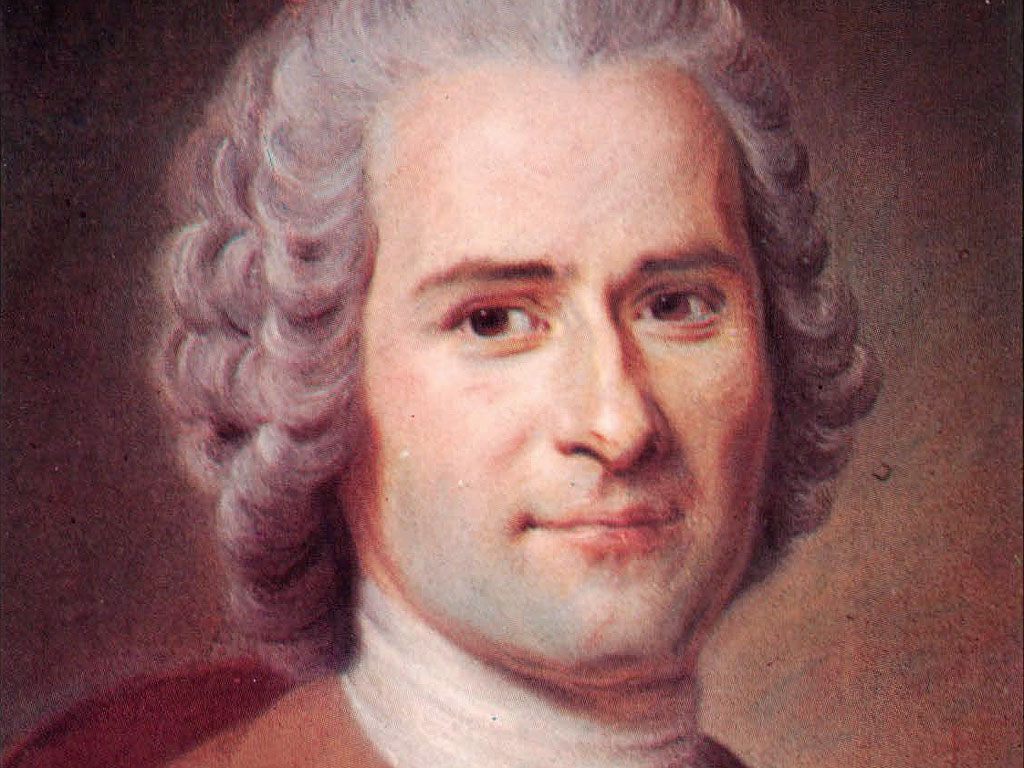
In the second part of the Discourse on the Origin and Foundations of Inequality Among Men, published in 1755, Rousseau draws a distinction that is deceptively simple and almost impossibly difficult to undo once you have genuinely understood it. Amour de soi — love of self in its original, pre-social form — is the quiet biological hum of self-preservation. It is the reflex that pulls your hand from fire, the hunger that moves you toward food, the tiredness that sends you to rest. It asks nothing from anyone else. It has no audience. It is, in Rousseau’s formulation, the most natural of all human drives, the one we share with every animal that has ever breathed, and it is fundamentally good precisely because it is indifferent to comparison. You do not need another person to be cold in order to feel warm.
Amour-propre is something else entirely, and its birth is one of the most consequential events in Rousseau’s entire philosophical architecture. It is not merely vanity, though vanity is one of its symptoms. It is the structural transformation of the self into an object that requires external validation to feel real. It emerges, Rousseau argues, the moment human beings begin to live in each other’s eyes — the moment when being observed becomes a condition of being. Once that shift occurs, the self is no longer the origin of its own experience. It becomes a reflection, dependent on the mirror that other people hold up, and therefore perpetually unstable, perpetually hungry, perpetually performing.
The man laughing too early is not insecure in some shallow, correctable way. He is a creature of a particular historical formation. He has been shaped by precisely the social world Rousseau diagnosed — a world in which worth is not felt from the inside but confirmed from the outside, in which every gesture has become legible to an imagined audience, even gestures performed in private. Erving Goffman, two centuries after Rousseau, would call this the presentation of self in everyday life, the constant dramaturgical labor of managing impressions. But Goffman described the mechanism with sociological neutrality. Rousseau named it a wound.
What makes this distinction genuinely destabilizing is not that amour-propre leads to bad behavior. It is that it colonizes even the desire to be good. The man who ostentatiously donates, the woman who speaks loudly of her exhaustion from helping others, the person who posts the photograph of the meal they cooked for someone sick — none of them are necessarily lying about the generosity. They are, rather, living in a condition where the gesture and its witness have become inseparable. Pure amour de soi would allow you to cook the meal, leave it at the door, and feel nothing further. No record. No echo. No confirmation. For most people alive today, that silence would feel like deprivation.
The mirror, once invented, cannot be uninvented. And Rousseau never pretended it could. What he insisted on was something more uncomfortable: that we have built entire civilizations on the compulsion to look into it, and called that civilization progress.
The Campfire That Started Everything
There is a fire somewhere in the distant past — not metaphorical, not symbolic, but an actual fire around which actual bodies gathered because the cold was real and the dark was real and the warmth was something you moved toward without needing to reason about it. Rousseau places this moment at the center of his Second Discourse, published in 1755, and what he sees happening around that fire is not the birth of civilization but something more intimate and more catastrophic: the birth of comparison.
Before the fire, in Rousseau’s account, human beings moved through the world in a kind of sovereign solitude. They were not brutes. They were not stupid or brutish or savage in the degraded sense the word had already accumulated by the eighteenth century. They were simply sufficient — physically capable, emotionally unencumbered, indifferent to what anyone else thought of them because there was no stable anyone else to think anything. The encounter with another human was brief, functional, occasionally erotic, and then dissolved back into solitude. There was no memory of it that organized the self around it. There was no reputation to protect.
The fire changed the geometry. Bodies stayed near each other long enough to be seen repeatedly. A man noticed that he was stronger than another man. A woman noticed she was more admired than another woman. The comparison, once made, could not be unmade. It attached itself to the self like a second skin, and suddenly the self had an outside — a surface exposed to evaluation, to judgment, to rank. Rousseau calls this the beginning of amour-propre, that corrosive self-regard that is not love of oneself but love of one’s image in the eyes of others, and he distinguishes it sharply from amour de soi, the clean and uncontaminated instinct for self-preservation that preceded it. The distinction is precise and devastating: one is a biological drive, the other is a social wound that learns to call itself a value.
Around the same fire, people began to sing. They built shelters that turned into habits that turned into attachments that turned into the couple, the family, the small community. Language thickened from gesture into grammar. And with language came something that Rousseau understood as a trap disguised as an achievement: the ability to make abstract claims about the world, including abstract claims about ownership. The leap from here is where I sleep to this is mine is not a small one. It required a particular kind of linguistic confidence, a particular kind of collective amnesia about what had existed before the statement was made, and a particular kind of social enforcement to make the statement stick. Rousseau names the moment without softening it: the first man who, having enclosed a piece of ground, bethought himself of saying This is mine, and found people simple enough to believe him, was the true founder of civil society.
What follows in the Second Discourse is not triumphalism but an autopsy. Rousseau traces how property required law, how law required the state, how the state required the fiction that all parties entered it equally — when in fact the rich invented the state precisely to protect the inequality they had already secured. The social contract, in its historical form, was not a mutual agreement. It was a confidence trick pulled by those who already had something to protect, sold to those who had nothing to lose and everything to lose simultaneously.
This is not a philosophical abstraction. It is a description of a structure that anyone who has ever signed a lease they could not afford, or watched a border drawn through a map they did not make, has felt in the body before they found the words for it. Rousseau did not invent the grievance. He gave it a genealogy, which is something considerably more unsettling.
The Anthropologists Who Came After
There is a photograph taken in the Kalahari sometime in the early 1960s. A man is sitting in the shade of a thornbush, doing nothing in particular. Not sleeping, not working, not performing any recognizable modern task. Just sitting. The researcher who took the photograph later calculated that the people in that community spent, on average, between fifteen and twenty hours per week acquiring food. The rest was conversation, ceremony, rest, and the particular quality of attention that has no name in any European language but which every European has lost.
Marshall Sahlins presented these findings to a conference in 1966 and the room did not know what to do with them. His argument, published under the deliberately provocative title “The Original Affluent Society,” was not that hunter-gatherers were happy in some soft, pastoral sense. The claim was structural and economic: that poverty is not a condition of having little but of wanting more than you have, and that societies organized around limited desires achieve a form of material sufficiency that industrial capitalism, despite its extraordinary productive power, has never managed to deliver to the majority of its participants. The average French worker in 1966, when Sahlins was writing, spent more hours in labor per year than a member of the !Kung San spent in a lifetime of equivalent effort. That is not a romantic observation. That is an accounting problem.
What makes this uncomfortable is not that it flatters indigenous peoples. It is that it indicts us. The data does not say that pre-state life was gentle or free of suffering. It says that the particular form of chronic, low-grade, inescapable exhaustion that most people in wealthy societies accept as natural — as simply what life is — is not natural at all. It is a specific historical production, assembled across several centuries, and the evidence of its contingency was sitting in the Kalahari shade all along.
Claude Lévi-Strauss, who spent decades studying the structural logic of so-called primitive thought, called Rousseau the founder of the human sciences — not because Rousseau was right about facts, but because he was the first to insist that the distance between self and other, between civilization and its outside, was itself an object of inquiry rather than a fixed coordinate. In “Tristes Tropiques,” published in 1955, Lévi-Strauss described his own disorientation in the Brazilian interior with an almost physical honesty: the discovery that the people he came to study were not simpler than him but differently organized, following grammars of kinship, myth, and exchange that were as intricate as anything in Paris, only arranged along different axes. Rousseau had not predicted this. But he had created the intellectual condition under which it could be seen.
The harder challenge came from a different direction. Lawrence Keeley’s 1996 work “War Before Civilization” assembled archaeological and ethnographic evidence that pre-state societies were not spared from organized violence. The death rates from conflict in many such communities, when calculated as a proportion of population, exceeded those of the twentieth century’s most catastrophic wars. Hierarchy appeared wherever researchers looked carefully enough. Gender asymmetries, ritual domination, the controlled distribution of food and prestige — these were not European imports. They were structural features of human social life at every scale of organization.
And here is where Rousseau’s error and his insight collapse into each other in a way that neither his admirers nor his critics have fully absorbed. He was wrong about the content of natural life. He was right about the mechanism of comparison. The point was never that somewhere, at some time, people lived without domination. The point was that domination takes historical forms, that those forms are contingent, and that the capacity to see them as contingent — rather than as expressions of permanent human nature — is itself a kind of freedom, fragile and easily extinguished.
A vision curated by a filmmaker, not an algorithm
In this video I explain our vision
Nature as Argument, Not as Place

The brochure on the kitchen counter promises “a return to natural living” for four hundred dollars a month. Organic supplements, cold exposure protocols, ancestral diets. The word “natural” does the entire work, carrying its freight of legitimacy without ever being asked to prove anything. What is natural is good. What is good is what we have lost. What we have lost can be recovered — for a subscription fee.
Rousseau would have found this grotesque, and not only because of the commerce. He would have found it philosophically illiterate. The state of nature he described in the Second Discourse was never a place you could visit, a period you could carbon-date, a way of life you could reconstruct with the right supplements and a barefoot running coach. He said so explicitly. The opening of that text announces that the inquiry does not concern historical truths but hypothetical and conditional reasonings. He was not doing archaeology. He was doing geometry — starting from a simplified model not because the model is real, but because reality is too cluttered to think clearly about. Strip away language, property, vanity, comparison, accumulated habit, and what remains? The question was always structural, never nostalgic.
This distinction matters enormously, and it has been almost universally ignored. Ernst Cassirer, writing in 1932 in his study of the philosophy of the Enlightenment, was one of the few to insist on it with real precision: Rousseau’s state of nature is a regulative idea in the Kantian sense, a standard of critique rather than a recoverable origin. It tells you what to measure against, not where to go back to. The moment you treat it as a destination, you have already betrayed the entire project.
But betrayal is precisely what happened, and it happened fast and with tremendous aesthetic force. The Romantics needed a nature that was visible, paintable, emotionally overwhelming — mountain passes, peasant virtue, the nobility of the unlettered shepherd. They took Rousseau’s methodological fiction and turned it into a landscape. The poverty of rural life became picturesque. The suffering of people without property or education became evidence of their authenticity. Wordsworth walking through the Lake District was moved by the simplicity of those who had no choice but to be simple. The philosophical instrument became a pastoral fantasy, and the fantasy served functions that were entirely convenient for those who could afford to admire what they did not have to endure.
The nationalist move came later and was more violent. If nature is a place, then a people can be native to it. Blood and soil become versions of the same argument, the organic rooted against the artificial cosmopolitan. What Rousseau had described as a universal human baseline — something shared by all humans prior to their contingent social formations — was compressed into a particular ethnic body, a specific territory, a racial inheritance. The universalism was annihilated and replaced by its precise opposite. This is not a marginal distortion. It is what happened, repeatedly, across the nineteenth and twentieth centuries, in political movements that explicitly invoked nature as their warrant.
The concept bears the marks of these uses without being reducible to them. An idea is not responsible for every violence committed in its name, but it is not innocent either. When a conceptual tool is repeatedly misused in the same direction, the question of whether it contains some internal affordance for that misuse is not paranoia — it is intellectual honesty. Rousseau’s nature offered a zero degree of humanity, a human stripped of all social determination. That image can be used critically, to expose how much of what we call essential is actually constructed. Or it can be used to project a specific, historically contingent content onto the blank — and then call it eternal.
The tool does not choose. The hand that picks it up does. But some tools are shaped in ways that make certain grips more natural than others.
The Child in the Garden and the Citizen in the Contract
A child is sitting with a toy she has been playing with for an hour. Another child reaches for it. An adult leans down and says, with practiced gentleness, that she must share. She does not want to share. The toy is hers. Her face goes through something remarkable in that moment — not anger exactly, but the first recognition that the world has a claim on her that precedes her consent. She had not agreed to this. She was not consulted. And yet here is the rule, spoken softly, enforced absolutely.
This is the hinge of Rousseau’s entire project, and he knew it. The Social Contract opens with one of the most famous sentences in political philosophy — that man is born free and is everywhere in chains — but what the sentence conceals is that Rousseau wrote both halves of that paradox intentionally. He was not simply lamenting the chains. He was asking whether a different kind of chain, one forged collectively, might constitute freedom rather than negate it. The answer he arrived at in 1762 was the concept of the general will, la volonté générale, which is not the sum of what individuals want but the expression of what they would want if they were thinking as citizens rather than as private appetites. It is a distinction that sounds clean in theory and becomes vertiginous the moment you try to apply it.
The child at the table is not being asked to express her private will. She is being inducted, however gently, into the logic of collective life — that your claim on a thing is never absolute, that others exist with equal claims, that society mediates between them. Rousseau would have recognized this scene. In Emile, published the same year as the Social Contract, he spent four books trying to construct a pedagogy that would produce a citizen capable of genuine participation without the corruption of dependence. He wanted a person who had internalized freedom, not one who had simply been disciplined into compliance. The problem is that the line between those two outcomes is not always visible from the outside, and sometimes not from the inside either.
What later thinkers took from Rousseau’s general will was not always the liberatory impulse. Jacob Talmon, in his 1952 work The Origins of Totalitarian Democracy, traced a direct genealogy from Rousseau’s concept to the Terror of 1793 and beyond, arguing that when you posit a collective will that transcends individual consent, you create the theoretical structure for overriding any individual who refuses to align with it. The general will becomes what everyone would want if they were rational and virtuous — and the distance from that formulation to forcing people to be free, Rousseau’s own alarming phrase, is shorter than it appears. Talmon was not wrong about the genealogy. He may have been too quick to condemn the root.
Because the alternative is not innocence. The child who keeps the toy does not return to nature. She simply learns a different lesson — that the world accommodates her, that her wants are sufficient justification, that the claims of others are optional. This is not freedom. It is a different kind of deformation. Rousseau saw this with clarity that his critics often miss: the problem was never society per se but unexamined society, society that reproduces itself through habit, deference, and the performance of virtue without its substance.
The Social Contract was not a cage disguised as liberation. It was an attempt to describe the conditions under which collective life might generate something genuinely shared rather than merely imposed. Whether those conditions can ever be fully met is a question Rousseau left open, perhaps because he suspected the answer, perhaps because the child eventually puts down the toy and moves on, and what she carries forward is not the rule but the moment she first felt the world looking back at her with its own requirements.
What You Miss When You Watch the Sunset
There is a moment, usually in the late afternoon, when everything you have been avoiding catches up with you. The light does something particular to the edge of a roofline, or to the surface of water, and for a few seconds you are neither here nor there — not in the city, not in the past, not in any specific grief, but hovering in a quality of longing so precise and so sourceless that it almost feels like information. You do not know what you want. You know only that you want it badly.
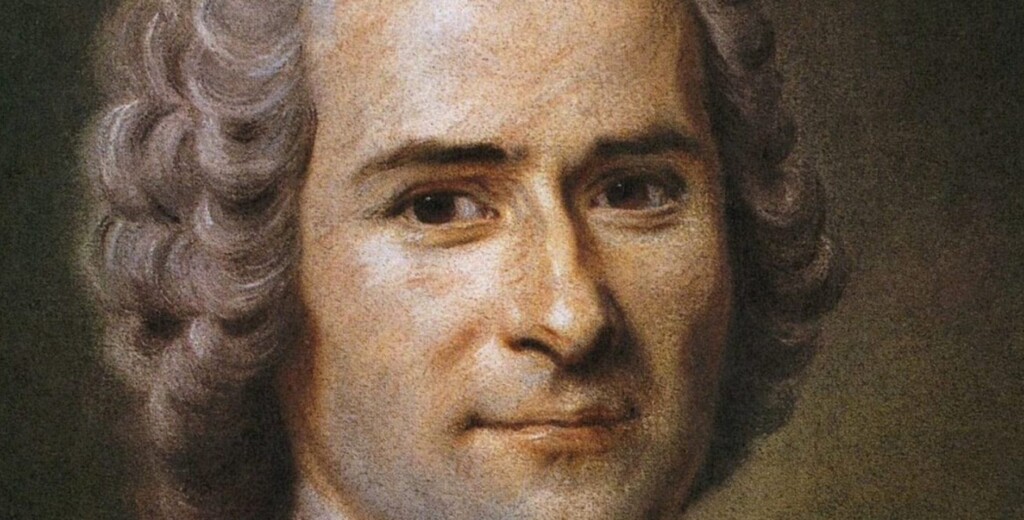
Rousseau knew this feeling. He did not name it nostalgia, because nostalgia implies a place you have been. He named it something harder to dismiss: the residue of a condition subtracted from you before you arrived. In the second Discourse, published in 1755, he was careful to say that natural man was not a historical figure you could locate in an archive or excavate from a riverbed. He was a structural hypothesis, a way of asking what remains when everything social is removed. And what remained, for Rousseau, was not barbarism but a kind of ease — an unselfconsciousness so complete it did not know itself as ease at all, the way a body in good health does not think about breathing.
The trouble is that the removal cannot be undone. This is where Rousseau parts ways with every romanticized version of his thought, every wellness retreat that puts his name, implicitly, on its brochure. He did not believe in return. He believed in diagnosis. The ache you feel at the edge of a roofline is not pointing you toward something retrievable. It is pointing you toward something structural, something built into the architecture of how you became a self.
Émile Durkheim, working a century and a half later, gave one name to the mechanism: anomie, the condition of wanting more than any social structure can satisfy because the social structure itself has trained you to want without limit. But Durkheim was describing a social pathology, a dysfunction to be corrected. Rousseau was describing something worse: a design feature. The longing is not a malfunction. It is what the system produces in order to keep running.
A man sits at a window in a high apartment and watches the last light leave a city he has lived in for twenty years. He is successful by every measure he was taught to apply. He is also, quietly and without explanation, bereft. He does not know what he has lost because he has never had it. That is the precise shape of Rousseau’s problem, and no subsequent thinker — not Marx, who translated it into economic alienation; not Freud, who relocated it inside the psyche; not even Thoreau, who tried to live his way out of it beside a pond in Massachusetts for two years and two months and then came back — has fully dissolved the original formulation.
What you miss when you watch the sunset is not nature in the ecological sense, not birdsong or clean air, though you may tell yourself it is. What you miss is a mode of existing that did not require you to perform yourself for others, to measure your worth through comparison, to want things because wanting them signals something about who you are. Rousseau called amour-propre the engine of all this distortion, the self-love that cannot look at itself without first looking at how it appears to someone else, and once you see it operating, you see it everywhere — in the way you frame the photograph of the sunset before you have finished watching it, in the way the longing itself becomes something to display.
The light moves off the water. The moment closes. What was taken was not a place, not a time, not an innocent world that existed once and could exist again. What was taken was the capacity not to know it was taken, and that particular loss is the one you keep returning to the window for, without ever being able to name it precisely enough to mourn it properly.
🌿 Nature, Freedom and the Roots of the Human
Rousseau’s vision of the Noble Savage stands at the crossroads of philosophy, ecology, and political thought. These related articles explore the broader conversation about nature, civilization, and the authentic human condition that Rousseau’s ideas helped ignite.
Philosophy of Nature: From Aristotle to Today
From Aristotle’s teleological cosmos to contemporary ecological philosophy, the history of thinking about nature reveals how deeply our sense of self is tied to the world around us. This article traces the major turning points in philosophical reflection on the natural order, providing essential context for understanding Rousseau’s radical departure from Enlightenment rationalism. Reading it alongside Rousseau illuminates why the question of nature versus civilization remains so urgent today.
GO TO THE SELECTION: Philosophy of Nature: From Aristotle to Today
Deep Ecology: History and Philosophy
Deep Ecology, as developed by Arne Næss and others, carries a powerful echo of Rousseau’s suspicion of civilized society and its corrupting distance from the natural world. This article examines the philosophical roots and ethical implications of a movement that insists on the intrinsic value of all living beings beyond human utility. It offers a compelling modern continuation of the Rousseauian intuition that humanity loses something vital when it severs its bond with nature.
GO TO THE SELECTION: Deep Ecology: History and Philosophy
Thoreau’s Walden: Meaning and Analysis
Thoreau’s Walden is perhaps the most famous literary experiment in living out Rousseau’s ideal of a simpler, more authentic existence close to nature. This analysis explores how Thoreau retreated to Walden Pond not merely as a personal exercise, but as a philosophical and political statement against the dehumanizing forces of industrial society. The parallels with Rousseau’s critique of civilization make this one of the most direct inheritances of the Noble Savage tradition in modern literature.
GO TO THE SELECTION: Thoreau’s Walden: Meaning and Analysis
Karl Marx and Alienation: Economic and Philosophical Manuscripts
Marx’s concept of alienation shares surprising common ground with Rousseau’s diagnosis of civilized man as a being estranged from his original nature and freedom. This article examines how Marx, in his early Economic and Philosophical Manuscripts, developed a critique of modern society in which labor, community, and authentic selfhood are systematically stripped away. Placing Marx and Rousseau in dialogue reveals a deep current of thought questioning whether progress is truly a liberation or a more sophisticated form of bondage.
GO TO THE SELECTION: Karl Marx and Alienation: Economic and Philosophical Manuscripts
Discover Independent Cinema on Indiecinema
If these ideas about nature, freedom, and the human condition resonate with you, independent cinema has long been one of the most powerful spaces where such questions come alive on screen. On Indiecinema streaming you will find films that dare to explore the boundaries between civilization and wilderness, authenticity and social mask, with the depth and courage that only independent voices can offer. Come and discover a world of cinema that thinks, feels, and asks the questions that matter.
👉 EXPLORE THE CATALOG: Watch Indie Films in Streaming
A vision curated by a filmmaker, not an algorithm
In this video I explain our vision

