
The Signature You Never Read
You tap “I agree” before the screen has finished loading. The gesture takes less than a second — thumb, glass, done — and somewhere in the architecture of that half-second, you have consented to forty-seven pages of legal language that governs what a corporation can do with your sleep patterns, your purchasing hesitations, the pauses you take before deleting a message. You did not read it. Nobody reads it. A 2008 study by Lorrie Faith Cranor and colleagues at Carnegie Mellon estimated that actually reading every privacy policy encountered in a year would cost the average American 76 work days. So the agreement happens in the only form modern life makes practical: blind, automatic, and total.

This is not a scandal about technology. It is a very old structure wearing new clothes.
Jean-Jacques Rousseau published Du Contrat Social in 1762, and the opening sentences remain among the most aggressive in the history of political philosophy. “Man is born free, and everywhere he is in chains.” The sentence is so famous it has been drained of its violence by repetition, turned into a bumper sticker for vague discontent. But Rousseau did not write it as a lament. He wrote it as a diagnosis, and the disease he was naming was not tyranny in its obvious forms — the king, the dungeon, the whip. It was something far more insidious: the condition of people who believe themselves free precisely because they have forgotten the moment they surrendered.
The chains Rousseau was describing are the ones you do not feel because you were born wearing them. The social order you inhabit, the property arrangements that determine what you can access and what remains forever beyond you, the political structures that frame which choices are even thinkable — none of these were designed by you, presented to you for review, or submitted to your genuine deliberation. They were already running when you arrived. And yet they operate, in every legal and philosophical sense the modern world recognizes, with your consent.
This is the central provocation of The Social Contract, and it has lost none of its discomfort in two and a half centuries. Rousseau was not asking a technical question about governmental legitimacy. He was asking something closer to the bone: is it possible to be truly free within a society, and if so, what would that actually require? Not freedom as the absence of obvious coercion — not the freedom to choose between forty-seven brands of the same object — but freedom in the demanding, almost unbearable sense of genuine self-governance, of living under laws that you have, in some real and traceable way, given yourself.
The answer he constructed is still deeply strange. He called it the general will — la volonté générale — and it is not what most people assume it to be when they first encounter the phrase. It is not majority opinion. It is not the aggregate of individual preferences. It is something philosophically harder and politically more unsettling, and misreading it has produced some of the most distorted appropriations in modern political history, from Jacobin terror to twentieth-century totalitarianism, all claiming Rousseau’s authority while doing precisely what he feared most.
But before any of that, before the general will and its dangers and its strange beauty, there is the prior question that The Social Contract forces into the open and refuses to let settle: what does it mean that you are already inside an agreement you never signed, living under a contract whose terms were written before your birth, whose exit clauses do not exist, and whose enforcement requires no chains visible enough to call chains? The thumb on the screen is just the contemporary version. The structure underneath it is as old as the first city wall, the first grain store, the first law written in someone else’s hand and handed to you as if it were yours.
Slow Life
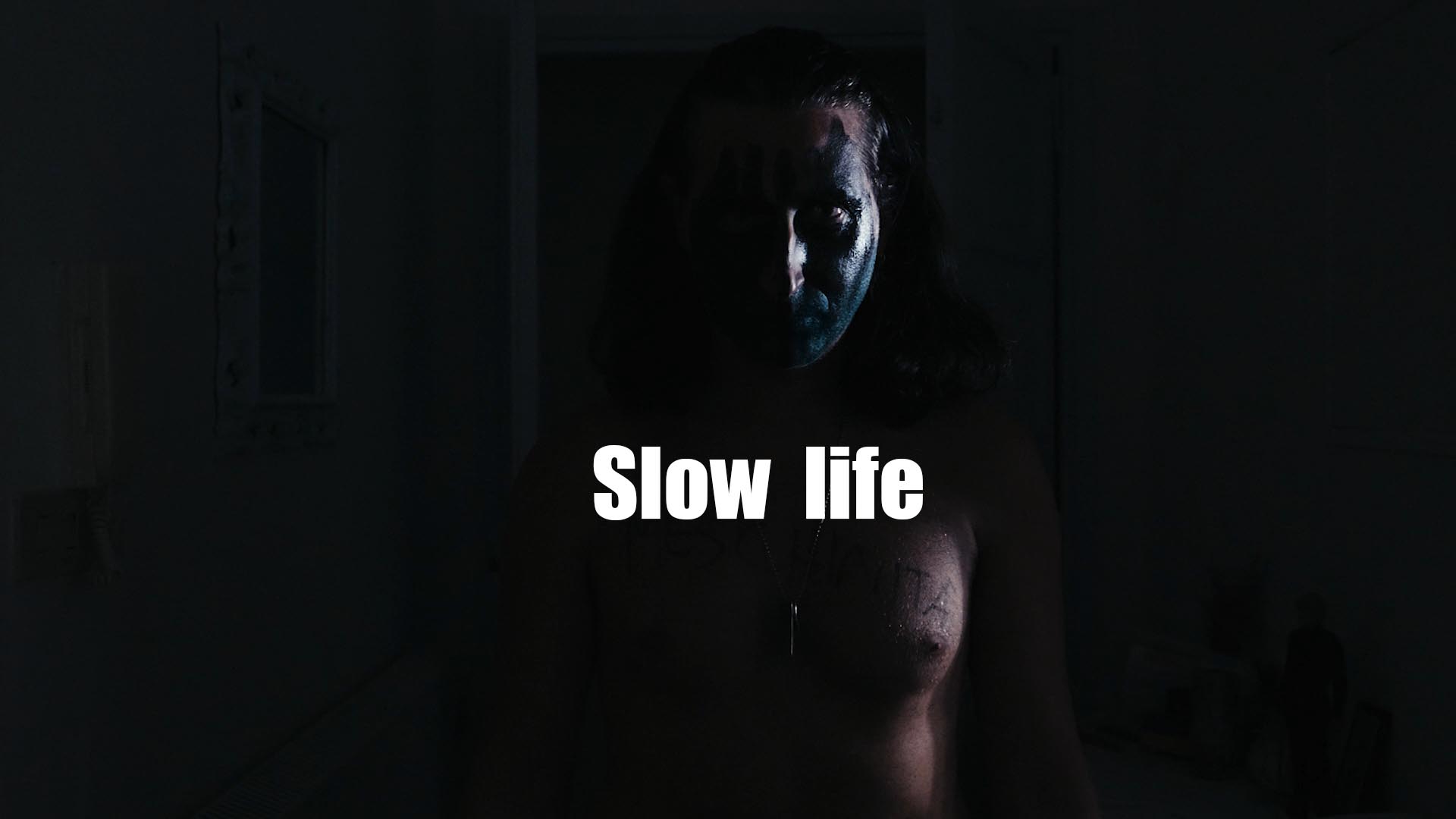
Drama, comedy, thriller, by Fabio Del Greco, Italy, 2021.
Lino Stella takes a period of vacation from his alienating job to devote himself to relaxation and his passion: drawing comics. But he did not foresee certain disturbing elements: the intrusive administrator of the building where he lives, the postman who delivers crazy fines and tax bills, an overbearing security guard, a very enterprising real estate agent, the old lady downstairs who raises the feline colony of the condominium. These characters will make his vacation hell.
Food for thought
The larger a social group is, the more rules and bureaucracy are needed, which often do not respect the individual. You have to learn to live with annoying people, but sometimes the social pressure and arrogance can become intolerable. The only laws that always come to our aid are the laws of Nature.
LANGUAGE: Italian
SUBTITLES: English, Spanish, French, German, Portuguese
Geneva, 1762, and the Book They Burned
The book arrived in Paris in April 1762 and was condemned by the Parlement within two months. Not shelved, not ignored — condemned, ordered burned, its author facing arrest. Rousseau fled France on foot, crossing into Switzerland with little more than what he could carry, and discovered that Geneva, the city of his birth, the republic he had idealized so loudly in the opening pages of the very text they were now destroying, had issued its own order of suppression barely a week after Paris. The city whose name he had printed beneath his own on the title page, as if to anchor the work in civic virtue and republican pride, moved against him faster than the monarchy he had spent years critiquing.
There is something almost too perfectly ironic about this, except that irony implies a safe distance, and there was nothing safe about it. Rousseau was fifty years old, in deteriorating health, dependent on the kindness of patrons who were themselves frightened of association with him. He had published, in the same season, Emile, his treatise on education, which was condemned alongside The Social Contract as though the two crimes were a matched set. In a sense they were. One asked how a child could be raised to remain free. The other asked how a society could be organized so that freedom was not simply declared but structurally guaranteed. Together, they constituted something that the authorities of both France and Geneva recognized immediately for what it was: not philosophy in the abstract but a direct interrogation of their right to exist in the form they had assumed.
The Social Contract opens with a sentence that has been quoted so often it has lost its edge: man is born free, and everywhere he is in chains. Read it again as if you are a magistrate in 1762, as if your authority rests on precisely the arrangement that sentence refuses to accept as natural. Rousseau is not lamenting. He is indicting. The chains are not a tragedy to be mourned but a construction to be examined, and examining them means asking who built them, and for whose benefit, and by what right. That last question — by what right — is the one that cannot be tolerated by any power whose legitimacy depends on not being asked.
The political philosophy of the eighteenth century had largely operated within a framework that assumed some form of natural hierarchy, or at minimum a social order whose authority was inherited rather than constructed. Even Locke, whose influence on Enlightenment political thought was enormous, grounded legitimate government in property rights that effectively excluded the majority of people from the full exercise of sovereignty. Rousseau broke from this not by proposing a utopia but by insisting on a question: if political authority is not natural, if it is not divine, if it is not a simple extension of paternal power as Filmer had argued and Locke had dismantled, then it can only be legitimate if it derives from a genuine act of collective will. This was not a comfort to those in power. It was a test they were certain to fail.
What the burning of the book revealed, perhaps more clearly than the book itself, is that the authorities understood it correctly. They did not misread Rousseau as a dangerous radical when he was merely a moderate reformer. They read him accurately. A text that makes the legitimacy of authority conditional on the consent and benefit of the governed is, in the most literal sense, a threat to any authority that cannot meet that condition. Paris could not. Geneva could not. And so they lit the match, which is always the surest sign that the argument has landed exactly where it was aimed.

The General Will Is Not What You Voted For
You voted. The measure passed. And yet something feels wrong — not because you lost, but because the thing that won does not seem to represent anything you recognize as a shared desire. It represents numbers. It represents whoever showed up, whoever was counted, whoever had the time and the ID and the correct address on file. Rousseau would tell you, with a precision that should unsettle anyone who has ever walked out of a polling station feeling vaguely cheated, that you are right to feel that way. The result of a vote is not the general will. It may not even be close.
The volonté générale is one of the most persistently misread concepts in Western political thought, and Rousseau is partly responsible for that, since he wielded it with a certainty that invited misappropriation. But what he meant was specific and demanding. The general will is not the sum of individual preferences. It is not even the preference of the majority. It is what the entire community would will if each member were thinking not of private advantage but of the common good. Rousseau distinguished it sharply from the volonté de tous — the will of all — which is merely the aggregate of what people actually want, self-interest included. The general will, by contrast, is what remains when those private interests cancel each other out. It is structural, not statistical.
This distinction matters enormously because it means the general will cannot be read off from any vote, any poll, any show of hands. A population can vote overwhelmingly for something that serves only a faction, or that serves everyone’s immediate appetite while destroying their long-term flourishing. Rousseau knew this. He was also honest, in a way that should make anyone uncomfortable, about what follows from it: if the general will is the true expression of collective freedom, then forcing someone to comply with it is not oppression. It is, in his own words, forcing them to be free.
There is a man in a room, told he is free to leave, but every door he approaches has been locked by a decision made in his name. The decision was collective. The process was legitimate. The will was general — or so the officials insist. He does not feel free. He feels the peculiar suffocation of someone who has been liberated on paper. This is not an abstraction. It is the texture of life inside systems that have weaponized Rousseau’s framework while hollowing it out entirely.
The Terror of 1793 and 1794 is the most violent historical demonstration of what happens when the general will becomes a political instrument without the philosophical constraints Rousseau placed around it. Robespierre genuinely believed he was enacting the volonté générale when he signed death warrants. He was not misquoting Rousseau so much as stripping the concept of the one condition that gave it legitimacy: the requirement that every citizen genuinely participate in a small, transparent, morally engaged community. Isaiah Berlin, writing in 1958 in his essay on positive liberty, identified exactly this mechanism — the way a collective self can be invoked to justify coercion of the individual self, always in the name of that individual’s deeper freedom, their true will, the one they would have if they weren’t so confused.
What Rousseau imagined was a city-state the size of Geneva, where civic participation was intimate enough that the general will might actually crystallize from genuine shared deliberation. What his heirs built were empires and republics of millions, and they kept the vocabulary while discarding the conditions. The general will became whatever the ruling coalition needed it to be on a given Tuesday. The coercion remained. The liberation evaporated.
And somewhere in all of this, the individual stands at the door, and the door is still locked, and the key is called freedom.
The Myth of the Original Agreement
Picture the moment someone plants a fence post in open ground, looks around to see who is watching, and when no one objects, begins to believe the land was always theirs. Not seized. Inherited. That small psychological movement — from theft to entitlement, executed in the absence of witnesses — is the founding act Rousseau describes in the Discourse on Inequality, and it is worth holding that image against everything he builds eleven years later in The Social Contract, because the two books are quietly at war with each other in ways their author never fully acknowledged.
In 1755, Rousseau was ruthless. The first person who, having enclosed a plot of ground, took it into his head to say “this is mine” and found people simple enough to believe him — that person, Rousseau writes, was the true founder of civil society. Not a statesman. Not a philosopher. A usurper who got lucky. The social order that followed was not a rational arrangement among equals; it was the institutionalization of a prior robbery, layer upon layer of law and custom built to make the original theft permanent and invisible. Property did not create civilization. It created inequality, and then civilization was called in to protect that inequality under another name.
This is one of the most corrosive arguments in the history of political thought. Pierre-Joseph Proudhon would build his entire anarchist program on a version of it in 1840, and Karl Marx would later trace the “primitive accumulation” of capital to the same originary violence. But Rousseau himself, in 1762, appears to move in a different direction. The Social Contract opens with the famous line that man is born free and everywhere is in chains, yet the book’s project is not to break those chains. It is to make them legitimate. The sovereign general will, the founding agreement, the body politic formed by mutual consent — these are the instruments by which Rousseau hopes to rescue political authority from mere domination. The contract is supposed to transform the fact of living together into the right of living together.
The tension between these two positions is not accidental. It is structural. If the first enclosure was theft, then no subsequent agreement among the dispossessed and the propertied can be called genuinely consensual. A contract signed between a man holding a fence post and the man who just lost access to the field behind it is not an agreement between equals. It is a capitulation formalized in legal language. Rousseau knew this. He had written the argument himself. Yet The Social Contract proceeds as though the founding agreement could happen in a kind of moral clean room, among persons who arrive at the negotiating table unburdened by prior advantage or prior loss.
John Rawls, working in a very different tradition in A Theory of Justice in 1971, tried to solve this problem by placing the contracting parties behind a veil of ignorance — they do not know their position in society before they agree to its terms. It is an elegant philosophical device, and it implicitly concedes the problem Rousseau had identified: real people do not contract from neutral positions, and pretending they do simply dresses up existing hierarchies in the language of fairness. Rousseau had no such device. He offered instead a foundational fiction and seemed to know, somewhere, that it was one.
What makes his unresolved contradiction more honest than any tidy synthesis is precisely that he did not paper it over. The Social Contract and the Discourse on Inequality sit side by side in his work like two testimonies that cannot both be true but neither can be dismissed. He showed you the theft. Then he tried to imagine justice. The gap between those two gestures is not a failure of philosophical nerve. It is an accurate map of the problem itself, which no political theory has since managed to close.
Hobbes Kept the Monster, Rousseau Named the Cage
Picture a man standing at the entrance of a prison, explaining to the inmates that without these walls, they would tear each other apart. He is not lying, exactly. He has simply forgotten — or chosen to forget — who built the walls, who trained the men inside to fear each other, and who profits from the conviction that the alternative to confinement is chaos.
Thomas Hobbes looked at human beings in 1651 and saw creatures whose natural condition was war — not metaphorical war, but the real, grinding, perpetual violence of every hand raised against every other. The Leviathan, that sovereign artificial monster assembled from surrendered freedoms, was his solution to a problem he took as given: that without external force, humans would destroy themselves. The social contract, in his version, was a transaction of desperation. You give up your liberty; you receive your survival. The arithmetic was brutal but honest.
Rousseau accepted neither the problem nor its premises. Where Hobbes saw natural violence as the precondition requiring political authority, Rousseau saw political authority as the very engine that had manufactured the violence it then claimed to suppress. This is not a subtle distinction. It is the difference between a doctor who treats a disease and a doctor who administers it while positioning himself as the only available cure. The state of nature Rousseau described in the Discourse on Inequality, published in 1755, was not peaceful in any idyllic sense — it was simply indifferent. Humans in their original condition were not, for him, wolves. They were solitary animals capable of pity, incapable of the sustained resentment and organized cruelty that require social structures to sustain. Envy, for instance, is impossible without comparison. Comparison requires proximity. Proximity, in the sustained and hierarchical form that produces domination, is a social invention.
The cage, Rousseau argued, did not restrain the beast. It created the conditions in which the beast became possible — and then pointed to the beast as justification for the cage.
What makes this more than an academic dispute between two seventeenth and eighteenth-century philosophers is what it reveals about the logic contemporary institutions use to justify their continued existence. The argument has not changed in three centuries; only the vocabulary has been updated. Security apparatuses explain their expanding surveillance by pointing to threats that their own previous interventions helped generate. Economic systems that concentrate wealth defend their architecture by warning that dismantling it would produce the instability it has in fact already been producing in the margins, invisibly, for decades. The institution presents itself as the solution to a problem it declines to examine as its own product.
Rousseau gave this pattern its clearest early anatomy. In The Social Contract, the legitimate version he was trying to construct was precisely the opposite of this circular trap — a form of collective agreement in which authority derived from genuine consent rather than manufactured necessity. But the diagnostic power of his work lies less in the utopian alternative and more in the forensic exposure of the existing arrangement. He was asking: who benefits from the story that human beings, left to themselves, would inevitably destroy each other? And the answer, as it tends to be, pointed toward those already holding the mechanisms of control.
Hobbes kept the monster because he believed in it. He saw violence as the ground floor of human nature, something that had to be contained from outside because it could not be transformed from within. Rousseau named the cage because he understood that the story of the monster was itself a political act — not a neutral description of what humans are, but a strategic narrative about what they must be told they are, so that they will keep paying for the walls.
A vision curated by a filmmaker, not an algorithm
In this video I explain our vision
The Child Who Was Never Asked

There is a birth certificate somewhere in a government archive with your name on it, and attached to that document, invisibly but legally, is a chain of obligations you did not choose, debts you did not incur, and a constitutional order you were handed before you could speak. You were enrolled in the social contract before you understood what a contract was. This is not a metaphor. It is the structural condition of every human being born into a political community, and it is the silence at the center of Rousseau’s entire edifice.
The Social Contract opens with the famous declaration that man is born free and everywhere he is in chains. Rousseau means this as an indictment of illegitimate power. But he does not fully reckon with the implication that follows immediately: even a legitimate political order, even one founded on genuine popular sovereignty, will be inherited by people who were never asked. The first generation consents, however imperfectly, through the founding act. Every generation after that is simply born inside it. The chains, in this case, may be gilded. They are still chains.
Edmund Burke understood this, and celebrated it. In his Reflections on the Revolution in France, published in 1790, Burke argued that society is a partnership not only between the living but between the dead, the living, and those yet to be born. Inherited institutions carry the accumulated wisdom of centuries, he insisted, and to tear them down in the name of abstract rational consent is to substitute the arrogance of one generation for the tested knowledge of many. Burke’s position has an undeniable force, particularly when you watch a revolution devour itself. But it also performs a quiet sleight of hand: it transforms the inability to escape inherited obligation into a virtue, calling it continuity, calling it civilization, calling it gratitude toward the dead.
Thomas Jefferson saw the trap more clearly. In a letter to James Madison written in September 1789, Jefferson calculated that a natural generation lasts approximately nineteen years, and proposed on that basis that constitutions and public debts should automatically expire at that interval, requiring each new generation to actively re-adopt the laws under which it lived. The earth belongs to the living, Jefferson wrote, and the dead have neither powers nor rights over it. It is one of the most radical statements in the Atlantic political tradition, and it went nowhere. Madison replied with practical objections. The proposal disappeared into the archive. But its failure was not merely logistical. It was symptomatic of something deeper: the political order depends on the passivity of the newly born, on their inability to refuse what they find upon arrival.
Rousseau could not resolve this because his theory of the general will presupposes a community already constituted, already sharing common interests and a common history. The founding moment in The Social Contract is curiously static. It happens once, legitimately, and then sustains itself through the ongoing expression of the general will. But Rousseau does not tell us what happens when someone is born into the community after the founding, when they open their eyes not to a moment of free association but to a fully operational legal system, a national debt, a standing army, and a flag. The fiction of consent stretches to cover them too, silently, like a blanket pulled over someone who is sleeping.
What this reveals is not a flaw in Rousseau’s logic but a structural violence embedded in the very concept of legitimate political order. Every constitution that claims to speak for the people necessarily speaks for people who have not yet arrived. Every generation inherits obligations contracted in its name before it existed. The social contract, understood strictly, is always partly a contract signed by the dead on behalf of the living, and the living are never asked whether the signature still stands.
When Sovereignty Becomes a Mask
The crowd cheers. It always cheers. That is the first thing to understand about the moment sovereignty becomes something else entirely.
Someone stands before thousands of faces turned upward, and invokes the name of the people as though the word itself were a kind of proof. The people have decided. The people demand. The people will not tolerate. And somewhere in that crowd, you feel it too — the intoxicating warmth of being included in a noun that sounds like destiny. Rousseau built the architecture for exactly this feeling, and he knew it could be dangerous, and he included the danger anyway, folded inside the text like a hidden clause.
The Legislator is the problem no one wants to linger on. In Book II of The Social Contract, Rousseau introduces this figure almost apologetically: a superior intelligence who sees all human passions without feeling them, who must transform human nature itself in order to make citizens capable of self-governance. This person cannot use force, because legitimate law cannot be founded on coercion. So what tool remains? Rousseau is explicit: the Legislator must appeal to divine authority, must persuade the people that the laws come from the gods rather than from a man. Deception, in other words, is not a corruption of the social contract at its founding moment. It is the condition of possibility for it.
Hannah Arendt spent much of The Origins of Totalitarianism, published in 1951, excavating precisely how twentieth-century movements transformed popular sovereignty from a constraint on power into its most effective disguise. What she found was not a betrayal of the democratic idea but something more disturbing: its logical extension. When the will of the people is declared to be unified, total, and historically inevitable, no individual dissent can survive without being recast as treason against the whole. The sovereign people does not merely govern; it absorbs. Any voice outside it becomes, by definition, the enemy of the very legitimacy that was supposed to protect everyone equally.
Rousseau’s general will already contained this seed. He insisted that it could not be represented, could not be divided, could not err. A will that cannot err and cannot be divided is not a political concept anymore. It is a theological one. And theology, as every inquisitor understood, has efficient tools for handling those who disagree.
The machinery of corruption Rousseau embedded does not require malicious actors to operate. It requires only the sincere belief that one has correctly identified the general will — and that sincerity is perhaps the most dangerous component. The revolutionary tribunal that sends dissenters to their deaths in the name of the people is not, in its own mind, betraying the social contract. It believes it is fulfilling it. This is not hypocrisy. Hypocrisy would be easier to dismantle. This is a structural feature of what happens when sovereignty is defined as singular, inalienable, and self-legitimating.
Claude Lefort, writing in the 1980s on the political philosophy of democracy, identified what he called the “empty place” of power in genuinely democratic societies — the idea that in democracy, the seat of sovereignty must remain symbolically unoccupied, contested, never fully claimed by any body or person. Rousseau’s general will does the opposite. It fills that place completely, colonizes it with a concept so pure and total that any attempt to question it appears not as legitimate criticism but as an assault on society’s foundation itself.
You recognized this in the crowd that was cheering. Perhaps you were cheering too. That recognition — of having felt included in a sovereignty that turned out to belong to someone else’s definition of the people — is not an abstract political lesson. It is a specific chill, the kind that arrives only after the warmth has already done its work.
Freedom as the Last Word That Still Fools You
You already know the word. You have used it today, probably more than once, without noticing the weight it carries or the emptiness that has accumulated inside it over two and a half centuries. Freedom. Liberty. The syllables are so worn they slide off the tongue like water off glass, leaving no residue, no friction, no trace of the argument that once made them explosive.
Rousseau placed liberty at the absolute center of The Social Contract, published in 1762, with a confidence that can only belong to someone who believes a word still means what it says. His opening sentence about man being born free and found everywhere in chains was not a metaphor for him. It was a diagnosis, and like all diagnoses it implied a cure. The cure was the general will, the collective sovereign, the body politic that would transform private obedience into something indistinguishable from self-governance. To obey the law you helped create, he argued, is not submission. It is the only form of freedom that does not eventually devour itself.
The problem is that every political tradition since 1762 has claimed that sentence as its own. The French revolutionaries who invoked Rousseau while constructing the Terror believed they were liberating humanity. The liberal economists of the nineteenth century who dismantled every collective protection in the name of market freedom believed the same. Isaiah Berlin, in his 1958 lecture “Two Concepts of Liberty,” tried to name the fracture precisely: positive liberty, the freedom to participate in shaping collective life, versus negative liberty, the freedom from interference, from constraint, from the state itself. Rousseau’s liberty was unmistakably positive. What the twentieth century bequeathed to the twenty-first was almost exclusively the negative version, dressed in the older word’s clothes.
There is a man sitting in a room. He owns nothing. The building is owned by an entity that has no face. The food he eats was produced under conditions he did not choose and cannot alter. The work he does is governed by a contract he signed because the alternative was worse. At no point in his day does anyone point a gun at him. By the strictest definition of negative liberty, he is free. Rousseau would have called that a sentence, not a condition.
What has happened to the word is not simple corruption. Benjamin Constant, already in 1819, warned that the ancients and the moderns understood liberty as entirely different things, and that confusing them was not an accident but a structural temptation of modern politics. The ancients meant active participation in collective power. The moderns meant peaceful individual enjoyment shielded from that same power. Constant thought the moderns had the better deal. What he did not fully reckon with was that a freedom defined entirely as absence is a freedom that requires no one to be responsible for anything.
And so the word has traveled. It has been placed on tanks and on trade agreements, on constitutions and on advertising campaigns for automobiles. It has been used to justify the removal of labor protections and the expansion of surveillance, always with the same rhetorical gesture: we are freeing you from something. The something changes. The word remains stable, luminous, apparently full.
What Rousseau intuited, and what the subsequent three centuries have systematically avoided confronting, is that liberty without a common world to inhabit together is not a political concept at all. It is a private sensation, and private sensations do not build societies. They only describe individuals standing alone, each holding a word that once meant something shared, turning it over in their hands, feeling its heft, wondering when exactly it became so light.
🏛️ Power, Society, and the Bonds of the Political
Rousseau’s The Social Contract stands at the crossroads of political philosophy, moral theory, and the question of human freedom within collective life. The articles below trace the intellectual landscape surrounding his thought, from the nature of sovereign power to the critique of modern social bonds.
Hobbes’s Leviathan: Meaning and Analysis
Hobbes's Leviathan offers a strikingly different vision of the social contract from Rousseau’s, grounding political authority in fear and the surrender of natural rights rather than in popular sovereignty. Reading Hobbes alongside Rousseau reveals the central tension in modern political philosophy between security and freedom. Their dialogue continues to shape debates about the legitimate foundations of state power.
GO TO THE SELECTION: Hobbes’s Leviathan: Meaning and Analysis
Thomas Hobbes: Life and Political Thought
Thomas Hobbes developed one of the most consequential theories of political order in Western thought, arguing that only an absolute sovereign can prevent the war of all against all. His life and intellectual context illuminate why the question of the social contract became so urgent in the seventeenth century. Understanding Hobbes is essential for grasping the revolutionary force of Rousseau’s own answer to the same question.
GO TO THE SELECTION: Thomas Hobbes: Life and Political Thought
Karl Marx and Alienation: Economic and Philosophical Manuscripts
Karl Marx’s early manuscripts transform Rousseau’s critique of inequality into a systematic theory of alienation under capitalist conditions. Where Rousseau lamented the corruption of natural goodness by society, Marx located the source of that corruption in the structure of economic production. Together, these thinkers form the backbone of modern critiques of the social order.
GO TO THE SELECTION: Karl Marx and Alienation: Economic and Philosophical Manuscripts
Putnam’s Bowling Alone: Analysis
Robert Putnam's Bowling Alone revisits the Rousseauian concern with civic bonds and communal life by documenting the collapse of social capital in contemporary democracies. Putnam’s empirical analysis of declining associational life echoes Rousseau’s warnings about a society fragmented by private interest. The work raises urgent questions about whether the general will can survive in an atomized, individualistic culture.
GO TO THE SELECTION: Putnam’s Bowling Alone: Analysis
Discover the Cinema of Ideas on Indiecinema
If these philosophical reflections on society, freedom, and political power have stirred your curiosity, Indiecinema streaming is your next destination. Explore a curated selection of independent films that bring these very questions to life through bold, uncompromising storytelling. Join us and let cinema deepen your thinking.
👉 EXPLORE THE CATALOG: Watch Indie Films in Streaming
A vision curated by a filmmaker, not an algorithm
In this video I explain our vision

