
The Manuscript That Burned
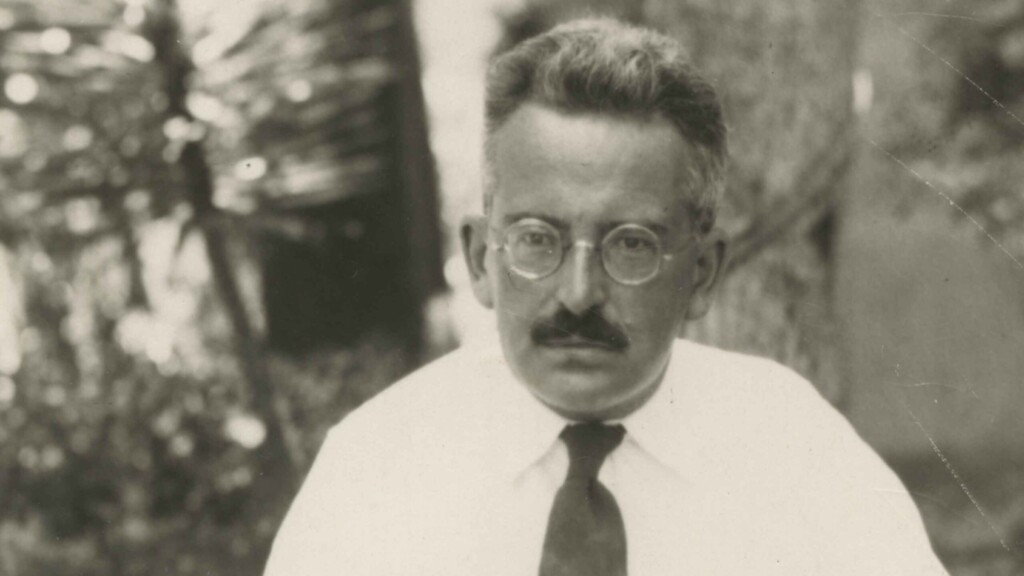
You are crossing the mountains in September, and the briefcase does not leave your hand. Not because you are afraid of losing it to the border guards, though you are afraid of that too, but because the manuscript inside it is the only proof that the thinking happened at all — that the years of exile in Paris, the notebooks filled in libraries that would not let you sit too long, the theoretical architecture assembled from borrowed time and borrowed money, amounted to something that could be carried forward into a world that had not yet decided whether to let you live in it. The path over the Portbou pass is not long, but Walter Benjamin is fifty-eight years old and his heart is already damaged, and the group of refugees he is crossing with moves faster than his body can sustain. He keeps pace. He does not set the briefcase down.

What he was carrying has never been definitively identified. Some scholars believe it was a final version of his theses on the philosophy of history, the fragmentary and explosive text known in German as Über den Begriff der Geschichte, composed in early 1940 and circulated only in typescript among a handful of friends. Others have argued the briefcase held something else entirely, a new manuscript no one had seen, work that exceeded even the theses in its ambition. The Spanish authorities confiscated his belongings after his death on the night of September 26th, and when the French philosopher Hannah Arendt crossed the same border weeks later carrying copies of the theses Benjamin had given her, she found no trace of a separate manuscript among his effects. The briefcase, if it still existed, had been absorbed into the bureaucratic silence of a border town that had no particular reason to care about German-Jewish philosophy.
What makes this loss structurally different from the ordinary loss of documents in wartime is that Benjamin had spent his entire intellectual life theorizing exactly this kind of disappearance. His 1936 essay Das Kunstwerk im Zeitalter seiner technischen Reproduzierbarkeit argued that mechanical reproduction destroys the aura of an artwork — that singular, untransferable quality bound to its original presence in time and space. A manuscript carried across a mountain pass and never recovered is pure aura, pure unreproducible singularity, a thought that existed in one place and then ceased to exist in any place. Benjamin had written the theory of his own loss before the loss occurred, which is either the most terrible irony in the history of ideas or the clearest possible sign that he understood, at a level below argument, what the century intended for him.
He had been stateless since 1939, when the Nazi government stripped German Jews of their citizenship. He had spent the preceding years in Paris working on what he called the Passagenwerk, the Arcades Project, an unprecedented accumulation of quotations, observations, and theoretical fragments organized around the iron-and-glass shopping arcades of nineteenth-century Paris as the material unconscious of capitalist modernity. The project ran to over a thousand pages in its unfinished state and was never meant to be a conventional book. It was an attempt to write history the way memory actually works — in flashes, in collisions between the past and the present moment of recognition, in what Benjamin called the dialectical image, the point where historical time crystallizes into a now that illuminates everything before it.
He did not make it to the United States, where a visa and an affidavit of support were already waiting for him, arranged through the Emergency Rescue Committee. The American consul in Marseille had already approved his papers. He had, technically, been saved. The geometry of the catastrophe required only that the Spanish border be closed for exactly one day — the day he arrived — and that he understand, at Portbou, that he could not survive being sent back.
Crazy World

Drama, thriller, by Fabio Del Greco, Italy, 2010.
Luca is poor and works, precariously, as a waiter. He lives a problematic relationship with his girlfriend, and his life is full of doubts. One day Luca meets Chiara, a friend who had studied philosophy with him at university. She has realized her dream of opening a night and is now well-off. Luca leaves everything behind and starts a relationship with Chiara. He manages the nightclub with her and, thanks to the cocaine and call girls sold to politicians, he gets out of his hard economic situation. But Chiara does not manage to obtain the contract for an old furnace, so she blackmails Saverio, a member of the Parliament. Chiara owns a video in which Saverio has sexual intercourse with a transsexual.
LANGUAGE: Italian
SUBTITLES: English, French, Spanish, German, Dutch, Portuguese.
A Mind Born Out of Place
You are seven years old and the city around you is performing confidence. The streets of Charlottenburg are wide and swept, the facades of the apartment buildings press upward with a kind of civic vanity, and your father moves through all of it as though the arrangement were permanent — as though the prosperity of 1899 Berlin were not a wager but a fact of nature. You learn, before you learn anything else, that the world of adults is a theater of certainty, and that this theater requires your silent participation.
Walter Benjamin was born on July 15, 1892, into a family of assimilated Jewish bourgeoisie in Berlin’s affluent Tiergarten district. His father Emil was an art dealer and businessman, comfortable, socially ambitious, oriented entirely toward integration — toward the fantasy that if German Jews performed their Germanness with sufficient conviction, the performance would eventually become identity. The apartment at Magdeburger Platz was large, well-furnished, and faintly suffocating. Benjamin would recall it decades later in the fragmentary prose of his Berlin Childhood around 1900, a text completed in exile in the 1930s, where memory is not nostalgic but forensic — a slow investigation of the architecture that produced him. He did not remember childhood as warmth. He remembered it as a spatial problem: rooms that concealed more than they revealed, thresholds that separated the child’s uncertain world from the adult world of transactions and appearances.
Wilhelmine Germany was, by almost any material measure, a society ascending. Between 1871 and 1914, industrial output tripled, the population of Berlin swelled from under a million to over two million, and the German empire presented itself to the world and to itself as the vindication of progress — rational, organized, Protestant in its discipline even when secular in its self-description. The philosopher of that moment was not Nietzsche, who was already being misread into service of other projects, but Hegel, or rather the administrative ghost of Hegel: the belief that history had a direction, that the nation-state was its vehicle, and that prosperity was its reward. Assimilated Jewish families occupied a particularly unstable position inside this ideology. They had accepted its premises more completely than most, staking their social existence on the promise that modernity would dissolve the old categories of exclusion. What Benjamin absorbed in that apartment, without anyone naming it, was the specific anxiety of people who believe in a system they are not fully permitted to enter.
Georg Simmel, who was teaching in Berlin during exactly these years and whose 1900 work The Philosophy of Money dissected the way capitalist exchange hollows out qualitative human experience, was himself a Jew repeatedly denied a full professorship — a man whose ideas circulated widely while his institutional existence remained precarious. The young Benjamin would eventually encounter Simmel’s thinking, but the structure Simmel described was already pressing against him from the inside of childhood: the sense that modernity offers legibility and belonging with one hand and withholds them with the other. The ordered prosperity of Charlottenburg was not a lie exactly, but it was a selective truth, and a child’s nervous system, more honest than any ideology, registers the gap between what is said and what is felt.
What this produced in Benjamin was not radicalism, not yet, but something more precise and more durable: a constitutional suspicion of forward motion. The families around him narrated their lives as progress — each generation more integrated, more educated, more German than the last. Benjamin’s sensibility moved laterally instead, or backward, finding in the overlooked detail, the discarded object, the passed-over moment, a density of meaning that the progressive narrative required everyone to walk past without stopping. This was not melancholy as temperament. It was melancholy as epistemology — a refusal to accept that what gets left behind deserves to be left behind.

The Arcades and the Dream-World of Capital
You are standing in a covered passage in Paris — one of those iron-and-glass galleries built between 1820 and 1850, where gas lamps once made merchandise glow at hours when the street outside was dark and dangerous. The floor is mosaic. The ceiling admits a diffuse, sourceless light. You are not exactly outside, not exactly inside. You are in a space that was engineered to make you forget you needed to be anywhere else.
Benjamin began accumulating the notes that would become the Arcades Project in 1927, and he never stopped. By the time the Gestapo forced him to flee Paris in 1940, the manuscript had grown to over a thousand pages of fragments, citations, observations, and theoretical constellations — organized under cryptic headings like “iron construction,” “boredom,” “the collector,” “prostitution,” and “the gambler.” It was never published in his lifetime. It was never finished. It may have been, by design, unfinishable.
What Benjamin was attempting was something no straightforward historical study could accomplish: to read the physical and commercial culture of nineteenth-century Paris as a collective unconscious. The arcades, those first temples of consumer capitalism, were not simply shopping spaces — they were, in his reading, the material expression of a society dreaming. In them, the new technologies of mass production created the illusion that objects could fulfill desires that were not actually about objects. The commodity arrived wearing the costume of the wish. The window display was the form a hallucination takes when it wants to be respectable.
The philosophical instrument he reached for was the concept of the dialectical image — a form of historical recognition in which two moments separated by time suddenly flash into an unstable, electrically charged proximity. History, for Benjamin, did not flow like a river; it exploded like a photograph taken in darkness. The task of the materialist historian was not to narrate the past but to detonate it, to release the unfulfilled possibilities compressed inside each image before they were permanently buried under the official story. The Arcades Project was his attempt to apply this method to an entire century.
What makes the diagnosis genuinely corrosive is not the evidence it marshals about the nineteenth century — it is the fact that the dream it describes did not end. Theodor Adorno and Max Horkheimer, writing their Dialectic of Enlightenment in 1944, four years after Benjamin’s death, would formalize a parallel argument: that the culture industry had replaced the capacity for experience with the simulation of experience, producing not satisfaction but the perpetual deferral of it. But Benjamin had already seen this in the arcade’s gaslit window, decades before the television set and the shopping mall made the mechanism invisible through sheer ubiquity. He had seen it in the figure of the flaneur — the urban stroller who consumes the city as spectacle, who mistakes the freedom to look for the freedom to act.
The reader who takes the Arcades Project seriously — who actually sits with it, follows its threads — eventually arrives at a discomfort that is difficult to name. It is not the discomfort of being told something unpleasant. It is the discomfort of recognizing that the categories through which you organize your own desires — novelty, taste, the curated self, the meaningful purchase — are not yours. They were built before you arrived. The dream was already running when you were born into it, and the dream’s particular genius is that it presents itself as wakefulness.
The thousand pages were left in the care of Georges Bataille at the Bibliothèque nationale when Benjamin fled. They survived the occupation in a library while their author did not survive the border. There is something in that inversion that Benjamin himself might have called a dialectical image — the archive persisting while the archivist is consumed by the very historical forces he spent his life trying to read.
Against Progress: The Angel of History
You are standing in a museum, face to face with a small painting on brownish paper — oil transfer and watercolor, barely the size of a sheet of notebook paper. The figure staring back at you has wide eyes, open wings, and a mouth that seems caught mid-cry. Most visitors pass it in thirty seconds. What Benjamin saw in it, in 1921 when he purchased it from Paul Klee, was not a symbol. It was a diagnosis.
The ninth thesis of “On the Concept of History,” written in 1940 in the weeks before Benjamin’s death at the Spanish border, does not describe an angel. It describes the structure of historical knowledge itself. The angel’s face is turned toward the past, Benjamin writes, and where we perceive a chain of events, it sees a single catastrophe that keeps piling wreckage upon wreckage. The wings are spread, but not in flight — a storm from Paradise is blowing with such violence that the angel cannot close them. That storm is what we call progress. The angel does not advance. It is pushed backward into a future it cannot see, unable to stop, unable to look away from the ruin accumulating at its feet.
This is not a lament. It is a methodological claim, and it cuts directly against the grain of every teleological account of history — Hegelian, Marxist, liberal — that reads time as an ascent toward a fulfillment. Benjamin had spent the 1930s watching European social democracy capitulate, watching the German left dissolve into bureaucratic optimism while fascism organized in the streets, watching a politics of gradual improvement prove catastrophically insufficient against a catastrophe that was not gradual at all. His 1940 theses, written in haste and circulated in typescript, are not melancholy. They are surgical. The problem with progressive historicism, he argues, is not that it is too optimistic but that it is epistemologically wrong — it mistakes the viewpoint of the victors for the structure of reality itself.
The line that cuts deepest in “On the Concept of History” — rooted already in the 1925 Trauerspiel book and the methodological preface to the Passagenwerk — is the declaration that there is no document of civilization which is not at the same time a document of barbarism. This is not a paradox asking to be resolved through dialectical synthesis. It is a factual description of how cultural inheritance works. The cathedrals of medieval Europe were built by labor extracted under conditions indistinguishable from coercion. The Greek tragedies that form the foundation of Western literary culture were performed at festivals funded partly by tribute from subjugated city-states. The museums that house the treasures of Western civilization were stocked, throughout the nineteenth century, by systematic plunder rationalized as preservation. To call these things documents of barbarism is not to dismiss them. It is to insist that the history they carry is double, always double, and that any reading that flattens this doubling into a single narrative of achievement is not neutral scholarship — it is a political act in favor of the inheritors.
What Benjamin demands is something harder than guilt and more uncomfortable than celebration: a form of attention that holds both registers simultaneously without resolving them. The historian who brushes history against the grain — his own phrase, bristling with physical texture — is not looking for hidden victims to make the narrative more inclusive. The gesture is more destabilizing than that. It is a refusal to let the present inherit the past on the terms the past set for itself, a refusal to allow the continuity of tradition to function as a kind of forgetting dressed up as memory.
The storm that drives the angel backward has no name in Benjamin’s text. It does not need one. You already know what it feels like to be moved forward by a force you did not choose, toward a future you cannot see, while everything you recognize recedes and breaks apart behind you.
Language, Translation, and the Afterlife of Meaning
You are reading a text right now that was not written for you. It was written for a reader who does not yet exist, someone who will arrive after the language you speak has shifted, after the words you use to feel certain have migrated toward meanings you cannot predict. This is not a metaphor. It is the structural condition that Walter Benjamin identified in 1923, in an essay prefacing his translation of Baudelaire’s Tableaux parisiens, an essay that most readers still approach as if it were about the craft of translating foreign sentences, when in fact it is about the impossibility of owning what you say.
Benjamin’s argument in “The Task of the Translator” begins with a provocation that literary theory has spent a century trying to soften: a translation is not made for readers. Not for the readers of the original, not for the readers of the target language, not for anyone who comes to the text with a practical need to understand. The translation exists to serve the original text’s survival, what Benjamin calls its Fortleben, its afterlife. An original work does not reach completion at the moment of publication. It reaches toward a completion it cannot achieve in the language that gave it birth, and translation is the form this straining takes across time. The uncomfortable implication, which most commentary quietly sidesteps, is that the original is therefore incomplete — constitutively, irreparably incomplete, not through any failure of the author but through the nature of language itself.
What Benjamin is doing philosophically here draws on his early engagement with the Romantic theory of language, particularly his 1916 essay “On Language as Such and on the Language of Man,” where he argued that human language is always a fallen fragment of a divine creative word that named things in their essence. By 1923, this theological scaffolding has become something more disquieting: the idea that all languages circle around a pure language, eine reine Sprache, that no single language can contain. French cannot hold it. German cannot hold it. The act of translation does not transfer meaning from one vessel to another; it cracks both vessels open and lets something leak through that neither could have released alone. The translator’s task is not fidelity to the original but loyalty to what the original was reaching for and missed.
This has consequences that extend well beyond linguistics. If meaning is always arriving late, always constituted through subsequent readings, translations, and reframings, then the authority of the first statement, the founding text, the original declaration, is structurally a fiction. Every institution that claims to possess an originary truth, a sacred founding document, an authentic cultural identity rooted in the purity of its own idiom, is operating on a fantasy that Benjamin’s essay quietly dismantles. The political implications were not lost on those who came after him: Jacques Derrida’s 1985 lecture “Des Tours de Babel” spent considerable energy unpacking the way Benjamin’s translator essay destabilizes the sovereignty of any original, including the sovereign nation that claims its language as patrimony.
Benjamin himself translated. He translated Proust, together with Franz Hessel, producing the German volumes of A la recherche du temps perdu between 1925 and 1930. Those who have studied his translation practice note that he consistently chose the stranger construction, the syntactically uncomfortable rendering, over the domesticated equivalent. He was not trying to make Proust sound German. He was trying to make German sound like something it had not yet become. This is what he meant by the translator as one who expands the language, who bends the target toward the foreign rather than absorbing the foreign into the familiar. The violence in this is intentional. The reader of a good translation should feel the pressure of another world pressing against the membrane of their own.
What language carries, then, is never what was originally placed inside it, but what it accumulates in moving through time toward readers who were not yet
A vision curated by a filmmaker, not an algorithm
In this video I explain our vision
The Mechanical Eye and the Loss of Aura

You stand in front of a painting in a museum — one you have seen reproduced a thousand times on posters, coffee mugs, phone screens — and something unexpected happens: nothing. The proximity changes nothing. The painting simply confirms what you already know, already own in miniature on your desk. This is not familiarity. This is a kind of ontological deflation, and Benjamin named it with surgical precision in 1935.
The essay he completed that year, circulated through the Institut für Sozialforschung in Paris while he was stateless and increasingly broke, introduced a concept that has since been quoted so relentlessly it has nearly lost the edges that made it dangerous. Aura, for Benjamin, was not mysticism. It was something extraordinarily material: the singular presence of a thing in a particular place and time, its embeddedness in tradition, in ritual, in the irreversible fact that this object existed here, once, and can never fully exist anywhere else. A handwritten manuscript, a particular afternoon light on a cathedral wall, a human face in a moment of involuntary expression — these carried aura precisely because they were unrepeatable. Mechanical reproduction did not merely copy these things. It extracted them from their context and made that context irrelevant.
What photography and film accomplished between the 1880s and the 1930s was not simply a technological shift but an epistemological one. The image became infinitely portable, infinitely reproducible, stripped of the distance and singularity that had once made it sacred or at least specific. Benjamin read this not as catastrophe but as ambivalence — a crack through which political possibility could enter. If aura tied art to ritual, to the cult of the original, to ownership and distance, then its destruction democratized the perceptual field. The masses could now encounter images that were not hoarded behind the walls of aristocratic taste.
But there was another side to this crack, and it was the one that kept him awake in his Paris exile. The same machinery that liberated images also made them infinitely manipulable as instruments of mass affect. Fascism had understood this before any theorist of the left had fully processed it. The Nuremberg rallies were not political events with aesthetic elements. They were aesthetic events with political pretensions — total environments of light, geometry, sound, and human bodies arranged into living symbols. Leni Riefenstahl’s camera work in 1934 was not documenting power; it was constructing it, lending the state the very aura that mechanical reproduction had elsewhere dissolved. Benjamin watched this happen in real time and wrote the phrase that ends his essay like a diagnosis pronounced too late: fascism aestheticizes politics, and the left must politicize art.
This inversion is not a slogan. It describes a structural trap that entire populations walked into voluntarily. When a political movement offers its citizens the experience of being part of something beautiful — a spectacle of unity, a choreography of collective will — it activates something in the nervous system that rational argument cannot reach. The aesthetic experience bypasses deliberation. It does not ask to be believed; it asks to be felt. And in a republic crumbling under unemployment, humiliation, and institutional failure — the Weimar Republic, which had produced some of the most sophisticated political art in European history, collapsed in January 1933 with barely a tremor of resistance — the offer of beauty, of grandeur, of belonging to something overwhelming and total, was not irrational. It was seductive in ways that democratic procedure simply was not equipped to match.
What Benjamin saw, and what made his position so uncomfortable for both communist orthodoxy and liberal aesthetics, was that the problem was not ignorance. The masses were not deceived. They were enchanted. And enchantment is a different kind of epistemological condition — one that no pamphlet, no manifesto, no corrective historical narrative has ever reliably broken from the outside.
Friendship, Exile, and Intellectual Survival
You are sitting at a desk that is not yours, in a city where you do not speak the language well enough to argue, and the letter you are writing contains a disagreement so precise and so loaded that it might end the only friendship keeping you intellectually alive. You choose your words with the care of someone defusing something.
This was Benjamin’s condition for much of the 1930s, and the letters he exchanged with Gershom Scholem and Theodor Adorno during those years constitute one of the strangest triangles in modern intellectual history — not a collaboration, not a school of thought, but a sustained argument conducted across borders, in which Benjamin was perpetually the middle term between two irreconcilable poles. Scholem, whom he had known since 1915 and with whom he shared a bond forged in the wreckage of German-Jewish identity, pulled relentlessly toward theology, toward the Kabbalistic tradition, toward the idea that Benjamin’s most powerful insights were essentially mystical in character and would be betrayed by any Marxist frame. Adorno, younger, sharper in institutional ambition, allied with the Frankfurt School and its apparatus of critical theory, pulled with equal force in the opposite direction, reading Benjamin’s work as a project of materialist analysis that needed to shed its messianic residue to become properly rigorous.
What makes this tension philosophically remarkable is that both men were, in important respects, correct. Benjamin’s 1936 essay on the work of art in the age of mechanical reproduction genuinely does operate as historical-materialist analysis — it tracks how the collapse of what he calls the “aura” of a unique artwork transforms political consciousness, how fascism aestheticizes politics while communism politicizes aesthetics. But the very concept of aura trembles with something that exceeds materialism, a nearness and distance simultaneously present, a quality closer to the sacred than to the economic. Benjamin knew this. He did not resolve it because he believed the contradiction was generative rather than incoherent.
Exile made these intellectual disagreements existential in a way that neither man safely ensconced elsewhere could fully register. After 1933, when Benjamin fled Berlin following the Nazi seizure of power, the manuscripts he was working on became not merely texts but survival documents — things that needed to be copied, hidden, passed across borders in the luggage of trusted intermediaries. The Arcades Project, that massive unfinished investigation into nineteenth-century Paris as the prehistory of consumer capitalism and mass spectacle, existed in fragments that Benjamin was terrified of losing. He deposited one copy with Georges Bataille at the Bibliothèque nationale in Paris before his final flight in 1940, an act of archival desperation that happened to save the work. Scholem received letters from him begging for support to emigrate to Palestine. Adorno and Max Horkheimer, operating the Frankfurt School in exile from New York, provided a stipend that kept Benjamin alive in Paris while simultaneously pressuring him, with considerable tactlessness, to revise essays they found politically or theoretically embarrassing.
The 1938 exchange over Benjamin’s essay on Baudelaire is the document that reveals this pressure most nakedly. Adorno returned the manuscript with detailed objections, arguing that Benjamin had juxtaposed materialist and theological elements without mediating them, that the montage method produced brilliance without argument. Benjamin rewrote. The revision cost him months he did not have, in conditions of poverty and precarity he did not describe in detail to either correspondent because he understood that describing them accurately would read as a demand neither could fully answer. Scholem, from Jerusalem, urged him to abandon the entire European project — intellectually, geographically, existentially. Benjamin declined, again, as he had been declining since the 1920s, unable to sever himself from a world that was in the process of making him its victim.
What exile does to an intellectual is not silence them — it forces every sentence to carry the weight of a position that cannot be revised tomorrow in comfort. Whether that pressure purifies or distorts the thinking is a question Benjamin’s correspondence leaves permanently
What Remains When Nothing Is Preserved
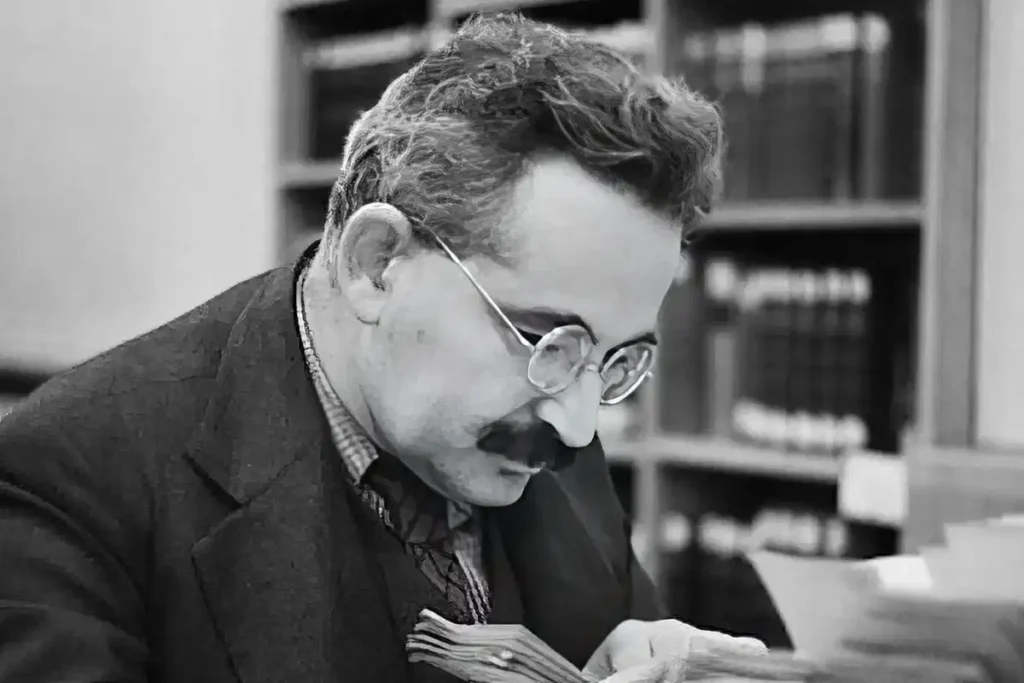
You find a folder of loose papers in a dead man’s coat pocket at the Spanish border, 1940, and you do not know whether to burn them or keep them. The man is gone. The papers are in a language you barely read. You keep them. That decision — arbitrary, exhausted, made under the pressure of a fascist checkpoint — is how a significant portion of Western critical thought entered the twentieth century.
The paradox that follows from this biographical fact is not sentimental. It is structural. Walter Benjamin spent the better part of his intellectual life arguing, in ways both explicit and buried, that the transmission of culture is inseparable from its distortion. His 1940 theses “On the Concept of History” treat every act of cultural inheritance as a potential trophy carried in the triumphal procession of the victors — the idea being that what gets passed down is never neutral, that archives are instruments of power before they are instruments of memory. He was not speaking abstractly. He was describing the very mechanism by which his own work would eventually be received, catalogued, institutionalized, and made into the kind of monument he spent his life dismantling.
Hannah Arendt physically carried some of his manuscripts out of Europe and delivered them to Theodor Adorno in New York. Adorno and Gershom Scholem then spent decades in a quiet editorial war over who the real Benjamin was — the Marxist dialectician or the Jewish mystic, the materialist or the theologian. Both men had legitimate claims. Both men also had agendas, institutional positions, and the kind of interpretive authority that comes with being the last person in the room who knew the author personally. What was published under Benjamin’s name in the first German Suhrkamp editions of the 1950s and 1960s was already a selection shaped by ideological preference. The Benjamin most people read for the next forty years was substantially Adorno’s Benjamin, framed by the priorities of the Frankfurt School.
This is not a scandal. It is simply how texts survive. The scandal is imagining that there exists somewhere a pure, unmediated version of any thinker’s thought that the editorial process has merely failed to transmit faithfully. Benjamin himself understood — and this is what makes his case so vertiginously self-referential — that meaning is never stored, only ever produced in the moment of reading, in the collision between a historical fragment and a present that was not foreseen. His concept of the dialectical image, developed across the unfinished Arcades Project, his massive montage of nineteenth-century Paris assembled from quotations, depended precisely on this: that the past does not contain its own significance, that significance erupts only when a now recognizes itself in a then.
What it means to inherit a philosophy built on this premise is that the philosophy cannot be inherited in any straightforward sense. It can only be misread productively or misread destructively. Every graduate seminar that assigns “The Work of Art in the Age of Mechanical Reproduction” as an essay about film or photography is, in Benjamin’s own terms, doing violence to it — and that violence may be the only form of life available to a text. The alternative is the archive: perfectly preserved, perfectly dead, visited by specialists who mistake proximity for understanding.
He never completed a major book. His habilitation thesis on German baroque drama was rejected by Frankfurt in 1925. The Arcades Project, begun in 1927 and still growing at his death in 1940, runs to over a thousand pages of fragments that explicitly resist synthesis. What remains is a body of work that survives against its own logic, preserved by the same historical forces it described with such merciless precision, and alive only because each generation of readers is willing to betray it just enough to make it speak again.
🌀 Between Memory, City, and the Modern Aura
Walter Benjamin’s thought weaves together philosophy of history, urban experience, and the critical theory of culture. The articles below explore the intellectual landscapes closest to his restless vision — from the figure of the flâneur to the Frankfurt School, from the decay of the aura to the labyrinthine nature of modern existence.
The Flâneur: From Baudelaire to Benjamin
The flâneur — the idle wanderer who reads the city like a text — is one of Benjamin’s most celebrated figures, inherited from Baudelaire and transformed into a philosophical method. Benjamin saw in the Parisian arcades a dreamworld of commodity culture, a labyrinth of desire and forgetting. This article traces the concept from its Baudelairean origins through Benjamin’s monumental Arcades Project.
GO TO THE SELECTION: The Flâneur: From Baudelaire to Benjamin
Situationist Psychogeography: The City as Lived Space
Situationist psychogeography shares with Benjamin a conviction that urban space is never neutral but charged with power, memory, and affect. Guy Debord and the Situationists developed the dérive — a drifting walk through the city — as a tool of political and aesthetic resistance, echoing Benjamin’s own wandering through Paris. This article maps the theory and practice of the city as lived, contested terrain.
GO TO THE SELECTION: Situationist Psychogeography: The City as Lived Space
Georg Simmel: Life and Sociological Thought
Georg Simmel was a direct intellectual precursor to Benjamin, and his essay ‘The Metropolis and Mental Life’ shaped the way critical theory would think about modernity and the urban experience. Simmel analyzed how the sensory overload of the city creates a protective emotional blunting in its inhabitants — a theme Benjamin would deepen in his studies of shock and distraction. This article introduces Simmel’s sociological thought and its lasting influence.
GO TO THE SELECTION: Georg Simmel: Life and Sociological Thought
Antonio Gramsci: vita e pensiero politico
Antonio Gramsci, like Benjamin, was a Marxist thinker who refused to reduce culture to mere economic superstructure, insisting instead on the autonomy and political weight of intellectual and artistic life. Both thinkers wrote in conditions of exile and persecution, producing fragmentary but visionary bodies of work. This article explores Gramsci’s political thought and his enduring relevance for cultural criticism.
GO TO THE SELECTION: Antonio Gramsci: vita e pensiero politico
Discover Cinema That Thinks
If Benjamin taught us that every image carries a hidden history waiting to be redeemed, independent cinema does the same — frame by frame. On Indiecinema you will find films that think, drift, and question, offering the kind of shock of recognition Benjamin always sought in art. Explore our streaming catalog and let the unexpected find you.
👉 EXPLORE THE CATALOG: Watch Indie Films in Streaming
A vision curated by a filmmaker, not an algorithm
In this video I explain our vision

