
The Island, the Prison, the Notebook
You are sitting at a table that is not yours, in a room that is not yours, in a country that has decided it owns your future. The paper in front of you is cheap, the ink unreliable, and your hands — your hands are the real problem. They shake not from fear but from something worse: from the slow, methodical destruction that a body undergoes when it is given just enough to survive and nothing more. You write anyway. Not because you believe someone will read it. Not yet. You write because the alternative is to let them win in the only place they cannot actually reach, which is the interior of a mind still moving, still grinding, still refusing the stupor of despair.

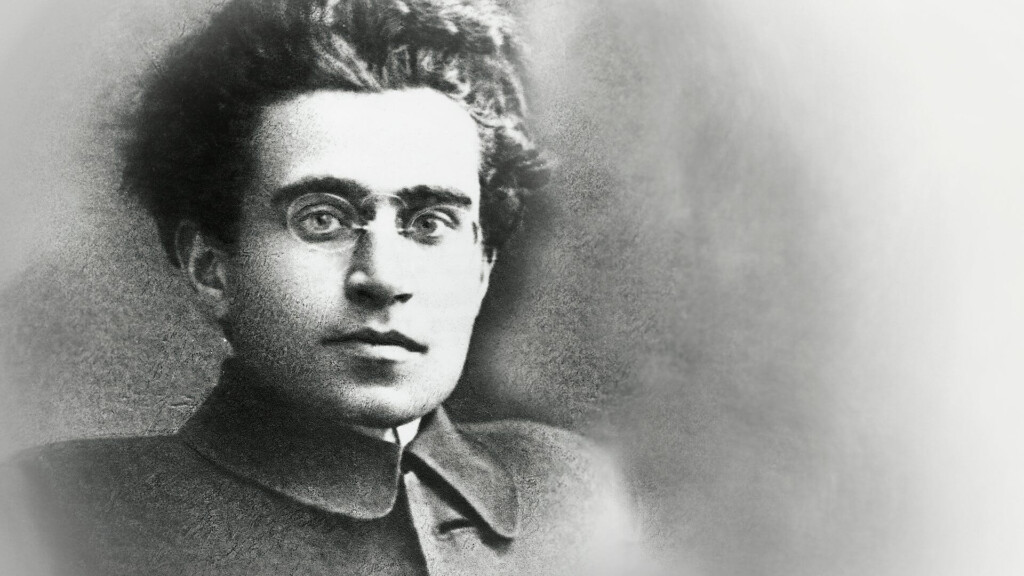
This is where Antonio Gramsci wrote the Quaderni del carcere. Not in the serenity of a study, not in the productive isolation of a voluntary retreat, but in a fascist prison, under surveillance, with censors reading everything that left and entered his cell. He began the notebooks in 1929, two years after his arrest, one year after Mussolini’s regime sentenced him to twenty years, four months and five days — a sentence delivered with the prosecutor’s famous declaration that this brain must stop functioning for twenty years. It did not stop. What emerged instead were thirty-three notebooks, nearly three thousand pages, a body of thought that would reshape how the twentieth century understood power, culture, and the relationship between the two.
But to read Gramsci as a triumph of the intellect over adversity is to make exactly the sentimental mistake he would have despised. He was not a hero of the spirit. He was a sick man. By the time he reached the prison at Turi in 1928, he was already suffering from Pott’s disease, arteriosclerosis, severe intestinal disorders, and the particular exhaustion that comes from years of exile, political defeat, and the knowledge that the movement you gave your life to has been crushed. He weighed less than fifty kilograms. He had persistent headaches that made reading sometimes impossible. He bled, he fainted, he spent extended periods in the prison infirmary. He wrote through all of it.
What this means — and it is not a small thing — is that the Quaderni are not the product of a mind operating at full capacity in ideal conditions. They are the product of a mind operating at whatever capacity remained, under conditions designed to produce silence. This changes how we read them. There is a reason the notebooks are fragmentary, allusive, written in deliberately obscure language — Gramsci knew the censors were reading, so he referred to Marxism as the philosophy of praxis, to Lenin as Ilyich, to the Communist Party as the Modern Prince, borrowing the name from Machiavelli. The coding was not merely strategic. It forced him into a kind of philosophical density that a freer writing might never have achieved. Necessity became method.
Gramsci was born in 1891 in Ales, a small town in Sardinia, the fourth of seven children of a minor civil servant who would eventually be imprisoned for administrative irregularities, plunging the family into poverty. That island — marginal, internal, looked down upon by the mainland — never left his thinking. The question of the South, of the peasantry, of the populations that modernity treats as obstacles rather than subjects, is already there in the Sardinian boy who had to wear a hump brace as a child, who was poor before he was political, who understood marginality as a lived condition before he ever understood it as a theoretical category.
The prison at Turi was a continuation of something that had begun much earlier. The cell was colder, the surveillance more explicit, the violence more systematic. But the basic situation — a mind that does not belong to the world that surrounds it, forced to find its own language for what it sees — that was not new to him at all.
Eve of the Irises

Documentary, by Isabel Russinova, Rodolfo Martinelli Carraresi, Italy, 2026
Eva of the Irises is a historical biographical docu-film about the scientist Eva Mameli Calvino, a botanist and pioneer of environmentalism in Italy, mother of the writer Italo, born in Sassari in 1886. The film, based on a multidisciplinary approach that combines several genres—such as theatre, documentary, cinema, and research—moves between memories, reflections on life, as well as the goals and missions the scholar still wished to achieve.
The multifaceted artistic sensibility of Isabel Russinova is expressed across many fields, from writing to acting, from directing to civic engagement, and finds one of its highest expressions in the docu-film Eva of the Irises, created with Rodolfo Martinelli Carraresi. The film blends scientific rigor and poetic refinement to portray the extraordinary figure of the botanist Eva Mameli Calvino, mother of Italo Calvino but above all an independent protagonist of 20th-century scientific culture. It is told through a combination of archival materials, interviews, and evocative staging capable of elegantly and profoundly conveying her intense human and professional story.
LANGUAGE: Italian
SUBTITLES: English, Spanish, French, Portuguese
Sardinia in the Bones
You know what it feels like to carry a body that announces your disadvantage before you open your mouth. The slight forward lean, the asymmetry that strangers clock in under a second, the way a room recalibrates its expectations of you before you have said a single word. You know this or you have watched someone you love know it, and either way you understand that the body is never merely biological. It is political. It is the first territory anyone ever colonizes.
Antonio Gramsci was born in Ales, a small town in the Campidano plateau of Sardinia, on January 22, 1891, the fourth of seven children in a family that was already walking the razor edge between precarious respectability and outright ruin. His father Francesco was a minor municipal registrar, a small functionary of the Italian state — which is to say, a man whose authority extended about as far as the walls of his own office and no further. When Antonio was seven years old, Francesco was arrested on charges of administrative irregularities, almost certainly engineered by local political enemies, and sentenced to nearly six years in prison. The family lost everything: their income, their standing, whatever fragile buffer they had maintained against the grinding poverty of the island. Antonio’s mother Giuseppina moved the children to Ghilarza, where she would spend years taking in sewing and doing whatever could be done to keep the household alive.
It was in this period, somewhere between ages two and four, that Antonio suffered the fall — or was dropped, accounts vary, the truth buried under the shame and confusion of desperate people — that left him with a spinal deformity. He grew hunchbacked and stopped growing upward, reaching barely five feet as an adult. He spent years of his childhood bedridden, hemorrhaging from the nose, so consistently ill that his family reportedly prepared a small coffin for him more than once, certain he would not survive the night. He survived every night. But the body he survived into was a body that Sardinia — and later the Italian state, and later the world — would read as evidence of some fundamental insufficiency.
This is where the Southern Question is not theory. It is a child who cannot afford the medical care that might have corrected his spine, in a region that the unified Italian state had treated since 1861 as a colony to be exploited rather than a society to be developed. The Mezzogiorno was not simply poor. It was systematically kept poor, its agriculture distorted to serve northern industrial interests, its peasantry taxed into immobility while northern factories received state protection and investment. When Gramsci later wrote, in his 1926 essay “Some Aspects of the Southern Question” — the text he was working on when he was arrested and which remained unfinished, a fragment that somehow contains more clarity than most complete works — he was not conducting sociological research. He was conducting an autopsy of his own childhood, finding the structural bones beneath the flesh of everything he had personally endured.
Antonio Gramsci developed his later obsession with who gets left behind by history and why because he had been left behind first. He had watched his mother’s hands move through cloth in a cold house, had watched his father return from prison a diminished man, had learned to navigate the particular humiliation of the gifted poor: the boy who won a scholarship to study in Cagliari at sixteen, who traveled to Turin at twenty, who would eventually read half the libraries of Europe from a prison cell — and who never, in any of that distance, stopped being from Sardinia. The island did not leave him when he left the island. It settled into his posture, into the curvature of his spine, into the precise angle from which he would spend his entire intellectual life looking at power.

Turin and the Factory Floor

Turin in 1911 is not a city that waits for you to adjust. It arrives all at once — the noise first, then the smell of hot metal and cutting oil, then the sheer physical mass of the Fiat plants rising along the Corso Dante like monuments to a new kind of power that has not yet decided what it believes in. Gramsci steps off the train from Cagliari a young man with a scholarship, a curved spine, a ferocious memory, and almost nothing else. He is twenty years old. He has never seen an industrial city. What he encounters is not the abstract proletariat that socialist theory describes in its cleaner moments, but actual men — men with blackened hands whose fingernails will not come fully clean regardless of how long they scrub, men who carry the factory home in their skin every evening and return it the following morning slightly diminished.
This is the detail that transforms him. Not a book, not a professor, not a political programme. The workers themselves, their specific intelligence, the way they talk about the machines they operate with a precision and intimacy that no engineer in the management offices can match. Antonio Labriola had already argued, before the turn of the century, that Marxism must be understood as a philosophy of praxis rather than a mechanical doctrine — that ideas do not descend from above into passive social formations but emerge from the friction between material life and human consciousness. Gramsci absorbs this not as a theoretical proposition but as something he watches happening every shift change on the factory floor.
By 1919 the world has been reorganized by war and the Russian Revolution has made a certain kind of political imagination suddenly feel possible rather than merely noble. In April of that year, in a small rented room in Turin, Gramsci founds L’Ordine Nuovo together with Angelo Tasca, Umberto Terracini and Palmiro Togliatti. The journal does not begin as a grand theoretical organ. It begins, almost hesitantly, as a weekly review of culture and socialist politics. What accelerates its radicalization is contact — the workers who start arriving at the editorial office, the conversations that refuse to stay polite, the arguments that do not end when the meeting formally closes.
The factory council movement that crystallizes around L’Ordine Nuovo in those years carries inside it an idea of extraordinary provocation: that the factory, precisely because it concentrates people who have learned to solve collective problems under pressure, could become a school of self-government. Not a metaphor for democracy but a literal training ground for it. Think about what it means — genuinely, not rhetorically — for a man who has spent his entire adult life being told that decisions happen elsewhere, in offices and boardrooms and parliamentary chambers where people like him are not present, to suddenly sit in a room with his fellow workers and deliberate about how the production process should be organized. Something cracks open in the structure of what seems possible.
There is a kind of intellectual vertigo that accompanies this cracking. You can see it in the faces of people who have just understood, for the first time, that the rules they have been obeying were not natural laws but choices made by someone else — choices that could, in principle, be made differently. The philosopher Charles Taylor would much later describe recognition as a fundamental human need, the need to have one’s capacity for self-determination acknowledged by others, and the denial of that recognition as a form of violence that distorts the self from inside. What Gramsci is watching in the factory councils of Turin between 1919 and 1920 is recognition arriving late and arriving hard, like a blow that is also a door opening.
The factories produce approximately one hundred and fifty thousand workers in Turin alone during this period. That number is not an abstraction.
The Trap Called Common Sense
There is a moment you have probably lived without naming it. You are sitting somewhere public — a waiting room, a crowded train, a table where a conversation is already in progress — and someone says something you know, in some buried layer of yourself, to be wrong. Not factually wrong in a way you could easily dispute, but wrong in the way that a house built on sand is wrong: structurally, fundamentally, in its foundations. And yet you nod. Not because you are cowardly, or not only because of that. You nod because the thing they said arrived dressed in the clothes of obviousness, wrapped in the tone people use when they are simply describing the world as it is.
This is where Gramsci’s most unsettling idea begins. Not in a prison cell, not in a theoretical treatise, but in that nod. In the almost muscular reflex of agreement with propositions you never consciously chose to believe.
He called the mechanism hegemony, but the word has been so thoroughly academicized that it now floats above the phenomenon it was meant to describe. Strip away the vocabulary and what remains is this: the dominant classes of any era do not hold power primarily through violence or coercion, though they use those tools readily enough when threatened. They hold power through something far more economical and far more durable — through the colonization of what feels normal. Through the patient, generational work of making their particular arrangement of the world appear to be the only arrangement imaginable. Not the best arrangement. Not a chosen one. The only one.
Think of a man in a crowded cinema sometime in the mid-twentieth century, watching newsreels before the main feature. Images of labor disputes portrayed as chaos, of strikers’ faces filmed from angles that make them look threatening, of industrial production celebrated with the same swelling music reserved for national victories. He does not agree with all of it consciously. He is not a fool. But he laughs when the crowd laughs, falls silent when the crowd grows solemn, and leaves the cinema with his sense of disorder subtly reinforced, his tolerance for things as they are slightly deeper than when he entered. No one has forced him to think anything. That is precisely the point.
Pierre Bourdieu, writing decades after Gramsci but in unmistakable intellectual debt to him, gave this phenomenon another name: doxa. The pre-reflexive, the unthought, the realm of experience that presents itself not as one perspective among many but as the natural order of things. In Outline of a Theory of Practice, published in 1972, Bourdieu described doxa as the experience by which the established order is perceived not as arbitrary but as self-evident. The particular becomes universal. The historical becomes eternal. And the most potent instrument of this transformation is not propaganda — propaganda is too visible, too crude, it produces resistance — but common sense, which is propaganda that has already won.
Gramsci understood this with the clarity available only to someone who has watched working-class people vote against their own material interests and wondered not how to condemn them for it but how to understand it. The question was never one of intelligence or moral failure. It was a question of which stories a culture makes available to people for interpreting their own lives. If the only narrative that arrives fully formed, coherent, emotionally satisfying, is the one that explains poverty as the result of individual weakness and wealth as the reward for individual virtue, then even those ground down by poverty will reach for that story before they reach for any other, because it is the one that feels like thinking rather than ideology.
The most effective prison, Gramsci wrote from his own very literal one, has no bars. It has a vocabulary. It has a set of assumptions so ambient they feel like oxygen.
The Organic Intellectual and the Betrayal of Culture
There is a kind of man you have met in seminar rooms and at conference dinners, a man of genuine erudition who speaks with measured precision about power, about inequality, about the mechanisms by which the weak are kept in their place. He has read everything. His footnotes are impeccable. He will spend three hundred pages dismantling a single ideological formation with surgical elegance, and when he finishes, when the last acknowledgment is written and the book goes to press with a university imprint, the world he has described so brilliantly remains exactly as he found it. He returns to his office. The heating works. His salary arrives on the first of the month. He has, without ever intending to, served the order he spent a career anatomizing.
Gramsci understood this figure not as a hypocrite but as something more structurally dangerous: a man who genuinely believed in his own neutrality. The traditional intellectual, in Gramsci’s formulation from the Prison Notebooks, is the one who experiences himself as floating free of social determination, as belonging to a continuous and unbroken lineage of thought that precedes and transcends any particular class arrangement. The priest, the professor, the jurist, the literary critic — they all inherit a self-image of independence, of speaking for humanity rather than for a fraction of it. This self-image is not merely vanity. It is ideology in its most refined and therefore most effective form, because it does not announce itself as ideology. It presents itself as objectivity, as rigor, as the disinterested pursuit of truth.
The organic intellectual is the counter-figure, and the term is deliberately uncomfortable. Organic means rooted, accountable, inseparable from the living conditions of the class or group from which one emerges. It means that knowledge is not produced in a void but in response to concrete historical pressures, and that the intellectual’s legitimacy depends on whether they remain answerable to those pressures or find a way to escape them through credentialing, through institutional absorption, through the slow drift into respectability. Gramsci saw this drift everywhere. He watched the Italian socialist movement produce thinkers who were brilliant in theory and absent in practice, men whose sophistication became a kind of alibi, a way of endlessly deferring the moment of real confrontation with power.
Edward Said, writing in 1994, extended this analysis with a precision that felt almost personal. In his Reith Lectures, published as Representations of the Intellectual, Said argued that the intellectual’s central obligation is never to allow themselves to become what he called a “yes-man,” an accommodationist whose critical vocabulary has been quietly domesticated by the institutions that house and reward them. Said was drawing directly on Gramsci’s distinction but pushing it forward into the landscape of late twentieth-century professional intellectual life, where the danger was no longer overt co-optation but something subtler: the way academic prestige, foundation grants, advisory positions, and media visibility could transform a thinker into a legitimating figure for the very structures they once questioned. The intellectual who had once spoken from the margins eventually found themselves invited to the center, and the invitation itself was the mechanism of capture.
What Gramsci was accusing the traditional intellectual of was not bad faith but something almost worse: unconscious service. You do not need to be cynical to betray a class. You only need to believe, sincerely and consistently, that your position above the fray is real rather than constructed, earned rather than granted, permanent rather than contingent on your continued usefulness to those who control the conditions of intellectual production. The sophistication of the argument, the beauty of the prose, the genuine insight — none of it changes the question of who benefits when the last page is turned and the book is shelved.
A vision curated by a filmmaker, not an algorithm
In this video I explain our vision
War of Position, War of Maneuver

There is a moment — and you have probably lived some version of it — when you find yourself winning an argument and losing everything at once. You have the facts, you have the logic, you have the moral high ground, and yet something in the room resists you, some atmospheric pressure that your words cannot penetrate. The other person does not need to refute you. They simply look at you as though you are speaking a language that has no bearing on reality as they understand it. You walk away victorious in the technical sense and defeated in every sense that matters.
Gramsci spent years inside a fascist prison cell understanding exactly why that happens.
The distinction he built — between what he called the war of maneuver and the war of position — is not a military metaphor casually borrowed. It is a diagnosis of how power actually sustains itself in modern societies, and why the revolutionary playbook of 1917 could not simply be photocopied and applied to Turin, to Paris, to Berlin. In the Russian context, he argued, the state was everything and civil society was primordial, gelatinous, barely formed. When you struck the state, it fell, because there was nothing behind it to absorb the blow. The frontal assault worked because the terrain was open. One decisive movement, and the fortress collapsed.
But in Western Europe, the state was not a fortress standing alone in an empty field. It was the visible tip of something vast and largely invisible — a dense web of institutions, habits, associations, churches, schools, newspapers, professional bodies, cultural assumptions so deeply internalized that they no longer needed to be enforced. They were simply felt as natural. Gramsci called this civil society, and he understood that it functioned as a system of trenches and fortifications extending far behind the front lines. You could seize a ministry, you could win an election, you could even topple a government, and find that the ground beneath your feet had already been occupied for a century by someone else’s ideas about what is normal, what is possible, what is reasonable.
This is what the war of position means. Not patience as passivity, but patience as strategy — the long, unglamorous work of contesting every institution, every cultural assumption, every common sense certainty that makes the existing order feel like the only order imaginable. Antonio Gramsci wrote in the Quaderni del carcere, those thirty-three notebooks produced between 1929 and 1935 under conditions of physical deterioration and constant surveillance, that the intellectuals of a rising class must become organic to that class — not observers of transformation but active participants in the construction of a new common sense. The transformation of consciousness had to precede, or at least accompany, any transformation of structures.
Think of a man who organizes his neighbors, who builds coalitions, who speaks truth to power with extraordinary force and clarity — and then realizes, slowly, that the terms in which he is speaking were handed to him by the very system he is contesting. That the language of reform he has mastered was designed to contain, not to liberate. That every victory he wins is metabolized by the system and used to demonstrate its own flexibility, its own generosity, its own capacity for self-correction. He has been winning battles in a war whose strategic map he never drew and was never shown.
The enemy, in Gramsci’s analysis, does not primarily operate through prohibition. It operates through definition. It decides what counts as realistic, what counts as extreme, what counts as common sense. And if you accept those definitions — even while fighting within them — you have already conceded the war of position before the war of maneuver has even begun. The trenches were dug long before you arrived at the front.
The Prison Notebooks and the Censor Inside
Between 1929 and 1935, in a cell in Turi di Bari and later in clinics that were prisons by another name, Gramsci filled thirty-three notebooks with a handwriting that grew increasingly difficult to read as his body failed him. Nearly three thousand pages. The pencil marks so faint in places that later scholars would need magnifying equipment to decipher them. And yet this fragility was not incidental. It was constitutive of the entire enterprise.
The prison censor read everything. Gramsci knew this with the same certainty he knew the pain in his teeth, his failing vision, the tuberculosis working through him. So he wrote obliquely. He called Marxism “the philosophy of praxis.” He called the Communist Party “the modern Prince,” borrowing Machiavelli’s armor to smuggle his own ammunition. Lenin became references to an unnamed theorist of political will. The language bent around the surveillance like water around stone, finding every available channel. But something strange happened in that bending: the thought itself became more precise. The necessity of indirection forced a discipline that direct declaration never would have demanded.
This is what Walter Benjamin understood when he wrote, in the 1940 theses on the philosophy of history, that the historical materialist must brush history against the grain — not because obliqueness is elegant, but because the grain itself is the problem. The smooth surface of official knowledge is not neutral. It is the sediment of a thousand prior victories by those who controlled the telling. Gramsci’s notebooks are the methodological embodiment of this brushing. They do not arrive at conclusions. They circle positions. They contradict themselves across the span of months and then return to the contradiction and examine it again. The incompleteness is not a flaw in the thinking. It is the thinking.
Consider what happens when a translator, years later, sits with the original Italian and the canonical English edition side by side. She notices, in a passage concerning the relationship between intellectuals and the subaltern classes, that a phrase has been softened. The original says something closer to “the necessary rupture with the existing order of knowledge.” The translation renders it as “a new orientation within the existing cultural framework.” The difference is not academic. One phrase is revolutionary. The other is reformist. The shift is small enough that no casual reader would notice, and large enough to change everything about what Gramsci is understood to have meant. The apparatus of transmission has become, quietly and without announcement, an apparatus of distortion.
This is not conspiracy. It rarely is. It is something more banal and therefore more dangerous: the unconscious alignment of the translator’s interpretive framework with the political common sense of his own moment. Benedetto Croce did the same thing to Vico. The Soviet editors did it to Marx. The history of ideas is substantially a history of these small erasures, these imperceptible softenings, accumulated across decades until the original voice has been replaced by a ventriloquist’s version that confirms what the present already believes.
Who controls the archive controls memory. This is not a metaphor. The Gramsci Institute in Rome holds the original manuscripts. The question of who has access, under what conditions, with what interpretive authority granted or withheld, is a political question wearing the costume of an administrative one. Edward Said, writing in 1983 in “The World, the Text, and the Critic,” argued that texts do not exist in a pure space of meaning but are always situated within institutions that regulate their circulation. The Prison Notebooks are perhaps the most extreme demonstration of this principle: a text produced under physical censorship, transmitted through ideological censorship, and now institutionally managed in ways that determine which Gramsci the world is permitted to encounter.
The notebooks themselves, fragmentary and self-questioning, resist this management more than any finished work could. A system can more easily absorb a conclusion than a question that keeps reopening.
Pessimism of the Intellect, Optimism of the Will
She has read every report, studied every statistic, traced every institutional mechanism that keeps her exactly where she is. She knows which doors are structurally closed and which ones only appear open. She has no illusions about the goodwill of the powerful, no fantasy about meritocracy rescuing her, no residual faith in the idea that working harder will eventually tip some invisible scale. She sees the architecture of her subordination with a clarity that is almost surgical, and that clarity, on certain evenings, feels indistinguishable from paralysis.
And yet she shows up. She organizes the meeting. She drafts the document. She persuades the reluctant colleague. Not because she believes victory is guaranteed, not because some inner warmth insulates her from what she knows, but because she has made a wager that is simultaneously rational and almost unreasonable, a wager that Gramsci understood as the only honest position available to someone who refuses both delusion and surrender.
The phrase he borrowed from Romain Rolland, the French novelist and Nobel laureate who used it as early as 1902, became in Gramsci’s hands something far more precise than a motivational formula. Pessimism of the intellect, optimism of the will: Gramsci repeated it across several of the Prison Notebooks, deploying it not as consolation but as method. The intellect’s task is to see without mercy, to strip away every comforting narrative, to count the actual forces arrayed on each side of any historical conflict and refuse to soften the arithmetic. This is not cynicism. Cynicism is a posture, a way of feeling sophisticated while doing nothing. Gramscian intellectual pessimism is rigorous, almost ascetic, because it demands that you hold the worst-case analysis not as an excuse for inaction but as the precise ground from which any serious action must depart.
The will operates on different logic. It does not contradict the intellect’s findings. It does not pretend the terrain is easier than it is. It simply insists that transformation remains possible even when probability argues against it, because historical change has always been improbable before it happened, and because the alternative, accepting the given order as permanent, is itself a political act, a contribution to that permanence. Georg Lukács, writing in History and Class Consciousness in 1923, had already argued something structurally similar: that class consciousness is not a passive reflection of material conditions but an active intervention in them, a decision to treat potential as real before it has manifested. Gramsci sharpened this into something more personal and more demanding. The wager of the will is not optimism in the ordinary sense, not cheerfulness, not the belief that things will necessarily improve. It is closer to what the moral philosopher Bernard Williams would later call integrity, the refusal to allow external conditions to fully determine the shape of your agency.
The woman who has mapped her own marginalization and acts anyway is not naive. She is practicing something harder than hope, something that requires her to hold two incompatible truths simultaneously and not resolve the tension between them prematurely. She knows the system. She also knows that systems have edges, fissures, moments of internal contradiction when the bloc of forces that maintains them fractures just enough for something else to enter. Gramsci called those moments crises of authority, and he knew they could not be manufactured on demand, but he also knew they could be seized only by forces that had been preparing in conditions that looked, from the outside, like futile persistence.
This is where the philosophy refuses to close neatly, because the distance between the clarity that shows you the wall and the will that reaches for what is on the other side cannot be bridged by argument alone, only by the decision, made again each morning, to treat the possible as if it were already underway.
🔥 Power, Thought, and Political Struggle
Antonio Gramsci’s life and political thought do not exist in isolation — they emerge from a broader European and world conversation about power, ideology, resistance, and the role of intellectuals in society. These related articles illuminate the philosophical and historical currents that shaped, paralleled, or challenged Gramsci’s legacy.
Hannah Arendt: the Philosopher Who Unmasked the Banality of Evil
Hannah Arendt, like Gramsci, confronted the darkest expressions of political power and sought to understand how ordinary systems produce extraordinary oppression. Her analysis of totalitarianism and the ‘banality of evil‘ offers a compelling counterpoint to Gramsci’s theory of hegemony, exploring how consent and coercion intertwine in modern states. Reading Arendt alongside Gramsci opens a richer dialogue about freedom, authority, and political responsibility.
GO TO THE SELECTION: Hannah Arendt: the Philosopher Who Unmasked the Banality of Evil
Mass Social Homologation Today
Gramsci’s concept of cultural hegemony finds a disturbing echo in the contemporary phenomenon of mass social homologation, where dominant ideologies shape desires, tastes, and identities without apparent coercion. This article examines how modern societies produce conformity through media, consumerism, and cultural standardization — dynamics Gramsci anticipated decades before the digital age. Understanding homologation today is, in many ways, understanding Gramsci’s warnings made flesh.
GO TO THE SELECTION: Mass Social Homologation Today
Annie Besant: From Socialist Activism to Theosophical Leadership
Annie Besant‘s trajectory from socialist activism to theosophical leadership illustrates how political and spiritual radicalism often share the same restless energy in the early twentieth century — the same era that shaped Gramsci’s formation. Her commitment to workers’ rights and Indian independence placed her at the crossroads of emancipation movements that Gramsci would have recognized as expressions of subaltern agency. Exploring her life enriches our understanding of the intellectual and activist landscape in which Gramsci operated.
GO TO THE SELECTION: Annie Besant: From Socialist Activism to Theosophical Leadership
Albert Camus: Life and Philosophical Thought
Albert Camus and Antonio Gramsci both grappled with the question of how to act meaningfully in a world structured by injustice and absurdity. While Gramsci theorized collective political transformation through the ‘war of position,’ Camus explored individual rebellion as the only honest response to an indifferent universe. Together, their philosophies form a powerful meditation on resistance, solidarity, and the ethics of engagement.
GO TO THE SELECTION: Albert Camus: Life and Philosophical Thought
Discover the Cinema of Ideas on Indiecinema
If Gramsci’s thought has stirred your curiosity about power, culture, and human freedom, Indiecinema’s streaming platform is the natural next step. Explore a curated selection of independent and avant-garde films that challenge dominant narratives and give voice to the margins — exactly the kind of cinema Gramsci himself might have championed. Join Indiecinema and let film become your next instrument of critical thought.
👉 EXPLORE THE CATALOG: Watch Indie Films in Streaming
A vision curated by a filmmaker, not an algorithm
In this video I explain our vision

