
The Locked Stall at the End of the Hall
You are eight years old, and the bathroom at the end of the third-floor corridor smells like chalk dust and old water. You did not want to come here alone, but the teacher sent you during class, and now you are standing at the row of sinks with the tap running because the sound of the water is better than the sound of silence. The last stall is closed. It was closed when you walked in. You do not know if it was closed before that, because you have never been brave enough to look directly at it when you pass. You count the stalls without meaning to: one, two, three. The third one. Always the third one. Your eyes go there before your mind gives permission, and what you see is ordinary — a closed door, a latch that might be turned from the inside, the gap at the bottom where you can see nothing, no shoes, no feet, nothing at all. And then something knocks. Not loudly. Not like a fist. Like a small hand pressed flat against wood, testing whether you are still there.

No adult has ever adequately explained what happens in the body during that specific kind of fear. Not the fear of a dog running toward you, not the fear of a car too close on a narrow road, but the fear of something that should not be there, in a place you were told was safe, making a sound that is almost normal. The neurologist Joseph LeDoux spent decades mapping what he called the low road of fear processing — the amygdala’s capacity to register threat and discharge cortisol before the prefrontal cortex has finished constructing a rational sentence about the situation. By the time your conscious mind says there is probably no one in that stall, your legs have already made a different decision. The body does not wait for the story. It responds to the shape of the thing, not its explanation.
Hanako-san lives inside that gap between the shape and the explanation. She is, in her oldest recorded forms from the late 1950s and early 1960s in Japanese elementary schools, a girl who died in the bathroom during the Second World War — some versions say she was killed in an air raid while hiding, others that she was the victim of abuse, others still that she simply vanished and was never found. The story did not emerge from a single author or a single city. It spread through playgrounds and classroom whispers the way all genuinely virulent folklore spreads: horizontally, without attribution, carried by children who had heard it from other children who could not remember where they had heard it first. By the time Japanese folklorists began formally cataloguing it — scholars like Tsunemitsu Toru, who in the 1990s documented hundreds of variant forms across different prefectures — the legend had already been alive for at least two generations, mutating and stabilizing in equal measure.
What stabilized was not the backstory but the ritual. You go to the third stall on the third floor. You knock three times. You ask, in a voice that must be loud enough to be genuine but quiet enough to feel like a secret: Hanako-san, are you there? And she answers. In some versions she says yes. In some versions the door opens on its own. In some versions a bloody hand reaches under the gap. The precise horror changes depending on who is telling it, which school, which decade, which particular anxiety is circulating through that cohort of children at that moment. But the architecture of the encounter never changes: you must initiate contact, which means you must want it badly enough to ask, which means the terror that follows is, in some sense, one you chose.
That is not a coincidence. Folklore rarely is.
Ugetsu
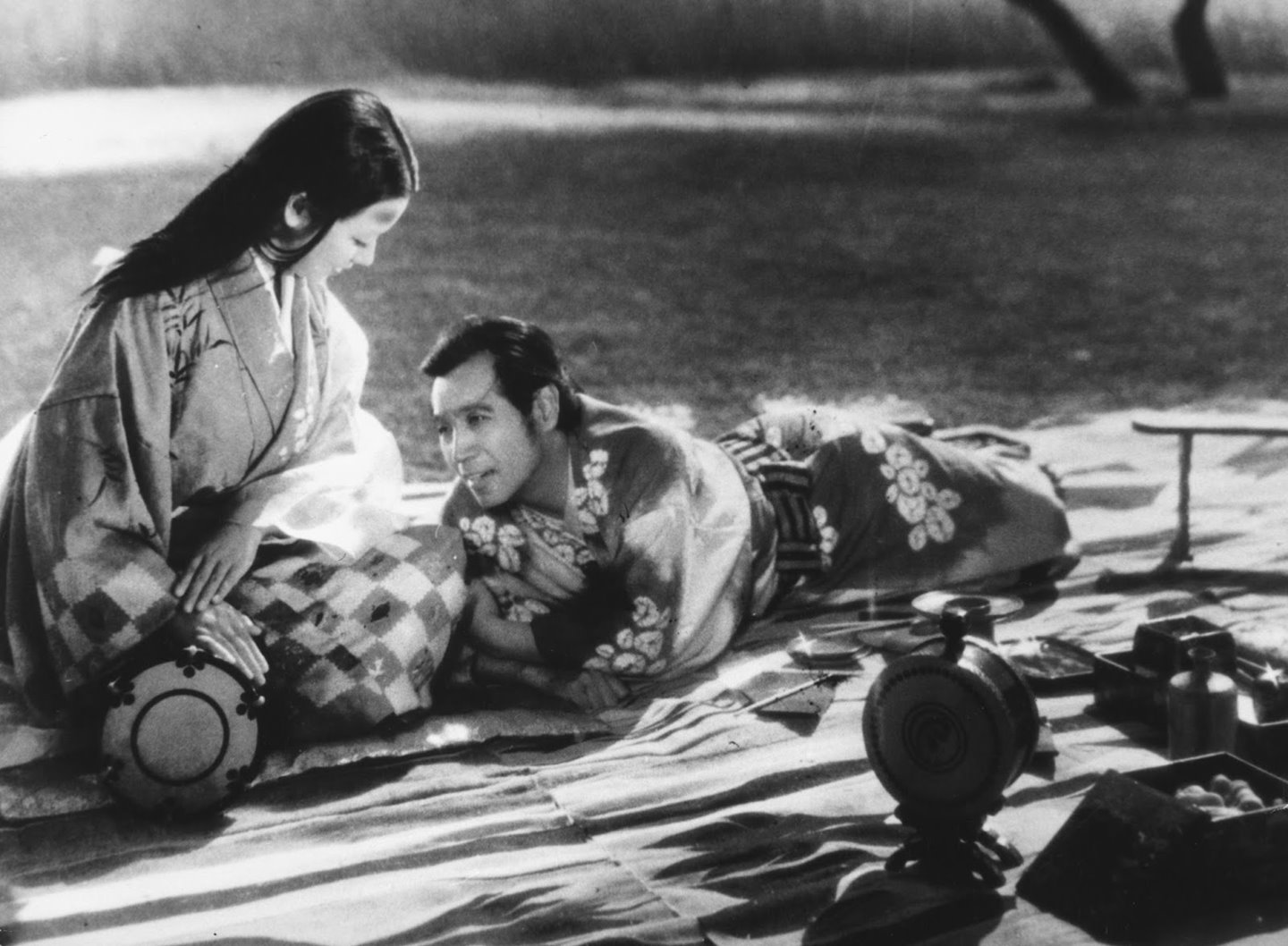
Drama, fantasy, by Kenji Mizoguchi, Japan, 1953.
Japan, late 16th century: the potter Genjurō and his brother Tobei live with their wives Miyagi and Ohama in a village in the Omi region; Genjurō, convinced that he can earn a lot of money by selling his goods in the nearby city, goes to the county of Omizo with Tobei, who joins him with the sole purpose of being able to become a samurai. Back home with a good income, the two work hard to make even more money; Tobei, increasingly obsessed with the ambition of becoming a samurai, needs the money to buy an armor and a spear while Genjurō, overcome by greed, tries to cook a batch of crockery with his brother in just one night. Legend and innovation of cinematic language, a wonderful world next to a brutal and cruel world. Mystery film that opens a discourse with the invisible planes of existence, ghosts and forays into the fantastic, made by Kenji Mizoguchi in a Japan still frozen by the two atomic bombs dropped on Hiroshima and Nagasaki. Fundamental work by Mizoguchi, recognized as one of the greatest expressions of the Seventh Art. A lofty lesson in directing that creates wonder with a dramatic tale of greed and lust for possession. A woman who is a tempting demon and a wife abandoned to a fate of war and misery, Mizoguchi uses the camera to enter "another world".
Food for thought
According to ancient Eastern traditions there are other non-physical planes beyond the physical plane. The etheric plane envelops the physical body, gives it vital energy and acts as an intermediary with the higher levels. Beyond the etheric plane there is the astral plane where entities may exist that have not been able to resign themselves to the loss of their body and wander in search of sensations. They are what are commonly referred to as "ghosts". These entities are looking for bodies that have unbalanced etheric planes to "hook up" to in order to experience sense satisfaction through them.
LANGUAGE: Japanese
SUBTITLES: English, Spanish, French, German, Portuguese
Fear Institutionalized
You are eleven years old, and the third-floor bathroom at the end of the east corridor has not changed in thirty years. The fluorescent tube flickers with the specific rhythm of institutional neglect. The tiles are the color of old teeth. You knock three times on the last stall door, and the sound travels differently here than anywhere else in the building — absorbed, dampened, swallowed by walls that were poured from the same postwar concrete that encases every elementary school between Hokkaido and Kyushu, identical in the way that only things designed without love can be identical.
The Japanese school building that emerged from the 1950s reconstruction period was never architected for children in the sense of being designed around their interiority. It was engineered for throughput — for the efficient processing of postwar subjects into productive national citizens. The Ministry of Education standardized floor plans, corridor widths, classroom dimensions, and even the placement of stairwells with the same bureaucratic logic applied to factories. Sociologist Kaoru Yamamoto, writing on institutional space in Japan, identified what he called the “architecture of consensus” — built environments that make deviation feel not merely wrong but physically awkward, spatially illegible. To run down a Japanese school corridor is not just against the rules; the corridor’s length and echo make you feel surveilled even when no teacher is present. The building itself enforces.
Within this architecture, adult authority has almost total spatial coverage. Classrooms are transparent to the corridor through glass panels. Lunch is eaten in the classroom. Cleaning duties are assigned to the students themselves, which means even the act of maintenance becomes pedagogical, supervised, structured into the daily timetable. There is one zone, and only one, where the adult gaze conventionally withdraws: the toilet block. Not because anyone planned it that way, but because the social contract of bodily privacy created an accidental lacuna in the surveillance grid. Children have always known this. They conduct their real conversations there, their cruelties and their tenderness, their first experiments with autonomy. Hanako-san did not choose the bathroom arbitrarily.
What the legend does, with extraordinary structural precision, is colonize that remaining gap. It installs a presence in the one space adult authority cannot enter without violating the very decorum that legitimizes adult authority. The ghost enforces a rule the teachers cannot: do not linger here. Do not make this space yours. Do not treat the unsupervised moment as freedom. Anthropologist Marilyn Ivy, in her 1995 study Discourses of the Vanishing, traced how Japanese folk belief repeatedly places the uncanny at the thresholds of social order — not outside institutions, but in their structural interstices, the hinges where one regime of control hands off to another. Hanako-san lives precisely at that hinge.
The specific form she takes is itself telling. She is not a monster from outside the school. She is a child. She wears a red skirt — the color repeated across dozens of regional variants with a consistency that demands attention — and she died, in most versions, within the school itself, often during the war years, often while adults were elsewhere doing the business of catastrophe. She is the institution’s own casualty turned back against the institution, a recursion that the children who tell her story navigate without ever being able to articulate it. They feel the logic without possessing its vocabulary.
When folklore scholars began systematically cataloguing her appearances in the 1980s and 1990s, what surprised them was not the variation but the stability. Across forty-seven prefectures, across rural and urban schools, across generations separated by decades, the ritual and the location held. Three knocks. The last stall. The third floor when there is one. The specificity is not incidental — it is the mechanism by which the legend converts architecture into ritual space, turning poured concrete and ceramic tile into something the building’s designers never intended it to become: a site of genuine encounter with the uncontrolled.

The Ghost as Social Mirror
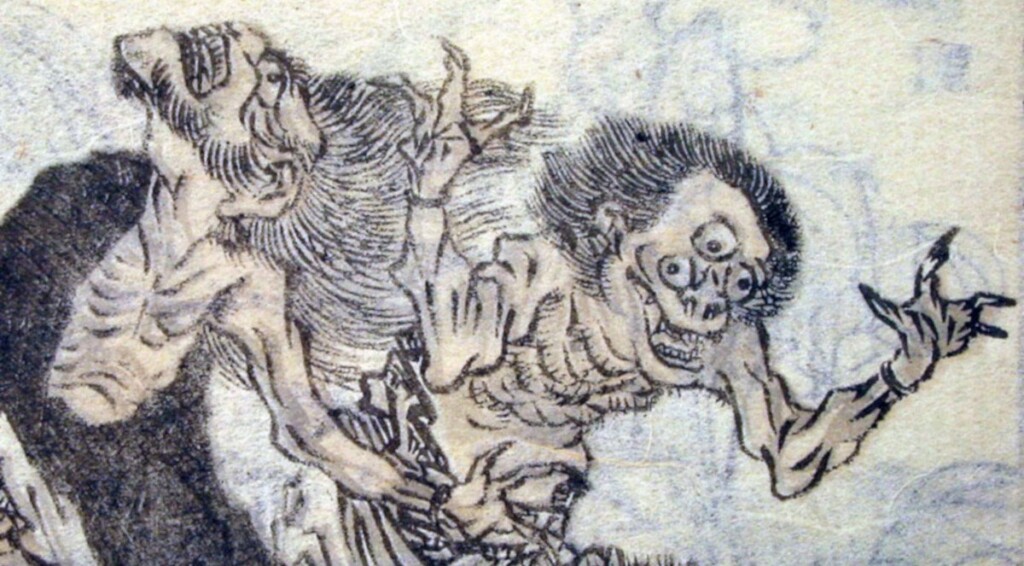
You are seven years old, and the school bathroom smells like wet concrete and something older, something the janitor’s mop cannot reach. The stall at the end is always slightly open, never fully closed, never fully ajar, and every child in every grade knows without being told that you knock three times and wait, because waiting is the only ritual that makes the fear manageable.
What Marilyn Ivy understood, working through the paradoxes of Japanese modernity in her 1995 study Discourses of the Vanishing, is that haunting is not a failure of rationalization but its direct byproduct. The more aggressively a society organizes itself around productivity, institutional legibility, and the suppression of ambiguity, the more insistently the expelled material returns — not in philosophy or protest, but in the stories children whisper to each other in corridors that adults pretend not to notice. Ivy’s argument is structural: the ghost is not a symptom of backwardness but of modernization itself, the residue that accumulates precisely where official discourse most forcefully claims there is nothing left to account for.
The Japanese postwar school was, by design, a machine of normalization. The 1947 Fundamental Law of Education rebuilt the entire national curriculum around democratic citizenship and rational self-development, erasing the prewar imperial model and replacing it with something that presented itself as neutral, hygienic, progressive. By the 1960s, the pressure encoded in that neutrality had become its own form of violence — academic tracking, entrance examination culture, the slow bureaucratic sorting of children into futures they had not chosen. The school was the site where the nation rehearsed what it wanted to believe about itself, which meant it was also the site where everything the nation refused to examine was quietly deposited.
Folklorists working in the tradition that Ivy’s theoretical framework opens up have noted that Hanako-san appears in Japanese oral culture with notable consistency from the late 1950s onward, precisely the decades when compulsory education was becoming the central experience of childhood and when the school bathroom — unglamorous, unsupervised, architecturally marginal — occupied a unique position as the one space inside the institution that was not fully colonized by its logic. You could not be tested in the bathroom. No teacher stood there recording your performance. It existed inside the school and yet beside it, which is exactly the topological position that folklore has always assigned to the threshold between worlds.
There is something in Hanako-san that resists the interpretation of pure fear. Across the hundreds of regional variants documented by researchers like Tsunemitsu Toru and compiled in the broader ethnographic record of Japanese school legends, she is rarely simply a threat. She answers when called. She appears because she is summoned, which means she requires the child’s participation, the child’s agency, the child’s willingness to stand at the boundary and speak. This is not the grammar of horror; it is the grammar of negotiation, the kind of negotiation children learn to conduct with all the forces larger than themselves that they cannot name and cannot refuse.
What cannot be said directly in an institution organized around progress and formation is that the child inside it is also a kind of captive — organized, scheduled, assessed, moved in cohorts through identical corridors toward predetermined endpoints. The ghost of the girl who never left encodes that truth in a form that is transmissible, that survives from one generation of schoolchildren to the next without requiring adult authorization, without being sanctioned by any curriculum. She is the story the institution cannot tell about itself, which is why she lives in the one room the institution cannot fully enter.
The anxiety she carries is not supernatural in origin. It is the anxiety of a society that built its recovery on the intensive management of its youngest members and then needed somewhere to put the cost of that management, somewhere damp and tiled and just out of sight.
1950s Japan and the Birth of the Legend
You are standing in the third-floor girls’ bathroom of a public elementary school sometime in the early 1950s, and the building around you is less than five years old. The tiles are uniform. The corridors are identical to corridors in forty other schools built from the same postwar municipal blueprint. Outside, Japan is rebuilding at a pace that has no real precedent in modern industrial history — between 1950 and 1955, the country poured concrete over the ruins of a civilization and called the result progress. Inside, children are being sorted, scheduled, and processed through institutions designed to produce a standardized citizen. Hanako-san appears in this context not as a ghost from ancient folklore but as something far more specific: a creature born from the particular textures of institutional childhood.
The postwar Japanese school was not simply a place of education. It was the primary site where a generation experienced collective life stripped of family, neighborhood, and ritual continuity. The old community structures — the village shrine, the extended household, the seasonal patterns of agricultural life — had been either bombed away or deliberately dismantled under the American occupation’s modernization agenda. In their place stood the gakko, the standardized public school, which by 1953 enrolled over ninety-nine percent of school-age children across Japan. These buildings were everywhere, and they were fundamentally alike. Sameness was not incidental but structural: the Ministry of Education issued uniform architectural guidelines, uniform curricula, uniform schedules. A child moving from Osaka to Sendai would enter a different school and find the same bathroom in the same position on the same floor.
It is precisely in that bathroom — that universally replicated, institutionally anonymous space — that the legend took root. The folklorist Michiko Iwasaki, writing in the 1990s on the transmission patterns of school-based urban legends in Japan, noted that Hanako-san’s spread followed the geography of educational infrastructure rather than any regional or cultural boundary. She appeared wherever the new school model appeared. This is not the behavior of a legend attached to a specific haunted location; it is the behavior of a legend that belongs to the architecture itself. The bathroom was the one space in the postwar school that existed outside direct adult supervision, outside the curriculum, outside the collectivizing logic of the classroom. It was a gap in the institution, and into that gap a child’s imagination poured something that felt true.
What made the legend feel true was not supernatural belief in any conventional sense. Sociologists studying children’s folklore in the postwar period, including Tsuneichi Miyamoto in his broader fieldwork on Japanese communal life documented across the 1960s, observed that urban legends circulating among children functioned as a kind of emotional cartography — ways of marking which spaces were owned by adult authority and which remained, however briefly, unclaimed. Hanako-san was not simply a ghost to be feared. She was proof that the bathroom, that tiled and humming room at the end of the hall, contained something that the school’s architects had not accounted for. Her presence was a crack in the blueprint.
The generation of children who first transmitted her name had also grown up inside a specific historical silence. Japan in the early 1950s did not publicly mourn its wartime dead in ways that reached children. Grief was displaced, privatized, buried inside family shame or national narrative management. A significant number of children attending those new schools had lost siblings, parents, or peers during the firebombings and the Pacific campaigns. The cultural mechanism for processing that loss had not been reconstructed alongside the physical infrastructure. Hanako-san — a dead girl, a child specifically, lingering inside a building built for children — carried the weight of what the official postwar story refused to name.
The Girl Who Died There
You are standing in the third stall of a school bathroom, and you have just knocked three times, and now you are waiting. What you are waiting for, exactly, is the problem — because no one who has ever transmitted this ritual has ever agreed on what Hanako-san actually is, where she came from, or why the school building is the place she chose, or was condemned to, or never managed to leave. The disagreement is not a flaw in the legend. It is the legend.
The most persistent origin story places her death during the Second World War, specifically in the years of American firebombing that reduced Japanese cities to ash between 1944 and 1945. In this version, a young girl is killed during an air raid while hiding in a school toilet, either struck by shrapnel or buried beneath collapsing walls while her family and teachers could not reach her. There is something geographically and historically plausible about this account — schools were used as civilian shelters, and the Tokyo raids of March 1945 alone killed an estimated 80,000 to 100,000 people in a single night, many of them children, many of them in places that should have protected them. The school-as-refuge becoming school-as-tomb is a compression of the entire civilian experience of that war into one small body in one tiled room.
But a second genealogy refuses the comfort of external catastrophe. In this version, Hanako-san was not killed by an enemy. She was killed by the institution itself — bullied so relentlessly by classmates that she retreated to the only space in the school that promised even temporary solitude, and died there, or killed herself there, escaping through the only door available to her. This account circulates with particular persistence in the postwar decades when Japanese education was expanding rapidly, enrollments swelling, classroom hierarchies solidifying into the brutal social architecture that the sociologist Merry White documented in her 1987 study of Japanese schooling as a system that produces conformity through peer surveillance as much as adult authority. The bathroom stall, in this reading, is the one square meter of school architecture not subject to that surveillance — and therefore also the place where the child who could not survive surveillance disappeared.
A third myth strips away even the social dynamics of peer cruelty and locates her death in the hands of an adult. In this version, Hanako-san was abused — by a parent, by a teacher, by a figure of institutional authority — and murdered, her body hidden within the school’s infrastructure, her spirit unable to leave the building because the building is both her grave and her last proof that something happened here, something that was never acknowledged. This version contains the most accusatory logic: she does not haunt the children. She waits for them, as a witness, as evidence.
What is striking about these three competing accounts is that they cannot be reconciled, and yet the legend has never required them to be. Hanako-san persists across all three genealogies simultaneously, absorbing each without collapsing into any one of them. She is the child killed by geopolitical violence, and the child destroyed by her peers, and the child erased by an adult who should have protected her — and the reason the legend tolerates this multiplicity is that all three things kept happening. The institution kept failing children in different registers, through different mechanisms, wearing different faces, and the bathroom stall kept receiving them.
A vision curated by a filmmaker, not an algorithm
In this video I explain our vision
Ritual as the Grammar of Powerlessness

You are nine years old, and you have just knocked on a bathroom stall three times. Your knuckles barely made contact with the door before you pulled your hand back. You whispered the question into the gap between the wood and the frame, and now you are waiting — not exactly hoping she answers, not exactly hoping she doesn’t.
There is a structure to what you just did that you didn’t invent. The three knocks, the pause, the spoken interrogation of empty space — these steps were handed to you with the same gravity as a recipe or a prayer, and you followed them with the same precision a priest follows liturgy. Children who perform this ritual rarely deviate from its sequence. The knocking comes first. The question comes second. The waiting is non-negotiable. Improvisation is not permitted. This is not because the ritual’s effectiveness depends on the sequence — no child genuinely believes the ghost would refuse to appear if approached differently — but because the sequence itself is the point.
Victor Turner, developing his analysis of rites of passage in “The Ritual Process” published in 1969, identified what he called the liminal phase: the threshold moment in ceremonial life where the initiate is neither what they were before nor what they will become after. The liminal is the between, the doorway held open and not yet crossed. Turner drew heavily on van Gennep’s earlier structural work, but pushed the concept toward something more socially volatile — the liminal is not merely a pause between states, it is a zone of radical possibility where the ordinary rules of hierarchy and social positioning temporarily dissolve. What Turner observed in Central African Ndembu initiation rites was a structured suspension of structure itself, a controlled disruption that paradoxically reinforced the community’s continuity by letting its members briefly inhabit a space outside its grammar.
A bathroom stall at the end of a school corridor is not the savanna. But it is a threshold. It sits at the edge of the school’s sanctioned social space — a room where adults rarely follow, where surveillance relaxes, where the body is temporarily permitted its privacy. When children stand before that specific door and perform those specific actions, they are not simply playing. They are constructing a liminal event inside an institution built almost entirely on the principle that children do not get to determine what happens to them or when.
The school is a machinery of structured denial. Bell schedules, permission slips, raised hands, assigned seats — the entire architecture communicates a single persistent message: your time, your movement, and your voice are not yours. Children learn early that competence in this environment means successfully anticipating what adults want before being asked, not generating their own desires and pursuing them. The developmental psychologist Lev Vygotsky, writing in the 1930s, observed that children’s play consistently involves the rehearsal of roles and rules that exceed their current capacities — play is always, for Vygotsky, a step ahead of development, a space where the child operates at the upper limit of what they can do. The summoning ritual extends this logic into explicitly transgressive territory.
To knock on that stall and ask for Hanako-san is to perform an act of agency so total it courts obliteration. The child is not requesting permission. The child is summoning. That verb belongs to a register entirely inaccessible in the classroom, where the child is always the one summoned — to the board, to the principal’s office, to an explanation of behavior. In the ritual reversal of the bathroom, the child becomes the one who calls forth, who initiates contact with a force beyond institutional authority, who stands at the edge of something the teacher cannot grade or confiscate.
The ghost’s power is not incidental to the ritual’s appeal. Her power is precisely what the child is briefly borrowing by learning to speak her name correctly into the dark.
A Second Scene: The Adult Who Returns
You go back for a reunion, or maybe it is a parent-teacher meeting for your own child, and the hallways smell exactly the same — that particular compound of chalk dust, industrial cleaner, and something organic underneath that no renovation ever fully eliminates. The school has been repainted. The gymnasium floor has been resanded. But when you walk past the corridor that leads to the third-floor bathroom, your feet slow before your mind has registered why. Nobody told them to. They just did.
This is not nostalgia. Nostalgia is warm and selective, a curated archive of pleasant distortions. What happens in that corridor is something closer to what the psychoanalyst Nicolas Abraham called a “phantom” in his 1975 theoretical work developed with Maria Torok — the idea that certain fears are not products of personal experience but of inherited transmission, lodged in the psyche not as memory but as structure. The legend was never yours to begin with. It arrived already assembled, passed through the mouths of older children who received it from older children still, a chain of transmission that precedes your individual consciousness entirely. You didn’t generate the fear. You inherited the architecture of it.
And yet standing there, forty years old or thirty-five, with a mortgage and a cynicism earned through genuine disappointment, you do not knock on that bathroom door. You tell yourself you have no reason to go in. You tell yourself you need to find the administrative office. Both of these things may even be true. But the specific quality of your not-going-in — the slight acceleration of your breathing, the way your eyes don’t quite settle on the door — that is not rational avoidance. That is something older and more embarrassing, and you know it, which is precisely why you don’t name it.
The sociologist Émile Durkheim, writing in “The Elementary Forms of Religious Life” in 1912, argued that the sacred is not a property of objects but a property of the relationship a community maintains toward them. The bathroom door on the third floor is not haunted. It is sacred in Durkheim’s precise sense: set apart, governed by prohibition, surrounded by behavioral codes that everyone follows without consciously agreeing to follow. The child who refused to knock and the adult who finds a reason not to enter are participating in the same ritual structure, separated only by the vocabulary they use to justify it. One says she is afraid. The other says he simply has somewhere else to be.
What maturity actually accomplishes, in most cases, is not the dissolution of these structures but the development of a more sophisticated language for honoring them while pretending not to. This is the performance the adult excels at: maintaining every behavioral output of the frightened child while producing a continuous internal commentary that insists on the distance between himself and that child. The fear has not been processed. It has been narrated around.
There is something almost forensic about what the unchanged bathroom reveals in that moment. It functions as a control condition in an experiment you didn’t consent to run. Everything else in your life has been updated — your opinions, your relationships, your understanding of how institutions actually work and who they serve. But the door on the third floor holds the original data, uncorrupted, and when you stand close enough to it, the gap between who you believe you have become and who you actually are in relation to that particular threshold becomes briefly, uncomfortably measurable.
What the legend preserved was never a ghost. It was a question the child asked about the nature of enclosed spaces, loneliness, and what it means to call for help where no one can hear you — and the adult walking quickly past the door is still not ready to answer it.
Legends That Refuse to Die Because the Conditions Don’t
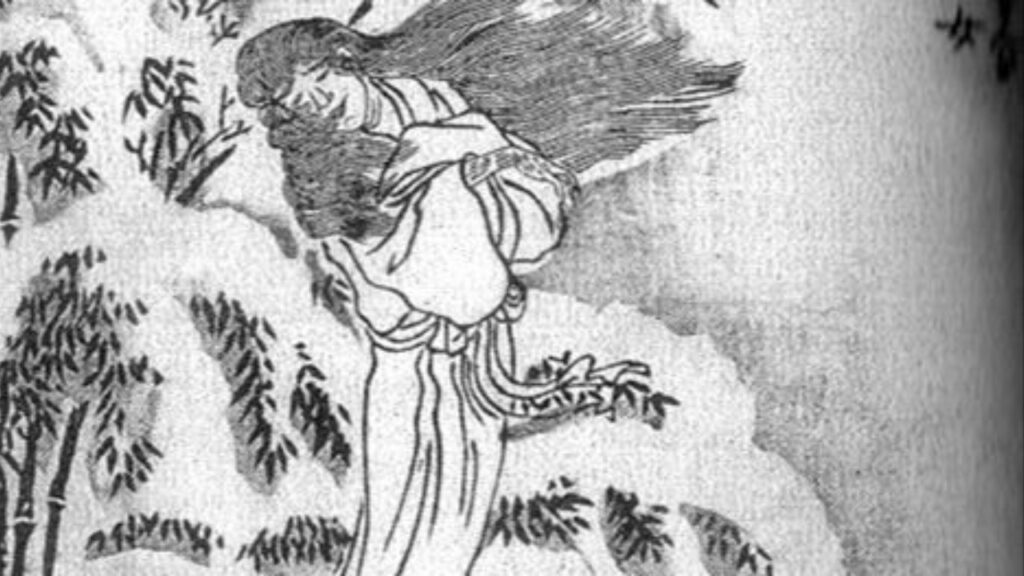
You are standing in a school bathroom that smells of institutional bleach, the fluorescent light humming a frequency just below the threshold of complaint, and you understand — not intellectually but somewhere behind your sternum — that this room was never designed for you to feel at ease in it. It was designed to process you. Get in, get out, return to the row.
Hanako-san did not emerge from superstition. She emerged from architecture. The particular architecture of compulsory education — its corridors built for surveillance, its silences enforced by bell schedules, its bathrooms as the only space where a child could exist outside the direct line of adult authority for thirty unaccounted seconds. Folklorists like Noriko Reider, writing on Japanese kaidan traditions, have noted that the ghost story functions not as irrational belief but as social map: it marks the coordinates where official reality becomes untrustworthy. Hanako inhabits precisely the space the institution forgot to script.
What keeps her alive across decades is not the credulity of children. Children, in fact, are among the most rigorous empiricists alive — they are testing cause and effect constantly, revising their models under pressure. What they cannot do is name what they feel in spaces that produce dread without offering them language for that dread. In 1973, the psychologist Silvan Tomkins completed the later volumes of his affect theory, arguing that shame — the affect of interrupted connection — is one of the most socially contagious and least verbalized of human experiences. A child standing at the threshold of a school bathroom, feeling something that has no adult-approved name, will reach for the nearest available container. Hanako-san is that container.
The legend resurfaces in every generation not because it is passed down faithfully but because it is rediscovered independently, which is a structurally different claim. Urban legends that persist through faithful transmission eventually calcify into folklore — they become historical, quaint, someone else’s fear. What keeps a legend operationally alive is that new children, encountering new versions of the same institutional conditions, arrive at the same figure through parallel invention. The sociologist Gary Alan Fine documented this mechanism in 1992 in “Manufacturing Tales,” showing that contemporary legends are less about collective memory than about collective present-tense experience. Hanako is not remembered. She is re-encountered.
Across the Pacific and across the decades since her first documented appearances in Japanese schoolyard culture during the 1950s and 60s, structurally identical figures emerge in contexts with no direct cultural borrowing. The ghost in the girls’ bathroom of a Chicago middle school in 1987. The knocking presence in a provincial French lycée described in ethnographic fieldwork from the 1990s. These are not imports. They are indigenous responses to the same set of conditions: compulsory attendance, enforced silence, the institutional erasure of what the child experiences as opposed to what the child is expected to experience. The bathroom is the only room where the institution’s eye blinks, and so it is the only room where the repressed is allowed to materialize.
What this means for Hanako-san specifically is that her longevity is diagnostic. Every year she is summoned in a new school bathroom is a year in which a child needed a name for something that adults in that building were unwilling to acknowledge existed. The rituals — knocking three times, asking her name, waiting for the answer that confirms or denies — are not magical thinking. They are the only available protocol for approaching an emotion that the official curriculum has declared outside its jurisdiction. She persists because the conditions that require her persist: the fluorescent hum, the enforced return to the row, the childhood interior that institutions have never found useful and have therefore never bothered to make room for.
👻 Spirits, Shadows & the Horror of the Ordinary
Hanako-san inhabits the threshold between childhood innocence and primal dread, a ghost born from the anxieties of school life and the uncanny. These related articles explore the literary, psychological, and mythological territories that surround urban legends, supernatural folklore, and the strange worlds that emerge when the familiar becomes terrifying.
The Literary Fantastic: Todorov and the Theory of the Fantastic
Tzvetan Todorov’s theory of the fantastic offers a precise framework for understanding why urban legends like Hanako-san retain their power over the imagination. The fantastic, as Todorov defines it, lives in the hesitation between a natural and a supernatural explanation — exactly the ambiguity that makes school ghost stories so enduring. This article explores how that theoretical lens can be applied to folklore, horror narratives, and the literature of the uncanny.
GO TO THE SELECTION: The Literary Fantastic: Todorov and the Theory of the Fantastic
H.P. Lovecraft: Life and Works
H.P. Lovecraft built an entire cosmology around the terror of the unknown lurking just beneath the surface of everyday life, a sensibility that deeply resonates with Japanese urban legend traditions. Like Hanako-san, Lovecraft’s horrors are intimately tied to specific places — basements, corridors, forbidden rooms — where ordinary space becomes a portal to dread. This article examines his life, his mythology, and his lasting influence on supernatural fiction worldwide.
GO TO THE SELECTION: H.P. Lovecraft: Life and Works
Gustav Meyrink: Life and The Golem
Gustav Meyrink’s The Golem is one of European literature’s most haunting explorations of a spirit bound to a place and a collective fear, echoing the way Hanako-san is summoned by the ritual repetition of a name. Meyrink transforms the old Prague ghetto into a living labyrinth of guilt, memory, and supernatural presence, much as Japanese school corridors become charged spaces in urban legend. This article traces Meyrink’s strange biography and the enduring symbolic power of his most famous work.
GO TO THE SELECTION: Gustav Meyrink: Life and The Golem
Venetian Legends and Ghosts of the Lagoon
Venetian legends and lagoon ghosts represent one of Europe’s richest traditions of place-bound supernatural folklore, offering a fascinating cultural parallel to Japan’s yūrei and school spirits. Like Hanako-san, these spectral figures are inseparable from the architecture that contains them — bridges, palaces, and dark canals that transform the city into a stage for the uncanny. This article surveys the most compelling ghostly legends of Venice and the cultural imagination that sustains them.
GO TO THE SELECTION: Venetian Legends and Ghosts of the Lagoon
Discover the Cinema of Fear and Wonder on Indiecinema
If Hanako-san and the world of Japanese urban legends have awakened your appetite for the strange and the supernatural, Indiecinema is the streaming platform where that curiosity finds its truest home. From avant-garde horror to mythological cinema and films that blur the line between the real and the spectral, our curated catalog invites you to keep exploring the darkness. Join us and let independent cinema take you further into the unknown.
👉 EXPLORE THE CATALOG: Watch Indie Films in Streaming
A vision curated by a filmmaker, not an algorithm
In this video I explain our vision

