
The City That Refuses to Be Only Real
You stop walking and the echo stops a half-second later. Not immediately — a half-second later, as though the stone needed a moment to decide whether to give your footstep back to you. It is past midnight, and the calle is so narrow that you could touch both walls with your arms outstretched, and there are no cars, no engines, no mechanical hum of any kind, and this absence — which you expected to feel like silence — feels instead like the presence of something listening. You are in a city of roughly two hundred and fifty thousand people if you count the mainland, fewer than fifty thousand on the islands themselves, and yet you are entirely alone in a way that no metropolis has ever made you feel alone, because in other cities alone means unobserved, and here alone means witnessed.

This is the first thing Venice does to you. It reverses the perceptual contract. You came here as a subject moving through an object — a city, a place, a destination — and somewhere between the station and the third bridge and the moment your footstep hung suspended in the air before returning to you, the city quietly changed positions. It is looking at you now. You are the thing being moved through.
Gaston Bachelard wrote in The Poetics of Space, published in 1958, that certain spaces do not simply contain human experience but actively produce it — that the house, the corner, the cellar each generate specific qualities of consciousness in the person who enters them. He was speaking of intimate architecture, of private interiors, but the argument opens outward with unsettling precision when you walk Venice at night. The city is not a backdrop. It is a mechanism, and the mechanism runs on time, specifically on the capacity to fold time back on itself until past and present occupy the same stone simultaneously.
Water does this. The lagoon does not reflect the sky so much as it duplicates it, and the duplication is always slightly wrong — the angle off, the color a shade too deep, the image arriving just after the original — and this persistent wrongness trains your eye to accept the impossible as a variant of the actual. You stand on a fondamenta and you see a palazzo that has stood since the fifteenth century, and its reflection in the water below is a fifteenth-century palazzo, and the one above is also a fifteenth-century palazzo, and you are standing between them like a figure in a sentence that has lost its main verb.
Jung, in his 1925 seminars on analytical psychology, described Venice as one of the few places in Europe where the unconscious geography of the Western mind becomes visible as landscape — where the internal architecture of dream and memory finds its external correspondent in stone and water. He was not speaking metaphorically. He meant that certain places have accumulated enough human projection over enough centuries that they begin to operate according to a different logic than merely physical space. They become what he called charged environments, and charged environments do not leave you unchanged simply by being traversed.
The legends and ghosts come later in the story, but they are not the subject of the story. They are the symptom. What produces them is this — the sensation you are having right now on this narrow calle at half past midnight, when your own footstep returns to you with that half-second delay and you cannot entirely dismiss the possibility that something else is responsible for it. Venice has been generating that sensation in visitors and inhabitants alike for over a millennium, and the supernatural archive the city has accumulated is simply the record of what happens to human consciousness when it is subjected, night after night, to a city that refuses to behave like an object.
Venetian Arcanum
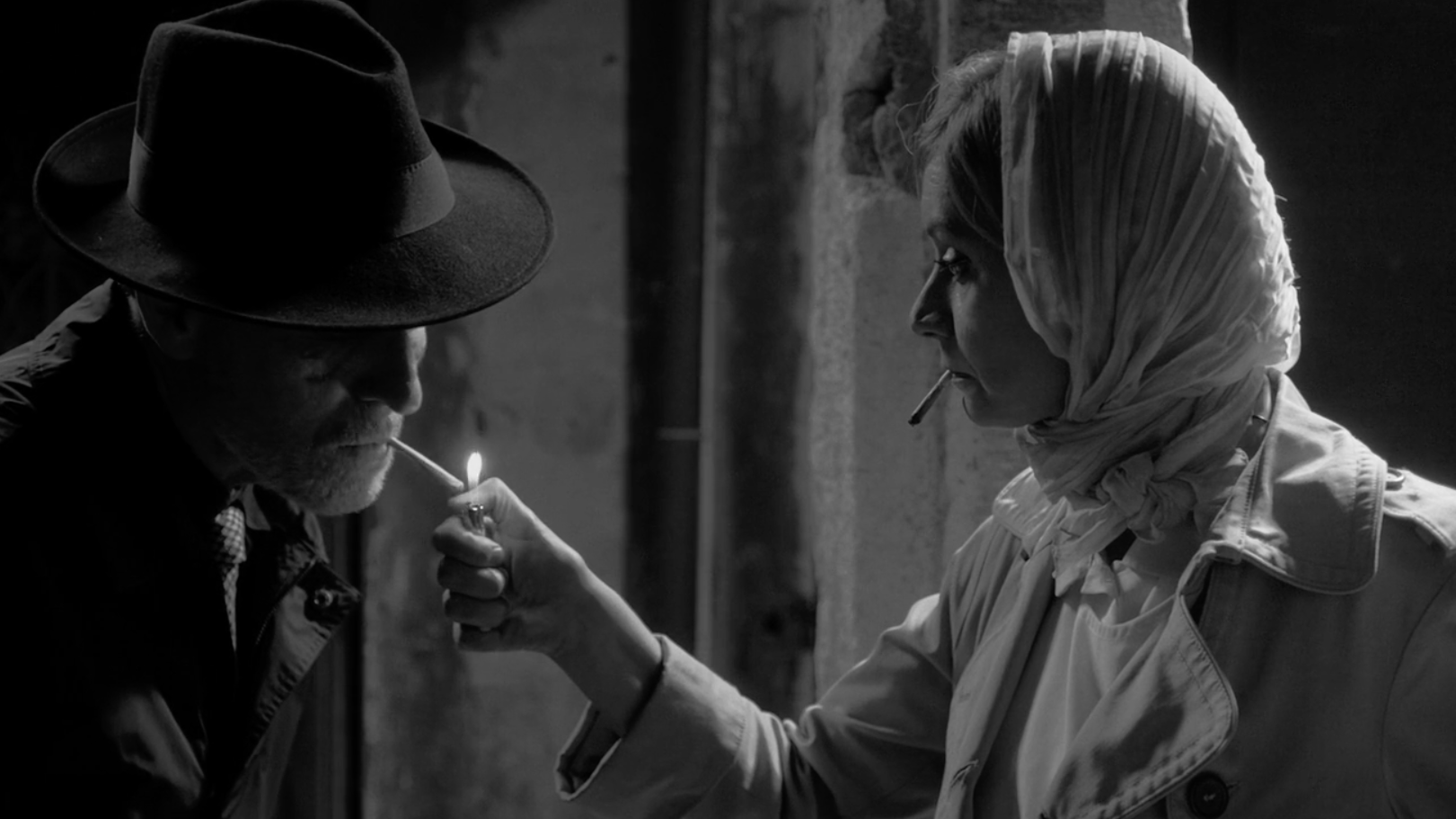
Thriller, by Serge Turgeon, Italy, 2025.
In Venice, a mysterious presence appears once every century or two, haunting the canals and hidden corners of the city. Driven by a sense of destiny, a woman decides to search for it. Following its elusive traces, she is drawn deeper and deeper into the city’s arcane secrets. Reality and myth begin to blur, and Venice itself transforms into a labyrinth of dangers.
LANGUAGE: Italian
SUBTITLES: English
Water as Memory, Not Metaphor
There is a moment that happens to almost everyone who spends more than two days in Venice, though almost no one speaks of it directly. You are crossing a bridge, or waiting for a vaporetto, or simply standing at the edge of a fondamenta watching the canal move, and you lose your sense of when you are. Not where — the disorientation is not spatial. It is temporal. The light off the water does something to the air that makes the fifteenth century feel like it happened this morning, and this morning feel like it may not have happened yet.
This is not poetry. It is geology and hydrology expressing themselves through human perception.
Venice sits on 118 islands separated by roughly 150 canals and connected by more than 400 bridges, all of it resting on wooden piles driven into sediment that has been compressing and shifting since the first refugees from the mainland fled onto the mudflats in the fifth century. The city sinks — has always sunk — at a rate that in the twentieth century accelerated dramatically due to groundwater extraction, reaching peaks of nearly two centimeters per year before emergency interventions slowed the descent. The acqua alta is not a seasonal inconvenience. It is the lagoon reclaiming what it considers its own, moving through ground floors and doorways that were built when the relationship between stone and water was calibrated differently. The city and the sea are in a slow negotiation that has never stopped, and every high tide is a reminder that the terms have not been settled.
Fernand Braudel spent years trying to articulate why the Mediterranean world refused to behave like history was supposed to behave. His answer, developed across the two volumes of La Méditerranée et le Monde Méditerranéen published in 1949, was the concept of longue durée — the idea that beneath the surface of events and political structures, there are geological and ecological rhythms so slow that human generations cannot perceive them as change at all. They experience them instead as permanence, as nature, as the way things simply are. Venice is perhaps the purest living specimen of what Braudel was describing. The lagoon does not change on a human schedule. It shifts in increments that span centuries, and the city built into it has absorbed that rhythm into its own self-conception.
What this creates, structurally and not merely atmospherically, is a place where the past cannot be fully past. In most cities, time moves horizontally — the old quarter gives way to the new district, the industrial waterfront becomes the creative hub, and you can literally walk from one era into another. In Venice, time moves vertically, or perhaps it circulates, the way water circulates. The same calle has been a calle for six hundred years. The same reflection appears in the same canal regardless of who is looking at it. There is no suburban sprawl to absorb the pressure of the present. The lagoon acts as a physical boundary that keeps history from dispersing, from diluting itself into something more manageable. It is contained here, concentrated, perpetually present.
A man carries a casket across a narrow rio at dawn, the water black and perfectly still, the sound of the wood against the hull of the boat absorbed by the fog. He has done this route so many times that his arms know the turnings before his eyes confirm them. The city he moves through is the city his grandfather moved through, and his great-grandfather, and the repetition is not nostalgic — it is structural. The route exists because the water demands it. The water has always demanded it.
This is what gives Venetian ghosts their peculiar quality. They are not anomalies. They are the logical inhabitants of a place where the geological and the human have been collaborating in the same slow tempo for fifteen centuries.

The Legend of the Doge Who Would Not Die
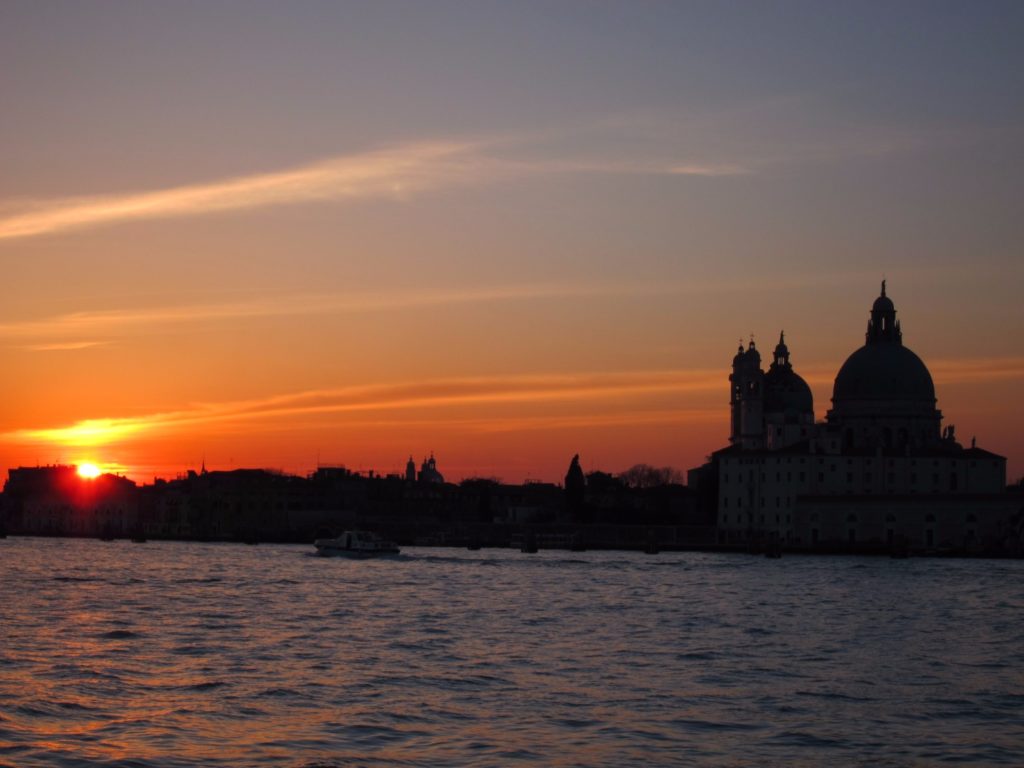
There is a portrait in the Doge’s Palace that is not a portrait. In the long procession of painted faces lining the Sala del Maggior Consiglio, each doge rendered in solemn oils and gilded frames, one space holds something else entirely: a black rectangle, a void where a face should be, and beneath it an inscription that reads, in cold Latin, hic est locus Marini Faledro decapitati pro crimine proditionis — here is the place of Marino Falier, beheaded for the crime of treason. The Republic did not simply remove him. It replaced him with an announcement of his removal. It hung his absence on the wall and made every visitor look at it for six hundred years.
This is not mourning. Mourning acknowledges a loss and works, however painfully, toward absorption. What the black veil performs is something structurally opposite: it is erasure that insists on being seen, deletion that demands a witness. The Republic of Venice was telling itself, and everyone who entered that room, that Marino Falier had existed precisely in the form of his non-existence. You cannot look at that black rectangle without thinking about the face it covers. The censorship becomes the monument.
Freud, writing in 1919 in his essay on the uncanny, identified a specific category of psychological dread that arises not from the alien or the monstrous but from the familiar made strange — the unheimliche, the unhomely, the thing that should have stayed hidden but has come back. His central insight was that repression does not destroy what it suppresses. It preserves it in a form that can return. The more forcefully something is buried, the more insistently it reappears, wearing the distorted mask that repression itself has given it. What Venice did to Falier in 1355 was not judicial resolution. It was psychic compression. And compressed things do not stay compressed.
The legend that accumulated around Falier across the centuries carries exactly this structure. He appears in accounts as a figure who wanders the palace corridors, headless or near-headless, his doge’s cap still on what remains of his neck, searching for something the chronicles never quite specify. In other versions he appears at the threshold of the council chamber, unable to enter the room that bears his erasure, unable to leave it. The details shift, accumulate contradictions, absorb new anxieties from each century that tells the story. But the core remains constant: he is not gone. The beheading did not finish him. The official sentence of historical annihilation produced, instead of absence, an insistence.
What Freud’s framework reveals, when pressed against this kind of material, is that legends are not primitive attempts at explanation. They are not folklore in the dismissive sense, not the superstitions of people who did not yet have science. They are the psychic residue of events that a society cannot metabolize consciously. When a community performs an act of political violence too destabilizing to be fully acknowledged — a doge who conspired against the very oligarchic structure that created him, an aristocrat who tried to arm the poor against his own class — the official record closes over it like scar tissue. But scar tissue is not the original skin. Everyone who touches it knows something happened there.
Falier was not simply a traitor by the Republic’s own account. He was a doge who had turned. He had held the highest ceremonial power Venice possessed and had tried to use it to dismantle the system that gave him that power. The Council of Ten moved with extraordinary speed in April 1355: arrested, tried, convicted, and beheaded within days, the entire proceeding sealed behind the closed doors of a logic that could not afford to be examined too carefully. Speed in political violence is almost always a sign of something that cannot survive deliberation.
Ghosts Are Not Dead People, They Are Unfinished Contracts
You still do not walk between the two columns. You may not know why. You approach the Piazzetta from the water side, you see the granite shafts rising above the lagoon, you feel something shift in your chest — some old instruction written in the body rather than the mind — and you step around them. Tourists pass between the columns freely, unaware, while Venetians detour without thinking, without explaining, because the explanation dissolved long ago into pure reflex. The knowledge that public executions were carried out on that precise strip of stone for centuries became, eventually, not a thought but a muscle memory. The body archived what the conscious mind forgot.
This is already a kind of haunting, and it has nothing to do with the supernatural.
Jacques Derrida, in Specters of Marx published in 1993, introduced the concept of hauntology — a neologism that collapses haunting and ontology, being and its unresolved remainder. His argument was not about ghosts as popular culture imagines them: transparent figures rattling chains in midnight corridors. His argument was structural. A specter, in Derrida’s framework, is what remains when something was never properly finished — a debt uncollected, a promise broken, a violence that was never acknowledged and therefore never fully past. The ghost is not a dead person who refuses to leave. The ghost is an unfinished contract that refuses to expire.
Apply this to Venice and the entire archipelago of its legends reorganizes itself. The figure that drifts through a campo at three in the morning is not a soul trapped between worlds. It is an event that was never processed, never absorbed into the official story the city tells about itself. Venice built its identity on extraordinary sophistication: mercantile genius, diplomatic cunning, legal precision. The Republic’s mythology was one of perpetual equilibrium, of a state so well designed it could not fall. And yet the lagoon holds every contradiction that mythology required to be suppressed — every execution, every betrayal committed in the name of stability, every testimony silenced to preserve the appearance of justice.
The two columns arrived in Venice from the East sometime in the twelfth century, brought as trophies of commercial empire. A third column fell into the lagoon during unloading and was never recovered. On top of the two that survived, the Republic placed its symbols of power: the winged lion of Saint Mark and Saint Theodore with his crocodile. And below them, it placed its condemned. The space between those columns became the threshold where the state performed its absolute authority over life. Venetians stopped walking there. The prohibition endured for centuries after the last execution, after the Republic itself ceased to exist in 1797 when Napoleon’s soldiers entered the city. The state that issued the death sentences was gone. The stones remained. And so did the refusal.
This is what Derrida meant by the specter’s “visor effect” — the ghost sees you before you see it, it organizes your behavior before you recognize its presence. You avoid the space without knowing you are obeying anyone. The contract persists without the parties who signed it. In Freudian terms, which Derrida inherited and complicated, this would be the structure of the symptom: the body enacting a law it cannot name, observing a prohibition whose origin has dissolved into the unconscious sedimentation of collective life.
A ghost story, then, is Venice’s way of making a social document out of what the official record refused to hold. The Republic’s archives, housed in what is now the Archivio di Stato, are among the most detailed in European history — centuries of diplomatic correspondence, trade agreements, criminal proceedings. And yet the archive always has an outside. What the archive excluded — the unofficial, the shameful, the structurally necessary violence — went somewhere. It went into the stories people told after dark, in dialects the archive did not transcribe, about figures seen where something wrong had happened and never been named as such.
The Courtesan, the Mirror, and the Story Venice Tells About Women
There is a bridge in the sestiere of San Polo where, on certain nights, a woman is said to appear at the water’s edge — pale, elaborately dressed, her face turning toward you before dissolving into the canal’s dark surface. Locals know the story. Tourists are sometimes told it with a kind of theatrical pleasure, as though Venice were generously sharing its secrets. What nobody tends to mention, in the telling, is what that woman actually was to the Republic that now immortalizes her as atmosphere.
In the late sixteenth century, the Venetian state had officially registered more than eleven thousand courtesans within a city whose total population hovered around one hundred and fifty thousand. This was not an accident of moral laxity. It was policy. The Republic institutionalized prostitution with the same administrative precision it applied to its trade routes and its tax ledgers, designating specific zones, regulating prices, and in certain periods actively encouraging the visibility of women at the Ponte delle Tette — the Bridge of Breasts — as a civic corrective to the perceived spread of sodomy among young noblemen. The female body was deployed as an instrument of social hygiene. The state looked at women and saw a regulatory mechanism.
Erving Goffman, in his 1963 work Stigma: Notes on the Management of Spoiled Identity, describes how societies construct categories of the discredited not to destroy those individuals but to manage them — to make their presence legible, contained, useful. The stigmatized person is not simply excluded. She is placed. She occupies a role that the social order requires precisely because it cannot acknowledge requiring it. The courtesan in Venice was placed with extraordinary deliberateness: visible enough to serve her function, marked enough to remain outside the boundaries of respectable womanhood, and ultimately disposable enough that her suffering required no institutional accounting.
What the ghost does, then, is something far more sophisticated than haunt. She converts a history of managed exploitation into an aesthetic experience. She takes what was a ledger entry — a name, a registration number, a body assigned to a function by a bureaucratic apparatus — and transforms it into mystery, longing, the bittersweet ache of something lost. You stand on the bridge and feel the melancholy of vanished beauty. You do not feel the weight of the system that produced her, used her, and then had the further audacity to make her into poetry.
He sees a figure in an ornate mirror, her reflection appearing before she does, her eyes already knowing what he has come for — and there is something in that image that the legend of the ghostly courtesan shares completely. The woman who exists only in reflection. The woman whose interiority is never the subject. She is always the thing seen, never the one seeing. Even in death, even as a ghost, she performs. She appears at the water’s edge, she turns toward you, she dissolves — always for an audience, always in service of someone else’s emotional experience.
Goffman understood that the most durable social controls are those that the controlled internalize and even, in time, reproduce. The woman who accepted the stigma of courtesanship, who dressed and moved and presented herself according to the codes assigned to her, was not simply obeying external pressure. She was navigating a system that had foreclosed nearly every other option, in a city where legitimate marriage for women of certain classes required dowries that families could not always provide, where convents absorbed those who could not be otherwise settled, and where the space between respectability and registration was sometimes thinner than a single season’s misfortune.
The ghost does not haunt Venice. Venice haunts itself with the ghost, and the distinction matters enormously, because one is a supernatural visitation and the other is a choice — a collective, ongoing, quietly political choice about which histories get to dissolve into beauty and which ones are never required to be examined at all.
A vision curated by a filmmaker, not an algorithm
In this video I explain our vision
Carnival and the Mask That Became the Face
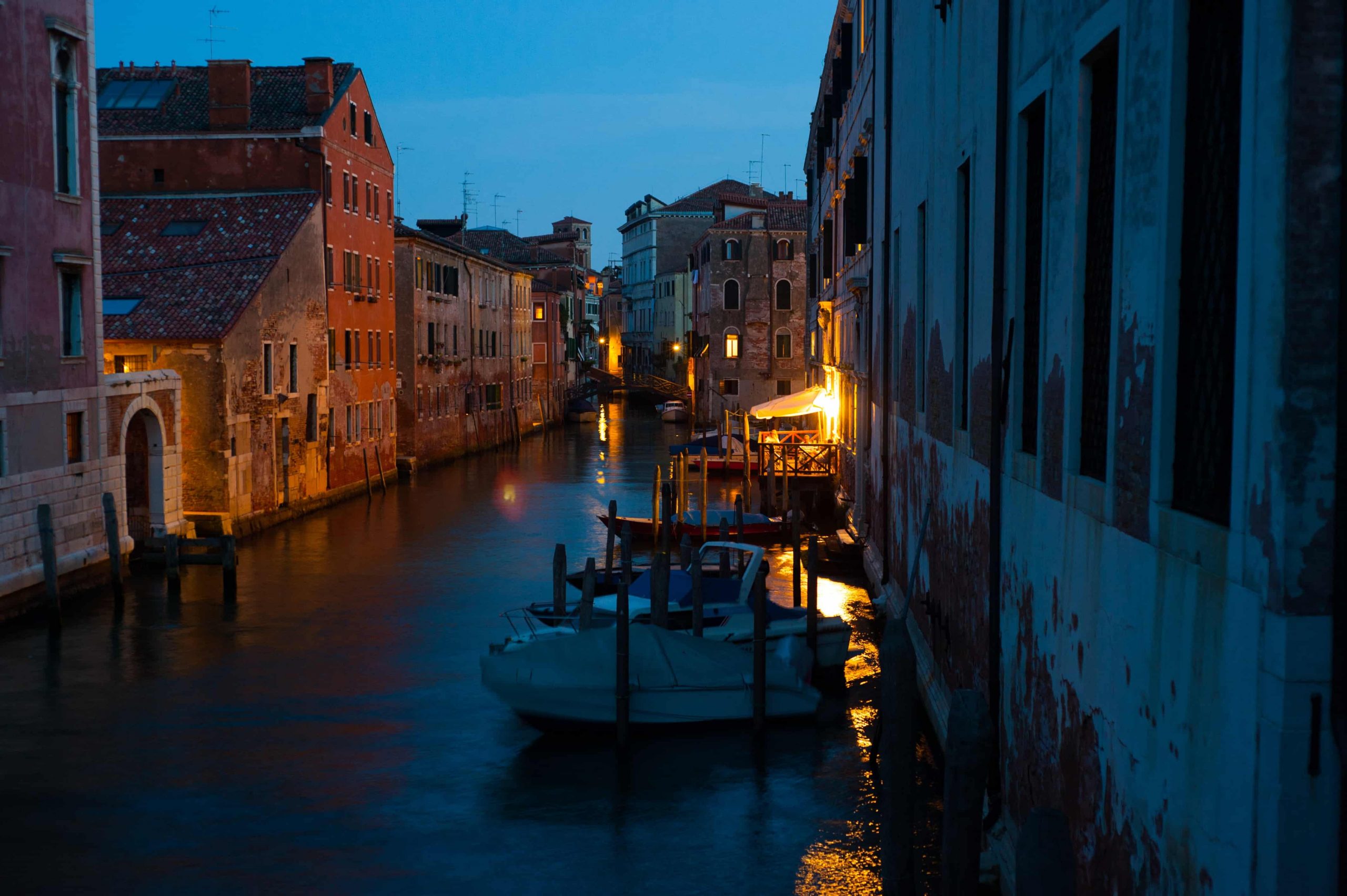
There is a moment, sometime in February, when you walk through a narrow calle and cannot tell whether the figure ahead of you is dressed for the carnival or simply dressed. The bauta covers everything — jaw, mouth, the lower half of the face — and the tabarro drapes the shoulders into a shape that belongs to no particular century. You follow for a moment, not because you mean to, but because something in the anonymity pulls at you. Then the figure turns a corner and is gone, and you are left wondering whether you saw a person at all, or only the idea of one projected onto the fog.
This was not a malfunction of Venetian society. It was the design. From the thirteenth century onward, the bauta was not merely a carnival accessory but a legal identity, recognized by the Republic as a legitimate face for conducting business, attending the opera, placing bets, receiving confessions. For months each year — at certain periods the carnival season stretched from October to Lent, consuming nearly half the calendar — a citizen of Venice could move through the city as no one and as everyone simultaneously. The philosopher and the prostitute wore the same white mask. The senator and the debtor occupied the same anonymous silhouette. The state did not merely permit this. It occasionally required it, so that certain negotiations could proceed without the friction of rank.
Jean Baudrillard, in Simulacra and Simulation published in 1981, proposed that there exists a condition beyond representation, beyond even deception, in which the copy precedes the original — in which the map is drawn before the territory exists, and the territory then grows to match it. He called this the hyperreal: not a false image of something real, but a real produced by the image itself. Most cities use symbols to represent what they are. Venice used symbols to become what it could not otherwise be — a republic of unverifiable identity, a place where the social contract was not between persons but between masks.
There is a story, not quite historical and not quite invented, of a man who becomes obsessed with a woman he sees moving through fog-grey streets, a woman who seems to know where she is going with a certainty that exceeds the living. He follows her for days. He learns her movements better than his own. And then, when he finally reaches her — in a room, in a church, at the edge of water — she dissolves. Not dramatically. Simply: she is no longer there, and may never have been there in the form he believed. What he followed was a silhouette projected by his own need onto the architecture of a city built for exactly that projection. The city did not deceive him. It offered him the conditions under which deception becomes indistinguishable from desire.
Baudrillard would have recognized this immediately. The woman was not a lie covering a truth. She was a simulation — real in every functional sense, producing real grief, real obsession, real loss — but without an original underneath. Venice is full of such constructions. The facades on the Grand Canal present piano nobile windows that, in many cases, open onto nothing, or onto a wall, because the facade was built to be seen from water, and the interior was organized around entirely different logic. The outside and the inside are not connected by any necessary truth. They are two separate productions, coexisting without resolving into each other.
The mask did not hide the face. It educated the face into new possibilities. After generations of men and women who spent half their social lives behind the bauta, the bare face itself became a kind of performance — provisional, aware of being seen, never entirely convinced of its own sincerity. The carnival did not end when the masks came off. It simply moved inward, where no one else could see it, and where it has been running ever since.
What the Acqua Alta Actually Floods
When the water comes, it does not announce itself with drama. It seeps. It arrives through the drains first, bubbling up from below rather than falling from above, and suddenly the piazza is a mirror, and you are standing in something that was always there, just hidden beneath the level of ordinary sight. The boots, the raised walkways, the shopkeepers lifting merchandise onto higher shelves with the tired efficiency of people who have rehearsed this particular emergency several hundred times — none of it reads as crisis. It reads as memory. The city remembering what it is made of.
What the water surfaces, literally, are the foundations. The wooden piles, alder and oak driven into the lagoon floor beginning in the fifth century by people fleeing the mainland, fleeing Attila, fleeing the collapse of a world they had known. They built on nothing solid. They built on mud and desperation and the particular genius of a population that had run out of land. Millions of trunks, submerged in anaerobic sediment, petrified over centuries into something harder than stone, holding up a city that has no right to exist. When the acqua alta rises above the pavement stones, you are not watching a disaster. You are watching the infrastructure declare itself. The hidden made visible, briefly, before the tide retreats and everyone agrees, again, not to speak of what is underneath.
Nicolas Abraham, working with Maria Torok in the years that produced what would become The Shell and the Kernel, articulated something that feels architecturally precise when applied to Venice. The transgenerational phantom, as Abraham theorized it, is not the product of your own repression. It is the crypt installed in you by someone else’s secret — the thing your parents or grandparents could not mourn, could not name, could not metabolize, and so transmitted silently, encrypted in behavior and anxiety and recurring patterns whose origin you cannot locate because it predates your own experience. You are haunted by a burial you did not attend, for a loss you did not personally suffer. The ghost, Abraham wrote, is the gap left in us by the secret of the other.
Venice floods because it was built on burial. Not metaphorically. The city rose from an act of collective flight, from the wreckage of the Roman world, from the particular trauma of people who watched everything they knew dissolve and then drove wooden stakes into a lagoon and said: here. This is where we begin again. That founding violence, that founding grief, was never mourned. It was immediately converted into commerce, into architecture, into the relentless productive energy of a merchant republic that became, for several centuries, the wealthiest and most sophisticated power in the Mediterranean. The Serenissima did not process its origins. It built over them. It laid marble on top of mud and called it civilization.
And so what rises when the water comes is not merely water. It is the unassimilated material of a foundation that was never allowed to be simply a foundation — it was required to be invisible, to be strength, to be the silent premise of everything built above. A man watching his bookshop fill from below, lifting volumes from the lowest shelves with hands that know exactly how high the water will reach, is performing a kind of archaeological labor. He is meeting the substrate. He is standing in what was buried.
Abraham’s phantom operates across generations because secrets do not die when the person keeping them dies. They migrate. They find new hosts. They reproduce their pressure in people who have no conscious knowledge of what they are carrying. Venice has been carrying the weight of its own founding displacement for fifteen centuries, building higher and higher above it, and every year the water returns to remind the city of the exact depth at which the real story was interred.
The Lagoon Looks Back
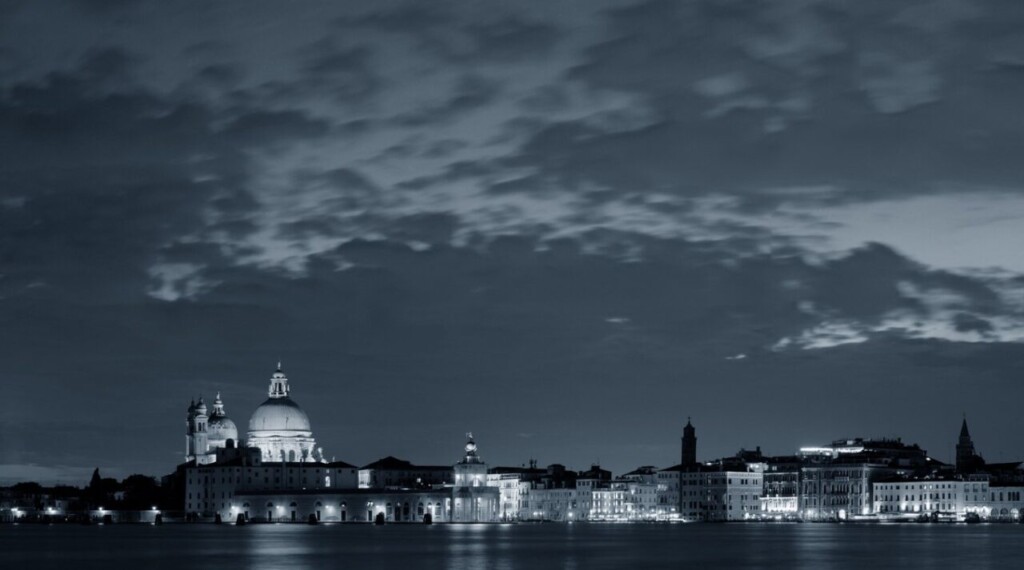
You are standing at the edge of the lagoon at dusk, and the water is showing you a sky that is no longer there. The light you are seeing left several minutes ago. The clouds reflected beneath your feet belong to a moment that has already passed, and yet the surface holds them with perfect fidelity, as though the water has decided that accuracy matters less than beauty, that the past deserves a better afterlife than simple disappearance. You stand there watching a faithful portrait of something that no longer exists, and you do not immediately register this as strange. You register it as Venice.
There is a particular kind of searching that has no object, because the object dissolved before the searching began. A woman walks through a house she has not entered in thirty years, running her fingers along doorframes, pausing at thresholds, waiting for something to arrive that she cannot name. She is not looking for a person. She is not looking for a memory. She is looking for the precise texture of a life she never fully inhabited, a self she was about to become before something redirected her, and the terrible discovery is not that it is gone but that she cannot locate the moment of its going, cannot find the wound, cannot perform the grief that would release her, because grief requires an acknowledged loss and this loss was never acknowledged, never declared, never given a name. The searching itself is the only form the thing takes now. She would have to stop searching to lose it completely.
Walter Benjamin, writing in 1940 in the final months before his death at the Spanish border, described an angel driven backward into the future by a storm blowing from Paradise. The angel’s face is turned toward the past. Where we see a chain of events, the angel sees a single catastrophe that keeps piling wreckage upon wreckage, heaping it at the angel’s feet. The angel would like to stay, to gather the shattered pieces, to wake the dead and make whole what has been smashed. But the storm will not let it. This is what Benjamin called the Angel of History, and it is the most precise description ever written of what it feels like to stand in Venice at dusk, watching the water reflect a sky that has already changed.
The city has made a choice, though it would not call it that. It has chosen to be a monument to itself, to freeze the evidence of its own glory at the precise moment before the freezing became necessary, to sell the arrested image of vitality as a substitute for vitality itself. The population of the historic center has fallen from roughly 175,000 in the mid-twentieth century to fewer than 50,000 today, a number that continues to contract each year, drained by the pressure of thirty million annual visitors moving through streets that were built for a living community and now function as corridors between photographs. The stones remain. The light on the water remains. The reflections remain. What drains away is harder to photograph and therefore easier to ignore.
To live in a city that has already decided it would rather be eternal than alive is to inhabit a particular kind of vertigo, one that has no cure because it is not a sickness but a condition, a structural feature of a place that has accepted its own mythologization so completely that it can no longer distinguish between existing and being commemorated. The lagoon holds the light of a vanished sky and calls it beauty, and perhaps it is beauty, and perhaps beauty is sometimes what we call the things we cannot save, the name we give to loss when we are not yet ready to call it loss, the word we use when the water gives back a sky that has already, quietly, become the past.
🌊 Shadows, Myths, and Labyrinths of the Ancient World
Venice has always been a city suspended between the visible and the invisible, where water mirrors legends and stone corridors hide centuries of whispered memory. These articles explore the cultural, mystical, and philosophical currents that flow beneath the surface of places like the lagoon — where history, spirit, and myth converge.
Pierre Nora and the Sites of Memory
Pierre Nora‘s concept of ‘lieux de mémoire’ — sites of memory — is essential to understanding how a city like Venice transforms its canals, bridges, and palaces into living archives of collective identity. Memory does not simply reside in texts or monuments, but in the very atmosphere of places soaked in time. Venice, with its ghosts and legends, is perhaps the purest example of a city that is itself a site of memory.
GO TO THE SELECTION: Pierre Nora and the Sites of Memory
Byzantine Art: History and Characteristics
Byzantine art shaped the visual and spiritual soul of Venice more profoundly than any other tradition, from the golden mosaics of St. Mark’s Basilica to the solemn gaze of its icons. The flat, luminous forms of Byzantine imagery were not artistic limitations but deliberate expressions of a theology in which the sacred ruptures ordinary space. To walk through Venice is to walk through a city still haunted by the gold and silence of Byzantium.
GO TO THE SELECTION: Byzantine Art: History and Characteristics
What Is Alchemy: History and Origins
Alchemy, in its deepest sense, is the art of transformation — of turning the leaden weight of the material world into something luminous and enduring. Venice, built improbably on water and sustained for centuries by mercantile and intellectual daring, embodies something of that alchemical ambition. Understanding the origins of alchemy opens unexpected corridors into the esoteric currents that quietly shaped Renaissance Venice.
GO TO THE SELECTION: What Is Alchemy: History and Origins
Mystical Films not to Be Missed
Mystical cinema shares with the legends of the Venetian lagoon a fascination with the threshold — the blurred line between the world of the living and the realm of something older, stranger, and unreachable. These films, like Venetian ghost stories, invite the viewer to surrender to atmosphere and symbol rather than seek rational resolution. They remind us that some of the most profound truths are best approached through shadow and water rather than daylight clarity.
GO TO THE SELECTION: Mystical Films not to Be Missed
Discover Cinema That Breathes Like a Venetian Night
If these myths and shadows have stirred something in you, Indiecinema streaming is the place to follow that feeling further. Explore a curated world of independent films that dare to go where the light doesn’t always reach — atmospheric, visionary, and unforgettable. Come and get lost in cinema that, like Venice itself, reveals a different face with every viewing.
👉 EXPLORE THE CATALOG: Watch Indie Films in Streaming
A vision curated by a filmmaker, not an algorithm
In this video I explain our vision

