
The Object in the Glass Case
You stand before a melted watch stopped at 8:15, and the first thing you feel is not horror. It is recognition. The hands have frozen mid-gesture, the casing has collapsed into something closer to sculpture than instrument, and yet the face of the watch still performs its original function with obscene fidelity — it still tells time, just not yours. The glass case between you and the object is doing more work than the curators intended. It is not merely protecting an artifact. It is managing a confrontation that human consciousness would otherwise refuse to complete.

The Hiroshima Peace Memorial Museum, which opened in its original form in 1955 and was substantially reorganized in 2019 to foreground individual testimony over strategic abstraction, understood something that most memorial institutions have not: that objects carry what language abandons. The watch belonged to Kengo Nikawa, who wore it on his left wrist on the morning of August 6, 1945, when the United States dropped Little Boy over the city at 8:15 a.m., detonating at approximately 600 meters altitude to maximize blast radius across an estimated 13 square kilometers. Nikawa died within days. The watch did not. And the asymmetry of that survival is the thing the glass case is quietly asking you to hold.
There is a philosophical tradition that treats objects as neutral, as props in the drama of human meaning-making. But Maurice Merleau-Ponty’s work on embodied perception, particularly in Phenomenology of Perception published in 1945 — the same year the bomb fell — dismantled the idea that our relationship to things is mediated primarily by thought. We encounter objects first through the body, through the implicit memory of touch, weight, and use. A watch is something you have clasped around a wrist, felt tick against a pulse point, glanced at in the middle of ordinary afternoons. When you see one melted, the body registers the violation before the mind can frame it. The museum knows this. The glass case does not neutralize that response. It contains it just enough to prevent collapse.
What the glass also does, less charitably, is permit a certain distance that has become the dominant Western mode of engaging with Hiroshima. The bomb entered official American memory as a necessary evil, a tragic but rational calculation made to end the Pacific War and spare the estimated hundreds of thousands of casualties projected for a land invasion of Japan. Secretary of War Henry Stimson articulated this logic in a 1947 Harper’s Magazine essay titled “The Decision to Use the Atomic Bomb,” which reached millions of readers and effectively installed the framework still operative in most American high school curricula. What Stimson’s essay required was precisely the kind of glass case the museum provides: proximity without contact, witness without implication. The numbers he cited — the figure of one million American casualties that has since been disputed by historians including Gar Alperovitz in The Decision to Drop the Atomic Bomb, published in 1995 — were designed to make the dead in that case disappear behind the hypothetical dead in another.
Memory is not a neutral archive. It is an argument made continuously in the present tense, revised when the argument requires revision, and the melted watch makes an argument that no strategic calculus can absorb. It does not argue about necessity or alternatives or the geopolitics of 1945. It argues about a wrist. It argues about an ordinary Tuesday morning in August when a man put on his watch as he had done every morning of his adult life, and the Tuesday ended in a way that Tuesdays are not supposed to end. The intimacy is not metaphorical. The radiation burns documented on the surviving bodies of hibakusha — the Japanese term for atomic bomb survivors, carrying within it a grammatical structure that means literally “explosion-affected people” — were so severe that clothing patterns were seared into skin, flowers from summer kimonos transferred permanently to flesh.
The glass case lets you look at all of this. It does not let you look away.
Memory as Architecture of Power
You walk through the Peace Memorial Park in Hiroshima on a Tuesday morning in late August, and everything is arranged to receive you. The paths are clean. The cenotaph is centered with almost uncomfortable precision. The flame burns. And somewhere in the geometry of it, in the curated stillness, you begin to feel something you cannot immediately name — not grief exactly, but the management of grief, its architectural administration. The city has been rebuilt around a lesson, and the lesson is not quite what you think it is.
Paul Connerton argued in How Societies Forget, published in 2008, that forgetting is not the absence of memory but a practice — active, structured, socially enforced. He identified what he called “prescriptive forgetting,” the kind sanctioned by authority, where erasure becomes the condition for a new social contract. What happened in Hiroshima and Nagasaki after August 1945 was one of the most concentrated exercises of this mechanism in modern history, not because the dead were ignored, but because the terms under which they were mourned were decided by others, elsewhere, in languages the survivors were not always permitted to speak.
The American occupation of Japan, which ran from 1945 to 1952, imposed Press Code restrictions that explicitly prohibited the publication of material that might, in the language of the directives, “disturb public tranquility.” This included medical reports on radiation sickness, survivor testimony, and virtually any documentary account of what the bombs had actually done to human bodies. Censorship was not confined to journalism: Masaji Ibuse spent years unable to publish what would become Black Rain, his 1965 novel reconstructing hibakusha experience from diaries and interviews. The silence was not natural. It was engineered, and the engineering left physical traces.
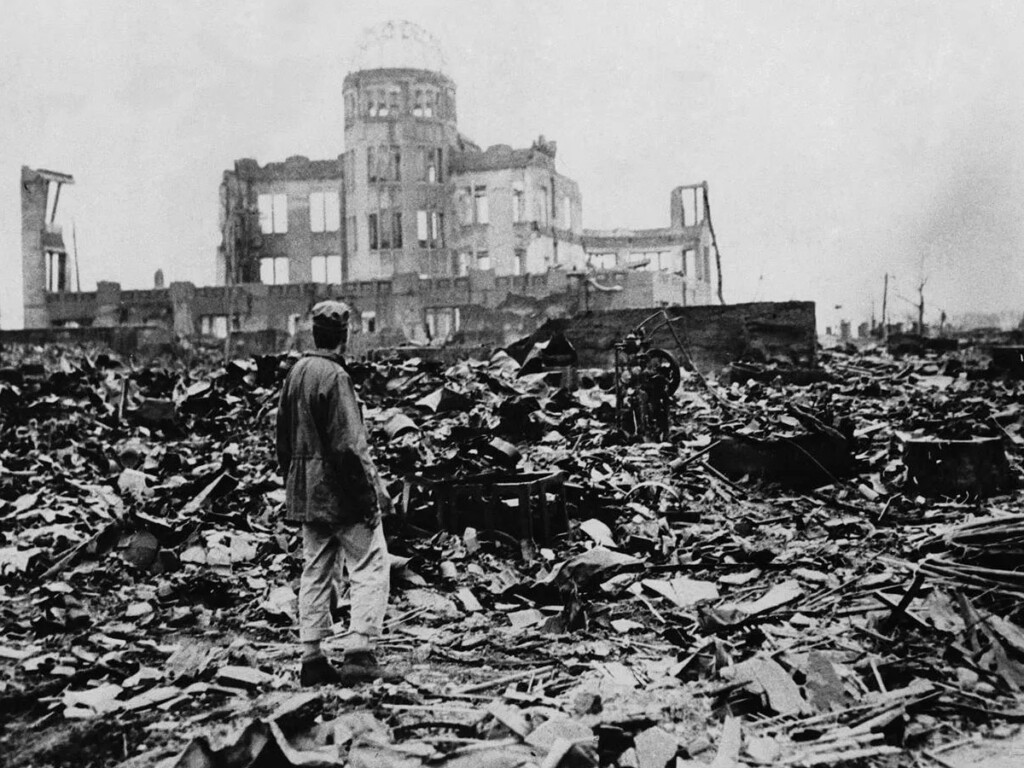
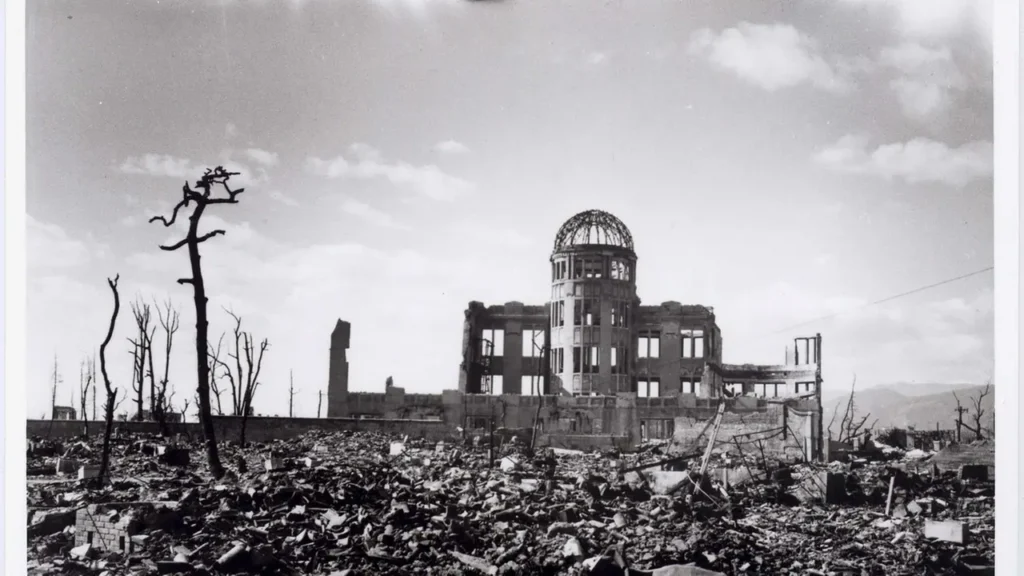
When Hiroshima was redesigned, the city fathers and their American advisors made choices that speak with the clarity of policy. The hypocenter site was not left as ruin but absorbed into a park intended for “peace and culture,” a phrase that does the heavy lifting of aestheticizing catastrophe into civic virtue. The Genbaku Dome, preserved as a skeletal monument, performs the function of controlled visibility — here is the wound, marked, bounded, enclosed within a narrative of recovery and international reconciliation. The dome looks like memory. It functions like a frame that tells you exactly how far to look and exactly when to stop.
Nagasaki received a different choreography, partly because its Christian community, centered in the Urakami district that was obliterated, generated a competing theological interpretation. The Catholic survivors framed the bombing through the language of martyrdom and providential suffering, a framework the Japanese government later found useful because it redirected anguish toward transcendence rather than accountability. The Nagasaki Peace Park, inaugurated in 1955, features a monumental figure with one arm pointing skyward and one extended horizontally — a posture that has been read as both supplication and accusation, a deliberate ambiguity that kept the figure politically portable across audiences with opposed interests.
What Connerton’s framework illuminates is that these spaces do not simply commemorate. They train. They instruct the body in how to move through grief, how long to pause, when to bow, where the cameras should point. The rebuilt city is a curriculum, and every visitor who passes through it, moved and uncertain, is undergoing something closer to civic conditioning than personal mourning. The hibakusha themselves — the estimated 360,000 survivors who carried radiation in their cells and stigma in their social lives — were never quite the intended audience for these monuments. They were the evidence that needed to be housed, interpreted, and ultimately quieted beneath the clean geometry of postwar optimism.
Discipline does not always arrive with obvious force. Sometimes it arrives as a park, a flame that never goes out, a path that leads you gently and inevitably to a single, sanctioned conclusion about what you are standing inside of.

The Victim Who Could Not Speak First
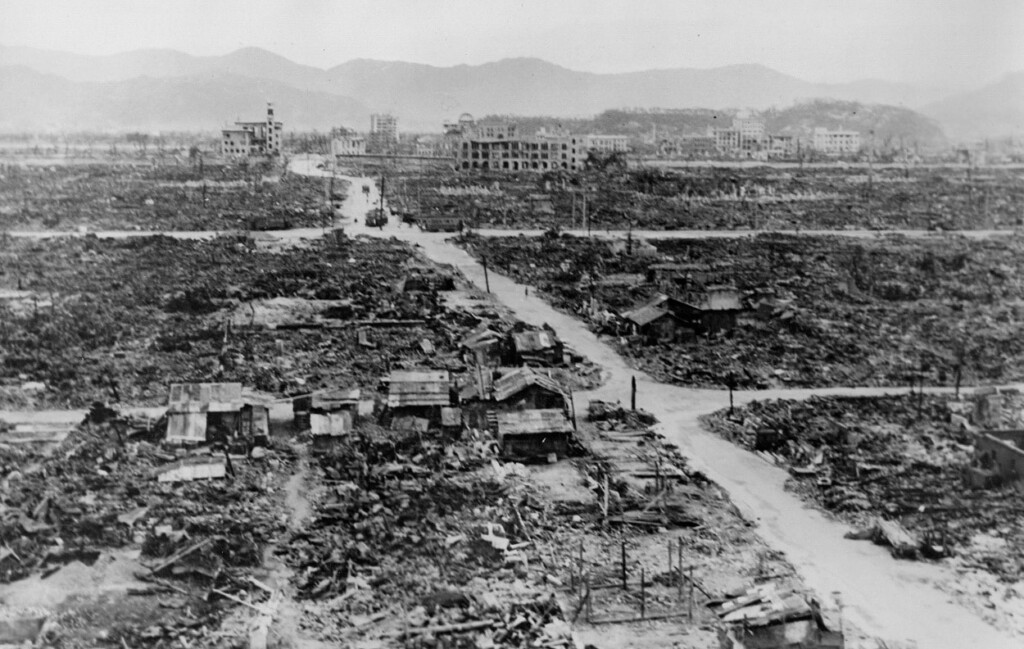
You are sitting in a hospital ward in Hiroshima in the autumn of 1945, and you are not allowed to describe what you see. Not the keloid scars climbing a child’s neck. Not the hair falling in clumps onto white cotton. Not the word “radiation” — because that word, under the Press Code issued by General Douglas MacArthur’s Supreme Commander for the Allied Powers on September 19, 1945, constitutes material “inimical to the objectives of the Occupation.” You are a Japanese journalist, or a survivor with a notebook, or a doctor trying to publish his findings, and the apparatus of the most sophisticated censorship operation in postwar history has already decided that what you witnessed does not yet belong to language.
The SCAP censorship regime, which operated from 1945 to 1952, was not simply military prudishness about military secrets. It was an act of narrative architecture. The Civil Censorship Detachment employed at its peak approximately 8,700 people, monitoring mail, radio broadcasts, newspapers, films, and private correspondence across occupied Japan. What concerned the censors most specifically was not pride or troop morale — it was the emerging medical picture of what ionizing radiation did to the human body over weeks and months. When the physician Masao Tsuzuki, who had studied radiation injuries on animals before the war, attempted to circulate his clinical observations on hibakusha patients, his papers were suppressed. The American Joint Commission for the Investigation of the Effects of the Atomic Bomb, which began working in Japan in late 1945, collected the same data — and classified it. The survivors were studied. They were not heard.
Wilfred Burchett, an Australian journalist, managed to enter Hiroshima on September 2, 1945, and cabled a story to the Daily Express in London describing an “atomic plague” still killing people a month after the bomb. MacArthur’s staff immediately questioned his credentials, suggested his Geiger counter readings were fabricated, and effectively blacklisted him from the occupation press pool. His story ran on September 5 under the headline “The Atomic Plague” — and was immediately countered by an officially sanctioned American narrative insisting that any remaining deaths were simply the delayed effect of blast and fire, that the bomb was, in its way, humane, over quickly, surgical. This counter-narrative was not incidental. It was produced. Brigadier General Thomas Farrell told journalists gathered at a press conference that reports of radiation sickness were “Japanese propaganda.”
What this manufactured silence created was not merely a gap in the historical record. It produced a specific cognitive structure in the cultures that inherited it. When John Hersey’s “Hiroshima” appeared in The New Yorker in August 1946 — the entire issue devoted to six survivor testimonies — it caused a rupture precisely because the American public had been kept, by design, in a condition of managed ignorance for a full year. Hersey’s piece sold out newsstands within hours and was read aloud on ABC Radio over four consecutive evenings. The response was not grief exactly — it was closer to shock at encountering information that felt simultaneously new and somehow already guilty. The public had not been lied to about a detail. They had been lied to about a category of suffering they were never supposed to be able to imagine.
The hibakusha themselves internalized the prohibition in ways that lasted decades. Sociologist Robert Jay Lifton, conducting interviews in Hiroshima between 1962 and 1963 for what became “Death in Life: Survivors of Hiroshima” published in 1967, documented a pervasive phenomenon he called “psychic numbing” — but embedded in his interviews is something structurally prior to psychology: the survivors had spent seventeen years inside a culture that had first forbidden, then merely neglected, their testimony. The silence was not in their minds first. It was in the legal and institutional world around them, and they had learned, with extraordinary precision, the exact shape of what could not be said.
The Humanitarian Weapon
You open the newspaper on August 7, 1945, and the headline tells you that a single bomb has saved a million lives. You do not question this. The arithmetic feels like mercy.
The number itself — one million American casualties projected from a land invasion of Japan — arrived in public consciousness with the confident weight of military calculation, as though it had been tabulated before the fact, extracted from strategic planning documents, verified by the sober machinery of war. Secretary of War Henry Stimson’s 1947 Harper’s Magazine article, “The Decision to Use the Atomic Bomb,” gave that figure its canonical form, presenting the bombings as a tragic but rational humanitarian act, the lesser evil chosen by men who understood the full cost of alternatives. What Stimson did not advertise was that his article was drafted with direct assistance from the War Department, reviewed and shaped by officials whose institutional survival depended on the decision appearing unimpeachable. The piece was not a confession. It was architecture.
Gar Alperovitz spent decades in the archives — American, British, Japanese — and what he reconstructed in his 1995 work is not a conspiracy but something more unsettling: a retroactive moral framework assembled after the targeting decision had already been made on largely political grounds. The casualty projections cited by Stimson were not fixed before August 1945. They escalated dramatically in postwar accounts. Wartime planning documents from the Joint War Plans Committee, dated June 1945, estimated American deaths from a full invasion at somewhere between 25,000 and 46,000 — serious, catastrophic figures, but nowhere near the million-life threshold that became the cornerstone of public legitimacy. The million emerged later, when the justification needed to be proportionate to the act.
This is how moral legitimacy is manufactured in modern democracies: not through falsification exactly, but through a careful selection of numbers, a strategic timing of disclosures, and a public that has been taught to treat official grief as proof of official sincerity. Stimson’s Harper’s article appeared at the precise moment when a broad scientific and ethical critique of the bombings was gaining traction. The Federation of Atomic Scientists had already begun publishing dissenting voices. Some of the Manhattan Project’s own architects — men like Leo Szilard, who had circulated a petition against the bombings signed by 70 scientists in July 1945 — were speaking publicly about the moral dimensions of what had been done. The Stimson piece functioned as a pre-emptive closure of that conversation, translating a political decision made in the context of Soviet diplomatic pressure and postwar geopolitical positioning into the language of anguished necessity.
What Japan’s own military situation actually looked like in the summer of 1945 complicates the framework further. By July, the Japanese navy was effectively destroyed. American naval blockades were producing severe civilian shortages. The Soviet Union’s declaration of war against Japan on August 8 — between the two bombings — had been anticipated by Japanese leadership as a potential war-ending event, since it eliminated any possibility of Soviet mediation. Numerous post-war analyses, including the United States Strategic Bombing Survey published in 1946, concluded that Japan would have surrendered before any land invasion, with or without the atomic bombs. That survey was commissioned by the American government. It has been largely invisible in the popular retelling.
A weapon that kills approximately 70,000 people instantly at Hiroshima, with tens of thousands more dying from radiation sickness and burns across the following months, requires an enormous moral counterweight to remain justifiable in democratic memory. The counterweight was the million lives, and the million lives were, in measurable historical terms, a projection retrofitted to a decision already made for reasons that had as much to do with demonstrating American nuclear capability to Moscow as with ending Pacific combat. To name that is not to dishonor the American soldiers who would have died in an invasion. It is to notice that their hypothetical deaths were conscripted into a moral argument they never agreed to serve.
Hibakusha and the Contamination of Survival
You survived the bomb and then you survived Japan, which turned out to be the harder thing.
The hibakusha — the word itself a bureaucratic coinage, meaning roughly “explosion-affected people,” registered and catalogued by the state beginning in 1957 under the Atomic Bomb Survivors Relief Law — numbered approximately 650,000 in the immediate aftermath of the two bombings. By 2023, the official registry maintained fewer than 113,000 living survivors, most past the age of eighty. Between those two numbers lies not merely mortality but a particular kind of social annihilation that Japan spent decades refusing to name honestly. The survivors did not return to society. They were permitted to return to its physical spaces while being systematically expelled from its human fabric.
The mechanism was contamination by proximity to the unacceptable. Japan in the postwar decade needed its dead to be heroic and its living to be functional, and the hibakusha were neither. They carried radiation sickness, keloid scarring, leukemia rates that by the early 1950s were already statistically visible, and a cancer mortality pattern that Robert Lifton documented with clinical precision in his 1967 study Death in Life: Survivors of Hiroshima — a book that named, for the first time in systematic psychological terms, the survivor’s particular form of guilt: not the guilt of causing harm, but the ontological guilt of having remained alive while others did not. Lifton called it “death imprint,” the way the boundary between the living and the dead becomes internally permeable for those who passed through mass death without dying. Japanese society, rather than confronting this wound, treated it as infectious.
Employers asked on application forms whether candidates had been present in Hiroshima or Nagasaki on the relevant dates in August 1945. Marriage brokers — the nakōdo, those professional intermediaries whose role in arranging unions was still socially central in the 1950s and 1960s — routinely screened out hibakusha from matchmaking registers, or were instructed by families to do so. The fear was explicitly biological: that radiation damage might be heritable, that children of survivors would be born defective, that the contamination was written into the germline. This belief had no scientific support. The long-term studies of survivor offspring, conducted under the aegis of the Radiation Effects Research Foundation established jointly by Japan and the United States in 1975, found no statistically significant increase in hereditary disease or genetic abnormality among children of atomic bomb survivors. The discrimination continued regardless, because the function of the stigma was never medical. It was social quarantine of the inconvenient.
What makes this particular cruelty so structurally elegant is the simultaneity of mourning and exclusion. The same culture that built the Hiroshima Peace Memorial Museum in 1955, that enshrined the ruined Genbaku Dome as a monument, that ritualized August 6th and August 9th as dates of national and eventually international solemnity — this same culture was, in the same decades, quietly ensuring that the people who actually survived those events could not find spouses, could not disclose their status to employers, could not speak openly without risking further social consequence. The monument replaced the person. Commemoration became a technology of disappearance.
The sociologist Yoshida Yutaka, writing in the 1990s on the politics of war memory in Japan, observed that Japanese postwar identity required victimhood to remain abstract and photogenic — the shadow burned into steps, the melted watch stopped at 8:15 — precisely because concrete, living victims complicated the narrative of innocent national suffering. A burned silhouette cannot demand compensation or challenge the state’s account of events. A seventy-year-old woman with radiation-induced cataracts and a lifetime of rejected marriage proposals can, and occasionally did.
Some hibakusha chose silence so complete their own children did not learn the truth until the parents were dying, at which point the secret had already shaped every decision the family had ever made without anyone being permitted to know why.
A vision curated by a filmmaker, not an algorithm
In this video I explain our vision
Godzilla Was Not a Metaphor
You are watching a man in a white coat stare at a devastated coastline, and his face does not carry the expression of a scientist observing data. It carries the expression of someone who already knew this was coming and said nothing, which is a different kind of guilt entirely, and the film does not let him off the hook for it.
The creature that emerged from Japanese cinema in 1954 is still habitually described as a symbol — a metaphor for nuclear anxiety, a displacement of unprocessable grief into monster form, a safe container for feelings too dangerous to name directly. This interpretive gesture is itself a kind of violence, because it performs exactly the operation it claims to describe: it takes something direct and codes it back into abstraction. The film was not processing anything. It was reporting, in the only register available to a society whose government and occupying authority had both, for different reasons, decided that certain truths could not circulate as truths.
On March 1, 1954, the fishing vessel Daigo Fukuryu Maru — the Lucky Dragon No. 5 — was operating outside the declared exclusion zone when the United States detonated Castle Bravo at Bikini Atoll. The blast yielded fifteen megatons, two and a half times the predicted force, and the fallout drifted east as white ash that the crew initially mistook for snow. Twenty-three fishermen were irradiated. One died by September. The Japanese public was told almost nothing useful by American authorities, and what was told was shaped to minimize the political damage of the fact that the United States had again, demonstrably, showered Japanese civilians with radioactive material. The film went into production within months.
What Ishiro Honda and producer Tomoyuki Tanaka built was not allegory. The creature rises from the Pacific, specifically, not from some mythological elsewhere. It is burned, scarred, visibly irradiated — its skin modeled on the keloid scarring that had become, in postwar Japanese visual culture, the indexical mark of the atomic survivor, the hibakusha. The word hibakusha itself carried a social stigma so severe that survivors frequently hid their status to avoid discrimination in employment and marriage as late as the 1980s. Honda was not reaching for myth. He was reaching for the face of someone he had actually seen.
The philosopher Elaine Scarry argued in The Body in Pain, published in 1985, that intense physical suffering resists language — that it unmakes the world of the sufferer precisely because it cannot be shared through ordinary speech. What she did not fully account for is what happens when the political structure actively collaborates with that unmmaking, when the state has a vested interest in the suffering remaining inexpressible. Japan’s 1952 release from American occupation had not released it from American strategic management of its nuclear narrative. The Atomic Bomb Casualty Commission, operating in Hiroshima and Nagasaki since 1950, studied survivors without treating them — a fact that survivors experienced not as neglect but as a second inscription of powerlessness into their bodies.
Mass entertainment absorbs what official speech expels. This is not a therapeutic mechanism and it is not sublimation in any psychoanalytic sense — it is closer to what the sociologist Stanley Cohen described in States of Denial as the way entire societies maintain simultaneous knowledge and not-knowledge of atrocity. The creature is not a symbol of the bomb. The creature is the bomb, rendered at a scale where the audience can finally look at it directly, because it has been given a body, a movement, a sound, a direction of approach. The monster makes visible the thing that policy had made invisible by making it too large to be officially acknowledged.
The Japanese government had banned publication of atomic bomb photographs until 1952. For seven years, the specific texture of what happened — the shadows burned into stone, the skin hanging from raised arms — had been legally absent from public sight.
The Universal That Erases
You have seen the photograph. Not the one you think — not the mushroom cloud rising in its terrible symmetry, which belongs more to poster art than to grief — but the other one: a man sitting on steps that lead nowhere, his shadow burned permanently into the stone behind him, his body itself erased. The shadow outlasted him. That is what you are looking at when you look at Hiroshima: not a war crime with perpetrators and victims and a political chain of decisions, but something that presents itself, after decades of careful cultural management, as a visitation. An event that happened to humanity the way a plague happens. As if the bomb assembled itself.
Susan Sontag argued in Regarding the Pain of Others, published in 2003, that photographs of atrocity do not reliably produce understanding or political clarity — they produce a peculiar form of anaesthesia. Prolonged exposure to images of suffering generates the sensation of having witnessed without the obligation of having understood. The viewer feels morally present at a tragedy while remaining intellectually absent from its causes. Applied to Hiroshima, this mechanism has worked with extraordinary efficiency across eight decades. The iconography of the destroyed city — the skeletal dome, the shadow on the steps, the paper cranes — has become so universally legible that it no longer points anywhere specific. It points inward, toward a generalized sorrow about human nature, which is precisely where political accountability goes to dissolve.
The phrase Never Again emerged from the aftermath of the Second World War carrying real historical weight, but it was never politically neutral. It bundled together events of radically different moral architectures — genocides and bombings and occupations — and dissolved the distinctions between them under a humanitarian umbrella broad enough to cover everyone and therefore to indict no one specifically. When Hiroshima is absorbed into this universalist grammar, August 6, 1945 becomes a monument to the dangers of technology or the madness of war rather than to a specific government’s decision to detonate a nuclear weapon above a civilian population of approximately 350,000 people. The perpetrator dematerializes. What remains is the wound, floating free of the hand that inflicted it.
This floating is not accidental. The American occupation of Japan from 1945 to 1952 included direct censorship of atomic bomb survivor testimony under Press Code provisions that prohibited content critical of Allied conduct. John Hersey’s Hiroshima, published in The New Yorker in August 1946, was the first sustained Western account to restore human faces to the dead and injured, and it was deliberately written without political analysis, a choice that made it publishable and that simultaneously established a template: the story of Hiroshima could be told as a human story only if it was stripped of its geopolitical anatomy. Hersey gave the survivors their suffering back and took away the question of who chose to inflict it.
Japanese cultural production has participated in this structure, not merely as victim but as agent. The Hiroshima Peace Memorial Museum, as it stood for decades before partial revisions in 2019, framed Japan primarily as recipient of destruction, compressing or omitting the country’s own role in the Pacific War, the occupation of Manchuria, the atrocities in Nanjing. The memorial grammar required a clean victim, which meant a selectively amnesiac nation. The universalist humanitarian frame thus served multiple political interests simultaneously: it allowed the United States to mourn without confessing, Japan to commemorate without accounting, and the international community to feel the appropriate weight of tragedy without being required to locate it on a map of cause and effect.
What the universal absorbs most efficiently is not the specific dead but the specific living — the hibakusha, survivors who spent decades fighting for medical recognition, legal compensation, and the most elementary acknowledgment that what happened to their bodies had a name and a responsible party, and who found that the louder the world proclaimed Never Again, the less it seemed interested in answering the prior question of what, exactly, it was never doing again, and to whom, and on whose order.
What the Anniversary Performs
Every August 6th, in Hiroshima’s Peace Memorial Park, a mayor reads a declaration, a bell tolls at 8:15 in the morning, and figures in dark suits lower their heads before a curved stone cenotaph while the city holds its breath for sixty seconds. The choreography is impeccable. Children release doves. A choir sings. And somewhere above the treeline, at an altitude calibrated not to disturb the proceedings too visibly, aircraft from the Japan Air Self-Defense Force conduct scheduled exercises over the Seto Inland Sea, their contrails dissolving into the same August sky that seventy-nine years ago turned white and then black and then silent. Nobody at the microphone mentions this. The doves circle and land.
What the ceremony produces is not memory but the management of memory — a distinction that the sociologist Paul Connerton drew with uncomfortable precision in his 1989 work How Societies Remember, where he argued that commemorative rituals do not preserve the past so much as they choreograph a relationship to it, selecting which affects are permissible, which bodies are visible, which silences count as mourning and which count as erasure. The cenotaph inscription reads: “Rest in peace, for the error shall not be repeated.” In Japanese, the subject of that sentence is grammatically absent. No one committed the error. No nation dropped the bomb. The stone mourns an event that, syntactically, happened by itself.
This grammatical void did not appear by accident. It was the result of a political negotiation in 1952, the year Japan regained sovereignty under the San Francisco Peace Treaty, a treaty signed while the Korean War was still burning and American bases were already being permanently embedded into Japanese soil under the bilateral security agreement. The postwar Japanese state needed a language of victimhood that could coexist with military alliance, and the cenotaph gave them exactly that: grief without accusation, loss without perpetrator, commemoration without the friction of historical accountability. The American government, for its part, required Japanese civil society to metabolize the bombings not as war crimes but as the tragic terminus of a conflict that Japan itself had started — a framing that absolved the decision-makers in Washington while permitting the survivors, the hibakusha, to mourn within strictly bounded emotional parameters.
What makes the contradiction at the ceremony so structurally stable is that both elements — the mourning and the military normalization — draw legitimacy from the same source: the idea that Japan is now a peaceful nation, defined by its suffering rather than its imperial violence, committed to a security architecture that happens to require the very weapons and alliances that make another Hiroshima not unthinkable but merely impolitic to mention. The 1947 Article 9 of the Japanese Constitution, which renounced war as a sovereign right, was drafted under American occupation and has been reinterpreted steadily since 2015 to permit “collective self-defense,” meaning Japan can now participate in armed conflicts alongside allies. The dove and the contrail are not in tension. They are collaborating.
Judith Butler, writing on grief and politics in Precarious Life in 2004, asked which lives are grievable — which losses a society is permitted to publicly mourn and which remain outside the frame of legitimate suffering. The August 6th ceremony answers this question with architectural certainty: the Japanese civilian dead are fully grievable, canonized in stone and silence and schoolchildren’s paper cranes. The Korean forced laborers who died in Hiroshima, estimated at somewhere between twenty and thirty thousand, received a memorial only after decades of activism, and it was placed outside the park’s official boundary until 1999. The hibakusha who were Korean were for years denied the same medical benefits as Japanese survivors under a legal distinction that the Japanese Supreme Court did not fully close until 1978. Grief, it turns out, has a passport control.
The ceremony does not fail to remember. It remembers with extraordinary discipline, which is precisely the problem — because disciplined memory is always memory in the service of something other than the dead.
💀 Memory, Trauma, and the Weight of History
The atomic bombings of Hiroshima and Nagasaki left wounds that transcend individual experience, shaping collective memory, cultural identity, and the ethical imagination of entire generations. These articles explore how literature, philosophy, and the arts have grappled with catastrophe, remembrance, and the meaning of survival.
Jan Assmann and Cultural Memory
Jan Assmann’s theory of cultural memory examines how communities preserve and transmit traumatic historical experiences across generations through rituals, texts, and monuments. His work is essential for understanding how the memory of Hiroshima and Nagasaki became encoded in Japanese cultural and political identity. Assmann shows that collective memory is never neutral — it is always shaped by the needs and wounds of the present.
GO TO THE SELECTION: Jan Assmann and Cultural Memory
Pierre Nora and the Sites of Memory
Pierre Nora’s concept of ‘sites of memory’ offers a powerful framework for interpreting the memorials and museums of Hiroshima as places where history crystallizes into living symbol. He argues that such sites emerge precisely when a living memory begins to fade, replaced by the need for deliberate commemoration. The Peace Memorial Museum in Hiroshima stands as one of the most charged examples of this phenomenon in the modern world.
GO TO THE SELECTION: Pierre Nora and the Sites of Memory
Paul Ricœur: Life and Philosophy of Memory
Paul Ricœur devoted much of his philosophical life to the relationship between memory, forgetting, and the ethical obligation to bear witness to historical suffering. His reflections on narrative identity help us understand how survivors of Hiroshima and Nagasaki constructed meaning from the ruins of the unthinkable. For Ricœur, true memory is inseparable from justice — a call to remember that must resist both oblivion and the distortion of ideology.
GO TO THE SELECTION: Paul Ricœur: Life and Philosophy of Memory
Banal Evil and Radical Evil: Kant and Arendt
Hannah Arendt’s distinction between banal evil and radical evil illuminates the moral catastrophe implicit in the decision to drop atomic bombs on civilian populations. Her analysis of how bureaucratic systems enable extraordinary destruction without personal malice remains hauntingly relevant to the history of Hiroshima and Nagasaki. Reading Arendt alongside atomic history forces us to ask not only what happened, but how ordinary political and military structures made it possible.
GO TO THE SELECTION: Banal Evil and Radical Evil: Kant and Arendt
Discover Independent Cinema on Indiecinema
If these themes of memory, trauma, and historical consciousness move you, Indiecinema’s streaming platform offers a curated selection of independent and documentary films that explore war, survival, and the ethics of remembrance with the depth and courage that mainstream cinema rarely dares. Dive into a world of cinema that challenges, provokes, and transforms — only on Indiecinema.
👉 EXPLORE THE CATALOG: Watch Indie Films in Streaming
A vision curated by a filmmaker, not an algorithm
In this video I explain our vision

