
The Man Who Just Did His Job
You are sitting across from him at a table that is too small for the conversation. He has ordered coffee, something ordinary, and he stirs it with the patience of a man who has nowhere else to be. His hands are clean. His collar is pressed. When he speaks, his voice carries the particular flatness of someone recounting a commute or a grocery list — the voice of a man who has spent decades being professionally reasonable. He tells you, without flinching, about the forms he processed. The transfers he authorized. The quotas he helped meet. He uses the word “efficient” three times in four minutes. He does not look away. He does not lower his voice. There is no tremor in his jaw, no shadow crossing his eyes at the memory of what those forms, those transfers, those quotas actually meant for the people they named. He finishes his coffee. He checks his watch. He has, he tells you, another meeting.

This is not a monster. This is the thing that is far more difficult to hold in the mind than a monster: a man who is simply not there, morally speaking, even while being thoroughly, agreeably, physically present. He has a family. He votes. He probably helps neighbors carry furniture. And he participated, with full procedural competence, in catastrophe — because the procedures asked him to, and because asking further questions was not, strictly speaking, part of his role.
Hannah Arendt spent time watching a man like this in Jerusalem in 1961, and what disturbed her — what disturbed the entire watching world, though for different reasons — was not what she saw but what she failed to see. She had expected a demon. She found a clerk. Adolf Eichmann, the SS-Obersturmbannführer who coordinated the logistics of the Holocaust’s deportations, sat in his glass booth and spoke in bureaucratic clichés, corrected minor factual errors with the zeal of a man protecting his professional record, and displayed what Arendt described in her 1963 “Eichmann in Jerusalem” as a near-total absence of independent thought. Not stupidity exactly, but something more vertiginous: a kind of deliberate, almost cultivated thoughtlessness. A refusal to think from anyone else’s position. A man who had surrendered the faculty of judgment so completely that it no longer registered as a loss.
Arendt called this the banality of evil. The phrase scandalized people because it seemed to diminish. It seemed to let someone off a hook that the twentieth century had spent enormous effort constructing. But Arendt was not diminishing — she was making a distinction that philosophy had not yet had the precision to make, and that distinction cuts directly back to Immanuel Kant, whose moral architecture Eichmann had not violated in any dramatic, defiant, Satanic sense. He had simply never used it. Kant argued in the “Groundwork for the Metaphysics of Morals” in 1785 that moral action requires the exercise of rational autonomy — that to act ethically is to act as a legislating member of a kingdom of ends, treating humanity never merely as a means. What Eichmann demonstrated was not the refusal of that principle but the evacuation of the space in which it could even be considered. He had replaced practical reason with practical compliance.
And this is what makes the man across the table from you so much harder to process than any villain you have ever watched or read or been warned about. Villainy has a face. It has motivation, interiority, a recognizable shape. What sat in that glass booth — what sits across from you now, stirring his coffee — has none of those things. It has a job description. It has a filing system. It has, somewhere in a drawer, a performance review that probably calls him diligent.
The Mirror and the Rascal

Drama film, by Valerio De Filippis, Italy, 2019.
The mirror and the rascal is an experimental film based on the tragedy "Richard III" by William Shakespeare. It tells the delirium of contemporary power in an author's reinterpretation of cinema, video art and music. The protagonist, Richard Duke of Gloucester, brother of King Edward IV, through a long series of crimes eliminates all the obstacles that stand between him and the throne of England.
Valerio de Filippis, a well-known painter who has been following his research path for a long time, investigating the relationship between light, corporeality and the psyche. The mirror and the rogue and the cinematographic equivalent of Valerio De Filippis' painting, his figurative style is in fact very recognizable looking at his paintings. But cinema is a new way where the artist can also be involved as an actor and performer, with an original mix between acting and singing. Staging the dark side of the human soul, the film is a surreal and disturbing interpretation of a great classic. The director says: "The first suggestion was musical: I was interested in transforming the text of Shakespeare's tragedy Richard III into notes. I love cinema and at a certain point I felt that the time had come to combine research on the image of painting to my love for cinema and music. When the film is finished I realize that I have remained faithful to painting: every frame of the film appears to me like a painting: the same light, the same colors, the same atmosphere ". The mirror and the rascal is a kind of psychoanalytic session that the painter does while hiding behind the mask of Richard III. Behind this ferocious and unscrupulous character we find a path of self-analysis by De Filippis, who is mainly interested in the more violent and turbid aspects. An experimental film in which, with great courage, the author gets involved completely, fragmenting the images in an unconventional montage, which is at the same time a flow of consciousness and spectacle.
LANGUAGE: English
SUBTITLES: Italian
Kant’s Radical Evil: The Corruption at the Root
You already know the moment. You have lived it more than once, probably more than you would like to count. Someone needed something from you — not a great sacrifice, not a heroic gesture, just your honesty, your time, your willingness to say the uncomfortable thing — and you chose not to give it. Not because you misunderstood what was right. Precisely because you understood it perfectly. You weighed it, you felt it, and then you quietly placed your own comfort on the other side of the scale and watched it win. You walked away telling yourself a story that made the choice bearable: it was not the right moment, the relationship was too fragile, no one else would have done differently, the outcome would have been the same anyway. The justification arrived almost before the decision did, as if the mind had rehearsed it in advance for exactly this kind of occasion.
Kant called this radical evil, and what makes his account so difficult to dismiss is that it has nothing to do with ignorance or monstrosity. In Religion Within the Bounds of Bare Reason, published in 1793 when he was nearly seventy and already in conflict with Prussian censorship, Kant proposed something that cut against the optimism of his own Enlightenment project: that human beings possess a fundamental, innate propensity to invert the moral order. Not a propensity to forget the law. A propensity to know it and subordinate it anyway. To place the incentives of self-love above the demands of practical reason while maintaining the full awareness that you are doing so. This is why he called it radical, from the Latin radix, root. The corruption is not on the surface of behavior. It lives at the ground of the will.
What this means in practice is something far more intimate and far less dramatic than any image of villainy. It is the conversation you redirected when it was heading somewhere that would have cost you. It is the professional assessment you softened because the full truth would have created friction. It is the pattern you recognized in yourself and chose not to examine because examination would have required change. The human being capable of radical evil is not alien to moral reasoning. He is, in Kant’s precise formulation, a being who uses reason to construct the very justifications that excuse him from reason’s demands. He does not abandon the moral law. He bends it into the shape of his convenience and calls the result a principle.
For Kant, this propensity is universal. He is not describing a character type or a social class or a historical period. He is describing the structure of human freedom itself, the fact that to be free is to be capable of choosing against what you know, and that this capability is not an accident but a permanent feature of being human. Schiller, his contemporary and occasional sparring partner, found this vision grim enough to mock: the only way to be truly virtuous by Kantian standards seemed to require that you act rightly against your own inclinations, as if virtue were a form of perpetual self-resistance. But Schiller missed the harder point. The grim thing is not that we must resist our appetites. The grim thing is that we are sophisticated enough to dress those appetites in the language of ethics, to genuinely believe, at the moment of choosing, that we are being reasonable.
This is what makes the small betrayals so persistent. They do not feel like betrayals. They feel like judgment calls. They feel like wisdom, pragmatism, proportion. The man who tips the scales of his own self-interest does not experience himself as corrupt. He experiences himself as someone who understands how the world actually works.

The Desk Murderer and the Absence of Thought
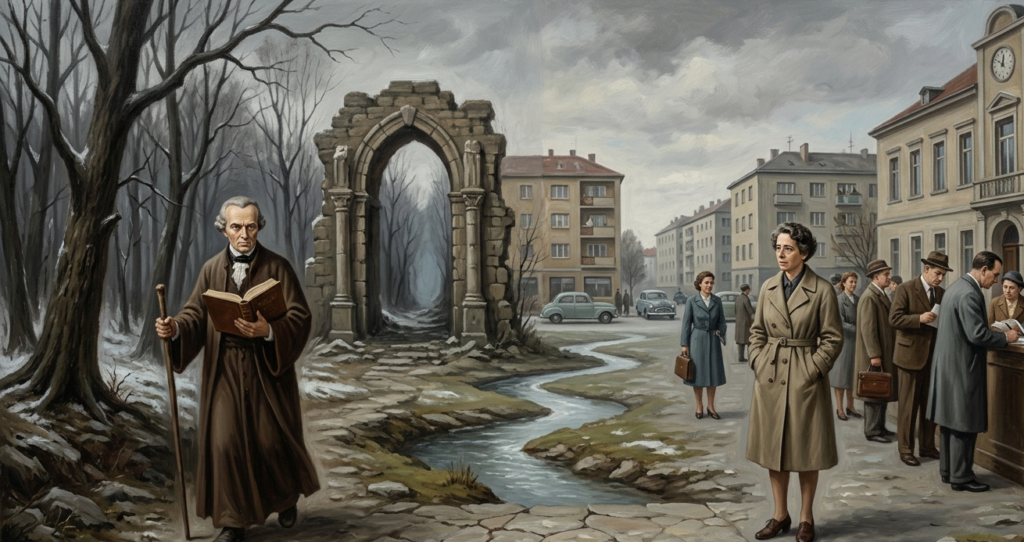
You sit across from him at the table and you realize, with a quiet horror that takes a moment to register, that there is nothing there. Not malice. Not contempt. Not even indifference in the dramatic sense. There is simply a man doing his job, carefully, conscientiously, with the mild satisfaction of someone who has found the correct answer to a procedural question. He is reviewing timetables. He is cross-referencing departure schedules with capacity figures, noting which routes can accommodate larger volumes, which transfer points create unnecessary delays. He has the focused, unremarkable expression of someone solving a crossword puzzle on a Sunday morning. The horror is not in what he feels. The horror is precisely that he feels nothing in particular — or rather, that the question of feeling has simply never entered the room.
Hannah Arendt sat in a Jerusalem courtroom in 1961 and watched Adolf Eichmann, the man who had organized the logistical architecture of the Holocaust, and found herself confronting something that her existing moral vocabulary could not adequately describe. She had expected a monster. What she found was a bureaucrat. What she found, in the precise and devastating phrase she coined in Eichmann in Jerusalem in 1963, was the banality of evil — not a diminishment of the evil, but a description of its mechanism. Eichmann had not acted from hatred, or from ideological fanaticism in any psychologically deep sense. He had acted from something far more disturbing: from thoughtlessness. From the complete and apparently comfortable absence of the capacity to think from anyone else’s point of view.
This is not stupidity. Arendt was meticulous about this distinction. Eichmann was not an imbecile. He was, as she noted with visible discomfort, terrifyingly normal. He used clichés with the fluency of a man who has replaced genuine thought with a set of phrases that do the thinking for him. He spoke of duty, of orders, of the proper channels, of his professional responsibilities. When pressed on the moral dimension of his actions, he retreated not into cruelty but into procedure. The language of administration had become, for him, a complete cognitive universe, one with no aperture through which the reality of the people being transported could enter.
Kant had argued, in the Critique of Practical Reason, that moral action requires what he called the capacity to reason universally — to ask whether the maxim of your action could be willed as a law for all rational beings. This is not merely an abstract formula. It is a demand for imagination. It requires you to step outside your own position and inhabit, at least hypothetically, the position of the other. Eichmann had systematically, perhaps effortlessly, dismantled this capacity. He had made himself into a purely functional entity. Arendt saw this and understood that Kant’s moral framework had been not refuted but simply switched off, the way you switch off a lamp not by destroying it but by unplugging it from its source.
The timetables were real. The trains ran on time, or close enough. Somewhere between one departure and the next, between one column of figures and the next, what was being organized ceased to be imaginable as human. This is what Arendt meant by the absence of thought — not ignorance of the facts, but the refusal, or the inability, to let the facts become real in the way they must become real if moral response is to be possible at all. The desk is always clean. The paperwork is always in order. The man behind it is, by every conventional measure, doing his job well. And it is precisely this wellness, this professional adequacy, this complete closure of the self against the weight of what is actually happening, that makes the machine run without friction.
Banality Is Not Innocence
There is a persistent and dangerous misreading that has followed Arendt’s work like a shadow for decades, one that mistakes her diagnosis for an acquittal. To say that evil can be banal is not to say that it is forgivable, or minor, or somehow diminished by its ordinariness. The confusion is understandable — we have been trained, culturally and morally, to believe that the magnitude of a crime must be matched by the magnitude of the criminal’s inner darkness. When Arendt refuses that match, when she looks at Eichmann and sees not a monster but a bureaucrat, many readers hear absolution. They are hearing something else entirely.
What Arendt is doing, and what requires genuine intellectual courage to follow, is relocating the site of moral failure. The failure is not in the presence of malice. It is in the absence of thought. And this is not a soft indictment — it is, in many ways, a harder one. A monster can be recognized, contained, exorcised from the social body like a foreign element. A man who simply does not think, who processes orders the way a machine processes input, who attends to procedures while remaining completely sealed off from the human meaning of what those procedures produce — that man is everywhere. He sits in offices. He signs forms. He attends meetings. He goes home and loves his children.
In 1961, the same year Eichmann stood trial in Jerusalem, a young psychologist at Yale named Stanley Milgram began what would become one of the most disturbing empirical projects in the history of social science. Ordinary American adults — teachers, engineers, accountants — were instructed by an authority figure in a white coat to administer electric shocks to another person whenever that person answered a question incorrectly. The shocks were not real, but the subjects did not know that. What Milgram found was that approximately sixty-five percent of participants continued to administer shocks all the way to the maximum voltage, labeled on the machine as “Danger: Severe Shock,” even as they heard what they believed were screams of pain from the next room. They were not sadists. Many showed visible distress. They simply could not find the internal mechanism to disobey. The authority of the situation overrode the authority of their own moral perception.
This is Arendt’s thoughtlessness made measurable. Philip Zimbardo’s later situationist research pushed even further into the same territory, demonstrating that ordinary people placed in structured roles — guard, prisoner, officer, subordinate — would enact cruelty not because of who they were, but because of where they had been placed. The situation, once accepted, began to think for them. Their individual moral agency did not disappear dramatically. It simply went quiet, suffocated under the weight of institutional logic and social expectation.
Kant had already understood the stakes. For him, the moral law was not something imposed from outside — it was something reason gives itself. The categorical imperative demands that you ask, always, whether the principle behind your action could function as a universal law. That question requires you to be present, to think, to remain a subject rather than a function. The moment you delegate that question — to your superior, to your role, to the efficiency of the system — you have committed what Kant would recognize as a fundamental abdication. You have treated yourself as a means, and in doing so, you have made it structurally inevitable that you will treat others the same way.
Thoughtlessness, then, is not a neutral condition. It is not the absence of evil — it is the specific climate in which a particular kind of evil becomes not only possible but routine. Arendt was not excusing Eichmann. She was warning you about something much closer to home than a Nazi trial in Jerusalem, something that does not require hatred to function, only habit and the willingness to stop asking questions.
When the System Becomes the Conscience
There is a particular kind of stillness that settles over a man who has found procedural peace. You have seen it, perhaps even inhabited it: the satisfaction of completing a form correctly, of following a protocol to its final checkbox, of delivering a report that satisfies every metric demanded of you. The conscience quiets itself precisely because the system has spoken first. There is nothing to judge because everything has already been adjudicated by the institution that holds your signature.
This is the architecture Zygmunt Bauman spent the better part of his intellectual life excavating. In Modernity and the Holocaust, published in 1989, he argued something that still has not been fully absorbed: the Holocaust was not a rupture in Western civilization but its logical extension. Bureaucracy, rationalization, the division of moral labor — these were not corruptions of modernity but its instruments, turned toward a task that modernity made conceivable and manageable. The horror was not that it was primitive. The horror was that it was orderly.
Think of the man burning documents at dawn. Not in some wartime cinema of chaos, but quietly, methodically, feeding paper into fire with the same attentiveness he brings to his taxes. He is not agitated. He checks each batch against a list. He is, in the fullest administrative sense, doing his job. The question of what those documents contain, what lives they encode, what their destruction forecloses — this question does not arrive. It has been pre-empted by procedure. He was told to do this. The authorization came from above. He is, as Bauman would have recognized immediately, a cog who has mistaken the smoothness of his rotation for virtue.
Bauman borrowed from Max Weber the concept of the bureaucratic personality — the official who succeeds by making himself invisible inside the machine — and showed how modernity refined this into a moral technology. The more complex the chain of command, the more diffuse the sense of responsibility. Each person does their fragment, and no one does the whole. An engineer calculates the load-bearing capacity of a train. A logistics officer schedules the departure times. A clerk processes the transport lists. None of them touches anyone. All of them are implicated in everything.
What makes this so difficult to see from the inside is that institutional loyalty presents itself as its own ethics. You keep your word. You complete your assignments. You do not let your colleagues down. These are recognizable moral categories, even admirable ones in ordinary life. The system does not ask you to abandon your conscience. It simply relocates it — from the abstract question of what is being done to the concrete question of whether you are doing your part correctly. Hannah Arendt noticed this in Eichmann: he was not indifferent to morality. He was ferociously attentive to a morality entirely internal to the system he served.
This is what Bauman meant by the social production of moral invisibility. Evil does not need willing perpetrators. It needs reliable functionaries. It needs people for whom the question of whether something should be done has been permanently replaced by the question of how it should be done. The transition between those two questions is where conscience disappears — not dramatically, not in a moment of choice, but gradually, almost imperceptibly, the way a language fades when you stop speaking it.
And this is the real inheritance, the one that makes Bauman’s argument still inflammatory: these conditions did not dissolve in 1945. The bureaucratic architecture of diffused responsibility, of institutional loyalty as moral substitute, of procedural correctness as ethical alibi — it survived, reformed, modernized. The man burning documents at dawn is not a historical figure. He files reports. He processes applications. He implements policies whose downstream consequences he is structurally positioned never to see, and the system rewards him precisely for not looking.
A vision curated by a filmmaker, not an algorithm
In this video I explain our vision
Radical Evil Returns: The One Who Chose

There is a moment, buried in the later correspondence between Hannah Arendt and her teacher Karl Jaspers, where she admits something she never quite managed to say cleanly in print: that the figure of thoughtlessness, of the man who simply did not think, had perhaps occluded another figure lurking behind him — one who thought very clearly, who constructed a worldview with genuine internal coherence, and who acted from within it with full deliberate intention. She did not retract Eichmann. She complicated the frame.
Kant had been there first. Before Arendt turned the concept of radical evil into something she would later partially disown, Kant had already located it in the Religion Within the Boundaries of Mere Reason, published in 1793, in a place that makes most readers uncomfortable: not in the monster, not in the demon, but in the human capacity to knowingly subordinate the moral law to self-interest while continuing to dress that subordination in the language of principle. Radical evil, for Kant, was not the absence of moral reasoning. It was its corruption from the inside — a will that had inverted the proper hierarchy of maxims and elevated inclination above duty, not through ignorance but through a kind of perverse lucidity.
This is what the banal picture, taken alone, cannot account for. Think of someone — not a clerk, not a middleman — who knew the architecture of what was being built, who had studied it, who contributed to its ideological scaffolding with genuine intellectual investment. Someone who had read the texts, refined the arguments, felt the fervor of a cause understood as not only permitted but required. The deliberate evil-doer is not thoughtless. He is saturated in thought. His thought has simply organized itself around a different center of gravity, one in which the victims are not fully real, or are real precisely as obstacles, or are real as necessary sacrifices to something the perpetrator genuinely regards as higher. The moral universe is not absent. It is inverted.
This is where the Arendtian revision gets its teeth. She had argued, famously, that radical evil — in the sense of a positively demonic will — had become obsolete, replaced by something more mundane and therefore more dangerous. But in the years following the Eichmann trial, she returned to the question with less certainty. The philosopher Judith Butler, reading Arendt closely, noted that the concept of thoughtlessness never fully displaced radical evil — it displaced one version of it, the romantic version, the Miltonic Satan who at least had the dignity of knowing he had fallen. What remained was something harder to name: the ideologue who had thought himself into a closed system where cruelty became virtue.
You have encountered this, in smaller registers. The person who has constructed a complete moral architecture in which their cruelty toward someone is not only justified but obligatory. Who does not flinch because they have done the intellectual work of not flinching. Who can explain, with genuine conviction, why what they are doing is not merely permissible but good. This is not the bureaucrat who does not look up from the paperwork. This is someone who looked, saw, and built a philosophy around the looking.
The psychologist James Waller, in his 2002 study Becoming Evil, documented how ordinary people are transformed into perpetrators not simply through the mechanism of thoughtlessness but through active ideological investment — the construction of a moral vocabulary that reframes violence as purification, harm as hygiene, destruction as duty. The banality and the radical are not mutually exclusive. They coexist in the same historical event, sometimes in the same person at different moments of the same day.
Arendt never fully resolved this. The question she could not answer cleanly was whether the two types — the thoughtless executor and the deliberate architect — required different moral languages entirely, or whether they were simply two expressions of the same fundamental rupture.
The Mirror Between the Two
There is a corridor. Two men pass through it daily, sometimes twice, sometimes three times. They do not greet each other, do not look each other in the eyes, do not share a meal or a word. One carries files. The other carries an ideology. Together, without ever speaking, they have organized something that neither could have accomplished alone.
This is the structural truth that most analyses of evil refuse to acknowledge, because acknowledging it collapses the comfortable architecture of moral distinction. We want banal evil and radical evil to be opposites — the zealot on one side, the functionary on the other — because if they are opposites, we can choose which one we are not. But they are not opposites. They are accomplices. They are the two halves of a single mechanism, each one useless without the other, each one granting the other precisely what it lacks.
The ideologue needs the bureaucrat because vision without infrastructure is merely fantasy. The bureaucrat needs the ideologue because procedure without purpose is merely noise. What binds them is not agreement, not friendship, not even mutual recognition. What binds them is the division of moral labor — a silent compact in which each party outsources to the other the part of the act he cannot bear to own.
Christopher Browning documented this compact with an almost unbearable precision. His 1992 study of Reserve Police Battalion 101 — five hundred ordinary German men, not ideological fanatics, not SS zealots, but middle-aged Hamburg policemen, many of them working-class, with no particular history of antisemitism — demonstrated that these men killed approximately 38,000 Jews and deported 45,000 more to the Treblinka extermination camp. They were offered the choice to opt out. Very few did. Not because they were monsters. Because the bureaucratic framework surrounding them had already pre-digested the moral weight of the act. Someone else had decided. Someone else had signed. Someone else believed. All they had to do was follow procedure.
Browning was drawing on the same vein that Hannah Arendt had struck two decades earlier, but he drove the excavation further into the empirical bedrock. What he found was not a population of haters but a population of conformists — men who killed not out of conviction but out of group pressure, careerism, and the path of least social resistance. Philip Zimbardo would later frame this within his concept of the Lucifer Effect, published in 2007, arguing that evil is less a property of individuals than a product of situations — that the situation itself becomes the moral agent when individuals abdicate that function.
But here is what the corridor reveals that neither Browning nor Zimbardo fully names: the situation was not accidental. It was designed. Someone built that corridor. Someone decided that the files would flow in one direction and the orders in another. The banality and the radicalism did not simply coexist — they were architecturally integrated. The bureaucrat’s indifference was not a failure of the system. It was a feature of it. Heinrich Himmler understood this with cold administrative clarity. Rudolf Höss, the commandant of Auschwitz, understood it in his bones. The machine required men who did not feel too much. The men who did not feel too much required the machine to tell them what they were doing was not murder but logistics.
Kant had glimpsed this danger in his concept of radical evil — the capacity of human will to invert the hierarchy of moral law and self-interest — but he had framed it as an individual corruption. Arendt saw that it had become collective, institutional, distributed. What she perhaps did not say with enough force is that the two forms are not merely related. They are constitutive of each other. You cannot have the Holocaust’s administrators without the Holocaust’s architects. You cannot have the architects without the administrators. The silence in the corridor is not emptiness. It is the sound of collaboration.
What Thinking Actually Costs
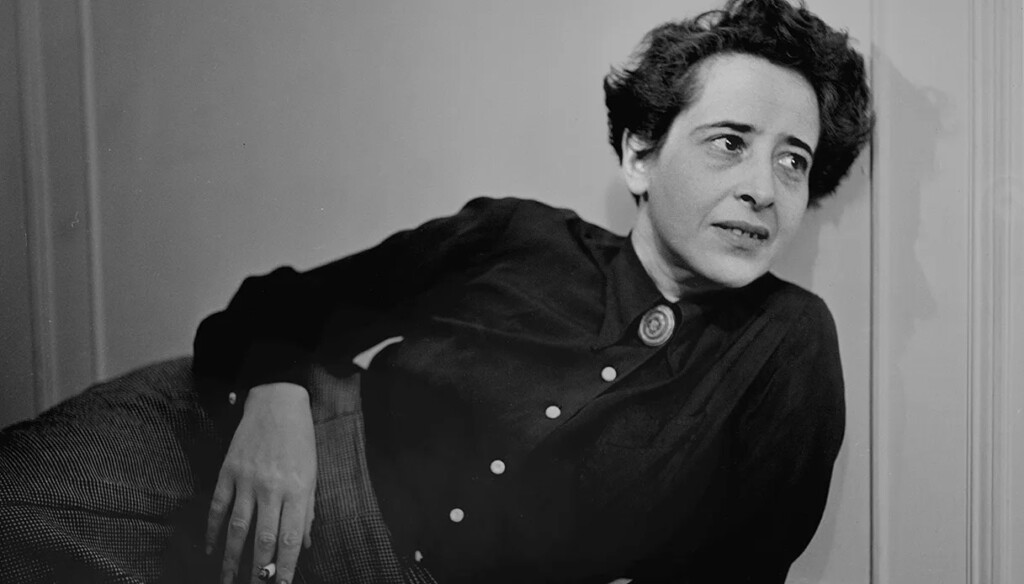
There is something almost embarrassing about the act of pausing. You stand at a desk, a form in front of you, a pen already uncapped, and you stop. Not because you have discovered some new information. Not because anyone has asked you to reconsider. You stop because something in you — not conscience exactly, not yet, but something anterior to conscience, something more like a splinter of attention — refuses to let the hand move automatically. The people behind you in the queue shift their weight. The clerk glances up. The pause has no content yet. It is just a pause. And it costs something.
Arendt spent the last years of her life trying to understand what happens inside that pause. The Life of the Mind, which she did not finish before she died in December 1975 and which appeared in two volumes in 1978, is her most uncomfortable book precisely because it refuses to be reassuring. She was not arguing that thinking makes you good. She was arguing something harder: that thinking is the only activity that by its very nature interrupts the automatic. It is not a moral vaccine. It is a friction. The mind turned on itself, questioning its own conclusions, unable to move forward without encountering resistance — this is not a guarantee of virtue. It is simply the opposite of the frictionless slide into complicity that she had watched happen in courtroom after courtroom, document after document, life after life.
Kant had already understood that moral failure was not primarily a failure of knowledge. In the Groundwork of the Metaphysics of Morals, published in 1785, he was explicit: ordinary human reason already contains within itself the principles of morality. The problem is not ignorance. The problem is what he called self-incurred immaturity — the voluntary surrender of one’s own judgment to another’s authority, to habit, to the path of least resistance. His famous definition of Enlightenment from 1784 is not a triumphalist manifesto. It is a diagnosis of a specific cowardice: the courage to use your own understanding is necessary precisely because not using it is so easy, so comfortable, so thoroughly rewarded by every institution that depends on your compliance.
What Arendt added to Kant was the phenomenology of how that surrender actually feels from the inside, which is to say: it does not feel like surrender at all. It feels like efficiency. It feels like professionalism. It feels like getting things done. The bureaucrat who processes the form feels productive. The manager who implements the policy feels competent. The soldier who follows the order feels loyal. None of them feel like they are abandoning their capacity to think. They feel like they are exercising their capacity to function. And this is exactly the trap that neither Kant’s categorical imperative nor any moral philosophy that begins from principles can fully dismantle, because the trap is not located in the domain of principles. It is located in the domain of attention — in whether the mind pauses long enough to notice that it is about to do something, rather than simply doing it.
The pause before the form is not heroism. It does not announce itself. It does not come with the internal drama of a great ethical crisis. It is just a moment in which thinking has not yet been replaced by processing, in which the person holding the pen has not yet become the function that the pen represents. What lives in that pause is not certainty, not goodness, not even resistance — it is something more fragile and more fundamental than any of those: the bare fact of a mind still present to itself, still capable of the discomfort that Arendt considered the only honest starting point for anything that might, without any guarantees, deserve to be called a human choice.
🧩 The Labyrinth of Power, Conscience, and Evil
The question of evil — whether banal or radical — cannot be separated from the broader philosophical traditions that shaped how we think about power, morality, and human nature. These four articles trace the intellectual corridors that lead directly to Kant’s moral law and Arendt’s haunting diagnosis of modern evil.
Hannah Arendt: the Philosopher Who Unmasked the Banality of Evil
Hannah Arendt‘s life and thought are inseparable from the concept explored in ‘Banal Evil and Radical Evil.’ This article illuminates how Arendt developed her philosophical vision through exile, political engagement, and the trial of Adolf Eichmann, arriving at the disturbing conclusion that evil can operate without demonic intent. Understanding her biography is essential to grasping why her distinction between banal and radical evil carries such moral urgency.
GO TO THE SELECTION: Hannah Arendt: the Philosopher Who Unmasked the Banality of Evil
Albert Camus: Life and Philosophical Thought
Albert Camus confronted the problem of evil and moral responsibility from an existentialist standpoint that both parallels and diverges from Arendt’s political philosophy. His notion of the absurd and the ethical demand to rebel against unjust systems echoes the Kantian imperative to never treat humanity as a mere means. Reading Camus alongside Arendt reveals how mid-twentieth-century thinkers wrestled with the collapse of moral certainties in the wake of totalitarianism.
GO TO THE SELECTION: Albert Camus: Life and Philosophical Thought
Thomas Hobbes: Life and Political Thought
Thomas Hobbes constructed a vision of human nature grounded in fear and self-preservation that provides a stark counterpoint to Kant’s moral idealism and Arendt’s republican ethics. His Leviathan asks what kind of evil is possible when human beings are left without sovereign constraint, a question that haunts every discussion of political violence and complicity. Tracing Hobbes’s political thought helps clarify what is at stake when Arendt argues that evil thrives within — not outside — ordered political systems.
GO TO THE SELECTION: Thomas Hobbes: Life and Political Thought
Mass Social Homologation Today
Mass social homologation is one of the contemporary phenomena that Arendt’s concept of the ‘banality of evil‘ most presciently anticipated: the erosion of individual judgment within conformist societies. This article examines how the pressure to think and behave like everyone else produces a dangerous moral anaesthesia, precisely the condition Arendt identified in Eichmann. The connection between homologation and the suspension of ethical thinking remains one of the most urgent philosophical problems of our time.
GO TO THE SELECTION: Mass Social Homologation Today
Cinema That Dares to Ask the Hard Questions
If these philosophical reflections have stirred something in you, Indiecinema is the place to follow that thread further. Our streaming platform gathers independent and auteur films that explore power, conscience, moral failure, and the fragile boundary between ordinary life and complicity with evil. Discover the films that think — and feel — as deeply as the ideas that move you.
👉 EXPLORE THE CATALOG: Watch Indie Films in Streaming
A vision curated by a filmmaker, not an algorithm
In this video I explain our vision

