
The Accumulated Spectacle of Everyday Life
You wake up and before your eyes have fully adjusted to the light, your thumb is already moving. Not toward anything in particular — toward the feed, the scroll, the ambient hum of other people’s curated existence pressing against the glass of your screen. You check who has seen your story. You rephrase a caption in your head. You photograph your coffee not because the coffee is beautiful but because the act of photographing it is a kind of proof — proof that you are here, that your morning is worth witnessing, that your life, assembled into its correct visual grammar, merits attention. The disturbing part is not that you do this. The disturbing part is that you no longer notice you are doing it.

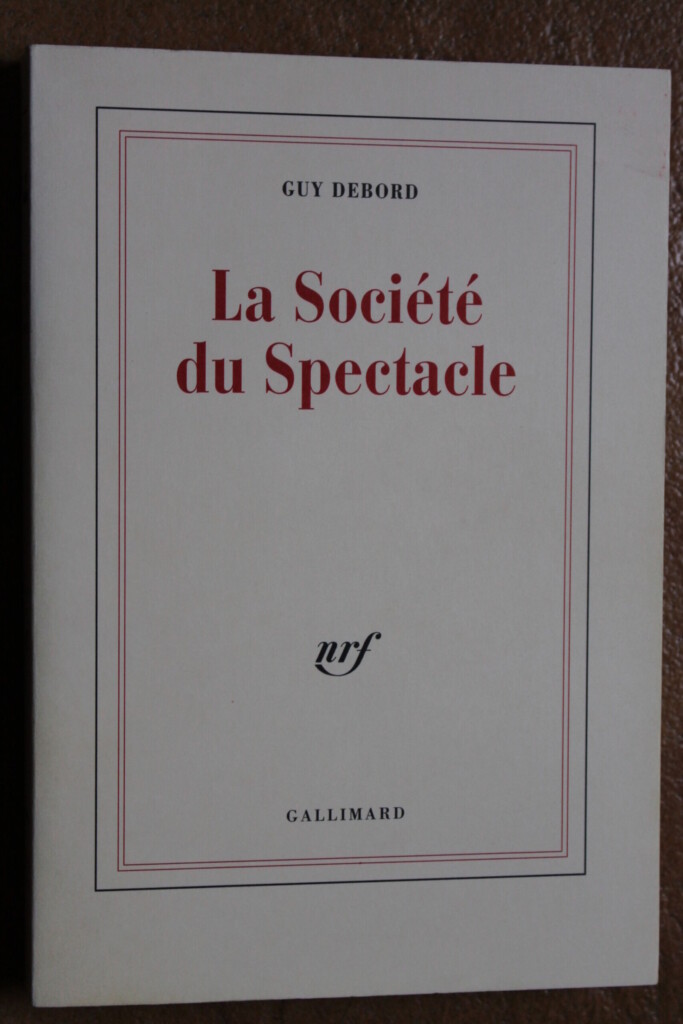
Guy Debord published The Society of the Spectacle in Paris in 1967, two years before the moon landing, six years before the first mobile phone call, and roughly four decades before the architecture of social media would make his argument feel less like theory and more like prophecy. He was thirty-five years old, writing in numbered theses with the cold precision of someone diagnosing a disease the patient had not yet learned to name. His opening move was not subtle: “All that was once directly lived has become mere representation.” A single sentence, and the entire twentieth century shifted on its axis.
What Debord was mapping was not technology. He was mapping a structural transformation in the relationship between human beings and their own experience, one that had been quietly accelerating since the post-war commodity explosion reshaped Western life from the inside out. Between 1945 and 1967, consumer spending in the United States tripled. Television sets went from inhabiting roughly 9 percent of American homes in 1950 to over 90 percent by 1960. Advertising ceased to sell products and began to sell versions of the self — the self you could become, the life you could perform, if only you purchased the correct objects and arranged them correctly in view of others. Debord saw this not as a cultural quirk but as a civilizational inversion: life had not merely been accompanied by images, it had been replaced by them.
The spectacle, in his framework, was never simply a collection of images. That is the misreading that has allowed the word to be domesticated, turned into a synonym for spectacle in the theatrical sense — something dramatic and visible. Debord meant something more insidious: a social relationship between people mediated by images. The image does not decorate reality; it substitutes for it. When you perform your grief at a funeral for the benefit of those watching, when a government stages a military intervention for the cameras before the strategic logic has been worked out, when a corporation releases a statement of solidarity with a social movement while lobbying against it in private — these are not hypocrisies layered onto an otherwise authentic world. They are the world, operating according to its actual logic.
The post-war boom did not merely produce abundance. It produced a specific kind of human being: one whose desires had been detached from need and reattached to image, whose sense of self was increasingly legible only through consumption and display. Debord drew on Marx’s concept of commodity fetishism — the way objects under capitalism appear to have an independent life, a value that seems to emanate from them rather than from the human labor that produced them — but he extended it outward, past the factory floor and into consciousness itself. The fetish was no longer just the commodity. The fetish was the represented life, the life that appeared, the life that could be seen.
And the most sophisticated trap of the spectacle is that it does not feel like a trap.
Separation as the Original Violence
You are standing in a crowd watching something happen to someone else, and the distance between you and that event feels natural, even comfortable — as if observation were simply what humans do, as if the glass between you and your own life had always been there.
Debord’s entire theoretical architecture rests on the claim that this glass did not always exist, and that its installation was not accidental. In “The Society of the Spectacle,” published in 1967, he identifies separation not as a symptom but as the generative wound — the original act by which lived experience is extracted from the person living it and returned to them as image. The worker who produces a commodity loses ownership of that object the moment it enters circulation; this much Marx had established in the 1844 manuscripts. What Debord adds, with a precision that feels almost surgical, is that the same expropriation happens to time, to desire, to attention itself. You do not merely lose the product of your labor. You lose the felt sense of having been the one who acted.
This is why the Situationist International, founded in Cosio d’Arroscia in July 1957, was never primarily an art movement, despite being populated by painters, architects, and poets. The eleven signatories who merged the Lettrist International with the International Movement for an Imaginist Bauhaus were diagnosing a civilizational condition, not proposing an aesthetic program. Asger Jorn, Constant Nieuwenhuys, and the others who gathered around Debord understood that capitalist modernity had achieved something unprecedented: it had made alienation pleasurable. Prior forms of domination required visible coercion. The spectacle required only that you prefer the representation to the thing itself — and by 1957, the infrastructure for that preference was already deeply in place. Television ownership in the United States had jumped from 0.5 percent of households in 1946 to nearly 72 percent by 1956. The mechanism did not need to force you away from your life. It simply needed to be more vivid than your life, more coherent, more satisfying in its resolutions.
What makes this diagnosis genuinely disturbing is not the critique of media — that critique had been available since Walter Benjamin’s 1935 essay on mechanical reproduction, and Frankfurt School thinkers had been mapping the culture industry for decades. What makes it disturbing is the claim that perception itself had been colonized. Raoul Vaneigem, writing alongside Debord in the SI, argued in “The Revolution of Everyday Life” in 1967 that survival had replaced living as the operative mode of existence — that people had become so thoroughly administered that even their dissatisfactions were pre-formatted, arriving as consumer preferences rather than genuine ruptures. The person who believes they are rebelling by choosing one brand over another, one lifestyle aesthetic over another, is not experiencing resistance. They are experiencing the spectacle’s most refined product: the simulation of autonomy.
The SI’s response was the derive and the detournement — drifting through cities to short-circuit habituated perception, hijacking existing cultural materials to expose their ideological freight. These were not hobbies. They were attempts to reintroduce friction into a world that had been sanded smooth. Debord wanted situations, moments of constructed intensity that could not be photographed and sold back, experiences that exhausted themselves in the living rather than persisting as documentation. The tragedy he intuited, and which the subsequent decades confirmed with a kind of merciless precision, is that even the concept of the situation could be recuperated — absorbed into the very apparatus it meant to disrupt, repackaged as immersive theater, as experiential marketing, as the Instagram caption that reads “being present.”
Separation, once installed deep enough, begins to feel like interiority.

The Integrated Spectacle and the Disappearance of Outside
You are standing in a store that sells rebellion. The shelves are organized by subculture — punk patches mass-produced in Vietnamese factories, Che Guevara printed on water bottles, tote bags that read “eat the rich” sold for forty-two dollars beside organic granola. Nobody in the store finds this strange. That is not irony gone wrong. That is the system working precisely as designed.
By 1988, twenty years after the barricades of Paris had been dismantled and the revolutionary moment had curdled back into consumer society, Debord returned to his own theory and found it had metastasized. In “Comments on the Society of the Spectacle,” he introduced the concept of the integrated spectacle — a mutation of the earlier diffuse and concentrated forms that had characterized American commodity culture and Stalinist propaganda respectively. The integration meant that the spectacle had ceased to be something outside ordinary life that one could observe, critique, resist, or turn away from. It had dissolved into the fabric of lived reality so completely that the very idea of an outside — of a position from which critique could be mounted — had been structurally eliminated. The spectacle no longer needed to convince anyone of anything. It simply occupied all available cognitive and perceptual space.
This is what makes Debord’s later work genuinely disturbing in a way his earlier writing was not. “The Society of the Spectacle” in 1967 still implied a watcher and a screen, a gap between representation and experience that could, theoretically, be exploited by those with enough lucidity and courage. The 1988 text withdraws that consolation entirely. The critical observer has no ground to stand on because the ground itself is a production. When Fredric Jameson, writing in 1991 in “Postmodernism, or the Cultural Logic of Late Capitalism,” described the postmodern condition as one of depthlessness — a world of surfaces without hidden interiors — he was mapping the same territory from a different angle. There is no backstage. The backstage has been converted into premium seating.
What this produces, concretely, is a society in which dissent becomes a content category. The machine does not suppress anti-consumerist gestures; it monetizes them. The documentary exposing fast fashion’s exploitation of Cambodian garment workers — women earning under three dollars a day in 2023 to produce garments retailing for sixty — becomes a Netflix acquisition, a conversation piece at dinner parties, a reason to buy a more expensive brand that markets its ethical supply chain as a lifestyle identity. The critique does not weaken the system. It feeds it new material. Awareness campaigns generate awareness of awareness campaigns. Irony, once the intellectual’s instrument for maintaining distance from ideology, became the dominant aesthetic register of advertising by the mid-1990s. When a brand can wink at you about the absurdity of brands, you have no place left to stand outside of it.
There is a particular kind of vertigo in recognizing that your resistance was anticipated. The person who boycotts social media and announces it on social media before leaving is not being hypocritical in any simple sense — they are demonstrating, involuntarily, that every gesture of withdrawal has already been pre-formatted as a gesture of withdrawal, complete with its own visual grammar, its own audience, its own eventual return. The integrated spectacle does not fear rejection. It has already written rejection into the script, given it an aesthetic, found its demographic, calculated its conversion rate.
What Debord saw clearly — and what makes “Comments” a grimmer and more claustrophobic text than anything he produced in his earlier career — is that the problem is not false consciousness in the old Marxist sense, where ideology clouds people’s perception of their real interests. The problem is that consciousness itself, including the consciousness that believes it has seen through the illusion, has become a raw material the spectacle processes and returns to circulation as product.
Dérive, Détournement, and the Trap of Resistance

You leave the house without a destination. Not because you are lost, but because you have decided, deliberately, that the logic of the city — its commercial corridors, its transit lines engineered to funnel bodies toward consumption — will not govern your movement today. This is the dérive as Guy Debord and the Letterist International conceived it in the early 1950s, formalized in Debord’s 1958 “Theory of the Dérive”: a drift through urban space guided by the psychogeographical pull of atmospheres rather than the calculus of utility. The drifter refuses to be a commuter, refuses the city as a machine for producing predictable behavior. For a moment, walking becomes a form of epistemology.
The companion tactic, détournement, operated on representation itself. Rather than escaping the spectacle’s images, it seized them and corrupted their meaning from within — splicing advertisements, rerouting propaganda, turning the language of power against its own architecture. The practice drew on a simple and devastating observation: that capitalist imagery is not neutral information but a system of commands dressed as pleasure. To détourne a billboard was to expose the command structure hiding beneath the seduction. The Situationists published journals, produced altered comics, hijacked films. Ivan Chtcheglov’s 1953 manifesto “Formulary for a New Urbanism” envisioned cities rebuilt entirely around desire rather than productivity, each neighborhood a different emotional climate, the very geography of daily life redesigned as liberated experience.
What happened next is the kind of historical irony that the Situationists themselves would have recognized as structural rather than accidental. By the 1990s, advertising agencies were deploying the visual grammar of détournement to sell athletic shoes and energy drinks. The aesthetic of subversion — the rough splice, the ironic appropriation, the hijacked corporate logo — became a premium signifier of authenticity, which is precisely what the market had always been most efficient at manufacturing and selling. Naomi Klein documented this absorption in “No Logo” in 2000, watching countercultural gestures become brand identities almost faster than they could be invented. The market did not defeat these tactics by banning them. It honored them with reproduction.
The dérive met a parallel fate, though more quietly. What began as a practice of radical disorientation became, in the hands of the creative economy, the “walkable city” index, the curated urban wandering of tourism apps, the artisanal neighborhood marketed precisely by its atmosphere of drift and discovery. The psychogeographical charge that Debord located in the unplanned encounter was packaged as a weekend experience for the professional class. Even the vocabulary survived intact: “immersive,” “experiential,” “haptic” — words that once carried the force of rupture now appear in the marketing materials of luxury retail environments.
This is not simply co-optation in the banal sense of “the system absorbs everything.” The mechanism is more precise and more troubling. The spectacle does not neutralize resistance by diluting it — it neutralizes it by fulfilling it aesthetically while leaving the underlying relations of production entirely untouched. A person can experience the full emotional register of revolt, the genuine frisson of transgression, without a single material condition changing. Herbert Marcuse saw the outline of this logic in “One-Dimensional Man” in 1964, arguing that advanced industrial society had developed the capacity to satisfy the need for opposition at the level of culture while foreclosing it at the level of structure. What Marcuse could not fully anticipate was the speed and appetite with which this satisfaction would be delivered, the way the market would learn to crave the gesture of refusal precisely because refusal, aestheticized, generates desire more efficiently than compliance ever could.
The question this leaves open is not whether any particular tactic fails, but whether the category of “resistance” itself has become a product category — and what it means to refuse from inside a system that has already priced your refusal into its inventory.
Performance, Identity, and the Self as Product
You wake up and the first decision you make is not what to eat or whether to exercise — it is what version of yourself to transmit. The phone is already in your hand before your eyes have fully adjusted to the light, and the calculation begins: which photograph from last night, which caption strikes the right balance between casual and considered, which mood is worth performing today for the audience you have assembled and continue to tend like a crop.
Erving Goffman spent years watching people in ordinary situations — hotel lobbies, psychiatric wards, dinner parties — and what he concluded in 1959 was that social life is an uninterrupted theatrical production, with front stages and backstages, costume choices and rehearsed lines, and an implicit agreement between performers and audience to maintain the fiction of the encounter. He was describing something pre-digital, something as old as the city itself, but what he could not have anticipated was the complete collapse of the backstage. The region he identified as the space for dropping the mask, resting from the role, recovering the unperformed self, has been systematically converted into content. The backstage selfie, the “real and unfiltered” caption, the vulnerability post — these are not exits from performance but its most sophisticated moves, because they claim to show what performance usually hides while remaining entirely constructed for consumption.
The market understood this before the philosophers did. By the early 2000s, brand consultants were already circulating internal research showing that consumers no longer trusted institutional voices and had begun attaching credibility to individuals who appeared to speak from personal experience rather than corporate script. The response was not to abandon manufactured messaging but to manufacture the appearance of its absence. What emerged was the authenticity economy — a cultural regime in which the most commercially valuable thing a person can possess is the convincing performance of not performing. A 2019 study published in the Journal of Consumer Research found that audiences consistently rated influencers as more persuasive when they disclosed imperfections, regardless of whether the disclosure itself had been strategically timed and professionally edited. Sincerity became a technique, and the technique became invisible because calling it a technique felt ungenerous, even cruel.
What this produces is a particular kind of vertigo that has no clean philosophical name yet. The sociologist Arlie Hochschild documented in 1983, in The Managed Heart, how emotional labor in service professions required workers to align their felt emotions with their displayed ones until the boundary between genuine feeling and performed feeling became genuinely uncertain to the worker themselves. She was writing about flight attendants and bill collectors. The condition she described now applies to anyone with a social media profile, which is to say almost everyone navigating adult life in the contemporary world. The self does not precede its presentation and get subsequently distorted by it — the presentation is now constitutive of whatever the self becomes.
The deep structure of this situation is not psychological but economic. Identity has become the primary unit of production in an attention economy, and like all units of production it is subject to optimization, quality control, and planned obsolescence. The person who does not manage their personal brand is not free from the market — they are simply losing ground within it. What looks like authentic refusal registers, at the level of the system, as low engagement, reduced reach, algorithmic invisibility. The trap is not that people are forced to perform; the trap is that the infrastructure of daily life has been reorganized so that not performing carries material consequences, which means the choice to be seen or unseen is never neutral, never simply personal, and never fully yours to make.
A vision curated by a filmmaker, not an algorithm
In this video I explain our vision
🎭 The Spectacle, the Mask, and the Society of Illusion
Guy Debord’s theory of the Spectacle dismantles the boundary between authentic life and its mediated representation, revealing a world in which appearance has colonized reality. The articles gathered here explore the interconnected territories of alienation, mass culture, manipulation, and the performance of identity that define modern existence.
Herbert Marcuse and Mass Culture
Herbert Marcuse argued that mass culture functions as a sophisticated instrument of social control, manufacturing consent through entertainment and consumption rather than overt repression. His critical theory illuminates precisely the mechanisms Debord identified as the Spectacle: a system in which desire is channeled, neutralized, and sold back to the subject as a commodity. Together, Marcuse and Debord form the twin pillars of a radical critique of postwar Western society.
GO TO THE SELECTION: Herbert Marcuse and Mass Culture
Situationist Psychogeography: The City as Lived Space
Situationist psychogeography is perhaps the most direct practical expression of Debord’s theoretical project, transforming the city into a terrain of resistance through the dérive and détournement. By mapping the emotional and psychological contours of urban space, the Situationists sought to reclaim lived experience from the grip of spectacular capitalism. This article explores how the city itself becomes both the prison and the potential site of liberation.
GO TO THE SELECTION: Situationist Psychogeography: The City as Lived Space
The Masks We Wear: Identity and Fiction in Everyday Life
The masks we wear in everyday social interaction are not merely Jungian personae but also, in Debordian terms, the very fabric of spectacular performance. This article investigates how identity is constructed, performed, and ultimately alienated through the social roles imposed by a society organized around appearance. The question of who we truly are beneath the performance becomes increasingly urgent in a world saturated by spectacle.
GO TO THE SELECTION: The Masks We Wear: Identity and Fiction in Everyday Life
Celebrity as a Trap in Contemporary Culture
Celebrity culture represents one of the most visible and pervasive manifestations of the Spectacle as Debord theorized it: the reduction of human existence to image, to representation consumed passively by the masses. This article examines how fame functions as a trap, seducing individuals into identifying with their public persona while hollowing out any authentic interior life. The celebrity becomes the ultimate Debordian figure—a living image that has entirely replaced a living person.
GO TO THE SELECTION: Celebrity as a Trap in Contemporary Culture
Discover the Cinema That Resists the Spectacle
If these reflections on performance, alienation, and the colonization of everyday life by image have stirred something in you, Indiecinema is the streaming platform where independent cinema dares to look behind the curtain. Explore films that challenge, unsettle, and illuminate—because authentic cinema, like authentic life, begins where the Spectacle ends.
👉 EXPLORE THE CATALOG: Watch Indie Films in Streaming
A vision curated by a filmmaker, not an algorithm
In this video I explain our vision

