
The Canal City as Controlled Transgression
You arrive in Amsterdam for the first time and something feels immediately, almost suspiciously, correct. The canals are the right width. The light falls at the angle that paintings taught you to expect. Someone cycles past carrying tulips and a baguette, and you understand, with a small embarrassed thrill, that you have stepped into a city that has been performing itself for so long the performance has become indistinguishable from fact.

What Amsterdam sells is the sensation of permission. The coffee shops with their laminated menus, the red-lit windows in the Wallen, the open beer on bridges at dusk — all of it reads as liberation, as a civilization mature enough to have outgrown its own puritanism. What it actually represents is something far colder and more interesting: the systematic conversion of transgression into municipal revenue, a civic policy so elegant that its subjects have never stopped believing they are free.
The Dutch word gedoogbeleid translates approximately as tolerance policy, and its logic is worth dwelling on. It does not legalize. It does not decriminalize in any philosophically committed sense. It permits, conditionally, in designated zones, under administrative supervision, for pragmatic reasons that have nothing to do with personal liberty and everything to do with containing social friction at minimum cost. Cannabis was never made legal under this framework — its sale was tolerated at the retail level while cultivation and wholesale supply remained criminal, a deliberate absurdity that allowed the state to profit from the visible end of a market while maintaining plausible deniability about the invisible end. The sociologist Jock Young, writing in The Drugtakers in 1971, identified this exact mechanism in British drug culture — the way institutions manufacture a bounded space of deviance that actually reinforces normative boundaries by making transgression visible, located, and therefore governable. Amsterdam did not invent this logic. It simply perfected its architecture.
The historical record here is not romantic. Amsterdam’s famous tolerance did not emerge from Enlightenment principle. It emerged from the commercial imperatives of the seventeenth century, when the city was the wealthiest trading port in the world and could not afford the luxury of sectarian conflict. The regent class that governed the Dutch Republic after 1588 practiced what the historian Simon Schama, in The Embarrassment of Riches published in 1987, called a deliberate civic pragmatism — a willingness to permit religious minorities, Jewish communities, dissenting preachers, and foreign merchants to coexist not because tolerance was a moral value but because intolerance was expensive. The Portuguese Jewish community in Amsterdam, the Huguenot refugees, the English separatists who passed through on their way to the New World — these populations were assets, not guests. Tolerance was the transaction fee the city charged itself in exchange for their capital and expertise.
What is astonishing is how completely this transactional logic has been rewritten as cultural virtue. The Dutch speak of their own openness with a pride that has genuine warmth in it, and that warmth is real — it is simply located about three centuries downstream from the original calculation. By the time the gedoogbeleid was formalized in the late 1970s and codified more explicitly through the revised Opium Act policies of 1976, the mechanism had been running long enough that no one needed to remember it was a mechanism. A city that manages dissent through designated tolerance zones does not need censorship, does not need visible repression, does not need the crude instruments of authoritarian control. It needs only geography — a neighborhood, a window, a coffee shop on a corner near a canal — to ensure that what might otherwise metastasize into genuine political disruption remains, instead, a tourist attraction.
The Underground as Historical Reflex
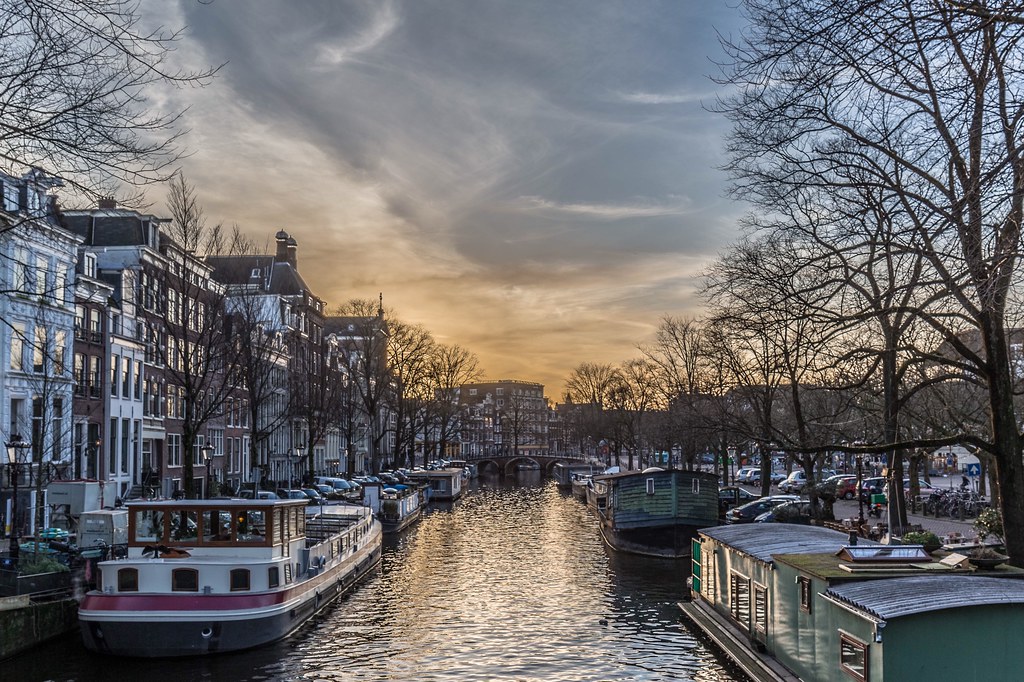
You are standing in a city that has never quite believed in its own rules. Not because it lacks them — Amsterdam has always had an extraordinary density of ordinances, bylaws, and civic agreements — but because the rules here have traditionally been understood as provisional arrangements between parties who know they are negotiating, not legislating truth. That specific quality of pragmatic skepticism, baked into a trading culture that needed flexible ethics more than fixed morality, created the exact soil in which the Provo movement took root in 1965.
The Provos were not revolutionaries in the Marxist sense. They were provocateurs in the literal one. Robert Jasper Grootveld had been staging happenings around the Lieverdje statue since 1964, turning a small bronze figure into a ritual site of anti-consumerist theater. When Roel van Duijn and Rob Stolk formalized the movement, they brought with them a pamphlet culture of deliberate absurdism — the White Plans proposed giving free bicycles to the city, flooding Amsterdam with public transport, turning the streets over to pedestrians. The genius of this was not the content of the proposals but their form: they were entirely reasonable, which made the authorities’ irritation with them look completely irrational. By 1966, when police beat Provo demonstrators at the wedding procession of Princess Beatrix and Claus von Amsberg while smoke bombs turned the royal route into something between a nightmare and a carnival, the movement had forced Amsterdam to reveal the violence beneath its tolerant surface. Two years later, the Provos dissolved themselves voluntarily, before the machinery of co-optation could do it for them — and some of their members walked directly into city council seats, which is either the purest form of victory or the most elegant demonstration of how resistance is metabolized by power.
The krakers arrived in the late 1970s with considerably less wit and considerably more fury. Amsterdam’s housing crisis was not metaphorical: vacancy rates in the inner city hovered around thirty percent while thousands waited on municipal housing lists that moved with the speed of continental drift. Squatters occupied empty buildings under a legal framework that had, almost accidentally, made their position defensible — a property unused for more than a year could be claimed under specific conditions, and krakers exploited this with rigorous organizational discipline. By 1980 the movement had become a city within the city, with its own newspapers, its own radio stations, its own internal governance structures. The battle of Vondelstraat in February of that year, and the tank-accompanied eviction at Groote Keijser in October, turned Amsterdam into something that looked briefly like it was rehearsing a different kind of history. The state brought in military hardware. The squatters had barricades and a theory of legitimate habitation that was, legally speaking, not entirely wrong.
What followed was not suppression. It was something more disorienting. The municipality began a process of negotiated legalization, converting occupied buildings into social housing cooperatives, incorporating kraker demands into urban planning discourse, funding alternative cultural centers that had begun as illegal occupations. OT301, Vrankrijk, the ADM — each of these spaces carries the trace of a confrontation that ended not with defeat but with institutionalization. The city learned, after the Provos and then again after the krakers, that the cheapest way to neutralize a genuine challenge to its ordering logic was to give it a lease and a small subsidy. What had been a refusal of the property relation became a line item in the cultural budget. The radical claim that empty buildings should house people who needed housing was transformed into a service the municipality could manage, evaluate, and eventually, when the real estate market made it necessary, terminate.

Subcultural Identity and the Myth of Authenticity
You discover the flyer on a wet Tuesday morning, tucked under your windshield wiper on a street in the Jordaan — no address, just a canal coordinate and a time, 02:00, and the word RESIST printed in a font that looks deliberately broken. You feel chosen. You are not chosen. Thirty thousand people received the same flyer through six degrees of WhatsApp, and the feeling of election is precisely the product being sold.
The underground has always understood that scarcity is theater. When the first squat parties erupted across Amsterdam’s Oost and Noord districts in the early 1990s — warehouses off the Spaarndammerdijk, disused printing facilities near the NDSM wharf — the exclusion was initially material and genuine. There was no money, no permit, no safety net. The music was harder and stranger than anything commercial radio would touch: Detroit techno arriving in the Netherlands through figures like DJ Mijk van Dijk and the early Tranceport collective, acid house pressing up through London and folding into a local scene that had already spent a decade building infrastructure through the kraakbeweging, the squatter movement that had occupied hundreds of buildings since the late 1970s. The 1980 coronation riots, in which the Amsterdam police and squatters fought pitched battles on Nieuwmarkt, had seeded a generation with the conviction that cultural space was something you seized, not applied for. Identity built under those conditions carries the particular density of something that cost something real.
What happens next is the mechanism that cultural theorists have circled without quite naming cleanly. Dick Hebdige, writing in Subculture: The Meaning of Style in 1979, described how dominant culture neutralizes subcultural threat through two simultaneous moves: the commodity form, which packages the style for retail, and the ideological form, which reframes the deviance as trivial or exotic. What Hebdige did not fully account for is that subcultures frequently anticipate this and respond not by retreating but by accelerating their own mythology of authenticity — digging the opposition deeper, making the style more extreme, the access more difficult, the codes more opaque. This is not resistance. This is collaboration in a longer loop. The mainstream does not simply absorb the underground; the underground generates the raw material the mainstream cannot produce internally, because novelty under commercial constraint is an oxymoron.
Amsterdam’s contemporary queer spaces know this dynamic with a sophistication that would have been unimaginable in the early squat era. Venues like Shelter and the rotating nights that occupy industrial shells in Noord operate with a curation so precise it functions as ideology: the door policy is not about face value but about legibility within a specific grammar of otherness. You must appear to have already understood something. The effect is a layered exclusion that performs radicalism while structuring hierarchy with the efficiency of any luxury brand. This is not cynicism on anyone’s part — it is the logical terminus of using opposition as the primary material of identity construction. When your selfhood is built against something, the survival of that something becomes a structural necessity.
Thomas Frank documented a version of this in The Conquest of Cool, published in 1997, showing how American advertising in the 1960s did not follow counterculture — it ran alongside it, sometimes ahead, feeding on the same cultural hunger for authenticity that rebellion claimed to satisfy. The Dutch context accelerates this compression because the city’s geography is small enough that the distance between underground and overground is measured in meters rather than years. The Paradiso, which opened as a squatted youth center in 1968, was hosting international stadium acts within a decade. What looked like capture was also, from another angle, exactly what the scene had been rehearsing for.
The Architecture of Permission

You have stood at the edge of the NDSM wharf on a Tuesday morning, the cranes still overhead like rusted apostrophes, the old shipyard converted into artist studios and a boutique hotel whose rooftop bar charges fourteen euros for a natural wine. The transformation did not happen violently or suddenly. It happened through a series of permits, subsidies, and municipal agreements that allowed just enough friction to remain visible — a graffiti wall here, a repurposed container there — so that the place retained the aesthetic of resistance while functioning as a real estate catalyst for the northern bank of the IJ.
What Amsterdam has perfected over several decades is not tolerance in the philosophical sense that John Stuart Mill articulated in 1859 when he argued that the only legitimate limit on liberty is harm to others. The city has instead developed something structurally different: a spatial policy of contained transgression, where the dangerous, the experimental, and the marginal are not suppressed but assigned coordinates. Give the underground an address, and it stops being underground. Give it a subsidy cycle and a noise ordinance and an official capacity limit, and what remains is the theater of subversion — the costumes without the conspiracy.
The licensed squat is perhaps the most concentrated expression of this logic. In the 1980s, Amsterdam’s kraakbeweging, the squatters’ movement, occupied somewhere between ten and twenty thousand empty properties at its peak, and the confrontations with police carried genuine political stakes about housing, capital, and the right to the city as Henri Lefebvre had theorized it — the idea that urban space is produced socially and therefore belongs to those who inhabit it, not merely those who hold title. The city’s eventual response was not to dismantle squatting but to institutionalize it selectively, offering legalization agreements to occupations that agreed to formalize their status, pay symbolic rent, and operate within cultural programming frameworks. The radical demand for housing became an arts residency. The occupation became a venue.
This process has a specific bureaucratic name in Dutch urban policy: gedoogbeleid, a term meaning roughly the policy of deliberate non-enforcement, which the Netherlands applied most famously to cannabis sales but extended structurally across domains of social life considered too costly or too popular to criminalize outright. The gedoogzone is not a space of freedom. It is a space of managed liability, where the state withdraws its prohibition in exchange for the transgressor’s implicit agreement to remain legible, taxable, and bounded. The rave that receives a municipal permit is no longer illegal, which means it is also no longer what it was. The politics evacuate the moment the paperwork arrives.
What is lost in that evacuation is harder to measure than what is gained. Sociologist Sarah Thornton, in her 1995 study of club culture in Britain, identified how the media’s attention to underground scenes was itself the mechanism of their destruction — that publicity transformed subcultural capital into something exchangeable on mainstream terms. Amsterdam anticipated that logic institutionally, bypassing the media phase entirely by inserting the municipality directly into the conversion process. The city does not wait for a scene to go mainstream and then mourn its commercialization. It offers the scene a framework that makes commercialization structurally inevitable from the first approved event permit.
The result is a city that looks, from the outside, like a laboratory of human freedom, and functions, from the inside, like a very sophisticated system for extracting cultural value from people who believe they are refusing the system. The underground does not disappear. It becomes load-bearing infrastructure for a tourism economy worth approximately ninety billion euros annually, its edges carefully maintained sharp enough to attract, blunt enough never to cut the hand that funds it.
Freedom as Aesthetic, Rebellion as Product
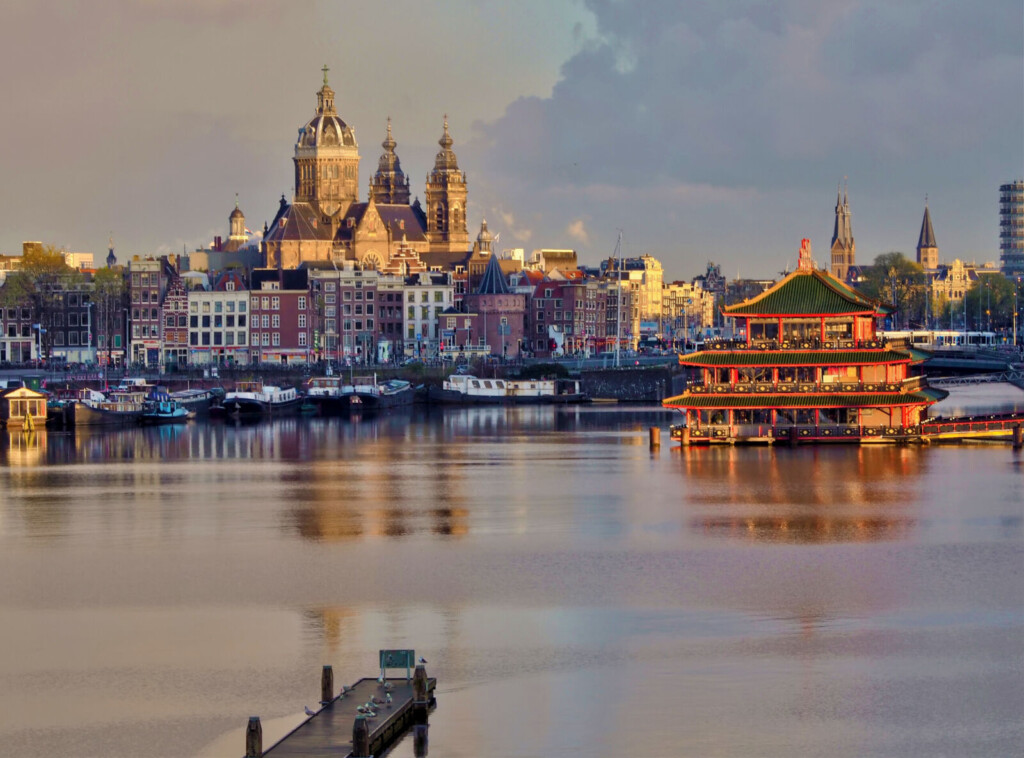
You are standing in a bar in the Jordaan that your grandfather’s generation would have recognized as a squat, and the cocktail menu quotes Provo.
There is a particular exhaustion that sets in when you realize the furniture of your resistance has been reupholstered and placed in a boutique hotel lobby. Not the exhaustion of defeat — that would at least carry the dignity of a real fight — but the exhaustion of finding that the fight was absorbed so efficiently it never registered as a loss. Amsterdam has been doing this longer than most cities, which makes it not a cautionary tale but something more unsettling: a case study in how a culture can metabolize its own negatives, turn contradiction into character, and sell the whole operation as authenticity.
The Situationists called this recuperation, and Guy Debord described its mechanism with surgical precision in 1967: the spectacle does not suppress rebellion, it stages it. What looks like resistance becomes content, and content becomes commodity. But Debord was writing about a general condition of capitalist society, while what happened in Amsterdam was something more specific and arguably more corrosive — a city that built its legal and civic identity around the controlled permission of transgression, which meant the underground never had to be crushed because it was always already pre-permitted. The tolerance policy, the gedoogbeleid, was not liberalism, it was a form of municipal containment that gave deviance an address and therefore a postcode that could appear on a tourism brochure.
By the late 1990s, the club culture that had genuinely shocked European cities in the previous decade had become the primary export image of Amsterdam alongside tulips and Rembrandt. The Melkweg and Paradiso, which had been genuine sites of disruption in the early 1970s, were by then receiving municipal subsidies and operating as cultural institutions with box office software and gift shops. This is not a betrayal — institutions must survive — but it demonstrates the speed at which Dutch culture converts radical gesture into civic asset. The squat movements of the 1980s, which at their peak involved an estimated 20,000 people living in illegally occupied buildings across the Netherlands and produced some of the most genuinely adversarial political art in postwar European history, are now documented in university theses and occasionally referenced in city council presentations on urban heritage.
What remains is a question about whether resistance requires an outside. Every underground assumes the existence of a surface pressing down on it — a force from above that makes the subterranean position both necessary and meaningful. Amsterdam’s peculiar achievement was to eliminate that pressure without eliminating the posture, which left a generation of artists, activists, and scene participants performing the gestures of refusal in a context that had already incorporated those gestures into its self-image. The city markets itself on its own tolerance, which means the act of being tolerated is now the trap. To be different here is expected. To transgress is anticipated. The machine has learned to smile at everything.
There are still people in Amsterdam who believe a genuine underground exists, who know addresses that are not on any map, who gather in warehouses in the port district on the eastern edge of the city where the postwar planners never arrived with their visions of order. Some of them are right. But the question they cannot answer, the one that lives underneath every act they perform, is whether the experience of rupture they are protecting is real or whether it is simply the last room in a very large museum that has not yet been catalogued, waiting quietly for the curator who will eventually arrive with a label and a price.
A vision curated by a filmmaker, not an algorithm
In this video I explain our vision
🌀 Canals, Counterculture, and the Underground City
Amsterdam has long been a crossroads of freedom, transgression, and artistic rebellion. From its legendary underground scenes to the philosophical currents that flow beneath its canals, the city embodies a living tension between liberation and labyrinthine complexity.
Masterpieces of Rebellion and Counterculture Cinema
Amsterdam’s spirit of radical freedom has always found its most vivid expression in the cinema of rebellion and counterculture. This article explores the films that dared to challenge social norms, capturing the restless energy of underground movements that cities like Amsterdam helped nurture. From the New Wave to punk aesthetics, these works remain essential maps of dissent.
GO TO THE SELECTION: Masterpieces of Rebellion and Counterculture Cinema
New York Underground of the 1980s: Art and Culture
The underground cultural explosion that transformed New York in the 1980s shares deep structural roots with the Amsterdam scene of the same era — both were cities where marginalized artists forged new languages out of chaos and freedom. This article traces the art, music, and street culture that emerged from the margins to reshape the cultural mainstream. Basquiat, Haring, and their contemporaries remind us that underground culture is always on the verge of becoming history.
GO TO THE SELECTION: New York Underground of the 1980s: Art and Culture
Situationist Psychogeography: The City as Lived Space
Situationist psychogeography offers one of the most powerful conceptual tools for understanding how a city like Amsterdam operates as a lived, drifted, and subverted space. The dérive — the unplanned journey through urban landscapes — finds its ideal terrain in Amsterdam’s concentric canals and hidden courtyards. This article unpacks how the Situationists transformed walking into a political and poetic act.
GO TO THE SELECTION: Situationist Psychogeography: The City as Lived Space
Michel Foucault and Drugs: Pleasure and Power
Michel Foucault’s reflections on drugs, pleasure, and power illuminate the philosophical underpinnings of Amsterdam’s famously permissive drug culture and its complex relationship with freedom and social control. The city became a living laboratory for the tensions Foucault identified between bodily autonomy and institutional regulation. Understanding his thought is essential to grasping why Amsterdam’s underground scene carries such enduring ideological weight.
GO TO THE SELECTION: Michel Foucault and Drugs: Pleasure and Power
Discover the Films That Lived Underground
If these cultural undercurrents resonate with you, Indiecinema is the streaming platform where independent cinema breathes freely — films that refuse the mainstream, embrace complexity, and keep the underground spirit alive. Explore the catalog and let the labyrinth lead you somewhere unexpected.
👉 EXPLORE THE CATALOG: Watch Indie Films in Streaming
A vision curated by a filmmaker, not an algorithm
In this video I explain our vision

