
The Body as Evidence
You are lying on a paper-covered examination table, the kind that crinkles when you shift your weight, and the doctor is looking at the scan on the screen rather than at you. He speaks in a low, confident register, using three Latin-derived words in a row, and somewhere in the space between those words and your comprehension, a decision has already been made about your body that you were not consulted on. The diagnosis has not been stated yet, but the room has already reorganized itself around a conclusion. You are not a person in that moment. You are a set of findings.

Italian medical thriller writing has understood this dynamic with particular precision because it inherited something that Anglo-American genre fiction largely abandoned: a deep suspicion of expertise as a category. Where the English-language tradition tends to position the physician as a solving intelligence, a rational agent who restores order to biological chaos, the Italian variant — from the clinical procedurals of Gianrico Carofiglio to the more structurally experimental work of Carlo Lucarelli — treats medical knowledge as a system that generates its own blind spots faster than it eliminates them. The doctor who knows too much is not a reassuring figure. He is an epistemological trap set inside a white coat.
This is not merely a literary preference. It reflects a specific cultural memory. Italy’s relationship with institutional medicine was shaped, in ways that never fully resolved, by the catastrophic collisions of science and politics in the mid-twentieth century. When Giorgio Agamben, in Homo Sacer published in 1995, described the figure of bare life — the human being stripped to a biological substrate over which sovereign power exercises unrestricted authority — he was working from materials that Italian intellectuals had been living with for decades. The hospital corridor in Italian fiction is never just a corridor. It carries the ghost of what happens when a body becomes purely administrative.
The physician figure in this tradition fails not because he is incompetent but because competence itself becomes a form of tunnel vision. He has organized the world into patterns that he can recognize, and anything that falls outside those patterns becomes noise rather than signal. In Carofiglio’s 2002 novel Testimone inconsapevole, the forensic and medical experts who examine evidence are consistently the last characters to perceive what a genuinely attentive observer might notice immediately, because their attention has been trained to function like a sieve with specific mesh sizes, catching only what it was designed to catch. The thriller mechanics depend on this: the reader is positioned to see around the expert rather than through him.
What makes this uncomfortable is that the reader has been trained, by decades of procedural culture across every medium, to identify with the expert’s gaze. You trust the scan. You trust the terminology. You experience the doctor’s confidence as competence even when you cannot verify the connection between the two. Italian medical thrillers exploit this trust not to betray it sensationally but to make you watch yourself extending it. The genre becomes a mirror turned not on the crime but on the act of believing.
Umberto Eco’s observation in Semiotics and the Philosophy of Language, published in 1984, that every sign system contains within it a structural mechanism for producing error — that meaning and misreading are not opposites but are generated by the same process — finds its most visceral expression not in academic semiology but in exactly this kind of fiction, where a misread test result or a symptom categorized too quickly becomes the load-bearing wall of an entire false reality.
Stem Cell
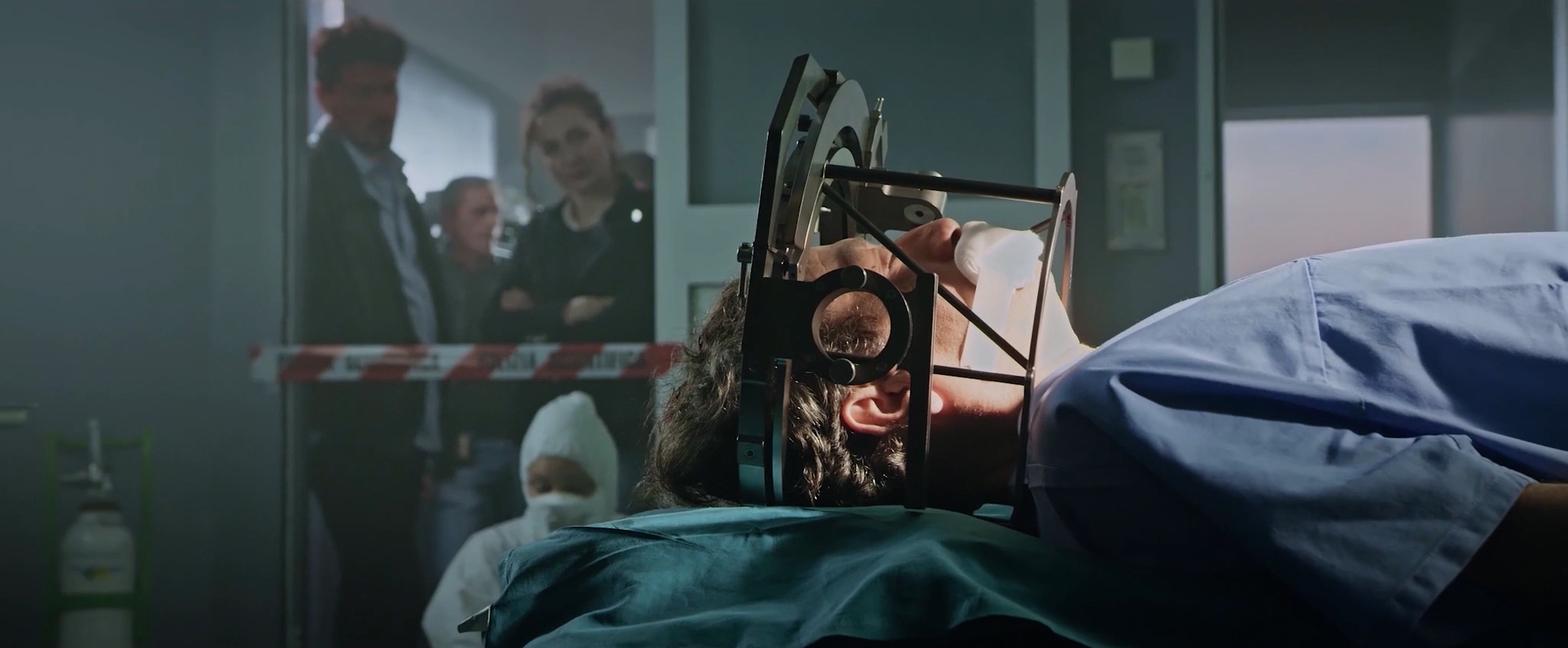
Stem Cell, directed by Giuseppe Di Giorgio, Italy, 2020.
A brilliant neurosurgeon is found murdered in his own operating room. The scene is gruesome. His killer used the very tools of his trade. Who is the murderer? A psychopath? Someone from within the institute? Commissioner Lorenzo Aliprandi and his team find themselves in a race against time to stop a killer who continues to murder using the same heinous methods, targeting other prominent doctors, leaving no trace behind except a trail of blood. New knowledge, intense experiences, and the race against time will test the strong character of Commissioner Aliprandi, who determined to uncover the murderers, will face every challenge head-on.
Based on the novel of the same name by Paolo Gaetani, a neurosurgeon by profession, Stem Cell addresses the major issues facing healthcare and its institutions, with a more poignant relevance than ever. Cinema thus complements the narrative and becomes a powerful tool for in-depth analysis and dissemination, exploring questions and proposing answers. It does so through the powerful tools of a fast-paced thriller rhythm and meticulous, bold cinematography. Alongside the main theme, the crimes unfold along with the intrigues, betrayals, economic interests, stories, and psychologies of all the characters.
Language: Italian
SUBTITLES: English, Spanish, French, German, Portuguese
A Genre Born from Distrust
You are sitting in a waiting room that smells of disinfectant and old magazines, and the doctor who will decide something important about your body is running forty minutes late. Nobody explains why. The nurse looks through you when you ask. This is not paranoia — this is the specific texture of an institution that has stopped pretending to see you as a person, and Italian literature in the late 1970s recognized that texture before journalism or sociology had found the right language for it.
The medical thriller did not arrive in Italy as an imported American genre dressed in local clothes. It emerged organically from a culture already saturated with institutional suspicion, shaped by the anni di piombo, by the Moro assassination in 1978, by a decade in which the state had demonstrated, repeatedly and lethally, that its official version of events was rarely the true one. When Giorgio Scerbanenco had already spent the 1960s building his Duca Lamberti cycle around a doctor stripped of his license for a mercy killing — a man punished by the medical order precisely for acting with human conscience — he was drawing the blueprint for what would follow: the physician not as healer but as figure caught between institutional loyalty and ethical survival.
The real ignition came with the structural crisis following the establishment of the Servizio Sanitario Nazionale in 1978. The reform that promised universal healthcare arrived simultaneously with chronic underfunding, regional mismanagement, and a pharmaceutical industry whose relationships with hospital procurement offices were, to use the most charitable possible word, irregular. Between 1979 and 1985, a series of malpractice scandals — contaminated blood products, surgical errors buried under bureaucratic silence, hospitals in the south operating under camorra supply contracts — produced a social wound that fiction was faster to name than the courts. Carlo Fruttero and Franco Lucentini, working in Turin with the deadpan precision they had developed through their editorial direction of Urania, began embedding medical institutions into their crime plots not as backdrop but as active agents of concealment. Their 1983 novel Enigma in luogo di mare uses a spa clinic as a hermetic world where diagnosis and deception share the same vocabulary, where the doctor’s authority to interpret the body becomes indistinguishable from the authority to falsify it.
What the Italian medical thriller understood, and what separated it from its Anglo-American counterparts, was that the threat did not come from a single rogue physician — the brilliant sociopath, the mad scientist — but from the system’s ordinary functioning. Michel Foucault had published Naissance de la clinique in 1963, arguing that the clinical gaze was always already a political technology, a way of transforming the suffering body into an object of knowledge and therefore of power. Italian thriller writers had not necessarily read Foucault, but they had lived inside institutions that proved his argument every day. The doctor in these narratives is frightening not because he is exceptional but because he is perfectly normal, embedded in hierarchies that reward silence and punish transparency.
By the mid-1980s, authors like Renato Olivieri — whose Milanese detective Ambrosio navigated a city dense with professional guilds and their mutual protections — were producing plots where the medical establishment operated with the same omertà logic readers recognized from organized crime fiction. The convergence was not metaphorical. It pointed toward something structural: that any closed body of specialized knowledge, granted monopoly over a domain of human vulnerability, generates the same dynamics of secrecy, internal solidarity against external scrutiny, and the quiet erasure of those who cannot protect themselves from inside the room where decisions about them are being made.

The Pathology of Power
You are handed a gown that opens at the back, and in that single architectural gesture — the exposure of the spine, the removal of pockets, the surrender of your clothes to a numbered bag — you have already confessed something you did not intend to say.
Italian writers working in the medical thriller understood this moment with a precision that their Anglophone counterparts rarely achieved. Where the American tradition tended to locate danger in the rogue physician, the maverick scientist, the individual monster, the Italian literary imagination consistently pushed the camera further back, until the building itself became the antagonist. The hospital in this fiction is never merely a setting. It is an argument about who has the right to define reality.
Michel Foucault’s Discipline and Punish, published in French in 1975 and translated into Italian within two years as Sorvegliare e Punire, arrived in a country whose intellectual left was already primed to receive it. The Italian reception was not passive absorption but active conversion — thinkers like Franco Basaglia, who by 1978 had engineered the passage of Law 180 abolishing the psychiatric asylum as a legal institution, had arrived at structurally identical conclusions through the entirely different route of clinical practice and Marxist phenomenology. When Foucault described the clinic as a space organized around the medical gaze, around the power to see without being seen, Italians recognized something they had already been living inside. This convergence between French theory and Italian institutional crisis gave the medical thriller in Italy a sociological density that reads, decades later, less like genre fiction and more like testimony.
The narrative choices that followed were specific and deliberate. Secrecy in these novels does not function as a simple plot mechanism, a hidden formula or a missing document waiting to be found. It functions as an atmosphere, a condition of the building’s air. Characters who work inside hospitals in this tradition communicate in abbreviations, in looks held a half-second too long, in the precise calibration of what is not written in a chart. The silence is not the silence of conspiracy but of hierarchy so thoroughly internalized that those at its lower rungs have ceased to experience the withholding of information as an act of violence. They experience it as professionalism.
Hierarchy in these narratives is always rendered through the body’s comportment in space. The senior physician does not need to raise his voice because the junior one has already arranged himself at a slight angle, has already half-turned toward the door, has already performed the posture of someone who understands they are present on sufferance. Carlo Castellaneta’s novels of Milanese institutional life in the 1970s and 1980s capture this choreography with merciless fidelity, showing how moral authority and institutional rank become so thoroughly fused that to question a clinical decision is experienced — by everyone in the room, including the questioner — as a breach of decorum rather than an exercise of conscience.
What makes this specifically Italian, rather than a generalized critique of biopower that could have been written anywhere, is the particular weight of the Catholic hospital network in the country’s healthcare geography. By the time the national health service, the Servizio Sanitario Nazionale, was established in 1978, roughly a third of Italian hospital beds remained under ecclesiastical administration, creating zones where civil accountability and canonical authority overlapped in ways that neither fully governed. Italian writers located their most unsettling narrative machinery precisely in these interstices — not in the publicly scandalous laboratory or the obviously corrupt clinic, but in the institution that answered to two different systems of law and was therefore answerable, in practice, to neither.
Truth That Kills Before It Speaks

You sit in a room where the doctor has already decided what you are allowed to know about your own body. The folder is closed. The conversation is warm, even paternal. You will be told to rest, to eat well, to return in two weeks. What you will not be told is the word that has already been written in ink on the page facing away from you.
This was not a literary invention. Italy maintained one of the most entrenched cultures of therapeutic privilege in Western medicine well into the late twentieth century, a practice whereby the physician, in agreement with the family, withheld a terminal diagnosis from the patient on the grounds that truth would harm more than silence. A 1994 study published in the Annals of the New York Academy of Sciences found that Italian oncologists disclosed a full diagnosis to fewer than 40 percent of patients, compared to over 90 percent in the United States. The family became the custodian of a truth the patient had no legal or moral claim to — and the physician became something stranger than a healer: an actor performing wellness to a man who was dying.
Italian writers seized this structure not as local color but as a precision instrument for dissecting the nation’s social anatomy. The withheld diagnosis in their fiction is never merely about illness. It is about who holds the right to narrate another person’s life. The doctor who speaks to the wife but not the husband, the specialist who briefs the adult children while the elderly father sits in the waiting room — these scenes recur across decades of Italian prose because they encode a power transaction so normalized it had become invisible. Giovanni Arpino, in his 1964 novel Un delitto d’onore, builds moral catastrophe out of exactly this invisibility: the information that could save a character is withheld not out of cruelty but out of a tenderness so assured of its own rightness that it cannot be questioned.
What emerges from this literary excavation is a portrait of paternalism not as aberration but as architecture. The physician in Italian medical fiction rarely resembles the cold technician of Anglophone thrillers. He is cultivated, courteous, often beloved — and it is precisely his refinement that makes the suppression of truth so difficult to name as violence. Gramsci’s analysis of the intellectual as organic servant of the ruling class finds, in these novels, a clinical application: the doctor does not need to coerce because he has already absorbed the class logic that assigns different categories of truth to different categories of person. The laborer, the peasant woman, the elderly contadino — they are spared the diagnosis because they are presumed incapable of processing it, which is to say, they are presumed to be children inside their adult bodies.
Carlo Cassola and, later, Sebastiano Vassalli both understood that the thriller’s tension — the slow revelation of concealed knowledge — becomes in the Italian context a study in asymmetrical citizenship. The reader knows what the patient does not, and this creates not the clean suspense of a murder mystery but something far more corrosive: complicity. You are made to watch a person navigate decisions about their future using information that has been deliberately falsified by silence. The horror is not that the doctor is lying. The horror is that every institution surrounding the patient — the hospital, the family, the priest, the village — is sustaining the lie through a shared and unspoken agreement that some people simply do not need to know their own fate.
The medical thriller in this tradition does not ask whether the patient would have wanted the truth.
The Witness Without a Chart

You sit in a waiting room that smells of disinfectant and old upholstery, holding a number that no one has called, watching a door that opens only for people who seem to know something you were never told. The forms you completed asked for your history, but the questions were arranged to produce a particular kind of answer, one that fits a database field rather than a life, and somewhere in the translation from what happened to you into what the system can record, the most essential thing — the part that keeps you awake, the part that brought you here — simply disappears.
Italian literary fiction discovered this disappearance and recognized it as structurally identical to the suppression of evidence in a crime. Giorgio Pressburger, writing in the long shadow of Central European displacement, understood that bureaucratic medicine operates through the same logic as authoritarian documentation: it does not falsify, it selects, and selection at sufficient scale becomes a form of erasure indistinguishable from intent. The patient who cannot read their own chart is not merely inconvenienced; they have been rendered a suspect in the investigation of their own body, denied access to the file that names them.
What the most formally serious Italian medical thrillers did — and here one thinks of the structural experiments pushed through by writers working in the 1990s and early 2000s, when the genre briefly became a laboratory rather than a formula — was to collapse the investigator and the patient into a single unstable position. The figure trying to reconstruct what went wrong inside a hospital ward and the figure trying to understand what is happening inside their own deteriorating tissue are pursuing the same epistemological project under conditions designed to defeat it. Both are reading signs whose key has been deliberately withheld. Both are working against a clock they cannot see.
This formal collapse produced something philosophically vertiginous: once the detective and the patient occupy the same structural slot, justice and recovery cease to be distinguishable goals. The reader cannot determine whether the protagonist is trying to expose a culpable institution or simply trying to get well, because the narrative has arranged itself so that these two drives require identical acts — the recovery of suppressed documents, the reconstruction of a sequence that powerful actors prefer remain scrambled, the insistence on being believed by people whose professional authority depends on not believing you. Illness, in this architecture, is not metaphor for injustice; it is its precise mechanism, the site where power writes itself most legibly precisely because the person subjected to it is least equipped to read.
Massimo Carlotto, better known for his noir brutalism, touched this territory when he turned his attention to institutional medicine as a space where class operates with the same quiet lethality as organized crime, where the gap between what a wealthy patient and a working-class patient are told about their own prognosis functions as a form of structural violence whose perpetrators will never face a courtroom. The thriller framing was not decoration; it was the only available genre that permitted the reader to feel the withholding of information as an active crime rather than an administrative oversight.
What remains genuinely unresolved — not as a rhetorical gesture but as a structural problem the fiction refused to paper over — is whether any narrative form can restore legibility to a subject the system has made illegible, or whether the very act of telling the story requires imposing coherence that the experience itself never possessed, smuggling resolution into a world that offered none.
A vision curated by a filmmaker, not an algorithm
In this video I explain our vision
🔬 When Medicine Becomes a Dark Labyrinth
The medical thriller in Italian literature draws its power from a distinctive tension: the healer who harms, the institution that conceals, the body as a site of mystery and dread. To fully understand this genre, one must explore the deeper cultural and narrative currents that feed it — from the ethics of power to the psychology of evil.
Sciascia’s The Day of the Owl: Analysis
Sciascia’s The Day of the Owl is a foundational text for understanding how Italian literature has approached the concealment of truth within institutions. The novel’s anatomy of silence and complicity offers a direct literary ancestor to the medical thriller’s core premise: that those entrusted with authority may be the very agents of harm. Sciascia’s cold, precise prose transforms southern Italy into a laboratory of moral ambiguity.
GO TO THE SELECTION: Sciascia’s The Day of the Owl: Analysis
The Psychology of Evil: Why People Commit Violent Acts
The medical thriller is ultimately a genre about the psychology of evil — how ordinary professionals can cross ethical boundaries under pressure, ambition, or ideological conviction. This article examines the psychological mechanisms behind violent and harmful acts, offering a rigorous framework for understanding the antagonists who populate Italian medical fiction. Understanding why people commit harm is essential to decoding the genre’s deepest anxieties.
GO TO THE SELECTION: The Psychology of Evil: Why People Commit Violent Acts
Gadda’s That Ugly Mess on Via Merulana: Analysis
Gadda’s labyrinthine investigation in That Ugly Mess on Via Merulana anticipates many of the structural and thematic obsessions of the Italian medical thriller. His baroque, digressive style mirrors the impossibility of clean diagnosis — whether of a crime or a disease — and places doubt at the very center of narrative. The novel’s Rome is a body politic riddled with infection, a metaphor that medical thriller writers would inherit and transform.
GO TO THE SELECTION: Gadda’s That Ugly Mess on Via Merulana: Analysis
Illness as Awakening: When the Body Says Enough
Illness as a transformative force — where the body’s breakdown becomes a signal of deeper psychological and social dysfunction — is a recurring motif in Italian literary culture. This article explores how physical collapse can serve as a moment of radical awakening, forcing characters to confront suppressed truths about themselves and their world. In the medical thriller, this dynamic becomes a plot engine: the patient who knows too much, the symptom that unmasks a conspiracy.
GO TO THE SELECTION: Illness as Awakening: When the Body Says Enough
Discover the Cinema of the Body and Its Secrets on Indiecinema
If these literary and psychological themes have sparked your curiosity, Indiecinema is the streaming platform where independent cinema explores them with the same depth and courage. From medical dramas to psychological thrillers rooted in European culture, Indiecinema offers films that dare to look where mainstream cinema looks away — stream them now and let the labyrinth unfold.
👉 EXPLORE THE CATALOG: Watch Indie Films in Streaming
A vision curated by a filmmaker, not an algorithm
In this video I explain our vision

