
The Smell of Something Wrong
You walk into the apartment and you know immediately, before your eyes have adjusted, before you have crossed the threshold or touched anything or spoken a single word. Something is wrong. The wrongness is not visible yet — it is olfactory, atmospheric, the kind of information the body processes faster than language can follow. A chair is at a slightly wrong angle. A cup sits where no cup should be. The air carries the faint metallic trace of something that has no business being in a domestic space. You are standing inside a room that has been violated, and the room itself is still broadcasting the fact, the way a tuning fork continues to vibrate long after the hand that struck it has withdrawn.

Carlo Emilio Gadda understood this. Not as a novelist’s trick or a stylistic gambit, but as a fundamental truth about how human beings actually inhabit the world, how we read spaces and objects and silences before we read words. His monumental, unfinished novel, published in Italian in 1957 as Quer pasticciaccio brutto de via Merulana, places you inside exactly this kind of room, this kind of knowing, from its very first pages. A woman has been robbed in an apartment building in Rome. Then a woman has been murdered. The murders and the robbery happen in the same building, on the same street, in the same bourgeois corridor of 1920s Roman life, and the plot, in the conventional detective-novel sense, never resolves. No one is conclusively caught. No one is cleanly explained. The mess of the title — pasticciaccio, a word that means something like a terrible tangle, a botched affair, a foul muddle — is never cleaned up, because Gadda believed, with the precision of an engineer and the despair of a philosopher, that nothing ever is.
He was born in Milan in 1893 into a family already defined by financial collapse and the particular cruelty that comfortable people inflict on one another when they can no longer afford to be comfortable. He trained as an electrical engineer, fought in the First World War, was captured at Caporetto, and watched his younger brother Enrico die in the same war that was supposed to be a national triumph. He spent decades after that in a kind of professional humiliation — working as an engineer in Argentina, in Germany, in Italian factories — writing fiction in the margins of a life that kept refusing to organize itself into something legible. He was not published seriously until he was past forty. His relationship with his mother was a sustained catastrophe of mutual love and mutual damage that he spent his entire literary career trying to decode. He carried grief the way some people carry a wallet — close to the body, always present, occasionally checked.
What this produced, in the novel, is not merely a murder mystery set in fascist Rome. It produced a theory of causality that feels, even now, even when you are standing in your own kitchen with nothing worse than a misplaced set of keys, viscerally true. Gadda’s detective, the Neapolitan officer Francesco Ingravallo — known as Don Ciccio, a man who philosophizes quietly and eats well and thinks too much — articulates the novel’s central premise in its opening pages. He believes that crimes do not have single causes. They have knots. A tangle of causes, a convergence of pressures, private failures and social conditions and historical forces and personal obsessions, all pulling simultaneously, until something or someone breaks. No crime, for Ingravallo, is explicable by reference to a single motive or a single perpetrator. Everything is connected to everything else, and the connection is not elegant — it is precisely a mess.
The room you walked into at the beginning of this essay, the one where you already knew before you knew — that room is Gadda’s Rome. The smell of something wrong is not an accident. It is the accumulated residue of every decision and every silence and every small cruelty that preceded the moment you arrived.
The Smartphone Woman
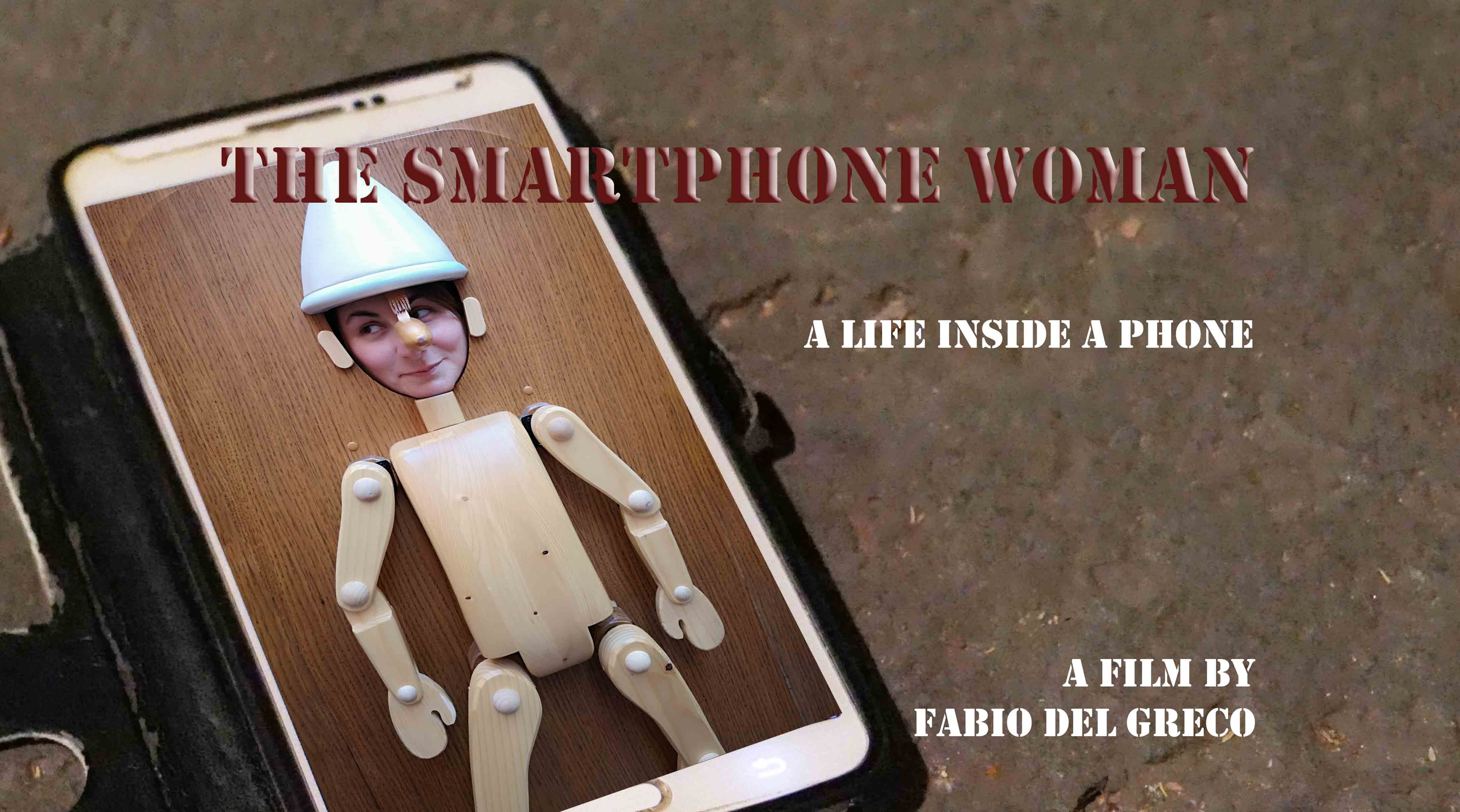
Drama, thriller, dark comedy, by Fabio Del Greco, Italy 2020.
On a bridge over the Tiber River, an elderly and severely ill man has decided to end his life, but an unusual discovery changes his mind: he comes across a lost smartphone. Intrigued, he decides to return home and watch the videos contained within it. On the screen, a series of videos unfold, telling the story of a woman who has emigrated from southern Italy to Rome to work as a teacher in schools and her struggles with integration in a social reality she cannot fully grasp.
"The Smartphone Woman" is a realistic tale of a woman's life and her complex relationship with an "infernal" city. It portrays the challenges she faces, her connection to her origins, the social discomfort she discovers in the outskirts, and the eerie presence of the ghosts of ancient Roman empire. Fabio Del Greco employs a fragmented style, using pieces of "real life" shot with the smartphone, to construct a narrative that ambiguously oscillates between fiction and truth. This creates a captivating exploration of the discomfort and alienation within the bustling city, contrasting with the peaceful village life from which the protagonist hails. The film is constructed with a variety of heterogeneous characters and situations, an emotional kaleidoscope, weaving between evenings of exploration in the Eternal City and daily struggles. Realistic smartphone-shot videos are alternated with a narrative thread reminiscent of film noir and, ultimately, surrealism in the finale. On screen, a succession of grotesque characters unfolds, representing the director's vision of a tumultuous humanity. The film's potency lies in the emotion it manages to convey and in the protagonist's naive perspective. "The Smartphone Woman" is a must-see for enthusiasts of independent and experimental cinema.
LANGUAGE: italian
SUBTITLES: English, French, German, Portuguese, Spanish
Gadda’s Rome and the Biography of Chaos
There is a particular kind of order that announces itself too loudly. You have seen it: the freshly polished brass nameplate beside an apartment door, the curtains always drawn at the same precise angle, the neighbors who greet each other with a warmth calibrated to reveal nothing. The building on Via Merulana that Carlo Emilio Gadda constructs in his 1957 novel is exactly this kind of place — a Roman palazzo in 1927 where middle-class respectability has been lacquered over something that cannot hold, and where a robbery and a murder become less a crime story than a seismic event, cracking the surface to expose what lived beneath all along.
Gadda was born in Milan in 1893 into a family whose material comfort concealed an architecture of anxiety and resentment that would take decades to fully collapse. His father died when Gadda was young, leaving a widow and children in a financial position that required constant performance of a class they could barely afford. His mother, Adele, was a figure of such suffocating severity that Gadda’s relationship with her constitutes something close to the emotional plot of his entire literary career — a decades-long entanglement of guilt, fury, and devotion that never resolved into anything clean. When his younger brother Enrico was killed in the First World War in 1918, something in Gadda’s internal organization shifted permanently. He had served himself, had been captured and imprisoned at Caporetto, had endured the humiliation of Italy’s catastrophic military defeat — and then returned to find the brother gone and the family’s already precarious finances in ruins. He trained as an engineer and worked for years in that capacity, writing on the margins of a professional life that never satisfied him, accumulating manuscripts and notebooks and an almost pathological relationship to language as the one system that might finally make sense of what everything else refused to.
By the time he sat down to write what would become That Ugly Mess on Via Merulana — serialized in the journal Letteratura between 1946 and 1947, then published as a book a decade later — he had already been shaped by the specific gravity of Fascist Italy in ways he could not entirely name or separate from himself. The novel is set in 1927, at the height of Mussolini’s consolidation of power, in a Rome that had been subjected to exactly the kind of aggressive surface-renewal the regime specialized in: monumental architecture, cleared slums, the theatrical reconstruction of imperial grandeur over a city of neighborhoods and contradictions. This is not decorative historical placement. The year 1927 in Rome meant a city under pressure to present a unified face to history, to perform coherence, to submit private complexity to public myth. The palazzo on Via Merulana, with its bourgeois tenants and their interlocking secrets, is Fascist social logic miniaturized and made domestic.
What Gadda understood — and what makes the novel’s famous linguistic excess feel structurally necessary rather than merely stylistic — is that this kind of enforced coherence produces its own specific form of rot. The philosopher Cornelius Castoriadis would later argue that every social institution produces a central imaginary that legitimizes itself by suppressing contradictions; Gadda arrived at the same insight through the body, through personal loss, through the experience of watching a nation and a family both demand that grief and disorder be reorganized into presentable shapes. His mother’s domination was not separate from Mussolini’s Rome. They were the same epistemological event: authority that mistakes rigidity for strength and calls the result civilization.
The murder victim in the novel, the beautiful Liliana Balducci, is found not in a back alley but in the middle of the most respectable environment imaginable. This is Gadda’s fundamental claim, delivered not as argument but as scene: the catastrophe was never outside. It was always inside the building, behind the polished nameplate, sharing an address with everything the residents had agreed, very carefully, never to discuss.

Language as Crime Scene
You open the novel expecting a detective story and instead find yourself inside a mouth that speaks in five languages at once. The Roman dialect bleeds into Milanese slang, which collides with bureaucratic Latin, which dissolves into Neapolitan invective, which surfaces again as something almost medieval, almost liturgical. The prose does not translate itself for you. It does not apologize. And after the initial vertigo, something stranger happens: you begin to feel that this is how the world actually sounds when no one is managing it for you, when the institutional fiction of a single, stable language has been stripped away. Gadda’s style — the so-called pasticciaccio of the title, a word meaning both a complicated mess and a baked pasta dish — is not a formal experiment in the academic sense. It is a claim about the nature of reality itself.
Carlo Emilio Gadda spent decades as a practicing engineer before his literary career became undeniable, and this matters more than any biography can contain. An engineer measures, calculates, and resolves. Gadda understood this impulse from the inside, which is precisely why he distrusted it so completely. His theoretical notebooks, collected posthumously in the Meditazione milanese, written around 1928 but unpublished in his lifetime, reveal a mind obsessed with what he called the baroque complexity of causal systems — the idea that every event is the convergence point of an essentially infinite network of prior conditions, none of which can be isolated, none of which can be declared the cause without falsifying everything. When Ingravallo, his detective, says in the novel’s opening pages that crimes are never the result of a single cause but always the knot of multiple, interlocking causes, he is not delivering a procedural hypothesis. He is delivering Gadda’s philosophy of knowledge, his epistemology dressed in a policeman’s hat.
Mikhail Bakhtin, writing in the 1930s, named what Gadda was doing before Gadda had finished doing it. In his theory of the novel’s heteroglossia, Bakhtin argued that the novel as a form is constitutionally polyphonic — that it is the literary space in which social languages, class dialects, professional jargons, and historical registers are brought into friction with one another, refusing to resolve into a single authoritative voice. For Bakhtin, the novel is healthy precisely when it refuses the monologue of official culture. Gadda’s prose is perhaps the most structurally committed realization of this principle in twentieth-century European literature. Every paragraph is a war of tongues. And that war does not produce chaos — it produces accuracy. The chaos is in the world; the prose is merely honest about it.
Gilles Deleuze and Félix Guattari, in their 1975 study of Kafka, developed the concept of minor literature: a literature that uses a major language against itself, deterritorializing it from within, making it stutter, making it bear the weight of what it was designed to exclude. Gadda operates inside standard Italian the way a termite operates inside wood — not from the outside, not as decoration, but from within, hollowing out its pretensions to clarity, its ambitions to represent a unified national reality. And this is not politically innocent. Italian as a national language was still young in Gadda’s time, having been standardized alongside the Risorgimento project in the nineteenth century, still carrying the ideological freight of national unification, still being used by the Fascist regime of the 1930s as an instrument of cultural homogenization. To write in dialect, in slang, in macaronic contamination, was to refuse the very grammar of the official story.
What the language of That Ugly Mess on Via Merulana enacts, then, is not stylistic difficulty for its own sake. It enacts the impossibility of the clean solution — not only to the crime at the center of the plot, but to any human event that anyone has ever tried to reduce to a single cause, a single agent, a single language that speaks the final word.
The Detective Who Cannot Solve Anything
You already know what it feels like to need an answer so badly that you invent one. Not consciously, not with malice, but with the quiet desperation of a mind that cannot tolerate remaining inside an open question. Ingravallo, the detective at the center of Gadda’s novel, knows this feeling from the inside, and he despises it. He is a man professionally employed to close questions, and he spends the entire book refusing to do so — not out of incompetence, but out of a kind of brutal intellectual honesty that the genre he inhabits was never designed to accommodate.
Carlo Emilio Gadda published the novel in its complete form in 1957, after serializing portions of it in the literary journal Letteratura in the early 1940s. The detective story as a form had by then calcified into a reliable machine: a crime occurs, a singular mind investigates, causality is restored, the social order exhales. From Poe’s Dupin to Conan Doyle’s Holmes, the detective exists as a figure of epistemological mastery — someone who reads the world’s chaos and translates it, fluently, back into reason. Walter Benjamin, writing in the dense and unfinished archive of reflections that would be published posthumously as The Arcades Project, identified this structure as a bourgeois fantasy. The detective story, he argued, performs a function of ideological reassurance: it promises that the modern city, for all its anonymity and menace, is ultimately legible. That behind every rupture there is a cause, behind every cause a face, and behind every face a punishment that restores equilibrium. The genre does not describe the world. It flatters the class that built it.
Ingravallo does not flatter anyone. He is a southern Italian in Rome, heavy, melancholy, perpetually underdressed for the social performances around him, a man who carries in his body the kind of displacement that the northern bourgeoisie prefers not to examine too closely. Before any crime occurs in the novel, he has already articulated what Gadda called his theory of combinatory causation — the idea that no event has a single origin, that every disaster is the convergence of an entire sedimented history of causes, tensions, desires, and failures. This is not a hypothesis Ingravallo holds lightly. It is the structure of his grief. He already knows, before the investigation begins, that the answer he is supposed to produce is a fiction. And yet he investigates. He moves through apartments, through lies, through the dialects and bodies of Rome’s lower neighborhoods, through a city that smells of anxiety and garlic and old money pretending to be older. He accumulates detail with the ferocity of someone who believes in evidence even while doubting the conclusions evidence is meant to support.
The crime — a robbery, then a murder — is never resolved. Gadda does not withhold the solution as a stylistic provocation or a postmodern game. He withholds it because Ingravallo’s own theoretical framework makes resolution structurally impossible. If causality is always plural, always knotted into social conditions and historical wounds and the micro-violences of daily humiliation, then naming a single murderer is not justice. It is scapegoating. It is the same gesture the genre always performs: selecting one body to carry the weight of everything that cannot be fixed, so that everything else can continue unchanged. Ingravallo understands this, and the understanding paralyzes him in ways that look, from outside, like failure.
Benjamin’s point cuts here with surgical precision. The detective story as a form was never interested in truth. It was interested in the restoration of a particular order’s confidence in itself. Gadda takes the form and empties it of that promise deliberately, methodically, with full knowledge of what he is destroying. The reader who arrives expecting resolution is not simply frustrated. They are implicated. Their hunger for the answer is itself the object of the investigation — a need trained into them by the same social world that produced the crime, the investigator, and the impossibility of naming what actually happened.
Fascism as Interior Design
You already know the building. You have lived in it, or something very close to it — the neighbor who reports the noise complaint not because the noise bothers her but because reporting is a form of power she can exercise without cost, the landlord who enforces rules selectively and calls it fairness, the doorman whose deference to certain residents and coldness to others maps onto a hierarchy no one has ever formally announced but everyone perfectly understands. Gadda’s apartment building at the center of the novel is not a metaphor for Fascism. It is Fascism, rendered in plaster and gossip and borrowed respectability, in the way a body rendered in wax is still a body — accurate in every surface, hollow only where life would have been.
Hannah Arendt, writing in 1951 in The Origins of Totalitarianism, made an observation that most readers absorb intellectually and almost no one actually believes: that totalitarianism is not the imposition of an alien system onto a passive population, but the crystallization of tendencies already present within the social fabric — the desire to belong, the relief of having someone to blame, the quiet comfort of hierarchy when you find yourself on the right side of it. What she described as the “temporary alliance between the elite and the mob” was not a political strategy dreamed up in a cabinet. It was a social texture, something already woven into the way people spoke to each other across thresholds, the way they measured one another’s furniture and coats and accents. Gadda understood this before Arendt named it, and he understood it from the inside, which is why his novel never offers a vantage point clean enough to feel like criticism. You are always standing too close.
Robert Paxton, whose work on Fascism across several decades consistently refused the comfortable reading of the movement as an ideology imported from above, argued that Fascism in practice was a set of daily social performances — the rally, yes, but also the snub, the preferential queue, the bureaucratic cruelty administered with a smile. It lived not in manifestos but in the practiced micro-gestures of ordinary people who had learned that loyalty to the regime was most efficiently demonstrated through small betrayals of one another. The residents of Via Merulana are engaged in exactly this performance. Their surveillance of one another is not paranoia — it is civic participation as the regime has redefined it. To watch is to belong. To report is to prove your belonging.
The apartment building functions as a structure of nested loyalties and legible hierarchies, where the performance of decency is the primary social currency and actual violence remains structural, invisible, deniable. Nobody in the building is a monster in the way narrative tradition would recognize. They are something more difficult: they are collaborative. The small cruelties — the withheld information, the cultivated suspicion, the alliance formed against the socially marginal — are not corruptions of the social order. They are its infrastructure. Gadda refuses to separate the crime investigation from this texture, which is precisely why the investigation cannot conclude. To solve the crime would require naming a system, and naming the system would require that the narrator, the police, the residents, and by extension the reader acknowledge their own position within it.
Commissario Ingravallo moves through this building with his Irpinian melancholy and his baroque intuitions, and what he perceives — what he cannot quite articulate but what accumulates in his body as a kind of nausea — is that the violence he is investigating did not arrive from outside. It was always already resident. It was paying its rent on time, attending the right dinners, performing the right deferences to the right people. The crime, in this sense, is not a rupture in the social fabric of Fascist Rome. It is simply a moment in which that fabric became briefly, uncomfortably visible — and everyone in the building has a vested interest in making it invisible again before anyone asks who chose the pattern.
A vision curated by a filmmaker, not an algorithm
In this video I explain our vision
The Body of the Woman as the Site of Everything
There is a moment in the novel when a woman’s body is described with a precision that makes you stop reading. Not because the language is brutal — though it is — but because it is also tender, almost reverent, and that combination is what unsettles you. Gadda lingers. He circles. He catalogs the contours of Liliana Balducci’s dead form with a vocabulary that belongs simultaneously to the forensic report and to desire, and the reader understands, with something close to physical discomfort, that these two registers were never as separate as civilization pretended. The murder of Liliana is not a crime that interrupts the novel’s domestic world. It is the novel’s domestic world, finally made legible.
Silvia Federici argued in Caliban and the Witch, published in 2004, that the transition to capitalist accumulation in early modern Europe required a specific act of violence: the systematic subjugation of the female body as a site of productive and reproductive labor, to be controlled, surveilled, and when necessary, destroyed. The witch trials were not hysteria. They were policy. They eliminated a class of women who held autonomous knowledge — of bodies, of land, of community — and replaced that knowledge with a new dispensation in which the female body was terrain to be governed from outside. Federici’s argument is historical, but its architecture is visible in Gadda’s Rome with remarkable fidelity. The women in the building on Via Merulana are not free inhabitants of their own lives. They are objects of administration: by husbands, by the state, by the Church whose presence saturates the city, and by the investigating gaze of Ingravallo himself, who loves Liliana with the precise, anguished devotion of a man who has never once considered whether his loving constitutes a form of ownership.
What makes Gadda’s treatment extraordinary is that he does not sentimentalize this condition away. He allows the violence to mean what it means. The rape and murder of the women in the novel are not anomalies erupting into an otherwise functional social order — they are the social order’s logic arriving at its terminus. The apartment building is a miniature of patriarchal Rome, and Rome is a miniature of the Fascist state, and the Fascist state is only the most honest recent incarnation of a structure that had been encoding female bodies as contested territory for centuries. Gadda wrote That Awful Mess — the novel was serialized between 1946 and 1947, then published in full in 1957 — at the exact historical moment when Italians were trying to narrate Fascism as an aberration rather than a culmination. He refused that comfort. The crimes in the novel do not require a Fascist villain to explain them. They require only a building, a staircase, a society of watchers and watched.
But the essay cannot let Gadda’s clarity be the end of the matter. His gaze diagnoses the patriarchal structure and simultaneously participates in it. The prose that describes Liliana’s body is erudite, mournful, and also voyeuristic in a way that implicates the reader who reads it with pleasure, which is most readers. Gadda sees the trap and describes it from inside. He cannot exit. His narrator circles the female victims with the same obsessive, categorizing energy that the killers brought to the act itself — as though knowing what you are doing, naming it precisely, is somehow different from doing it. Laura Mulvey, decades after Gadda, theorized the male gaze as a structural feature of representation rather than a personal failing, and that framework lands with particular force here. Gadda’s formal innovation — the baroque accumulation of detail, the linguistic excess, the refusal of clean causality — is not a solution to the problem of the gaze. It is the problem of the gaze made aesthetically brilliant, which is a different thing entirely, and perhaps a more dangerous one, because brilliance disarms the resistance you knew you were supposed to maintain.
What the Reader Recognizes and Refuses to Name
You have filled out a form recently. Perhaps it was a noise complaint, or a parking dispute, or a request submitted to a building administrator who never quite answered. You described a situation in careful, neutral language, stripping it of its emotional charge because the form demanded it, because the institution required legibility, and because to name what you actually felt — the fury, the humiliation, the suspicion that something wrong was being protected — would have made you appear unreasonable. You translated your experience into a format the system could process. And in doing so, you cooperated with the same logic that makes the apartment block on Via Merulana so terrifying: not the violence itself, but the collective infrastructure that absorbs, redirects, and neutralizes it.
Carlo Emilio Gadda understood this before the vocabulary existed to describe it precisely. His building in 1927 Rome is not merely a setting. It is a social machine that operates through proximity and propriety, through the management of appearances and the silent agreement that the community’s reputation matters more than any individual truth inside it. The residents know each other in the way neighbors always know each other: partially, strategically, with a familiarity that coexists comfortably with profound and convenient ignorance. Zygmunt Bauman, writing in Liquid Modernity in 2000, described the transformation of modern social bonds from solid, territorially rooted commitments into fluid, conditional arrangements that preserve the aesthetic of community while evacuating its ethical content. The apartment block, in this sense, is a perfect transitional object: it still has walls, a shared stairwell, a concierge, the architecture of collective life — but the solidarity it performs is entirely oriented toward self-protection, not toward truth.
What Gadda dramatizes is that this is not a corruption of community. It is what community, under certain political and psychological pressures, actually becomes. The residents of his building do not fail to act because they are cowards in any simple sense. They fail to act because action would rupture the surface that grants them their identity. They are respectable people. Respectability, Gadda understood, is not an achievement of character. It is a technology of evasion. It allows a person to stand very close to wrongdoing and remain, in some technical and socially legible sense, uninvolved. Bauman identified the same mechanism operating in bureaucratic modernity more broadly: the fragmentation of moral responsibility through procedural distance, the way institutions are designed to ensure that no single person is ever close enough to an outcome to feel fully accountable for it. The form you filled out performs exactly this function. It is not indifference dressed as process. It is indifference constituted by process.
The building you live in now may not be under a fascist government. The concierge may not be reporting to anyone. The neighborhood association newsletter may use the language of inclusivity and shared values. But the structural logic is the same: a sealed community that processes conflict through proprietary channels, that turns grievances into administrative categories, that rewards the person who describes their distress in the fewest and most manageable words. The violence that circulates in this system is rarely dramatic. It does not require a murder on the second floor. It requires only the sustained, collective decision not to ask certain questions, not to name certain dynamics, not to acknowledge what everyone in the building already knows.
Gadda’s novel was never solved, and this is not an accident or an artistic failure. The investigation collapses not because the detective is incompetent but because the community around the crime is perfectly coherent. It has no interest in resolution. Resolution would mean exposure, and exposure would mean that the building’s interior — its arrangements, its silences, its settled hierarchies of propriety — would have to be made visible to something outside itself. The reader who finds this frustrating is reacting exactly as Gadda intended. The frustration is recognition. Something in you already knows why the case was never closed, because something in you has participated in keeping a different case exactly as open, and exactly as unresolved.
The Unresolved and the Unbearable
There is something almost violent about reaching the last pages of a book and finding not an ending but an abandonment. The novel stops. The murder of Liliana Balducci is never solved. The theft of her jewels is never explained. The investigation that Ingravallo conducts with such ferocious, intuitive intelligence simply ceases, not because the truth has been found but because Gadda, working on the text between 1945 and its incomplete publication in 1957, put down his pen and did not pick it up again for this particular purpose. Critics have spent decades debating whether this was a failure of will, a crisis of nerve, or a philosophical statement made through silence. The answer is probably all three, and none of them, because the question itself assumes that completion was ever the point.
Wittgenstein, in the final proposition of the Tractatus Logico-Philosophicus of 1921, declared that whereof one cannot speak, thereof one must be silent. It is one of the most quoted and least understood sentences in the Western philosophical tradition, deployed most often as an elegant justification for restraint, for the dignified refusal to pursue what cannot be pinned down with logical precision. Gadda seems to have understood this proposition and then committed an act of deliberate philosophical vandalism against it. He spoke anyway. He spoke in Roman dialect and Milanese slang and bureaucratic Italian and Neapolitan street language and the tortured syntax of a man who cannot stop qualifying every observation because every observation contains within it a hundred other observations. He spoke with furious, almost obscene abundance, and still the murder went unsolved. The silence at the end of the novel is not the silence of a man who knew when to stop. It is the silence of a man who exhausted every linguistic resource available to him and arrived at the same wall.
What makes this philosophically unbearable rather than merely frustrating is that the incompletion is not incidental to the meaning but structural to it. Gadda’s entire theoretical framework, developed explicitly in his 1963 essay Meditazione milanese and embedded in the novel’s every sentence, holds that reality is a system of infinite interconnections in which isolating any single cause is an epistemological act of violence. If you follow that logic to its conclusion, a detective novel cannot end. Resolution requires the severing of connections, the identification of a single thread as the thread, the transformation of a web into a line. Ingravallo himself articulates something close to this when he describes how crimes accumulate from a tangle of causes, a knot of circumstances, none of which is sovereign. He knows this. Gadda knows this. And yet both men spend the entire novel pursuing the solution with grinding, obsessive energy, as if knowing that resolution is structurally impossible has no bearing whatsoever on the hunger for it.
This is the trap the novel sets for its reader, and it is the same trap that daily life sets for every person who has ever demanded an explanation from a grief that refused to organize itself into meaning. The hunger for resolution is not rational. It does not respond to philosophical argument. A man can understand perfectly well that the universe does not owe him an answer and still find himself unable to sleep at three in the morning because the answer has not arrived. Gadda understood this from the inside, having carried the unresolved murder of his brother during the First World War, having never stopped interrogating a history that gave him no verdict. The novel is not a metaphor for that wound. It is the wound, rendered in five hundred pages of magnificent, suffering prose that refuses to become clean.
What remains, then, is the question that the novel’s open ending forces into the reader’s chest without warning: whether the demand for resolution is a form of dignity, the refusal to accept a world that will not account for itself, or whether it is the most reliable mechanism through which that same world keeps you permanently, usefully, unfinished.
🌀 Labyrinths of Language, Crime, and Urban Chaos
Carlo Emilio Gadda‘s That Ugly Mess on Via Merulana is a labyrinthine detective novel set in Fascist Rome, where the investigation of a crime dissolves into an endless proliferation of causes, languages, and digressive thought. These related articles explore the intellectual and literary territories most alive in Gadda’s restless, encyclopedic vision.
Eco’s The Name of the Rose: Meaning and Analysis
Umberto Eco‘s The Name of the Rose shares with Gadda’s novel a fascination with the detective form as a philosophical and semiotic puzzle. Like Gadda, Eco builds a labyrinthine narrative where the pursuit of truth leads not to clarity but to ever-deepening complexity. Both works use crime as a pretext to explore epistemology, language, and the impossibility of totalizing knowledge.
GO TO THE SELECTION: Eco’s The Name of the Rose: Meaning and Analysis
Kafka and Bureaucracy: The Trial and The Castle
Kafka’s novels of bureaucratic entrapment offer a striking parallel to Gadda’s Rome, where institutions, procedures, and language itself become obstacles rather than instruments of justice. The Trial and The Castle dramatize the same sense of systemic opacity that pervades Via Merulana, where every clue multiplies the confusion. Both Kafka and Gadda transform the mechanisms of modern society into sources of existential and narrative anxiety.
GO TO THE SELECTION: Kafka and Bureaucracy: The Trial and The Castle
Stream of Consciousness in Literature and Cinema
Stream of consciousness as a literary technique is central to understanding Gadda’s explosive, digressive prose, which fractures linear narrative into cascades of association, dialect, and erudite reference. This article traces how writers like Joyce and Woolf developed interior monologue into a formal instrument for capturing the chaos of subjective experience. Gadda’s own practice pushes this tradition further, merging psychological interiority with satirical violence toward language and society.
GO TO THE SELECTION: Stream of Consciousness in Literature and Cinema
Situationist Psychogeography: The City as Lived Space
The Situationist concept of psychogeography reimagines the city as a space of drift, desire, and hidden political meaning, a framework that resonates deeply with Gadda’s Rome as a labyrinth of class tensions and repressed violence. Like the dérive, Gadda’s narrative wanders through urban layers, accumulating social and sensory detail that resists resolution. The city in both frameworks is never a neutral backdrop but an active, destabilizing force on those who inhabit it.
GO TO THE SELECTION: Situationist Psychogeography: The City as Lived Space
Discover the Cinema of Complexity on Indiecinema
If Gadda’s chaotic, layered vision of reality speaks to you, Indiecinema streaming is your next destination. Explore independent and avant-garde films that share the same refusal of easy answers, the same love for narrative complexity and the hidden depths of everyday life.
👉 EXPLORE THE CATALOG: Watch Indie Films in Streaming
A vision curated by a filmmaker, not an algorithm
In this video I explain our vision

