
The Analyst's Chair as Cinematic Apparatus
You settle into the seat and the lights go down, and something in your nervous system — something older than language — understands that what is about to happen requires your stillness. Not the stillness of sleep, not the alertness of waking life, but a third state that the body recognizes without being able to name: a controlled suspension, a voluntary paralysis that you entered into freely and cannot quite remember choosing.

This is not unique to you. It is structurally engineered. The darkened room, the fixed gaze directed at a luminous surface, the suppression of voluntary movement, the dissolution of social obligation — these are not aesthetic choices made by architects of theaters. They are the precise conditions that Sigmund Freud, in 1900, identified as prerequisites for the emergence of unconscious material in “The Interpretation of Dreams.” He called it the abandonment of “critical activity” in favor of something more receptive, more porous. He was describing a patient on a couch, eyes unfocused, instructed to say whatever came without filtering it first. The structural rhyme between that room and a cinema is not metaphorical. It is architectural, physiological, and very nearly identical.
Christian Metz pursued this convergence with the precision of a surgeon in “The Imaginary Signifier,” published in 1977, where he argued that cinema operates as a mirror with one crucial and vertiginous exception: it reflects everything except the body of the person watching. Every object in the frame can be identified, every face recognized, every gesture catalogued — but the spectator looks and does not find themselves there. This absence is not a failure. It is the mechanism by which the screen becomes available for projection. The surface is empty of the viewer precisely so that the viewer can fill it. What you see when you watch a film is therefore never entirely the film. It is the film plus the pressure of everything inside you that has found a permitted exit.
Freud’s model of the unconscious was never a container. This is one of the most persistently misread aspects of his work. In “Project for a Scientific Psychology,” drafted in 1895 though not published in his lifetime, and across the theoretical architecture of what he called the “Pcs-Ucs” system in the 1915 metapsychological papers, the unconscious is not a place where things are stored. It is a scene — a staging ground, a theater of representation, where contents appear as images, dramatizations, and condensed figures rather than as thoughts in the conventional sense. The unconscious does not think. It shows. It produces spectacles for an internal viewer who is also, in some structural sense, always slightly off to the side of what is being shown, never quite in the frame.
What cinema does — at its most fundamental level, before story, before character, before genre — is externalize this interior theater and place it in a shared social space. The darkness of the screening room is not a retreat from the world. It is a permission slip issued by the culture to its members, authorizing them to sit in proximity and hallucinate together without the embarrassment that would attend such an activity in daylight. There is a reason that the history of psychoanalysis and the history of cinema begin within five years of each other: Freud’s “Studies on Hysteria” in 1895, the Lumière brothers’ first public projection in December of the same year. Two technologies for the externalization of inner life arrived simultaneously, as though the culture had been holding its breath and exhaled both at once.
The analyst’s chair and the cinema seat are not analogies for each other. They are instances of the same need made visible in two different rooms.
Beyond Our Lives
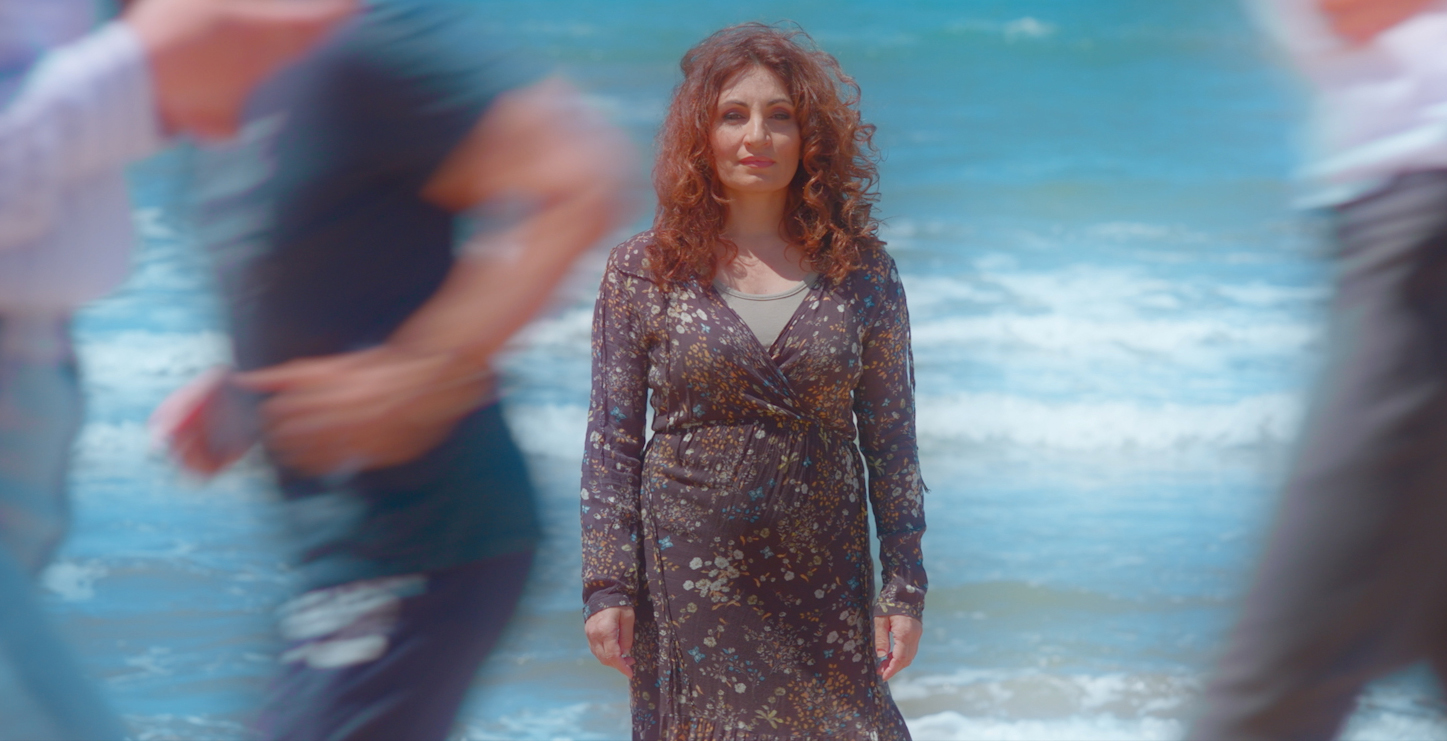
Drama, noir, by Fabio Martorana, Italy, 2021.
Alex and Claire have something in common, between recurring nightmares and restless memories; only time will allow them to understand what is happening. Where is the truth hidden? Perhaps in a time that the two protagonists don't even imagine. A sweet and complicated, painful and troubled love story, between a psychoanalyst and a woman who must fight a tough battle against herself and her introspective fears. Two soul mates that fate brought together after reliving distant experiences over time.
Dedicated to the world of noir, where lighting rich in chiaroscuro, the contrast between light and shadow symbolically represents the conflict between good and evil, the feature film tells of a sweet and complicated, painful and troubled love story. The film was shot between the provinces of Rome and Latina in the splendid settings of Circeo and Doganella di Ninfa.
LANGUAGE: Italian
SUBTITLES: English, Spanish, French, German, Portuguese
Desire, Identification, and the Voyeuristic Contract
You are sitting in the dark, watching someone who does not know they are being watched, and you feel nothing illicit about it. That is the first and most revealing fact about what cinema does to a person — not what it shows, but what it makes permissible, what it trains the nervous system to accept as natural.
Laura Mulvey published “Visual Pleasure and Narrative Cinema” in Screen magazine in 1975, and the argument she made was not primarily about women or men but about architecture — the hidden structural logic that organizes what the eye is permitted to desire. Drawing on Freudian scopophilia and Lacanian mirror theory, she demonstrated that classical Hollywood cinema was not accidentally organized around a masculine gaze that objectified feminine presence; it was constitutively so, built from the inside out around a splitting of the screen into the one who looks and the one who is looked at. The camera does not record desire; it legislates it, frame by frame, cut by cut, in decisions about where the eye is invited to linger and where it is punished for looking away.
What makes this more than a feminist critique of bad representation is the mechanism it exposes regarding identification. When a spectator aligns with the protagonist’s point of view — which classical editing actively engineers through shot-reverse-shot, eyeline matches, and the systematic restriction of visual information to what the hero sees — they are not choosing to adopt that perspective. It is chosen for them before they enter the theater, before they buy the ticket, before they know the film exists. Identification in cinema is not empathy freely extended; it is a harness fitted around the viewer’s perceptual apparatus so gradually and pleasurably that the harness itself becomes invisible. The viewer mistakes the director’s desire for their own.
This is where Mulvey’s analysis becomes genuinely dangerous rather than academically interesting — it implicates the viewer not as victim of manipulation but as willing co-author of a fantasy they retroactively claim to have merely witnessed. Psychoanalytically, this is the structure of disavowal: I know very well that this image is constructed, staged, and ideologically loaded, and yet I feel desire, recognition, longing, as though none of that were true. The “and yet” is the engine of cinema’s social power. It is also, not coincidentally, the engine of ideology as Louis Althusser described it in 1970 in his essay on Ideological State Apparatuses — the way subjects recognize themselves in representations that were never made for them as autonomous individuals but for the reproduction of a particular social order.
The voyeuristic contract cinema offers is therefore not between the viewer and the characters on screen. It is between the viewer and the institution of cinema itself, and its terms are written in a language most people never learn to read because the literacy required to read it is precisely what the institution withholds. A person who grows up watching a particular configuration of bodies, desires, and looks does not acquire a preference; they acquire a perceptual grammar that feels like preference, that presents itself as personal taste, individual sensibility, private longing. By the time they sit in that dark room, the contract has already been signed — years earlier, in childhood bedrooms, on television screens, in the accumulated visual education that no one calls an education because it never announced itself as one.
What Mulvey opened, and what subsequent theorists like E. Ann Kaplan in her 1983 work “Women and Film” extended, is the recognition that the screen does not mirror desire back to us — it produces desire as a specific social artifact, gendered, racialized, and class-inflected, stitched invisibly into the pleasure itself so that to question the desire feels indistinguishable from attacking the pleasure.

The Symptom as Narrative Engine
You already know something is wrong with the shower scene before the knife appears. The tension precedes the violence by a full minute — the camera restless, the cutting rhythm slightly off, the ordinary gestures of a woman washing her hair rendered suddenly strange by attention. What the scene gives you is not dread of what might happen; it gives you dread of what you already sense is structurally inevitable. The murder, when it comes, does not create the fear. It merely discharges it.
Slavoj Žižek, in his 1992 collection of essays on Hitchcock, makes a move that most film criticism had carefully avoided: he refuses to treat the thriller’s suspense as a technique of misdirection and insists instead that it operates by the logic of the neurotic symptom. In psychoanalytic terms, a symptom is not a mistake the psyche makes — it is the psyche’s solution, the only way it has found to manage a desire it cannot name directly. The symptom is functional. It repeats not because it has failed but because repetition is precisely the point. Žižek’s argument, rooted in Lacan’s rereading of Freud, is that what Hitchcock constructs is not suspense in the journalistic sense — not uncertainty about outcome — but the formal reproduction of this structure, a narrative architecture in which the audience is locked into a loop of approaching something they simultaneously want and cannot consciously acknowledge wanting.
The mechanisms Freud first outlined in his clinical work — condensation, displacement, repetition compulsion — turn out to be extraordinarily precise descriptions of how mainstream narrative cinema is actually built. Condensation, the process by which a single image carries the freight of several incompatible meanings at once, explains why certain objects in commercial films hold an almost irrational charge: the key, the staircase, the recurring piece of clothing worn by someone who is absent. These objects are not symbols in the literary sense. They are knots. They concentrate contradictory emotional material that the story cannot speak aloud, and their power depends entirely on that illegibility. The moment a film explains its own symbol, the symbol dies and the tension collapses with it.
Displacement operates differently but with equal precision: the emotional content of one relationship migrates invisibly onto another, and the audience feels the transferred affect without being able to locate its source. This is why genre cinema can generate genuine grief over characters introduced forty minutes before their deaths, or genuine erotic tension in scenes with no physical contact. The emotion is real. Its object is a decoy. What the viewer is actually mourning, or desiring, arrived earlier in the film and was never resolved — it simply found a new address.
What Žižek makes uncomfortable, and what the entertainment industry has no interest in advertising, is that this architecture is not incidental to popular cinema’s commercial success — it is the mechanism of that success. Audiences do not pay to be surprised. Surprise, as any screenwriting manual will quietly admit, is the least durable of pleasures. They pay to be held in a state of suspended, unresolved tension that resembles nothing so much as the position of the neurotic subject before the symptom breaks — close enough to the unbearable thing to feel its gravity, protected enough by the fictional frame not to have to act on it. The screen functions as the membrane of that protection, thin enough to allow affect through, thick enough to prevent consequence.
What this means for the viewer’s self-understanding is considerably less flattering than the idea that cinema simply entertains or enlightens. The film you remember most vividly — the one you have seen three times, the one whose images return to you unprompted — is almost certainly the one that managed to touch something you have no clean language for, and whose narrative resolution you felt, at some level, as a small bereavement rather than a satisfaction.
The Girl from the Back Desk

Drama, by Matteo Piacenti, Corrado Bonicelli, Italy, 2020.
Viola is a lonely teenager who feels out of place in the world around her, inadequate and imperfect. The comfort and support of her parents and friends are of no use. Art is the only way she has to express herself: like a colorful mosaic, Viola represents her own world and her way of seeing reality, one drawing at a time. Then she meets Giacomo, her new deskmate. From the relationship between the two, something opens up in the shell that imprisons Viola in loneliness and social isolation. A new path opens up for her in this difficult adolescent phase, which leads her to realize something more about herself and the reality around her.
This is a film made by very young boys and girls who share a passion for films, theater, and art. The film explores the sensitivity of young people, encourages them to reflect on their own self-perception in relation to society, with a positive message and attitude towards themselves and the community. "The Girl from the Back Desk" highlights the values that adolescents believe are essential for a healthy society: respect, generosity, kindness, trust in others, courage in defending their ideals, and participation.
LANGUAGE: Italian
SUBTITLES: English, Spanish, French, German, Portuguese
Historical Entanglement: Hollywood, the Ego, and Postwar Normativity

You are sitting in a darkened theater in 1947, and the man on screen is not a villain — he is sick, and the film wants you to understand the difference. He flinches, sweats, hallucinates. A calm physician appears. Order is restored. You leave feeling that medicine has triumphed over chaos, that the mind, like a broken limb, can be set straight and returned to function. What you do not know, and what the credits will never tell you, is that the calm physician was scripted in close consultation with the newly formed Hollywood psychiatric advisory board, established in 1946 under the auspices of the Group for the Advancement of Psychiatry, whose members had spent the war years managing shell-shocked soldiers and returned home with a mandate to manage the peacetime psyche as well.
The collaboration was not accidental or informal. It was institutional. Figures like John Huston, who had filmed the documentary Let There Be Light in 1946 for the Army — footage so destabilizing in its portrayal of traumatized veterans that the government suppressed it for thirty-five years — found themselves navigating a Hollywood apparatus increasingly shaped by clinical consultation. The studios needed stories about psychological disturbance that did not frighten audiences into nihilism, and the psychoanalytic establishment, dominated by the ego psychology of Heinz Hartmann, needed a mass vehicle for its core premise: that the healthy ego is one capable of adaptation, of fitting itself to social reality without friction. The screen became the laboratory where adaptation was dramatized as salvation.
Hartmann’s 1939 text Ego Psychology and the Problem of Adaptation, translated into English in 1958 and rapidly absorbed by American analytic training institutes, provided the theoretical skeleton. The concept of the “conflict-free ego sphere” — the idea that part of the self operates in harmonious adjustment with its environment — translated cinematically into the figure of the recovered patient who returns to his job, his wife, his mortgage. Mental illness in this cinematic grammar was not a critique of the social order but a temporary deviation from it, and cure meant reintegration, not transformation. The films of this period did not ask whether the social reality to which the patient was meant to adapt was itself a source of suffering. That question was structurally inadmissible.
Gender was the most precise instrument of this inadmissibility. The postwar screen repeatedly diagnosed female ambition, sexual autonomy, and professional independence as symptoms — as expressions of unresolved penis envy, as Freudian pathology dressed in noir lighting. Phyllis Chesler, writing in Women and Madness in 1972, would later document the statistical reality that women were hospitalized for psychiatric conditions at dramatically higher rates than men during this period, and that the diagnostic criteria used tracked almost perfectly with deviation from domestic femininity. The films did not invent this, but they normalized it, gave it the emotional grammar of tragedy and recovery, made the viewer feel that a woman who chose the office over the kitchen was courting breakdown.
What makes this period irreducible to simple propaganda is precisely its sophistication. These were not crude instructional films. They were emotionally complex, formally accomplished, acted with genuine psychological nuance. The ideology operated through beauty and through identification — through the viewer’s desire to see themselves in the recovering figure, to believe that the institutions offering cure were trustworthy, that the definitions of health being handed to them were neutral descriptions of a natural order rather than historically contingent prescriptions enforced by the most powerful cultural apparatus the twentieth century had yet produced.
What the Screen Cannot Metabolize
You are sitting in the dark, and something in your nervous system has already surrendered before the first image appears. The seat holds you at a precise angle, the projector locks your gaze into a field you cannot rotate away from, and the sound surrounds you from directions your body cannot locate. This is not incidental engineering. Jean-Louis Baudry argued in 1970, in his essay on the ideological effects of the basic cinematographic apparatus, that the architecture of cinema is itself a meaning-producing machine — that the conditions of spectatorship, not merely the content of films, reproduce a psychic state close to dream, to regression, to the hallucinatory satisfaction of wishes that waking life refuses. The spectator does not watch a film. The spectator becomes a temporary infant, held in a darkness that mimics the original helplessness from which all desire was born.
What Baudry identified was not a flaw in cinema but its operating principle. The apparatus works precisely because it suspends the reality-testing function that Freud placed at the center of mature psychic life — the capacity to distinguish between a wish and its fulfillment, between an image and an object. In analysis, that same suspension is cultivated carefully, provisionally, so that what emerges from beneath it can be named, recognized, and eventually relinquished. The couch and the darkened room share a surface resemblance: both invite regression, both loosen the grip of ordinary social performance. But the analytic setting is designed to be survived, metabolized, ended. The symptom is invited to speak so that the subject can hear what they have been saying without knowing it, and then — gradually, painfully — stop saying it. Cinema has no such intention.
The economic logic of the screen is structurally incompatible with resolution. A symptom dissolved is a spectator who no longer needs to return. The thriller that names its anxiety too cleanly, the romance that satisfies its longing completely, the horror film that exhausts its dread — these are failures at the box office because they have committed the cardinal sin of finishing. What sustains the industry is not storytelling but the precise calibration of tension that never fully discharges. Laura Mulvey observed in 1975, in her foundational essay on visual pleasure and narrative cinema, that the gaze itself is organized around a scopophilic drive that the film simultaneously excites and frustrates — you are made to want to see more, to see differently, to see what is withheld. The machine runs on the energy of the incomplete.
This is not simply a commercial calculation. It describes something about what contemporary visual culture is structurally designed to prevent, which is the encounter with one’s own opacity. Psychoanalysis is, at its core, an extended confrontation with the fact that the subject does not know what it wants, does not know why it does what it does, and cannot access the logic of its own repetitions from the inside. That confrontation is bearable only because it happens in language, between two people, in time that is measured and boundaried. The screen offers an alternative: a space where your opacity is never returned to you as a question, but is instead projected outward onto characters whose suffering you can observe, identify with, and then leave in the parking lot. You are moved without being changed. You recognize something without having to claim it.
What visual culture has perfected, in the century since Freud published “Beyond the Pleasure Principle” in 1920 and identified repetition compulsion as the signature of the unlived, is a delivery system for exactly that compulsion — one that feels like experience, carries the emotional weight of revelation, and produces no alteration in the subject who consumed it, leaving them already reaching for the next title in the queue.
A vision curated by a filmmaker, not an algorithm
In this video I explain our vision
🛋️ The Mind Unmasked: Cinema, Psyche & the Unconscious
Psychoanalysis and cinema have always shared a secret language — both excavate the hidden layers of the self, staging desires, fears, and repressions that everyday life keeps buried. The articles below trace the philosophical, psychological, and aesthetic territories that illuminate this intimate dialogue between the couch and the screen.
The Unconscious and its Relationship With Cinema
The relationship between the unconscious and cinema is one of the most fertile intersections in cultural history, where Freudian and Lacanian theory find their moving image. Dreams, repression, and the return of the buried self become structural elements of cinematic language itself. This article is an essential companion for understanding why the darkened theatre so closely mirrors the architecture of the mind.
GO TO THE SELECTION: The Unconscious and its Relationship With Cinema
The Uncanny in Freud: The Unheimliche
Freud’s concept of the Unheimliche — the uncanny — offers one of the most powerful keys to reading psychoanalytic cinema, describing that peculiar dread born when the familiar suddenly feels strange and threatening. It is a sensation that great filmmakers from Hitchcock to Lynch have weaponised with extraordinary precision. Exploring this idea is indispensable for anyone seeking to understand how psychoanalysis infiltrated the grammar of the screen.
GO TO THE SELECTION: The Uncanny in Freud: The Unheimliche
Jacques Lacan and the Mirror Stage
Jacques Lacan‘s theory of the mirror stage — the moment when the infant first misrecognises itself in a reflection — became a cornerstone of film theory, particularly in the work of Christian Metz and the apparatus theorists of the 1970s. The cinema screen itself functions as a mirror, inviting spectators to project and identify in ways that are deeply psychoanalytic. Understanding Lacan is therefore understanding how movies construct the very experience of watching them.
GO TO THE SELECTION: Jacques Lacan and the Mirror Stage
Dissociation in Psychology: When the Mind Divides
Dissociation — the mind’s capacity to fragment and compartmentalise experience — is both a clinical phenomenon and a recurring narrative device in psychoanalytically inflected cinema. From the split protagonists of Bergman to the shattered identities of David Lynch, the dissociated self becomes a dramatic and aesthetic engine. This article maps the psychological terrain that underpins some of the most haunting films ever made.
GO TO THE SELECTION: Dissociation in Psychology: When the Mind Divides
Explore the Cinema That Dares to Go Deeper
If these intersections between psyche and screen intrigue you, Indiecinema is the streaming platform where independent and auteur cinema takes centre stage — films that do not merely entertain, but genuinely disturb, illuminate, and transform. Discover a curated world of cinema that refuses easy answers and keeps the conversation between the couch and the screen gloriously alive.
👉 EXPLORE THE CATALOG: Watch Indie Films in Streaming
A vision curated by a filmmaker, not an algorithm
In this video I explain our vision

