
The Familiar That Turns Against You
You stand in the doorway of a house you have lived in, and something is immediately, inexplicably wrong. The smell is right — that specific combination of old wood and a particular soap your mother used for thirty years — and the crack in the plaster above the staircase is exactly where it always was. The armchair faces the window at the same angle it has occupied since before you could name angles. Nothing has been moved. Nothing is missing. And yet you are standing in the doorway unable to cross the threshold, because the room is looking back at you with the face of something that knows you too well, and that knowledge no longer feels like safety. It feels like exposure.

This is not nostalgia gone sideways, and it is not grief, though it borrows their textures. What you are experiencing in that doorway is something more structurally strange — a sensation that the most intimate territory of your existence has quietly become foreign, not through change, but through the uncanny persistence of sameness. The philosopher Edmund Burke spent considerable energy in 1757, in his Philosophical Enquiry into the Origin of Our Ideas of the Sublime and Beautiful, mapping the aesthetics of terror, arguing that obscurity and darkness produce dread precisely because they withhold information. But the horror in that doorway is the opposite problem: there is no obscurity. Everything is legible. Every object is in its correct place. The terror arrives through total familiarity, not its absence.
Sigmund Freud published his essay “Das Unheimliche” in 1919, and the critical move he made before any psychoanalytic argument was a linguistic one. He opened by examining the German word heimlich, which means homely, belonging to the home, intimate, sheltered from the outside world. He then traced how the same word, in its usage across centuries of German literature, accumulates a second meaning that runs in exactly the opposite direction: something concealed, kept secret, hidden from view precisely because it belongs too deeply to the interior. The prefix un- does not simply negate what heimlich means — it reveals what heimlich was always suppressing. The familiar and the concealed are not opposites in the German unconscious. They are the same territory seen from two different moments of knowing.
What Freud was mapping was not an aesthetic category but a mechanism of the psyche. The unheimliche emerges specifically from things that were once known and intimate, then repressed, and that return — not as new information, but as the old information wearing its original face. The doll that blinks. The voice on the telephone that sounds like someone dead. The gesture your father makes that you have been making unconsciously for years and only now notice in a mirror. The uncanny is not strangeness arriving from outside. It is the inside becoming visible from the wrong angle.
This matters beyond the clinical case study because it means that the architecture of the self is already infiltrated by what disturbs it. There is no clean separation between the self that feels frightened and the material that produces the fright. In 1906, Ernst Jentsch had proposed in his essay “On the Psychology of the Uncanny” that the uncanny was fundamentally a problem of intellectual uncertainty — the discomfort of not knowing whether an object is alive or dead, animate or mechanical. Freud read Jentsch carefully and then dismantled him. Uncertainty alone does not produce the uncanny, Freud argued. The uncanny requires prior intimacy. You cannot find something uncanny that was never yours. The doll only disturbs you if something in its stillness rhymes with something you were told about your own stillness as a child, asleep, unguarded, already containing whatever you would later spend years pretending you did not contain.
Nosferatu
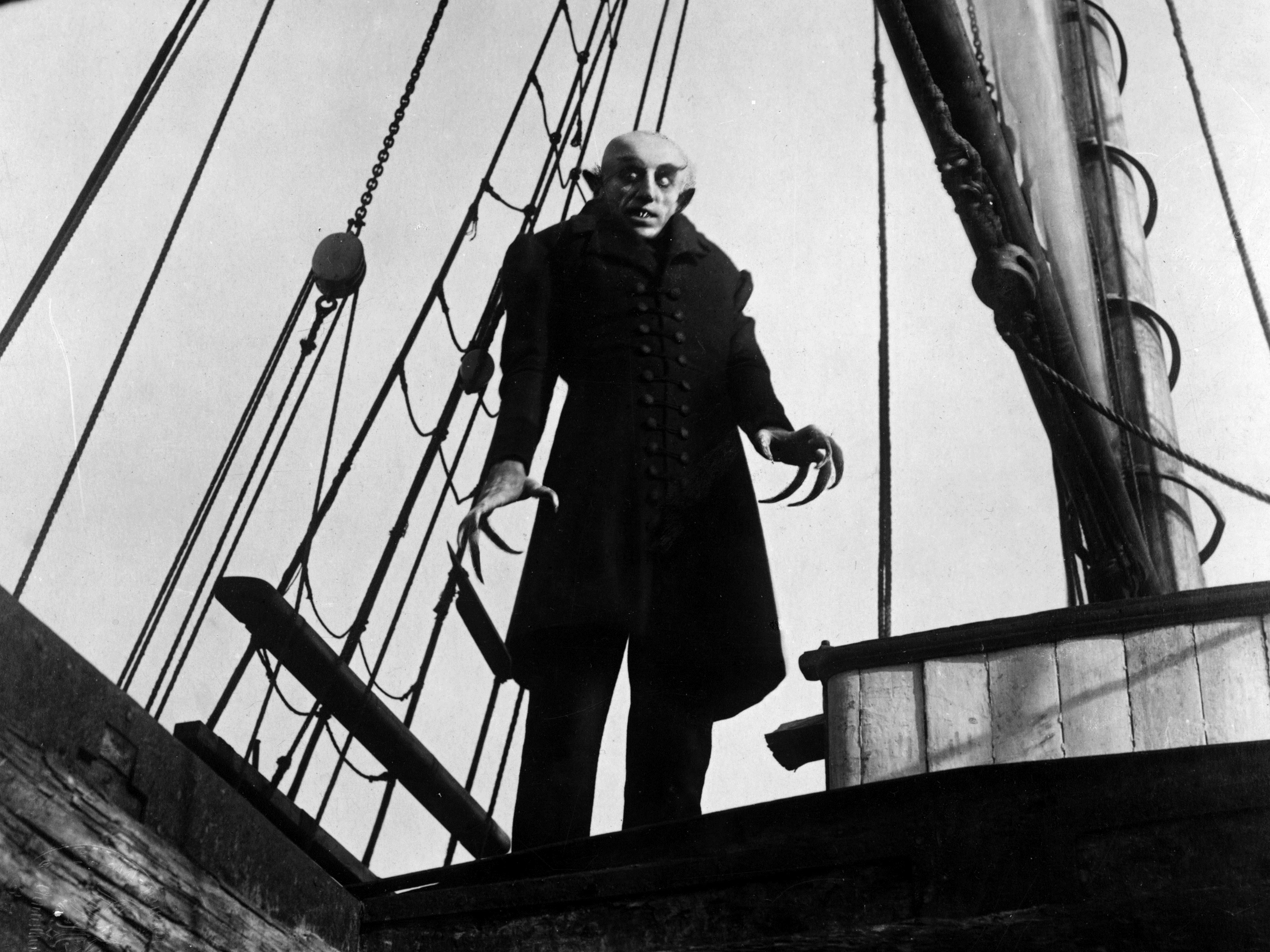
When a young real estate agent, Thomas Hutter, goes to the castle to close a deal, Orlok is attracted by his blood and decides to follow him to his hometown. The arrival of the count causes a series of mysterious deaths and spreads panic among the inhabitants.
Murnau, through evocative images and disturbing atmospheres, creates a work that goes far beyond the simple adaptation of Stoker's novel. The film explores universal themes such as the fear of death, isolation and the loss of humanity. The production of Nosferatu was characterized by some legal difficulties due to the copyright of Bram Stoker's novel. Despite this, Murnau and his crew managed to make a film of great visual impact. The choice of Max Schreck to play Count Orlok was ingenious. His cadaverous appearance and his unnatural movements have made the character of Orlok one of the iconic monsters in the history of cinema. Over the years, Nosferatu has become a cult film, influencing generations of filmmakers and becoming a reference point for the horror genre. The image of Count Orlok, with his elongated nails and sunken eyes, has become an icon of horror cinema.
Freud's 1919 Essay and the Problem of Definition
You pick up a photograph from a drawer you haven’t opened in years — your own face, but younger, caught in an expression you don’t remember making, in a room you no longer recognize as yours. The discomfort isn’t grief and it isn’t nostalgia. It is something more precise and more unsettling: the sensation that what was most intimate has quietly become foreign without your permission.
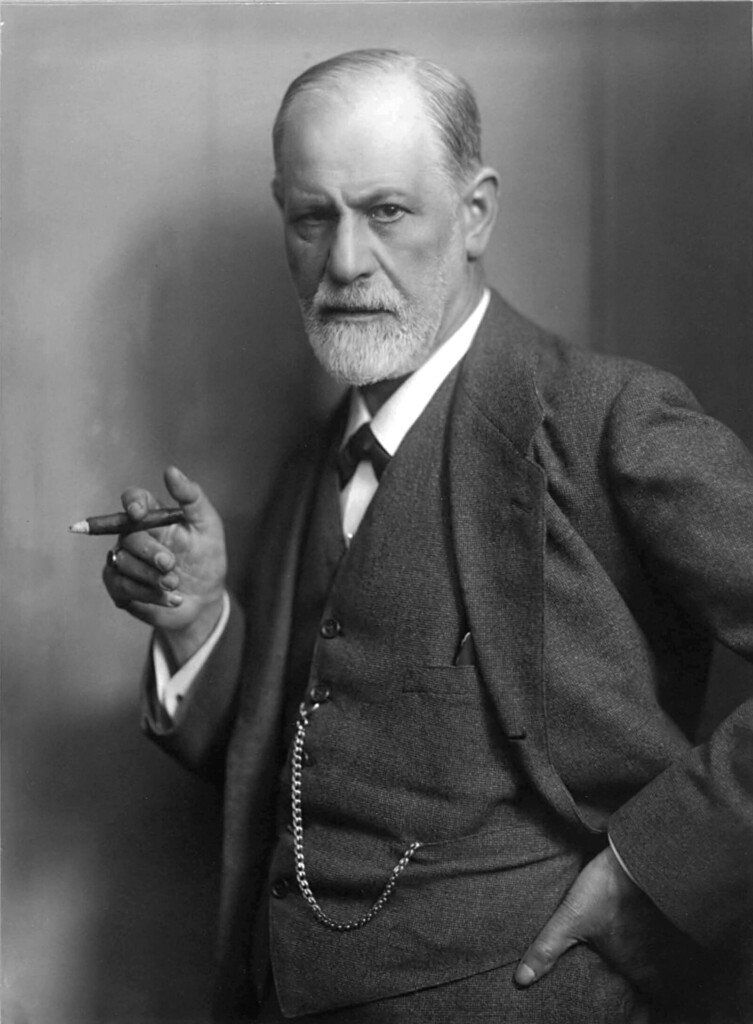
Freud published “Das Unheimliche” in 1919, tucked between the catastrophic social wreckage of the First World War and the theoretical ambitions that would soon produce “Beyond the Pleasure Principle.” The essay is, on its surface, an exercise in aesthetics — an inquiry into why certain experiences in art and life produce a specific quality of dread. But Freud, characteristically, refuses to begin with a definition. Instead, he begins with a dictionary. He opens Jacob and Wilhelm Grimm‘s “Deutsches Wörterbuch” and performs what amounts to a linguistic autopsy on a single German adjective: heimlich.
The word, at first glance, seems perfectly stable. It derives from Heim — home, hearth, the domestic interior — and carries the warm connotations of what is familiar, sheltered, belonging to the household. A heimlich place is a safe place. A heimlich feeling is one of comfort and recognition. The etymology appears to point in one direction only, toward the intimate and the known. But Freud, reading further into the accumulated historical usages catalogued by the Grimms, notices something that should not be there. A second cluster of meanings begins to emerge from within the same word: hidden, concealed, kept from sight, secret, clandestine. What belongs to the home is also what is kept behind closed doors. What is familiar is also what must not be shown to strangers.
The German language, in other words, had performed over centuries a slow conceptual drift inside a single lexical container, so that by the time Freud was reading, heimlich simultaneously meant the warmly familiar and the deliberately obscured. He quotes Friedrich Schiller‘s usage, where the word describes something whispered, something buried from open view. The domestic and the covert had collapsed into each other without any single speaker of the language noticing the contradiction accumulating inside an ordinary word.
This is where the theoretical charge detonates. Freud observes that the antonym, unheimlich — typically translated as uncanny, eerie, or strange — does not simply sit opposite heimlich as its clean negation. Because heimlich already contains within itself the meaning of concealment, of what is kept hidden, the prefix un- is not introducing foreignness from outside. It is releasing something that was always already coiled inside the familiar. The uncanny, in Freud’s formulation, is not the arrival of the alien. It is the return of something that was home, then hidden, and is now no longer containable.
He cites Friedrich Wilhelm Joseph Schelling’s definition directly — the uncanny is everything that ought to have remained secret and hidden, but has come to light — and finds in it the philosophical hinge his argument requires. What makes an experience uncanny is not its objective strangeness but its specific relationship to a prior intimacy. The thing that disturbs you was once yours. The fear that arrests you was once a room you knew.
This is not a metaphor Freud is constructing. It is a structural claim about how repression operates in the production of affect. The psychic mechanism and the etymological one run in perfect parallel: something familiar is pushed from consciousness, concealed behind the domestic surface of ordinary life, and its return — when it breaks through — carries the double signature of recognition and revulsion precisely because recognition and revulsion were never opposites to begin with. Language had known this long before psychoanalysis arrived to name it, and the German word had been quietly holding the contradiction open, waiting for someone to read it carefully enough to feel the floor shift beneath them.

Schelling's Shadow and the Return of the Hidden
You already know the feeling — not the one that arrives with a stranger, but the one that arrives with something you recognize. The moment a thought surfaces that you swore you had finished with, settled, left behind like furniture in a former apartment. It does not knock. It is simply there, rearranged in the living room, looking as if it never left.
Friedrich Wilhelm Joseph Schelling wrote, in his 1835 lectures on the philosophy of mythology, that the uncanny names precisely this: everything that ought to have remained secret and hidden but has come to light. The word he used was unheimlich, and what he meant was not terror in the dark but exposure in the light — the horror of revelation, not concealment. Schelling was not writing psychology; he was writing cosmology, tracing the movement by which the divine ground of being, what he called the Ungrund, erupts through the ordered surface of the world. But when Freud lifted that definition forty years later and placed it at the center of his 1919 essay, the consequence was seismic, because it shifted the problem from metaphysics to mechanism. The question was no longer what is being revealed, but why it keeps returning.
The conventional picture of repression is architectural. Something is placed in the basement; the door is locked; a rug is set over the hatch. This image is comfortable because it implies agency, a self that chose to store rather than confront, and it implies containment, a self whose basement does not leak. But Freud’s actual model, developed most rigorously in “The Interpretation of Dreams” in 1900 and refined through “The Metapsychology” papers of 1915, is not a building with a basement. It is closer to a hydraulic system under continuous pressure. Repression is not a completed act but an ongoing expenditure of energy. The unconscious does not sit still because it was never locked away — it was redirected. And what is redirected must go somewhere.
This is why Schelling’s formulation, transplanted into Freud’s framework, becomes so structurally precise. If the uncanny is what should have remained hidden but has come to light, then uncanny experience is not an accident of insufficient repression — it is the proof that repression as total burial is a fantasy the psyche can never afford. The hinge does not separate two rooms; it connects them. The act of hiding something guarantees the existence of a structure through which it can return, because hiding requires a relationship between the hider and the hidden, and relationships are by definition two-directional.
What makes this philosophically savage rather than merely clinical is what it implies about identity. If the self is partly constituted by what it has expelled — by the desires, fears, and perceptions it has declared unacceptable and pushed below the threshold of consciousness — then every return of the repressed is also a return of a self the person officially no longer is. The uncanny does not confront you with the foreign. It confronts you with an earlier edition of yourself that you canceled without ever quite deleting, a version that signed different contracts with the world, wanted different things, feared different losses.
Ernest Jones, in his 1910 paper “The Pathology of Morbid Anxiety,” documented cases where patients experienced acute dread not in the presence of genuinely threatening stimuli but in the presence of situations that precisely mirrored, without replicating, circumstances from their early emotional histories. The dread was not about what was happening. It was about what the current situation rhymed with — the uncanny working as a kind of temporal echo that the conscious mind could not locate but the body had already answered. The body knew the meter of the poem before the mind had recognized
Meshes of the Afternoon
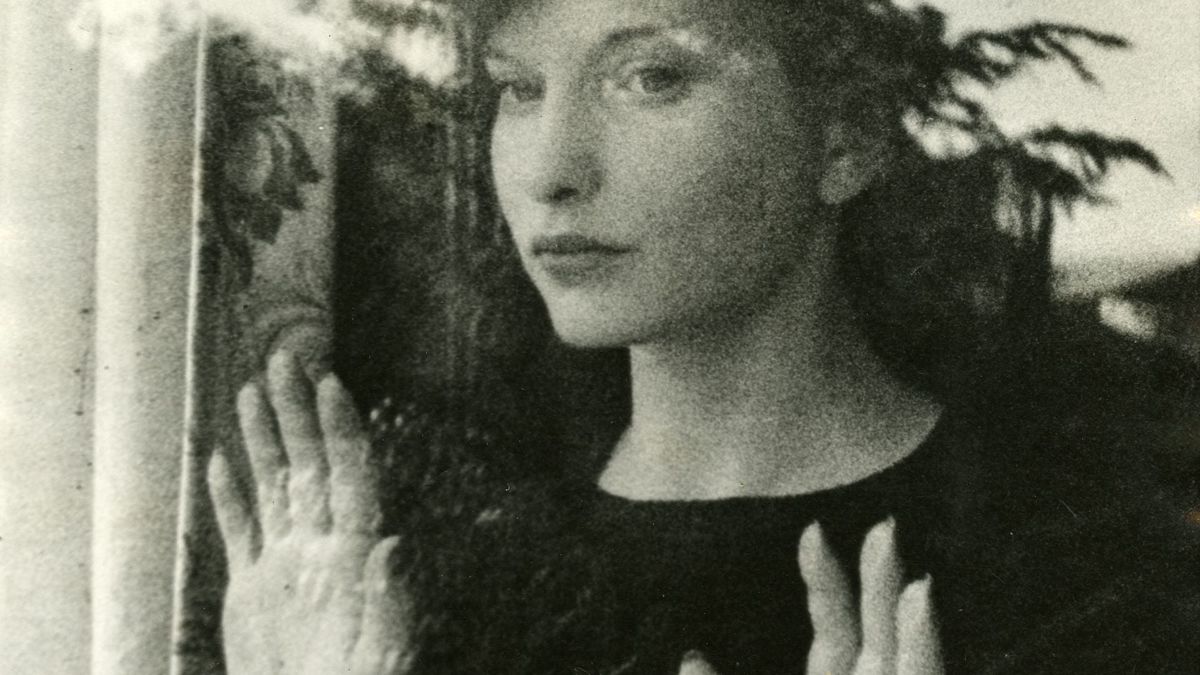
Experimental short film, by Maya Deren, United States, 1943.
Meshes of the Afternoon is one of the masterpieces of surrealistic cinema and American avant-garde and has become an iconic work in the world of experimental cinema. The film is characterized by a non-linear and dreamlike narrative that challenges traditional cinematic conventions. The plot revolves around a woman, played by Maya Deren herself, who experiences a series of strange and surreal events in a domestic setting. The objects and events in the film are laden with symbolism, and the film itself can be interpreted in various ways.
"Meshes of the Afternoon" is known for its innovative use of cinematography, with evocative framing and bold editing. Maya Deren uses cinema as an art form to explore the psychology and inner experiences of her character, creating a mysterious and unsettling atmosphere. The film has been influential for many subsequent filmmakers and cinematic artists, contributing to the definition of the language of experimental and avant-garde cinema. "Meshes of the Afternoon" is often studied in film courses and continues to be a reference work in the world of avant-garde and experimental cinema.
WITHOUT DIALOGUES
Automata, Doubles, and the Anxiety of the Copy
You are sitting across from someone at dinner and something is wrong, but you cannot name it. The laugh lands a half-second late. The eyes track your face with a precision that feels more like measurement than attention. Nothing is broken. Nothing is missing. And yet the wrongness accumulates in your chest like water in a sealed room, rising without any visible source.
Ernst Jentsch, writing in 1906 in his essay “On the Psychology of the Uncanny,” located that wrongness in what he called intellectual uncertainty — the mind’s failure to determine whether a thing before it is alive or not. He used the automaton as his central case: a figure so perfectly constructed that the question of its status cannot be resolved by observation alone. Freud read Jentsch carefully and then disagreed with almost everything useful in him. Where Jentsch saw cognitive confusion, Freud saw something more structural and far less innocent — not a question the mind cannot answer, but an answer the mind refuses to deliver.
The figure at the center of Freud’s 1919 essay “Das Unheimliche” is Olimpia, the mechanical doll in E.T.A. Hoffmann‘s 1816 story “The Sandman.” Nathanael, the story’s protagonist, falls in love with her. He dances with her, reads her poetry, believes she understands him with a depth no living person has matched. What Freud notices is not that Nathanael is deceived by a convincing fake. He notices that Olimpia works as a seduction precisely because she has no interiority to resist him. She reflects. She does not respond — she mirrors. And the man who falls into that mirror is not projecting random fantasies onto a blank surface; he is encountering, in concentrated form, the image of himself he most needs to believe in.
This is why the double does not frighten by being alien. It frightens by being intimate in ways that exceed permission. Otto Rank, whose 1914 work on the double Freud drew on, traced the figure across folklore and literature and found it consistently attached not to the fear of the other, but to the fear of death — specifically the terror of one’s own mortality glimpsed in a form that will not age, will not tire, will not suffer the erosion that the living body cannot escape. The automaton is deathless. That is not a comfort. That is the threat.
What Freud adds, and what makes his reading irreducible to either Jentsch or Rank, is the mechanism of repression folding back on itself. The uncanny double is not something the unconscious creates from nothing. It is made from material the conscious self has already handled, processed, and filed away as resolved. Childhood animism — the belief that objects are alive, that thoughts have weight, that wishing something can make it real — does not disappear in the adult. It goes underground. And when the double appears, it does not introduce a new fear. It reactivates an old one that the self had quietly agreed to forget it ever held.
The horror of Olimpia, then, is not that she is too strange to be human. It is that she is strange in precisely the ways that expose how much of Nathanael’s inner life was already mechanical — already a set of patterns running without a pilot, desires that circulate without genuine contact, emotions that perform depth without touching anything beneath the surface. She is not his opposite. She is his structure, externalized and given a body. The mirror does not invent what it shows. It only refuses to let you look away at the moment you most need to.
When the uncanny lands with maximum force, it is always because recognition arrives before explanation. The strangeness was never out there.
The Death Drive Underneath the Familiar
You have already survived something you cannot name. Not a near-accident, not a loss, but a moment when the machinery of ordinary life stuttered and you felt, beneath the familiar motion of your days, something pulling in the opposite direction — not toward experience, but away from it, toward stillness, toward the erasure of tension itself. Freud gave that pull a name in 1920, and it cost him something to do it. “Beyond the Pleasure Principle” was not a comfortable text to write; it forced him to abandon the elegant economy of his earlier drive theory and admit that the organism does not simply seek pleasure and avoid pain. It seeks, at a deeper register, to return to the condition that preceded it. The death drive — Todestrieb — is not suicidal ideation dressed in theoretical language. It is the tendency of living matter to restore itself to the inorganic state from which it was once disturbed into existence.
This is where the uncanny stops being a curiosity of perception and becomes something structurally significant. The repetition compulsion that Freud identifies in “Beyond the Pleasure Principle” — that strange tendency in patients to re-enact traumatic situations rather than remember them, to reproduce suffering rather than resolve it — is already operating beneath what we call ordinary unhappiness. A person who keeps choosing the same kind of devastating relationship, or who keeps arriving at the same professional failure by entirely different routes, is not making mistakes. They are executing a program whose terminal destination is not satisfaction but cessation. The loop is not broken because the loop is the point. What returns is not content but the drive’s momentum toward a prior state of zero tension, what Freud called the Nirvana principle, borrowing the term from Barbara Low in 1920 — the tendency of the mental apparatus to reduce excitation to its absolute minimum.
The uncanny is where this mechanism becomes phenomenologically visible. When the automaton’s eyes follow you across the room, when the wax figure seems to breathe, when the doll in a child’s hands appears for a split second to move of its own accord, what you are experiencing is not merely a cognitive error about whether something is alive. You are encountering the boundary between animated and inert matter — and that boundary is the exact threshold the death drive is always, quietly, pressing toward. The unease is not about the object. It is about recognizing in the object a destination.
Ernst Jentsch, whose 1906 essay on the uncanny Freud both cited and systematically dismantled in his own 1919 text, had argued that the effect arose from intellectual uncertainty about whether something was alive. Freud’s correction was surgical: it is not uncertainty that disturbs us, but recognition. We are not confused about whether the automaton is alive. We are momentarily convinced that we already know what it is like to be without life — because something in us is always already oriented toward that condition.
The body that moves without volition, the face that smiles without interiority, the mechanism that imitates purpose without having any — these images do not frighten us because they are foreign. They frighten us because they are accurate. They are portraits of what the organism is also doing, beneath the performance of desire and intention, in the basement of its own drives. Schopenhauer had intuited something adjacent when he described the will as fundamentally self-negating — the will that wills its own exhaustion — but Freud biologized the insight, grounded it in the compulsive repetitions of shell-shocked veterans who woke screaming into the same trenches every night for years after 1918, their nervous systems rehearsing an ending that had not yet fully arrived.
What the uncanny makes available to consciousness, then, is not a ghost or a monster but a preview — the death drive interrupting the pleasure principle long enough to make itself briefly, intolerably legible before the ordinary machinery of forgetting resumes its work.
A vision curated by a filmmaker, not an algorithm
In this video I explain our vision
Social Architecture as Manufactured Heimlichkeit

You have probably never thought of a doorstep as a philosophical argument, but every bourgeois threshold built in Vienna or Paris or London between 1850 and 1900 was exactly that — a claim about which lives count as interior and which are permanently outside the frame of recognition. The heavy curtains, the wallpaper in deep burgundy, the upholstered silence of the parlor: none of this was decorative in any innocent sense. It was a technology. The domestic interior of the nineteenth-century bourgeoisie was an apparatus engineered to produce a particular sensation of enclosure, safety, and self-evidence — the feeling that here, within these walls, the world is as it should be. Walter Benjamin understood this when he wrote about the interior in the Passagenwerk, arguing that the bourgeois home of that era was a casing for the private individual, a place where every object was a velvet impression of its owner’s selfhood. What Benjamin did not press far enough is that the warmth of that impression required a precise calibration of what it refused to hold.
The exclusion was never random. Domestic architecture in the Victorian period was shaped by an emerging science of hygiene that was always also a science of social sorting. Edwin Chadwick’s 1842 Report on the Sanitary Condition of the Labouring Population of Great Britain did not simply describe poor living conditions — it mapped a geography of moral threat, locating disease, disorder, and danger in the bodies of the working poor and the racially marked migrant. The language of ventilation and cleanliness became the language of social legitimacy. To live in a heimlich space was to have proven, through architecture and habit, that one belonged to the category of the clean, the bounded, the legible. Every improvement to the bourgeois interior was simultaneously a refinement of the threshold — a more precise mechanism for ensuring that certain presences would register not as guests but as intrusions.
National mythology performs the same operation at a larger scale. The idea of the homeland — Heimat in German, a word whose emotional charge sits precisely at the center of Freud’s analysis — is never simply a description of a territory. It is a narrative machine that processes historical violence into a feeling of natural belonging. When nineteenth-century German Romanticism elevated the Heimat to a spiritual category, through Riehl’s 1854 work on land and people or the folk-song collections that preceded it, it was simultaneously drawing an invisible cordon around who could experience that belonging authentically. The peasant at the hearth, the ancestral village, the forest that remembers its own name — these images produce warmth precisely by designating their inverse: the rootless, the wandering, the foreign body that has no soil to authorize its presence. The comfort of national mythology is structurally indistinguishable from a threat made against whoever falls outside it.
What this reveals about family structure is perhaps the most difficult thing to hold steadily in view. The family, particularly in its bourgeois nineteenth-century form, presented itself as the most natural of all arrangements — the biological given, the pre-political unit of affection. But as Eli Zaretsky demonstrated in Capitalism, the Family, and Personal Life, published in 1976, the bourgeois family was a historical production tightly synchronized with capitalist economic organization, designed to privatize reproduction and concentrate emotional life behind a wall that separated it from the market. The intimacy manufactured inside that wall was real in its intensity. That is precisely what made it so effective as a mechanism of suppression. The heat inside the family structure — its genuine loves, its real wounds — consumed the attention of everyone inside it so thoroughly that the conditions producing that structure remained almost entirely invisible to those it organized.
The uncanny begins to flicker precisely at those moments when the suppressed history becomes legible inside the comfort it was meant to protect.
The Political Uncanny: Colonialism and the Return of the Repressed Nation
You are standing in a colonial administrator’s office in Calcutta, 1887, and the clerk before you speaks your English better than you do — cleaner vowels, no hesitation, the grammar of someone who has studied the language as a system rather than absorbed it as an accident of birth. Something in your chest tightens. You cannot name the feeling. It is not quite threat, not quite admiration. It is the sensation of a mirror that reflects you slightly wrong.
Homi Bhabha, writing in The Location of Culture in 1994, called this mimicry — the colonial demand that the native become English, but not quite, not entirely, always leaving a remainder of difference that preserves the hierarchy. The paradox Bhabha identified is that this project of cultural imposition carries within it the seed of its own destabilization. The colonized subject who learns too well, who masters the forms of the colonizer with greater precision than their origin warrants, does not become reassuringly similar. They become uncanny. They produce in the colonial observer exactly the sensation Freud described in 1919: the familiar made strange, the home suddenly unrecognizable from within its own walls.
What the colonial administration required was a legible other — someone distant enough to be dominated, proximate enough to be administered. What mimicry produced instead was a third figure that fit neither category: too civilized to be safely subordinated, too colonial to be fully admitted. The British imperial project exported its institutions, its literature, its legal codes, its educational frameworks to roughly a quarter of the earth’s surface by 1920, and then discovered with mounting anxiety that these exports did not create grateful recipients. They created interlocutors. People who could cite Burke and Mill against the empire’s own contradictions, who could hold a copy of On Liberty in one hand and point with the other to the fact of their own unfreedom.
This is the structure of the political uncanny: a repressed truth that returns through the very mechanisms designed to suppress it. The empire taught its subjects to value civilization, rationality, and universal rights — and the colonized took those values seriously in ways the colonizer never intended. Frantz Fanon documented this rupture viscerally in The Wretched of the Earth in 1961, tracing how the vocabulary of European humanism, once genuinely inhabited by colonized intellectuals, became not an instrument of assimilation but a weapon of indictment. The French Republic proclaimed liberté, égalité, fraternité while administering Algeria through torture and mass dispossession. When Algerians cited the Republic’s own principles back at it, the uncanny arrived not as a ghost in a hallway but as a political crisis with seven and a half years of armed consequence.
Nations, like egos, repress what they cannot integrate. The historical narratives that cohere collective identity always require exclusions — events, populations, and actions that are placed outside the frame of the official story. But repression is not erasure. It is storage under pressure. Colonial violence was repressed into the administrative language of civilizing missions and protectorates, into the bureaucratic neutrality of census categories and taxation records, into the aesthetic distance of imperial exhibitions where human beings were displayed alongside agricultural equipment in Paris in 1931 before six million paying visitors. The clinical distance of that vocabulary did not neutralize the underlying fact. It preserved it, hermetically, in exactly the form that would allow it to return.
What returned, and kept returning across the twentieth century, was not just political resistance but something stranger — the demand to be recognized by the very civilization that had defined itself through the act of withholding that recognition. The colonized intellectual writing in the master’s language, to the master’s audience, using the master’s analytical tools to dismantle the master’s authority, produces a vertigo that no colonial administration ever fully knew how to absorb, because absorbing it would mean acknowledging that the distinction between civilized and savage had been a performance all along, maintained not by evidence but by the political necessity of keeping certain things out of sight.
When Recognition Becomes Unbearable
You are sitting across from someone you have known for years, and without warning — mid-sentence, mid-gesture — you see something in their face that does not belong to them. Not a stranger’s feature, but your own. A contraction around the mouth when threatened, a particular stillness before retreat. The recognition is instantaneous and unbearable in equal measure, because what you are seeing is not them failing to be other enough; it is you failing to remain safely elsewhere.
This is the precise mechanism Freud locates beneath the surface of aesthetic discomfort in his 1919 essay “Das Unheimliche,” and it operates with a logic that has nothing to do with novelty or shock. The uncanny is not produced by encountering something alien. It is produced by the collapse of the distance you had carefully installed between yourself and something you once knew too well. Ernst Jentsch, who wrote about the uncanny in 1906, framed it as intellectual uncertainty — the unease of not knowing whether an object is alive or inert. Freud rejected this as insufficient. The dread is not epistemic. It is memorial. What disturbs is not the unknown but the re-known, the thing that was repressed precisely because knowing it was intolerable, now returning with the full weight of its original intimacy.
The ideological implications of this are structurally violent. When a society constructs an outgroup — racially, religiously, economically — the energy required to maintain that construction is always proportional to the resemblance being suppressed. René Girard spent decades demonstrating in works like “Violence and the Sacred” that scapegoating rituals across human cultures target not the most different but the most similar: the rival, the double, the one who wants what you want using the methods you recognize as your own. The violence escalates precisely because the difference must be manufactured faster than the resemblance keeps surfacing. Every dehumanizing gesture is, at its core, a defensive act against recognition.
What makes this politically irreducible is that the structure does not require bad faith to function. You can sincerely believe in the absolute otherness of the figure you have constructed as enemy while the unconscious registers, continuously, the shared ground. Freud’s concept of the double — the Doppelgänger — is instructive here not as folklore but as psychological architecture. Otto Rank, in his 1914 study “Der Doppelgänger,” traced the figure through literature and myth and found it consistently associated with the moment a self becomes unable to sustain its own coherence. The double does not arrive from outside. It separates from within, and the horror is that it carries everything the self refused to integrate: the aggression, the desire, the capacity for exactly the behavior the self has moralized against.
This is why political polarization intensifies rather than resolves over time, even when material conditions would logically favor negotiation. Each side builds the other as a receptacle for what it cannot acknowledge in itself, and the more successfully that projection holds, the more uncanny the occasional glimpse of overlap becomes. The crack in the structure is not caused by an external force. It opens when recognition leaks through — when the language used by the other is suddenly indistinguishable from your own, when the fear they display is the fear you carry, when the face across the divide does something your face does in private.
Freud’s deepest claim in the essay is that the home — the Heim, the familiar, the place of belonging — was never sealed. The unheimlich does not designate a space outside the home but a quality latent within it from the beginning, waiting for the conditions under which concealment becomes impossible. What was hidden in the architecture of the self, in the grammar of a belief system, in the emotional logic of a collective identity, does not disappear when repressed — it accumulates pressure, and the uncanny is the name for the moment that pressure finds a surface, cracks it open, and makes the interior suddenly, devastatingly visible.
🪞 The Uncanny and the Hidden Self
Freud’s concept of the Unheimliche — the uncanny — points to that eerie sensation when something familiar suddenly appears strange, as if the repressed has returned to haunt the surface of consciousness. The articles below explore the psychological, literary, and cultural territories that border and illuminate this unsettling threshold between the known and the unknown.
Dissociation in Psychology: When the Mind Divides
Dissociation in psychology describes the mind’s capacity to split off fragments of experience that feel too threatening to integrate — a process deeply related to the uncanny sensation Freud identified. When the familiar self suddenly feels alien, the dissociative split is often at work beneath the surface. Understanding dissociation helps us grasp why the Unheimliche strikes not just in haunted houses, but in the mirror of our own identity.
GO TO THE SELECTION: Dissociation in Psychology: When the Mind Divides
Carl Gustav Jung and the Shadow: The Dark Side We Don’t Want to See
Jung’s concept of the Shadow — the dark, repressed dimension of the psyche — resonates profoundly with Freud’s Unheimliche, since both describe the return of what we have buried. The Shadow does not disappear when denied; it resurfaces in uncanny projections, disturbing encounters, and irrational fears that seem to come from nowhere. Exploring the Shadow is, in many ways, a Jungian map of the very territory Freud charted in his 1919 essay.
GO TO THE SELECTION: Carl Gustav Jung and the Shadow: The Dark Side We Don’t Want to See
The Strange Case of Dr Jekyll and Mr Hyde: Analysis
Stevenson’s The Strange Case of Dr Jekyll and Mr Hyde is one of literature’s most visceral embodiments of the uncanny: the horrifying discovery that the monstrous Other is not a stranger, but the self. The novella dramatizes Freud’s insight that the Unheimliche arises precisely when the repressed — here, Hyde — erupts from within the familiar, respectable home of the ego. It remains an indispensable text for understanding how the uncanny operates in narrative form.
GO TO THE SELECTION: The Strange Case of Dr Jekyll and Mr Hyde: Analysis
Jacques Lacan and the Mirror Stage
Lacan’s theory of the mirror stage offers a structural account of why the image of the self can provoke uncanny unease: the ego is founded on a misrecognition, an alien reflection mistaken for the self. This originary strangeness at the heart of identity is precisely what Freud’s Unheimliche brings to the surface in moments of psychological disturbance. Together, Freud and Lacan illuminate how the self is never fully at home within its own image.
GO TO THE SELECTION: Jacques Lacan and the Mirror Stage
Discover the Cinema of the Unconscious on Indiecinema
If the uncanny has opened a door in your mind, Indiecinema is where that door leads — a streaming platform dedicated to independent and auteur cinema that dares to explore the hidden depths of the human psyche. Discover films that disturb, illuminate, and transform, curated for those who believe cinema can be a genuine act of inner discovery.
👉 EXPLORE THE CATALOG: Watch Indie Films in Streaming
A vision curated by a filmmaker, not an algorithm
In this video I explain our vision

