
The Architecture of Exclusion
You are standing in a courthouse built in 1887, and every doorway, every bench, every procedural requirement has been calibrated — not to dispense justice — but to make certain people feel the weight of their own illegitimacy before a single word is spoken.

The architecture of exclusion has always been, above everything else, an architecture of normalcy. The most sophisticated systems of inequality never announce themselves as such. They present their arrangements as the natural consequence of observable facts, as the sedimented outcome of human difference rather than human decision. This is precisely what made the Black Codes enacted across the American South between 1865 and 1866 so remarkable as instruments of social engineering. They did not emerge despite the abolition of slavery. They emerged because of it, as a direct legal response to the formal collapse of one regime of control, building its replacement from the raw material of criminal procedure, vagrancy statutes, and labor contracts. Mississippi passed its version in November 1865, barely six months after Appomattox. South Carolina followed within weeks. The codes mandated that Black citizens carry written proof of employment, criminalized the act of leaving a job without a white employer’s permission, and created a category of “apprenticeship” for Black children that bore no operational distinction from the bondage that had just been constitutionally prohibited. The Thirteenth Amendment’s own exception clause — “except as a punishment for crime” — was not an oversight. It was a door left deliberately ajar.
Michelle Alexander, writing in The New Jim Crow in 2010, identified the recurring structural logic with a precision that made comfortable readers genuinely uncomfortable: the system does not fail at producing justice, it succeeds at producing something else entirely. What looks like a broken machine is actually a functioning one with different objectives. The mass incarceration apparatus she anatomized — the drug war launched in earnest under Reagan in the 1980s, the mandatory minimums, the felon disenfranchisement that stripped voting rights from an estimated 5.85 million Americans by 2010 — operated not through explicit racial targeting in its statutory language, but through the racially asymmetrical application of discretion at every point where a human being made a choice: which neighborhood to police, which offenses to prosecute, which defendants to offer plea deals. The law remained colorblind on paper while the outcomes were anything but. That gap between written neutrality and lived reality is not a bug in the system’s design. It is the design.
What makes these structures so difficult to dismantle is that they do not only organize space and legal procedure — they reorganize perception. The sociologist W.E.B. Du Bois, in Black Reconstruction in America published in 1935, described the psychological wage of whiteness: the way poor white workers accepted material conditions that should have generated solidarity with Black laborers, because the social currency of racial hierarchy compensated them symbolically. This was not false consciousness in any simple sense. It was a rational response to a real market in social dignity, one the planter class had deliberately constructed after Bacon’s Rebellion in 1676, when the terrifying proximity of poor white and Black insurrection forced the colonial elite to drive a legal and cultural wedge between groups whose economic interests were nearly identical. Race, in this reading, is not a natural category that society then organized around — it is a product of the organization itself, a fiction that became material through law, repeated application, and the generations of bodies that bore its consequences.
There is a particular violence in being told that the cage you live inside is the shape of reality itself, that the walls are simply where the world ends and not where someone decided to stop building.
The War in Cuba
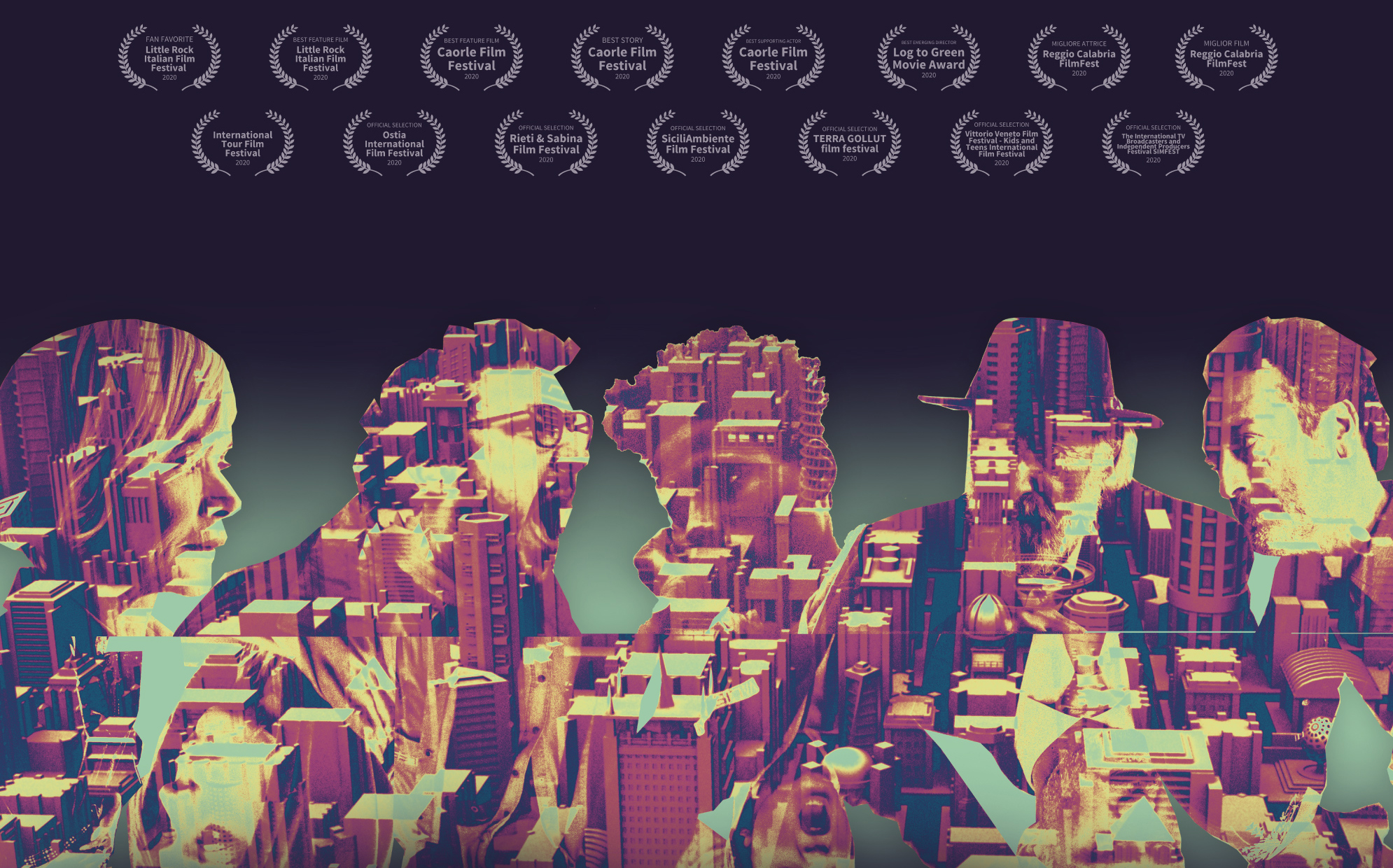
Drama, by Renato Giugliano, Italy, 2019.
The story is set in a small community in Valsamoggia, in the province of Bologna, Italy. The daily routine is disrupted by a strike by the workers of one of the main factories in the area. Parallel to this, five stories unfold, intertwining with each other. The situation is exacerbated by the arrival of a journalist in search of sensational news. Among private and collective events, hidden somewhere between people's indifference and the spread of fake news, a subtle and insidious discontent grows, especially among those who do not have strong ideals to refer to. And so, at the dawn of the festival in Valsamoggia, there is an increase in small and large crimes, more or less serious: from the beating of a black boy, to the escape of a refugee boy, and the forced repatriation of a young immigrant who was instead considered part of the community. In an escalation of clashes, frustrations, and conflicts, someone - in the middle of the Patronal Festival - climbs to the top of the town's bell tower and shoots at the crowd.
Born on the wave of a project on education for integration, "The War in Cuba" is a film that addresses, in a choral story, the horror that arises from the mixing of intolerance, cynicism, and fake news. The story explores a society that has crumbled and whose citizens, confused and lost, increasingly become victims of false myths, serial haters, and fake news. In a world full of frustrations and in which the media are increasingly subservient to the obsession with clicks and advertising, in an instant the monster is created, which, as it happens, is always the other, the one who is different from us, the minority subject. This is the sick game in which the resentment that is in us fuels resentment in others and vice versa.
LANGUAGE: Italian
SUBTITLES: English, Spanish, French, German, Portuguese
Progress as Permitted Grievance
You are watching a man sign a piece of paper, and the room around him is full of people who believe they are witnessing justice. The cameras flash. The president lifts a pen that has already been used to calculate exactly how much freedom is affordable.
Lyndon Johnson understood something that moral historians prefer to obscure: the Civil Rights Act of 1964 was not the product of conscience scaling the walls of power. It was the product of a cold political arithmetic in which the suppression of Black American life had finally become more expensive than a managed, partial inclusion. The FBI had files on every major civil rights leader. The National Security Council had memos on the optics of racial violence reaching Soviet propaganda desks. When Bull Connor turned fire hoses on children in Birmingham in May 1963, the images did not primarily horrify the American government — they embarrassed it on the world stage at the precise moment it was competing for the allegiance of newly decolonized African and Asian nations. Johnson and his advisers did not grant civil rights because they saw Black Americans as fully human. They granted a version of civil rights because the international cost of not doing so had exceeded the domestic cost of doing so.
This is the mechanism that gets buried beneath the language of progress. The sociologist Frances Fox Piven, writing with Richard Cloward in “Poor People’s Movements” in 1977, documented with devastating precision how the American state consistently responded to mass disruption not by transforming power but by absorbing enough of its challenge to neutralize it. Concessions arrive at the moment they are strategically necessary, and they are calibrated to be just sufficient — enough to dissolve the organized pressure without redistributing the underlying structure. The March on Washington in August 1963 drew 250,000 people. The Civil Rights Act arrived not because those 250,000 people moved the soul of the nation, but because their visible, documented, internationally televised suffering had become a liability that a superpower in a Cold War could not afford to carry.
What this exposes is something far more destabilizing than simple cynicism about politicians. It reveals that the categories through which minorities are invited to understand their own liberation are pre-manufactured by the very system they believe they are pressuring. The grievance is permitted — encouraged, even — precisely because a permitted grievance is one that has already been stripped of its most radical demand. When the state frames a civil rights concession as a gift, as moral awakening, as the nation living up to its founding ideals, it simultaneously erases the coercion that produced it and forecloses the question of what was never conceded. The Voting Rights Act of 1965, passed one year later, explicitly protected Black suffrage — yet the structural economic conditions that made that suffrage politically near-meaningless in many contexts were never touched. The right to vote arrived as a substitute for the right to economic self-determination, not as a complement to it.
The philosopher Charles W. Mills argued in “The Racial Contract” in 1997 that Western liberal political theory has always operated on an invisible racial sub-contract — a set of agreements among those categorized as white that the formal principles of equality simply do not apply symmetrically. Mills was not making a rhetorical point. He was describing a documented, operative structure in which constitutional language and lived racial hierarchy coexist without contradiction because the contradiction is never meant to be resolved. Rights are extended at the margin while the contract at the center holds. And so the signing ceremony feels like justice, the pen lifts, the cameras flash, and the question of who designed the room, who built the table, and who decided which grievances were now affordable enough to permit — is the question the ceremony is specifically designed to prevent anyone from asking.

The Mythology of the Peaceful March
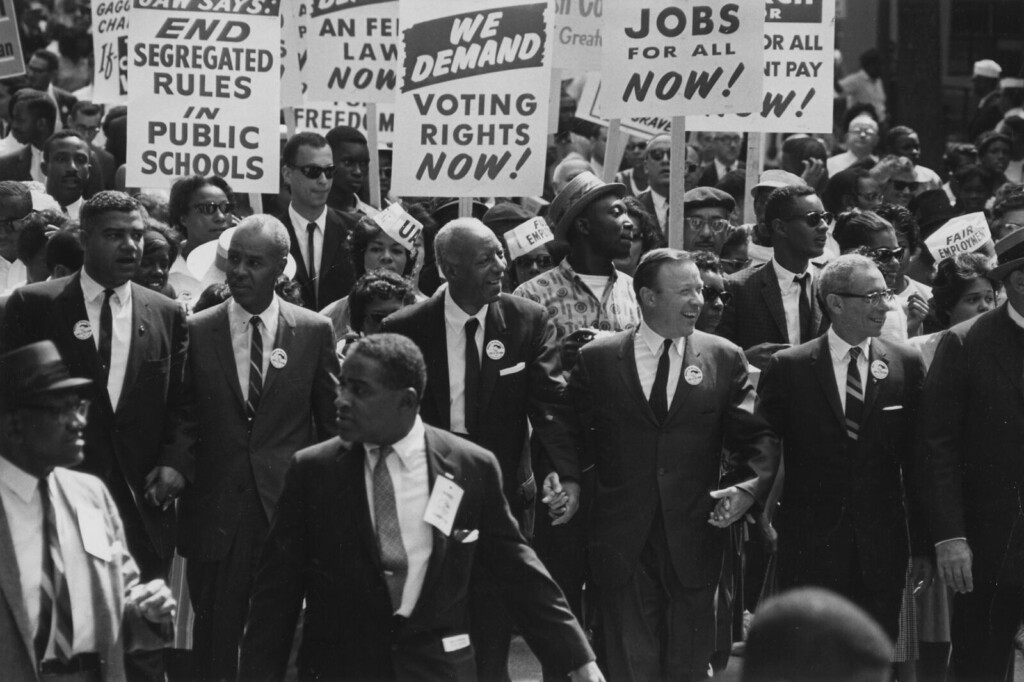
You have seen the photograph so many times it has become a kind of scripture: rows of marchers in Sunday clothes, moving in dignified silence, absorbing violence without returning it, their moral purity so blinding it eventually shames the nation into justice. The image is not false, exactly. But it has been edited with extraordinary care, and what was cut from the frame tells a more accurate story about how power actually yields.
The legislative victories of the mid-1960s did not emerge from a single moral argument delivered to a conscience that was simply waiting to be activated. The Civil Rights Act of 1964 and the Voting Rights Act of 1965 arrived after years of economic hemorrhage that white Southern business elites found increasingly intolerable. The Montgomery Bus Boycott, which began in December 1955 and lasted 381 days, worked not because it moved hearts but because it moved money — the Black community represented roughly 70 percent of the bus system’s ridership, and the resulting financial damage was structural, not symbolic. When Bayard Rustin and others within the movement’s organizing infrastructure spoke of economic withdrawal as a primary weapon, they were speaking the language that municipal power actually understood.
Labor was doing the same work in registers that official civil rights history tends to underplay. The Brotherhood of Sleeping Car Porters, led by A. Philip Randolph since 1925, had spent decades building the first major Black-led labor union in American history, and in 1941 Randolph threatened a march of 100,000 Black workers on Washington unless President Roosevelt issued an executive order banning discriminatory hiring in the defense industry. Roosevelt signed Executive Order 8802 before anyone marched a single step. The march that didn’t happen changed federal policy because the economic and political cost of the march that would happen was calculated with precision. The threat was credible, and credibility came from organized labor power, not from moral witness alone.
In the rural South, the conditions under which nonviolent discipline was maintained were never as clean as the photographs suggest, and in many places they were maintained only because armed Black men were standing at the perimeter of the meeting. The Deacons for Defense and Justice, founded in Jonesboro, Louisiana in 1964 and spreading rapidly through Mississippi and the broader Deep South, openly carried weapons and made it known they would use them. Their presence deterred Klan attacks on civil rights workers in ways that federal indifference and local law enforcement complicity made otherwise impossible. Lance Hill‘s 2004 study of the organization documented how their armed patrols protected CORE workers and local organizers at a moment when the nonviolent front line survived partly because the rear was defended by people who had no intention of dying passively.
What the sanitized narrative requires is a movement with a single moral logic, so that its success can be attributed to that logic rather than to the collision of multiple pressures — economic disruption, labor solidarity, armed deterrence, international Cold War embarrassment, and the federal government’s calculation that containing Black radicalism required offering legislative concessions to Black moderates. When Robert F. Williams, the NAACP chapter president in Monroe, North Carolina, armed his members against Klan violence in the late 1950s and was suspended from the organization for it, the NAACP’s leadership understood that his approach threatened the narrative of legitimate, dignified suffering that made white liberal sympathy possible. Williams understood something else: that sympathy without consequence changes nothing, and that the consequence of ignoring armed self-defense in Monroe would be bodies.
The mythology of the peaceful march is not merely a historical distortion. It performs a specific function in the present, reassuring those with institutional power that social change requires petitioners, not adversaries — people who ask rather than people who cost.
Citizenship Without Belonging
You have the document in your hands. The certificate is real, the ink is dry, the date is legal — and yet when you walk into the room where decisions are made, something shifts in the air before you open your mouth, a kind of atmospheric pressure that was not there for the man who entered before you, and you understand in your body what no paragraph of law has ever been written to describe.
The Reconstruction Amendments rewrote the constitutional architecture of the United States with a speed that still feels dizzying in retrospect. The Thirteenth Amendment abolished slavery in 1865, the Fourteenth guaranteed equal protection under the law in 1868, the Fifteenth prohibited denying the vote on grounds of race in 1870. Within five years, the formal juridical condition of four million formerly enslaved people had been transformed on paper. Black men were elected to Congress. Hiram Revels took Jefferson Davis’s old Senate seat in Mississippi. And then the federal troops withdrew, and the Black Codes mutated into Jim Crow statutes, and the Supreme Court gutted the Civil Rights Act of 1875 in its 1883 ruling, and the distance between the letter of constitutional law and the lived reality of Black Americans stretched into something that resembled a geological fault — invisible on the surface, catastrophic in its consequences.
Hannah Arendt, writing in The Origins of Totalitarianism in 1951, identified the precise mechanism behind this catastrophe when she argued that the abstract proclamation of human rights was historically proven to be worthless the moment a person was stripped of political community. Her formulation — that the only meaningful right is the right to have rights, meaning the right to belong to a political body that recognizes and enforces your claims — cuts through the sentimentality of rights discourse with the precision of a scalpel. Rights do not exist in nature. They exist in the enforcement gap between what a document declares and what a society is willing to protect, and that gap is never neutral.
The Nineteenth Amendment in 1920 enfranchised women nationally, yet its architects largely understood women to mean white women, and the infrastructure of racial disenfranchisement that had neutralized Black male voting rights — poll taxes, literacy tests, grandfather clauses, terror — operated just as efficiently against Black women after 1920 as it had before. The suffrage movement had, in significant portions, purchased its political momentum by explicitly distancing itself from racial equality. Elizabeth Cady Stanton had argued in the 1860s that educated white women deserved the vote more urgently than freed Black men. The amendment arrived, the exclusion continued, and the century-long conflation of women’s rights with white women’s rights was written into the foundational achievement of American feminist history.
What this reveals is not hypocrisy as a personal failing but structure as an organizing principle. Every formal expansion of rights in American history has been followed by a period of counter-mobilization in which the newly recognized group discovers that recognition without enforcement is a ceremony, not a transfer of power. The Civil Rights Act of 1964 prohibited employment discrimination, and the Equal Employment Opportunity Commission created to enforce it was underfunded from its inception, overwhelmed by a backlog that reached 125,000 unresolved complaints by the early 1970s. The law existed. The mechanism to make the law real did not exist at the scale the problem required.
Arendt had watched stateless persons move across Europe in the 1930s carrying documents that proved their existence but not their belonging — passports to nowhere, identities certified by states that no longer protected them. The lesson she drew was not pessimistic so much as anatomical: she was describing the skeleton beneath the skin of liberal democracy, the way political membership is always a constructed condition that some bodies are made to feel they must perpetually re-earn while others inherit it invisibly, automatically, as though it were simply the air.
The Assimilation Trap
You learn the language, dress for the interview, modulate your accent until it stops alarming people, and somewhere in that long rehearsal of acceptability, the law finally opens a door for you. This is presented as progress. The record says you won.
What the record omits is what you surrendered at the threshold. The architecture of civil rights legislation, for all its genuine force, was built on a foundational demand that minority subjects prove their legibility within dominant frameworks before being granted protection by them. The 1866 Civil Rights Act in the United States extended personhood to formerly enslaved Black Americans, but the operative logic was assimilationist from its first clause — citizenship was conferred upon those who were “subject to the jurisdiction” of the nation-state, meaning those who could be absorbed into its administrative and cultural grammar. The law did not protect difference. It protected conformity, conditionally.
Frantz Fanon diagnosed this mechanism with a precision that has never been surpassed. In Black Skin, White Masks, published in 1952, he described how the colonized subject internalizes the colonizer’s image of civilization as the measure of human worth, then spends an entire life performing adequacy against that standard — not out of deception, but out of a psychic necessity that the colonial structure has made total. The violence was not only economic or physical; it was ontological. To be recognized under the law, you had to first become recognizable in the colonizer’s language, through the colonizer’s categories, at the cost of whatever self had existed before the translation. Fanon called this the lived experience of the Black man, but its structure reproduces in every minority group that has ever been told it must earn inclusion.
The Cherokee Nation in the nineteenth century offers a case that makes this visible with almost brutal clarity. By the 1820s, Cherokee society had adopted a written constitution, a bilingual newspaper, a formal legislative assembly — precisely the markers of “civilization” that American political culture insisted were prerequisites for respect and sovereign standing. The response in 1830 was the Indian Removal Act. Assimilation as performance did not purchase protection; it purchased a more sophisticated justification for dispossession. The very success of cultural adaptation was reframed as evidence that indigenous identity was already dissolved, that there was therefore nothing authentic left to protect in place.
What this reveals is that the demand for assimilation was never really about culture at all. It was about power’s need to remain the sole author of legitimate identity. Legal personhood, extended through the frameworks that defined civil rights progress throughout the nineteenth and twentieth centuries, came consistently attached to a silent codicil: you may enter, but you must enter as we have imagined you. The landmark rulings, the landmark legislation, the landmark marches — they cracked open institutions without necessarily cracking open the epistemology governing those institutions. Integration into a school system that teaches one civilization as civilization leaves the integrated student holding a diploma in their own erasure.
The psychological cost does not stay contained in the generation that pays it. Sociologist Eduardo Bonilla-Silva, writing in Racism Without Racists in 2003, documented how structural assimilation produces what he terms “the new racism” — a racial order in which explicit hierarchy disappears from the surface while informal mechanisms of exclusion continue operating through cultural gatekeeping, aesthetic standards, and the language of “merit” and “fit.” The minorities who succeeded under civil rights frameworks frequently did so by mastering those informal codes, and their success was then held up as proof that the system worked, which made it harder to name what the system was still doing to everyone who refused or failed to disappear into it.
There is a particular cruelty in winning rights that cost you the self on whose behalf the rights were supposedly won, and what makes it durable is that it never announces itself as cruelty.
A vision curated by a filmmaker, not an algorithm
In this video I explain our vision
Law as Lagging Indicator

You pass the law and feel the relief, the clean click of a thing finally named, finally official — and in that moment you mistake the record for the cause.
The Voting Rights Act of 1965 is taught as a turning point, a legislative gift extended to Black Americans who had been denied the ballot for generations. What that framing quietly erases is the decade of mass organizing, economic boycotts, jail time, and arterial bleeding on the Edmund Pettus Bridge that made the law politically unavoidable. Lyndon Johnson did not wake up in January 1965 with a moral revelation. He woke up to a movement that had already restructured the cost of inaction. The legislation was the state’s formal acknowledgment that it had lost a prior argument conducted in the streets, in the churches, in the bodies of people willing to be beaten on camera. Congress did not lead — it ratified.
This pattern is not incidental to civil rights history. It is the structural grammar of every major legislative advance in the twentieth century. The Fair Housing Act of 1968 followed years of tenant organizing in northern cities, rent strikes in Harlem that began as early as 1943, and the slow documentation by sociologists like Robert Weaver — whose 1948 study “The Negro Ghetto” mapped residential segregation with statistical precision long before any federal body was prepared to name it a policy problem. The law arrived after the sociological and communal work had already diagnosed the wound, proposed the remedy, and absorbed the retaliation. By the time a statute exists, the people it protects have usually been protecting themselves without it for years.
The labor movement makes the same argument in a different register. The National Labor Relations Act of 1935 did not invent the idea that workers deserved collective bargaining. It recognized a reality that had been fought into existence through the Triangle Shirtwaist fire of 1911, through strikes, lockouts, and the slow construction of union infrastructure across decades of industrial violence. The state, in passing the Wagner Act, was not granting workers a new right — it was absorbing into its own architecture a power that organized labor had already demonstrated it could exercise, sometimes illegally, sometimes at the cost of lives. What the law added was not the condition but the paperwork.
This is what the sociologist William Julius Wilson, in “The Declining Significance of Race” published in 1978, was circling when he argued that legal gains could mask structural retreats — that the formal codification of rights could coincide with the quiet erosion of the economic foundations that made those rights exercisable. A law against housing discrimination means something different in a labor market that has already evacuated the jobs from the neighborhoods it now formally protects. The signature on the bill looks like arrival. Sometimes it is the moment the real contest becomes invisible.
Jürgen Habermas, writing in “Between Facts and Norms” in 1992, argued that law gains its legitimacy through communicative processes — through deliberation, contestation, and the slow formation of public will. What this means in practice is that the law is downstream of discourse, and discourse is downstream of lived experience, and lived experience is downstream of who controls the material conditions of daily life. The sequence matters enormously because it determines where you apply pressure if you want change, and the mythology of legislative triumph consistently misdirects that pressure toward the final link in the chain.
Education desegregation offers perhaps the sharpest illustration. Brown v. Board of Education in 1954 is memorialized as a judicial act of moral courage. Less memorialized is that by 1954 the NAACP’s Legal Defense Fund had spent two decades deliberately constructing the evidentiary and legal architecture that made the ruling possible — and that the ruling itself required another decade of furious enforcement battles before it produced any measurable change in a single Southern classroom.
Intersectionality and the Hierarchy of Grievances
You have spent your whole life being told that solidarity is the foundation of liberation, and you have believed it with the particular conviction of someone who has never been asked to choose which part of themselves to leave at the door.
The problem is that the door has always had dimensions, and not everyone’s grief fits through it the same way. When Kimberlé Crenshaw published her 1989 paper in the Stanford Law Review, “Demarginalizing the Intersection of Race and Sex,” she was not introducing a metaphor for academic circulation — she was documenting a legal catastrophe already in motion. Black women employed at General Motors had been systematically laid off, and their discrimination claims failed in court because the company could demonstrate it hired women (white ones) and hired Black people (men). The law, structured to recognize single-axis injury, simply could not perceive them. They were invisible not through malice but through the architecture of recognition itself — a framework built to see categories one at a time, which rendered compound experience legally incoherent.
What makes this more than a juridical footnote is how precisely it mirrors the internal logic of every emancipatory coalition that came before it. The suffrage movement in the United States was not simply slow to include Black women — it was actively organized around their exclusion when their inclusion threatened white Southern support. Elizabeth Cady Stanton, one of its architects, explicitly argued in 1869 that educated white women deserved the vote more urgently than freedmen, a hierarchy of grievances dressed in the language of prioritization. When the Nineteenth Amendment passed in 1920, poll taxes and literacy tests ensured that for Black women in the South, it was largely ceremonial. The amendment celebrated a gender without honoring its full population.
The civil rights organizations of the mid-twentieth century reproduced this stratification in a different register. Women who organized, canvassed, and sustained the movement from its cellular structure were routinely excluded from its public face and its leadership decisions. Ella Baker spent decades building the institutional infrastructure of Black political organizing, and the 1963 March on Washington — an event she helped make logistically possible — featured no women as speakers among its official program. The silence was not accidental. It was the product of a movement that had internalized respectability politics, which demanded a legible, unthreatening image, and women’s visibility was calculated to disturb it.
Queer Black people occupied an even more compressed margin. Bayard Rustin, who designed the tactical and logistical framework of the 1963 March, was pushed to the organizational periphery specifically because his homosexuality was deemed a liability. His contribution was indispensable and his person was managed as a risk. The civil rights establishment did not expel him — it simply ensured that his name would not appear where it might attract scrutiny, a form of erasure that required his labor while denying his presence.
What these cases reveal is not hypocrisy in the conventional sense — not a cynical gap between stated principle and private belief. They reveal something structurally more disturbing: that liberation frameworks inherit the exclusionary logic of the systems they oppose, because they are built by people whose own relative privilege within oppression remains unexamined. The person who has experienced one axis of marginalization does not automatically develop fluency in another. The man who has been denied rights because of his race may reproduce patriarchal hierarchies without registering them as violence. The woman who has been denied rights because of her sex may reproduce racial hierarchies without registering them as betrayal. Each believes sincerely in their own emancipation while managing, unconsciously, the visibility of those whose liberation would complicate the coalition’s image.
This is not a failure of character but a failure of political imagination — the tendency to build the walls of the new house using the same measurements as the old one, trusting that because the address has changed, the architecture must have too.
The Permanence of the Unfinished
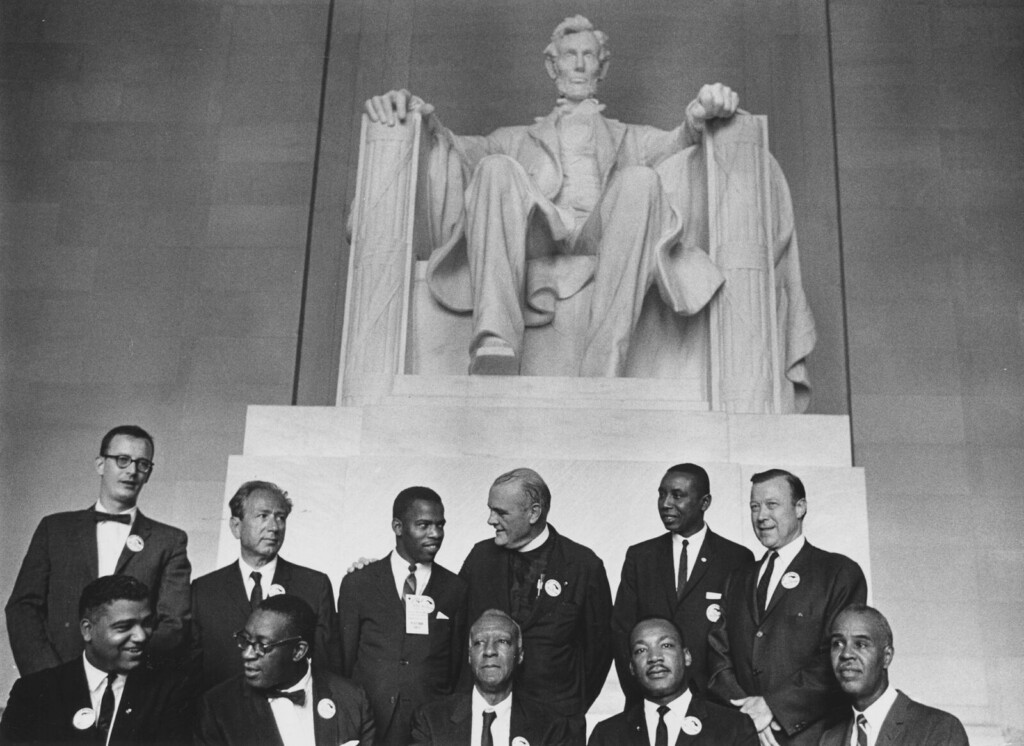
You are standing in a museum, reading a plaque that says “never again,” and somewhere beneath the solemnity you feel a quiet, almost embarrassing relief — that history has been archived, that the worst of it belongs to before, that you live on the correct side of a turning point. This feeling is not wisdom. It is a neurological artifact.
Cognitive scientists who study moral psychology have documented what they call the “end of history illusion,” a systematic bias in which people readily acknowledge how much they have changed in the past decade while simultaneously believing they will change very little in the next. Applied collectively, this bias means that every generation experiences itself as the culmination rather than the middle of moral development. The abolitionists of 1833 believed emancipation was the threshold. The suffragists of 1920 believed the vote was the threshold. The marchers of 1965 believed the Voting Rights Act was the threshold. Each was wrong in the same structural way, not because their victories were hollow, but because the threshold keeps moving for reasons that have nothing to do with moral maturity and everything to do with how power reconstitutes itself in the grammar of newly granted rights.
Orlando Patterson, in his 1982 study of slavery across sixty-six societies, introduced the concept of social death to describe something more precise than legal bondage: the condition of being violently removed from all claim to social existence, to ancestors, to descendants, to the recognition that one’s suffering registers as suffering. What Patterson found, tracing records from ancient Greece through the antebellum American South, was that formal liberation rarely dismantled social death — it often simply privatized it, moved it from statute into custom, from explicit hierarchy into the texture of ordinary interaction. The freed person remained, in the deepest structural sense, someone whose humanity was conditional on the continuous goodwill of those who had previously owned the category.
This is why civil rights legislation, however necessary, has never been sufficient on its own terms. The Civil Rights Act of 1964 made discrimination illegal in public accommodations; it did not make Black wealth accumulate at the same rate as white wealth, because the mechanisms of that disparity had already been laundered into property values, credit scores, and inheritance law decades earlier. By 1968, the Fair Housing Act theoretically outlawed redlining; by 2023, the racial homeownership gap in the United States remained nearly as wide as it had been in 1960. The law changed the surface of the negotiation without touching its engine, because the engine was never purely legal to begin with.
What civil rights history actually records, beneath its official narrative of progressive achievement, is a recurring argument about the boundaries of the fully human — about who is permitted interiority, complexity, grief that counts, ambition that is not perceived as threat. Each era draws this boundary differently, and each era believes its drawing is finally correct. What shifts is not the underlying architecture of exclusion but the vocabulary in which it is justified, moving from theological to biological to economic to cultural registers with remarkable fluidity, each new register feeling to its contemporaries like common sense rather than ideology.
The most destabilizing thing you can do with this history is refuse the comfort of the arc. Not because the victories were meaningless — they were not, and the people who bled for them deserve something more honest than a metaphor about bending — but because the arc narrative asks you to be a spectator to a story already moving toward its resolution, when what you are actually inside of is a negotiation that is still open, still vicious in places you have agreed not to look, and entirely dependent on whether the current generation is willing to experience itself as the middle rather than the end of something that has not yet found its name.
⚖️ Rights, Justice & the Struggle for Equality
The history of civil rights is inseparable from the broader social forces that shape how societies define justice, belonging, and human dignity. From legislative battles to grassroots resistance, the fight for minority rights intersects with questions of exclusion, identity, and collective memory. These related articles explore the social, psychological, and historical dimensions that illuminate the civil rights journey.
The impact of racial discrimination on contemporary social dynamics
Racial discrimination is not a relic of the past but a living force that continues to shape social structures, opportunities, and identities in the present day. This article explores how discrimination operates at systemic and interpersonal levels, tracing its historical roots and its ongoing impact on marginalized communities. Understanding these dynamics is essential to any serious engagement with the civil rights tradition.
GO TO THE SELECTION: The impact of racial discrimination on contemporary social dynamics
The roots of social prejudice and the mechanisms of exclusion
Social prejudice does not emerge in a vacuum; it is cultivated through specific historical, cultural, and institutional mechanisms that normalize the exclusion of certain groups. This article dissects the psychological and sociological roots of prejudice, examining how stereotypes become embedded in legal systems and everyday practices. The analysis provides crucial context for understanding why civil rights movements have been both necessary and fiercely contested.
GO TO THE SELECTION: The roots of social prejudice and the mechanisms of exclusion
Social Exclusion: Causes, Dynamics and Ways Out
Social exclusion is one of the most concrete consequences of systemic discrimination, cutting minorities off from economic resources, political participation, and cultural recognition. This article examines the causes and dynamics of exclusion, as well as the pathways that individuals and communities have found to resist and overcome marginalization. It offers an indispensable lens for reading the social achievements of civil rights struggles.
GO TO THE SELECTION: Social Exclusion: Causes, Dynamics and Ways Out
Protecting human dignity against the processes of social marginalization
Human dignity is the philosophical and legal cornerstone upon which all civil rights frameworks are built, yet it remains perpetually threatened by processes of marginalization and dehumanization. This article investigates how dignity is eroded in peripheral and stigmatized communities, and what strategies — cultural, political, and psychological — have been deployed to protect it. It connects the abstract principles of rights discourse to the lived realities of those who have fought for recognition.
GO TO THE SELECTION: Protecting human dignity against the processes of social marginalization
Discover the Cinema of Rights and Resistance on Indiecinema
The struggle for civil rights has inspired some of the most powerful and uncompromising films ever made — stories of resistance, dignity, and transformation that mainstream cinema too often overlooks. On Indiecinema, our streaming platform dedicated to independent and auteur cinema, you will find a curated selection of films that bring these histories to life with courage and artistic integrity. Explore our catalog and let independent cinema expand your understanding of justice and human freedom.
👉 EXPLORE THE CATALOG: Watch Indie Films in Streaming
A vision curated by a filmmaker, not an algorithm
In this video I explain our vision

