
The Body as Camera Obscura
You wake and the ceiling is wrong. Not wrong in any way you could report to another person — the angle is fine, the light is ordinary — but something in the sequencing of your own consciousness has slipped, and for three or four seconds you cannot locate yourself in time. You do not know if it is Tuesday or whether Tuesday has already passed, whether the conversation you remember having was real or constructed by the night, whether the person you were in the dream is continuous with the person now pressing their palms flat against the mattress to verify solidity. The dream does not feel like something you watched. It feels like something that happened to you with your full participation, and the violence of the transition back is precisely the violence of having to reassemble causality from scratch.

Maya Deren understood that this was not a malfunction. In 1943, working with a camera borrowed from a friend and a budget of roughly two hundred and fifty dollars, she made a film that refuses to let that transition happen. Meshes of the Afternoon does not depict a dream or narrate one. It installs the viewer inside a perceptual condition where forward movement and backward movement become genuinely indistinguishable, where a key falling in slow motion carries more ontological weight than any plot point in any film produced that year by the studios she had specifically, vocally, and irrevocably chosen to reject. Hollywood was then at its industrial peak — MGM, Paramount, Warner Bros. collectively releasing over three hundred features annually, each one engineered to produce exactly the opposite of disorientation, to suture the viewer into comfortable identification and legible cause and effect. Deren looked at this machinery and understood it as a philosophical position, not merely an aesthetic preference, and she chose the opposite philosophical position with full deliberateness.
She had read Sigmund Freud, but she had also read Deren — meaning she had thought carefully about her own body’s movement through space as a primary instrument of meaning-making. Her theoretical writings, collected and published posthumously in “Essential Deren,” show someone who was not illustrating psychological theory but conducting perceptual experiments that psychology had not yet found language for. She wrote about the camera as an extension of the human nervous system, which in 1943 was not metaphor but method. Every choice she made about where to place the lens, how fast to move through a doorway, whether to cut on motion or against it, was a choice about what the human sensorium could be made to feel in the absence of cognitive scaffolding.
What the body knows before the mind has organized the information is a subject that phenomenologists would spend decades trying to articulate. Maurice Merleau-Ponty’s “Phenomenology of Perception,” published in 1945 — two years after Meshes of the Afternoon — argues that perception is never passive reception but always already an active engagement between the body and its environment, that to perceive is to be implicated. Deren had arrived at this by different means: not through the French philosophical tradition but through choreography, through her study of Haitian Vodou ritual, through the practical problem of making a film that cost nothing and had to earn its force from pure structural intelligence. The body in her films is never merely a body in frame. It is the organizing principle of the film’s grammar.
This is what separates her from the Surrealists she is sometimes grouped with by critics who need to store her somewhere. Salvador Dalí and Luis Buñuel made films in which the strange image is offered to consciousness like a riddle to be decoded. Deren made films in which decoding is precisely what becomes impossible, not because the images are obscure but because the logic animating them is the logic of felt experience prior to language, prior to interpretation, prior to the moment you press your palms flat and decide which direction time is moving.
Against the Grammar of Cause and Effect
You follow the logic of a film without noticing you are following a logic. A woman runs from something you cannot name, enters a door, and the next shot shows her safe inside a room — and your nervous system, trained by decades of sequential storytelling, exhales. You do not ask why safety follows escape. You accept it as though the universe itself had signed a contract with causality, as though the grammar of one image leading inevitably to the next were not a cultural invention but a law of physics.
Western narrative cinema did not arrive at this structure by accident. It inherited it from a much older architecture of thought, one that Aristotle laid down in the Poetics around 335 BCE, where he argued that the proper form of a plot is a unified action with a beginning, middle, and end — not merely sequential but causally bound, each event existing because of the one before it and for the sake of the one after. This was not a description of how stories happen to be told. It was a prescription, a normative claim that disorder is a failure of craft and that the highest achievement of narrative is to make contingency disappear inside necessity. Two thousand years later, D.W. Griffith would cut between spaces and times and teach an entire civilization that the cut itself is a logical operator, that montage is argument, that cinema thinks in syllogisms.
Maya Deren understood that this meant cinema had been conscripted into a particular epistemology before most of its practitioners had any idea what epistemology meant. In An Anagram of Ideas on Art, Form and Film, published in 1946, she laid out with almost geometric precision the distinction between what she called the horizontal development of narrative — the forward march of cause producing effect producing consequence — and a vertical investigation that plunges into the density of a single moment rather than racing toward the resolution of the next. She was not proposing a stylistic variation. She was identifying two incompatible philosophies of knowledge, and she was choosing the one that dominant cinema had been designed to suppress.
At Land, made in 1944, does not illustrate this argument — it enacts it as a form of pressure applied directly to the viewer’s expectations. Deren crawls out of the surf and up a banquet table and no one acknowledges her, and the table extends through mismatched spaces that share no causal relationship to one another, and a chess piece moves across a board without explanation and becomes the organizing obsession of a journey that never arrives at a destination because arrival is precisely what the film refuses to promise. The logic operative here is not the logic of because but the logic of and then, not necessity but contiguity, not the Enlightenment faith that observation yields explanation but something older and stranger — the associative drift that the rational tradition has been trying to domesticate since Descartes decided in 1637 that the mind could be trusted only when it proceeded in orderly steps from simple to complex.
What is at stake is not merely aesthetic pleasure or discomfort. The causal structure of conventional film trains its audience to believe that the world is, at its core, decipherable — that events have parents, that outcomes can be attributed, that the chaos of lived experience is always secretly orderly if you find the right angle of explanation. This is not an innocent belief. It is the epistemological foundation of a civilization that has consistently mistaken its own narratives for discovered truths, that has read its own explanatory frameworks back into nature as though they were waiting there to be found rather than imposed. Deren’s counter-grammar does not simply scramble plot sequence. It attacks the assumption that sequence is where meaning lives, that time moves in one direction because reality does, that to understand something is to place it correctly in a chain.

The Vertical Axis of Experience
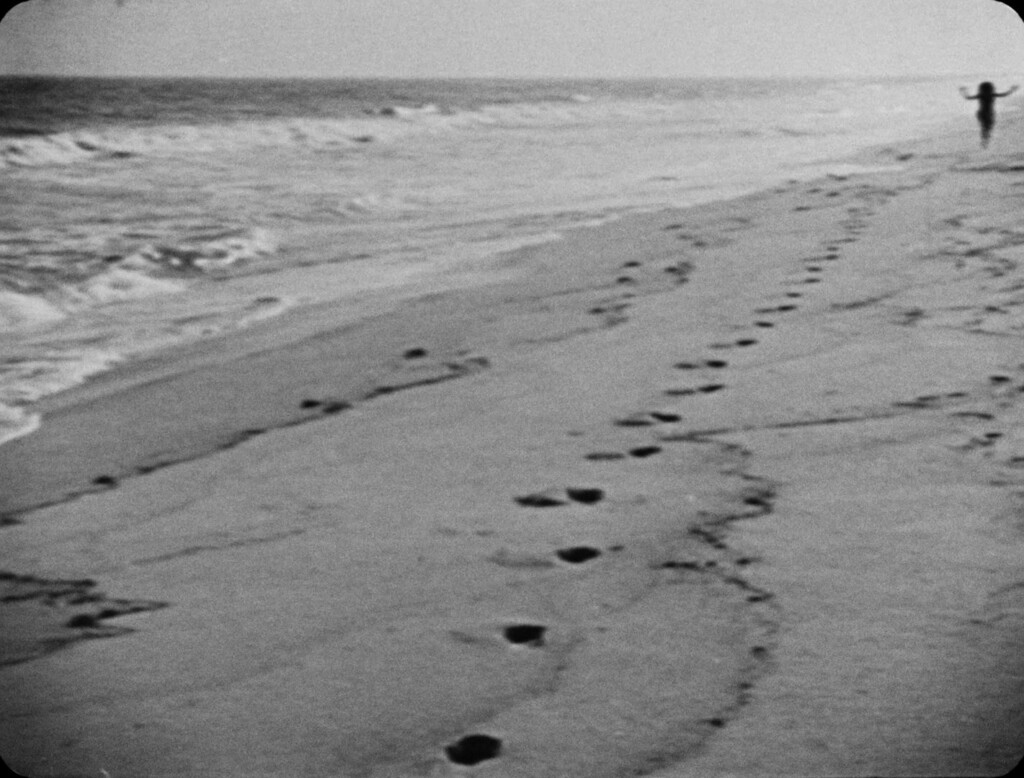
You are watching a film and nothing happens. That is the sentence that stops you, because you know exactly what it means — not nothing as in absence, but nothing as in no forward motion, no antagonist closing in, no clock ticking toward detonation. The camera holds on a woman’s hand suspended above water, and you feel the unease of a viewer whose nervous system has been calibrated for resolution, for the next beat, for the door that finally opens. What you are experiencing is not boredom. It is withdrawal.
Maya Deren stood before an audience at Cinema 16 in New York in 1953 and named something that most filmmakers had not dared to formalize: that cinema could move vertically instead of horizontally. Horizontal cinema, she argued, is the cinema of drama — it travels across time, from problem to consequence, from desire to satisfaction or defeat. It is the railroad track of narrative, and audiences had been trained to ride it so completely that any deviation read as failure rather than choice. Vertical cinema, by contrast, does not travel across an event. It drops through it. It excavates the simultaneity packed inside a single moment — its textures, its contradictions, its emotional harmonics layering beneath the surface rather than unfolding across a sequence. Deren was not proposing an aesthetic preference. She was describing two entirely different epistemologies of time.
Henri Bergson had already laid the philosophical groundwork for understanding why this felt so disorienting to modern audiences. In his 1889 doctoral thesis, later published as Time and Free Will, Bergson distinguished between clock time — the spatialized, measurable, divisible succession of instants that science and industry depend on — and durée, the lived flow of consciousness in which past and present interpenetrate without clean borders. The industrial economy needed the first kind of time desperately. Factory shifts, railway schedules, telegraphic coordination across distances — all of this demanded a human being who could synchronize their inner life to an external, segmented clock. By the early twentieth century, Frederick Winslow Taylor had published his Principles of Scientific Management, reducing the worker’s body to a series of timed, optimizable gestures, and the culture surrounding that body followed suit. Leisure became scheduled. Entertainment became paced. Narrative cinema arrived precisely when the population had been most thoroughly restructured to experience time as a line with endpoints.
What Deren’s vertical axis demanded was a recovery of durée that industrial modernity had made feel alien even to the people who had originally possessed it. When her camera lingers, when her editing refuses to propel you forward and instead folds one image into another like a translation between states of being, the viewer does not lack the capacity to receive this — they have simply been taught to distrust it. The sensation of depth without progress, of intensity without payoff, registers as disorder because the culture has no civic or economic use for it. A worker who experiences time vertically — who falls through the texture of a moment rather than managing its passage — is not a productive worker. Contemplative perception had been quietly reclassified as dysfunction.
This is why Deren’s work could not be dismissed on purely aesthetic grounds. Critics who called it difficult or obscure were, without knowing it, reporting a conditioned response rather than a judgment. The same audience that found her films opaque had no difficulty sitting inside a piece of music, receiving its simultaneity of harmonics without demanding that it resolve into a story. The difference was that film had been colonized by narrative long enough to feel natural in that form, while music had retained its right to exist as duration experienced rather than plot delivered. Deren was simply asking cinema to remember that it shared this capacity — that the moving image, before it became a storytelling machine, was always also a time-sense machine, capable of teaching the eye to fall rather than march.
Ritual, Repetition, and the Dissolution of the Self
She arrived in Haiti in 1947 with a camera and the confident posture of an avant-garde filmmaker, certain that what she would find there could be translated into footage, into structure, into art. She left — years later, after multiple returns — with almost no usable film and a book that reads less like ethnography than like a confession of epistemological defeat. Divine Horsemen: The Living Gods of Haiti, published in 1953, is the document of someone who went looking for material and found instead the collapse of the framework she used to identify what material was. Deren had expected to observe. What she encountered was possession, and possession does not permit the observer to remain at a safe remove from what is being observed.
Vodou ceremony does not stage an altered state for an audience. It enacts a transfer — the lwa, the divine principle, descends and the human vessel empties itself, or is emptied, and what inhabits the body afterward moves with a different grammar, carries a different weight, addresses the gathered community in a register that is not the register of individual personality. Deren watched this happen repeatedly, cross-checked her observations against her categories, and found the categories insufficient. The person who had been standing there was gone. Not suppressed, not performing, not psychologically destabilized in any pathological sense — gone, and replaced by something that the surrounding community recognized, named, and engaged with as a coherent presence. Her secular training had given her no instrument precise enough to account for what she was seeing without immediately reducing it to something smaller than itself.
William James, writing in The Varieties of Religious Experience in 1902, had already pressed against this exact boundary with a precision that American psychology would spend the following century quietly ignoring. He proposed that normal waking consciousness, rational and bounded, represents only one type of possible consciousness, and that adjacent to it — separated by the filmiest of screens — lie entirely different forms of mental life, which may determine our action and destiny as completely as ordinary mental life does. James was not speculating about pathology. He was articulating a permeability in the architecture of selfhood that Western modernity had chosen to treat as a malfunction rather than a capacity. The choice was not philosophically neutral. It was a jurisdictional claim — a decision about which states of consciousness would be granted authority and which would be administered.
The pathologization of trance, of ecstatic experience, of ego dissolution, is not a scientific finding. It is a cultural inheritance that dressed itself in clinical language around the same period that colonial administrations were classifying non-European ritual practice as primitive and therefore treatable — treatable meaning suppressible. What got labeled hysteria in a Parisian clinic in the 1880s and what got labeled divine possession in a Haitian peristyle were, structurally, the same phenomenon encountered by two different knowledge systems with two radically different orientations toward the permeable self. One system built an institution to contain and cure it. The other built a cosmology to receive and interpret it.
Deren herself was eventually possessed. She describes the moment in her book with a sobriety that makes it more unsettling than any dramatic account could. She does not claim revelation. She claims loss — specifically, the loss of the “I” that had been organizing her experience up to that instant. When she returned, she had notes, recordings, thousands of feet of film that she would never be able to edit into a coherent documentary, because a documentary requires a stable observing subject, and she was no longer certain she believed in the stability of the observing subject as a natural given rather than a cultural construction. The film was finally released in 1985, fourteen years after her death, with a soundtrack assembled by her former husband Teiji Ito — a document completed by someone else, framed by an absence at its center that was not accidental but definitional.
The Female Gaze as Structural Threat
You walk into a room where someone is already watching you, has been watching you since before you arrived, has organized the furniture, the lighting, the angle of entry, so that your body becomes the object the space was built to receive. You did not choose this. You were simply born into a visual grammar that had already decided what you were for.
Laura Mulvey named this grammar in 1975, in her essay “Visual Pleasure and Narrative Cinema,” with a precision that still makes certain people uncomfortable. The male gaze, she argued, is not a preference or a tone or even an ideology in the loose sense — it is a structural mechanism embedded in the syntax of classical cinema itself. The camera does not merely look at women; it organizes all the elements of looking — framing, editing rhythm, point-of-view shots, narrative motivation — so that the spectator is positioned as an implicitly masculine subject whose pleasure depends on the woman remaining passive, available, and visually consumable. This is not about what appears on screen. It is about who holds the grammar.
What Deren had already been doing for three decades before Mulvey wrote that sentence was dismantling the grammar at the level of its joints. Not by putting women in positions of narrative power — though her films do that — but by refusing the syntactic conditions under which the female body becomes a spectacle at all. In “Meshes of the Afternoon,” shot in 1943 with Alexander Hammid, the camera does not desire the woman it follows. It inhabits her. The editing does not cut to reveal her to an external observer; it cuts along the interior logic of her perception, so that the viewer is never offered the safe distance of the voyeur. There is no position outside the experience from which to consume it aesthetically. The grammar of pleasurable looking is not subverted — it is made structurally unavailable.
This is why the hostility Deren encountered was rarely about content. No one could accuse her films of obscenity or political provocation in any legible sense. The discomfort was formal and therefore harder to articulate, which made it more virulent. When critics dismissed her work as “private” or “personal” or “experimental” in the pejorative sense that word carried in mid-century American culture, they were reaching for language to describe a threat they could not locate precisely. The threat was not that a woman had made a film about a woman. The threat was that the apparatus itself — the camera, the cut, the gaze — had been rewired so that it no longer produced the subject-object structure on which mainstream cinema’s visual economy depended.
The institutional response was proportional. The American film industry of the 1940s and 1950s offered women exactly one legitimate relationship to the camera: in front of it, shaped by it, made meaningful by the desiring look it transmitted. Deren refused that position and then, more dangerously, refused the alternative that liberal culture would eventually offer — the token woman director who made films indistinguishable in their grammar from those made by men. She did not want access to the existing apparatus. She wanted a different apparatus entirely, which is a far more threatening demand because it implies the existing one was never neutral to begin with.
Mulvey’s theoretical framework arrived thirty years after Deren had already enacted its conclusions in celluloid. That gap is not incidental. Theory tends to arrive when the danger has been partly absorbed, when it is safe to name what was once only felt as an irritant. The women who actually broke the grammar in real time — in 1943, in 1946, in 1959 — did so without the protection of academic discourse, without institutional legitimacy, with only their own certainty that the way images moved through time could be something other than what it had always been made to be.
A vision curated by a filmmaker, not an algorithm
In this video I explain our vision
Surrealism's Failure and Deren's Divergence

You have probably heard Deren’s name spoken in the same breath as the Surrealists, filed alongside them in the cultural imagination as part of the same dream-obsessed lineage, and that proximity has done her a quiet but decisive violence. The grouping feels intuitive — the dissolving bodies, the logic that refuses waking coherence, the images that seem excavated from somewhere below language. But the resemblance is a surface phenomenon, and beneath it lies a fundamental disagreement about what the unconscious is for, and who gets to use it.
André Breton’s 1924 Surrealist Manifesto is a document of conquest. Its language is saturated with the vocabulary of extraction: the unconscious is a territory, the artist is an explorer, and automatism is the method by which sovereign rational control is temporarily suspended so that richer, wilder material can be hauled upward into the light of composition. The suspension is strategic. Reason steps aside not because it has been genuinely overthrown but because it has calculated that yielding briefly will produce better results. The artist remains, throughout, the one who decides what to keep. He is the editor of his own dissolution.
What Deren proposed was structurally incompatible with this. Her notebooks and the theoretical essays she produced throughout the 1940s and early 1950s consistently return to an image of the artist not as the one who descends and returns with treasure, but as a conducting surface — something form moves through rather than something that moves form. In a 1953 lecture at Cinema 16 in New York, she distinguished sharply between what she called the “vertical” investigation, which plunges into depth and psychology, and the “horizontal” one, which moves across the surface of event and relationship in time. She aligned herself explicitly with the horizontal. The vertical was, without her naming it as such, the Surrealist operation: the sovereignty of depth, the hierarchy of hidden over visible, the artist as diver.
Georges Bataille, writing in the same decades, developed a distinction that cuts directly to what separates these two operations. In his economic thinking, most fully elaborated in “The Accursed Share” published in 1949, he contrasted a restricted economy — one organized around accumulation, return, and utility — with a general economy governed by excess, expenditure, and irreversible loss. The restricted economy is the logic of investment: you spend in order to gain more than you spent. The general economy recognizes that the universe produces more energy than any system can absorb, and that what cannot be used must be destroyed, wasted, given away without the possibility of recuperation. Sovereignty, in Bataille’s framework, is not the mastery that accumulates — it is the willingness to lose without account.
Breton’s Surrealism, whatever its rhetoric of liberation, was a restricted economy. The unconscious was mined for its yield. The irrational was harvested. The dream was transcribed so that the waking artist could exhibit it. Every descent was structured by the assumption of return, and the return justified the risk. The movement produced objects — paintings, texts, films — that entered the market, the museum, the archive. The expenditure was never total.
Deren’s practice involved something the Surrealists structurally could not afford to attempt: the genuine risk that form might not consolidate into an object that could be owned, exhibited, or exchanged at profit. When she shot “Meshes of the Afternoon” in 1943 in a rented house in Los Angeles with a camera borrowed for the afternoon and no budget that would permit retakes as a financial strategy, she was not performing poverty — she was working inside a logic where the process could not be guaranteed to produce a retrievable asset. The self that moves through those corridors is not the self that staged them. The distance between those two figures is precisely where Bataille’s general economy breathes, and where the Surrealist contract quietly collapses.
The Political Unconscious of Legible Cinema
You already know how to watch a film. You know when to tense your shoulders and when to exhale, when the protagonist’s scattered life is about to be gathered by the plot into something recognizable as meaning. The machinery is so well-calibrated that you rarely notice you are being trained — not in aesthetics but in ontology, in the belief that experience moves toward resolution the way water moves toward a drain.
Fredric Jameson argued in The Political Unconscious in 1981 that narrative is not simply entertainment or communication but a socially symbolic act, a cultural mechanism that takes historical contradiction — the raw, unmanageable fact of class conflict, of exploitation, of irreconcilable social forces — and processes it into story form, which means into something with a beginning, a complication, and a restoration of order. The narrative is not a lie exactly; it is a container, and what it contains stops being dangerous the moment it has been given shape. A story about poverty that ends in the hero’s redemption does not expose economic structure — it converts structural violence into personal drama and then resolves the drama, leaving the structure untouched and the audience feeling, paradoxically, that something has been addressed.
Legible cinema performs this operation with exceptional efficiency because it recruits the body. The nervous system learns the grammar — rising action, catharsis, denouement — and after enough repetitions, that grammar begins to feel like the shape of time itself. Suffering becomes something that has an arc. Injustice becomes something that moves, however slowly, toward correction. The audience leaves the theater not comforted by any argument the film has made but by the formal experience of resolution itself, which their bodies now carry as a template for how reality behaves. This is not ideology as a set of ideas to be held or rejected. It is ideology as a sensory expectation, installed below the threshold of any conscious assent.
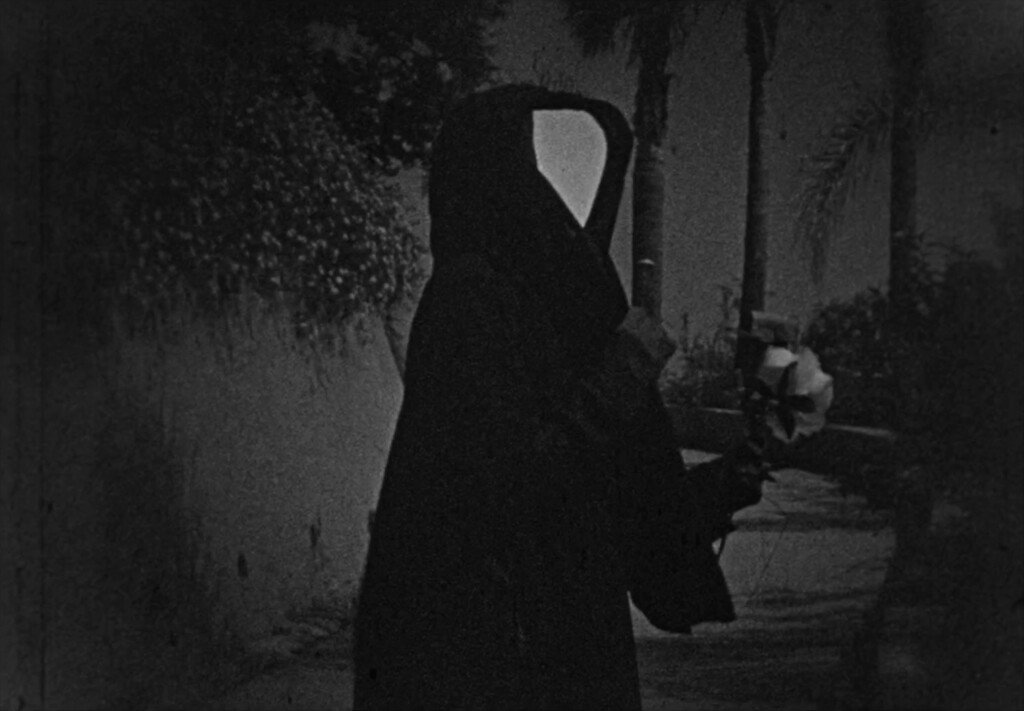
Deren’s films refuse every stage of this process, which makes them difficult in a way that is physiologically precise. Meshes of the Afternoon, completed in 1943 with Alexander Hammid, offers no catharsis and no restoration because it refuses to establish a complication that demands resolution. The figures that traverse its landscape — the key that becomes a flower that becomes a knife, the hooded figure with a mirror for a face — are not symbols awaiting decoding. They are images that absorb interpretation without confirming it, that press the viewer into an anxiety the film will not metabolize for them. The suffering, if it is suffering, will not arc. The contradiction, if it is contradiction, will not be contained.
This refusal placed her at the margins not only of commercial cinema but of the avant-garde circles that might have claimed her as one of their own. The American experimental film culture of the postwar period, for all its declared opposition to Hollywood, remained invested in the artist as a coherent subject producing legible statements — countercultural, subversive, difficult perhaps, but ultimately communicative, ultimately resolvable into a position. Deren’s work could not be resolved into a position because it was not making one. She was operating below the level where positions are formed, in the territory where experience is still undifferentiated and unmanageable, where the psyche has not yet assigned meaning to what it perceives.
Her theoretical writing, particularly An Anagram of Ideas on Art, Form and Film published in 1946, articulates this with a lucidity that is almost paradoxical: she could explain in precise analytic prose what her films refused to do discursively, which suggests the refusal was entirely deliberate and not the result of a mind that could not organize itself. She was organizing something else — not argument but encounter, not position but pressure, the specific pressure of an experience that has not yet been told what it means and is not waiting for anyone to tell it.
What the Dream Knows That Waking Forgets
It is two in the morning and someone is sitting alone with the blue light of a screen on their face, watching something they will not be able to explain tomorrow. The film ends. They close the laptop. They lie in the dark and try to reconstruct what happened — some kind of corridor, a figure moving backward, water that seemed to fall upward — and nothing holds together into a story they could relay at a table with other people. Yet something has shifted inside them, not metaphorically but almost somatically, as though a small interior weight has been redistributed without their consent. They do not feel moved in the way a drama moves you, where you can point to the scene and say there, that is the moment. They feel rearranged, and they have no language for it, and by morning they will have quietly filed the experience away in the drawer marked inconclusive.
Gaston Bachelard spent much of his 1958 work on the phenomenology of intimate space arguing that certain images do not pass through cognition on their way to significance — they arrive directly in the body, bypassing the interpretive layer entirely. He was writing about corners and nests and the underside of staircases, but the mechanism he described applies with precise force to the kind of image that cannot be narrated afterward. Bachelard called these images resonant rather than meaningful, a distinction that sounds polite but is in fact radical: it implies that the category of meaning is simply too narrow a vessel for what some images carry. A resonant image does not ask to be decoded. It vibrates at a frequency the body recognizes before the mind has had time to form a question. The person lying in the dark after the film is not failing to understand something. They are succeeding at a different and less culturally sanctioned form of knowing.
What makes this culturally dangerous is not the experience itself but the shame structure built around it. Western epistemological tradition, at least in its dominant institutional form since Descartes, has organized knowledge as something that can be stated, defended, and reproduced. Anything that resists this format is not merely different — it is suspect, primitive, or simply not serious. The arts survive within this framework by producing interpretable objects: criticism exists to translate the resonant back into the legible, to make the experience of a painting or a poem safe for discourse. The moment a work refuses that translation — refuses to yield a paraphrasable content — it tends to be pushed toward the margins of legitimate culture and held there by a vocabulary of condescension: obscure, self-indulgent, inaccessible.
The cost of this arrangement falls unevenly. It falls hardest on the kinds of knowing that have historically been gendered as feminine, racialized as non-Western, or classed as uneducated — ways of processing experience through the body, through repetition, through image rather than argument. When a culture decides that only the legible deserves serious attention, it is not making a neutral epistemological choice. It is enforcing a hierarchy disguised as a standard, and the disguise is almost perfect because the hierarchy presents itself as rigor. The person who cannot explain what happened to them at two in the morning is not inarticulate. They have encountered something that exists prior to articulacy, which is not the same thing at all.
And so the question that remains — the one that does not resolve into an answer simply because it has been named — is what precisely a culture surrenders when it trains its most careful attention exclusively on what can be argued, paraphrased, and taught in a syllabus, and whether what it loses in that transaction is even the kind of thing it would recognize as a loss.
🌙 Between Dream and Image: Cinema as Inner Language
Maya Deren’s films transformed cinema into a living dreamscape, where movement, ritual, and the unconscious dissolved the boundaries between waking and sleep. Her work resonates with a broader conversation about how images, symbols, and the hidden layers of the mind shape art and experience. These articles explore the territories that surround her visionary practice.
Psychoanalysis and cinema: when the couch becomes the screen
Psychoanalysis and cinema have long shared a common territory: the exploration of desire, repression, and the unconscious through narrative and image. This article traces the deep theoretical connections between the couch and the screen, from Freud’s influence on early surrealist filmmakers to Lacan’s mirror stage and its echoes in film theory. Understanding this relationship illuminates why Deren’s dreamlike structures feel so psychically immediate.
GO TO THE SELECTION: Psychoanalysis and cinema: when the couch becomes the screen
Slow and contemplative cinema: the aesthetic of slow cinema
Slow and contemplative cinema represents a deliberate resistance to the acceleration of mainstream film language, privileging duration, stillness, and sensory immersion over plot and action. This aesthetic tradition shares a profound kinship with Maya Deren’s approach, where each frame is treated as a meditative threshold rather than a narrative unit. The article examines the history and theory of slow cinema as an art form rooted in presence and inner time.
GO TO THE SELECTION: Slow and contemplative cinema: the aesthetic of slow cinema
Synchronicity and meaningful coincidences: Jung and chance
Jung’s concept of synchronicity — the meaningful coincidence that escapes rational causality — offers a powerful lens through which to read Maya Deren’s film structures, where chance and necessity seem to collapse into a single gesture. This article explores how Jung theorized the uncanny alignment of inner and outer events, drawing on both clinical observation and esoteric philosophy. It opens a rich dialogue between depth psychology and the poetic logic of avant-garde cinema.
GO TO THE SELECTION: Synchronicity and meaningful coincidences: Jung and chance
The Unconscious and its Relationship With Cinema
The relationship between cinema and the unconscious is one of the most fertile and contested fields in film theory, touching on dreams, desire, and the hidden architecture of meaning beneath every image. This article traces how filmmakers and theorists have understood the moving image as a machine for accessing what lies beneath conscious perception. Maya Deren herself occupies a central place in this tradition, making this exploration essential for anyone drawn to her work.
GO TO THE SELECTION: The Unconscious and its Relationship With Cinema
Discover the Cinema That Dares to Dream
If Maya Deren’s world of ritual images and waking dreams speaks to something deep in you, Indiecinema is the streaming platform where that conversation continues. Explore a curated selection of avant-garde, experimental, and independent films that push the boundaries of what cinema can say and feel — films that dare to look inward.
👉 EXPLORE THE CATALOG: Watch Indie Films in Streaming
A vision curated by a filmmaker, not an algorithm
In this video I explain our vision

