
The Weight of a Face That Does Not Perform
You are watching a man sit still, and it costs you something. He is at a table in a room where the light does not flatter anyone, his hat pulled low enough to suggest he is not interested in being seen, his jaw carrying that particular set that belongs to people who have already decided how the conversation ends. He does not look at the camera. He barely looks at the other person in the room. And yet you cannot look away, because something in his face is doing what most faces on screen never manage: it is refusing you.

That refusal was Humphrey Bogart’s central instrument, and it arrived in Hollywood at a moment when the dominant grammar of screen acting was still built on legibility. The industry had inherited from the stage a vocabulary of gesture and expression designed to communicate emotion to the back row of a large theater. Even as silent cinema had trained performers to work with their bodies and faces at close range, the transition to sound brought with it a wave of stage-trained actors who carried theatrical projection into a medium that neither needed nor benefited from it. The face, in this tradition, was a transmitter. It sent signals. It told you what to feel. Bogart’s face did none of this.
What made his screen presence so structurally strange was not that he underacted, which is the word critics reach for when they mean something they have not yet fully described. It was that his face operated as a resistant surface rather than an expressive one. The distinction matters enormously. An expressive face opens toward the audience, inviting projection, offering emotional cues that allow the viewer to complete the circuit, to feel recognized in what they see. A resistant face does the opposite. It withholds. It maintains an interior that the camera cannot penetrate, and in doing so, it forces the audience into a different posture: not passive recipients of emotion, but active interpreters of a man who will not explain himself.
Constantin Stanislavski had spent decades theorizing the actor’s inner life as the source of authentic performance, arguing in An Actor Prepares, published in English in 1936, that truth on stage comes from genuine psychological experience rather than technical mimicry. But Bogart’s resistance operated outside this framework entirely. He was not drawing on hidden emotional reserves and carefully concealing them. The blankness was the performance. What looked like restraint was actually a kind of structural opacity built into the architecture of his face itself — the heavy-lidded eyes, the asymmetric mouth that gave even his smiles the quality of something provisional, the slight forward lean of his head that suggested perpetual skepticism. These were not choices. They were facts, and he used them with the precision of a man who understood that the camera would do the work he refused to do for it.
This is where Bogart diverges from the tradition of screen charisma that preceded him. Clark Gable gave you access. James Cagney gave you energy. Even Edward G. Robinson, whose screen menace was considerable, gave you legible villainy, emotion that pointed clearly at itself. Bogart gave you a closed door, and the audience leaned toward it. The psychological dynamic this creates in the viewer is not comfort but tension — the productive tension of encountering someone who cannot be easily read, who exists on screen with the same opacity that most human beings present to strangers in actual life, which is to say far more opacity than cinema had ever been willing to represent.
The breakthrough this represented was not stylistic but epistemological. Bogart introduced into mainstream American cinema the radical proposition that a face need not perform its interior to be believed.
Hollywood's Manufactured Virility and Its Contradictions
You are watching a man lose a screen test. Not metaphorically — literally watching the footage, the way casting directors at Warner Bros. did in 1930, running celluloid through a projector and deciding, with the confidence of accountants, that the face in front of them did not compute. Too angular. Lip deformed by an old wound that made the mouth curl in a way that read as contempt even when the man was attempting sincerity. The studio system in those years was not looking for sincerity anyway — it was looking for legibility, for faces that could be mass-produced across forty-eight states and understood by a farmhand in Nebraska and a secretary in Pittsburgh with equal immediacy.
The masculine ideal that Hollywood industrialized between 1930 and 1950 was not an accident of culture. It was a contractual artifact. Louis B. Mayer and Jack Warner ran their studios with the logic of factory owners who had accidentally discovered that human beings could be vertically integrated. Actors signed seven-year contracts that gave studios the power to loan them out, suspend them without pay, and dictate everything from their weight to the width of their lapels. The result was a highly codified virility — broad-shouldered, square-jawed, emotionally inert in a way that passed for strength — that the market had essentially pre-approved before any individual body walked into it. Clark Gable was not a star because audiences discovered him. He was a star because MGM manufactured the conditions under which discovery became inevitable, placing him in thirty-seven films between 1931 and 1936 with a precision that had less to do with art than with saturation.
Into this machinery, Warner Bros. fed Bogart as raw material for a specific industrial function: the disposable villain. Between 1930 and 1935, he appeared in a sequence of films that studios internally classified as programmers — pictures budgeted low, shot fast, designed to fill the bottom half of double bills. He played killers who died in the third act, lawyers who turned out to be corrupt, men whose narrative function was to be defeated so that the legible hero could remain intact. This was not a supporting role in the honorific sense. It was structural expendability. The studio system required a supply of men audiences could be comfortable watching die, and Bogart’s face — with its unresolvable ambiguity, its lip that refused to smile cleanly — made him physiognomically available for that purpose.
What the system could not have planned for was that ambiguity accumulating into authority. The psychologist James Hillman, writing about the archetypal dimensions of the persona in Re-Visioning Psychology in 1975, argued that cultural figures sometimes exceed the roles assigned to them not because they resist those roles but because they inhabit them so completely that the role itself cracks open. Every villain Bogart played between 1930 and 1937 added a layer of moral texture that the system was producing without intending to. Duke Mantee in The Petrified Forest in 1936 — a role Leslie Howard fought to get him despite studio resistance — was the first moment this accumulation became visible to anyone paying attention. Audiences watching that performance were not watching a programmer villain. They were watching eight years of structural expendability suddenly become something the studio had no category for.
The contradiction at the heart of Hollywood’s masculine factory was that it needed authenticity as a product while being constitutionally unable to manufacture it. Authenticity requires friction, and the studio system spent enormous energy eliminating friction — smoothing faces, neutralizing accents, replacing working-class biographies with promotional mythologies. Bogart’s early career was nothing but friction. His biography was genuinely strange: the son of a society physician and a commercial illustrator, educated at prep school, a Navy veteran who ended up managing a chess piece concession on Broadway before the movies found him. None of this fit the promotional grammar that turned men into stars on schedule.

Authenticity as Cultural Commodity
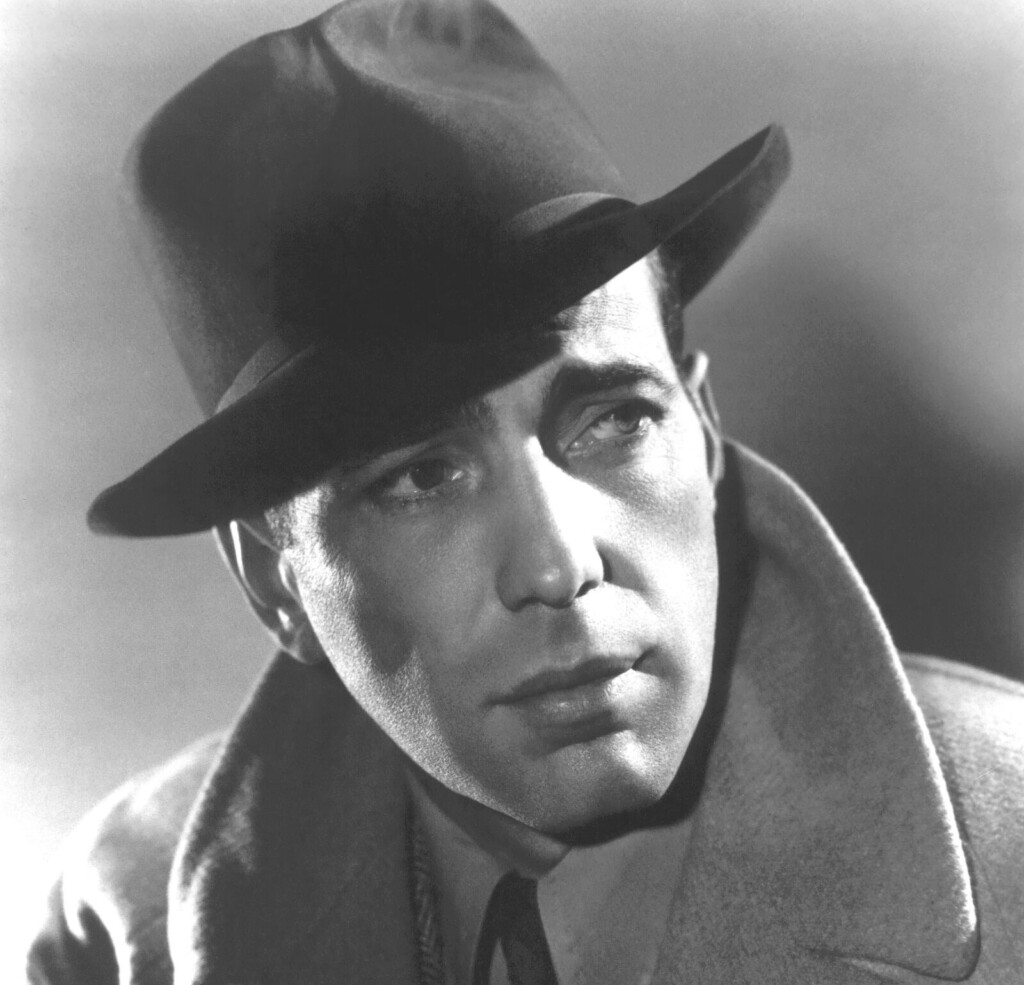
You have seen his face so many times that you believe you know him. Not the character, not the role — him. That is the trick, and it worked on nearly everyone who ever sat in a darkened room and watched light flicker across a screen.
Walter Benjamin wrote in 1935, in “The Work of Art in the Age of Mechanical Reproduction,” that the technological capacity to copy an image infinitely destroys what he called the aura — that singular, unrepeatable presence attached to an original object existing in one place at one moment in time. He was right about painting. He was catastrophically wrong, or perhaps simply unprepared, for what cinema would do to the human face. Film did not destroy the aura. It manufactured one from nothing, then mass-produced it, and the mass production was precisely the mechanism that made audiences feel they were encountering something irreducible and singular. The paradox is structural: the thousandth time you see a face, you do not think you are seeing a copy. You think you are finally seeing the truth of it.
Bogart’s physical markers functioned as authentication stamps. The slight droop of the upper lip, the lisp that emerged under emotional pressure, the scar running along the left side of his mouth — these were read by audiences as proof of a man who had been somewhere, done something, survived something real. The scar’s origin was repeated across studio publicity materials throughout the 1940s as the result of a wound sustained during World War One naval service, a shrapnel fragment near Petty Officer Bogart’s mouth during transport duty aboard the USS Leviathan. The story was clean, patriotic, and almost certainly false. Most biographical evidence points to a far more mundane explanation — a splintered wooden restraint during prisoner transport, possibly a bar fight, possibly a childhood accident — none of which has ever been confirmed with documentary certainty. What is certain is that Warner Bros. understood the scar’s narrative value and invested in its mythology with the same calculation they applied to set design.
The lisp itself, far from being a raw biological fact, was modulated across Bogart’s career in ways that correlate precisely with the emotional register the role demanded. Voice coaches at Warner Bros. in the late 1930s and early 1940s were not correcting speech impediments — they were calibrating them, shaping them into instruments of perceived authenticity. This is not a cynical footnote. It is the operating logic of an entire industrial system that had learned, by 1941, that audiences do not trust perfection. They trust damage. They trust the crooked line. So the crooked line was engineered.
Erving Goffman, in “The Presentation of Self in Everyday Life” published in 1959, argued that all social performance involves a backstage and a front stage, and that the most convincing front-stage performances are those that successfully suggest there is no backstage — that what you are seeing is the unmediated person, not the managed self. Hollywood studios had solved this problem decades before Goffman named it. The backstage of Bogart’s persona — the coaching, the lighting designed to harden his features, the scripts that consistently placed him in moral territory ambiguous enough to suggest depth without requiring it — was absolutely invisible to the audience buying a ticket to see a man who seemed to have no need for any of it.
What travels through this mechanism is not Bogart’s character or even his talent, which was considerable and underestimated. What travels is a specific cultural hunger — the American desire to locate authenticity somewhere outside the machinery of production, even when, especially when, that authenticity is itself the machinery’s most refined product. The face becomes the proof of something that was never there to be proven.
The Hard-Boiled Ethic and Its Philosophical Debts
You are sitting across from a man who has already decided nothing will surprise him. He listens to your problem, lights a cigarette, and the economy of his gestures tells you something you cannot quite name: that he will help you not because he believes in justice but because refusing would require a kind of hope he abandoned somewhere around 1932.
Dashiell Hammett published “The Maltese Falcon” in 1930, and the creature he released into American culture was not a hero in any inherited sense. Sam Spade operates by a code that has no theology behind it, no civic myth propping it up, no reward waiting at the end. When Spade hands Brigid O’Shaughnessy to the police despite wanting her, despite possibly loving her, his explanation is almost brutally administrative: a man’s partner gets killed, you’re supposed to do something about it, that’s all. The moral imperative arrives stripped of sentiment, stripped of transcendence, reduced to a kind of professional gravity — and the shock of it in 1930 was that it felt more honest than anything the preceding century of American fiction had offered about virtue.
Raymond Chandler pushed this further and made it explicit. In his 1944 essay “The Simple Art of Murder,” he articulated what Hammett had dramatized: the detective must go down mean streets without himself being mean, must be a complete man in a world of incompleteness. Chandler was describing an ethical posture that European philosophy was still formulating in academic language. Jean-Paul Sartre’s “Being and Nothingness” appeared in 1943, but its American penetration — the campus lectures, the paperback translations, the café conversations — came a decade later. What Chandler was naming in pulp essay form was a specifically New World version of the same crisis: how does a person act with integrity when the structures that were supposed to guarantee meaning have visibly failed? The Depression had not merely impoverished millions; it had discredited the American mythology of meritocratic providence. Hard work had not saved anyone. Virtue had not been rewarded. The 1930s produced a generation that had watched the promised contract dissolve, and the hard-boiled detective was their philosophical mascot — not a solution but an embodied question about how to persist without consolation.
Bogart carried this weight in his face before he carried it in his performances. The asymmetry of his features, the result of partial facial paralysis from a childhood injury, gave him an involuntary skepticism — a permanent slight curl that read on screen as a man processing the world’s absurdity in real time. Directors knew this. John Huston, who had spent years working in precisely the literary tradition Hammett represented, cast Bogart in “The Maltese Falcon” in 1941 understanding that the actor’s physicality would do philosophical work the screenplay could only gesture toward. The performance that emerged was not one of emotional withholding but of emotional clarity: Spade feels everything and acts from principle anyway, which is a far more demanding condition than feeling nothing.
The sociological weight of this posture in the years between the New Deal and the Truman Doctrine is difficult to overstate. America in the early 1940s was a country that had survived catastrophic institutional failure and was now being asked to believe in institutions again — to trust the government, the draft board, the wartime information apparatus. The noir protagonist offered a counternarrative: you can act, you can even act correctly, but not because you’ve been persuaded. The loner who does the right thing while remaining unconvinced of the system that benefits from his doing it was not a rebel. He was something more unsettling — a man who had internalized responsibility so completely that he no longer needed external legitimation, which meant external legitimation had permanently lost its claim on him.
Race, Whiteness, and the Invisible Architecture of Heroism
You have seen this man suffer on screen and never once thought to ask why his suffering was legible — why it read as depth, as tragedy, as the burden of a complicated soul — while other men in the same films carried their pain as scenery.
The question is not about Humphrey Bogart’s talent, which was real and hard-won. The question is about the architecture that made his particular face the face onto which an entire culture projected its most serious ideas about conscience, courage, and moral weight. Richard Dyer, in White published in 1997, argued that whiteness operates in Western visual culture not as a marked identity but as an invisible norm — the unspoken standard against which all other bodies are measured, always as deviation. What Dyer identified was not prejudice in its crude, individual form but something colder and more structural: a representational economy in which whiteness was the precondition for being seen as fully human on screen, and therefore the precondition for being granted complexity, ambiguity, and psychological interiority.
Bogart’s characters are almost definitionally ambiguous. Rick Blaine drinks too much and refuses to commit. Sam Spade manipulates everyone around him and feels no clear remorse. Dixon Steele is violent and unstable in ways the camera treats as fascinating rather than disqualifying. The film industry of the 1940s was capable of imagining a white man as morally compromised and still sympathetic, still the protagonist, still the one whose inner life organized the meaning of the story. This was not a neutral aesthetic choice. It was the product of a system that had, by that decade, spent roughly fifty years developing a visual grammar in which non-white characters — when they appeared at all — existed to serve the legibility of white ones. The suffering of a Black character, a Mexican character, a Chinese character, was not cinematic material for tragedy. It was background noise, or worse, comic relief.
Dyer’s argument becomes precise when you follow the money and the credits. In the same Hollywood that was building Bogart into an icon of psychological realism, Black actors with equivalent or greater technical ability were confined to roles that structurally forbade interiority. Hattie McDaniel won an Academy Award in 1940 for playing a loyal servant. She was seated at a segregated table at the ceremony. The industry did not experience this as a contradiction because the representational logic it operated under had already decided, in advance, which kinds of faces could anchor a story about what it means to be human under pressure. The invisibility of whiteness meant that Bogart’s race was never named as a condition of his heroism — it was simply naturalized as the ground on which heroism became possible.
What makes this economy particularly durable is that it disguised itself as quality. The moral complexity granted to Bogart’s characters was described in the language of craft, of psychological realism, of adult cinema. Critics praised the darkness, the ambivalence, the refusal of easy resolution. None of them were wrong about what they saw. But the frame around what they were allowed to see had been constructed long before the cameras rolled, and it determined who could be the bearer of darkness worth analyzing and who would remain a fixed point in someone else’s narrative.
The damage this did was not only to the actors and filmmakers excluded from the frame. It was epistemological. An entire society trained itself to recognize depth, conscience, and moral seriousness through a face that happened to be white, in a context that insisted this was simply what depth looked like — universal, unmarked, self-evident. The category of the hero was being quietly racialized at the precise moment it claimed to be speaking for humanity.
A vision curated by a filmmaker, not an algorithm
In this video I explain our vision
The Second World War as Narrative Engine

You are watching a man who has not changed, and everything about him means something different now. The jawline is the same, the lidded eyes are the same, the particular quality of stillness that reads simultaneously as danger and control — none of it has been altered. What has been altered is the world outside the frame, and that alteration is sufficient to transform a criminal into a hero without moving a single muscle of his face.
Between 1939 and 1941, Warner Bros. cast Bogart almost exclusively as men the audience was meant to fear or despise. Roy Earle in High Sierra, released in January 1941, was a getaway driver and killer given exactly one note of sentiment — a crippled girl he briefly tries to help — precisely so that sentiment could be stripped away again before the final reel. The studio understood his face as a register of threat. Then, on December 8, 1941, the United States entered the war, and the American film industry did not pause to reconsider its talent; it conscripted it. The Office of War Information began issuing production guidelines to Hollywood studios in 1942, explicitly encouraging narratives of sacrifice, coalition, and the morally necessary use of violence against fascism. Bogart’s particular competence with violence — the credibility of his threat, the weight his stillness carried — suddenly became a national resource rather than a problem to be managed by genre conventions.
Casablanca went into production in May 1942 and was released in November of that same year, rushed forward by Warner Bros. partly to capitalize on the Allied landings in North Africa. The timing was not incidental to meaning; it was constitutive of it. Rick Blaine’s refusal to engage, his famous neutrality, his line about sticking his neck out for nobody, were designed to mirror and then rebuke American isolationism — the political position the country had just abandoned at Pearl Harbor. The character’s arc from cynicism to sacrifice was not Bogart’s arc; it was the nation’s arc, and the face was borrowed to perform it. What the audience was watching was their own recent history dressed in a white dinner jacket, and they recognized it with the particular relief of people who needed to believe that reluctance and righteousness could occupy the same body.
The production records are unambiguous about the speed of this recontextualization. Sahara was shot and released in 1943; To Have and Have Not followed in 1944; Passage to Marseille also in 1944. Four major wartime productions in roughly thirty months, each casting Bogart as a man whose individual cynicism is converted, under pressure, into collective duty. The sociologist C. Wright Mills, writing in The Power Elite in 1956, described how institutions absorb individual identity and repurpose it as symbolic capital — Mills was analyzing corporate and military bureaucracies, but the mechanism is identical in the culture industry. Bogart did not choose to become the face of American ambivalence resolving into action. The studio system, responding to government pressure and audience demand, chose his face for that function and built scripts around it.
What this reveals is something more unsettling than the usual story of an actor finding his range. The usual story flatters the individual — it suggests that talent, correctly applied, eventually surfaces and finds its true expression. The production timeline between 1941 and 1945 suggests instead that character, even the most apparently essential and irreducible screen character, is a variable that historical crisis can reassign. The same gestures that coded as menace in 1940 coded as moral authority in 1943, and the only independent variable was the date of release. Which means the audience was never responding to Bogart — they were responding to the historical moment reading itself through the instrument of his face, finding there whatever the present emergency required a man to be.
When the Audience Becomes the Myth It Consumes
Somewhere in a city that has nothing to do with Hollywood, a man in his early thirties sits across a table from someone who wants something from him. He does not lean forward. He does not offer reassurance. He lets the silence accumulate until it becomes a kind of pressure the other person must manage alone, and when he finally speaks, his words are measured to the point of deliberate insufficiency — just enough to close the exchange, not enough to explain himself. He is not performing. He believes this is simply who he is, the shape of his character, something he arrived at through experience and temperament. He has no particular memory of an old film. He could not tell you the plot of a single noir from the studio era. And yet the grammar of that silence, the architecture of that restraint, did not originate in him.
Jean Baudrillard argued in Simulacra and Simulation, published in 1981, that the copy had long since consumed its original — that what circulates in culture is not representation but substitution, signs referencing other signs until the referent disappears entirely and the map becomes the territory. He was describing something more radical than influence, more corrosive than imitation: the condition in which a cultural model operates with full behavioral authority even after its biographical source has ceased to be legible. This is precisely the mechanism by which a particular species of masculine comportment — the refusal of emotional transparency, the theatrics of self-sufficiency, the word withheld as a form of power — has survived its own origin point. The model no longer requires the man. The posture has shed its history and re-entered circulation as anonymous instruction.
What is astonishing is not that this happens, but how completely the transfer erases its own tracks. When a behavioral code detaches from its source and migrates into the broader culture, it does not arrive carrying labels. It arrives feeling like instinct. The man at the table does not experience himself as performing a borrowed script; he experiences himself as authentic. This is the deepest function of the simulacrum — not deception in any conscious sense, but the colonization of interiority, the moment when a cultural construction settles into the self so thoroughly that it begins to feel like the self’s own invention. Masculinity has historically been one of the most efficient vehicles for this kind of laundering, because its codes are transmitted not through explicit instruction but through atmosphere, through what is praised in silence and what is punished by contempt.
The sociologist Michael Kimmel, in Manhood in America published in 1996, traced how American masculine identity has always been performed for an audience of other men, always threatened by the possibility of exposure, always one wrong gesture away from losing its precarious claim to legitimacy. What Bogart’s screen persona did — across twenty years of visible cultural dominance from the late 1930s through the mid-1950s — was provide a template so formally coherent, so cinematically legible, that it could be absorbed without being consciously studied. A generation of men learned from his silences without knowing they were learning. A subsequent generation inherited those behaviors without knowing there had been a teacher. By the time the transmission reached the thirty-year-old at that table, the chain of custody was invisible, the source unreachable.
What remains is a grammar without a speaker — a set of syntactical rules for masculine self-presentation that continues to organize behavior, shape expectations, and police deviation, entirely indifferent to whether anyone in the room has ever watched a film from 1941. The myth no longer needs to be consumed to function. It has already been consumed, metabolized, and redistributed into the nervous system of a culture that now carries it forward as nature rather than history, which is precisely the moment a myth achieves its most complete and least recoverable form of power.
Obsolescence and the Faces That Replace Nothing
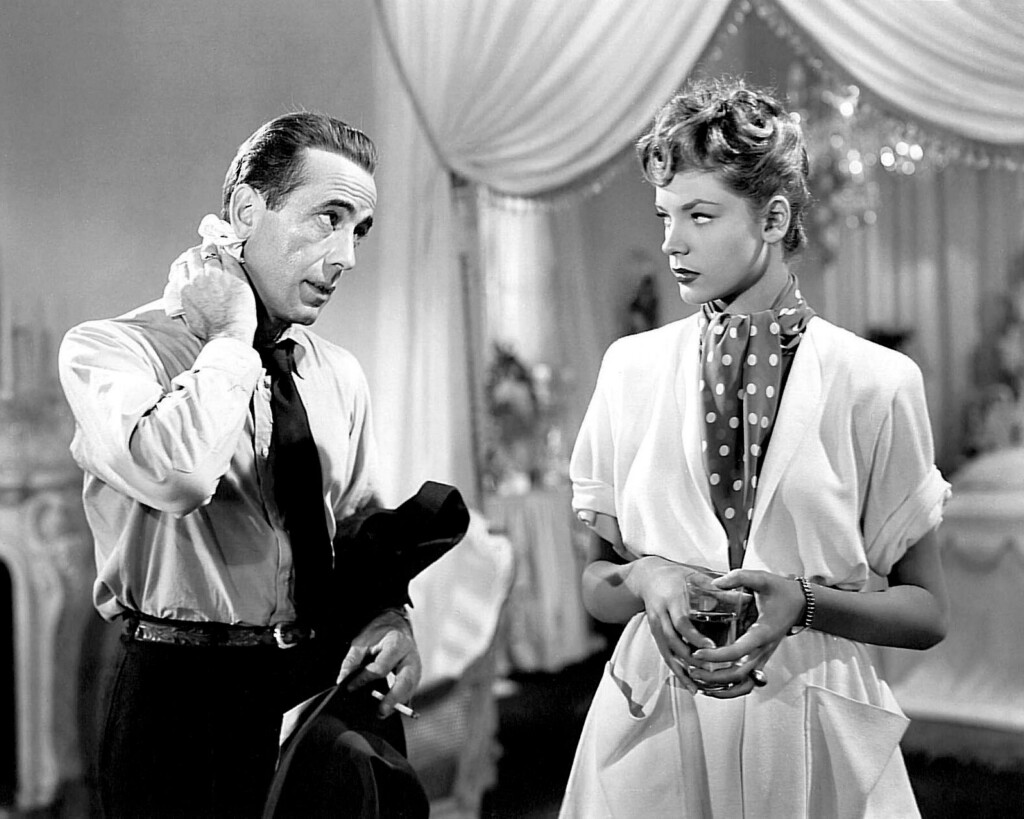
You scroll past a hundred faces in an afternoon and none of them stick. Not because the actors are less talented — several of them are more technically accomplished than anyone working in the studio era — but because the cultural infrastructure that once transformed a face into a symbol has dissolved at the structural level, and no amount of charisma fills that absence.
The conditions that built Bogart’s specific gravity were not accidental. The Production Code, enforced with genuine severity from 1934 onward, created a strange aesthetic pressure: desire, violence, and moral ambiguity had to be communicated through indirection, through the angle of a jaw or the weight of a pause, because the explicit was forbidden. Censorship, paradoxically, deepened the expressive range of the face. When language was constrained, the face became a second language. Bogart spoke both fluently. What contemporary audiences sometimes mistake for cool detachment was in fact the concentrated energy of everything that could not be said directly — compressed into a look, displaced into posture, encrypted in the slight curl of the lip that could mean contempt, attraction, or grief depending on what the viewer brought to it.
Then there is the question of mass simultaneity. In 1942, tens of millions of Americans shared a single media landscape: three major radio networks, a handful of national newspapers, and a studio system that sent the same film to the same theaters at the same time across the continent. Shared historical trauma — the Depression, the war, the particular moral vertigo of a generation asked to kill and die for abstractions — created an audience with enough common experience to receive a symbol collectively. Bogart’s face arrived at a moment when it was culturally possible for a face to mean the same thing to a factory worker in Detroit and a banker’s widow in Connecticut. That moment was not an achievement of genius; it was a window in historical time, and it closed.
Erik Erikson wrote in 1950, in Childhood and Society, about the relationship between individual identity and the cultural frameworks that make identity legible to others. His argument, stripped to its mechanism, is that the self is partly a projection screen for collective needs — that certain figures crystallize what a society needs to believe about itself at a specific historical juncture. Bogart crystallized the fantasy of the man who had seen through every institution and remained functional anyway, who had absorbed disillusionment without becoming either cynical enough to stop acting or naive enough to trust again fully. That was not a universal human fantasy. It was the specific emotional requirement of a country that had lived through fifteen years of consecutive catastrophe and needed to believe that integrity could survive experience.
The longing people express when they say that no one makes them like Bogart anymore is therefore not a film-critical judgment. It is a diagnosis of the present, delivered in the wrong vocabulary. What they are mourning is not a man or even a style of masculinity — it is the lost condition of collective legibility, the historical moment when a mass audience could agree, without discussion, on what a face meant. Fragmented media culture has made that structurally impossible. Streaming platforms deliver personalized catalogs; algorithms curate individual experience; the shared text that could produce a shared symbol no longer exists as a material fact. No actor is missing from the culture. The culture is missing the architecture that would allow an actor to become what Bogart became.
What remains is the image itself, cycling through retrospectives and restorations, carrying the residue of a coherence it can no longer generate. The face endures precisely because the conditions that made it meaningful do not, which means every time it appears on a screen it is simultaneously a presence and an evidence of something permanently foreclosed.
🎬 The Soul of American Cinema and Its Icons
Humphrey Bogart embodied a vision of American cinema that went far beyond acting — he became a cultural archetype, a moral compass filtered through shadow and cigarette smoke. To fully understand his legacy, one must explore the broader forces that shaped Hollywood storytelling: noir aesthetics, psychoanalytic undercurrents, the language of the image, and the myth of the hard-boiled hero. These related articles trace the deeper roots of the world Bogart inhabited and defined.
Chandler’s The Big Sleep: Analysis
Raymond Chandler’s The Big Sleep is one of the defining texts of noir fiction, and its brooding atmosphere directly influenced the cinematic world that made Bogart a legend. The novel’s labyrinthine plot and morally ambiguous detective anticipate everything Bogart brought to the screen in films like The Maltese Falcon and Key Largo. Reading Chandler is essential to understanding the cultural soil from which Bogart’s iconic persona grew.
GO TO THE SELECTION: Chandler’s The Big Sleep: Analysis
Existentialist Noir: History and Meaning
Existentialist noir is the philosophical dimension lurking beneath the hard-boiled surface of American cinema’s golden age, and Bogart was its most eloquent embodiment. This genre fuses the bleakness of existentialist thought with the visual grammar of shadows, rain-soaked streets, and morally fractured characters. Understanding existentialist noir means understanding why Bogart’s screen presence felt so charged with meaning and inevitability.
GO TO THE SELECTION: Existentialist Noir: History and Meaning
Psychoanalysis and cinema: when the couch becomes the screen
The relationship between psychoanalysis and cinema runs deep through Hollywood’s golden era, shaping the way characters were constructed and desires were projected onto the screen. Bogart’s roles often dramatized repressed trauma, masculine vulnerability, and the instability of identity — themes central to psychoanalytic inquiry. This article explores how the cinematic couch and the analyst’s couch have always been secret accomplices.
GO TO THE SELECTION: Psychoanalysis and cinema: when the couch becomes the screen
Cinematography as a narrative language
Cinematography as a narrative language is the invisible architecture behind every great performance, including those of Humphrey Bogart. The interplay of chiaroscuro light, angular compositions, and expressive shadow gave Bogart’s face its mythic weight and psychological depth. This article examines how the camera itself became a storytelling instrument capable of turning a human face into a cultural monument.
GO TO THE SELECTION: Cinematography as a narrative language
Discover the Cinema That Dares to Be Different
If the world of Bogart and classic American cinema has stirred something in you, Indiecinema is the place to follow that feeling further. On our streaming platform you will find independent films that carry the same spirit of authenticity, moral complexity, and artistic courage that defined the golden age of cinema. Come and explore a curated selection of works that refuse to compromise — because great cinema has never been about playing it safe.
👉 EXPLORE THE CATALOG: Watch Indie Films in Streaming
A vision curated by a filmmaker, not an algorithm
In this video I explain our vision

