
The Body on the Floor
You are standing in a room that smells like old roses and something underneath the old roses, something biological and final. The carpet is expensive. The body is not. Whoever this man was before the bullet found him, he is now furniture — horizontal, inconvenient, contributing nothing to the décor except a spreading problem that someone, eventually, will have to explain to someone else. You are Philip Marlowe, and you are not surprised. You have been in rooms like this before, in the way that certain kinds of people are always in rooms like this — not because they seek them out, but because the world keeps manufacturing them and needs a particular kind of witness to stand in the doorway and not look away.

Raymond Chandler published The Big Sleep in 1939, the same year Europe began its final argument with itself, and there is something about that timing that refuses to be coincidental. The novel arrived into a culture that had already absorbed the Great Depression’s lesson — that the systems built to protect people were also perfectly calibrated to destroy them — and it translated that lesson into the grammar of crime fiction. But to call it crime fiction is to make the same mistake as calling a fever a weather event. The genre is the container. What Chandler poured into it corrodes the walls.
What the novel understands, with a precision that most sociological texts of the period cannot match, is that wealth is not a condition but a performance requiring constant maintenance, and that the maintenance always involves someone getting hurt in a room no one officially enters. The Sternwood family, with their oil money and their sick patriarch and their two daughters careening toward disaster in different directions, is not a symbol. It is a diagram. Chandler had spent years working for Dabney Oil Syndicate in Los Angeles before his drinking cost him the position, and he knew from the inside how capital accumulation produces not stability but a permanent, low-grade emergency requiring the services of men like Marlowe — men who can be paid to absorb the emergency without becoming part of the official record.
The philosopher Walter Benjamin, writing in the 1930s in his unfinished Arcades Project, described the detective story as a form born from the anonymity of the modern city, where guilt becomes distributed so thoroughly across social structures that its localization in any single individual requires an act of almost mythological will. Marlowe performs that act continuously, but Chandler is honest enough — or dark enough — to show us that the localization is always partial, always a transaction, always leaving something important unnamed. Every answer Marlowe uncovers opens a door onto a corridor of further questions, and the corridor does not end in a room with light in it.
Los Angeles in 1939 was a city that had been incorporating itself for barely sixty years, a place built on water theft and real estate fraud and the deliberate erasure of its own agricultural and indigenous past, functioning under the mythology of perpetual arrival, perpetual beginning, perpetual reinvention. Chandler understood that a city with no acknowledged history develops a particular relationship to violence — it experiences violence not as a rupture in the social fabric but as a natural condition, like the Santa Ana winds, expected, seasonal, not requiring explanation. Carmen Sternwood is not a monster produced by individual pathology. She is what the city makes when it runs its process long enough on a particular kind of isolated wealth.
The body on the floor is not the mystery. The body on the floor is the only honest thing in the room — it does not pretend, does not perform, does not maintain any version of itself that contradicts its actual condition. Everything standing upright in that world is doing all three of those things simultaneously, and Marlowe knows it, which is why he looks at the dead with something closer to recognition than horror.
A Better Life
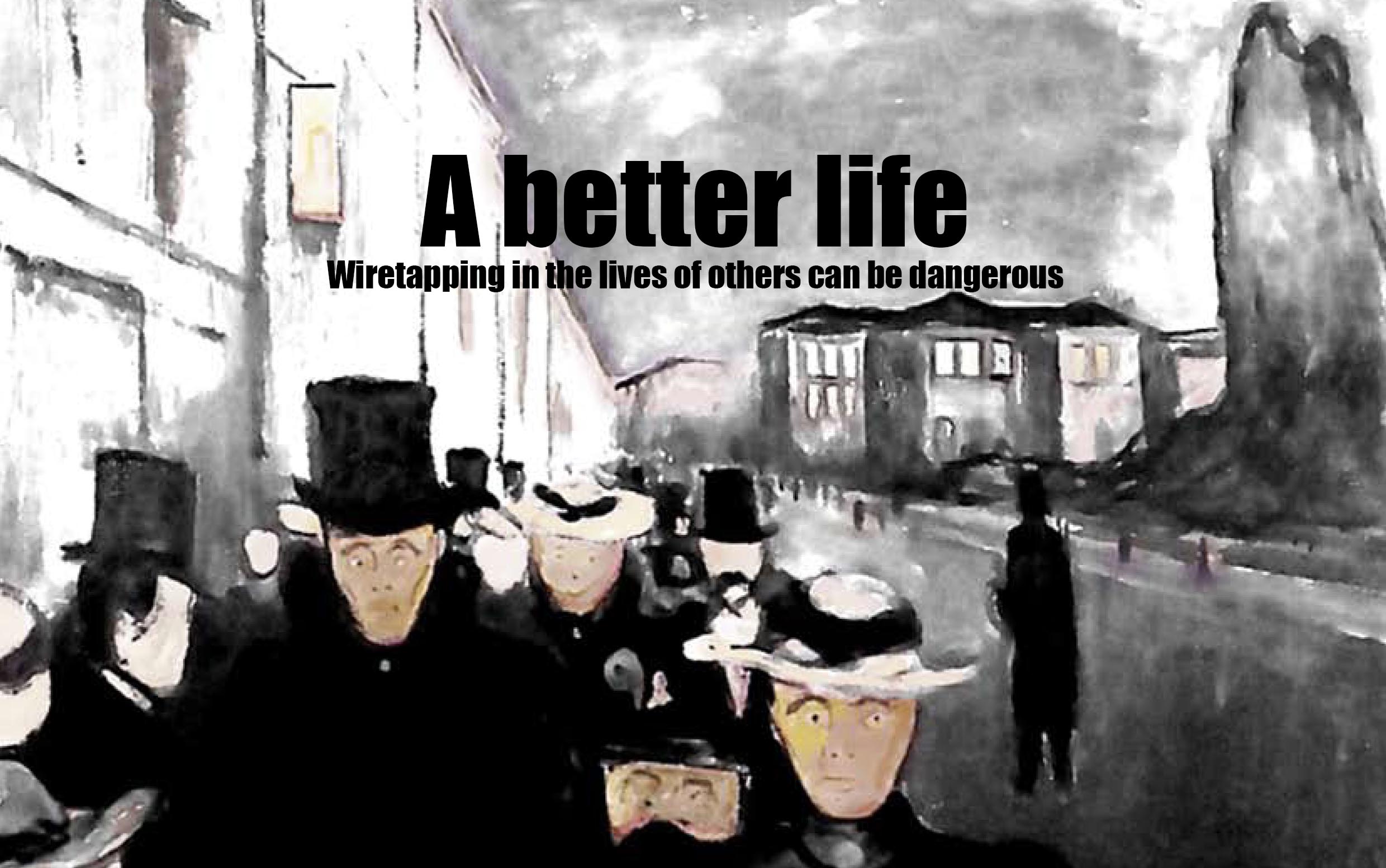
Drama, thriller, by Fabio Del Greco, Italy, 2007.
Rome: Andrea Casadei is a young investigator specializing in audio wiretapping who conducts investigations commissioned by husbands betrayed by their wives, or by parents worried about what their children are doing outside the home. But what interests him most is understanding the human soul, listening to casual conversations in the streets, knowing what people think. He often meets in Piazza Navona with his friend Gigi, a frustrated street artist obsessed with success at all costs, with whom he shares a passion for wiretapping. Shocked by the mystery of the disappearance of Ciccio Simpatia, another street artist common friend, Andrea decides to abandon the commissioned works to seek a better life and reflect on his own and others' existence. He will meet the actress Marina and with a bug he will slowly enter her life until he discovers her most unthinkable secrets. The film deals with an important theme of contemporary Western society: the lack of love. The mysterious and tormented figure of Marina is reflected in a gloomy and soulless Rome.
Director Fabio Del Greco declared about his film: "Perhaps this film is a reflection on the art of observing, of listening, in short, of what one does when one leaves the real world to tell about it. Perhaps he wants to talk about the subtle relationship between the mirages of success touted by today's society, power and the most authentic human relationships.A 'dark cloud' hangs over the city: it is engulfing everyone in a sort of indistinct, uniform mass, where everyone thinks the same things, where everyone they are more alone. Where is the truest part that makes us unique? Maybe you can try to intercept it only secretly."
LANGUAGE: Italian
SUBTITLES: English, Spanish, French, German, Portuguese, Dutch.
The Grammar of Rot
You are reading a sentence about Los Angeles in 1939 and something in it snags you, pulls the thread loose, and suddenly the whole fabric of the city is hanging off that one clause. That is what Chandler’s similes do. They are not decoration. They are not the rhetorical flourish of a man who liked words too much. They are a forensic instrument, a way of dragging abstraction into a room with bad lighting and making it confess. When Marlowe describes a woman’s smile as something you could feel in your hip pocket, he is not being colorful. He is telling you exactly what kind of transaction is about to occur, and exactly who holds the currency.
The simile, as Chandler deploys it, operates as a form of enforced concreteness. It refuses the vocabulary of dignity that money traditionally buys. The Sternwood family lives behind gates and orchids and a general atmosphere of protected remove, and the prose keeps hauling that remove down to street level, comparing their world to things — greasy, animal, mechanical things — that their wealth was specifically designed to keep invisible. This is not satire exactly. Satire exaggerates to expose. Chandler does something colder: he finds the accurate equivalence, the image that is not grotesque but simply true, and the truth is what makes it devastating. A dying old man in a greenhouse sweating through his blankets is compared to something already decomposing. The metaphor does not mock him. It simply refuses to look away from the biological reality that his fortune cannot suspend.
Georg Lukács, writing in the 1930s about the relationship between literary form and social totality, argued that narrative structure is never neutral — that the way a story moves through time and space enacts a theory of how the world coheres, or fails to. He was writing about the European novel, about Balzac and Tolstoy and the question of whether realism could still tell the truth after capitalism had dissolved the visible connections between cause and effect. Chandler was working the same problem from the underside, in a genre nobody was taking seriously, which gave him unusual freedom. The detective novel’s formal requirement — that everything must eventually connect — became, in his hands, a way of demonstrating that in Los Angeles in 1939 almost nothing actually connects, and that the shape of the investigation is the shape of the lie.
What makes the prose structurally argumentative rather than merely stylistic is the consistency of its targets. The powerful in The Big Sleep are never allowed to remain in the register of power. Every description of their world translates it, without ceremony, into the vernacular of rot, commerce, and physical decay. Carmen Sternwood’s thumb-sucking is not a quirk Chandler finds charming. It is a behavioral symptom that the prose treats with the same flat clinical attention it gives to a corpse’s position on a floor. The language refuses to grade its subjects morally, which is itself a kind of moral position — one that refuses the consolation of hierarchy, the idea that some bodies matter more when they stop moving.
The pornography racket at the center of the novel’s plot is almost incidental to what the novel is actually doing with bodies and visibility and who gets to remain unseen. Eddie Mars controls territory through the same mechanisms of obscured ownership and delegated violence that ran the city’s legitimate real estate market. Chandler does not draw this comparison explicitly. He does not need to. The prose’s refusal to distinguish between legal and illegal economies in the texture of its language is itself the argument — made not in a thesis statement but in the grain of every sentence, the accumulated pressure of a style that treats power as a physical substance, heavy, present, and already beginning to smell.

What the Detective Cannot Fix
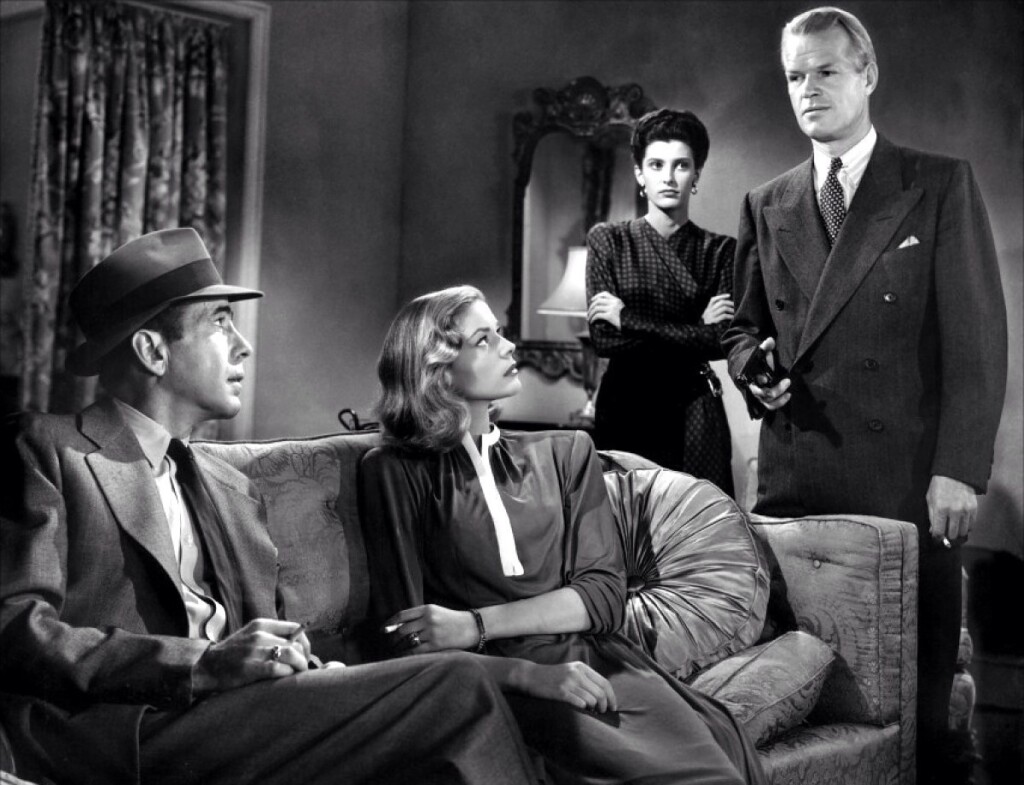
You hire him, and he finds everything. That is the promise — the private eye as secular confessor, the man who walks into the dark and returns with truth cupped in his hands like water. You watch him move through the Sternwood mansion, through the pornographic bookshop, through the rain-soaked streets of Los Angeles, and you feel the satisfaction of a mechanism working the way it was designed. Raymond Chandler published The Big Sleep in 1939, and the novel sold the fantasy so beautifully that most readers never noticed it was simultaneously dismantling it.
Philip Marlowe solves the murder of Owen Taylor, the chauffeur. He solves the blackmail scheme. He identifies Carmen Sternwood as the woman who killed Rusty Regan in a moment of rejected vanity. He arrives, in other words, at every answer. And yet Carmen will not be prosecuted. Vivian will arrange a private sanitarium, a quiet disappearance from public accountability, because General Sternwood’s money is large enough to replace the machinery of justice with a private version that costs more and delivers less. The crime is absorbed rather than answered. Marlowe knows this. He accepts it. The novel ends not with resolution but with the peculiar exhaustion of a man who has learned something he cannot use.
What Chandler was diagnosing, whether he fully intended to or not, is the structural impossibility of individual moral agency operating inside a system that is not broken but designed. The philosopher Charles Taylor, writing decades later in Sources of the Self, traced how Western modernity elevated the autonomous individual into a near-sacred category — the self as origin of meaning, the conscience as final court of appeal. This elevation was not merely philosophical; it became practical mythology, the story a society tells itself about how wrongs get righted. One person, sufficiently virtuous and sufficiently determined, cuts through the corruption and restores order. Marlowe is the purest literary expression of this mythology, and Chandler had the honesty to show it failing in real time.
The failure is not Marlowe’s. That is the precise and uncomfortable thing. He is not corrupt, not lazy, not seduced by money or fear. His moral compass is almost irritatingly intact. The failure belongs to the terrain itself, to the fact that Carmen Sternwood’s violence is not a rupture in the social order but a product of it — wealth producing idleness, idleness producing vacancy, vacancy producing cruelty, and enough accumulated capital to insulate every step of that chain from consequence. Max Weber, in Economy and Society, described how legal-rational authority inevitably bends toward those who can afford to replicate its functions privately. The Sternwoods do not subvert justice. They purchase a parallel version of it.
This is what the detective genre typically refuses to show its audience, and what Chandler, almost against the genre’s own commercial instincts, forces into plain sight. The case is closed in the sense that Marlowe knows the truth. It is open in every other sense — morally, legally, practically. Carmen will receive treatment, or confinement, or simply time, and eventually the money will find another arrangement. The Sternwood corruption is not a wound that Marlowe lances. It is a climate.
There is something almost cruel in the way Chandler lets Marlowe understand this completely without giving him any leverage against it. He is not disillusioned — disillusionment implies a prior illusion, and Marlowe never had one. He is simply a man of conscience operating in a structure that has no socket for conscience to plug into. His virtue is real and entirely beside the point. And if you find that unbearable, if you want to argue that surely individual moral action must count for something, must move the needle somewhere — you should sit with the discomfort of not being certain whether that belief is a principle or just a need.
Los Angeles as Ideology
You drive through a city that does not exist. The palm trees were imported, the river was concrete before anyone alive can remember it being otherwise, and the orange groves that gave the region its early mythology were themselves a marketing campaign, carefully staged by the Southern Pacific Railroad and the Los Angeles Chamber of Commerce beginning in the 1880s to sell real estate to Midwesterners who had never smelled citrus on a live branch. What Raymond Chandler understood — and encoded into every fog-draped canyon and every private gate along a Malibu bluff in The Big Sleep — is that Los Angeles was not a city that grew. It was a city that was fabricated, and the fabrication required constant concealment of what had been destroyed to make room for it.
The Owens Valley water theft, engineered by William Mulholland and consummated with the completion of the Los Angeles Aqueduct in 1913, is not a peripheral footnote to the city’s development. It is the city’s founding logic made hydraulic. An entire agricultural community was drained, its aquifer emptied through deception and political manipulation, so that real estate speculators in the San Fernando Valley could watch land values triple overnight. Mike Davis documented this in Ecology of Fear with a precision that should have been scandalous — the city’s growth was not the product of ingenuity or opportunity but of organized theft conducted at a scale that required institutional silence to survive. Chandler never names this history directly, but he builds his fictional geography on top of it like a second skin. The Sternwood mansion sits behind iron gates not merely to signal wealth but to signal the particular kind of wealth that requires a wall between itself and what it consumed to exist.
The Sternwoods are old money contaminated by new vices, which is precisely the correct metaphor for a city built on dispossession dressed in Mediterranean Revival architecture. Carmen’s pathology and Vivian’s controlled desperation are not personal failures dropped into a neutral landscape. They are symptoms of an inheritance that was never clean. Chandler understood, in the way that novelists sometimes understand what historians take decades to prove, that there is no such thing as a California fortune that does not have a seizure at its origin — land granted fraudulently, water stolen legislatively, labor extracted from populations excluded from the protections nominally extended to everyone else.
What the city’s spatial logic does is transform this structural violence into aesthetic fact. In Chandler’s Los Angeles, geography is already morality. The hills mean something different from the flatlands. Distances between neighborhoods encode entire philosophies of social worth. Philip Marlowe moves through these gradients with the trained eye of someone who was once inside the system — he worked for the DA’s office — and was ejected from it, which gives him exactly the kind of outsider clarity that the city’s residents have carefully arranged their lives to avoid developing. He does not mistake address for character. He knows that the farther you are from the Pacific Coast Highway, the less the city’s machinery works in your favor, and this knowledge is not cynicism. It is cartography.
The ideological function of the city as Chandler renders it is to make inequality feel like climate — something you dress for rather than dismantle. In 1939, when the novel was published, Los Angeles had already been sold to itself as the place where reinvention was possible, where the eastern hierarchies of class and family name dissolved in the perpetual sunshine. The promise was always a real estate pitch. And the genius of the noir form — the genre Chandler did more than any other writer to legitimize as literature — is that it takes that promise at face value long enough to watch it expose its own machinery, not in theory, but in the specific weight of a city block at two in the morning when the money has run out and the gates are locked from the inside.
Women as Architecture
You are sitting across from a woman who smiles at you, and you understand immediately that the smile is not for you — it is a structure, load-bearing, holding something up that would collapse without it. This is the first thing Marlowe notices about Vivian Regan, and it is also the last thing most readers bother to think about.
Raymond Chandler published The Big Sleep in 1939, a year in which American masculinity was already cracking under the pressure of a decade of economic humiliation. The Depression had done something precise and devastating to the symbolic architecture of male identity: it had exposed the provider myth as contingent, revocable, dependent on forces entirely outside any individual man’s control. What Chandler built in response was not a fantasy of restored masculine power but something far more honest — a map of male dread, and the women in it are not objects on that map but the terrain itself.
Vivian operates through controlled legibility. She gives Marlowe exactly enough information to feel like he is reading her, which means she is always the one writing. Erving Goffman, in his 1959 study of social performance, described this kind of strategic self-presentation as impression management — the deliberate cueing of interpretation so that the observed subject maintains authorship over their own image. Vivian never loses that authorship, not once, and what this means is that every scene featuring her is a scene in which Marlowe is fundamentally reactive. He believes he is investigating her. She is managing him. The detective genre promises a masculine epistemology — the man who knows — and Vivian dismantles that promise so quietly that both Marlowe and the reader barely register the dismantling.
Carmen operates differently, and the difference is structural rather than moral. Where Vivian controls the surface, Carmen ruptures it. She arrives in the novel’s opening pages already outside the codes — giggling at inappropriate moments, exposing her body without apparent awareness of consequence, moving through social space like a figure who has never been trained in the grammar of self-concealment. Sigmund Freud wrote in 1919 about the uncanny as the return of something familiar that has been repressed, and Carmen functions precisely this way: she is the id that the entire Sternwood household has built itself to contain, and she keeps leaking through the walls. Her threat to Marlowe is not sexual but ontological. She does not seduce him; she makes the categories he navigates — guilt, innocence, motive, sanity — stop functioning.
Agnes, who occupies far less space in the novel, performs a third function that is easy to miss because it arrives dressed as cynicism. She is the woman who knows exactly what she is worth on the market and has decided to negotiate accordingly. She sells information. She makes transactions. She treats the masculine world of deal-making and leverage as a space she can enter through the one door left open to her — the commodification of what she knows. What Agnes exposes is the economic substructure beneath every social relationship in the novel, the thing that Vivian’s elegance and Carmen’s chaos both serve to conceal. Thorstein Veblen, writing in 1899, argued that upper-class women functioned as displays of conspicuous consumption — proof of a man’s wealth made ambulatory. Agnes is what happens when a woman understands that mechanism completely and decides to use it from the other side of the transaction.
Together these three do not add up to a portrait of women. They add up to a portrait of what men need women to be, and the terror the novel generates comes from the fact that none of them cooperate with that need. Marlowe moves through this architecture looking for solid ground, for a wall he can put his back against, and every surface he touches turns out to be load-bearing in ways he cannot calculate.
A vision curated by a filmmaker, not an algorithm
In this video I explain our vision
The Knight Who Knows Better
You have already decided, before opening the novel, that Philip Marlowe is on your side. That assumption is the trap Chandler spent a career carefully laying and never once acknowledged setting.
In 1944, Raymond Chandler published “The Simple Art of Murder” in The Atlantic, ostensibly a takedown of the genteel British detective tradition — Agatha Christie‘s bloodless drawing rooms, the puzzle-box corpse that exists to be solved rather than mourned. His argument was bracing: crime fiction had insulated itself from the reality of violence, from the actual texture of money and power and corruption. He wanted a detective who walked real streets, breathed real air, spoke to real people. The prescription he offered was a man who is “not himself mean, who is neither tarnished nor afraid” — a figure of complete and uncorrupted moral integrity deposited into a world that has none. The sentence reads like liberation. It functions like a crown.
What Chandler never interrogated was the imperial structure encoded in that vision. The knight figure — and he used the word without irony, repeatedly, as though the medieval resonance was a feature rather than a symptom — presupposes a hierarchy of perception. The knight sees clearly because he stands above the terrain he traverses. Marlowe understands Los Angeles, its real estate corruption, its police brutality, its racial stratifications, in ways no one else in the novel does. He is not embedded in the city’s suffering; he is a connoisseur of it. That is a fundamentally different position, and it quietly converts critique into aesthetic pleasure.
The sociologist Erving Goffman, in his 1959 work “The Presentation of Self in Everyday Life,” mapped the way individuals manage their performance of identity across different social stages. Marlowe is a figure who never loses control of his performance — not with the Sternwoods, not with Carmen, not with the police. He reads every room while remaining unreadable himself. Goffman’s insight was that this kind of total self-possession is not a sign of authenticity; it is the most sophisticated form of social theater. The man who never drops his mask has simply made the mask permanent. Chandler presents this as dignity. It is closer to dissociation.
The philosophical contradiction at the heart of “The Simple Art of Murder” is that it critiques a genre for falsifying reality while constructing a protagonist whose unreality is total. Marlowe does not have debts that crush him. He does not have a past that returns in the night. He is not implicated in the systems he observes — the racism of the LAPD in the 1930s and 1940s, the exploitation embedded in the wealth of families like the Sternwoods, the gendered violence that Carmen embodies and suffers simultaneously. He witnesses all of this with perfect clarity and perfect detachment, and Chandler presents that detachment as the highest moral attainment. But detachment is not neutrality. It is a choice that has social coordinates. The man who can walk away clean walks away from something, and that something is always paid for by someone else.
The romanticism becomes most dangerous precisely where it feels most honest. When Marlowe refuses the Sternwood money, when he declines to be bought, the reader experiences this as incorruptibility. What it actually demonstrates is that Marlowe has no material vulnerability — he can afford refusal in a way that almost no one in the novel can. His integrity is a privilege dressed as a principle. And Chandler, in his 1944 essay, treated this costumed privilege as the solution to everything wrong with detective fiction, without noticing he had only replaced one fantasy with a more seductive one: not the fantasy of a world where murder is a puzzle, but the fantasy of a man for whom the world’s worst truths produce no wound.
Noir as Repressed History
You pick up the novel expecting a mystery and discover, somewhere around the third chapter, that you have no idea who killed the chauffeur. Neither does anyone else. Neither, famously, did Chandler himself when asked directly by the director preparing the film adaptation in 1945 — he could not answer, because the answer had never been the point.
The chauffeur’s death is a loose thread that the narrative refuses to pull, and this refusal is not a flaw in the architecture but the architecture itself. What Chandler built was not a puzzle with a solution but a structure that mimics the experience of trying to understand a society from inside it — where causes are buried, where the official version never quite explains the bodies, where the investigator keeps moving forward because stopping would force him to admit that coherence was never available to him.
Walter Benjamin, writing in 1940 with Europe already burning around him, described history not as progress but as a storm blowing debris forward, the past accumulating as wreckage at the feet of an angel who cannot stop and cannot look away. The Theses on the Philosophy of History argue that what gets called civilization is always, simultaneously, a document of barbarism — that every monument to cultural achievement is cemented with the labor and suffering of those the monument does not name. Los Angeles in 1939, when The Big Sleep was published, was precisely such a monument: a city of stucco and sunshine built on Indigenous displacement, on the legal theft of water from rural California documented in the Owens Valley crisis of the 1920s, on the systematic exclusion of Black residents through racially restrictive covenants that the California Supreme Court would not strike down until 1948. The novel does not announce these facts. It does not need to. They constitute its atmosphere the way carbon monoxide constitutes the air in an unventilated room — present, structural, lethal, and invisible until you’re already affected.
Fredric Jameson, in his 1990 work on postmodernism and the cultural logic of late capitalism, treated noir not as a genre but as a symptom — a formal eruption of everything that realist narrative had been trained to suppress. The hard-boiled novel emerged precisely at the moment when American capitalism was trying to stabilize itself after the catastrophe of 1929, when the New Deal was constructing a mythology of recovery that required the systematic forgetting of how the crash had actually worked, who had caused it, and who had paid. Marlowe moves through a world of inherited wealth and corrupt institutions because those are the actual coordinates of power in 1930s California, but the genre’s conventions require that guilt be personalized, located in a specific villain, resolved in a specific confrontation. The Big Sleep refuses this resolution so completely that it becomes, by Jameson’s logic, the most honest noir ever written — the one that cannot complete the ideological work the form was designed to perform.
Carmen Sternwood is not a femme fatale in the conventional sense. She is a young woman whose sexuality has been criminalized, whose instability has been pathologized, and whose violence gets absorbed into the novel’s atmosphere rather than explained or punished in any legally legible way. What happened to her — what the novel strongly implies happened to her in the Brody household, in the Geiger photography operation, in the long shadow of a family whose patriarch has spent his life watching his wealth outlast his ethics — belongs to a category of harm that 1939 American culture had no public language for. The novel carries it without naming it, the way trauma is carried before it can be spoken.
Marlowe knows more than he says, and what he does not say is not omitted for dramatic effect but because some knowledge has no available form in the culture that produced him. The wreckage is real. The storm is still blowing.
The Case That Was Never the Case
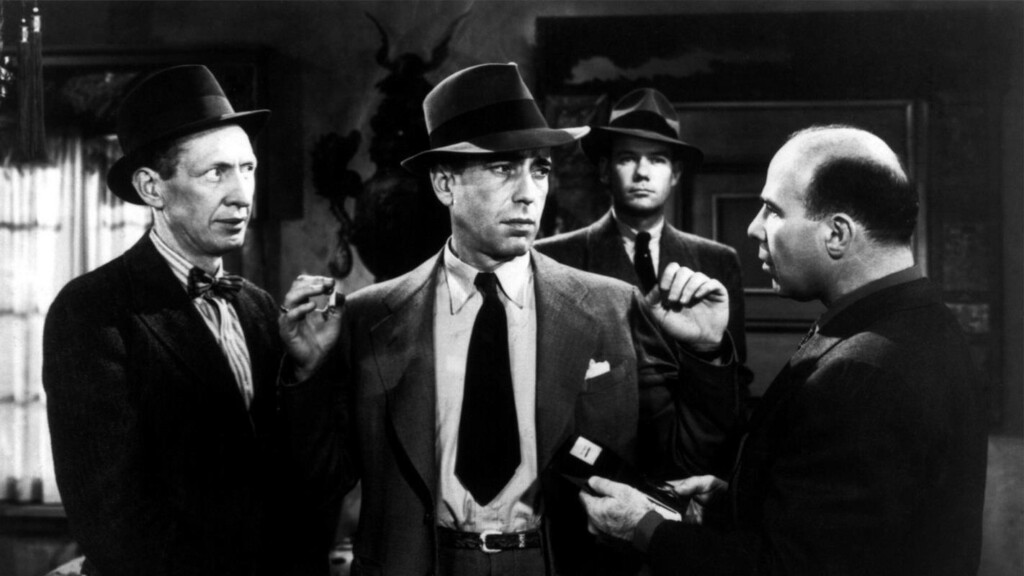
You have spent your entire life believing that if you looked hard enough, the truth would eventually cohere — that the facts, properly assembled, would yield a verdict, a cause, a clean account of what actually happened. Raymond Chandler did not believe this. He could not have, because when asked directly who killed Owen Taylor, the chauffeur found drowned in the Lido Pier with the Sternwood car, he admitted he did not know. Not that the answer was hidden somewhere in the manuscript, not that it had been edited out in revision. He simply had not decided, and the novel had been published anyway, and the world had accepted it, and for decades readers assumed the gap was their own failure of attention rather than a structural confession embedded in the text itself.
The assumption that a mystery must have a solution is so deep it operates before you choose to hold it. It is not a literary preference. It is the foundational grammar of Western legal reasoning, of insurance claims, of the way a doctor charts your history, of the way a therapist asks you to trace your suffering back to its originating event. Every institution you have passed through has trained you to believe that coherence exists and that your task is merely to locate it. Chandler’s novel was published in 1939, two years after the House Un-American Activities Committee was formed, in a decade when governments across Europe and America were manufacturing official explanations for events that had no stable cause, attributing to conspiracies and ethnic groups and foreign agitators the chaos that was simply structural, economic, and therefore inconvenient to name honestly. The detective novel was supposed to be the antidote to that ambient disorder — the genre that promised resolution, the narrative form that restored faith in cause and effect. Chandler took the form and quietly removed its promise from the inside.
Philip Marlowe never solves the case in any meaningful sense. He survives it. He moves through a city — Los Angeles, 1938, a place of pure invention built over dispossessed land, a city with no medieval center, no inherited memory, no story of itself that preceded the automobile — and he accumulates damage rather than knowledge. What he learns is not who did what but how power arranges the story after the fact. Arthur Gwynn Geiger is dead. Joe Brody is dead. Harry Jones is dead. Carmen Sternwood is the one who killed Rusty Regan, which Marlowe eventually pieces together, but he buries that truth to protect Vivian, and the official record reflects none of it. The resolution exists only as a private accommodation between a man and a family, and the law, the institution whose existence justifies the entire genre, is never permitted to know.
What Chandler intuited and rendered in prose was that the official story is not a record of events — it is a management of consequences. History is written this way, not by scholars but by whoever survives with access to the archive. The Warren Commission issued 888 pages in 1964. The Chilcot Report ran to 2.6 million words in 2016. Length and detail are often the aesthetic of concealment rather than disclosure, the way bureaucratic thoroughness mimics accountability without producing it. You recognize this when you read it in an essay. You do not recognize it when you are inside it, filling out the form, signing the document, accepting the settlement, agreeing that the version you are being given is the one that will stand.
The chauffeur’s death was never resolved because the novel did not need to resolve it in order to be true. That is the precision of Chandler’s achievement — not the hard-boiled dialogue, not the Los Angeles atmosphere, not even Marlowe’s corrosive moral clarity, but the structural honesty of leaving a death unexplained in a world that insists all deaths have explanations, because the insistence itself is what he was writing about all along.
🌀 Lost in the Labyrinth: Crime, Identity & the Unsolvable
Raymond Chandler’s The Big Sleep is more than a detective novel — it is a labyrinthine descent into moral ambiguity, where the solution to the mystery matters far less than the journey through shadows. Like great literary mazes, it forces its protagonist and reader alike to question whether any exit truly exists. These related works explore the same corridors of identity, meaning, and the art of wandering.
Jorge Luis Borges and the Labyrinth of Identity
Borges spent his career mapping the impossible geometries of identity and narrative, making him Chandler’s most natural literary companion. His labyrinths are not physical but conceptual — much like Marlowe’s Los Angeles, where every answer opens onto a new corridor of deception. Reading Borges alongside Chandler reveals how noir and metafiction share the same existential DNA.
GO TO THE SELECTION: Jorge Luis Borges and the Labyrinth of Identity
Jorge Luis Borges: Life and Works
This comprehensive overview of Borges’ life and works provides the essential foundation for understanding why his writing resonates so deeply with noir sensibilities. His fascination with mirrors, doubles, and infinite regress echoes the hall-of-mirrors quality of Chandler’s plotting. To know Borges is to better understand the literary universe in which The Big Sleep secretly dwells.
GO TO THE SELECTION: Jorge Luis Borges: Life and Works
Waiting for Godot by Beckett: Analysis
Beckett’s Waiting for Godot stages a world where waiting replaces action and meaning perpetually defers itself — a condition Marlowe would recognize in every dead-end lead he follows. The play’s circular structure mirrors the unresolvable plot of The Big Sleep, where closure is always just out of reach. Both works suggest that the search itself is the only truth on offer.
GO TO THE SELECTION: Waiting for Godot by Beckett: Analysis
The Journey as a Metaphor in Literature
The journey as metaphor is central to understanding Chandler’s novel, where Marlowe’s movement through Los Angeles is simultaneously a physical investigation and a philosophical odyssey. This article examines how literature uses travel and displacement to externalize inner states of alienation and longing. Seen through this lens, every drive down a dark street in The Big Sleep becomes a voyage into the self.
GO TO THE SELECTION: The Journey as a Metaphor in Literature
Discover More Hidden Gems on Indiecinema
If these literary labyrinths have awakened your appetite for complex, uncompromising storytelling, Indiecinema is your next destination. Stream a curated selection of independent films that share the same spirit of moral ambiguity, existential depth, and auteur vision — the cinematic cousins of Chandler’s shadowed world. Join Indiecinema today and lose yourself in stories that refuse to take the easy road.
👉 EXPLORE THE CATALOG: Watch Indie Films in Streaming
A vision curated by a filmmaker, not an algorithm
In this video I explain our vision

