
Cannibal movies are a film genre that have fascinated and disturbed audiences for decades. These films, which often feature scenes of violence and cannibalism, explore themes such as human nature, alienation and fear of the unknown.

History
The cannibal movies genre originated in the 1960s, with films such as Ruggero Deodato‘s Country of Wild Sex (1969) and Cannibal Holocaust (1980) by the same director. These films, which were often shot in extreme conditions and with non-professional actors, caused a sensation for their violence and realism.
In the 1970s and 1980s, the cannibal movies genre enjoyed a period of great popularity, with films such as Sergio Martino‘s The Mountain of the Cannibal God (1978), Ruggero Deodato’s The Food of the Gods (1979) and The House of horrors (1981) by Umberto Lenzi. These films, often made on limited budgets, featured increasingly extreme scenes of violence and gore.
In the 1990s, the cannibal movies genre began to decline, due to growing public attention towards other genres, such as supernatural horror. However, in recent years, the genre has experienced new interest, with films such as Eli Roth‘s The Green Inferno (2013) and Julia Ducournau‘s Raw (2016).
Style
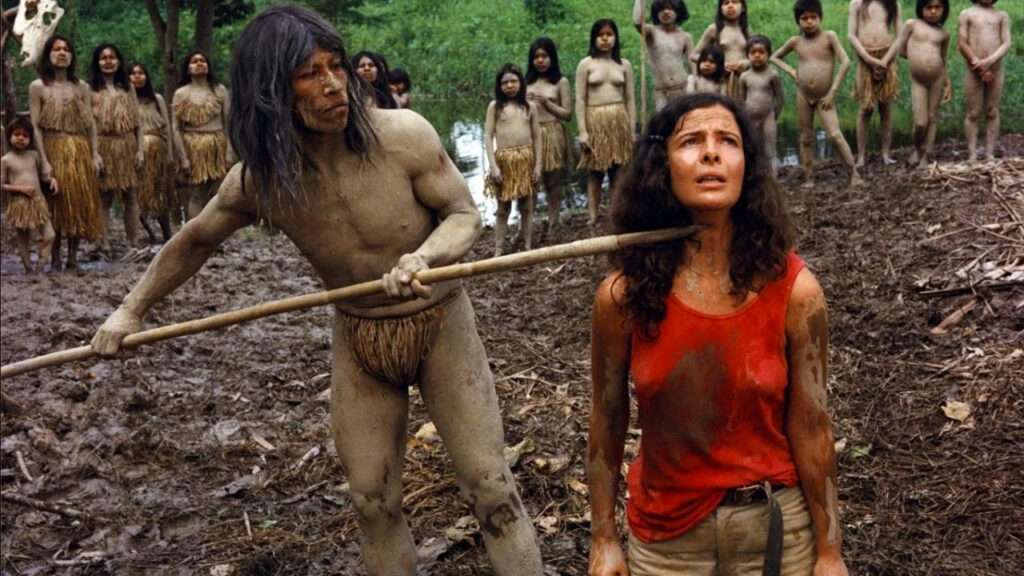
Cannibal movies are often characterized by a gritty and realistic style. Directors of this genre often use techniques such as handheld cameras, fast-paced editing, and dirty photography to create a sense of realism and immersion in the viewer.
Cannibal movies are also often characterized by scenes of extreme violence and gore. These scenes, which are often accompanied by loud sounds and gruesome images, are used to provoke an emotional reaction in the viewer.

The Themes
Cannibal movies explore a number of themes, including:
Human Nature: Cannibal movies often explore the dark and violent nature of man. These films ask the question whether man is naturally inclined to cannibalism or whether it is a tendency that can be repressed.
Alienation: Cannibal movies often explore the theme of alienation. The protagonists of these films are often people who find themselves in extreme situations, such as being lost in the jungle or captured by a cannibalistic tribe. In these situations, the protagonists find themselves isolated and without a point of reference.
Fear of the Unknown: Cannibal movies often explore fear of the unknown. The protagonists of these films often find themselves in unknown and dangerous places, where the rules of civilization do not apply. In these situations, the protagonists must face their fear of the unknown and death.
Cannibal movies are a controversial and fascinating genre. These films, which are often violent and disturbing, explore deep and disturbing themes. Cannibal movies are a genre that will continue to generate interest and debate for many years to come.
Cannibal Movies to Watch
Here is a complete list of cannibal movies to see, divided by year of release.
Raw (2016)
![RAW I Official Red Band Trailer [HD] l In theatres March 10, 2017](https://blog.indiecinema.co/wp-content/plugins/wp-youtube-lyte/lyteCache.php?origThumbUrl=https%3A%2F%2Fi.ytimg.com%2Fvi%2FwKYFH0hRpD0%2F0.jpg)
Justine is a bright, young vegetarian embarking on her first year at a prestigious veterinary school, following in the footsteps of her strictly herbivorous parents. During a brutal and blood-soaked hazing ritual, she is pressured by her older sister and peers into consuming a raw rabbit kidney. This single act triggers a dormant, predatory hunger within her, leading to a terrifying physical and psychological transformation. As her cravings for meat escalate into a desperate need for human flesh, Justine must navigate a world of carnal desire and animalistic violence, discovering dark family secrets that suggest her burgeoning cannibalism is not a freak occurrence but a deep-seated genetic legacy.
Julia Ducournau’s feature debut is a masterclass in body horror and a profound coming-of-age allegory that explores the boundaries between civilization and primal instinct. The film uses cannibalism as a visceral metaphor for sexual awakening and the shedding of childhood constraints, rendered through a clinical yet stylish lens. Garance Marillier delivers a stunning, fearless performance as Justine, capturing her descent from innocence to predatory awareness. Critically acclaimed for its bold direction and sensory impact, Raw won the FIPRESCI Prize at Cannes and became a lightning rod for controversy due to its graphic intensity. It remains a landmark of modern French horror, challenging the audience to confront the violence inherent in the process of self-discovery.
A vision curated by a filmmaker, not an algorithm
In this video I explain our vision
The Bad Batch (2016)

In a sun-scorched, dystopian future, those deemed unfit for society are branded as “scraps” and exiled to a lawless wasteland outside the borders of Texas. Arlen, a young woman newly abandoned in this desert, is immediately captured by a group of bodybuilding cannibals who scavenge for protein to maintain their physique. After a harrowing escape that leaves her mutilated, she finds her way to Comfort, a strange oasis ruled by a charismatic leader known as The Dream. There, she encounters “Miami Man,” a hulking, artistic cannibal searching for his missing daughter. The two form an uneasy, dangerous alliance in a landscape where human worth is measured only by survival and the desperate hunger of those left behind.
Ana Lily Amirpour crafts a hallucinatory, neon-soaked western that functions more as a sensory experience than a traditional narrative. The film explores themes of isolation, bodily autonomy, and the search for connection in a world that has discarded all moral pretenses. Featuring a standout cast including Jason Momoa, Keanu Reeves, and Jim Carrey, the production is noted for its striking visual style and an eclectic, mood-driven soundtrack that enhances its dreamlike atmosphere. While it polarized critics with its deliberate pacing, The Bad Batch won the Special Jury Prize at the Venice Film Festival. It stands as a unique piece of independent cinema, using the trope of cannibalism to interrogate the cruelty of social exclusion and the resilience of the human spirit in a barren world.
Bone Tomahawk (2015)

When a group of savage, unknown marauders kidnaps several townspeople from the quiet settlement of Bright Hope, Sheriff Franklin Hunt assembles a small rescue party. The team includes his aging backup deputy, an arrogant gentleman gunslinger, and a determined rancher who insists on joining despite a severe leg injury. Their journey takes them into a desolate, uncharted territory where they discover their quarry is not a typical native tribe, but a clan of inbred, troglodyte cannibals who communicate through haunting bone whistles. As the rescue mission reaches its destination, the men find themselves vastly outnumbered and outmatched by a primitive force that views human beings purely as meat for slaughter, leading to a visceral and horrifying climax.
S. Craig Zahler’s directorial debut is a brilliant, slow-burn hybrid of the classic Western and extreme horror genres. The film is characterized by its sharp, witty dialogue and its refusal to stylize the violence, presenting the atrocities of the cannibals with a gritty, unflinching realism that shocked audiences. Kurt Russell and Richard Jenkins provide masterful performances, grounding the increasingly macabre plot in authentic character drama. Critically acclaimed for its unique tone and tension, the film earned over $2 million at the box office despite its limited release and indie roots. Bone Tomahawk revitalized the cannibal subgenre by stripping away exploitation clichés and replacing them with a terrifying exploration of the clash between frontier civilization and prehistoric brutality.
The Green Inferno (2013)

A group of well-meaning but naive college activists travels from New York to the Amazon rainforest to protest a corrupt logging company that is threatening an ancient, indigenous tribe. Their mission seems successful until their plane crashes deep in the jungle, leaving the survivors stranded in a hostile environment. They are soon captured by the very tribe they were attempting to save, only to discover with agonizing clarity that the natives are practitioners of ritualistic cannibalism. Trapped in bamboo cages, the students are forced to watch as their friends are methodically butchered and prepared for a feast, turning their ideological mission into a desperate, blood-soaked struggle to survive a reality they never truly understood.
Directed by Eli Roth, the film is a direct and unapologetic homage to the Italian cannibal exploitation films of the 1970s and 80s, specifically Cannibal Holocaust. Roth utilizes his signature “splatstick” style to critique modern “slacktivism” and the hubris of the Western gaze, suggesting that a lack of true cultural understanding can have fatal consequences. The production utilized real members of an Amazonian village as extras, who reportedly found the film’s premise hilariously absurd. Despite mixed reviews regarding its extreme gore and representation of indigenous people, it became a cult favorite for its high-quality practical effects and unrelenting tension. It grossed approximately $12 million worldwide, serving as a visceral reminder of the subgenre’s enduring power to disturb and provoke.
The Human Centipede (First Sequence) (2009)

Two American tourists traveling through Germany find themselves stranded after their car breaks down in a remote forest. Seeking help, they stumble upon the villa of Dr. Josef Heiter, a world-renowned retired surgeon once specialized in separating Siamese twins. However, the doctor has a new, demented obsession: he wants to be the first to surgically join humans together to create a single, shared digestive system. After drugging the women and a third male captive, Heiter performs a horrific procedure, stitching them together mouth-to-anus. The survivors are transformed into a “human centipede,” a biological abomination forced to live and eat in a state of degrading, animalistic submission under the watchful eye of their narcissistic and insane creator.
Written and directed by Tom Six, this Dutch production became a global cultural phenomenon and a touchstone for extreme body horror. While the film is more about biological perversion than traditional cannibalism, the concept of a shared digestive tract pushes the boundaries of the “flesh-eating” genre into new, repulsive territory. Critics were largely repulsed by the film’s premise, accusing it of being purely exploitative and misogynistic, yet it earned a massive cult following due to its “100% medically accurate” marketing claim and Dieter Laser’s terrifying performance. On a budget of just $1 million, it launched a franchise and became a staple of extreme cinema discussions. It remains one of the most polarizing horror films ever made, exploring the absolute limits of human depravity.
The Last House on the Left (2009)

During a summer vacation, young Mari Collingwood and her friend are kidnapped by a gang of escaped convicts led by the sadistic Krug. The girls are subjected to a night of horrific torture and sexual violence in the woods, which ends with Mari being shot and left for dead. Seeking shelter from a violent storm, the criminals unwittingly knock on the door of Mari’s parents, John and Emma. When the couple discovers the bloody truth about their guests and finds their daughter barely clinging to life, they descend into a primal state of vengeful fury. The refined, civilized parents transform into calculated executioners, using their domestic environment to hunt and kill the intruders in an increasingly gruesome and ritualistic fashion.
This remake of Wes Craven’s 1972 classic, directed by Dennis Iliadis, is often associated with the cannibal/exploitation genre due to its focus on the regression of “civilized” people into savage killers. While it lacks literal flesh-eating, it explores the famished nature of revenge and the thin veneer of morality that separates victims from monsters. Critics praised the film for its technical polish and the strong performances by Tony Goldwyn and Sara Paxton, noting that it updated the original’s raw violence with a more sophisticated, albeit still nihilistic, intensity. The film was a commercial success, grossing over $46 million against a $15 million budget. It stands as a chilling examination of the cycle of violence and the capacity for extreme cruelty inherent in the human protective instinct.
Sweeney Todd: The Demon Barber of Fleet Street (2007)

Benjamin Barker, a barber who was unjustly exiled to Australia by a corrupt judge, returns to Victorian London seeking vengeance under the name Sweeney Todd. He discovers that his wife is gone and his daughter is in the judge’s custody, driving him to a state of homicidal madness. Todd opens a barber shop above the failing meat pie business of Mrs. Lovett and begins to slit the throats of his customers as a rehearsal for the judge’s eventual demise. To dispose of the bodies, Mrs. Lovett comes up with a macabre plan: she grinds the victims into meat and bakes them into pies, which become a massive success among the city’s oblivious residents. Cannibalism is thus transformed into a thriving, grisly commercial enterprise fueled by spite and despair.
Tim Burton’s adaptation of Stephen Sondheim‘s musical is a visually breathtaking and emotionally operatic exploration of cannibalism as a symptom of a corrupt society. The film uses a desaturated color palette and gothic set design to create a London that feels like a tomb, where people literally feed on one another to survive the crushing weight of industrialization and injustice. Johnny Depp and Helena Bonham Carter deliver iconic, haunting performances that balance the horror of their actions with a tragic, dark humor. Critically acclaimed for its direction and art design, the film won an Academy Award for Best Art Direction and grossed over $150 million. It remains a definitive example of how cannibalism can be used as a profound social metaphor within the context of a grand, theatrical tragedy.
Hannibal Rising (2007)
![Hannibal Rising - Official® Trailer [HD]](https://blog.indiecinema.co/wp-content/plugins/wp-youtube-lyte/lyteCache.php?origThumbUrl=https%3A%2F%2Fi.ytimg.com%2Fvi%2FNCCFleJPTAU%2F0.jpg)
The film traces the formative years of the infamous cannibalistic psychiatrist, beginning with his traumatic childhood in Lithuania during World War II. After his parents are killed, young Hannibal and his beloved sister Mischa are captured by a group of starving, desperate pro-Nazi collaborators. Driven by extreme hunger during a harsh winter, the soldiers kill and consume Mischa, an act that shatters Hannibal’s psyche and ignites an unquenchable thirst for retribution. Years later, while studying medicine in France, Hannibal begins to track down the men responsible for his sister’s death, discovering that his vengeance is most satisfying when paired with the ritualistic consumption of those who once ate his sister, marking his final transition into a monster.
Directed by Peter Webber and based on Thomas Harris‘s novel, the film serves as a prequel intended to demystify the origins of Hannibal Lecter’s particular appetite. Gaspard Ulliel stepped into the iconic role, providing a younger, more physically aggressive version of the doctor that focuses on his evolution from a traumatized orphan into a calculating predator. While critics were divided on the necessity of giving Lecter a sympathetic “origin story,” the film is noted for its lush cinematography and dark, atmospheric tone. It presents cannibalism as an aristocratic act of poetic justice and a direct response to war-time trauma. Despite a disappointing box office performance, the film remains an essential part of the Lecter mythos, exploring how a taste for human flesh can be born from the deepest grief.
The Hills Have Eyes (2006)

The Carter family is traveling across the New Mexico desert when their camper is deliberately sabotaged near an abandoned nuclear test site. Stranded in a desolate wasteland, they soon realize they are being hunted by a clan of mutated cannibals who were deformed by decades of government atomic testing. These mutants, living in a hidden village within the mines, view any trespassers as an essential source of food and genetic material. As the family members are methodically picked off in a series of brutal, nighttime raids, the survivors are forced to abandon their civilized morals and fight back with a savage ferocity that mirrors the inhumanity of their attackers, leading to a blood-soaked showdown in the radiation-scarred hills.
Alexandre Aja’s remake of the 1977 Wes Craven film is a relentless, high-octane assault on the senses that significantly increased the original’s levels of gore and nihilism. The film is often cited as a sharp political critique, suggesting that the cannibalistic mutants are the literal “monsters” created and then forgotten by American military policy. Its unflinching depiction of violence and its oppressive atmosphere made it a standout hit during the “torture porn” era of the mid-2000s. Produced on a budget of $15 million, it was a massive success, earning nearly $100 million at the global box office. It remains a terrifying example of rural horror, emphasizing the primal fear of being hunted for food in a place where no one can hear you scream.
The Texas Chain Saw Massacre (2003)

A group of five friends driving through rural Texas is lured to a remote farmhouse after picking up a traumatized hitchhiker. They soon find themselves trapped in the territory of the Hewitt family, a clan of former slaughterhouse workers who have turned to cannibalism following the economic collapse of their town. The family is led by the terrifying, chainsaw-wielding Leatherface, a hulking man who wears masks made from the tanned skin of his victims. The young travelers are captured and taken to a basement filled with decaying remains, where they are destined to be the main course for a family dinner that represents the absolute degradation of human morality and the terrifying reality of being reduced to nothing more than livestock.
Directed by Marcus Nispel and produced by Michael Bay, this remake of the 1974 Tobe Hooper classic focuses on grimy, high-contrast visuals and a relentless sense of dread. While the original film was noted for its lack of explicit gore, the 2003 version leans heavily into the visceral reality of a cannibalistic household, showing the putrid, blood-stained environment in graphic detail. Andrew Bryniarski’s portrayal of Leatherface is physically imposing and nightmarish, cementing the character’s legacy for a new generation of horror fans. The film was a massive commercial triumph, grossing over $107 million worldwide and launching a new wave of horror remakes. It remains a definitive modern take on the “Texas Chainsaw” mythos, emphasizing the horror of industrial-scale cannibalism in the American heartland.
Hannibal (2001)

Ten years after the events of The Silence of the Lambs, Dr. Hannibal Lecter is living a refined life in Florence, Italy, under an assumed name, indulging his tastes for fine art and classical music. However, his past catches up with him when Mason Verger, a wealthy and hideously disfigured former victim, launches a global hunt to capture Lecter and feed him to a pack of specially bred wild boars. Meanwhile, FBI agent Clarice Starling is drawn back into the doctor’s web as she investigates his whereabouts. The story moves toward a grotesque and infamous climax where Lecter demonstrates his absolute control over the human mind and body, culminating in a dinner party that features an act of cannibalism so refined and shocking it remains etched in cinematic history.
Ridley Scott took over the directorial reins for this sequel, shifting the tone from psychological thriller to a baroque, operatic horror film. The production is famous for its lush Italian locales and its extreme gore, particularly the scene where Lecter serves a conscious victim his own sautéed brain. Anthony Hopkins returns to the role with a more playful, almost god-like confidence, portraying cannibalism as the ultimate expression of his intellectual superiority over “rude” society. While critics were divided on the film’s shift toward graphic horror, it was a massive box office success, grossing over $350 million. It stands as a decadent, visual feast that explores the dark romance between the predator and the prey, solidifying Lecter as the screen’s most sophisticated monster.
Trouble Every Day (2001)
![Trouble Every Day (2001) ORIGINAL TRAILER [HD]](https://blog.indiecinema.co/wp-content/plugins/wp-youtube-lyte/lyteCache.php?origThumbUrl=https%3A%2F%2Fi.ytimg.com%2Fvi%2Fi9jblTKEWmQ%2F0.jpg)
Shane Brown is an American scientist traveling to Paris with his new bride for their honeymoon, but his real motivation is a desperate search for a former colleague who conducted illicit research on the human libido. Shane is secretly suffering from a terrifying condition: his sexual desire has become inextricably linked to a violent, cannibalistic compulsion. At the same time, the colleague’s wife, Coré, is kept locked in a room because she has regressed into a feral state, seducing and then literally devouring any man she can lure into her trap. The two storylines converge in a tragic exploration of carnal obsession, where the act of love becomes an act of consumption, leading to a bloody and inevitable erasure of the self.
Directed by Claire Denis, this film is a seminal work of the “New French Extremity,” using cannibalism as a visceral metaphor for the consuming nature of sexual desire. The film avoids traditional horror tropes, opting instead for a sensory, atmospheric approach that focuses on the textures of skin, blood, and hunger. Vincent Gallo and Béatrice Dalle give raw, haunting performances as the “infected” protagonists who are unable to control their predatory instincts. Initially met with boos and walkouts at the Cannes Film Festival due to its graphic depictions of sexual cannibalism, the film has since been reassessed as a masterpiece of provocative cinema. It remains a deeply unsettling meditation on the biological violence inherent in human intimacy, challenging the audience’s endurance and moral boundaries.
Ravenous (1999)

Set in 1847 during the Mexican-American War, Captain John Boyd is sent to a remote, snow-covered military outpost in the Sierra Nevada after a questionable act of bravery. The fort’s quiet is shattered by the arrival of a frostbitten stranger named Colqhoun, who claims his wagon train was stranded and the survivors were forced to eat each other to stay alive. Boyd and a small team set out on a rescue mission, only to discover that Colqhoun has embraced the indigenous myth of the Wendigo: a belief that consuming the flesh of another man grants his strength and immortality. The mission turns into a deadly game of cat-and-mouse as Boyd must decide whether to die an honorable man or succumb to the supernatural hunger that Colqhoun insists is the true nature of power.
Antonia Bird’s film is a cult masterpiece that blends dark comedy, frontier history, and supernatural horror into a unique social satire. The film uses cannibalism as a biting metaphor for American Manifest Destiny and the rapacious nature of imperialism, suggesting that the drive to conquer is fueled by a hunger that can never be satisfied. Featuring stellar performances by Guy Pearce and Robert Carlyle, and a dissonant, experimental score by Damon Albarn and Michael Nyman, the film was largely ignored upon its release but has since gained a devoted following. It is celebrated for its tonal unpredictability and its willingness to use the cannibal genre to explore profound philosophical questions about morality, survival, and the dark heart of the American dream.
Alive (1993)

Based on the incredible true story of the 1972 Andes flight disaster, the film follows a Uruguayan rugby team whose plane crashes into a remote, freezing mountain range. Stranded with no food, no winter clothing, and no way to signal for help, the survivors face an agonizing 72-day struggle against the elements. After realizing that rescue efforts have been called off and their meager supplies are exhausted, the group faces a devastating moral and spiritual dilemma: they must consume the flesh of their deceased friends and family members, preserved in the snow, to avoid starvation. The film documents their harrowing internal conflict and the eventual, miraculous trek across the mountains that leads to their rescue, framing their cannibalism as an act of profound courage and necessity.
Directed by Frank Marshall, Alive approaches the subject of cannibalism with a humanistic and respectful tone, deliberately avoiding the sensationalism of the horror genre. The film treats the act of eating the dead as a desperate “sacrament” of survival, focusing on the psychological and religious implications of the choice. Ethan Hawke leads a strong ensemble cast that captures the physical deterioration and spiritual resilience of the real-life survivors. The production was praised for its realistic depiction of the crash and the harsh mountain environment, and it was a critical and commercial success. It remains the most definitive cinematic treatment of survival cannibalism, emphasizing the will to live and the bonds of brotherhood that allowed the survivors to endure the unthinkable in the face of impossible odds.
Delicatessen (1991)

In a bizarre, post-apocalyptic France where grain is used as currency and meat is an almost nonexistent luxury, a butcher named Clapet runs a dilapidated apartment building with an iron fist. To keep his tenants fed, he periodically hires new handymen through newspaper ads, only to butcher and serve them as “delicatessen” to the residents. The cycle is interrupted when Louison, an optimistic former circus clown, arrives to take the job. He quickly falls in love with the butcher’s daughter, Julie, who is horrified by her father’s business. Julie contacts a group of underground, vegetarian freedom fighters known as the Troglodytes to help rescue Louison, leading to a chaotic and surreal confrontation within the claustrophobic confines of the building.
Jean-Pierre Jeunet and Marc Caro created a visually stunning, sepia-toned black comedy that uses cannibalism to explore themes of greed, survival, and the resilience of love in a dying world. The film is famous for its intricate production design, eccentric characters, and rhythmic editing, such as the iconic sequence where the tenants’ activities are timed to the squeaking of the butcher’s bedsprings. Delicatessen was a major critical success, winning several César Awards and becoming a cornerstone of modern French cinema. While the premise is morbid, the film maintains a whimsical, fairy-tale quality that sets it apart from traditional horror. It serves as a unique exploration of how humanity persists even in a society that has literally begun to consume itself to stay alive.
The Silence of the Lambs (1991)

Clarice Starling, a top student at the FBI Academy, is assigned by her mentor to interview Dr. Hannibal Lecter, a brilliant psychiatrist and incarcerated cannibalistic serial killer. The goal is to obtain Lecter’s psychological insights to help track down another killer, “Buffalo Bill,” who is kidnapping and skinning young women. Lecter, intrigued by Clarice’s ambition and vulnerability, enters into a high-stakes psychological game, demanding personal “quid pro quo” confessions from her in exchange for clues. As Clarice gets closer to the truth about Buffalo Bill, she must also navigate the terrifyingly calm and manipulative influence of Lecter, a man whose sophisticated intellect is matched only by his predatory instinct and his monstrous appetite for human flesh.
Jonathan Demme’s masterpiece is one of the few horror-thrillers to win the “Big Five” Academy Awards, including Best Picture. The film redefined the cannibal archetype, moving away from “jungle savages” to present the cannibal as a hyper-intelligent, cultured elite. Anthony Hopkins’s performance as Lecter became an immediate cultural icon, while Jodie Foster’s Clarice provided a groundbreaking portrait of female resilience. The film was a massive commercial success, grossing $273 million, and its influence on the thriller genre is immeasurable. It remains a haunting exploration of the nature of evil, identity, and the power of the mind, using cannibalism as the ultimate symbol of a predator who consumes the souls as well as the bodies of his victims.
Parents (1989)
![Parents (1989) ORIGINAL TRAILER [HD 1080p]](https://blog.indiecinema.co/wp-content/plugins/wp-youtube-lyte/lyteCache.php?origThumbUrl=https%3A%2F%2Fi.ytimg.com%2Fvi%2FVVDxDXq1VEY%2F0.jpg)
Michael, a young boy living in the sterile, pastel-colored suburbia of 1950s America, becomes increasingly disturbed by his parents’ behavior and the mysterious origin of the meat they serve at every meal. His father, Nick, a jovial man who works in chemical research, and his mother, Lily, seem to embody the perfect American dream, yet Michael is plagued by nightmares of blood and body parts. As he snoops through the house and observes his parents’ strange, nocturnal rituals, Michael begins to suspect that the “leftovers” in the fridge are not beef or pork, but human remains. His struggle to differentiate between childhood imagination and a horrific domestic reality creates a claustrofobica atmosphere of dread within the confines of his own home.
Bob Balaban’s directorial debut is a wickedly subversive piece of social satire that uses cannibalism to deconstruct the forced conformity and underlying rot of the post-war American family. The film’s meticulously designed 1950s aesthetic serves as a jarring contrast to its gruesome subject matter, suggesting that the era’s obsession with consumerism and “normalcy” was itself a form of predatory behavior. Randy Quaid is chilling as the father, moving seamlessly from friendly patriarch to a figure of mounting, cannibalistic menace. Although it was a box office failure upon release, Parents has since been recognized as a cult classic for its unique tone, which balances pitch-black humor with genuine psychological horror. It remains a sharp, allegorical critique of the secrets hidden behind the white picket fences of the “ideal” family.
Cannibal Holocaust 2 (1988)

A group of greedy adventurers—including a photographer, an anthropologist, and two mercenaries—travels deep into the Amazon jungle in search of a legendary treasure. Along the way, they treat the local indigenous tribes with extreme cruelty, burning villages and torturing natives to extract information about the gold. However, their arrogance proves to be their downfall when they are captured by a tribe of fierce cannibals who seek retribution for the group’s atrocities. The hunters become the hunted, as the natives engage in a brutal ritual of torture and consumption, proving that the modern, “civilized” intruders are the true savages of the jungle, and their greed leads them directly into a grisly, inescapable end.
While often marketed as a sequel to Ruggero Deodato’s 1980 masterpiece, this film was actually directed by Antonio Climati and is also known as Natura contro. It attempts to recapture the “found footage” and exploitation vibes of the early 80s cannibal boom but with a heavier focus on traditional adventure tropes. Like its predecessor, it faced significant controversy due to the inclusion of real-life animal cruelty, a common but abhorrent staple of the Italian cannibal subgenre. Though it lacks the philosophical depth and technical innovation of the original Cannibal Holocaust, it serves as a historical marker for the end of the cannibal film era in Italy. It remains a polarizing entry in exploitation cinema, blending the “civilization vs. savagery” theme with the visceral gore that defined the genre’s peak.
Manhunter (1986)

Will Graham, a retired FBI profiler who left the service after a mental breakdown following the capture of the cannibalistic serial killer Dr. Hannibal Lecktor, is called back into action to catch a new killer known as “The Tooth Fairy.” The murderer kills entire families during full moons and leaves mysterious, ritualistic marks on their bodies. To catch him, Graham must visit Lecktor in his high-security cell to “re-acquire” the mindset of a killer. The meeting ignites a dangerous psychological game as Lecktor attempts to manipulate Graham, leading the profiler toward a confrontation with Francis Dollarhyde—a disturbed man obsessed with a William Blake painting—while struggling to keep his own sanity from slipping back into the abyss.
Michael Mann’s adaptation of Thomas Harris’s Red Dragon was the first cinematic appearance of Hannibal Lecter (spelled “Lecktor” here), played by Brian Cox with a chilling, understated coldness. The film is noted for its stylish, neon-lit 1980s aesthetic and its focus on the psychological toll of criminal profiling rather than graphic gore. While it received mixed reviews and was a box office disappointment upon release, it has since been hailed as a masterpiece of the psychological thriller genre. Mann uses visual imagery and a synth-driven score to create a sense of clinical dread, exploring the thin line between the detective and the monster. It remains a sophisticated, atmospheric precursor to the later, more famous Lecter films, offering a grounded and terrifying look at the nature of obsession.
Cannibal Ferox (1981)
![Cannibal Ferox (1981) ORIGINAL TRAILER [HD 1080p]](https://blog.indiecinema.co/wp-content/plugins/wp-youtube-lyte/lyteCache.php?origThumbUrl=https%3A%2F%2Fi.ytimg.com%2Fvi%2FGu2drJc7oMM%2F0.jpg)
Three Americans, led by an anthropologist named Gloria who intends to prove that cannibalism is a myth created by colonialists, travel into the heart of the Amazon. There, they encounter Mike, a sadistic drug dealer who is on the run after torturing members of a local tribe to find hidden emeralds. Mike’s brutal actions provoke a violent response from the natives, who decide to prove Gloria’s theory wrong in the most horrific way possible. The group is captured and subjected to a series of excruciating tortures and ritualistic mutilations, leading to Gloria’s traumatic realization that the “civilized” world she comes from is just as capable of savagery as the “primitive” tribe currently consuming her friends.
Directed by Umberto Lenzi, Cannibal Ferox is often cited as the most extreme and violent of the Italian cannibal films, famously claiming to be “banned in 31 countries.” The film is notorious for its graphic practical effects and several scenes of real animal slaughter, which have led to it being censored or banned for decades. Unlike Cannibal Holocaust, it makes little effort at social commentary, focusing instead on pure, unrelenting exploitation and gore. Despite its controversial nature and initial critical panning, it has become a legendary cult film for fans of extreme horror. It represents the absolute peak of the cannibal subgenre’s brutality, offering a nihilistic and visceral viewing experience that tests the limits of the audience’s stomach and moral endurance.
Cannibal Apocalypse (1980)

Two Vietnam War veterans, Norman Hopper and Charlie Bukowski, return to Atlanta, Georgia, carrying a horrifying biological legacy from their time in captivity: a virus that causes an insatiable craving for human flesh. The infection is spread through biting, and soon, the trauma of the war manifests as a literal cannibalistic epidemic in the streets of the city. As the veterans struggle with their predatory urges, they begin to attack civilians, leading to a desperate standoff with the police in the city’s sewers and industrial zones. The film traces the breakdown of social order as the “cannibal virus” spreads, transforming the urban landscape into a battlefield where the horrors of the jungle have finally come home to consume the American heartland.
Directed by Antonio Margheriti under the pseudonym Anthony M. Dawson, this film is a unique blend of the cannibal subgenre, the zombie film, and the “disillusioned veteran” tropes of the late 70s. Unlike the jungle-based cannibal films of the era, Cannibal Apocalypse brings the horror into a modern, urban setting, using cannibalism as a metaphor for the lingering, infectious trauma of war. Starring John Saxon and Giovanni Lombardo Radice, the film is known for its creative practical effects and its gritty, action-packed pace. While it was banned in the UK as a “video nasty,” it has since become a cult favorite for its subversion of genre expectations and its unflinching look at human depravity within a civilized society.
Cannibal Holocaust (1980)

Anthropologist Harold Monroe leads a rescue mission into the Amazon “Green Inferno” to find a crew of four documentary filmmakers who disappeared while filming local cannibal tribes. He eventually recovers their lost footage and brings it back to New York. As Monroe and television executives view the film, they are horrified to discover that the filmmakers were not innocent victims but opportunistic sadists who raped, tortured, and murdered natives to stage “exciting” footage. The documentary captures the crew’s increasingly depraved behavior and their eventual, grisly deaths at the hands of the tribe they provoked, leaving Monroe to question whether the modern media is more savage than the cannibals they seek to exploit.
Ruggero Deodato’s film is a landmark of the horror genre, credited with inventing the “found footage” technique. It is one of the most controversial films ever made, leading to Deodato’s arrest on suspicion of real-life murder because the special effects were so convincingly realistic. While it is infamous for its scenes of genuine animal cruelty and extreme human gore, the film is also a sophisticated critique of sensationalist journalism and the ethics of the Western gaze. It was banned in dozens of countries and underwent years of legal battles before being fully released. Despite its repellent content, it is praised for its innovative structure and its haunting, beautiful score by Riz Ortolani. It remains a disturbing, essential work that forces the viewer to confront the brutality of “civilized” society.
The Mountain of the Cannibal God (1978)

Susan Stevenson and her brother Arthur travel to the jungles of Papua New Guinea to find her husband, an anthropologist who disappeared during an expedition. They are joined by a veteran guide named Edward Foster, who leads them toward a mysterious sacred mountain. As they venture deeper into the wilderness, they are stalked by a tribe of cannibals who worship a mountain god. The group is eventually captured and taken to a hidden cave system where Susan discovers the horrifying truth about her husband’s fate and the cult-like rituals of the tribe. She is forced to undergo a series of ritualistic humiliations and ceremonies, leading to a desperate struggle to escape before they are sacrificed and consumed by the mountain’s “gods.”
Directed by Sergio Martino, this film is one of the most famous and polished entries in the Italian cannibal cycle, benefiting from the star power of Ursula Andress and Stacy Keach. It effectively combines elements of adventure, erotica, and graphic horror, creating a tense atmosphere of exotic dread. The production is noted for its beautiful, authentic locations and its shocking special effects, though like many films of the era, it features controversial scenes of real animal violence. Critically, it is seen as a quintessential example of the genre’s peak, balancing its exploitative elements with a solid adventure plot. It remains a cult classic for its blend of 70s travelogue aesthetic and visceral horror, influencing later films like The Green Inferno.
Emanuelle and the Last Cannibals (1977)

While working as a volunteer in a New York psychiatric hospital, investigative journalist Emanuelle meets a young woman who was found wandering in the Amazon with a tattoo belonging to a supposedly extinct cannibal tribe. Sensing a massive story, Emanuelle travels to the Brazilian rainforest with an anthropologist, Mark Lester, to find the “Last Cannibals.” Their journey through the jungle is fraught with danger, including encounters with hostile tribes and sadistic smugglers. They eventually find the cannibal village, but they are captured and subjected to a series of degrading sexual rituals and gruesome mutilations. Emanuelle must use her wits and her sexuality to survive and find a way back to civilization with her shocking evidence intact.
Directed by Joe D’Amato, this film is a crossover between the “Black Emanuelle” erotic series and the cannibal exploitation genre. Starring the iconic Laura Gemser, it is famous for its explicit blend of erotica and extreme gore, a combination that made it a frequent target for censors worldwide. D’Amato, a master of exploitation cinema, delivers a film that is well-shot and atmospheric despite its low budget and repellent subject matter. The film is a prime example of the 1970s “Mondo” influence, where different exploitative tropes were combined to maximize audience shock. It remains a definitive cult title for fans of extreme Italian cinema, representing a time when filmmakers pushed the boundaries of sex and violence to their absolute limits without apology.
The Last Cannibal World (1977)

Oil prospector Robert Harper is part of a team that crashes in the jungle of Mindanao, Philippines. He is soon captured by the Manja, a primitive, stone-age tribe that lives in caves and practices cannibalism. Robert is treated like an animal—stripped naked, tied up, and forced to endure the tribe’s daily rituals of violence and consumption. Through his captivity, he observes the tribe’s brutal lifestyle, including their method of preparing human flesh. With the help of a young tribal woman named Pula, Robert eventually manages to escape, but the ordeal forces him to shed his “civilized” self and regress to a state of primal savagery to survive the jungle and his pursuers, culminating in a desperate flight back to the modern world.
Directed by Ruggero Deodato, this film is considered the first “true” cannibal movie that set the template for the subgenre’s peak. It focuses heavily on the theme of regression and the “Man vs. Nature” conflict, depicted with a raw, documentary-like grit. The film was highly controversial for its graphic depictions of cannibalism and real animal slaughter, which would become Deodato’s trademark. Despite the controversy, it was a massive international hit and is praised for its effective use of location and its unflinching look at the fragility of modern man when stripped of technology. It served as a direct precursor to Cannibal Holocaust, establishing the “lost in the jungle” narrative as a staple of horror cinema.
Man From Deep River (1972)

John Bradley, an English photographer on an expedition in Thailand, is captured by a primitive tribe known as the Manja after killing an indigenous man in self-defense. The tribe, which practices cannibalism, initially views John as a captive to be tormented or eaten. However, after he is spared through the intervention of the chief’s daughter, Maraya, John begins to adapt to the tribe’s way of life. He learns their hunting techniques, participates in their brutal social structures, and eventually earns their respect as a warrior. The story follows his slow integration into the tribe and his eventual attempt to return to civilization, taking Maraya with him after a rival tribe attacks their village in a blood-soaked finale.
Umberto Lenzi’s film is the historical progenitor of the Italian cannibal subgenre. While it leans more toward “mondo” travelogue and erotic adventure than the extreme gore of later films, it established the core themes of the genre: the “civilized” man trapped by “savages” and the subsequent cultural and physical clash. Ivan Rassimov and Me Me Lai became icons of the genre through their roles here. The film was criticized for its exploitative nature and racial stereotypes, but its commercial success proved there was a huge market for exotic, transgressive content. It effectively launched a decade-long obsession in Italian cinema with cannibalism, blending documentary-style footage with scripted horror to create a sense of voyeuristic reality that would influence the entire horror landscape for years to come.
A vision curated by a filmmaker, not an algorithm
In this video I explain our vision

