
The Face That Refused Heroism
You are watching a man who should not be there. Not by the logic of the screen, not by the calculus Hollywood had already spent two decades perfecting before he arrived. He is short — five feet six on a generous day — with a jaw built less for kissing than for confrontation, a lower lip that protrudes like a challenge, eyes that carry the particular wariness of someone who learned early that the world does not extend automatic welcome. The year is 1931, the film is playing in a theater that smells of cigarette smoke and cheap upholstery, and the audience is looking at a face that carries Romania in its bone structure, the Lower East Side in its muscle memory, and something else entirely that no casting director of the era would have invented from scratch. They are looking at Emanuel Goldenberg from Bucharest, who decided somewhere along the way to become Edward G. Robinson, and who is now, improbably, the most magnetic object in the room.

The cognitive dissonance this produces is not accidental, and it is not resolved by the film. Hollywood by 1931 had constructed an extraordinarily coherent visual language of masculine authority, and that language was nearly entirely Anglo-Saxon in its grammar. It drew on the tall, fair, square-jawed inheritance of actors like Gary Cooper — who stood six feet three, moved with the unhurried ease of someone who had never doubted his right to occupy space, and whose face read to audiences as a kind of continental promise, the frontier made flesh. The studio system understood instinctively what the French sociologist Pierre Bourdieu would not articulate until his 1979 work Distinction: that aesthetic preferences are never innocent, that what a culture calls beautiful is always simultaneously a map of who it believes deserves power. The leading man’s body was not merely attractive. It was an argument.
Robinson’s body made the opposite argument, and yet the argument landed. This is the thing that requires explanation, because it did not happen through exception or apology. He was not positioned as the ethnic curiosity, the comic relief immigrant, the swarthy villain softened by a final act of redemption. He was positioned at the center of the frame as the engine of the story, and the story ran. Rico Bandello in Little Caesar is not a character designed to make audiences comfortable with their discomfort. He is written and played as someone who wants — ferociously, structurally, without the dignity of remorse — and the wanting is rendered so completely that it colonizes the viewer’s attention regardless of whether they find the face handsome by the established standard.
What Robinson intuited, and what the studio executives financing his rise may not have fully understood they were permitting, is that screen presence is not a function of conformity to idealized form. It is a function of internal pressure made visible. The face that carries genuine psychological weight — anxiety, calculation, hunger, grief held at a controlled distance — creates a gravitational field that conventionally attractive vacancy cannot match. Robinson had been trained at the American Academy of Dramatic Arts, had worked the New York stage through the 1910s and 1920s, had absorbed the Stanislavski-adjacent techniques circulating through serious theater of the period, and he brought to the camera an interiority that the medium’s intimacy exposed and amplified in ways the stage never could. The close-up, that revolutionary instrument of cinema, was designed for exactly this kind of face — not the symmetrical mask, but the surface through which something is visibly happening underneath.
What an audience encounters, sitting before that particular combination of physical fact and psychic intensity, is a redistribution of the rules they arrived with — rules about who gets to matter, whose desire the camera dignifies, which bodies the narrative machine treats as central rather than peripheral.
Immigrant Stock and the Grammar of American Danger
You are sitting across from him at a dinner table, somewhere in the middle of a conversation about nothing in particular, and you realize you cannot quite place him. He is speaking English with full fluency, dressed correctly, holding his fork the right way, and yet something in the room has shifted — some invisible register of discomfort that nobody will name because naming it would expose the person who feels it.
Emanuel Goldenberg arrived in the United States in 1903, at the age of ten, having left Bucharest with his family under the particular pressure that Eastern European Jews understood in their bones: stay and be destroyed slowly, or move and be suspected quickly. He became Edward G. Robinson by the time Hollywood needed him, the name change itself a kind of citizenship ritual that millions of immigrants performed — not out of shame alone, but out of a precise social calculation. The original name was too legible, too foreign, too much of an invitation for a culture to file you under the wrong category before you had spoken a word. What he kept, because he could not shed it, was the face. The jaw. The density of presence that reads, in certain American visual grammars, not as authority but as threat.
Erving Goffman published Stigma: Notes on the Management of Spoiled Identity in 1963, and what he described there was not a sociological anomaly but the operating system of ordinary social life. A stigma, for Goffman, is not simply a mark — it is a discrepancy between what he called virtual social identity and actual social identity, between the person a culture expects based on visible cues and the person who is actually standing in front of them. The immigrant body, particularly the Jewish immigrant body from the wrong part of Europe, arrived in America already carrying a pre-written story. Certain features, certain vocal textures, certain ways of occupying space had been coded, through decades of caricature and anxiety, as signals of something untrustworthy. Hollywood did not invent this grammar. It simply discovered that the grammar was profitable.
The gangster film as a genre emerged with industrial precision at the exact moment when mass immigration had saturated public consciousness and public fear simultaneously. Little Caesar arrived in 1931, and the character Robinson built there — Rico Bandello, the immigrant’s son clawing upward through violence — was not a fantasy. It was a cultural projection machine. What the American mainstream could not process directly — the ambition, the foreignness, the refusal to remain quietly at the bottom — it metabolized through genre. The criminal became the vessel for everything the culture needed to feel afraid of without admitting what it was actually afraid of. Robinson’s face was not cast because it was ugly. It was cast because it was illegible in the precise way that made certain audiences feel justified in their unease.
What Goffman understood, and what the studio system exploited without understanding it at all, is that the performance of normality is exhausting and asymmetrical. The person carrying the stigma must constantly manage information — deciding what to reveal, how to speak, which version of themselves is safest in a given room. Robinson spent decades performing inside that asymmetry, giving American cinema one of its most forceful physical presences while the machinery around him kept assigning that force to danger. His intelligence was used to play cunning. His intensity was used to play menace. The culture borrowed his actual capacities and returned them to him re-labeled, and he took the work because the work was there, and because a man who arrived at ten years old with a different name on his tongue had learned early that you do not refuse the room you are given.
There is a particular kind of exhaustion that does not show on the face.

Little Caesar and the Arithmetic of the American Dream
You already know the ending before Rico Bandello fires a single shot. You have seen that face — compact, jaw-forward, eyes that calculate rather than feel — and you recognize it not as a gangster’s face but as the face of someone who wants, with a ferocity that polite society has learned to disguise as ambition. The wanting is the same. Only the costume differs.
Little Caesar opened in January 1931, nine months after the Great Depression had finished dismantling the rhetorical scaffolding of American prosperity. Warner Bros. spent roughly $700,000 on its production and recovered over five million dollars domestically, which was not merely a commercial triumph but a cultural confession. Millions of people paid to watch a man claw his way from provincial nothing to metropolitan power, and they did not boo. They leaned forward. Cesare Enrico Bandello wants what the decade’s mythology had promised everyone: visibility, accumulation, the particular dignity that comes from no longer being ignored. That the machinery he uses is criminal is almost incidental to the arithmetic — and the audience understood this with a speed that terrified commentators far more than the gunfire did.
Thorstein Veblen had already dissected the mechanism in 1899 in The Theory of the Leisure Class, demonstrating that conspicuous consumption is not a deviation from the social contract but its most honest expression. Rico’s apartment, his tailored suits, the photograph taken at a civic banquet where he sits alongside men who launder their violence through property law — these are not signs of corruption grafted onto an innocent system. They are the system operating without its customary insulation of euphemism. What makes Rico genuinely disturbing is not that he breaks the rules but that he follows them with embarrassing literalness, stripping away the etiquette that normally separates a robber baron from a rubber-gloved thief.
The censorship machinery sensed this immediately. The Studio Relations Committee, operating before the Hays Code achieved its full punitive architecture in 1934, demanded cuts and modifications throughout production, uneasy not about the violence per se but about the sympathy the film refused to withdraw from its protagonist. What finally arrived on screen retained enough moral ambiguity to provoke exactly the institutional anxiety its producers had courted. By 1934, the Production Code Administration under Joseph Breen moved to enforce a landscape where crime could only be depicted if punishment was rendered emphatic, instructive, and cinematically unavoidable. Rico’s death at the base of a billboard advertising a dance act — “Is this the end of Rico?” the line that closes the film — was retroactively reread as a morality lesson, but no audience in January 1931 experienced it that way. They experienced it as a tragedy. The distinction destroyed the censors’ sleep.
Robinson himself understood something the censors could not afford to. He had studied at the American Academy of Dramatic Arts, had spent two decades in theater absorbing European naturalism, and he brought to Rico a psychological interiority that the gangster genre had not previously required. He later described the performance in his memoir All My Yesterdays as an exercise in finding the “terrible sincerity” beneath the brutality — the genuine belief that the world owed Rico Bandello a legible existence. That sincerity is what the box office receipts were buying. Not transgression. Recognition.
The sociologist Robert Merton, writing in his 1938 essay “Social Structure and Anomie,” would formalize what the film had already dramatized: that crime surges not from moral failure but from the gap between culturally mandated goals and the structurally available means to reach them. A society that worships success while rationing access to legitimate pathways does not produce deviants — it produces Rico Bandello, in mass quantities, most of whom never pick up a gun because they have found other instruments equally effective and considerably better protected by law.
The Moral Economy of the Crime Film
You are sitting in a darkened theater in 1931, and the man on screen is not a villain. He is a mirror. He wants what you want — the house, the respect, the clean shirt, the moment when someone important looks at you and nods. The difference between him and you is not moral. It is geographical. He grew up on the wrong block.
The gangster film did not invent this ambiguity; it inherited it from a culture that had already built its entire mythology on the romance of self-made accumulation, then watched that mythology collapse in October 1929 when the Dow shed nearly ninety percent of its value over the following three years and thirteen million Americans found themselves without work. What the genre accomplished, in the hands of Warner Bros. and the actors it harnessed, was to make that collapse legible in human terms — not as an economic abstraction but as a man in a double-breasted suit climbing a ladder that the society around him had quietly sawed through at the fourth rung. The criminal did not stand outside the economy. He was its honest translation.
Walter Benjamin, writing in the early 1930s in his Arcades Project, developed the idea of the dialectical image — a moment in which historical contradictions freeze into a single, charged figure, legible precisely because two incompatible truths are caught in the same frame at once. The gangster of classical Hollywood functions exactly this way: he is the entrepreneur and the outlaw simultaneously, the self-reliant individual the culture celebrates and the social threat it prosecutes, visible as a coherent figure only because the Depression had made the gap between the official promise and the lived reality impossible to ignore. Robinson understood this intuitively, which is why his performances never register as performances. He is not playing evil. He is playing sincerity inside a rigged system.
There is a particular scene — a man behind a desk, his empire apparently intact, speaking to a subordinate with the patient authority of a CEO managing quarterly projections — in which the only thing that separates the register of the dialogue from a corporate boardroom is the nature of the commodity being moved. The scene works not as irony but as revelation, because the logic is identical and the audience knows it. Capital, in its operational grammar, does not distinguish between legitimate and illegitimate accumulation; law does, and law is written by those who accumulated first.
Thorstein Veblen had already argued in The Theory of the Leisure Class, published in 1899, that the respectable businessman and the predatory chieftain operated by identical instincts, separated only by the historical moment in which their aggression became codified as propriety. The Production Code of 1930, enforced with genuine teeth from 1934 onward, tried to close this interpretive window by mandating that criminals die for their crimes, that transgression be punished on screen. But the punishment arrived too late in too many films to undo what the first two acts had already deposited in the viewer’s nervous system. You had already identified. The moral resolution was institutional theater dressed over a lived recognition that the preceding hour had made irreversible.
Robinson’s particular gift was that he could hold the audience’s identification without releasing them from their discomfort. He never played sympathy as softness. The characters he inhabited in the Warner Bros. cycle of the early thirties — including Rico Bandello in Little Caesar, a role that made him a star and a cultural reference point before he turned forty — were not likable in any conventional sense. They were comprehensible, which is a far more dangerous quality, because comprehension cannot be walked back out of the theater the way sentiment can.
Double Indemnity and the Bureaucratization of Guilt
You are watching a man do paperwork. He sits behind a desk in a fluorescent-lit office, reviewing claim forms with the methodical patience of someone who has long since stopped being surprised by human greed. He is not the villain. He is not exactly the hero either. He is the institution made flesh, and Edward G. Robinson inhabits that space in Billy Wilder’s 1944 production with a precision that should unsettle anyone who has ever filed an insurance claim, signed a corporate compliance form, or reported a colleague’s misconduct through the proper channels.
Barton Keyes, the claims investigator Robinson plays in that film, represents something genuinely new in American cinema’s moral landscape — not the gangster who breaks the law from outside society, but the functionary who enforces it from within, and who is no less dangerous for his sincerity. Keyes is brilliant, incorruptible, and entirely captured by the logic of the system he serves. He loves catching fraud with the same ardor a zealot loves catching sin, and Robinson plays him without a trace of irony, which is precisely what makes the performance so disturbing. The character believes in what he does. That belief is not questioned by the film. The audience is left to do the questioning alone.
Hannah Arendt, writing in Eichmann in Jerusalem in 1963, identified what she called the banality of evil — the observation that history’s most consequential atrocities were not carried out by monsters but by administrators, people who had subordinated moral judgment to procedural competence. Her argument was specific and contested, but the underlying mechanism she named was real: institutions create roles that absorb ethical responsibility, distributing it so thinly across hierarchies that no single person feels accountable for outcomes they collectively produce. Keyes does not decide who goes to prison. He assembles evidence. The law decides. He is simply doing his job exceptionally well.
What Robinson’s postwar roles reveal, taken collectively, is that American cinema was processing something it could not yet name directly: the emergence of white-collar power as a moral category. The Production Code had constrained what could be shown explicitly, but displacement into genre allowed filmmakers to stage anxieties that sociology would not articulate for another decade. C. Wright Mills published The Power Elite in 1956, arguing that American society had been quietly restructured around managerial and bureaucratic elites whose authority derived not from wealth or violence but from their position within institutions. The ground for that argument had already been laid in the dark offices and fluorescent corridors of film noir, where men like Robinson’s Keyes exercised a form of power that looked like virtue from the inside.
The surveillance dimension cannot be bypassed. Keyes has informants, instincts, and an almost erotic relationship with suspicion. He trusts no one’s story at face value, which the film frames as professional wisdom rather than pathology. But this normalization of institutional distrust — the idea that everyone is potentially lying, that every claim must be verified, that human testimony is always suspect — did not remain confined to insurance offices. It migrated into workplaces, government agencies, and eventually into the digital architectures that now log every transaction, flag every anomaly, and build predictive profiles from behavioral residue. Keyes in 1944 is not a historical artifact. He is an early prototype of a sensibility that would become the organizational default of the twenty-first century.
Robinson understood, perhaps intuitively rather than theoretically, that playing a man of absolute procedural integrity was more corrosive to the audience’s comfort than playing a man of spectacular moral failure. The gangster releases something. The investigator contains it, reroutes it, makes it institutional. And what institutions do with human complexity — reducing it to data points, patterns, statistical likelihood — is something no claims form has ever been designed to confess.
A vision curated by a filmmaker, not an algorithm
In this video I explain our vision
HUAC, Friendly Witnesses, and the Price of Belonging

You are watching a man apologize for existing. He sits before a congressional committee in 1950, his hands folded on the table, his voice measured and cooperative, and he names no names because he has no names to give — he was never a Communist, never a member, never anything other than a liberal who signed petitions and attended fundraisers and believed, perhaps naively, that antifascism was not a political position requiring a defense. Edward G. Robinson testified before the House Un-American Activities Committee three times between 1950 and 1952, and each time he arrived with the same essential offer: his loyalty, his gratitude, his willingness to be inspected. It was not enough. The committee required not just innocence but the performance of innocence, and the distinction between those two things was the trap.
What HUAC understood, and what its targets often did not, was that the hearings were never primarily about Communism. They were about the structure of belonging. Senator Joseph McCarthy grasped something that the liberal imagination has always struggled to absorb: that accusation itself is a form of power, that the demand for a defense already implies a guilt requiring management. Richard Rovere, in his 1959 biography “Senator Joe McCarthy,” noted with surgical clarity that McCarthy’s genius lay not in producing evidence but in manufacturing the conditions under which evidence became irrelevant. Once a name entered the record, the name was stained — not by what it had done but by the very fact of its presence in the proceedings.
For Jewish figures in Hollywood, this dynamic carried a specific and older weight. The studios had spent three decades constructing an elaborate fiction of American universality — Jewish producers and directors and performers who had remade themselves as custodians of national mythology, as the people who gave America its own image back to it. Louis B. Mayer, Harry Cohn, the Warner brothers: their business model depended on their own invisibility as a particular ethnic group. Michael Rogin argued in “Blackface, White Noise” that Hollywood Jewishness achieved its cultural power precisely by becoming transparent, by translating itself into a generic American voice. HUAC cracked that transparency. Suddenly the Jewishness that had been dissolved into studio universalism became visible again, not as a heritage but as a suspicion.
Robinson had changed his name from Emmanuel Goldenberg at the start of his career, a standard ritual of assimilation that the industry enforced less through explicit demand than through ambient pressure — the unspoken understanding that a face as particular as his would need a name that didn’t announce its origins twice. But assimilation, Hannah Arendt observed in “The Origins of Totalitarianism,” published in 1951, is always conditional. The parvenu who has purchased belonging through performance remains subject to revocation the moment the social contract finds him inconvenient. The price of the ticket, as it were, is perpetual good behavior — and good behavior, in a loyalty state, means visible, enthusiastic cooperation with whoever is currently defining the nation’s enemies.
What made Robinson’s case peculiar was how transparently innocent his actual political activity had been. He had donated to Spanish Civil War relief organizations, signed his name to antifascist statements in the late 1930s, attended the kinds of meetings that any engaged liberal intellectual attended. The FBI file on him, eventually released under the Freedom of Information Act, runs to hundreds of pages and documents almost nothing that would constitute political radicalism by any serious standard. The file’s very thickness was the point. The surveillance apparatus did not exist to catch criminals. It existed to remind the surveilled that they were being watched — that their Americanness was provisional, on loan, revocable upon insufficient demonstration of gratitude.
Robinson eventually received a kind of clearance, was permitted to work again after his third testimony, and returned to a career that never quite recovered the cultural centrality he had held before — not because audiences rejected him, but because the industry, which runs on the management of risk, had learned to see him as a name that required extra calculation.
The Art Collector Behind the Gangster Mask
You are standing in a room full of paintings that do not belong to you anymore, and you know it, and you say nothing. That was Edward G. Robinson in 1956, forced to sell his entire collection of European modernist art — Cézanne, Renoir, Picasso, Degas — to settle a divorce from Gladys Lloyd, a collection assembled across three decades with the obsessive care of a man who understood that paint on canvas was one of the few places the century had not yet lied to him. The auction raised over three million dollars. The loss was categorical and silent, the kind that does not produce visible wounds.
What the press chose to find interesting was not that Robinson had spent years in correspondence with dealers, that he owned a Soutine that made visitors stop speaking, that he could discuss the structural logic of Cézanne’s late Mont Sainte-Victoire series with the informed precision of a trained eye. What the press found interesting was the irony — the gangster who liked paintings. The juxtaposition was the story. The man was not the story.
Pierre Bourdieu spent much of his career in the 1970s and 1980s documenting exactly this mechanism, most precisely in Distinction, published in 1979, where he argued that aesthetic taste does not exist outside power relations — that who is recognized as capable of genuine cultural appreciation is a function of class position, institutional legitimation, and the accumulated symbolic capital of an entire social biography. What Bourdieu could not have predicted, but what his framework explains with uncomfortable precision, is the variant where the denial of cultural interiority is not primarily about class but about image — the character an actor has been made to embody so completely that his actual inner life becomes professionally illegible. Robinson had been so efficiently flattened into Rico Bandello that his private life registered to audiences and journalists as a curious footnote rather than a contradiction that demanded explanation.
This gatekeeping of intellectual interiority runs deeper than celebrity culture. Western modernity has always maintained a hidden taxonomy of who is permitted to be complex on the inside. The immigrant, the criminal type, the man of the body and of violence — each of these categories has historically triggered a reflex of suspicion toward any claimed inner life. When Robinson spoke publicly about Modigliani or about the formal ambitions of the Fauves, the discomfort in the room was not about his knowledge being wrong. It was about his knowledge being present at all. A face like his was not supposed to house that particular kind of attention.
There is something ruthless in how American mass culture absorbs anomaly. Robinson’s collection was not absorbed — it was quarantined into anecdote, turned into proof that Hollywood produces quirky rich people with unexpected hobbies, a genre of story that neutralizes the challenge by converting it into entertainment. The alternative reading, the one that was never seriously attempted, is that a man who grew up in Bucharest, arrived at Ellis Island at ten years old, learned English from Shakespeare, and built one of the most serious private collections of European painting in mid-century Los Angeles was not contradicting his screen persona at all, but extending the same furious intelligence that made his performances disturbing in the first place.
The collection is now dispersed across institutions and private hands, each piece traceable in provenance records that list Robinson as a former owner. The archive of an inner life reduced to a line in a catalogue entry. Art history absorbed what popular culture could not accommodate — the full range of a mind that did not have the right face for depth, in an industry and a culture that had already decided, somewhere before he walked into the room, exactly how much of himself he would be allowed to be.
Typecasting as Epistemology
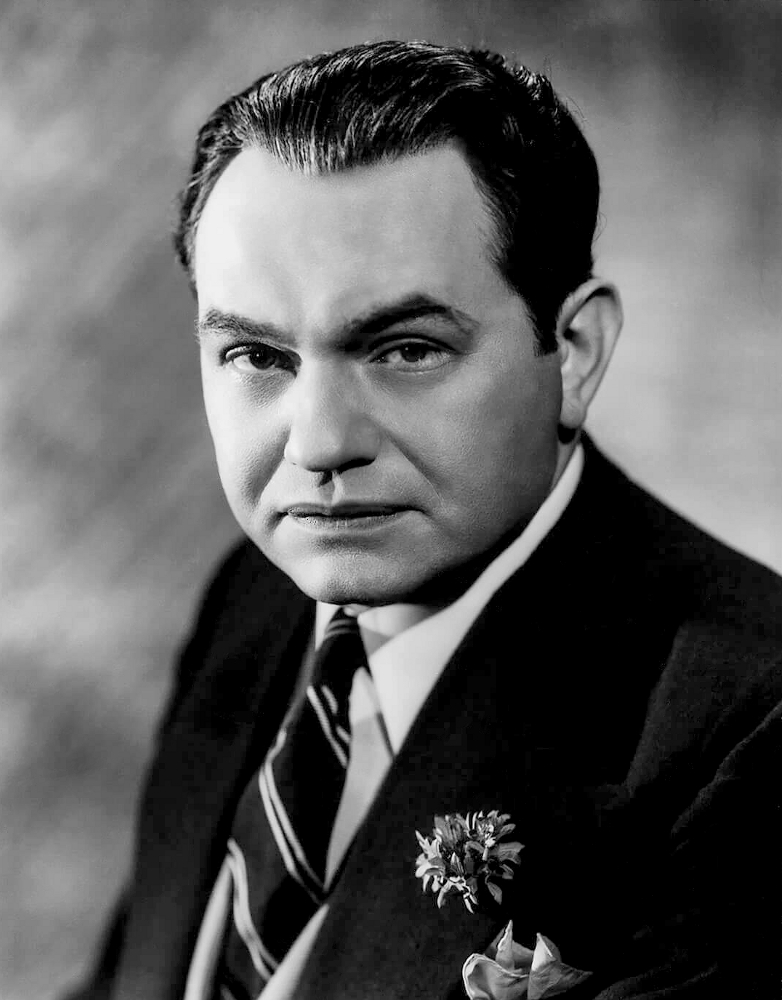
You are handed a face and told it is a verdict. That is what happened to Edward G. Robinson from the moment Rico Bandello snarled his last syllable in 1931 and the American film industry decided, with the quiet efficiency of a bureaucratic stamp, that this Romanian-born Jewish actor with the wide jaw and the compressed vowels had been fully understood. The decision was not announced. It never is. It simply calcified across casting calls, contract renewals, and studio memos until the man became a category.
Frantz Fanon, writing in 1952 in “Black Skin, White Masks,” described what he called the epidermal racial schema — the process by which a dominant culture arrests a body inside a fixed meaning, stripping it of the capacity to generate new significations. Fanon was writing about race and colonial power, but the mechanism he identified is not confined to those coordinates. It operates wherever a body is perceived as non-normative, wherever a face does not match the unmarked template of legible humanity that a culture has designated as neutral. Robinson’s face was not Black, but it was foreign in a decade when foreignness was its own threat category — Semitic in feature, Eastern European in origin, compressed and angular in ways that did not resolve into the clean American geometries of Gary Cooper or James Stewart. Hollywood did not need a theory to know what to do with it. The industry had a practice, and practices are epistemologies in disguise.
What is truly at stake in typecasting is not aesthetic laziness but cognitive control. When a studio locks an actor into a single register of meaning, it is performing an act of knowledge management: it is deciding what this particular body is permitted to signify and, more precisely, what it must be prevented from meaning. Robinson’s range was extensively documented by anyone who worked beside him — his preparation was legendary, his emotional architecture in quieter films like “The Woman in the Window” revealed a man capable of portraying paralysis, self-deception, and moral disintegration with a subtlety that required no violence to justify the camera’s attention. But range, in the Hollywood epistemology of the 1930s and 1940s, was a privilege distributed according to which faces were considered to contain multitudes by default. Others were required to earn legibility one genre at a time, and the debt was never retired.
The deeper irony is that Robinson’s menace was itself a construction that required extraordinary craft to sustain. Screen danger is not a natural property of any face; it is a performance of expectations. What the industry read as inherent threat was in fact a highly technical achievement, and by rewarding him exclusively for producing it, the studios were simultaneously exploiting his labor and using that labor as evidence for the very stereotype that justified his confinement. The trap was self-sealing. The better he was at playing danger, the more dangerous he was declared to be by nature, and the narrower the space available to him became.
This is the epistemological cruelty that Fanon’s framework illuminates: the fixed identity is not merely a cage imposed from outside, it is fed by everything the person does to survive within it. Every performance Robinson gave that succeeded on Hollywood’s terms became fresh ammunition for the argument that this was all he was. The HUAC hearings that temporarily destroyed his career in the late 1940s were only the most explicit version of this logic — a political apparatus confirming what the cultural apparatus had been quietly asserting for two decades, that Robinson was a man whose complexity posed a structural problem, and that the cleanest solution was to ensure he remained, in the industry’s imagination, perpetually and only one thing. What Robinson actually was — a collector of Cézanne and Renoir, a man who read Spinoza, who delivered radio addresses against fascism in five languages — existed in a parallel register that the camera was never quite permitted to reach.
🎬 The Golden Age of American Cinema and Its Icons
Edward G. Robinson stands as one of the most commanding presences in classic American cinema, a figure whose intensity and moral complexity shaped the very DNA of Hollywood storytelling. His career unfolded across the golden decades of noir, gangster films, and social drama, placing him alongside a constellation of unforgettable screen legends. This editorial block explores the cultural and cinematic world that surrounded Robinson and gave birth to an era of filmmaking that still resonates today.
Humphrey Bogart and the face of American cinema
Humphrey Bogart and Edward G. Robinson represent two faces of the same American myth: the man cornered by circumstance, fighting for survival in a world that rarely rewards virtue. Bogart’s weathered screen presence defined the moral ambiguity of Hollywood noir in ways that still influence filmmakers and actors today. Exploring Bogart’s career means understanding the visual language and narrative codes that classic American cinema used to examine the human soul.
GO TO THE SELECTION: Humphrey Bogart and the face of American cinema
Peter Lorre and the art of the unsettling villain
Peter Lorre and Edward G. Robinson frequently shared the screen, creating some of the most electrically charged moments in Hollywood history, particularly in their collaborations within the crime and noir genres. Lorre’s ability to embody unsettling menace through subtle gesture and trembling vulnerability made him a unique counterpoint to Robinson’s explosive authority. Together they illuminate the extraordinary depth of character acting that defined the classical Hollywood studio era.
GO TO THE SELECTION: Peter Lorre and the art of the unsettling villain
John Huston and the art of irregular cinema
John Huston’s directorial vision shaped many of the same thematic territories that Edward G. Robinson navigated as an actor: moral ambiguity, the corruption of the American dream, and the tragic dimensions of greed and power. Huston brought a literary intelligence to genre filmmaking that elevated crime cinema into a form of serious artistic inquiry. His irregular, unconventional approach to narrative and character remains a touchstone for understanding what classic American cinema could achieve at its most ambitious.
GO TO THE SELECTION: John Huston and the art of irregular cinema
Existentialist Noir: History and Meaning
The existentialist noir tradition provides one of the richest intellectual frameworks for understanding the moral universe inhabited by actors like Edward G. Robinson, where guilt, fate, and identity collide under the harsh glare of studio lighting. Existentialist noir drew on European philosophical currents to give American genre filmmaking a philosophical depth that transcended mere entertainment. Tracing this tradition reveals how Robinson’s most powerful performances tapped into fundamental questions about human freedom and self-deception.
GO TO THE SELECTION: Existentialist Noir: History and Meaning
Discover Classic and Independent Cinema on Indiecinema
If the world of Edward G. Robinson and classic American cinema has sparked your curiosity, Indiecinema streaming is your gateway to a broader universe of film history, from Hollywood’s golden age to the boldest voices in contemporary independent cinema. Stream curated titles that illuminate the art, culture, and human stories behind the screen, and let great cinema continue to surprise you.
👉 EXPLORE THE CATALOG: Watch Indie Films in Streaming
A vision curated by a filmmaker, not an algorithm
In this video I explain our vision

