
The desert is not a place; it is a concept. Cinema has often used it as a stage for colossal adventures, from Lawrence of Arabia to Dune—and you will find those canonical masterpieces here. But the true cinematic desert, the one that pulses in the works of great auteurs, is something else. It is a character, a philosophical antagonist, a mirror.

Auteur cinema does not use the desert to show adventure; it uses it to reveal the void. As Michelangelo Antonioni intuited, the desert is the perfect metaphor for the emotional aridity and incommunicability of modern man. It is the place where the superfluous is literally burned away by the sun, leaving characters naked before their own psyche. It is the only honest landscape for an era that has lost its center.
This space is never neutral. It is what Gilles Deleuze and Felix Guattari, analyzing the work of Pier Paolo Pasolini, would define as “smooth space.” It is the opposite of the “striated space” of the city, the factory, of bourgeois and capitalist society, which is controlled, geometric, and rational. The desert is the place of the nomad, the wanderer, the “barbaric” (in the Pasolinian sense, as primitive and pure). It is the space where the logic of profit and social structures collapse, allowing myth, primordial violence, or madness to emerge.
This definitive guide to films set in the desert is a path that unites the fundamental pillars, from the most famous films to the most courageous independent productions. We will explore works that have used the desert not as a backdrop, but as a tool for radical inquiry. Our journey will not be a simple list, but a path through the different functions this landscape fulfills: from the psychedelic deconstruction of the Western to the existential void of the auteur masters; from the brutal frontier of the Outback to the political sands that hold historical memory, to the unexpected discovery of an oasis of community.
El Topo (1970)
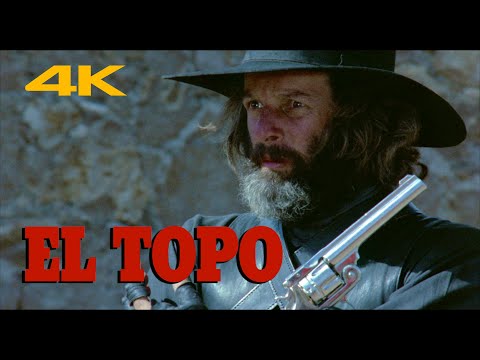
A gunman dressed in black (El Topo) traverses a surreal desert on an allegorical journey to defeat four master gunslingers and achieve enlightenment. After failing, he is reborn as a crippled holy man to free a community of outcasts living underground.
Alejandro Jodorowsky’s El Topo is the film that literally generated the “Acid Western” genre. The desert here is not Arizona or Mexico; it is a purely dreamlike and metaphysical landscape, a state of the soul. Jodorowsky uses extreme violence, Christian symbolism, and Eastern philosophy to transform the cinema and arid landscape into a sacred and blasphemous text. El Topo’s journey through the sand is not a quest for revenge, but a mad and desperate search for enlightenment that passes through the total destruction of the ego, represented by the desert’s empty immensity.
The Holy Mountain (1973)

A thief who resembles Christ wanders through a decadent city before being guided by an Alchemist (Jodorowsky himself). He joins seven powerful individuals representing the planets and, after freeing themselves of their earthly possessions, they embark on a journey into the desert to climb the Holy Mountain and obtain immortality.
If El Topo was the Old Testament of the Acid Western, The Holy Mountain is the psychedelic New Testament. The desert, in the first part of the film, is the place of initial purification. But it’s the final journey to the mountain—a vertical desert—that defines the film. Jodorowsky uses this mystical arthouse films desert landscape as the stage for the last, great deconstruction: that of cinema itself. The famous final breaking of the fourth wall would not be possible without the desert, the place that, by its nature, exposes all illusion.

Dead Man (1995)

William Blake (Johnny Depp), an accountant from Cleveland, travels to the frontier town of Machine. After a violent encounter, he is mortally wounded and flees into the desert/forest. There he meets a Native American named “Nobody,” who believes Blake is the reincarnation of the poet William Blake and prepares him for his journey into the spirit world.
Jim Jarmusch calls his film an “acid western,” and he’s right. Although set more in the forests of the Pacific Northwest, its spirit is desertic: it’s a landscape of desolation and transformation. It is one of those atypical westerns that inverts every cliché. The desert here is an ontological space where civilization (the industrial capitalism Blake represents) dies and poetry (blood) takes over. Blake’s journey is a descent into the void, an example of cinema and isolation that becomes a spiritual journey guided by Neil Young’s hypnotic score.
The Shooting (1966)

A former bounty hunter (Warren Oates) is forced by a mysterious woman (Millie Perkins) to accompany her across a ruthless desert. They are joined by an enigmatic gunslinger (Jack Nicholson). The mission is dark, the tension palpable, and the journey turns into an existential nightmare of survival in the desert.
Filmed back-to-back with Ride in the Whirlwind on a shoestring budget, Monte Hellman’s The Shooting is perhaps the first and purest “Acid Western,” a cornerstone in the essential acid western films list. It precedes El Topo and establishes the template: the desert as a space of paranoia and futility. Unlike Jodorowsky, Hellman doesn’t use surrealism; he uses extreme realism to create a “bad trip.” The heat, thirst, dust, and infinite horizon become instruments of psychological torture. The desert offers no redemption, only a nihilistic disintegration.
The Last Movie (1971)

After an American film crew finishes shooting a western in a Peruvian village, the stuntman Kansas (Dennis Hopper) decides to stay. He watches the locals who, not understanding fiction, recreate the film’s scenes using fake cameras made of branches, but using real violence.
This is the film that destroyed Dennis Hopper’s career after the triumph of Easy Rider. It is a work of total deconstruction. The Peruvian desert becomes the cemetery of the western and of cinematic illusion. Hopper, in a meta-cinematic delirium, explores the tension between the real and the imaginary. The cinema and arid landscape here is the place where cinema (the “machine” of Hollywood) infects and destroys “primitive” reality, leaving only the empty shell of a misunderstood ritual.
A vision curated by a filmmaker, not an algorithm
In this video I explain our vision
Zabriskie Point (1970)

A radical student (Mark) fleeing a protest gone wrong and a young secretary (Daria) traveling through the desert to meet her boss at a luxury villa, meet in Death Valley. Their brief encounter in the arid landscape culminates in an apocalyptic and metaphorical finale.
Michelangelo Antonioni’s only American film is a frontal assault on consumerism. The desert (Death Valley) is presented as the absolute antithesis of American civilization, described as a hell of concrete, billboards, and fetishes. The desert is the only space of purity, a “void” where the two protagonists can meet. The famous love-making scene among the dunes and, above all, the final explosion of the villa—a conceptual act of terrorism—represent the utopian refusal and cathartic destruction of the society of commodities.
Paris, Texas (1984)

Travis (Harry Dean Stanton), a catatonic man, re-emerges from the Texas desert after being missing for four years. He reunites with his brother and son, embarking on a road trip to find his wife and rebuild his own memory.
Wim Wenders‘ masterpiece opens with one of the most iconic images of the cinematic desert: Travis in a tattered suit under an immense sky. The desert of the American Southwest is the site of his dissociation, a self-imposed amnesia. For Wenders, the arid landscape is the space of lost memory. Travis’s journey is not into the desert, but out of it, a slow and painful process of transformation to find language again and reconnect with the past. The breathtaking photography turns Texas into an existential purgatory.
Gerry (2002)
![Gerry [2002] Gus Van Sant](https://blog.indiecinema.co/wp-content/plugins/wp-youtube-lyte/lyteCache.php?origThumbUrl=https%3A%2F%2Fi.ytimg.com%2Fvi%2Foz_k0E-qmm8%2F0.jpg)
Two young friends, both named Gerry (Matt Damon and Casey Affleck), decide to take an impromptu hike in the Death Valley desert. They leave the trail and become hopelessly lost. The film follows their slow physical and psychological disintegration in a merciless environment.
Gus Van Sant’s Gerry is the most radical example of cinema and isolation. It is a minimalist, almost silent work that takes Antonioni’s aesthetic to its extreme consequences. The desert here is an abstract labyrinth, a place without coordinates that compresses time. Van Sant focuses only on light and movement, stripping the narrative of every element except pure survival in the desert. It is one of those experimental films desert landscape that becomes a transcendental experience, where the landscape forces an “inner gaze” and confronts us with our fragile existence.
Suna no Onna (Woman in the Dunes) (1964)

An entomologist on vacation to collect insects in a vast coastal desert misses the last bus. The villagers shelter him in a hut at the bottom of a deep sand pit, where a widow lives. He soon discovers he is a prisoner, forced into the Sisyphean task of shoveling the sand that threatens to engulf the house.
A masterpiece of the Japanese New Wave, Suna no Onna by Hiroshi Teshigahara is perhaps the greatest existential horror film ever made. The desert is not a wide expanse, but a claustrophobic prison. The sand, photographed in almost microscopic close-ups, is a living, suffocating entity. The film is an allegory of the human condition, a reflection on the terrifying futility of existence. The sand desert becomes a metaphor for our “shoveling” lives, trapped in absurd and endless labor.
Fata Morgana (1971)

Shot in the Sahara Desert and the Sahel, Werner Herzog’s film is an experimental, science-fiction documentary. Divided into three parts (“Creation,” “Paradise,” “The Golden Age”), it shows landscapes distorted by heat, carcasses, solitary inhabitants, and mirages, all narrated with the Mayan creation myth.
Herzog is drawn to the wild and extreme places of the earth. Fata Morgana is not a documentary about Africa; it is a documentary about a distorted vision of the planet. The desert, with its mirages, is the perfect place for Herzog to contemplate the “illusion of reality.” It is cinema and arid landscape pushed to its perceptual limit. The images of a plane landing and taking off endlessly and the soundtrack mixing Leonard Cohen and sacred music create an alien planet atmosphere, a pre-creation or post-apocalyptic landscape.
Walkabout (1971)

After their father goes mad and commits suicide during a picnic in the desert, two white siblings (a teenage girl and a young boy) are abandoned in the Outback. They struggle to survive until they meet an Aboriginal
boy in the midst of his “walkabout” (rite of passage), who helps them.
A seminal work of the Australian New Wave, Nicolas Roeg’s Walkabout is a poetic and brutal meditation on the disconnection between modern life and the natural world. The Outback, the protagonist of many australian outback independent films, is here a “desert of the mind,” an Eden as splendid as it is dangerous. The film is built on the mystery of communication: the “civilized” children are completely helpless in the landscape, while the indigenous boy is in total harmony with it. The tragic ending, resulting from a fatal cultural misunderstanding, is a condemnation of civilization.
Wake in Fright (1971)

A young teacher, John Grant, gets stranded in a remote Outback mining town (“The Yabba”) while en route to Sydney. Over five days, he is dragged by the aggressive “hospitality” of the locals into a vortex of alcoholism, gambling, and brutal violence, losing all trace of his identity.
For decades considered a lost film, Wake in Fright is perhaps the most ferocious critique of Australian toxic masculinity ever filmed. The Outback is not just a desert; it’s a moral desert. The town of Yabba is a hell where culture is reduced to drinking, fighting, and hunting. The film transforms social pressure into a horror vehicle. The film’s apex, the infamous and real kangaroo hunt, shows survival in the desert not as a struggle against nature, but as an immersion into human brutalization.
The Proposition (2005)

In the Australian Outback of the 1880s, a police captain captures the outlaw Charlie Burns (Guy Pearce). He offers him an impossible proposition: to save his younger brother from the gallows, Charlie must find and kill his older brother, the notorious and psychopathic Arthur Burns (Danny Huston).
Written by musician Nick Cave, The Proposition is an “atypical western” of lyrical brutality. This is the Outback as hell on earth, an arid landscape that reflects the total absence of morality. There is no romance of the frontier, only dust, oppressive heat, and a racist, cyclical violence. The score by Cave and Warren Ellis doesn’t accompany the action but seems to emerge from the land itself, a funeral dirge for the unpleasant truths upon which Australia was built.
Sweet Country (2017)

Australia, 1929. Sam Kelly, an Aboriginal stockman, kills the white landowner Harry March in self-defense. Sam and his wife flee across the relentless Outback desert, pursued by a posse led by Sergeant Fletcher (Bryan Brown).
Indigenous director Warwick Thornton uses the western genre to tell a story of racial injustice. The Outback, the “sweet country” of the title, is ironic: it is a breathtakingly beautiful landscape but morally corrupt. For the white men, it is property to be defended. For Sam, it is a place to hide, but he knows there is no hope. The desert, in this powerful film, is the silent witness to a foundational crime that has yet to be atoned for.
The Night of Counting the Years (Al-mummia) (1969)

Based on a true story from 1881, the film follows Wanis, the son of the chief of a Bedouin tribe that for generations has secretly plundered a cache of pharaonic mummies. After his father’s death, Wanis is torn between loyalty to the tribe’s tradition and the desire to protect Egypt’s heritage.
Considered the most important Egyptian film ever made, Al-mummia is a solemn meditation on national identity. Shot in the Luxor desert, the film has a statuesque and dreamlike quality. This middle eastern cinema desert setting film uses the arid landscape as a guardian of history. The conflict is between the market value of the artifacts and their symbolic value for the nation. The desert is a sepulcher that poses the fundamental question: to whom does the past belong?
Timbuktu (2014)

In the Malian city of Timbuktu, which has fallen under the control of jihadist fundamentalists, daily life is crushed by absurd new laws: music, laughter, and soccer are banned. In the nearby dunes, the herdsman Kidane lives peacefully with his family, but a tragic accident drags him into the chaos of the new regime.
Abderrahmane Sissako’s masterpiece is a poetic and heartbreaking response to fanaticism. The Sahara Desert, traditionally a space of nomadic freedom and tolerant Islam, is “occupied.” Sissako contrasts the serene immensity of the dunes with the pettiness and absurdity of the “reign of terror.” The most powerful scene—boys playing a soccer match with no ball—uses the arid landscape to show the irrepressible human spirit.
Daratt (Dry Season) (2006)

In Chad, after the end of the civil war, the government has granted amnesty to all war criminals. 16-year-old Atim is sent by his grandfather to kill Nassara, the man who killed his father. Atim finds Nassara, who now runs a small bakery, and is hired as an apprentice, planning his revenge.
Chadian director Mahamat-Saleh Haroun creates a tense, minimalist drama in the dusty streets of N’Djamena. This is one of the great north african films set in sahara (Sahel region) that uses the landscape as a character. It is the “dry season” (Daratt) that gives the film its title, a time of waiting, of dust, and of wounds that will not close. The film explores the cycle of revenge and the difficult possibility of forgiveness in a traumatized nation.
Theeb (2014)
![THEEB Official Trailer - Oscar Foreign Film Nominee [HD]](https://blog.indiecinema.co/wp-content/plugins/wp-youtube-lyte/lyteCache.php?origThumbUrl=https%3A%2F%2Fi.ytimg.com%2Fvi%2FZAMrNcUoE_o%2F0.jpg)
In the Ottoman province of Hijaz in 1916, the young Bedouin Theeb (“Wolf”) lives a traditional existence. His life is upended when his older brother agrees to guide a British officer and his guide across the dangerous pilgrimage desert. Theeb secretly follows them, embarking on a journey of survival in the desert.
Filmed entirely in the Jordanian desert, Theeb is a “Bedouin Western” that looks at history (WWI, the Arab Revolt) from the bottom up, through the eyes of a child. The desert here is a space of ancestral tradition (Bedouin hospitality) invaded by modern, external forces (the railway, mercenaries). It is a coming-of-age story where Theeb must learn to survive in a world where the old rules of loyalty no longer apply.
Nostalgia de la Luz (Nostalgia for the Light) (2010)

In the Atacama Desert in Chile, the driest place on earth, astronomers scan the cosmos searching for the origins of the universe. At the foot of their telescopes, a group of elderly women digs into the same earth, searching for decades for the remains of their relatives, political ‘desaparecidos’ buried there by the Pinochet dictatorship.
This poetic documentary by Patricio Guzmán is one of the most profound reflections on latin american cinema atacama desert films. Guzmán creates a metaphysical connection between two seemingly different searches. The aridity of the Atacama Desert, which allows astronomers a clear view of the galaxies, is the same aridity that preserves the human remains intact. The desert becomes an archive of history and a telescope aimed at the past, a place where the search for cosmic truth and the search for political truth become the same, heartbreaking thing.
Bagdad Café (1987)

Jasmin, a German tourist, argues with her husband and leaves him in the middle of the Mojave Desert. She walks to the dilapidated Bagdad Café, a motel-diner run by the despotic and exhausted Brenda. Initially suspicious of each other, the two women, along with a motley community of eccentrics, create an unexpected bond.
Percy Adlon’s cult film is the anti-Zabriskie Point. Filmed in the same Mojave Desert, it doesn’t use it as a metaphor for the void, but as a canvas for rebirth. The film is a magical comedy about female friendship and the creation of a surrogate family. The arid landscape of the desert, with its unreal light, is the perfect backdrop for Jasmin’s magic tricks. Bagdad Café is a film about acceptance, transforming a “non-place” forgotten by civilization into a true oasis of connection.
A vision curated by a filmmaker, not an algorithm
In this video I explain our vision

