
The Man Before the Myth
You have heard the name so many times that you have stopped hearing the man. Antonius. Marcus Antonius. Born around 83 BCE into a family that combined aristocratic lineage with spectacular dysfunction — his grandfather was the great orator Marcus Antonius, killed by Marian partisans in 87 BCE, his father a naval commander who died in relative obscurity off the coast of Crete, his mother a woman of formidable character who would eventually remarry into the circle of Caesar’s allies. The family tree was prestigious enough to matter and damaged enough to require repair. That combination alone explains more about what Antony became than any number of dramatizations.

His early adulthood was not promising by Roman senatorial standards. Ancient sources, including Plutarch writing in his Parallel Lives around 100 CE, describe a young man given to excess, debt, and volatile companionship — precisely the qualities that Roman moralists catalogued as signs of future ruin. What those same moralists consistently underplayed was the degree to which such a youth in the late Republic was not anomalous but structural. The Roman elite in the final decades before Augustus produced an extraordinary concentration of brilliant, reckless, heavily indebted young men, because the system itself had become a machine for generating exactly that type. The institutions rewarded audacity, the costs of political competition were ruinous, and the social contract between discipline and reward had visibly broken down. Antony was not an exception to his era. He was its most legible symptom.
His formation as a soldier came through the eastern campaigns, first in Syria and Judaea under Aulus Gabinius in the late 50s BCE, where he distinguished himself enough to be noticed. But the real transformation came through Caesar. When Antony attached himself to Julius Caesar’s orbit and served as a military tribune, then as quaestor and legate in Gaul and across the following decade, he was not merely climbing a career ladder — he was absorbing a model of command that fused personal charisma with institutional authority in ways the traditional Roman cursus honorum had never quite anticipated. Caesar’s genius was partly organizational and partly theatrical, and Antony proved an apt student of both registers.
His election as tribune of the plebs in 49 BCE placed him at the precise hinge point of the Republic’s final crisis. When the Senate moved against Caesar and Antony, along with his colleague Quintus Cassius Longinus, fled Rome to join Caesar’s camp, their departure was not simply a political maneuver — it was the legal fiction that gave Caesar his justification for crossing the Rubicon. Antony’s body, his flight, his presence in the enemy camp, became the constitutional pretext for civil war. History rarely announces this clearly how much it depends on individuals who are not yet the protagonist of any story.
He served as Caesar’s Master of the Horse during the dictator’s absence in 47 BCE, governing Italy with a heaviness of hand that generated both resentment and grudging respect. By 44 BCE he was consul, Caesar’s colleague in the highest office of the Roman state, a position from which he watched the assassination on the Ides of March from a proximity that has generated speculation ever since. Nicolaus of Damascus, writing shortly after the events, places Antony outside the Theatre of Pompey when the knives came out — close enough to have known, far enough to have survived. Whether that distance was calculation or coincidence is a question the evidence refuses to settle cleanly.
What is certain is that the man who stood at Caesar’s funeral three days later, holding the will, speaking to a crowd that was already beginning to riot, was not yet a legend. He was a forty-year-old Roman politician, expert in violence, fluent in power, standing in the wreckage of a world whose rules had just been permanently suspended.
Bruto
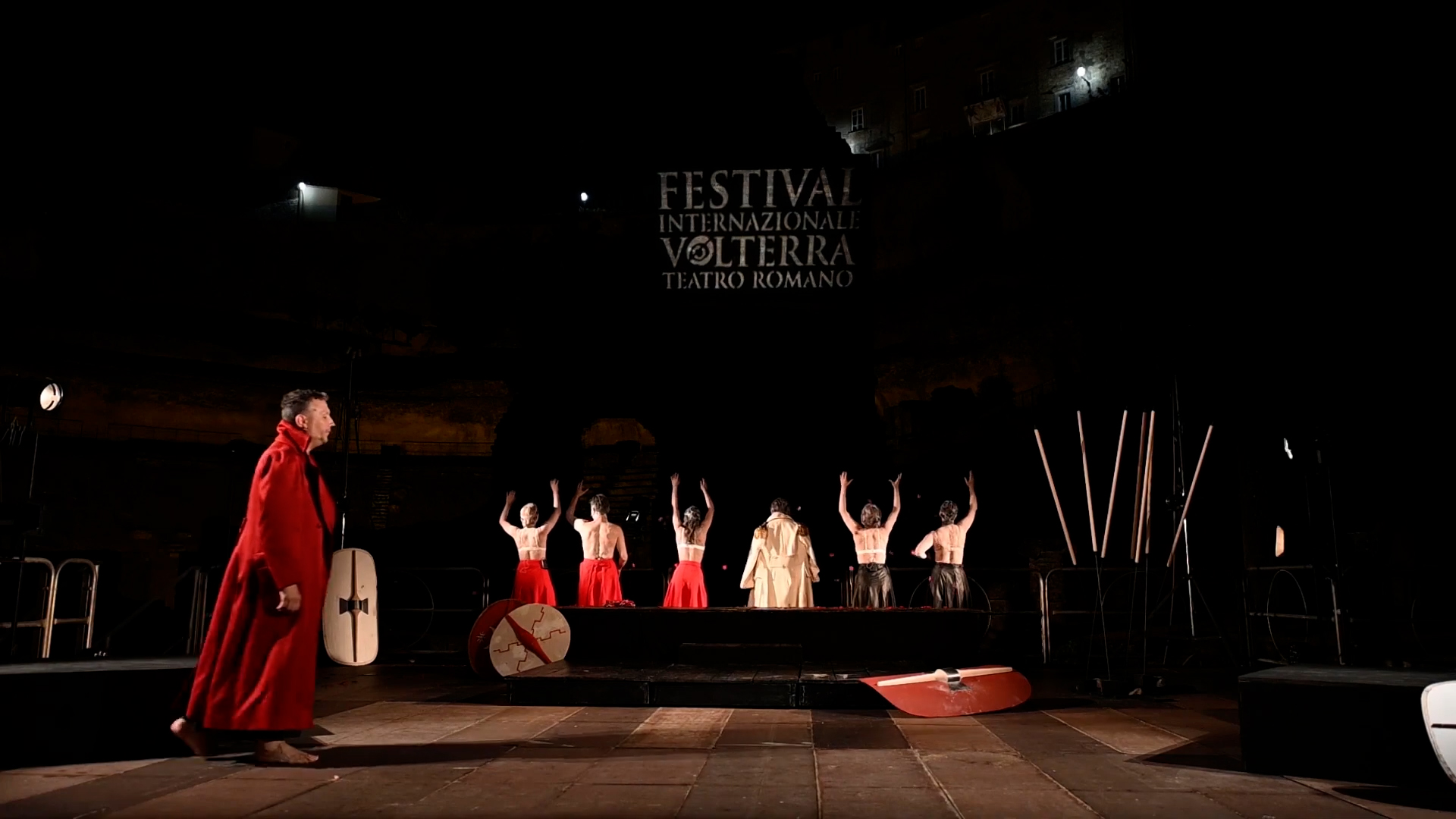
Theatrical show, by Nicola Fano e Simon Domenico Migliorini, Italy, 2022
The protagonist is Brutus, the celebrated instigator, along with Cassius, of the conspiracy of the Ides of March in 44 B.C., the assassin of Caesar. He enters the stage calling loudly for Cassius, his alter ego: we find ourselves in Philippi, where both conspirators have already fought and lost against the troops of Marcus Antonius, who has become the guarantor of justice towards Caesar and Rome. The story written in books materializes on stage with the words of Shakespeare, infinite, immortal, eternal words. The spectator listens, a symbolic battlefield and dead bodies appear before him, on which Brutus, defeated, wounded, almost dying, crawls and invokes and looks around bewildered, shocked at the appearance of the ghost of Caesar.
Brutus is Simone Migliorini, who speaks, moans, shouts, modulates those phrases of Shakespearean tragedy and makes them his own, as they have been generated, also in the adaptation from Shakespeare's "Julius Caesar" by the playwright Nicola Fano, who worked on the text focusing on the most controversial figure, that of the leader of the conspirators, the assassin of Caesar, specifically for Migliorini, who has studied and deepened the text and characters. But here Brutus, as the show unfolds, also becomes Macbeth, also Henry V, both tyrants, both assassins, soldiers, courageous or cowardly, great or infamous, in a flow of words and famous phrases, spoken, planted, recited, whispered, shouted by Simone Migliorini who with this performance confirms himself as a high-level interpreter. What strikes is the protagonist's ability to transform himself, from time to time, from Brutus into other characters, even into Marcus Antonius. A change of costume is enough for him, on stage. And it is here that Brutus looks into Antony's eyes and Antony scrutinizes Brutus, doubled by the same actor in a virtuosity that is extremely congenial to him. The actor is capable of being, at the same time, the one who kills and the one who exalts the killed; the one who is prey to doubts and remorse but is proud of his love for Rome and its freedom, and the one who exalts and celebrates the slain Caesar before the people, holding his will in his hand, in the famous Oration that has always been the flagship of the greatest actors.
LANGUAGE: Italian
SUBTITLES: English, Spanish, French, German, Portuguese
Rome's Architecture of Loyalty and Betrayal
You are sitting across from someone who has just lent you money you cannot repay, and they are smiling at you, and you understand, in that moment, that the smile is the contract.
The late Roman Republic ran on exactly this arrangement, only the sums were larger and the smiles were public. The system historians now call the patronage network — what Ronald Syme described in his 1939 work “The Roman Revolution” as a web of “personal attachments and obligations” rather than ideological alignments — was not a corruption of Roman political life but its actual architecture. A senator’s power was not measured in votes or in legislation but in the number of men who owed him something they could not afford to repay. Cicero understood this. Caesar understood it more ruthlessly. Antony, who had grown up watching both men operate, understood it as a physical truth, the way a soldier understands terrain.
What made this system structurally treacherous is that it required betrayal to function. The Roman word “fides” — usually translated as loyalty or faithfulness — carried within it a directional charge. You owed fides upward, toward the patron who had protected you, funded your campaigns, interceded with magistrates on your behalf. But the moment a more powerful patron extended his hand, the older bond did not simply weaken; it inverted. To remain loyal to a lesser protector when a greater one called was not virtue but miscalculation, and miscalculation in Rome was a form of moral failure. Betrayal was not an aberration in this system — it was the system’s primary mode of advancement, dressed in the language of necessity.
Antony’s trajectory from Caesar’s lieutenant to independent power broker cannot be read outside this logic. His debts were legendary and documented — Cicero, in the “Philippics” of 44 BCE, catalogued them with prosecutorial relish, describing Antony as a man who had consumed his inheritance, borrowed against his future, and sold political favors to cover what he could not otherwise sustain. But Cicero’s contempt was also a kind of inadvertent confession, because the machinery he was describing was one he himself had operated. The difference between a creditor and a debtor in Roman politics was often simply a question of timing.
Military allegiance added a second layer of transactional complexity. The reforms that Gaius Marius had pushed through in 107 BCE transformed the Roman army from a citizen militia tied to property ownership into a professional force whose soldiers bonded not to the state but to their commanding general, who promised them land, plunder, and a future after discharge. By the time Antony commanded legions in Gaul under Caesar and later in the eastern campaigns, the soldiers he led were not abstractly Roman — they were his men, in the same possessive and personal sense that clients were a patron’s men. Their loyalty was real, but it was real in the way a debt is real: conditional on the creditor’s continued ability to deliver.
This is what makes the period between Caesar’s assassination in March of 44 BCE and the formation of the Second Triumvirate in October of 43 BCE so analytically dense. In those eighteen months, every significant political actor in Rome was simultaneously a patron, a client, and a debtor to multiple competing networks. Octavian, nineteen years old and largely untested, leveraged Caesar’s name as a form of inherited credit. Lepidus held military resources he lacked the charisma to fully command. Antony had experience, armies, and the political intimacy of a man who had stood at Caesar’s side — but experience in a system built on shifting obligations is not stability.
It is proximity to the mechanism — which means proximity to the moment when the mechanism turns.

Shakespeare's Strategic Distortion
You are standing in a theater in 1606, surrounded by a crowd that has just watched a Roman general weep over a dead Egyptian queen, and you understand, without being told, that you are not watching history. You are watching a warning.
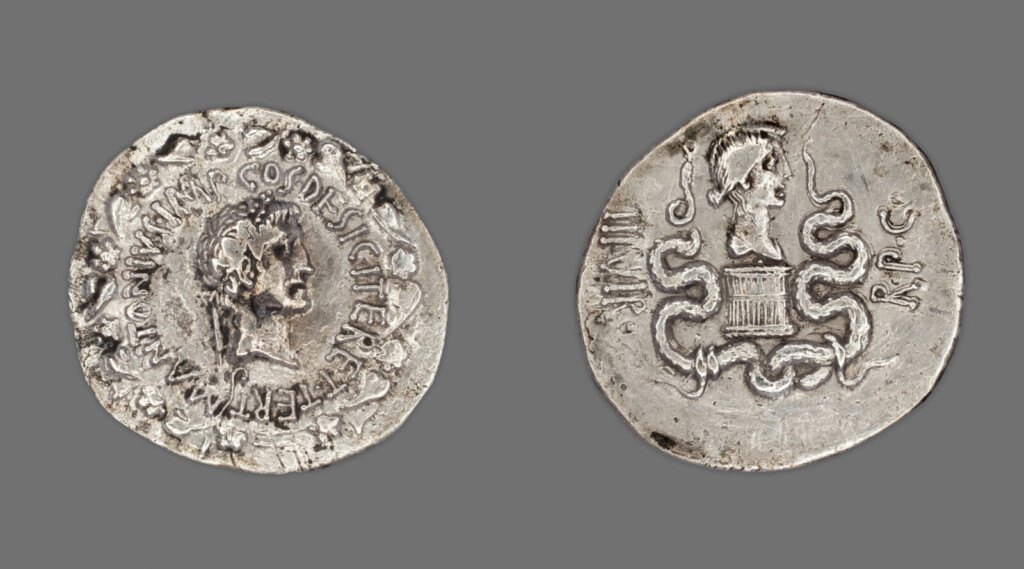
Shakespeare had access to Plutarch’s Lives through Thomas North’s 1579 translation, and he used it the way a surgeon uses a scalpel — selectively, with a destination already decided. The historical Antonius was a man of documented administrative competence who governed the eastern Mediterranean with enough institutional sophistication to mint his own currency, negotiate with Parthian client kings, and sustain a military alliance that held for over a decade. None of that survives the stage. What Shakespeare preserved from Plutarch was the erotic catastrophe, the rhetorical excess, the spectacle of a great man undone by the very qualities that made him magnetic. The pruning was not accidental. It was architectural.
The Elizabethan political unconscious was saturated with anxiety about charisma. The memory of Essex, the Earl who had ridden through London in February 1601 trying to spark a popular revolt on the strength of his personal legend, was barely five years old when Antony and Cleopatra was first performed. A man who could move crowds through the force of his presence alone, who could transform his own biography into political fuel, was not a figure of romance to Elizabeth’s court. He was a threat that needed to be dramatized, examined, and ultimately punished within the safe container of theatrical fiction. Shakespeare gave London that punishment twice: once in Julius Caesar, where Antony’s funeral oration is the most precise anatomy of demagogic technique ever written in English, and once in the later play, where the same man is shown paying the full price for what that technique costs its user.
The funeral oration over Caesar’s body is a masterclass in what the rhetoricians of antiquity called suasoria — the art of making an audience believe they are arriving at conclusions independently when in fact they are being steered by cadence, repetition, and the strategic deployment of silence. “I come to bury Caesar, not to praise him” is the sentence of someone who intends to do nothing but praise him. Every classical scholar in Shakespeare’s audience would have recognized the move. But the genius of the scene is that Shakespeare makes us feel the crowd’s manipulation happening to us in real time, which means he also implicates us in it. The play does not mock the Roman plebeians from a safe distance. It shows us that we are the Roman plebeians.
What changes between Julius Caesar and the later work is the emotional register Shakespeare assigns to Antony’s interiority. The earlier Antony is pure instrument, all tactical intelligence wearing the mask of grief. The later one has been cracked open by something he cannot manage rhetorically, which is the one relationship in his life that does not reward calculation. This is the structural logic of the tragedy: a man whose entire power rests on the ability to perform emotion convincingly meets an emotion he cannot perform, only experience, and it destroys him. Shakespeare did not invent this opposition between reason and passion from nothing. He inherited it from a long tradition of Stoic political philosophy that ran from Cicero through Seneca, both of whom wrote about Antony directly and both of whom would have recognized the archetype immediately. Seneca’s letters, especially the Epistulae Morales composed in the 60s CE, return obsessively to the idea that public greatness sustained by appetite rather than discipline carries within it the seed of its own annihilation.
What the Elizabethan stage accomplished, and what no historian had quite managed before it, was to make that seed visible.
Plutarch's Double Mirror
You are reading what feels like a biography but is in fact a courtroom, and the defendant has been dead for well over a century by the time the verdict is delivered. Plutarch composed his Life of Antony sometime around 100 CE, more than a hundred and thirty years after the battle of Actium, working not from personal memory or eyewitness testimony but from a layered sediment of earlier histories, political memoirs, and the kind of oral tradition that hardens into legend precisely because no one alive can contradict it. The distance is not incidental. It is the condition that makes the project possible.
Plutarch’s Parallel Lives pairs Greek and Roman figures not to write history in the conventional sense but to manufacture a moral gymnasium, a space where exemplary virtue and exemplary failure can be exhibited side by side so that the reader might calibrate their own character against the display. Antony is paired with Demetrius of Macedon, a pairing that announces its thesis before a single sentence of biography has been written: both men were gifted, both men were catastrophically susceptible to pleasure, both men allowed private appetite to consume public responsibility. The structure is the argument. Plutarch was a Platonist who believed that individual biography was the most legible surface on which the soul’s condition could be read, and he designed his pairings accordingly, which means that Antony arrives in the text already pre-sentenced, his life already arranged into the shape of a cautionary descent.
What makes this philosophically complex rather than merely propagandistic is that Plutarch was writing for an audience that still lived inside Roman imperial culture, which had by his time entirely normalized the Augustan settlement. The readers of the Lives had inherited a world in which Octavian’s victory was not just a military fact but a cosmological one, the moment at which Roman history corrected itself. To write Antony as a man whose greatness was real, whose charisma was genuine, whose military courage was historically documented, and yet to insist that he nevertheless failed the deeper test of rational self-governance, was to perform a service that no crude villain story could accomplish. Plutarch needed Antony to be sympathetic because only a sympathetic failure demonstrates the fragility of virtue under pressure.
The figure of Hercules enters Plutarch’s account not as metaphor but as genuine theological lineage, since the Antonian family claimed Herculean descent, and Plutarch uses this ancestry to dramatize the internal war within his subject’s character. The mythological tradition described Hercules as a man of exceptional power who was periodically unmanned by passion, enslaved by Omphale, driven mad, and it is against this template that Plutarch reads Antony’s relationship with Cleopatra. The queen is not, in Plutarch’s hands, an independent sovereign or a geopolitical actor making calculated alliances; she is the mechanism by which Antony’s Herculean inheritance collapses into its shadow. This is not misogyny incidental to the portrait; it is load-bearing, because without the feminizing force of eastern desire, Plutarch has no philosophical engine for the decline he needs to narrate.
Scholars including Christopher Pelling, in his 1988 commentary on Plutarch’s Life of Antony, have demonstrated that Plutarch selectively amplified and invented details to sharpen the moral contrast, smoothing away historical contradictions that might complicate the parabolic arc. The famous scene of Antony abandoning his fleet at Actium to follow Cleopatra’s retreating ships is presented as a moment of erotic surrender overriding military reason, yet ancient naval accounts suggest the tactical picture was far murkier. Plutarch chose the cleaner story because the cleaner story teaches the cleaner lesson, and the lesson was always the real destination.
What the reader holds in their hands, then, is a mirror — but the mirror has been ground and polished to a specific curvature, so that certain features of the face looking into it are enlarged beyond their actual proportion while others are quietly erased.
Cleopatra as Narrative Function
You have read the story before, even if you have not read it: a powerful man undone by a woman from the wrong part of the world. The mechanics of that story are so old and so thoroughly embedded in Western narrative that most readers encounter it not as an argument but as weather — something ambient, simply the way things are. Cleopatra VII Philopator, the last sovereign ruler of a dynasty that held Egypt for nearly three centuries, becomes in this telling not a political actor in her own right but an explanation for a man’s collapse. Her intelligence, her command of nine languages recorded by Plutarch in the Life of Antony, her fiscal and military governance of a kingdom Rome desperately needed — all of it dissolves into the simpler service of explaining why Marcus Antonius lost.
The rhetorical operation required for this is quite precise. Cleopatra must first be rendered as a force of nature rather than a strategist. Plutarch himself, writing in the late first century CE, performs this transformation with a kind of involuntary honesty: he acknowledges her political cunning in the same sentences where he frames it as seduction, as if the two could not be separated without the architecture of the story collapsing. What she calculates becomes what she emanates. Her choices become her body. This is not incidental carelessness — it is the load-bearing grammar of a tradition that needs her agency to exist only as a trap.
What that tradition is protecting, underneath the surface drama of desire and defeat, is a particular theory of Roman male identity. The virtus that organized Roman self-understanding — civic courage, martial discipline, the conquest of private appetite in service of collective authority — required a constitutive outside. Octavian’s propaganda machine understood this with brutal sophistication. The war against Antony was framed not as a civil war, which it plainly was, but as a war against a foreign queen. Dio Cassius records this consciously constructed inversion. Rome did not fight a Roman general who had made different political choices; it fought the East itself, embodied in a woman. Antony’s defeat could then be narrated as rescue rather than triumph, and his prior power as proof that corruption operates from outside the Roman self, never within it.
The colonial logic folded into this narrative survived the fall of Rome by centuries, resurfacing wherever Western empires needed to explain their own moral anxieties about conquest and contact. Edward Said‘s Orientalism, published in 1978, does not mention Cleopatra at length, but the epistemological structure he names — the feminization of the East as simultaneously desirable and dangerous, irrational and excessive, always in need of Western ordering — fits the Antony-Cleopatra tradition as if it had been designed to describe it. Egypt in Western historical writing is not a place with institutions, debts, alliances, and grain supply chains: it is an atmosphere, a climate of the soul. And Cleopatra is its most concentrated symptom.
What this arrangement forecloses is any account of Antony’s actual political decisions as political decisions. His choice to base his eastern strategy in Alexandria, his realignment of territorial administration, his conflict with Octavian over the inheritance of Caesar’s network — these can be examined as rational responses to specific pressures inside a system where no settlement was stable. But once Cleopatra has been installed as the explanatory principle, the political reasoning disappears into the personal. His losses become her fault; his choices become her will working through his weakness. The woman absorbs the complexity so that the man can remain, even in failure, a simpler and more legible figure — defeated from outside, not contradicted from within.
And that legibility is the real product being manufactured, across Plutarch and Shakespeare and every dramatization since, because a man destroyed by a woman is a tragedy, but a man destroyed by his own political miscalculations inside an unwinnable structural crisis is just history.
A vision curated by a filmmaker, not an algorithm
In this video I explain our vision
The Octavian Propaganda Machine

You are reading a man who never existed — or rather, a man whose existence was carefully edited into something useful for someone else’s purposes. The Mark Antony who reaches us through the centuries is not a historical figure in any straightforward sense; he is a political instrument, assembled after his death by the hands of the man who needed him to be monstrous. When Octavian returned to Rome in 29 BCE and staged his triple triumph through the streets, the celebration was not merely military. It was ontological. He was not just announcing a victory — he was manufacturing the only version of the war that would survive.
The mechanism was total and it moved on several frequencies simultaneously. Legal erasure came first: the damnatio memoriae directed against Antony’s image did not simply remove his likeness from public spaces but instructed future Romans in what was permissible to remember. Then came the poets, and this is where the operation becomes genuinely chilling, because Virgil’s Aeneid, completed around 19 BCE, does not mention Antony by name at the moment it most needs to destroy him. In Book Eight, the shield of Aeneas depicts the Battle of Actium as a cosmic struggle between Roman order and Eastern chaos, between the clean geometry of Octavian’s fleet and the shameful procession of a queen with her barbaric gods. The man who actually commanded the opposing fleet — a Roman general, a former triumvir, a man who had held the consulship — is dissolved into her retinue, rendered a mere accessory to foreign contamination. This is not omission. This is a more precise form of annihilation.
Horace performed the complementary function in the Epodes, specifically Epode Nine, where Antony’s soldiers are characterized as Romans who had surrendered their identity to serve under women and eunuchs — a formulation designed to trigger the deepest Roman anxieties about gender, subjugation, and civilizational collapse. What is remarkable about this propaganda architecture is its subtlety: it did not require outright lies so much as the strategic deployment of categories. By insisting relentlessly that Antony’s alliance with Cleopatra was an act of emasculation rather than a political calculation, Augustan literature made it impossible to discuss the man in terms of his actual strategic interests. The emotional register colonized the analytical one.
The historian Ronald Syme, writing in The Roman Revolution in 1939, was the first to map this operation with clinical precision, demonstrating that virtually every institutional and literary product of the Augustan age bore the fingerprints of a centralized narrative management that had no precedent in Roman history. Syme counted the consulships, traced the family networks, and showed how the word “liberty” — libertas — was systematically redeployed to mean the opposite of what the Republic had understood by it. But even Syme did not fully reckon with the temporal reach of the project: the Augustan settlement did not merely shape how the next generation remembered Antony. It shaped how every subsequent generation read the sources that survived, because the sources that survived were the ones Augustan patronage had an interest in preserving.
This is the template. Not censorship in the crude sense of burning texts, but the creation of an environment in which certain stories generate institutional support, replication, and survival, while others quietly fail to find copyists, patrons, or readers. Contemporary political actors who fund think tanks, endow university chairs, and cultivate relationships with filmmakers and novelists are not doing something categorically different from what Maecenas did when he brought Virgil and Horace into productive proximity with the new regime. The infrastructure of cultural memory is always also an infrastructure of power, and the genius of Augustus was to understand this before anyone had language for it — to act on the knowledge that the man you defeat on the battlefield remains dangerous until you have also defeated him in the imagination of people not yet born.
Heroism, Excess, and the Roman Moral Economy
You have stood in a room where everyone agreed on the rules until the moment you broke one, and then you discovered the rules had never been about conduct at all — they had always been about you.
The Romans possessed a word, virtus, that translates badly and misleads almost every time. Derived from vir, meaning man in the fullest sense of that term, virtus was not virtue in the Christian or Enlightenment register. It designated a capacity for forceful action, military effectiveness, the willingness to impose one’s will on circumstance. Cicero, in his De Officiis written in 44 BCE — the same year Caesar fell — tried to domesticate virtus into something philosophical and civic, but even he could not fully drain it of its raw, violent core. The Roman moral economy did not ask whether you were kind. It asked whether you were effective, dominant, and whether your dominance served Rome or merely yourself.
The categories used against Antony — superbia, the arrogance that forgets its social obligations, and luxuria, the dissolution of the self into pleasure and excess — were not ethical observations. They were forensic instruments. Cicero’s Philippics, delivered between 44 and 43 BCE, deployed these terms against Antony with the precision of a legal prosecution, not a moral reckoning. Antony drank. Antony was seen vomiting in public assemblies. Antony surrounded himself with actors, mimes, and foreign women. Each of these charges was selected not because Romans were puritans — they demonstrably were not — but because each charge mapped onto a specific category of political illegitimacy. The man who could not govern his appetites could not govern a republic.
What makes this machinery visible, once you step outside it, is that the same behaviors in a politically protected figure produced no such verdict. Sulla marched an army on Rome twice and died peacefully in his bed, lauded. Julius Caesar crossed the Rubicon, abolished the republic’s operating mechanisms, and was elevated to near-divine status within a generation of his assassination. The question was never excess itself. The question was whose excess, aimed at whose consolidation of power, and whether the Senate’s surviving faction could afford to absorb it or needed to expel it. Antony’s error was not his appetite. His error was that his appetite pointed east, toward Alexandria, toward a model of power that Rome had not yet decided to become, even though it was already becoming it.
The historians who followed — Livy writing under Augustus, Velleius Paterculus with his frank admiration for the Julio-Claudian settlement — inherited a vocabulary shaped by the needs of the victors. Livy’s Ab Urbe Condita, massive and largely lost, treated Roman decline as a moral phenomenon, a falling away from ancestral severity. This framework made Antony legible as a symptom rather than a protagonist. He became the proof that the republic had needed saving, and Augustus became the man who provided that salvation, which meant Antony’s luxuria had to be not merely excessive but symptomatic, representative of a broader rot that only one political settlement could cure.
What this erases is the actual texture of Roman aristocratic life, in which the boundaries between virtus and luxuria were navigated daily by men who feasted, hunted, kept elaborate households, and sponsored theatrical performances — all of which Antony also did, without censure, until censure became politically useful. Plutarch, writing from the comparative distance of his Parallel Lives in the early second century CE, noticed something the Roman sources preferred to obscure: that Antony’s qualities and his excesses were not separable. The generosity that made soldiers follow him into catastrophic campaigns was the same quality that made him incapable of calculated cruelty when calculation might have saved him. The moral economy that Rome applied to him required the separation of these things, because its purpose was condemnation, not comprehension, and condemnation requires clean edges that living people do not possess.
What Antony Reveals About How We Read Power
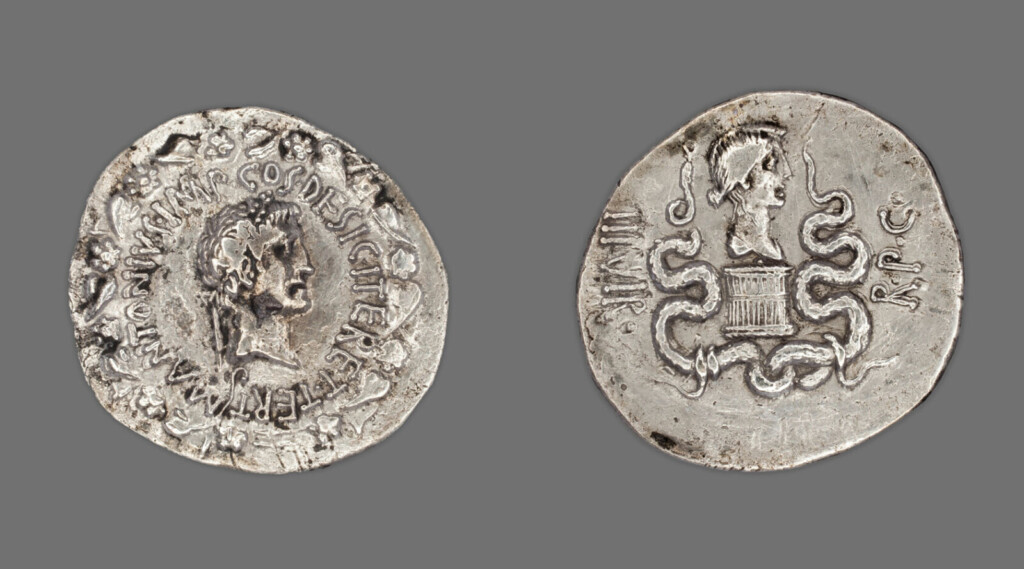
You have read about him before you knew his name. You have encountered him in the person who walks into a room and rearranges its emotional gravity, who makes you feel, inexplicably, that the room has been waiting for them, and that everyone in it has been only half-alive until this moment. You recognized something and filed it away without language for it, which is precisely why, centuries later, Antony keeps arriving in literature and drama and popular imagination like a creditor who refuses to be settled.
The persistence of a figure across twenty centuries is not sentimental. It is diagnostic. When Plutarch wrote his Life of Antony in the early second century, framing it against Demetrius of Macedon as a study in men destroyed by excess, he was not warning the reader. He was offering the reader a mirror, knowing full well that mirrors attract rather than repel. The Roman moralist tradition insisted on framing such lives as cautionary, but the rhetorical mechanics of cautionary tales have always worked against their stated purpose: the more vividly a destruction is rendered, the more the destruction compels. Readers of Plutarch did not close the scroll resolved to be Octavian. They closed it having spent hours inside the current of a man who could not stop being himself even when being himself was fatal.
Shakespeare understood that the ethical ambiguity was the point, not a flaw in the material to be resolved. When he distributed Antony’s self-knowledge across the play, allowing him to see his own dissolution clearly and proceed regardless, he was anatomizing something that no moral framework has successfully named: the condition of acting against one’s interests while remaining entirely lucid about doing so. Psychologists in the twentieth century reached for akrasia, the Greek term Aristotle deployed in the Nicomachean Ethics to describe weakness of will, the gap between knowing and doing. But akrasia as a clinical category flattens what Shakespeare made three-dimensional. Antony’s problem is not that he lacks willpower. It is that willpower, in the calculus he is running, is simply not the currency he values most.
This is what makes him unbearable to the portion of the reader that has organized a life around discipline and postponed desire. And it is what makes him irresistible to the portion of the same reader that suspects the discipline has cost more than it purchased. Both responses live simultaneously in almost anyone who has spent time with the character, and the discomfort of that simultaneity is not incidental to the fascination — it is the fascination. Hannah Arendt, writing in The Human Condition in 1958 about the distinction between action as self-revelation and labor as mere function, argued that political life at its most vital was always a performance of identity in the public sphere, irreversible and exposed. Antony performs identity so completely, so without reservation, that he leaves nothing in reserve for survival, and the reader who watches this cannot decide whether they are witnessing heroism or self-destruction, because the text refuses to decide for them.
What the two millennia of returns to this figure expose is not a fascination with failure in the abstract but a fascination with a specific kind of failure: the failure of someone who had everything the system offers and found the system insufficient. Octavian won the historical argument. He became Augustus, founded an empire, gave Rome two centuries of relative stability, and was deified. His name became a title. His victory was total, structural, and permanent. He is also, by any honest reckoning, almost entirely unreadable as a human being, which is why no one has staged him as a tragic hero, why no one returns to him the way they return to his rival, and why the man who lost remains the one the imagination cannot release.
⚔️ Power, Ambition, and the Fall of Great Men
Mark Antony’s story — torn between political ambition and passionate devotion — echoes through centuries of literature, philosophy, and historical reflection. These articles explore the themes of power, rhetorical mastery, tragic downfall, and the literary reinvention of historical figures that make Antony’s myth so enduring and universal.
Shakespeare’s Richard III: Meaning and Analysis
Shakespeare’s Richard III stands as one of literature’s most electrifying portraits of political ruthlessness and self-aware villainy. Like Mark Antony, Richard is defined by his extraordinary rhetorical power — capable of bending audiences and enemies alike to his will. This article explores how Shakespeare transforms historical material into a timeless meditation on ambition, manipulation, and the corrupting seduction of power.
GO TO THE SELECTION: Shakespeare’s Richard III: Meaning and Analysis
Machiavelli’s The Prince: Meaning and Analysis
Machiavelli's The Prince remains the foundational text for understanding how political power is seized, wielded, and lost — themes that run through every chapter of Mark Antony’s life. The treatise analyzes the tension between virtue and fortune that defined Roman politics and made figures like Antony both magnificent and vulnerable. Reading Machiavelli alongside the Antony myth reveals how little the grammar of power has changed across two millennia.
GO TO THE SELECTION: Machiavelli’s The Prince: Meaning and Analysis
Homer and the Odyssey: Nostos and the Archetype of Return
Homer’s Odyssey established the archetype of the hero undone not by enemies but by his own desires and the seductive pull of foreign worlds — a pattern that resonates deeply with Antony’s entanglement in Egypt and his distance from Rome. This article explores the literary theme of nostos, the longing for return, and how the failure to return becomes a form of tragic self-destruction. Antony’s story can be read as an Odyssey in reverse, where the hero chooses Circe’s island over Ithaca.
GO TO THE SELECTION: Homer and the Odyssey: Nostos and the Archetype of Return
Betrayal as a Theme in World Literature
Betrayal as a literary theme finds one of its most complex expressions in the world surrounding Mark Antony — from the assassination of Caesar to the shifting alliances of the Second Triumvirate. This article traces how world literature has used betrayal not merely as plot device but as a moral and psychological lens for examining loyalty, ideology, and human weakness. Understanding the literary genealogy of betrayal enriches any reading of the sources, from Plutarch to Shakespeare, that shaped the Antony legend.
GO TO THE SELECTION: Betrayal as a Theme in World Literature
Discover the Stories That Changed History on Indiecinema
If these themes of power, passion, and historical tragedy have sparked your curiosity, Indiecinema streaming is your gateway to independent films that dare to explore history, literature, and the human condition beyond mainstream narratives. Discover documentaries, auteur films, and cinematic essays that bring the ancient world and its timeless conflicts vividly to life.
👉 EXPLORE THE CATALOG: Watch Indie Films in Streaming
A vision curated by a filmmaker, not an algorithm
In this video I explain our vision

