
The Western genre, the foundational American epic, has always served as a mirror reflecting the nation’s shifting consciousness. For decades, it celebrated the triumphant narrative of manifest destiny, rugged individualism, and the inevitable march of civilization conquering the wilderness. The classic Western provided clarity, defining the hero by the white hat and the villain by the black, upholding a moral universe as vast and clear as the Monument Valley sky.

However, as the 1950s gave way to the social and political turmoil of the late 1960s and 1970s—marked by the Vietnam War, the Civil Rights movement, and a profound national loss of innocence—this mythology began to crumble. A new wave of filmmakers emerged, armed with a critical perspective that interrogated the very foundations of the American narrative. They sought to deconstruct the genre, replacing the epic triumph with moral ambiguity, psychological complexity, and historical scrutiny. This period gave rise to the Revisionist Western, a cinema of doubt, irony, and often devastating violence.
The Twilight Western, or Crepuscular Western, is a related subgenre, characterized by its elegiac tone and focus on protagonists who are anachronisms—gunfighters, outlaws, and lawmen who have outlived their time. These films explore the decay of the frontier and the painful transition to modernity, often concluding not with catharsis, but with existential resignation or nihilistic carnage. They force us to ask: What was the real price of the West? Who paid it? The list that follows—a chronicle of both mainstream studio productions and groundbreaking independent and international works—is a journey into the heart of this fractured, beautiful, and profoundly challenging cinema. We explore the essential works that redefined the West as a place of moral ambiguity, shattered dreams, and enduring loneliness, making the genre relevant for generations to come.
High Noon (1952)

Brief Synopsis Will Kane, the marshall of Hadleyville, has just married Amy, a Quaker, and handed in his badge, ready to start a peaceful new life. However, news that Frank Miller, a criminal he arrested years ago, is arriving on the noon train for revenge shatters their plans. Miller is expected by three accomplices at the station. Kane, initially tempted to flee, decides to return and face his destiny, but encounters a wall of cowardice, opportunism, and hypocrisy from his fellow citizens, who refuse to help, leaving him alone against four assassins.
In-Depth Analysis High Noon represents the first, traumatic epistemological break within the Western canon, marking the shift from the sunny foundation myth to a psychological examination of individual responsibility. Directed by Fred Zinnemann and written by Carl Foreman, the film systematically deconstructs the hero archetype and, even more radically, the community he is called upon to protect. While the classic Fordian Western features a sacred community rallying around the defender of the law in times of crisis, in High Noon the community is revealed to be a rotten social aggregate, dominated by economic self-interest and moral cowardice.
The historical context is crucial: conceived during the height of McCarthyite paranoia, the film is a transparent allegory for the anti-Communist “witch hunt” decimating Hollywood. Will Kane (Gary Cooper) is not the fearless, spotless knight; he is a sweating, fear-ridden man who writes his will with a trembling hand and, in a moment of despair, cries. His solitude is not the proud one of the pioneer, but that of the political outcast, abandoned by friends, the judge, and even the church. Zinnemann’s revolutionary use of film time, nearly matching real time, turns the Western into an anxiety-ridden psychological thriller. The final act of accusation: after winning the gunfight despite the town (and with the crucial help of his wife), Kane throws his tin star into the dust. It is not a gesture of triumph, but of contempt, signaling the end of the social contract.
Johnny Guitar (1954)

Brief Synopsis Vienna, a strong-willed woman with a dark past, runs an isolated saloon, anticipating wealth from the coming railroad. Her independence disturbs the local townspeople, particularly Emma Small, a puritanical rancher who harbors a pathological hatred for Vienna. When the reformed gunman Johnny “Guitar” Logan arrives at the saloon, reigniting an old flame with Vienna, tensions escalate. Emma falsely accuses Vienna and the bandit Dancin’ Kid of robbery and murder, initiating a fierce manhunt for the woman.
In-Depth Analysis Nicholas Ray directs a baroque, excessive, and chromatically violent work that shatters genre conventions through a radical inversion of sexual roles. Often dubbed “the Beauty and the Beast of the Western,” Johnny Guitar shifts the conflict’s engine from masculine action to feminine neurosis. The men, including the eponymous protagonist (Sterling Hayden) and rival Dancin’ Kid (Scott Brady), are reduced to passive instruments or objects of desire in the hands of two titanic women.
The film’s core is the struggle between Vienna (Joan Crawford) and Emma Small (Mercedes McCambridge). Vienna wears pants, carries a gun, manages business, and dominates the space with a masculine posture; Emma, dressed in mourning, is the personification of sexual repression sublimated into fascist-like violence. Emma’s hatred for Vienna is psychoanalytic: Emma desires Dancin’ Kid and seeks to destroy Vienna because she represents the sexual freedom Emma denies herself. The scene where Emma hysterically laughs as the saloon burns is pure Gothic horror transplanted into the West. Ray’s use of Trucolor enhances the artificiality and dreamlike quality, with skies that are blood-red or ochre, reflecting the collective hysteria. The final, definitive revisionist move is the climax: the decisive duel is not between two gunmen, but between the two women.

The Searchers (1956)
![The Searchers (1956) ORIGINAL TRAILER [HD]](https://blog.indiecinema.co/wp-content/plugins/wp-youtube-lyte/lyteCache.php?origThumbUrl=https%3A%2F%2Fi.ytimg.com%2Fvi%2FEITyLYVgDPU%2F0.jpg)
Brief Synopsis Texas, 1868. Ethan Edwards, a mysterious and solitary Confederate veteran, returns to his brother’s home only to see it destroyed by a Comanche raid that massacres the family and kidnaps his two nieces. Ethan, accompanied by his brother’s adopted, part-Cherokee son, Martin Pawley, embarks on a five-year quest. As time passes, it becomes horrifyingly clear that Ethan’s goal is not merely to rescue the surviving niece, Debbie, but to kill her for the racial dishonor of having become a “squaw” to a Comanche chief.
In-Depth Analysis The Searchers is the Everest of Western cinema, the point of no return where John Ford, the genre’s founding myth-maker, begins to interrogate it with ruthless clarity. The film is a visual symphony on racist madness and obsession, dominated by the monumental and terrifying figure of Ethan Edwards (John Wayne). Ethan is not the hero bringing civilization; he is a psychological war casualty, a man who knows the Natives better than anyone because, deep down, he shares their same tribal ferocity, but directs it against them.
Ford’s revisionism is subtle yet devastating. The film suggests that Ethan’s violence is a mirror image of that of the Comanche chief Scar. Both are driven by revenge for lost kin, both are warriors with no place in a world of peace. The search becomes a psychopathological journey into America’s Heart of Darkness. The fear of racial mixing, the terror of white blood being contaminated, is the true engine of the action, making Ethan a profoundly problematic protagonist, light years away from the reassuring Duke of Stagecoach. Visually, Ford contrasts the indifferent grandeur of the Monument Valley, shot in Vistavision, with the dark, cramped domestic interiors. The final, celebrated shot is the genre’s epitome: Ethan brings Debbie home, but cannot enter. The door closes on him, condemning him to wander the wilderness—a ghost too savage for the civilization he ferociously defended.
The Man Who Shot Liberty Valance (1962)

Brief Synopsis Senator Ransom Stoddard and his wife Hallie return to the small town of Shinbone for the funeral of an unknown old rancher, Tom Doniphon. Pressed by local journalists, Stoddard recounts the true story of his political rise, which began years earlier when he arrived as an idealist young lawyer convinced that law could replace the gun. His confrontation with the sadistic bandit Liberty Valance and the crucial, secret role played by Doniphon in that event, reveal a bitter truth about the founding of American democracy.
In-Depth Analysis If The Searchers is the epic poem of the frontier, The Man Who Shot Liberty Valance is the critical essay and funeral hymn on its demise. Filmed by Ford entirely indoors and in stark, almost televisual black and white, the film deliberately sacrifices landscape grandeur for theoretical abstraction. It is a film about memory, history, and legend. The director’s closing line, “This is the West, sir. When the legend becomes fact, print the legend,” is the genre’s tombstone and the official opening of the self-aware revisionist phase.
The film stages a dialectical triangle. Liberty Valance (Lee Marvin) is primordial chaos, brute force without law. Ransom Stoddard (James Stewart) is progress, written law, education, but physically impotent against chaos. Tom Doniphon (John Wayne) is the missing link: the man with the force to defeat chaos, who chooses to step aside to allow the advent of law. Doniphon’s sacrifice is absolute: by killing Valance in secret and letting Stoddard take the credit, Tom cancels his own raison d’être. Civilization (Stoddard) is built upon a foundational lie, an act of violence performed by the archaic hero (Doniphon) who must then vanish into oblivion, dying poor and forgotten. Ford offers no joyous celebration of progress; the tone is one of heartbreaking melancholy.
The Shooting (1966)
![Shooting (1966) theatrical trailer [FTD-0063]](https://blog.indiecinema.co/wp-content/plugins/wp-youtube-lyte/lyteCache.php?origThumbUrl=https%3A%2F%2Fi.ytimg.com%2Fvi%2F_Ts-CRIMJes%2F0.jpg)
Brief Synopsis Willet Gashade, a former bounty hunter returned to his mining job, finds his partner dead and his brother fled after allegedly running over a man and child in town. A mysterious, unnamed woman hires Willet and his timid companion Coley to guide her across the desert on a manhunt. They are joined by Billy Spear, a black-clad, sadistic, and lethal gunman. The journey turns into an exhausting march toward nothingness, where motivations blur and the identity of the hunted becomes a terrifying enigma.
In-Depth Analysis Monte Hellman, protégé of Roger Corman, directs a manifesto of the Acid Western and existential minimalism. The film strips the genre down to the bone, removing all reassuring historical, geographical, and moral coordinates. There are no Indians, no towns, no society: there is only the desert, understood not as a physical place but as a metaphysical labyrinth akin to Beckett or Kafka.
The work anticipates the paranoia and disintegration of the late 1960s counterculture. The characters move like sleepwalkers toward their own destruction. Jack Nicholson, as Billy Spear, is a stylized, almost abstract villain who embodies pure, purposeless violence. Warren Oates (Gashade) is the common man trapped in a mechanism he cannot understand. The tension derives not from gunfights (which are quick and unglamorous), but from the void, the silences, and the constant sense of an invisible threat. The ending is one of the most enigmatic in cinema history: the hunted man is revealed to be Gashade’s twin brother (also played by Oates), or perhaps Gashade himself caught in a time loop or hallucination. The Shooting uses the Western to explore the absurd condition of humanity, where the search has no object and the only destination is death.
A vision curated by a filmmaker, not an algorithm
In this video I explain our vision
The Good, the Bad and the Ugly (1966)
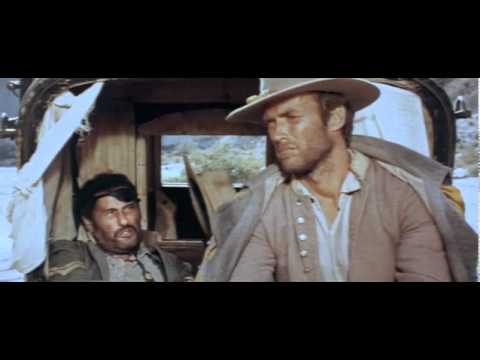
Brief Synopsis During the American Civil War, three solitary gunmen cross paths in pursuit of a hidden treasure of Confederate gold coins buried in a cemetery. Blondie (The Good) and Tuco (The Ugly) have an unstable partnership based on fraud, while Sentenza (The Bad) is a ruthless hitman working for money. Their journey takes them through prison camps, pitched battles, and deserts, culminating in the famous “triello” (three-way duel) in Sad Hill Cemetery.
In-Depth Analysis Sergio Leone completes his Dollar Trilogy with a monumental work that elevates the Spaghetti Western to a pure art form. Although often considered pure entertainment, the film is deeply revisionist in its portrayal of American history. The Civil War is not the heroic backdrop of Gone with the Wind, but a brutal and meaningless slaughter, an “useless carnage” viewed through the eyes of three cynical opportunists who couldn’t care less about ideology. Blondie (Clint Eastwood) laconically comments: “I’ve never seen so many men waste so much.”
Leone demystifies the Western morality: there is no substantial difference between “The Good” and “The Bad”; they are ironic labels. All are driven by greed. Leone’s direction stretches time indefinitely, transforming the duels into ritualistic ballets of stares, close-ups of eyes and hands, edited with frantic rhythm set to Ennio Morricone’s revolutionary music. The coyote’s howl, the choirs, the electric guitars: the soundtrack becomes a narrator, both ironic and tragic. The finale in the circular Sad Hill cemetery is the apotheosis of the Leone style: a Roman arena where death is spectacle. The film champions a nihilistic and picaresque worldview, where the only certainty is gold and individual survival.
The Great Silence (1968)
![The Great Silence (1968) DEUTSCH TRAILER [HD 1080p]](https://blog.indiecinema.co/wp-content/plugins/wp-youtube-lyte/lyteCache.php?origThumbUrl=https%3A%2F%2Fi.ytimg.com%2Fvi%2FUAaG58N2fZY%2F0.jpg)
Brief Synopsis Utah, 1898. An apocalyptic snowstorm has isolated the Snow Hill region. Outlaws, driven by hunger, descend from the mountains and are systematically massacred by bounty hunters operating under the protection of the law. Pauline, whose husband was killed by the sadistic bounty killer leader, Loco, hires Silence, a mute gunman who only shoots in self-defense, aiming at enemies’ hands or thumbs to disarm them before killing them.
In-Depth Analysis Sergio Corbucci delivers his masterpiece, a radical and desperate Western that reverses the genre’s sun-drenched iconography, replacing sand and sweat with snow and frost. The Great Silence is a political film, a fierce critique of predatory capitalism embodied by the bounty killers, who transform justice into the commodification of death. Loco (Klaus Kinski, terrifyingly rational) is not an irrational monster, but an entrepreneur of violence who operates according to ledger books and the written law, demonstrating how legality can be a tool of oppression.
The protagonist Silence (Jean-Louis Trintignant) is a tragic and disabled hero (his throat was cut as a child), an armed avenging angel who cannot speak, symbolizing the oppressed’s inability to have a voice in history. His automatic Mauser pistol underscores his otherness. But it is the finale that seals the film’s place in the darkest echelon of revisionism. Corbucci rejects the imposed happy ending and delivers a conclusion of absolute nihilism: the hero, already wounded and with mangled hands, is killed. The woman he loves is shot dead while defending him. The villains win completely, take the money, and ride away into the blinding white. There is no redemption, no divine justice. It is the death of the myth through the negation of hope.
Once Upon a Time in the West (1968)

Brief Synopsis The transcontinental railroad’s construction advances relentlessly across the West, bringing speculation and death. Jill McBain, a former New Orleans prostitute, arrives at her newlywed husband’s farm in Sweetwater only to find him and his children massacred. The outlaw Cheyenne is suspected, but the real perpetrator is Frank, a killer hired by railroad magnate Morton. Protecting Jill and seeking vengeance against Frank is “Harmonica,” a mysterious gunman playing an obsessive tune.
In-Depth Analysis Sergio Leone directs a monumental, funereal work, a “dance of death” that celebrates the farewell to the classic Western using its own archetypes. Once Upon a Time in the West slows time to stasis, transforming every gesture into ritual. The iconic opening sequence at the station, almost fourteen minutes of waiting, silence, water drops, and buzzing flies, is a treatise on pure filmmaking that defines the twilight atmosphere of the entire film.
Leone’s revisionism here is operatic and meta-cinematic. Henry Fonda, the quintessential American hero, is shockingly cast as the ice-eyed child murderer Frank. Charles Bronson (Harmonica) is a vengeful ghost with no name, an entity with no future but only a past. Jason Robards (Cheyenne) is the romantic bandit aware that he is an anachronism destined for extinction. The central theme is the arrival of modernity, symbolized by the train and money (“Mr. Choo-Choo”), which sweeps away the era of individual heroes. The woman, Jill (Claudia Cardinale), for the first time in a Leone film, becomes the moral and historical center: she survives, gives water to the workers, and embodies the birth of a matriarchal civilization on the ashes of masculine duels.
The Wild Bunch (1969)

Brief Synopsis Texas, 1913. Pike Bishop leads an aging gang of outlaws in one last bank robbery that turns into an ambush orchestrated by a former comrade, Deke Thornton, forced to collaborate with the railroad to avoid prison. Fleeing to revolutionary Mexico, the gang finds itself caught between advancing modernity (automobiles, machine guns) and the brutality of a local general, Mapache. Tired of running, they decide to redeem their existence with one final, suicidal act of loyalty.
In-Depth Analysis Sam Peckinpah revolutionizes the cinematic language of violence with frantic editing that alternates slow motion and normal speed, fragmenting the action into thousands of shots to show the horror and beauty of death. But The Wild Bunch is more than just aesthetics; it is a requiem for a type of man rendered obsolete by the 20th century. Set in 1913, the film shows cowboys looking suspiciously at the first automobiles; they are dinosaurs aware they must become extinct.
The protagonists are far from “good”: they kill innocents, use women as human shields, and steal. Yet, Peckinpah grants them a moral code of honor superior to that of “civilized” society, represented by hypocritical bankers and vile bounty hunters. The key line, “When you side with a man, you stay with him. And if you can’t do that, you’re like some animal,” defines the group’s ethics. The famous final walk toward Mapache’s headquarters is one of the most powerful sequences in cinema: four men consciously going to die not for money, but to reassert their dignity and avenge their friend Angel. The final massacre, an orgy of lead and blood filmed with unmatched technical mastery, is a nihilistic catharsis reflecting the chaos of Vietnam and the end of American illusions.
Butch Cassidy and the Sundance Kid (1969)

Brief Synopsis Butch Cassidy, the affable brains, and Sundance Kid, the lethal brawn, lead the “Hole in the Wall” gang. They rob trains with style and little bloodshed until the railroad owner, E.H. Harriman, hires a relentless “super-posse” of trackers to eliminate them. Unable to shake their pursuers, the duo flees to Bolivia with the schoolteacher Etta Place, hoping to recapture the freedom of old, but they discover that the world has changed everywhere.
In-Depth Analysis While Peckinpah treated the end of the West tragically, George Roy Hill and screenwriter William Goldman chose the path of ironic nostalgia and pop myth. Butch Cassidy and the Sundance Kid is the first modern buddy-movie Western, deconstructing outlaws by making them human, fallible, and incredibly charismatic. Paul Newman and Robert Redford are not tormented murderers, but charming anachronisms who react to the end of their era with witty banter and an almost childish refusal of reality.
The film is steeped in a light fatalism. The “super-posse” chasing them is faceless, an unstoppable, inhuman force symbolizing the corporatism and technology crushing the individual. The escape to Bolivia is not a new beginning, but a prolongation of agony in a foreign, squalid context. The use of pop music (Burt Bacharach’s famous “Raindrops Keep Fallin’ on My Head”) creates a temporal dissonance that emphasizes the film’s nature as a “modern fable.” The ending is legendary: besieged by the Bolivian army, wounded and out of ammunition, Butch and Sundance emerge talking about Australia, planning the next trip they will never take. The freeze-frame captures them in a moment of action, turning the frame into sepia, delivering them to the eternity of myth before physical death can defile them.
Soldier Blue (1970)

Brief Synopsis A payroll cavalry convoy is attacked and destroyed by the Cheyenne. Only two survive: Honus Gent, a naive and idealistic private, and Cresta Lee, a white woman who lived with the tribe for two years and understands their plight. On their journey back to the fort, Cresta tries to open Honus’ eyes to the reality of the ongoing genocide. Their destinies collide with History when they witness the cavalry attack a peaceful Cheyenne village.
In-Depth Analysis Directed by Ralph Nelson, Soldier Blue is one of the most controversial and politically explicit Revisionist Westerns. Inspired by the Sand Creek Massacre of 1864, the film functions as a direct and brutal allegory for the Vietnam War and, specifically, the My Lai Massacre, news of which was shocking American public opinion at the time. The Western here becomes a tool of accusation against U.S. military imperialism.
The film’s structure is deceptive: it begins as an on-the-road romantic comedy, playing on the verbal clashes between the puritanical Honus and the foul-mouthed, pragmatic Cresta (Candice Bergen). However, the third act shifts registers with unprecedented and unsustainable graphic violence. Nelson shows rapes, mutilations, murdered children, and decapitated women by blue-clad soldiers laughing and drunk on blood. There is no heroism, only horror. The revisionism lies in the complete ethical reversal: the “savages” are the rational victims, the “civilizers” are the sadistic barbarians. Cresta Lee represents the new critical American conscience, a strong female figure who has overcome racial prejudice and sees the truth that patriotic ideology refuses to accept.
Little Big Man (1970)

Brief Synopsis Jack Crabb, a decrepit man of 121 years, recounts his unbelievable life in the West to a skeptical historian. Kidnapped by the Cheyenne as a child and raised as one of them under the name “Little Big Man,” Jack navigates the century by oscillating between the two cultures: he is a failed gunfighter, a cheated merchant, a hermit, a scout for General Custer, and finally the sole white survivor (according to him) of the Battle of Little Bighorn.
In-Depth Analysis Arthur Penn directs a picaresque masterpiece that uses satire and the absurd to demystify every single trope of the frontier. Dustin Hoffman delivers a chameleonic performance as an opportunistic and mediocre anti-hero whose only skill is survival. Through his eyes, we see the West not as an epic, but as a series of disasters caused by the madness and greed of the white man.
The film makes a clear philosophical distinction: the Cheyenne call themselves “Human Beings” and live in harmony with the circle of life; the whites are alienated, obsessed with straight lines, possession, and destruction. General Custer (Richard Mulligan) is portrayed as a vain, delusional psychopath, a ferocious caricature of American military leadership. However, the heart of the film lies in the relationship between Jack and his adoptive grandfather, Old Lodge Skins (Chief Dan George), who offers wisdom, humor, and a moving spiritual vision (“Today is a good day to die”). Little Big Man champions the moral and human superiority of Native culture over the morally bankrupt Western one.
El Topo (1970)

Brief Synopsis A gunman dressed in black leather travels through a surreal desert with his naked son. He challenges and defeats the four Masters of the Desert through deception to please a woman, but is betrayed and left for dead. Rescued by a community of deformed outcasts living in caves, he is reborn years later as a humble saint, seeking to free his saviors by digging a tunnel toward the nearby town, which is dominated by a perverse religious cult.
In-Depth Analysis Alejandro Jodorowsky’s El Topo inaugurates the “Esoteric Western” and the Midnight Movies phenomenon. The film ignores all traditional narrative logic, proceeding through symbols, tarot, and mystical allegories. The desert is not Texas or Mexico, but a space of the mind, a place of alchemical initiation. The violence is extreme, grotesque, but stylized like a sacred ritual.
Jodorowsky’s revisionism is total because it ignores Hollywood rules for the surrealism of Buñuel and the cruelty of Artaud. El Topo (The Mole) is an anti-hero who must “kill” his own ego (the four masters) to achieve enlightenment, only to discover that the outside world is irredeemably corrupt. The critique of institutionalized religion and bourgeois bigotry is fierce: the city of “normal” people is a place of slavery, racism, and hidden depravity, while the subterranean “monsters” are pure. Visually shocking, the film became an instant cult hit, proving that Western iconography could be used to explore the collective unconscious and the psychedelic spirituality of the 1970s.
McCabe & Mrs. Miller (1971)

Brief Synopsis John McCabe, a boastful gambler, arrives in the perpetually rainy mining town of Presbyterian Church and opens a makeshift brothel. Constance Miller, a professional, opium-addicted madam, soon arrives and proposes a business partnership. The success of the venture attracts the attention of a major mining corporation that seeks to buy everything out. McCabe, overestimating his cunning, refuses the offer, triggering a lethal reaction from the company, which sends three killers to eliminate him.
In-Depth Analysis Robert Altman directs an “anti-Western” that dismantles heroism through gritty realism and the banality of evil. Set in the Pacific Northwest, the film replaces sun and dust with relentless snow, mud, and rain. Vilmos Zsigmond’s cinematography, “flashed” to achieve washed-out, antique colors, creates a unique visual atmosphere reminiscent of old, faded daguerreotypes.
McCabe (Warren Beatty) is no hero: he is a foolish small businessman who believes in the American dream of free enterprise, failing to understand that corporate capitalism tolerates no competition. Mrs. Miller (Julie Christie) is the real brain, a pragmatic woman who uses opium to tolerate reality. Altman’s technique of overlapping dialogue immerses the viewer in the confusion of real life, denying the clarity of classic Western dialogue. The finale is the antithesis of High Noon: while McCabe plays a desperate game of hide-and-seek with the killers in the snow, injured and alone, the entire town is preoccupied with saving the church from a fire, completely ignoring the man who brought them prosperity. McCabe dies frozen and forgotten, while Mrs. Miller retreats into the oblivion of her drug use. It is a bitter critique of American individualism and the solitude it engenders.
Jeremiah Johnson (1972)

Brief Synopsis Disillusioned with civilian life and war, Jeremiah Johnson decides to become a “mountain man” in the Rocky Mountains. Through harsh winters and encounters with other hermits, he learns to survive. He unexpectedly finds himself with an Indian wife (a chief’s daughter) and an adopted mute son. His peace is shattered when he agrees to guide a rescue expedition through a sacred Crow burial ground, triggering a relentless vendetta that costs him everything and forces him to become a legendary warrior against his will.
In-Depth Analysis Sydney Pollack directs a contemplative, ecological, and existential Western. Co-written by John Milius, the film is an ode to the “wilderness,” but without romantic idealization: nature is indifferent, cruel, yet beautiful. Robert Redford portrays Johnson not as a conqueror, but as a man trying to integrate into an environment that initially rejects him. The film is largely silent, focusing on the sheer physical difficulty of life (hunting, building, avoiding freezing).
The revisionism lies in the refusal of violence as a solution. The feud with the Crow is not heroic; it is a curse. Johnson kills the warriors sent against him one after another, but each killing hollows him out, making him more of a specter than a man. The suspended ending, where Johnson and his nemesis salute each other from a distance (a sign of peace or armed truce?), is a moment of mutual recognition between weary warriors. There is no victory, only the awareness of having survived another day. It is the Western of radical solitude.
Pat Garrett and Billy the Kid (1973)

Brief Synopsis New Mexico, 1881. Ranch owners want to “clean up” the territory for their business interests. Pat Garrett, former running mate of Billy the Kid, accepts the marshal’s star to survive the changing times. His job is to eliminate Billy, who refuses to flee or change his life. Thus begins a slow, painful hunt, a prolonged farewell between two friends who find themselves on opposite sides of the barricade of History.
In-Depth Analysis Sam Peckinpah returns to the theme of betrayed friendship and the end of the West with an elegiac and heartbreaking tone. The film, famously mutilated by the production and later rediscovered in the Director’s Cut, is a visual poem about the death of freedom. Billy (Kris Kristofferson) is the symbol of youthful anarchy, an armed Christ figure who smiles as he goes toward martyrdom. Garrett (James Coburn) is the tragic Judas, an aging man who sold his soul to the “Santa Fe Ring” for economic security, but who died inside long before pulling the trigger.
Bob Dylan’s soundtrack permeates the film with a sacred aura. The sequence of Sheriff Baker’s death, as he drags himself toward the river at sunset to the notes of “Knockin’ on Heaven’s Door,” his wife watching in silence, is one of the emotional peaks of American cinema: violence loses all spectacular connotation to become pure acceptance of the end. The final assassination of Billy is not a duel, but an execution in the dark, after which Garrett shoots his own reflection in the mirror, attempting to kill the part of himself he despises. It is the definitive farewell to the outlaw hero.
High Plains Drifter (1973)

Brief Synopsis An unnamed Stranger emerges from the desert heat and arrives in the mining town of Lago. After killing three men who provoke him, he is hired by the terrified citizens to protect them from the return of three outlaws recently released from prison, who have sworn vengeance on the town. The Stranger agrees, but demands total control in return. He begins subjecting the population to increasingly humiliating and absurd demands, turning their defense into a biblical punishment.
In-Depth Analysis Clint Eastwood, in his second directorial effort and first in the Western genre, takes Leone’s Man with No Name archetype and pushes it into the territory of supernatural horror and moral allegory. The Stranger is no savior; he is an avenging entity, perhaps the ghost of Marshal Duncan (flogged to death while the town watched in silence) or the Devil himself, sent to punish the sinners.
The film is a fierce critique of the American bourgeoisie, represented by the citizens of Lago: “God-fearing” people who hide cowardice, greed, and criminal complicity behind a respectable façade. Eastwood’s revisionism is ruthless: the hero humiliates the mayor, appoints the town dwarf (Mordecai, the only innocent one along with the Natives) as sheriff and mayor, and literally has the entire town painted blood-red, renaming it “Hell.” The final showdown, amidst flames and shadows, has a Dantesque tone. The Stranger vanishes as he arrived, dissolving into the heat, leaving behind only death and ashes. High Plains Drifter destroys the myth of the supportive community from High Noon: here, the town does not deserve to be saved—it deserves to burn.
The Outlaw Josey Wales (1976)

Brief Synopsis Missouri, during the Civil War. Northern “Redlegs” burn Josey Wales’ farm and massacre his family. Wales joins Confederate guerrillas for revenge. At the war’s end, he refuses to surrender and becomes a wanted man, pursued by his former enemies and bounty hunters. Fleeing toward Mexico, he involuntarily collects a “family” of outcasts: an old Cherokee chief, an Indian woman, a cranky grandmother, and her granddaughter.
In-Depth Analysis Considered by many to be Eastwood’s best film as a director, The Outlaw Josey Wales is a Western of healing and reconciliation following the trauma of Vietnam and the Watergate scandal. Wales is an infallible killing machine, but his violence is purely defensive. Unlike the nameless Stranger, Wales is profoundly human: a man emptied by pain who learns to live again by caring for others.
The film deconstructs the Manichaeism of the Civil War (both sides commit atrocities) and proposes a utopian multicultural community model. The relationship between Wales and Lone Watie (Chief Dan George) is based on melancholy humor and deep respect. The climax is not a gunfight, but a dialogue: the meeting with the Comanche chief Ten Bears, where Wales avoids war by offering his word and mutual respect (“Life is dear, and dying is cheap”). It is a film that transforms the solitary gunman into a reluctant patriarch, suggesting that true strength lies in building, not destroying.
The Shootist (1976)

Brief Synopsis J.B. Books, the most famous “shootist” (gunfighter) still alive, arrives in Carson City in 1901 to consult an old doctor friend. The diagnosis is harsh: terminal cancer. With only a few weeks to live and agonizing pain approaching, Books takes lodging in the boarding house of the widow Bond Rogers. While the town attempts to capitalize on his fame, Books decides to orchestrate his own death to avoid the agony and die “with his boots on.”
In-Depth Analysis Directed by Don Siegel, The Shootist is a moving work of meta-cinema. John Wayne, the living icon of the West, plays a dying icon of the West, being terminally ill with cancer in real life. The film is a long farewell, set in an era where automobiles and streetcars are replacing horses, and violence has become anachronistic.
The revisionism here is not angry, but tender and reflective. Books is not a psychopath, but a weary professional who adheres to a strict code of honor. His relationship with the widow’s son, Gillom (Ron Howard), is pedagogical: Books attempts to demystify violence in the eyes of the boy who idolizes him. However, fate is inescapable. The final duel in the saloon is a glorious, assisted suicide. But the true closure comes after: Gillom avenges Books by killing the treacherous bartender, then looks at the pistol with disgust and throws it away. Books nods and dies peacefully. That gesture sanctions the end of violence as an inheritance. Wayne exits the scene, closing a cinematic and historical era with absolute dignity.
Keoma (1976)

Brief Synopsis After the Civil War, the half-breed Keoma returns to his frontier village, finding it ravaged by plague and under the iron heel of Caldwell, a former Confederate soldier who prevents the arrival of medicine and isolates the sick in a lazaretto-mine. Caldwell is aided by Keoma’s three white half-brothers, who have always hated him. Keoma takes up the defense of a pregnant woman and his elderly father, igniting an apocalyptic family war.
In-Depth Analysis Directed by Enzo G. Castellari, Keoma is the swansong of the Spaghetti Western, a “twilight” film that pushes the genre toward mystical abstraction and Shakespearean tragedy. The atmosphere is leaden, dominated by wind, dust, and ruins; the irony of Leone is gone, replaced only by pain and fatalism. Franco Nero plays Keoma as a magnificent, spectral Christ-like figure, an armed messiah who brings death to enable life.
Castellari’s direction is virtuosic, with extensive use of slow motion and handheld camera to immerse the viewer in the chaos of battle. The narrative is fragmented by dreamlike flashbacks where past and present coexist. The De Angelis brothers’ soundtrack, featuring a female voice singing the protagonist’s thoughts in the first person (“Keoma, you cannot die”), functions as an alienating Greek chorus. The theme of racism and marginalization is central, but transcended into a universal struggle for freedom. The ending is open and melancholy: Keoma survives, but remains alone. He saves the woman’s newborn but refuses to be a father, leaving the child free. “He is free, he owes nothing to anyone.” He is the last hero who dissolves into the horizon, aware that his time is over.
Heaven’s Gate (1980)

Brief Synopsis Wyoming, 1890. Johnson County is the scene of a class war. The cattle association, with the tacit approval of the federal government, draws up a list of 125 poor European immigrants accused of cattle rustling and hires mercenaries to exterminate them. Marshal James Averill, a disillusioned Harvard intellectual, tries to protect the community and the woman he loves, Ella Watson, a local madam, who is also loved by Nate Champion, a hired killer who begins to harbor moral doubts.
In-Depth Analysis Michael Cimino creates a titanic work that marked the end of the New Hollywood era for its commercial failure, but which is now recognized as an absolute masterpiece of historical revisionism. Heaven’s Gate is a Marxist anti-Western that demolishes the myth of the Frontier as a land of opportunity, exposing it as a capitalist slaughterhouse where the wealthy (the cattlemen) exterminate the poor (the immigrants) for control of resources.
Visually sumptuous, with Vilmos Zsigmond’s photography filling the screen with smoke, dust, and oceanic crowds, the film possesses a Tolstoyan epic scope. Cimino shows the real West: dirty, overcrowded, multilingual, where violence is not a duel but indiscriminate massacre. The final battle is devoid of glory; it is a confusion of dust and blood where ideals perish. Kris Kristofferson (Averill) is the impotent hero, unable to stop the machine of history. The film is a requiem for the American dream, exposing the roots of oppression upon which the nation was founded, rejecting all narrative consolation.
Pale Rider (1985)
Brief Synopsis A community of poor independent gold panners is threatened by a powerful mining magnate who uses devastating hydraulic methods. A young girl prays for a miracle, and a mysterious Preacher arrives on horseback. The man, bearing the scars of six bullets, defends the miners against the magnate’s thugs and a corrupt marshal, Stockburn, who seems to know the Preacher’s past.
In-Depth Analysis Clint Eastwood revisits the theme of Shane in a spectral key. Pale Rider serves as the bridge between High Plains Drifter and Unforgiven. The Preacher is not a man of flesh and blood, but a ghost, the fourth horseman of the Apocalypse (Death on a pale horse), returned to avenge his own killing years earlier at the hands of Stockburn.
The film is ecologically minded: the “LaHood” mining company destroys the mountain with water cannons, violating the earth, while the small panners work manually. The revisionism here is mystical: Eastwood suggests that justice in the West can only come from the supernatural, because human institutions are irremediably corrupted by money. The final shootout is a spectral execution where the Preacher appears and disappears, eliminating his enemies with a Mauser C96 before vanishing again into the snow, having completed his divine and infernal mission.
Dances with Wolves (1990)

Brief Synopsis 1863. Lieutenant John Dunbar, decorated for a botched suicide attempt during the Civil War, requests a transfer to the frontier “before it disappears.” Assigned to a deserted outpost in Dakota, he makes contact with a Sioux tribe. Overcoming initial distrust, Dunbar learns their language, their customs, and finds love with “Stands with a Fist,” a white woman adopted by the tribe. Renouncing his past, he becomes “Dances with Wolves,” a Sioux warrior who fights to defend his new people from the white invasion.
In-Depth Analysis Kevin Costner revitalizes the mainstream Western with a neo-romantic epic that completely reverses the perspective of The Searchers. Where the Native American was the dehumanized enemy, here they are the bearers of a superior, harmonious, and spiritual civilization, contrasted with the vulgar and destructive brutality of American expansionism.
The film makes radical choices for a blockbuster: much of the dialogue is in the Lakota language with subtitles, restoring cultural dignity and complexity to the Natives. The Sioux are not two-dimensional “noble savages,” but individuals with humor, doubts, and fears. The buffalo hunt is celebrated as a sacred act of subsistence, contrasted with the needless massacre perpetrated by the whites purely for hides. Although sometimes accused of being a “White Savior” fantasy, the film holds the historical merit of having forever changed mass perception of Native Americans, denouncing the irreparable loss caused by the Frontier. Costner’s direction is classic, sweeping, and lyrical, celebrating a world about to end with poignant melancholy.
Unforgiven (1992)

Brief Synopsis William Munny is a notorious former killer, now a widower, old, and a failing hog farmer. To secure a future for his children, he reluctantly accepts the proposal of the young “Schofield Kid” to kill two cowboys who disfigured a prostitute in Big Whiskey, Wyoming. Together with his old partner Ned Logan, Munny returns to the saddle, but must confront the local sheriff, Little Bill Daggett, a sadistic man who enforces order with brutality.
In-Depth Analysis Unforgiven is the definitive masterpiece of revisionism, the film with which Clint Eastwood deconstructs his own myth and morally closes the genre. Dedicated to “Sergio and Don” (Leone and Siegel), the film is a dark treatise on the nature of violence and its consequences on the soul. Munny is not a hero reclaiming glory; he is an “unforgivable” man, haunted by the ghosts of his victims, who struggles to ride and shoot straight due to age and remorse.
David Webb Peoples’ screenplay demystifies every aspect of the Western: dying is neither quick nor elegant, it is painful, slow, and degrading. Killing a man is “a hell of a thing”: you take away everything he has and everything he will ever have. Little Bill (Gene Hackman) represents the law, but a fascist law that tolerates no dissent; yet, he builds his house with his own hands, blurring the line between monster and civilized man. The finale is terrifying: Munny, after seeing Ned’s body displayed as a warning, relapses into his old self. He drinks whiskey (his demonic potion) and becomes a homicidal fury in the saloon. But there is no triumph in his victory. He kills everyone with chilling efficiency, remaining a damned soul who disappears into the rain, threatening to kill again. Eastwood tells us that the gunfighter myth is a lie built on the blood of innocents and the guilty alike.
Geronimo: An American Legend (1993)
![Geronimo: An American Legend (1993) ORIGINAL TRAILER [HD 1080p]](https://blog.indiecinema.co/wp-content/plugins/wp-youtube-lyte/lyteCache.php?origThumbUrl=https%3A%2F%2Fi.ytimg.com%2Fvi%2Fv4alqybzcic%2F0.jpg)
Brief Synopsis The US Army campaign to capture the Apache chief Geronimo, who refuses to accept life on the reservations. The film follows the perspective of young officer Britton Davis and Lieutenant Gatewood, who respect Geronimo but must obey the orders that will lead to the final betrayal of promises made to the Natives.
In-Depth Analysis Walter Hill, a screenwriter for Peckinpah, directs a historical Western that seeks to tell the truth behind the myth. The film strips away all romanticism: the desert is dusty, the war consists of grueling waits and confused skirmishes. Wes Studi offers a complex portrait of Geronimo: not just a noble warrior, but a difficult, proud, and sometimes ruthless man. The film is a bitter analysis of the concept of “keeping one’s word”: American civilization proves incapable of honoring its own treaties, using bureaucracy and deception as weapons more lethal than rifles.
Dead Man (1995)

Brief Synopsis William Blake, a meek accountant from Cleveland, arrives in the industrial town of Machine for a job that no longer exists. After a night of passion ends in tragedy, he finds himself with a bullet near his heart and on the run, accused of murder. Guided by an outcast Native American named Nobody, who believes him to be the reincarnation of the visionary poet William Blake, he embarks on a journey toward the Pacific Ocean to die and “return his spirit.”
In-Depth Analysis Jim Jarmusch directs the definitive Acid Western of the 1990s, a visual poem in black and white accompanied by Neil Young’s distorted, improvised electric guitars. Dead Man is not a film about conquering the West, but about the dissolution of the self. Blake (Johnny Depp) transitions from a civilized man to a legendary killer, but does so in a state of trance, as if already dead from the start.
The film offers one of the most subversive portrayals of Native culture: Nobody (Gary Farmer) is learned, speaks fluent English, quotes British poetry, and finds the whites “stupid” and barbaric. White violence is shown as senseless and cannibalistic. Jarmusch demolishes Western iconography by transforming it into a psychedelic and spiritual journey. The canoe carrying Blake toward the open sea in the finale is a Viking or Egyptian funeral boat: the West is merely a place of passage between life and death.
The Quick and the Dead (1995)
Brief Synopsis In the town of Redemption, the tyrannical mayor, John Herod, organizes an annual single-elimination dueling tournament. Among the participants arrive a mysterious female gunfighter seeking revenge for the death of her sheriff father, an ex-bandit turned priest, and a young braggart who claims to be Herod’s son.
In-Depth Analysis Sam Raimi directs a postmodern pastiche that explicitly honors Sergio Leone (vertiginous zooms, eye close-ups, endless standoffs) by pushing the style to the point of a comic book. Sharon Stone (The Lady) is a female variation of Harmonica from Once Upon a Time in the West. Gene Hackman (Herod) reprises and parodies his role from Unforgiven, taking sadism to grotesque levels. Although mainstream, the film is revisionist in its placement of a woman at the center of the quintessential masculine ritual (the duel) and in showing the total artificiality of the Western myth, treated here as pure kinetic spectacle.
Ravenous (1999)

Brief Synopsis During the Mexican-American War, Captain Boyd is promoted for cowardice and sent to a remote fort in the Sierra Nevada mountains. Here arrives a stranger, Colqhoun, who tells how his wagon train became snowbound and resorted to cannibalism. But Colqhoun hides a secret tied to the Wendigo myth: eating human flesh grants superhuman strength and vigor.
In-Depth Analysis Antonia Bird directs a unique Western horror film that uses cannibalism as a metaphor for “Manifest Destiny” and American expansionism. “Eat to live, don’t live to eat” is the motto, but the characters discover that consumption is the only true ideology of the West. The film blends black humor, gore, and a hypnotic soundtrack by Michael Nyman and Damon Albarn. It is a fierce critique of the ravenous colonial appetite that devours everything it touches, including its own kind.
The Proposition (2005)

Brief Synopsis Australia, 1880. Captain Stanley captures the outlaw Charlie Burns and his younger brother Mikey. Stanley offers Charlie an impossible choice: kill their older brother, Arthur, a monstrous psychopath hiding in the Outback, or watch young Mikey be hanged on Christmas Day. Charlie rides into the desert, while Stanley attempts to civilize the town and shield his wife from the surrounding brutality.
In-Depth Analysis Written by Nick Cave and directed by John Hillcoat, this “Australian Western” is a sensory nightmare of heat, flies, and blood. The Outback is not Monument Valley; it is an alien landscape that drives the white men who attempt to dominate it insane. Captain Stanley (Ray Winstone) is a tragic colonizer seeking to impose British order (manicured gardens, china) on a primal hell, failing miserably.
The film is brutal yet lyrical. Arthur Burns (Danny Huston) is a Shakespearean villain who recites poetry and watches the sunset while massacring innocents, seeing violence as the natural state of being. The Proposition explores the moral corruption necessary to impose “civilization” on stolen land. The film is radical in its aesthetic and its anthropological pessimism.
The Three Burials of Melquiades Estrada (2005)

Brief Synopsis Pete Perkins, a ranch foreman in Texas, discovers that his Mexican friend and illegal laborer, Melquiades Estrada, was accidentally killed by a border patrol agent, Mike Norton, and hastily buried in a shallow grave. Pete kidnaps Mike, exhumes Melquiades’ decomposing body, and forces the agent to embark on a horseback journey to Mexico to give his friend a proper burial in his hometown.
In-Depth Analysis Tommy Lee Jones directs a contemporary Neo-Western that is a moral parable about redemption and friendship transcending borders. Written by Guillermo Arriaga, the film inverts the travel trope: not toward gold, but toward dignity. Melquiades‘ body, which progressively decomposes during the journey, becomes a physical and moral burden that the killer (Norton) must bear. The film harshly criticizes the dehumanization of the modern border and the indifference of institutions, contrasting the dry law of the U.S. with Pete’s personal and ancient ethics.
The Assassination of Jesse James by the Coward Robert Ford (2007)
![The Assassination of Jesse James by the Coward Robert Ford [ Trailer 2007 # 2 ] [ ENG ] - 1080p](https://blog.indiecinema.co/wp-content/plugins/wp-youtube-lyte/lyteCache.php?origThumbUrl=https%3A%2F%2Fi.ytimg.com%2Fvi%2FwUAuCElQ8v0%2F0.jpg)
Brief Synopsis Young Robert Ford, an obsessive admirer who collects newspaper clippings about the James gang, manages to get recruited by his idol, Jesse James. Jesse, now paranoid, sick, and hunted, sees his world shrinking. As their coexistence continues, Bob’s idolatry turns into resentment, fear, and a desire for greatness, leading him to plan the ultimate betrayal.
In-Depth Analysis Andrew Dominik directs a visual work of art (with Roger Deakins’ legendary cinematography blurring the frame edges like old photos) that is a meditation on toxic celebrity. Jesse James (Brad Pitt) is the first American rock star: self-aware of his myth, depressed, and trapped in the role of the “bandit” he can no longer sustain. Robert Ford (Casey Affleck) is the modern fan: he wants to be Jesse, and unable to do so, he must destroy him to absorb his light.
The murder scene is the antithesis of the duel: Jesse, perhaps seeking suicide, takes off his guns and climbs a chair to clean a picture, offering his back to Bob. The shot is a domestic, petty, and sad act. The film continues, chronicling the “aftermath”: Bob achieves fame, but only as a sideshow attraction, universally despised as “the coward.” Violence does not bring glory, but emptiness.
No Country for Old Men (2007)

Brief Synopsis Texas, 1980. Llewelyn Moss finds a briefcase containing two million dollars in the middle of the desert, surrounded by the bodies of drug traffickers. His decision to keep it unleashes the hunt of Anton Chigurh, a psychopathic hitman who decides his victims’ fate with a coin toss. Sheriff Ed Tom Bell tries to stop the massacre, but realizes he is “overmatched,” surpassed by a new form of evil he does not understand.
In-Depth Analysis The Coen brothers adapt Cormac McCarthy, creating a nihilistic Neo-Western about chance and destiny. Sheriff Bell (Tommy Lee Jones) is the archetype of the traditional Western lawman clashing with postmodern reality: evil no longer has comprehensible motivations, but is pure destructive force embodied by Chigurh (Javier Bardem). Chigurh, with his captive bolt pistol, is not a man; he is a natural calamity.
The film violates all genre rules: there is no soundtrack, no final showdown between hero and villain, and the protagonist Moss dies off-screen. The revisionism lies in denying the reassurance that good triumphs or that order is restored. The ending, with Bell recounting his dreams, is an admission of defeat: the “old country” of the fathers no longer exists, and perhaps never did outside of nostalgia. All that remains is the coldness of a changing world.
3:10 to Yuma (2007)

Brief Synopsis Dan Evans, an impoverished and Civil War-mutilated rancher, accepts the risky job of escorting the dangerous bandit Ben Wade to the Contention station to catch the 3:10 train to the Yuma prison. During the journey, hounded by Wade’s gang, a strange psychological bond develops between the honest but desperate farmer and the charismatic, cultured criminal.
In-Depth Analysis James Mangold remakes the 1957 classic by injecting modern action and moral ambiguity. Christian Bale (Evans) and Russell Crowe (Wade) represent two sides of the same coin: impotent law and seductive crime. The film is a reflection on heroism and fatherhood: Evans takes the job not just for the money, but to regain the respect of his eldest son, who idolizes bandits like Wade.
The revisionism lies in Wade’s ultimate choice. The “villain” decides to help the “good guy” take him to prison, completing Evans’ mission. Wade understands that Evans needs to be a hero for his son more than he needs to be free. Evans’ sacrifice, dying after successfully putting Wade on the train, and Wade’s subsequent (suggested) escape, create a secret pact between men of honor that transcends written law. It is an action Western that maintains a tragic and intensely human heart.
Appaloosa (2008)

Brief Synopsis Virgil Cole and Everett Hitch are itinerant “peacekeepers” hired by the town of Appaloosa to free it from the grip of the brutal rancher Randall Bragg. The duo imposes strict rules, but the arrival of a manipulative woman, Allison French, severely tests their friendship and professional efficiency.
In-Depth Analysis Ed Harris directs and stars in a “buddy” Western that is a homage to classicism but with a modern sensibility regarding human relationships. The dynamic between Cole (Harris) and Hitch (Viggo Mortensen) is built on silences, glances, and unstated affection. The revisionism is subtle: violence is quick, unpleasant, and un-choreographed. The female figure (Renée Zellweger) is not the usual “damsel” or “hooker with a heart of gold,” but an opportunistic woman who uses sex to survive and secure the protection of the current alpha male, creating a realistic and uneasy tension within the love triangle.
True Grit (2010)

Brief Synopsis Mattie Ross, a strong-willed, fourteen-year-old Presbyterian girl, arrives in Fort Smith to retrieve her murdered father’s body. She hires Rooster Cogburn, an old, one-eyed, drunken U.S. Marshal notorious for his “grit,” to pursue the killer Tom Chaney into Indian Territory. They are joined by LaBoeuf, a pompous Texas Ranger.
In-Depth Analysis The Coen brothers return to the Western with a faithful adaptation of Charles Portis’ novel, distancing it from the 1969 John Wayne film. The story is told entirely from Mattie’s (Hailee Steinfeld) perspective, and the language is archaic, biblical, and formal, creating an effect of estrangement. Cogburn (Jeff Bridges) is a brutal anti-hero who shoots people in the back and drinks to forget his past crimes.
The revisionism lies in showing the true cost of violence and revenge. Mattie gets her justice, but loses an arm (bitten by a snake in the pit of corpses) and her youth. The ending, set 25 years later, shows a spinster Mattie, rigid and alone, visiting Cogburn’s grave. There is no romance, only the realization that “time marches on.” The photography by Roger Deakins transforms the winter landscape into a mortal, yet beautiful, setting.
Blackthorn (2011)

Brief Synopsis Twenty years after his presumed death in Bolivia, Butch Cassidy (now under the name James Blackthorn) is alive and raising horses. Old and tired, he decides to return to the United States to see the son he never knew. During the journey, he is robbed by a young Spanish mining engineer and forced into one last adventure that confronts him with his past and his legend.
In-Depth Analysis Mateo Gil directs a melancholy “what if” scenario that functions as a spiritual sequel to the 1969 film. Sam Shepard plays a magnificent, twilight Cassidy, a man who has lost everything but his dignity. The film demystifies the myth by showing the bandit’s old age: the aches, the regrets, the solitude of the Andes. The final confrontation with an old enemy is not an epic shootout, but a moment of bitter truth. It is a film about memory and how legends age (or die) far from the spotlight.
Django Unchained (2012)

Brief Synopsis Texas, 1858. The German bounty hunter Dr. King Schultz frees the slave Django to help him identify three wanted men. In return, he teaches him the trade and promises to help him rescue his wife Broomhilda, enslaved at the “Candyland” plantation in Mississippi, run by the sadistic Francophile Calvin Candie.
In-Depth Analysis Quentin Tarantino rewrites American history by blending the Spaghetti Western (an homage to Corbucci) with Blaxploitation and Nibelungen myth. Django Unchained is a “Southern” that confronts the horror of slavery with the language of pop culture. The revisionism is explosive: it puts weapons in the hands of a Black slave (Jamie Foxx), allowing him to exact a historical vengeance that reality denied.
The film is provocative in showing the brutality of racism (the Mandingo fights, the dogs tearing apart the fugitive slave) contrasted with the formal elegance of Tarantino’s dialogue. Christoph Waltz (Schultz) is the European intellectual who unmasks American hypocrisy, while Samuel L. Jackson (Stephen) offers a terrifying depiction of the collaborating slave who has internalized the master’s power. The final destruction of Candyland is a cathartic act: cinema blows up the foundations of historical racism with the dynamite of entertainment.
The Homesman (2014)

Brief Synopsis Nebraska, 1854. Mary Bee Cuddy, an independent, unmarried woman, volunteers to transport three women driven insane by the harsh frontier life back East for care. For the dangerous journey, she rescues George Briggs, a wandering deserter and opportunist, from the noose, compelling him to help her.
In-Depth Analysis Tommy Lee Jones directs a dark, feminist Western that reverses the direction of the journey: not toward the West of hope, but toward the East of salvation (and defeat). The film shows the terrible psychic toll the frontier exacted on women: loneliness, the death of children, violence, madness. Hilary Swank delivers a heartbreaking performance as a woman too strong and too “ugly” for the standards of the time, destined for a tragic suicide. Briggs (Jones) is the anti-hero who, despite retaining his cynicism, performs the moral act of finishing the mission. It is a film that exposes the lie of the happy conquest, showing the madness hidden within the sod houses of the prairie.
Bone Tomahawk (2015)
![Bone Tomahawk (2015) movie official trailer in Italian/ trailer ufficiale italiano [HD]](https://blog.indiecinema.co/wp-content/plugins/wp-youtube-lyte/lyteCache.php?origThumbUrl=https%3A%2F%2Fi.ytimg.com%2Fvi%2FHlm-WAZwhEA%2F0.jpg)
Brief Synopsis When a group of cannibalistic troglodytes kidnaps several inhabitants of the town of Bright Hope, Sheriff Franklin Hunt leads a rescue expedition composed of his elderly backup deputy, a dandy gunslinger, and the kidnapped woman’s husband, who has a broken leg. The journey leads them to an isolated valley where the rules of civilization cease to exist.
In-Depth Analysis S. Craig Zahler debuts with a brutal hybrid of classic Western and splatter horror. The first part is a slow, dialogue-driven “men on a mission,” almost Fordian in its pacing; the second is a visceral nightmare. The film deconstructs the idea of the armed white man’s superiority: faced with the primitive and inhuman ferocity of the troglodytes, guns and courage are of little use.
The film is unflinching in its portrayal of pain and fear. Kurt Russell (Sheriff Hunt) embodies the stoic authority who accepts martyrdom to wound the beast. It is a Western that explores the ancestral fear of the Other and the fragility of human flesh, pushing the genre’s boundaries into pure body horror while adhering to the core tenets of the frontier quest narrative.
The Revenant (2015)

Brief Synopsis 1823. The explorer Hugh Glass is mauled by a bear during a fur-trapping expedition. The captain orders three men to stay with him until death, but John Fitzgerald, greedy and pragmatic, murders Glass’ half-Native son and buries Glass alive, convincing the young Bridger to flee. Glass miraculously survives and crawls through an icy hell to seek vengeance.
In-Depth Analysis Alejandro G. Iñárritu transforms a true story into a mystical and sensory experience. Filmed solely with natural light by Emmanuel Lubezki, the film is of dazzling and cruel visual beauty. Leonardo DiCaprio (Glass) acts almost without words, expressing pain and tenacity through his tortured body. Tom Hardy (Fitzgerald) is a modern villain who justifies evil with economic necessity and fear.
The revisionism lies in the representation of nature: it is not a backdrop, but a divine and indifferent entity that crushes man. The frontier is a place of multilingual chaos and rampant economic exploitation. The final revenge leaves Glass empty. The film is a technical tour de force that returns the Western to its primordial dimension of the biological struggle for survival.
The Power of the Dog (2021)

Brief Synopsis Montana, 1925. Phil Burbank, a charismatic but sadistic and unclean rancher, lives within the myth of the Old West and his deceased mentor, Bronco Henry. When his brother George marries the widow Rose and brings her and her sensitive, effeminate teenage son Peter home, Phil begins a campaign of psychological torment. But Peter, beneath his fragile exterior, hides a cold, calculating mind.
In-Depth Analysis Jane Campion directs a masterpiece of psychological revisionism that systematically dismantles the myth of Western virility. Phil Burbank (Benedict Cumberbatch) is a man who performs toxic masculinity to hide his repressed homosexuality and the unspeakable desire for Bronco Henry. The Montana landscape is not freedom, but a prison of mountains that loom like silent judges.
The film is a Gothic thriller where the weapon is not a gun, but an anthrax-infected rawhide rope. The role reversal is complete: Peter (Kodi Smit-McPhee), who appears to be the predestined victim, proves to be the most lethal predator. He uses intellectual seduction and medical science to kill Phil, “saving” his mother. It is the victory of the new America, cold and clinical, over the passionate and brutal Old West. Phil’s death does not occur in a duel, but in a hospital bed, killed by an intimate, calculated touch.
A vision curated by a filmmaker, not an algorithm
In this video I explain our vision

