
Origins and the Myth of the Founding Name
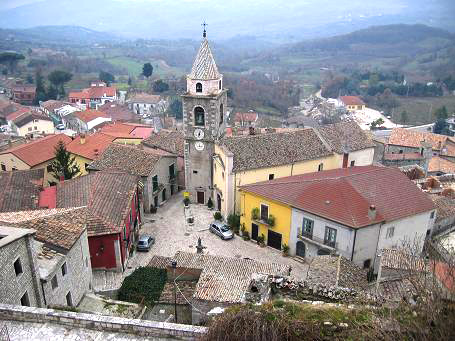

You ask an old man in the piazza where the name Cavoti comes from, and he tells you it is because the ancient inhabitants grew cabbages, cavoli, in the terraced fields above the valley, and he says this with the flat certainty of a man repeating something he has never once doubted, because his father told him, and his father’s father, and somewhere in that chain of telling the story stopped being a guess and became a fact. It is a good story. It is almost certainly wrong. But it survives for reasons that have nothing to do with cabbages and everything to do with what a town needs from its own past.

The scholarly consensus, when there is one, points somewhere else entirely. Cavoti likely descends not from vegetables but from a Lombard personal name or a gentilizio, a clan designation carried by the Germanic warrior groups who fragmented across the Beneventan countryside after the sixth century, when the Duchy of Benevento became the last redoubt of Lombard power in a peninsula otherwise swallowed by Byzantine reconquest. Paul the Deacon, writing his Historia Langobardorum in the 780s from the safety of Montecassino, describes exactly this kind of fragmentation: small fara groups, kinship units of the invading Lombards, peeling off to hold minor strongholds, naming the land after themselves the way a dog marks territory, permanently and without ceremony. If San Marco dei Cavoti carries a Lombard clan name fossilized into geography, it belongs to hundreds of similarly named villages across Campania and Molise, all bearing witness to a conquest so total it rewrote the vocabulary of the land itself.
But Lombard is only the second layer, and arguably not even the deepest one. The town sits within a territory that Byzantine Benevento contested for centuries, and the very structure of hilltop settlement, defensive, elevated, oriented toward sightlines rather than convenience, speaks a military logic older than either Lombard or Byzantine naming. Archaeologists working the Sannio region have long noted that these medieval villages frequently overlay Samnite fortification sites from the fourth and third centuries BCE, the same Samnites who humiliated Rome at the Caudine Forks in 321 BCE and who built their strongholds on exactly this kind of terrain, high, narrow, defensible. The name changes with every conqueror. The hill does not move.
San Marco, the other half of the name, arrived later and more legibly, a dedication to the evangelist that likely coincides with the construction or consecration of a church, the kind of pious relabeling that swept the Mezzogiorno as Christianity consolidated its grip on rural identity throughout the early medieval centuries. Two names, two eras, stitched together into a single civic identity, and almost nobody in the town thinks of it as a stitch. They think of it as a whole cloth, seamless, given.
This is where the cabbage story does its real work. It is not really an etymological claim. It is a psychological one. The historian Marc Bloch, in his unfinished reflections on historical method, observed that communities do not preserve the past so much as they continuously reinvent a usable version of it, and nowhere is this more visible than in toponymy, the study of place names, where invented folk etymologies almost always displace the harder, stranger, more discontinuous truth. A cabbage is comprehensible. A Lombard fara structure buried under Byzantine administrative memory buried under Samnite fortification logic is not comprehensible, not at a glance, not in the piazza, not from a grandfather to a grandson. The harder truth requires archives, comparative linguistics, an afternoon with a paleographer. The soft truth requires only a field of vegetables and an old man willing to point at it.
What gets lost is not just accuracy. It is the recognition that identity, even a village’s identity, is a palimpsest, layer over layer over layer, each conqueror or bishop or magistrate scraping at what came before without ever fully erasing it, and that the discomfort of that layering, the admission that your town’s name might belong first to a Germanic warlord and only later to a saint, is precisely the discomfort a founding legend exists to dissolve.
The Medieval Feudal Structure and Its Silent Legacies
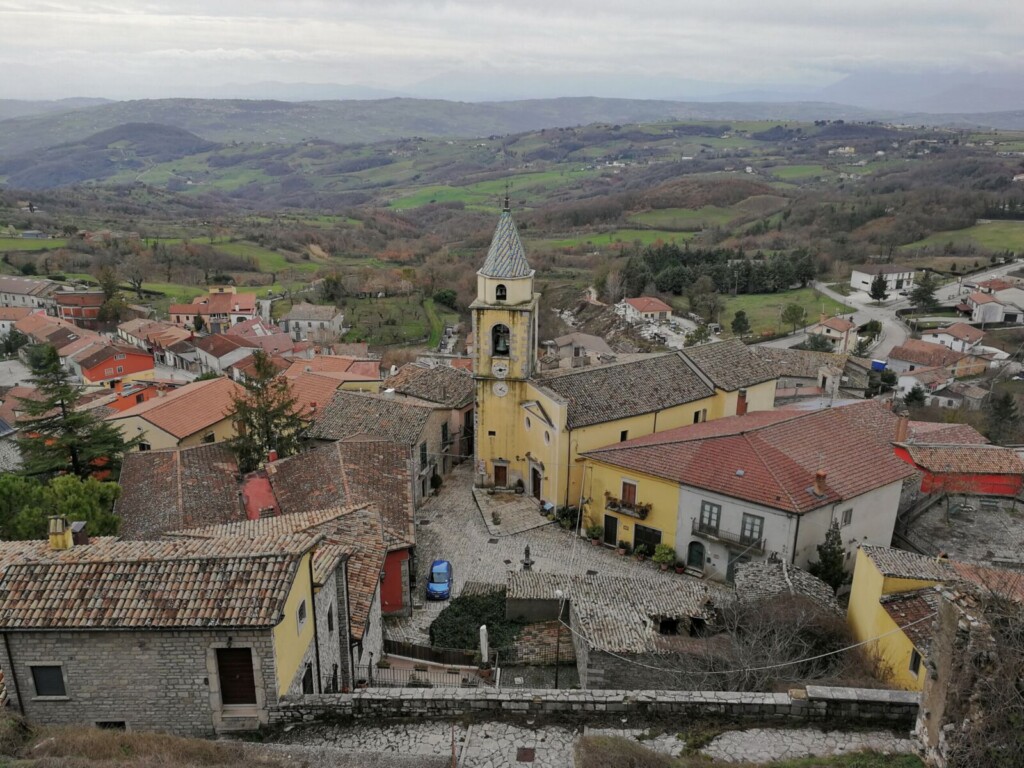
You can still ask who owns the land around San Marco dei Cavoti, and you will get an answer that begins not with a name in a registry but with a name from five centuries ago, spoken the way people speak of weather patterns, as though feudal possession were a climate rather than a historical accident. The Carafa family did not simply govern this stretch of Sannio; they metabolized it, turning the valleys and the chestnut groves into extensions of a household economy that had little interest in the people actually working the soil, except insofar as those people generated revenue that could be converted into Neapolitan prestige. Feudalism in the Kingdom of Naples was never the tidy pyramid of textbook diagrams. It was a tangle of overlapping jurisdictions, where a baron might hold criminal justice over a village while a bishop held its tithes and a separate creditor held its debts, and San Marco dei Cavoti existed inside precisely this kind of layered ownership, passed between noble hands through marriage contracts and inheritance disputes that had nothing to do with the actual valley and everything to do with Neapolitan court politics.
What gets lost in the standard telling is how thoroughly this arrangement colonized the imagination of the people living under it, not just their labor. The historian Tommaso Astarita, writing on the Sanseverino family’s domains in Calabria, described feudal lordship less as an economic system and more as a total performance of hierarchy, one in which subjects were required to internalize deference as a kind of second nature, so that the baron’s authority felt less like a political fact and more like a law of physics. San Marco dei Cavoti absorbed the same choreography. The town’s spatial layout still whispers it: the old baronial residence claiming the high ground, the parish church negotiating a delicate proximity to power without threatening it, and the cluster of humbler dwellings arranging themselves below in a gradient of visible subordination that no urban planner designed and no one needed to enforce, because everyone already knew where they belonged.
This is the part that unsettles, if you let it: the abolition of feudalism in the Kingdom of Naples in 1806, under Joseph Bonaparte’s administration, did not abolish the reflexes feudalism had spent centuries training into muscle memory. Land redistribution laws could reassign parcels on paper while leaving intact the deeper grammar of who asks permission and who grants it, who speaks first at the table and who waits. Sociologists studying southern Italian communities, Edward Banfield among them in his controversial 1958 study of a Basilicata village, tried to explain this residue as a kind of cultural pathology, what he called amoral familism, but he mistook the symptom for the disease. The real inheritance was not distrust of strangers. It was a template of asymmetrical relationship, a sense that some families are simply built closer to authority than others, a sense that persists in a hundred small transactions that have nothing to do with land titles anymore, in who gets the favor at the comune office, in whose son is expected to succeed and whose is expected to leave.
Walk through San Marco dei Cavoti today and ask an elderly resident about the old families, the ones whose surnames still anchor certain streets or certain trades, and watch how the answer arrives less as historical fact and more as unwritten protocol, a map of expectations nobody drew up and everybody carries. The Carafa are gone, their feudal rights dissolved by statute two centuries ago, their descendants scattered into irrelevance or absorbed into the anonymity of the Italian bourgeoisie. But the shape they left behind, the specific gravity that made certain doors easier to open and certain futures easier to imagine, did not dissolve with the paperwork. It migrated into etiquette, into who gets thanked publicly and who gets thanked never, into the quiet arithmetic of respect that still governs a piazza conversation, waiting to be noticed by anyone willing to ask why deference here so often feels less like courtesy and more like memory.
A vision curated by a filmmaker, not an algorithm
In this video I explain our vision

