
The Geometry of Disconnection: How Modern Life Built Walls Between Matter and Meaning
You wake to the insistent buzz of your alarm, not the dawn chorus outside a window that frames a living horizon, but a digital chime slicing through the dark cocoon of your bedroom. The walls around you are smooth, unyielding sheetrock painted in neutral grays, enclosing a space optimized for sleep efficiency—bed, nightstand, charger port, no more. You rise, navigate the hallway’s fluorescent glow to a kitchen of laminate counters and stainless steel, pouring coffee from a machine that hums like a distant engine. This is your home, a container for the body’s necessities, yet as you sip and scroll the screen’s feed of curated crises, a hollow ache stirs: where is the whisper of something larger, the curve that draws the eye upward, the form that echoes the pulse within your chest? Matter holds you, but meaning slips through the cracks like light under a door you never open.

This fracture did not arrive unannounced. It deepened after the 1950s, when television flickered into living rooms across America and Britain, drawing eyes inward to glowing screens that supplanted the wild edges of the world. Urbanization had plateaued, cities no longer swallowing fields at a voracious pace, yet nature’s presence in songs dwindled—for every three nature-tinged lyrics in the 1950s, barely one lingered by the 2000s—and storylines in films and novels followed suit, nature retreating from cultural imagination not by land loss alone, but by the siren call of virtual indoors. Ellen and Ron, mid-40s professionals in the late 20th century grind, embody this rift: she, a senior attorney buried in corporate briefs; he, a journalist chasing deadlines; their days a treadmill of long hours and child-rearing logistics, where scheduling a plumber unravels into nightmare, work devours life, and free time collapses into exhaustion. “Balancing work and life? Forget it,” Ron says, their stress a chronic shadow eroding health and bond, yet they cling, convinced this frenzy is adulthood’s sober reality, the romantic ideals of their 1960s youth traded for the cliff’s edge.
Here lies the geometry of disconnection: spaces engineered for utility, severing the thread between flesh and spirit. Modern physics, echoing ancient Sufi mystics and Buddhist seers, affirms what we sense in our marrow—a fundamental unity of all matter, where disruption breeds dysfunction not as byproduct, but as essence of illness. Yet our built world enforces separation: mind from body, self from other, humanity from the pulsing web of life. We treat our stresses as isolated “problems,” espouse democracy while wielding control in intimacy, champion fidelity yet rationalize betrayal, all while numb to the underclass or global atrocities that mock our professed oneness. Urban sprawl and “ease of doing business”—that pro-growth metric correlating strongest with nature’s eclipse—pave over biodiversity with hardscapes, prioritizing efficiency over reverence. Spirituality, conversely, blooms where science yields to deeper resonance, hinting at interventions in thoughtful urban design or economic rebalancing, though these remain whispers against the roar of infrastructure.
Rudolf Steiner saw this schism acutely in the early 20th century, diagnosing architecture’s fall from holistic speech to mere enclosure. In his 1925 vision for the Goetheanum—destroyed by fire that same year, only to rise anew in concrete curves defying rectilinear logic—he sought to reverse it, forms flowing like breath, double curves interweaving matter and etheric forces, speaking directly to the whole human being: senses, soul, spirit.. Before him, Émile Durkheim mapped modernity’s anomie in “The Division of Labor in Society” (1893), where functional specialization atomizes, stripping communal rituals that once bound body to collective meaning. Our homes, offices, suburbs—grids of isolation—mirror this, walls not bearing symbols of transcendence but insulating against the very unity physics now validates.
The 20-somethings inherit this legacy warped: wary of intimacy, skeptical of career altars yet ensnared, absorbing their parents’ hypocrisies while craving values-aligned success they fear unattainable. Picture the man in the high-rise cubicle, staring at a window framing only sky and steel, or the woman in her subdivision McMansion, where every corner screams convenience but none murmurs eternity—these are not anomalies but the architecture of our era, functional husks whispering that spirit resides elsewhere, if at all. What if the plumber’s delayed visit, that mundane fury, signals not logistics but a deeper misalignment, the built form refusing to converse with the unseen forces stirring in our fatigue? Steiner’s curves at Dornach aimed to mend this, geometry as spirit’s tongue, but our rectangles persist, containing the body while the soul wanders exiled. How long until the ache demands not renovation, but rebirth?
Steiner’s Revolt Against the Mechanical: Organic Form as Spiritual Necessity
There is a moment when a building stops speaking to you—when you walk into a room and feel the weight of its indifference, the cold precision of its geometry pressing down on your nervous system like an anesthetic. This is what Rudolf Steiner saw happening around him in the early twentieth century, and it disturbed him not as an aesthetic problem but as a spiritual catastrophe. The architecture that dominated the age was built on mathematics, on symmetry, on the dream that human reason could impose perfect order onto the world. Columns repeated themselves with mathematical regularity. Facades mirrored themselves along invisible axes. Everything was proportional, balanced, dead.
Steiner understood something that most architects of his time had forgotten: that this mechanical ordering of space was not neutral. It was a philosophy made concrete. Every symmetrical facade, every geometrically perfect building was teaching the human soul something about reality—that reality itself was mechanical, that nature was merely an assemblage of parts to be arranged according to rational principles, that the spirit had no place in the material world. The architecture was not representing the crisis of modernity; it was reproducing it, reinforcing it with every stone and line.
What Steiner rejected was not beauty or form itself, but the underlying metaphysical assumption that governed how form was created. The old styles, he insisted, were based on something fundamentally false about the nature of being. They treated the building as a problem of engineering—how to arrange parts in mathematically perfect relationships. But this approach missed something essential about how life actually works. When you look at an organism, at a plant growing from seed to flower to fruit, you do not see repetition of identical forms. You see metamorphosis. The leaf becomes the sepal becomes the petal. Each appears different, each is transformed, yet all are expressions of the same underlying idea. This is not mechanical repetition; this is living transformation.
Steiner’s vision was radical because it was not merely seeking a new style, a new set of forms to decorate buildings. He was attempting something far more dangerous: he was trying to make architecture express a completely different understanding of reality itself. He declared that new impulses must come through spiritual science, that architects must learn to work not by imposing geometric patterns but by attuning themselves to the formative principles that operated in nature. But—and this is crucial—not through imitation. He was explicit about this: one cannot simply copy the shapes of leaves and flowers and expect to create living architecture. That would merely be replacing one kind of mechanical thinking with another, swapping mathematical forms for botanical ones while leaving the deadness intact.
What Steiner demanded instead was something almost unthinkable: that the architect cultivate an inner, spiritual movement that corresponded to how nature itself creates. The architect must bring their own soul-life into such inner movement as corresponds to organic creation. Then, when the building rose, it would not be nature itself—it would be something else, something that did not exist in nature but that resonated with nature’s principles. It would remind one of the living without imitating it. This is a crucial distinction. Organic architecture does not copy nature; it thinks as nature thinks.
This distinction exposed something profound about the crisis Steiner was addressing. The mechanical architecture of his age was not just ugly; it was spiritually suffocating because it presented the world as fundamentally unintelligent, uninspired, a realm of dead matter to be rearranged by human will. Every repeated column, every perfect symmetry whispered a lie: that reality is lifeless and only the thinking mind brings order to chaos. Against this, Steiner’s organic architecture asserted something that modernity had nearly destroyed—that the world itself is alive, intelligent, creative. And that human beings, in order to inhabit it authentically, must learn to create in harmony with that living intelligence rather than against it.

The Body of the Building: How the Goetheanum Learned to Breathe
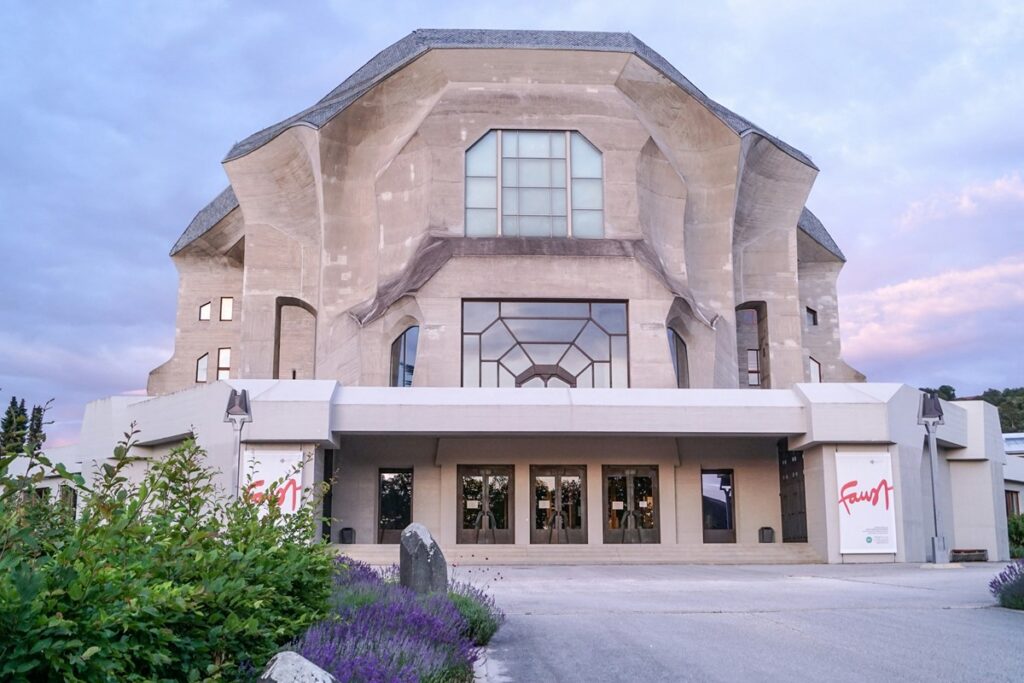
In the moment you cross the threshold of the building, your spine straightens without your conscious decision. The entrance is not a mouth that opens—it is an organism that breathes inward, drawing you into a logic that your body understands before your mind can name it. This is the first betrayal of what you thought architecture could be, the moment when the distinction between shelter and initiation collapses entirely.
Rudolf Steiner abandoned the column as a mere support. He abandoned the wall as a mere boundary. What emerged instead was a revolutionary recognition: that architecture could function as a living tissue through which thought itself becomes tangible. The balustrades supporting the staircases do not imitate organic forms—this would be a naturalist’s error, a copying of leaf and flower that misses the entire point. Instead, they embody the creative principle underlying organic growth. Each thickening, each thinning of these pillar-like structures was conceived in relation to their specific place within the whole. Nothing arbitrary. Nothing decorative. Every form answering a necessity that is both structural and spiritual.
The conventional pillar stands as a monument to repetition and weight. It is the same above as below, divorced from the life of the building around it. But in the Goetheanum, these organic supports appear to emerge from an internal dialogue with gravity itself, with the flow of human movement, with the emotional temperature of the space they inhabit. They do not support through dead resistance but through what might be called sculptural sympathy—a form that has surrendered to the forces moving through it and found its own balance within that surrender.
The heating elements lining the gallery betray Steiner’s refusal to separate the functional from the spiritual. These are not abstract radiators hidden behind utilitarian boxes. They possess a form that suggests growth, that speaks of living forces ascending from the earth. Enter the gallery and your eye encounters something that does not declare itself as a heating element at all—you feel instead a kind of architectural music, a geometry that reminds you of natural processes without reducing itself to mere imitation. The forms appear in dual structures, like beings engaged in conversation with one another, and in that mutual relationship, something about the nature of exchange itself becomes visible.
This is where the revolution occurs: in the recognition that the building’s organs must be precisely what they are in their precise location, or they are nothing at all. The organ pipes themselves do not sit in a corner as an object placed within space. They have grown out of the forms of the building itself, so that the architecture and the instrument become indistinguishable, speaking the same language, composed of the same logic. The separation between what supports and what is supported, between structure and ornament, between the mechanical and the living—all dissolves into a unified organism.
The two domes, which constitute the building’s most iconic feature, are not merely artistic gestures. They function as the building’s lungs, the spatial containers where breath becomes the primary experience. To stand beneath them is to understand that dome and chamber are not static volumes but breathing geometries, places where the shape of the space shapes your inner experience. Steiner had intuited what contemporary neuroscience would later confirm: that when one enters a space, a room, one’s feelings take on the shape of that room, that the concavities and convexities surrounding you do not merely house consciousness but actively reshape it.
This was heresy in 1913, and perhaps it remains so. In an era of purely functional modernism emerging elsewhere, Steiner proposed that a building’s capacity to transform the person within it—to initiate rather than merely contain—was not supplementary but foundational. The Goetheanum’s entire structural logic depends upon this principle: that every curve, every support, every transition between chambers serves as a medium through which anthroposophical thought becomes a lived, embodied experience rather than an abstract philosophy to be discussed in lectures. The building itself becomes the teaching, speaking directly to the body’s intelligence, to that deeper knowing that exists beneath the threshold of intellectual comprehension.
From Concealment to Confrontation: The Evolution Between Two Goetheaneums

You wake in the dim hush of a wooden chamber, the air thick with the scent of pine resin and candle wax, walls curving inward like the ribs of some ancient beast cradling your breath. Bodies shift in the half-light, faces turned not outward but deep into themselves, as if the space itself were a womb woven from timber, shipbuilders’ hands having bent the planks into forms that echo the pulse of hidden organs. This was the First Goetheanum, rising in Dornach between 1913 and 1919, a Gesamtkunstwerk where theater, color, and sound fused into spiritual immersion, sheltering the Anthroposophical Society’s summer festivals and the seekers who gathered there, a colony drawn to Rudolf Steiner’s vision of inner paths untrodden by the rationalist clamor of the contemporaneous Bauhaus. Here, right angles dissolved; double cupolas intersected like inner domes of the soul, extensions curling inward, protecting the periphery-oriented flow from the world’s gaze, much as Haus Duldeck nearby condensed that dynamic into rectangular intimacy, or the Glass House mirrored the separated yet equal cupolas for artists carving stained windows in seclusion. Steiner summoned boatbuilders to sculpt wood’s yielding grain, excavating forms that mimicked not nature’s surface but the soul’s subterranean currents, a pure sanctum where the spirit spoke without interruption.
Then fire came on New Year’s Eve 1922, devouring it in flames that licked the night sky over Dornach, leaving ash and a sudden void. In the wake of that catastrophe, Steiner, undeterred, sketched the replacement by 1923, construction breaking ground in 1924, the structure unfinished at his death in 1925 and only fully realized by 1928, then gradually to 1998. Concrete poured now, not wood—pioneering exposed, sculpted masses that thrust outward, bold and unyielding, a Swiss national monument by 1993, hailed by critic Michael Brennan as a masterpiece of 20th-century expressionist architecture. Where the first had been introverted, a protective husk for esoteric training, the second pivoted: its west façade with twin pillars echoing the Rudolf Steiner Halde’s rehearsal space, forms no longer flowing inward but confronting the landscape, self-confident, relating dynamically to surrounding nature. Wood’s plasticity yielded to concrete’s sculptural heft, artisans now carving the material like living clay rather than hollowing timber, translating static geometry into organic dynamism, as Steiner urged, per Albert Steffen’s recollection of his imperative to reshape architecture’s rigid inheritance.
This shift across a mere decade—1919 to 1928—mirrors the anthroposophical movement’s own convulsions and the world’s upheavals: war’s end in 1918, Steiner’s escalating lectures on spiritual science amid rising opposition, the society’s internal fractures. The first Goetheanum embodied concealment, its wooden universe of colors and curves a refuge for the “inner path of training,” as one observer phrased it, where experience stayed hermetic, the building’s very timbers insulating the spirit from profane eyes. Yet the same impulse birthed its successor as confrontation: no longer mere shelter, but a bridge hurling esotericism outward, demanding encounter. Steiner’s seventeen Dornach buildings from 1908 to 1925 culminate here, the second’s colossal hall seating a thousand, stage vast for eurythmy and culture that spills into alternative education and public life even today. Paradox presses: why did one spiritual force dictate enclosure, then rupture it? The first whispered to initiates alone; the second bellows to the street, its concrete mass—bolder, less flammable—sculpting not imitation of nature but its metamorphosis, forms “mentally impressive” in their abandonment of right angles for architectural scale.
Feel that tension in your chest, the way a hidden chamber once held you safe, only for the flames to force exposure. Steiner himself likened architecture to the spirit’s language, evolving as consciousness does—from womb to world, esoteric murmur to radical address. Ten years: enough for a wooden dream to burn and concrete to rise unapologetic, the universe of inner plasticity giving way to outer plasticity’s demand. What catastrophe in your own life has demanded such a turn, from sanctum to scaffold? The Goetheanum does not answer; it stands, double-domed impulse bifurcated, whispering of impulses that consume their own forms to speak louder still.
The Unfinished Gesture: What Remains When Architecture Becomes a Question
You stand at the edge of the Dornach hill on a late autumn afternoon, the air sharp with the scent of damp earth and pine, and gaze at the Goetheanum’s concrete bulk rising like a half-remembered dream against the gray sky. Your hand rests on the rough, molded surface, fingers tracing a curve that defies the eye’s expectation—it swells outward then inward, as if breathing, refusing to settle into the tidy geometries of cathedrals or the brutal slabs of factories you’ve known. This is no inert monument demanding your awe; it pulls you in, not with completion, but with its stubborn refusal to end, leaving you to wonder if the building is waiting for you to finish it, or if you’re the one unfinished.
That visceral tug, that unfinished pull, echoes what Rudolf Steiner described in his 1921 lectures on the building’s genesis, where he insisted forms must arise not from “dried-up symbolism or abstract allegorism,” but from a living revelation of spiritual reality manifesting in space. He modeled the concrete like clay, fluid and organic, so that pillars twist like growing stems and windows unfurl like petals caught mid-bloom, evoking the metamorphosis Steiner drew from Goethe’s botanical studies—the leaf transforming into calyx, petal, stamen, without a fixed telos, only perpetual becoming. You feel it in your chest, this shift: the structure doesn’t symbolize spirit; it enacts it, demanding your body participate in the alchemy. Walk inside, and the double domes—one vast hall seating 1,500 for eurythmy performances, the other intimate for lectures—curve overhead, light filtering through geometric blooms that pulse with the room’s acoustics, as if the walls themselves hum with the etheric forces Steiner sought to materialize.
Yet herein lies the resistance to closure. The first Goetheanum, carved from wood by anthroposophical hands between 1913 and 1922, burned to the ground on New Year’s Eve, its flames devouring what Steiner called an “instrument of inner training,” a sculptural hymn to the soul’s ascent. From its ashes rose the second in 1928, three years after Steiner’s death, shifting from esoteric contemplation to “esotericism combined with the greatest conceivable openness”—a call to carry spiritual insight into social action, the second half of the training path he deemed harder, more vital: utilizing the spirit on earth for oneself and others. This evolution mirrors the building’s form: no static icon, but a gesture toward a third, dreamed but unrealized, where inner development fully merges with outer engagement, like branches from a concealed trunk. Critics dismissed it as fantastical, organs of brain and heart rendered in concrete, yet Collins noted how these elements guide from physical exterior to enlightened interior, metamorphosis binding all.
In this perpetual incompletion, philosophy becomes form not as resolved theorem but as encounter. Henri Focillon, in his 1938 Vie des Formes, argued forms live through their mutations, escaping the prison of fixed meaning to inhabit the beholder’s perception—precisely what happens here, where your gaze on a vaulted ceiling awakens not interpretation but transformation, a stirring in the blood akin to the “initiation process” Steiner embedded in the first building’s color and form shifts. You recognize yourself in this: the cultural trap of demanding architecture deliver pat answers, as if Chartres’ rose windows or Corbusier’s machines-for-living could encapsulate the soul. But the Goetheanum unmasks that—concrete, born of industrial rigidity in the 1920s, bent to mimic nature’s fluidity, hosts today the School of Spiritual Science, conferences, theater, drawing 100,000 visitors yearly into its unfinished rite.
What lingers is not mastery, but the question etched in every curve: when a building withholds its final shape, does it free the spirit or expose our own incompletion? Steiner warned against allegory’s sterility; here, in the sheltering portal that “ushers light into inner space,” you confront not spirit’s image, but its demand upon you—to metamorphose amid the forms that never quite resolve. The hill wind rises, carrying echoes of fire and chisel, and the structure waits, eternally gesturing beyond itself.
A vision curated by a filmmaker, not an algorithm
In this video I explain our vision
🌀 Infinite Maze: Spiritual Paths
Explore the profound spiritual dimensions of Rudolf Steiner’s visionary Goetheanum through these curated articles on anthroposophy and esoteric wisdom. Delve into architecture as a vessel for the soul, mirroring the infinite maze of human consciousness and cosmic evolution. Each piece unveils layers of thought that resonate with the Goetheanum’s expressive forms.
Anthroposophic Medicine: Healing the Body through the Spirit
Anthroposophic Medicine bridges the physical and spiritual realms, much like the Goetheanum’s organic architecture embodies Steiner’s holistic vision. This healing approach treats the body as an extension of the spirit, using remedies attuned to cosmic rhythms and human evolution. It echoes the building’s role as a center for transformative experiences beyond mere materiality.
GO TO THE SELECTION: Anthroposophic Medicine: Healing the Body through the Spirit
Waldorf Schools: a Pedagogy that Educates the Soul beyond the Intellect
Waldorf Schools cultivate the soul through artistic and imaginative education, paralleling the Goetheanum’s fusion of architecture, sculpture, and theater as a Gesamtkunstwerk. Steiner’s pedagogy nurtures inner development free from rigid intellect, fostering creativity that mirrors the building’s liberated, curving forms. These methods invite students into an infinite maze of self-discovery and spiritual growth.
GO TO THE SELECTION: Waldorf Schools: a Pedagogy that Educates the Soul beyond the Intellect
Rudolf Steiner and Anthroposophy: A Guide to Modern Esoteric Thought
Rudolf Steiner and Anthroposophy offer a modern esoteric framework that directly inspired the Goetheanum’s revolutionary design. This guide explores Steiner’s synthesis of science, art, and spirituality, revealing how the building serves as a physical manifestation of anthroposophic principles. It navigates the labyrinth of human potential, where architecture speaks the language of the eternal spirit.
GO TO THE SELECTION: Rudolf Steiner and Anthroposophy: A Guide to Modern Esoteric Thought
Universal Consciousness
Universal Consciousness delves into the interconnected oneness of existence, akin to the Goetheanum’s expressionist forms that transcend traditional geometry to evoke spiritual unity. This exploration connects personal awareness to cosmic forces, reflecting Steiner’s intent for buildings that awaken the soul’s deeper perceptions. It charts an infinite maze where architecture becomes a portal to collective enlightenment.
GO TO THE SELECTION: Universal Consciousness
Discover Indiecinema’s Hidden Gems
Venture deeper into independent cinema on Indiecinema streaming, where films unravel the mysteries of spirit and form like the Goetheanum’s timeless architecture. Uncover visionary stories that challenge perceptions and ignite the soul’s infinite maze.
👉 EXPLORE THE CATALOG: Watch Indie Films in Streaming
A vision curated by a filmmaker, not an algorithm
In this video I explain our vision

