
The Woman Who Could Not Stay Still
You know the feeling. You are sitting at a desk that used to feel like yours — the coffee mug in its habitual place, the papers arranged in a system only you understand, the small rituals that once gave the day its spine — and something has shifted so quietly you cannot name the moment it happened. The work is the same. You are not. And the gap between those two facts is now so wide that every morning you have to will yourself across it, like crossing a fracture in ice, hoping it holds.

This is not a crisis in the dramatic sense. Nobody is screaming. Nothing has collapsed. It is subtler and more corrosive than that: it is the experience of wearing an identity that no longer fits, of performing a self that has outgrown its container, and doing it so convincingly that even the people closest to you do not notice the effort it requires.
Annie Besant knew this feeling with a ferocity that most people spend entire lifetimes managing to avoid. She was twenty-three years old when she married the Reverend Frank Besant in 1867, and the life that followed was correct in every visible dimension — a clergyman’s wife in a Victorian parish, domestically arranged, socially legible, theologically settled. She would later describe those years in her autobiography with a precision that reads less like memoir and less like accusation than like a clinical dissection of slow suffocation. The doctrine she was expected to embody had stopped making sense to her not dramatically but incrementally, the way a sentence you have read too many times eventually loses its meaning, leaving only the shape of words behind.
Erik Erikson, writing in Identity: Youth and Crisis in 1968, argued that what we tend to pathologize as breakdown is often something closer to biological necessity — that the self periodically needs to dismantle its working structures in order to rebuild them at a higher level of coherence. He called it identity crisis, but he was careful to strip the term of its clinical condescension. For Erikson, the refusal to resolve, to settle, to crystallize prematurely into a fixed social role was not neurosis. It was fidelity — a kind of loyalty to something not yet fully formed but already insisting on itself with undeniable pressure. What society reads as instability, Erikson read as integrity in motion.
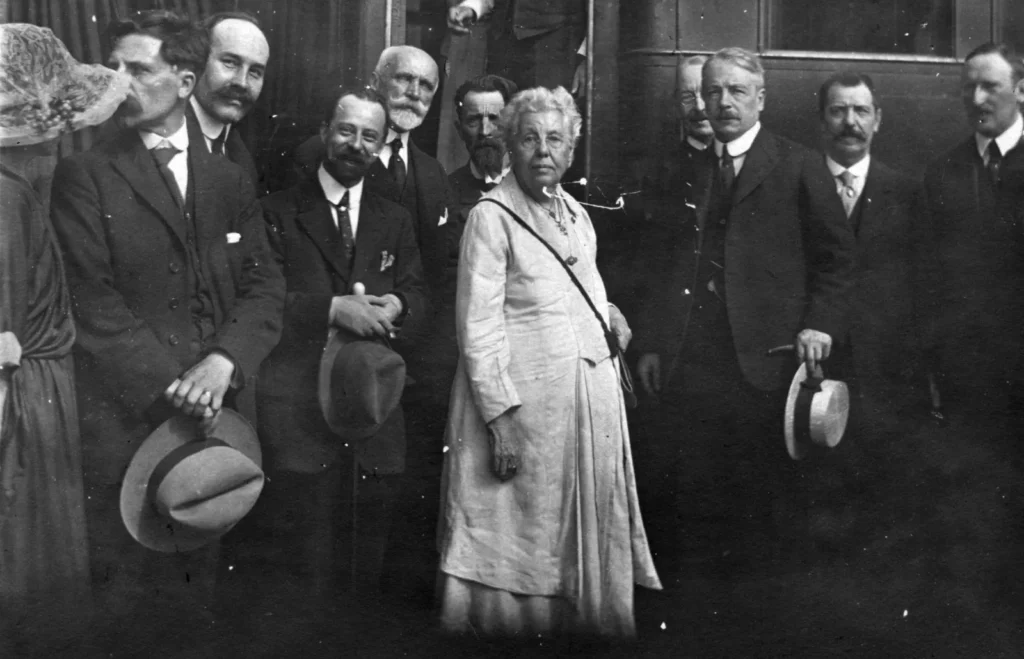
Besant’s entire life is a sustained argument for this reading. She did not transform once. She transformed repeatedly, each metamorphosis more total than the last, each departure more irreversible, each new identity inhabited with a completeness that makes the previous one almost unrecognizable in retrospect. From estranged clergyman’s wife to atheist pamphleteer. From atheist pamphleteer to socialist organizer on the docks and in the match factories. From socialist organizer to Theosophist and eventually to President of the Theosophical Society, then to the Indian independence movement, then to a kind of spiritual authority so vast it seemed to swallow the woman who had walked out of a Lincolnshire rectory in the 1870s with almost nothing except the refusal to pretend.
What makes her pattern recognizable — viscerally, uncomfortably recognizable — is that none of these transitions were opportunistic. She was not moving toward advantage. She was moving away from falseness. There is a particular kind of person who cannot metabolize inauthenticity, who develops something like an immune response to institutional belonging the moment the institution begins to demand more conformity than the self can honestly provide. Besant was constitutionally this kind of person, and the world she lived in was constitutionally unprepared for her.
The desk. The coffee mug. The papers in their system. At some point, you either stay and slowly disappear into the role, or you stand up and become the problem nobody expected.
The Cost of Thinking Out Loud
She was twenty years old when she married Frank Besant, and the ceremony itself was already a kind of sentencing. Not because the man was a monster — he was not, particularly — but because the institution required her to become smaller than she was, and she had never learned how to do that convincingly. The household in Sibsey, Lincolnshire, where Frank served as a clergyman, was orderly and suffocating in equal measure. She had opinions. She voiced them. This was, in the language of that drawing room and that marriage and that decade, the precise nature of her offense.
There is a woman in a story that belongs to no single telling but to many — she sits across a table from men who have decided her fate before she has spoken, and what condemns her is not her guilt but the quality of her attention. The way she listens too closely, reasons too clearly, refuses the minor fictions that oil the machinery of daily submission. She is not punished for breaking rules. She is punished for making her thinking visible, which is a far graver transgression.
John Stuart Mill, writing in On Liberty in 1859, made the argument with surgical precision: that the suppression of an opinion robs humanity not only of the dissenting view but of the livelier impression of truth that collision with error produces. What he could not fully account for, as a man writing from within the protections of his gender, was the specific tax levied on women who dared to exercise exactly this collision. The social mechanics were not abstract. They operated through marriage law, through ecclesiastical authority, through the custody of children — through every instrument that transformed private belief into public consequence.
Besant separated from Frank in 1873. She had already begun writing, already begun asking questions about faith that her husband’s vocation could not survive in the same house. When she drifted toward Charles Bradlaugh and the National Secular Society, she was not merely changing her philosophical address. She was choosing the version of herself that thought out loud over the version that survived quietly.
The trial came in 1877, and it was, in its way, a masterclass in institutional neutralization. She and Bradlaugh republished Charles Knowlton’s Fruits of Philosophy, a pamphlet advocating contraception that had circulated in various forms since 1832. The legal charge was obscenity. The actual charge was knowledge — specifically, the distribution of knowledge about reproductive autonomy to working-class women who had not been invited to possess it. They were convicted. The conviction was later overturned on a technicality, which is how systems often prefer to operate: not by admitting they were wrong, but by finding a procedural exit that allows the original judgment to remain unexamined.
The custody of her daughter Mabel was not overturned. Frank Besant argued, successfully, that a mother who distributed birth control literature was unfit to raise a child. The court agreed. This is the mechanism Mill could only partially theorize: the opinion does not merely lose the argument. It loses the daughter. The cost is calibrated precisely to where the thinker is most vulnerable, most human, most unable to sustain the abstraction of principle against the concreteness of loss.
She kept writing anyway. This is the detail that resists easy narrative — not the martyrdom, not the grand gesture, but the sheer continuation of thought after the punishment has landed. There is something almost unreasonable about it, which is perhaps the only honest word for what courage looks like when you remove the mythology from around it.

Socialism as a Language for Rage
There is a particular kind of woman who walks into a factory and cannot leave unchanged. She goes in with notebooks, with questions, with the measured curiosity of someone who has already formed opinions about suffering from a comfortable distance. Then she sees the jawbones. The phosphorus necrosis that the Bryant and May workers called “phossy jaw” — bone rotting from the inside outward, glowing faintly green in darkness, the body turned into its own slow lantern of destruction. You do not theorize your way past that. You either look away or you become someone else.
Besant became someone else, repeatedly, and 1888 was one of those thresholds. She had already moved deep into the orbit of Fabian socialism by then, sharpened by her friendship with George Bernard Shaw, whose particular genius was making radical thought feel like common sense, like something any intelligent person would have arrived at independently given sufficient courage. Shaw understood the performance of ideas, their theatrical necessity, and in Besant he recognized something rarer than a convert: a woman who needed not only to think correctly but to act until the thinking bled into consequence. The Fabians were gradualists, architects of slow transformation, and there was something in that measured approach that both suited and frustrated Besant simultaneously. She could write, she could lecture, she could fill the secular halls of late-Victorian London with arguments dense enough to build walls from — and she did, prolifically, in journals and pamphlets and packed auditoriums where working people sat and recognized their own lives being named for the first time.
That naming matters more than any subsequent ideology attached to it. Simone Weil, writing decades later in her 1934 essay on oppression and liberty, identified something that Besant was living in real time without the theoretical scaffolding to describe it: that the gravest violence done to the oppressed is not the physical condition of their suffering but the theft of the language adequate to it. When workers had no framework for understanding why their teeth were dissolving, why their faces were caving inward while the shareholders of Bryant and May paid dividends with the equanimity of men discussing weather, the experience remained trapped in the private register of individual misfortune. Besant gave it a different grammar. A grammar of structural causation, of class interest, of a system that required their destruction to sustain its comfort.
The 1,400 women who walked out in July of 1888 were not following an abstract ideology. They were following rage that had finally been given a name it could march under. That is what political movements at their most vital actually do — they do not create grievance, they make existing grievance legible and collective. The strike succeeded within two weeks. Bryant and May capitulated on nearly every demand. The matchgirls were celebrated, lionized, pointed to as evidence that the system could be moved.
And here the story becomes more complicated, as all stories of liberation do when examined without sentimentality. Because movements give language to suffering, but they also offer something more psychologically seductive and more dangerous: they offer belonging. The self that felt atomized, invisible, cosmically unimportant, discovers through collective action a sudden weight, a gravity. Besant felt this acutely. She was a woman who had survived expulsion from marriage, from the church, from respectable society, and who had rebuilt herself each time through affiliation with something larger. First rationalism, then freethought, then socialism. Each framework provided not only intellectual coherence but the warmer comfort of a community that recognized her.
Weil warned that this seduction has its own violence. That the belonging a movement offers can become the new cage, built from different materials but still a cage — one in which the price of continued membership is a gradual surrendering of the questions that no orthodoxy can answer.
The Seduction of the Invisible

There is a specific kind of silence that falls over a person who has just finished reading something that has broken them open. Not the silence of confusion, not the silence of boredom, but the silence of someone who has recognized, against all their previous commitments, that the ground beneath their arguments is less solid than they believed. Annie Besant sat with Charles Bradlaugh’s copy of The Secret Doctrine in 1889 and emerged from it a different person. She did not ease into it. She did not hedge. She wrote to Blavatsky almost immediately, and within months she was standing on platforms she had never imagined, speaking a language her former comrades could not follow.
The accusations came fast. George Bernard Shaw, who had admired her ferocity in the match girls’ strike barely a year earlier, watched what happened and called it a catastrophe. Edward Aveling, who had fought alongside her in the National Secular Society, treated her conversion as a kind of intellectual death. The socialist world she had inhabited — sharp, empirical, hostile to metaphysics on principle — had no grammar for what she had done. And the cruelest interpretation, the one that circulated most persistently, was that she had been seduced. That a woman of her intelligence had been captured by something irrational, and that this capture was evidence of a weakness that had always been there, waiting.
What that interpretation misses is everything structural. Pierre Bourdieu, writing in The Logic of Practice in 1980, described how different social fields generate different forms of capital — and how agents move between fields not merely out of conviction but because certain fields offer forms of recognition that others structurally deny. Besant had given everything to the secular left: her marriage, her children’s custody, her social respectability, her freedom. What socialism gave her in return was comradeship and purpose, but it could not give her what she had also been losing for years without a name for the loss: a cosmology. A framework in which her suffering was not arbitrary, not merely the friction of material conditions, but part of something that cohered.
William James, in The Varieties of Religious Experience, delivered at Edinburgh in 1901 and 1902, made a distinction that cuts directly to this moment. He separated institutional religion from what he called the personal religious experience — the immediate, first-person encounter with something that reorganizes the self. James argued that such experiences carried what he called a noetic quality: they were not merely emotional events but felt like knowledge, like access to truths that discursive reasoning could not reach. Besant’s reading of Blavatsky had precisely this character. It was not that she abandoned reason. It was that she encountered a structure of meaning that reason, as she had practiced it, had never provided.
There is a scene that belongs to no single life and to many simultaneously: a man who has spent decades building something — a political career, a scientific career, a marriage constructed on explicit principles — finds himself in a room he did not expect to enter, listening to something he cannot refute and cannot entirely believe, and walks out of that room unable to return to what he left. The people who loved him watch from outside and cannot understand why the door closed. What they see as abandonment is, from inside, something more like arrival. The problem is that arrival cannot be narrated backwards into a language the people outside still speak.
Besant did not stop being political. She brought to Theosophy the same organizational intensity, the same willingness to stand publicly exposed, that she had brought to the match girls and the birth control pamphlets. But the axis had shifted. The invisible had become, for her, the more real.
Power Without a Name
By 1907, something had shifted in the grammar of her life. She was no longer petitioning power from outside its walls — she had become the walls. The Theosophical Society, with its headquarters in Adyar and its networks spreading across continents, was now hers to govern, and she governed it with a certainty that would have been unrecognizable to the woman who once stood before hostile crowds in London defending the right of the poor to know their own bodies. The vocabulary had changed — she spoke now of Masters and planes of consciousness instead of wages and factory conditions — but the posture was identical: absolute conviction, delivered from a position that brooked no serious challenge.
Hannah Arendt, writing in Between Past and Future in 1961, drew a precise distinction between authority and power. Authority, she argued, requires neither coercion nor persuasion precisely because it is acknowledged as legitimate before any argument begins. It does not need to raise its voice. This is the most seductive trap available to someone who once suffered under authority’s weight: to become, in time, the figure before whom others fall silent not from fear but from reverence, which is merely fear with a gentler name. Besant did not command obedience. She inspired it, which is considerably more difficult to resist and considerably harder to name.
The Home Rule League, which she founded in 1916, represents perhaps the most genuinely remarkable act of her later years — a British woman demanding Indian self-governance at a moment when such a demand carried real risk, when she was briefly interned by the colonial authorities who found her inconvenient. For a few months in 1917, she became President of the Indian National Congress, a fact that seems almost impossible when held against the whole arc of Victorian womanhood she had been assigned at birth. And yet even here, even in this most outward-facing political work, something in the structure repeated itself. She knew what India needed. She had the vision. Others would be guided toward it.
Foucault called it pastoral power — the authority that operates through care, through the intimate knowledge of those it governs, through the shepherd’s genuine concern for the flock. It is power that does not announce itself as domination because it does not feel like domination from the inside. It feels like love, like guidance, like the transmission of something precious. When Besant took a young Telugu boy named Jiddu Krishnamurti and declared him the vehicle of the coming World Teacher, she was not lying. She believed it with every layer of herself. She dressed him in white, educated him in England, built an entire organization — the Order of the Star in the East — around his anticipated revelation. She loved him, genuinely, in the way that someone who has reorganized the entire universe around a single idea loves the proof of that idea.
When Krishnamurti dissolved the Order in 1929 and told the assembled thousands that truth cannot be organized, that no path leads to it, he was dismantling something she had built with the same ferocious sincerity she had once brought to dismantling the structures built against her. She was eighty-two years old. Whether she understood the symmetry is impossible to know.
The question that remains is not whether Annie Besant was a hypocrite. That accounting is too simple, too satisfying, too quick to close. The harder question is whether any mind shaped by genuine suffering, genuine rebellion, genuine hunger for a better order of things can ever fully see the authority it has become — or whether the very depth of the original wound makes that particular blindness not a failure of character but a structural condition, almost a law.
A vision curated by a filmmaker, not an algorithm
In this video I explain our vision
🌀 Paths of Spirit: Theosophy, Reform & Inner Truth
Annie Besant’s remarkable journey from socialist firebrand to president of the Theosophical Society reflects a broader 19th-century hunger for spiritual meaning beyond orthodox religion. Her life intersects with a rich web of esoteric movements, philosophical revolutions, and visionary thinkers who sought to map the invisible dimensions of human existence. These related articles trace the currents that shaped her world and continue to resonate today.
The Theosophical Society: History, Principles and Influence on Western Culture
The Theosophical Society, co-founded by Helena Blavatsky and Henry Steel Olcott in 1875, became the very institution Annie Besant would eventually lead and transform. Understanding its history, core principles, and far-reaching influence on Western esotericism is essential to grasping the spiritual framework Besant devoted the second half of her life to championing. This article offers an in-depth exploration of the Society’s legacy and its enduring impact on alternative spirituality.
GO TO THE SELECTION: The Theosophical Society: History, Principles and Influence on Western Culture
Helena Blavatsky and Theosophy: the Woman Who Revolutionized Esoteric Thought
Helena Petrovna Blavatsky was the towering intellectual predecessor whose writings and vision drew Annie Besant irresistibly into the Theosophical orbit. Her monumental works, including ‘The Secret Doctrine’ and ‘Isis Unveiled’, laid the philosophical foundations that Besant would later popularize and expand upon. To understand Besant’s conversion, one must first understand the extraordinary woman who made Theosophy a global phenomenon.
GO TO THE SELECTION: Helena Blavatsky and Theosophy: the Woman Who Revolutionized Esoteric Thought
The Astral Plane and the Subtle Bodies: the Theosophical Map of Human Being
Central to Theosophical teaching is its elaborate cartography of human consciousness, encompassing astral planes, etheric bodies, and layers of subtle existence invisible to ordinary perception. Annie Besant herself wrote extensively on these subjects, collaborating with Charles Leadbeater to produce clairvoyant investigations into the inner constitution of the human being. This article unpacks the Theosophical map of selfhood that Besant helped bring to a worldwide audience.
GO TO THE SELECTION: The Astral Plane and the Subtle Bodies: the Theosophical Map of Human Being
Rudolf Steiner and Anthroposophy: A Guide to Modern Esoteric Thought
Rudolf Steiner began his esoteric career within the Theosophical Society before parting ways with Besant to found his own school of Anthroposophy, making their intellectual relationship one of the most consequential rifts in modern spiritual history. His synthesis of Western esotericism, science, and spiritual philosophy stands as both a parallel and a counterpoint to the Theosophical tradition Besant represented. Exploring Steiner’s work illuminates the creative tensions and shared aspirations of an entire generation of spiritual seekers.
GO TO THE SELECTION: Rudolf Steiner and Anthroposophy: A Guide to Modern Esoteric Thought
Discover the Cinema of Inner Worlds on Indiecinema
If Annie Besant’s lifelong quest for truth, justice, and spiritual depth resonates with you, Indiecinema streaming is your gateway to independent films that dare to explore the same uncharted territories of consciousness, meaning, and transformation. From mystical documentaries to visionary narratives, our curated catalog celebrates the courageous cinema that mainstream platforms overlook. Join us and let independent film become your next frontier of discovery.
👉 EXPLORE THE CATALOG: Watch Indie Films in Streaming
A vision curated by a filmmaker, not an algorithm
In this video I explain our vision

