
The Mirror in the Coffee Shop
You sit at a small table in the corner of a coffee shop, the kind with mismatched chairs and steam fogging the windows against a gray afternoon drizzle. The cup warms your palms as you sip, eyes drifting idly to the mirror behind the counter, catching fragments of the room: the barista wiping down the espresso machine, a couple arguing in low tones over a shared pastry, your own reflection staring back, tired and alone in the crowd. Then a stranger slides into the chair across from you—uninvited, eyes locking onto yours through that same mirror before turning direct, piercing. “You think you’re separate,” she says, not a question, her voice carrying the faint rasp of too many cigarettes or perhaps secrets. Her gaze doesn’t waver; it pulls, unspooling the thread of your solitude until the boundaries blur—the argument at the next table becomes yours, the barista’s hurried rhythm pulses in your chest, even the steam curling from your cup feels like breath shared among strangers.

In that instant, the illusion cracks. Not with thunder or revelation from on high, but the quiet violence of recognition: we are not islands adrift in a sea of others, but waves crashing into one, foam mingling before receding. Helena Petrovna Blavatsky knew this unraveling intimately, long before she named it for a world armored in disconnection. Born in 1831 in Yekaterinoslav, Ukraine, to a family of minor nobility shadowed by Cossack unrest, she grew up amid tales of the unseen—visions from childhood that her relatives dismissed as fever dreams. Yet by 1851, at twenty, wandering London’s fog-shrouded streets, she encountered him: a tall figure among a procession of Indian princes, his presence not flesh alone but the echo of a protector glimpsed in subtle realms since girlhood. The next day in Hyde Park, he strode across the grass toward her, no barriers of rank or nationality holding him back, imparting words that fused her fate to a destiny twenty-eight years distant, in India. This was Master Morya, not some spectral fancy but a Mahatma, an adept whose gaze, like the stranger’s in the coffee shop, dissolved the veil between seer and seen.
Blavatsky’s life became a testament to this unity, phenomena blooming unbidden around her: furniture shifting at her will, bells ringing without touch, objects materializing for the unexpected guest at a picnic. Skeptics later called it fraud—debunkings in the 1870s press labeling her a medium turned trickster—but she pressed on, founding the Theosophical Society in 1875 with Henry Steel Olcott in New York, not as a cult but a bridge to ancient wisdom. “Theosophy is the world-old wisdom,” she would write in Isis Unveiled that same year, drawing from Kabbalah, Vedanta, and Neoplatonism to unmask the singular essence beneath multiplicity. Arthur Schopenhauer‘s The World as Will and Representation (1818) had posited the world as illusion, maya, where separate selves are but representations of a blind, striving will; Blavatsky embodied it, her body a vessel for forces that defied amputation. In Philadelphia’s White Dog Cafe around 1875—then a modest lodging at 3420 Sansom Street—surgeons urged sawing off her gangrenous leg. She refused, quipping in a letter, “Fancy my leg going to the spirit land before me!” A stray white puppy appeared, curling nightly against the wound, drawing out the poison until healing defied medicine. W.B. Yeats heard variants, but the truth persisted: nature’s hidden sympathies, the dog’s warmth a mirror to the unity Blavatsky proclaimed.
That coffee shop gaze lingers in memory because it echoes Plotinus’s Enneads (third century CE), where the One emanates all without division, souls forgetting their source in the descent to bodies. You feel it viscerally now—the stranger’s eyes not invading but revealing your own fragmentation, the daily grind of “me against them” as the true gangrene. Blavatsky didn’t console with promises of escape; she destabilized, dragging esoteric thought from occult parlors into public scrutiny. Her Secret Doctrine (1888) wove cosmogonies from the Stanzas of Dzyan—alleged Himalayan texts glimpsed in astral travel—with geological data: continents rising and sinking over eons, humanity’s roots in Lemuria some 18 million years past, not the Bible’s 6,000. Éliphas Lévi’s Dogme et Rituel de la Haute Magie (1854) had hinted at such correspondences, but Blavatsky lived them, her arrivals uncanny—appearing unannounced at a fractious London meeting in 1884, “following her occult nose” from Charing Cross station to break the deadlock, as if summoned by invisible decree.
The mirror reflects not just your face but the crowd’s, boundaries porous as the steam between you. What if that stranger were Morya himself, or the white dog reborn, pressing against the rot of isolation? Blavatsky’s revolution lay here: esoteric thought not for elites but the everyman, unity glimpsed in the mundane gaze, unraveling the self we clutch like a gangrenous limb. In Sikkim’s hidden passes, restored by Masters Morya and Koot Hoomi amid disciples, she learned the path winds through such dissolutions. Yet the coffee shop empties, the stranger gone, leaving only the echo: are you healed, or merely glimpsing the wound?
Cathnafola - A Paranormal Investigation
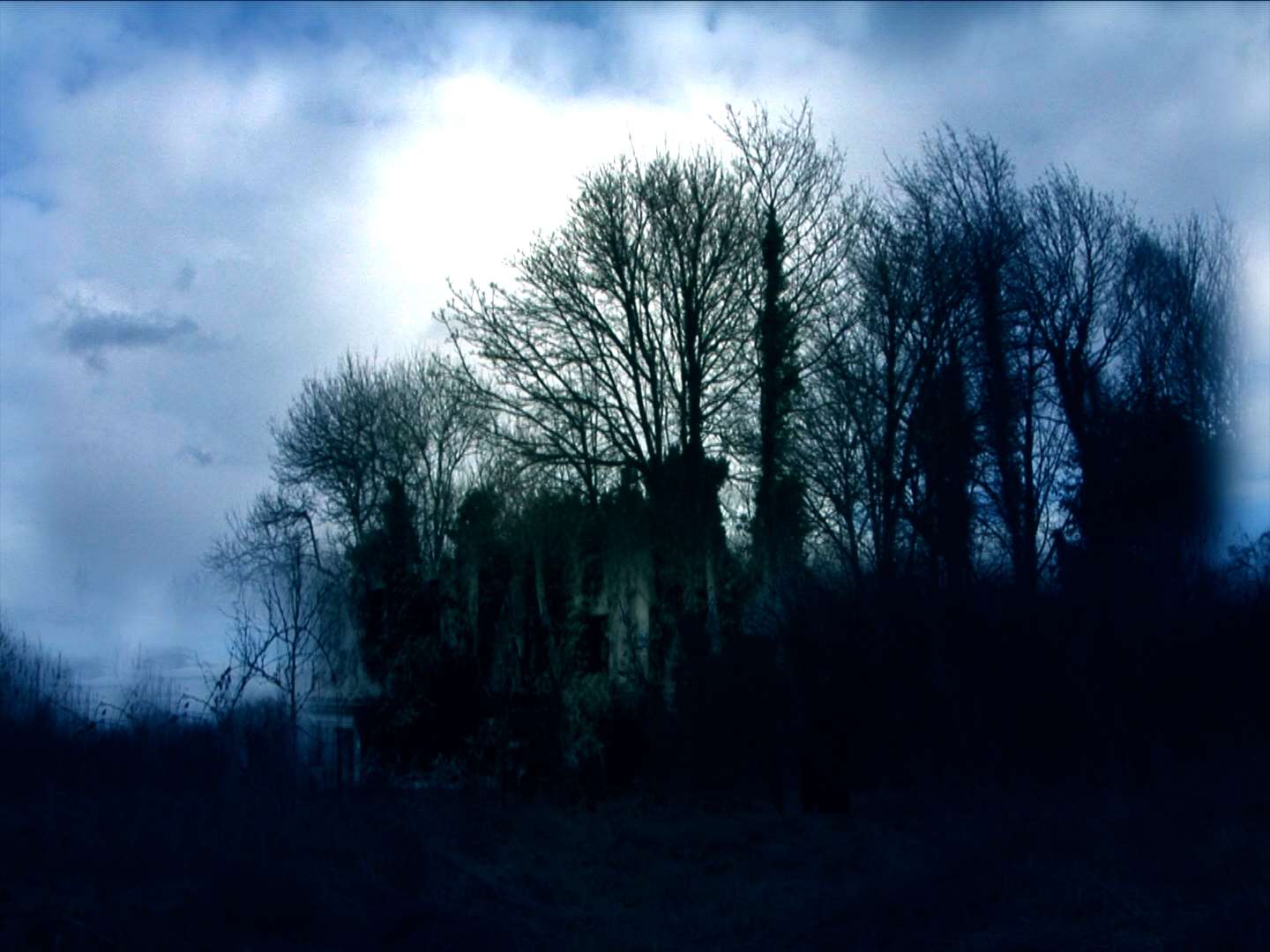
Documentary, horror, by Jason Figgis, USA, 2014.
In "Cathnafola", everything begins when renowned paranormal investigator Chris Halton of Haunted Earth UK receives footage filmed by three teenagers at the ruins of Cathnafola House in Ireland. Determined to unearth the truth behind the location’s bloody past, Halton embarks on a nighttime exploration of the infamous ruins—and soon uncovers terrifying and disturbing revelations.
LANGUAGE: English
SUBTITLES: Spanish, French, German, Portuguese
Whispers from the Shadows of Empire

A young woman slips through the humid haze of a Calcutta evening in 1879, her skirts damp against her legs, clutching a sealed envelope that arrived without a postmark, bearing only a strange sigil in place of a signature. She tears it open under the flicker of a kerosene lamp, the words inside whispering of Himalayan masters who watch from afar, urging her to guard the hidden wisdom against the prying eyes of empire. This was no ordinary correspondence; it was a lifeline from the shadows, delivered by an unknown Asian who vanished like smoke before her gaze, leaving her aunt to puzzle over its origins. Helena Petrovna Blavatsky lived this moment, not as fiction but as the raw pulse of her existence, her restless feet already scarred from decades of wandering—across the steppes of Russia, the opium dens of Cairo, the forbidden lamaseries of Tibet—each step a defiance of the colonial chains that bound knowledge to thrones and cathedrals.
In those letters, smuggled past British censors and missionary spies, Blavatsky communed with entities she called the Mahatmas, Koot Hoomi and Morya, who mocked her imperfect English yet entrusted her with revelations that shattered the spiritual hierarchies of the West. “Even though you haven’t learned much of the holy sciences and practical occultism—and who could dare to expect this from a woman—you have at least learned some English,” one quipped in a missive from 1884, blending jest with the gravity of cosmic secrets. These were not polite epistles but thunderbolts against the scientific materialism of Darwin’s age and the dogmatism of Victorian churches, echoing Nietzsche’s later contempt for slave moralities in Thus Spoke Zarathustra (1883-1885), where the Übermensch emerges not from divine grace but from an inner alchemy the empire feared to unleash. Blavatsky’s pen, racing across pages in New York tenements or Adyar’s bungalows, birthed Isis Unveiled in 1877, a 1,300-page torrent citing Vedic hymns unknown to Oxford dons, Akkadian tablets dustier than empire’s ledgers, and alchemical grimoires that made Rosicrucians blanch.
Yet the empire struck back, its grip tightening like the fever that wracked her body in India. Shadowed as a Russian spy from the moment she docked in Bombay in 1879, suspected by the Raj’s functionaries who saw in her circling crows and materialized letters a threat to Pax Britannica, Blavatsky endured. Missionaries, those self-appointed guardians of Christ’s light, forged counterfeits—letters mimicking her script to “expose” her phenomena as charlatanism, their maid conspirators fanning flames that reached London papers by 1885. The Society for Psychical Research dispatched Richard Hodgson, whose report branded her a fraud, ignoring the psychical residues on her envelopes, the precipitates defying lab analysis. This was colonial logic at work: wisdom from the East, untethered from Calcutta’s bureaucracy or Simla’s salons, must be illusion, a Russian adventuress’s ruse. But Blavatsky knew better, her letters to A.P. Sinnett from 1880 onward—over 300 preserved, dissected in The Letters of H.P. Blavatsky to A.P. Sinnett—revealing not forgery but a cosmology where humanity fractures into root races, some soulless shells in cosmic evolution’s draft, as she hinted in suppressed manuscripts censored for a century.
Picture her in that Jersey exile, telegram urgent to a disciple, pounding out The Secret Doctrine amid gales, 1,500 pages by 1888 weaving Stanzas of Dzyan into a narrative of seven rounds, planetary chains spanning millions of years—data drawn from Nag Hammadi echoes and Tibetan termas that predated empire’s maps. Éliphas Lévi had glimpsed it in Dogme et Rituel de la Haute Magie (1856), the astral light as memory’s reservoir, where Blavatsky read impressions of the “dead” Mrs. T.L. from her youth, only to find the woman alive, cryptomnesia unveiling the self-deception mediums peddle. The empire’s shadow loomed larger: in Adyar, her health shattered, she fled to Europe, leaving behind a Theosophical Society founded in 1875 New York—three years before Isis—now a nexus for mahatmic missives that Sinnett distilled into Esoteric Buddhism (1883), though Max Müller sneered it bastardized the Dharma.
These whispers from empire’s underbelly mirrored her own hybrid soul—Russian noble by birth, Tibetan initiate by ordeal—exposing how colonial ports choked the ancient gnosis. A Mahatma’s letter warns of “masks and covers of souls lifted to higher planes,” prefiguring Jung’s archetypes in Psychological Types (1921), not as therapy but as evolutionary triage: some awaken compassion innate, others grind through temples void of spark. Blavatsky’s travels, that endless circuit from 1849’s elopement at 18 to 1873’s shipwreck off Crete, were no tourist’s jaunt but initiations amid cholera and chelas, gathering fragments the empire commodified as “oriental curios.” By 1875, in a Mott Street loft amid spiritualist séances she soon disavowed, she co-forged the Society with Henry Steel Olcott, its motto—”There is no religion higher than truth”—a gauntlet to Anglican bishops and Raj governors alike. The letters multiply: to Sinnett, she scorns self-diagnosis of spiritual strata, behavioral keys simple as observing the soulless in their mechanical lives, while root races evolve across eons, current humanity a mongrel phase of third and fourth, per Secret Doctrine’s Vol. II.
What if those forbidden envelopes, precipitating in locked rooms under missionary noses, were the true revolution—not her books, but the breach they tore in empire’s veil? The Mahatmas jested at her womanhood’s limits, yet through her, Eastern profundity flooded West, destabilizing the very sciences that measured skulls for racial hierarchies. Hodgson’s calumnies faded; the letters endure, their authenticity debated yet potent, Blavatsky their amanuensis, not author, channeling what Lévi termed the “great magical agent.” In Simla’s summer heats, Sinnett pored over them, blind to how they unmasked his own era’s spiritual aridity, the empire’s materialist creed as the true soulless husk. And still, the sigils arrive unbidden, questioning whose shadows truly whisper.

Unveiling the Ancient Breath
You lie awake in the small hours, sheets tangled like the roots of some forgotten tree, the air thick with the kind of heat that presses against your skin as if the room itself is exhaling. Outside, a distant train rattles through the night, its rhythm syncing with the pulse in your temples, and suddenly the ceiling dissolves into a vast, starless void where shapes swell and contract—endless breath in, breath out, a cosmic lung inflating with cold radiance before bursting into fevered fire. This is no mere insomnia; it’s the ancient rhythm seizing you, the one you carry buried in your bones, whispering of cycles that devour their own tails, of debts unpaid across lifetimes you can’t remember but feel in every unjust ache.
She knew this fever, Helena Blavatsky, in the dim gaslight of 1877 New York, scribbling Isis Unveiled through nights when the veil between worlds thinned to a thread. There, amid critiques of Darwin’s half-blind evolution and the Royal Society’s smug materialism, she unveiled the Great Breath—not some poetic fancy, but the absolute abstract motion, eternally present as an aspect of the Absolute itself. As she etched in the Proem of The Secret Doctrine eleven years later, in 1888, from her London exile amid scandals and spectral accusations, this Breath is the perpetual motion of the universe, limitless ever-present Space where nothing is truly motionless within the universal soul. It out-breathes the Kosmos into being, a thought exhaled from the Unknowable Deity, then in-breathes it back into dreamless Pralaya, that night of the universe where even the Builders, those Dhyan-Chohans, dissolve into blissful non-being.
Picture it: the final vibrations of cosmic rest stirring in Stanza III of Cosmogenesis, the “solitary ray” descending into primordial space, swelling the Mother as Fohat—the electric vital power—spins the Web of Swabhavat. You know this swell, don’t you? That moment in your own life when ambition bloomed hot and corrupt, only to cool in the purifying bosom of loss, like the Breath cycling from radiant purity to fetid heat and back. Blavatsky drew from no solitary vision; hers was the uninterrupted record of seers across millennia, checked against the visions of other adepts over thousands of generations, predating Vedas and Puranas, threading through Chaldean whispers and Egyptian crypts long before the Gnostics mangled it into half-truths. In The Secret Doctrine’s Vol. I, she confronts the nebular theory’s cold mechanics—Laplace’s gaseous disks birthing stars like clockwork—with Akâsha, the septenary Æther, root of all substance and chariot of Divine Thought, alive with intelligent forces from Elementals to archangels.
This isn’t abstract; it’s your buried ledger. Karma, she called it, not as moral cudgel but inexorable law, the momentum of that Great Breath imprinting every act into the astral light. In 1860s Caucasus fever, amid Kudyani healers and her own “unbridgeable gulf” of transformation, she learned to control the one vital principle pervading all—magic as spiritual wisdom, will perfected bending prana’s flow through the etheric double. Eleven years on, in Stanza II’s Paranirvana, before the hour strikes for manifestation, the Eternal Breath persists, ceaseless, while planets hang as co-uterine brethren around a hidden spiritual Sun. Science glimpsed it as protyle, that hypothetical ur-matter, but missed Fohat’s guiding hand, the Dhyan-Chohans’ intelligence weaving matter from pre-cosmic Ideation.
You feel it now, that destabilizing pull: your choices, those small corruptions exhaled in haste, circling back not as punishment but physics, the universe’s lung refusing stasis. Shankaracharya glimpsed it in atma’s illumination of mind and senses, the pilgrim unfolding latent powers through degrees of intelligence to archangelic heights. Yet Blavatsky unmasked the trap—Western reason’s divorce from this Breath leaves us soulless myths, chasing material ghosts while the real fire, cold then hot, purifies in eternal cycles. What if your next breath isn’t yours alone, but the out-breathing of worlds unborn, demanding you remember the debt?
Masters in the Mist of Doubt
You wake in the dim hours before dawn, the air thick with the scent of rain-soaked earth, and there at the foot of your bed stands a figure, tall and turbaned, his eyes like polished obsidian holding yours without a word. He does not speak; a letter simply materializes in his hand, unfolds itself, and the script upon it burns into your mind—instructions, warnings, a glimpse of truths beyond the veil of your daily grind. You reach out, but he melts into the mist rolling in from the garden, leaving only the paper, warm as living flesh, on your pillow. This was no dream, no hallucination born of fevered longing; it was the kind of encounter that upends the solid floor beneath your feet, forcing you to question whether the world you navigate by streetlights and clocks is the only one that matters.
Helena Blavatsky knew such visitations intimately, these spectral guides who appeared not as gods thundering from mountaintops but as men—fleshly, fallible, cloaked in the dust of Himalayan trails or the anonymity of crowded bazaars. In 1879, as she sat with her young helper Mooljee in a rattling carriage outside the Theosophical Society’s headquarters in Bombay, she directed him turn by turn through the labyrinthine streets, her voice steady, until they halted before a shadowed figure who stepped from the gloom to receive a note of gratitude she had penned for her guru, Master Morya. The man vanished as abruptly as he came, his astral form projected across miles from a train bound for Puna, proving that distance and matter bowed to will. Witnesses multiplied: in 1882, the Hon. J. Smith entered his own bedroom alone in Bombay, confirmed its emptiness, then watched with Blavatsky as a Mahatma materialized, full-figured for minutes before dissolving into the shrubbery beyond the window. These were not ethereal ghosts but adepts, “men not gods,” as they insisted in letters precipitated without postmark onto desks or delivered by hand, defying the postal certainties of Victorian skeptics.
Yet scorn shadowed every shimmer. Society’s guardians—scientists clutching their test tubes, clergy polishing their dogmas—branded her a fraud, her Masters mere puppets jerked by a woman’s cunning. K. Paul Johnson, after eight years sifting the fragmentary evidence in his 1994 study, proposed they were no mythic Himalayan sages but a real network of collaborators: spiritually wise men and women from India, Europe, even America, whose identities Blavatsky veiled to shield them from colonial prying eyes and her own mounting fame. Letters poured in, some “precipitated” from thin air, others penned by human hands disguised as occult missives; Johnson called it an “esoteric whodunit,” where the myth inflated living helpers into superhuman lords, yet the merit stood firm in the content, not the authors. Even W.B. Yeats, drawn to her vigor amid spiritualist fog, wavered: were they living occultists, discarnate spirits, or “unconscious dramatizations” of Blavatsky’s trance nature? Psychological whispers added fuel—did these patriarchal phantoms fill the void of a neglectful father, granting a Russian exile authority in a man’s world?
Such doubts echo Blavatsky’s three fundamental propositions, those quiet dynamite charges laid in The Secret Doctrine of 1888, dismantling the traps of materialist certainty and exoteric faith. First, an omnipresent, eternal, boundless principle: no beginning, no end, mocking the linear timelines of historians and physicists who date the universe to a Big Bang thirteen billion years past. Second, the homogeneity of this principle differentiates into the “army of the voices”—hierarchies of monads, from divine sparks to human souls, evolving through seven rounds of manifestation, a cosmic rhythm that reduces Darwin’s blind struggle to a single note in an infinite symphony. Third, the pilgrimage of the monad through ever more complex forms, cycling from mineral to godhood and back, shatters the illusion of isolated egos chasing progress in a godless machine. Her Masters embodied this: not infallible oracles but pilgrims like us, adepts “only when acting as such,” veiling their humanity to pierce our veils.
In Austria, 1886, Franz Hartmann handed a peasant clairvoyante a letter from one such Master; unlettered, she described a temple near Shigatse, its ceiling panels etched with Tibetan script she sketched flawlessly—symbols Blavatsky confirmed from her own 1860s visits, though she’d never entered. The woman laughed at the “queer people” in fur caps below, dissolving into cloud, as if the scene itself questioned our anchors. Materialists demand laboratory proof, the faithful their miracles signed by saints; both miss the point. Phenomena, Blavatsky insisted, were mere ladders for the uninstructed, demonstrations that matter kneels to spirit. The Masters in the mist expose the scorn as another cage: we crave certainty to avoid the boundless, proof to evade the pilgrimage. What if your midnight visitor was neither myth nor man, but the voice in your own depths, waiting for you to step beyond the scorn into the homogeneity that binds us all? Johnson grants their reality without the inflation, affirming wise humans exist amid our doubt. Yet the letters endure, their wisdom standing “securely” on merit alone. And in that endurance, the propositions breathe: eternal principle whispering through human forms, urging the monad onward. What happens when the mist clears, and you see your own face staring back from the guide’s eyes?
Echoes That Refuse to Fade
You wake in the dim hours before dawn, the sheets tangled around you like the remnants of a half-remembered voyage, and there it is again—that fleeting image of a vast wheel turning in the void, spokes radiating into infinities you can’t name. Not a nightmare, but a probe from somewhere deeper, a question that slips through the cracks of your daytime certainties: who set this motion in place, and why does it pull at you still, unresolved? Helena Petrovna Blavatsky knew this terrain intimately; in 1888, as she set down the two volumes of The Secret Doctrine, she wasn’t crafting a tidy map but unleashing a storm of echoes that have rattled Western thought ever since, refusing to settle into the neat compartments of science or faith.
Picture a scholar in a cluttered London study, poring over her pages late into the night, the gas lamp flickering as he traces the cyclic nature of the cosmos she described—endless rounds of manifestation and dissolution, governed by karma’s inexorable law, where every cause ripples into effect across lifetimes. He feels the rift open: on one side, the rigid materialism of Darwin’s era, proclaiming a universe of blind mechanism; on the other, her assertion of consciousness as the true bedrock, evolving through microcosmic human souls toward higher planes—the astral, the mental, the spiritual—where the self fragments and reforms in reincarnation’s forge. This isn’t abstract; it’s the unease you carry when you stare at the stars and sense your own smallness laced with something vaster, a unity behind the diversity she called the Absolute, the One Life pulsing through all. Blavatsky didn’t invent this; she claimed it as an echo of ancient wisdom, whispered by hidden Masters guiding humanity’s unfoldment, a flame rekindled from philosophies long buried under dogma.
Yet the accusations linger like smoke from that flame—fraud in the Mahatma letters, tricks with slates and spirits that drew the Society for Psychical Research‘s censure in 1885, branding her a charlatan even as her ideas seeped into the unconscious mind’s shadowed realms. Long before Freud mapped the id in 1899 or Jung delved into archetypes in the early 1900s, she probed those depths, positing subtler realities where the psyche transforms, bridging Eastern reincarnation with Western longing for transcendence. You recognize it in your own fragmented dreams, those probes that question the soul’s pilgrimage: is this evolution mere illusion, or a real ascent toward intuition’s coming age, as her Theosophical Society envisioned in its 1875 founding, a conduit for Masters’ influence on human consciousness?
The rift endures because it mirrors our own—Western thought, fractured between empirical chains and the esoteric pull, can’t fully embrace her synthesis without destabilizing its foundations. Artists and musicians felt it first; composers like Scriabin, steeped in her cyclic cosmologies, wove Theosophical threads into symphonies that evoked cosmic rebirth, while abstract painters glimpsed her astral planes in canvases of pure vibration. Even physics, in its quantum whispers of interconnected fields, echoes her Secret Doctrine’s motion without beginning or end, sparks of eternal flame in a universe not separate but one. But the tension suspends us: if we’re microcosms of the macrocosm, evolving through lifetimes’ lessons, why does the soul’s journey feel so perilously adrift, probed by dreams that demand we listen to that inner knowing she ignited—beyond illusion, beyond borders?
Sociologists like Max Weber, dissecting modernity’s disenchantment in 1919’s essays, unwittingly circled her shadow, as Theosophy’s bridge between East and West fueled the New Age undercurrents that reshaped spirituality without resolving the divide. You live it daily, scrolling feeds of quantum mysticism or psychedelic quests, remnants of her 150-year legacy in the Theosophical Society’s quiet service to humanity’s holistic unfoldment. The questions probe deeper: what if those Masters were projections of our collective unconscious, as Jung might later intimate, or real adepts guarding the Ageless Wisdom she unveiled? The pilgrimage hangs there, soul caught in the wheel’s turn, echoes refusing to fade as the flame flickers on, waiting for the next daring heart to tend it—what hidden plane calls you next?
A vision curated by a filmmaker, not an algorithm
In this video I explain our vision
🔮 Exploring Esoteric Consciousness Through Cinema
Helena Blavatsky’s revolutionary teachings on the hidden layers of reality and human consciousness have profoundly influenced esoteric thought for over a century. These carefully curated films explore the mystical dimensions of existence, spiritual awakening, and the quest for transcendent understanding that mirrors Blavatsky’s fundamental vision of unity and hidden cosmic laws.
Universal Consciousness
Universal Consciousness delves into the interconnectedness of all beings and the underlying unity of existence—core principles that align directly with Blavatsky’s teaching of fundamental oneness. This exploration of how individual consciousness connects to a greater cosmic whole reflects the theosophical vision that all souls are individualized sparks of the Universal Divine Flame. The film’s investigation of transcendent awareness mirrors Blavatsky’s revolutionary concept that reality itself is layered and sustained by hidden spiritual laws.
GO TO THE SELECTION: Universal Consciousness
Esoteric Movies to Watch
Esoteric Movies to Watch provides a comprehensive collection of films that examine secret spiritual knowledge and inner planes of existence, directly echoing Blavatsky’s teachings on the Seven Planes of Existence. These films explore how consciousness extends beyond the physical realm into astral, mental, and higher spiritual dimensions, offering visual narratives of the multidimensional reality Blavatsky mapped in her esoteric philosophy. The collection serves as a cinematic gateway to understanding the hidden architecture of being that theosophical thought seeks to unveil.
GO TO THE SELECTION: Esoteric Movies to Watch
Mystical Films not to Be Missed
Mystical Films not to Be Missed captures the transcendent experiences and spiritual revelations that lie at the heart of Blavatsky’s teachings on inner transformation and cosmic truth. These films portray the journey of consciousness awakening to realities beyond ordinary perception, reflecting the theosophical understanding that human beings contain immortal sparks capable of accessing higher knowledge. The mystical narratives resonate with Blavatsky’s conviction that spiritual insight—whether glimpsed by prophets or scientists—represents genuine contact with higher planes of reality.
GO TO THE SELECTION: Mystical Films not to Be Missed
Spirituality: Movies to Watch
Spirituality: Movies to Watch explores diverse spiritual traditions and paths of enlightenment that share common ground with Blavatsky’s monistic philosophy and universal approach to mystical truth. These films examine the human quest for meaning, transcendence, and connection to something greater than the individual self—themes central to theosophical thought on reincarnation, karma, and spiritual evolution. The collection demonstrates how cinema can be a vehicle for exploring the spiritual dimensions of human experience that Blavatsky believed were hidden but accessible to the awakened mind.
GO TO THE SELECTION: Spirituality: Movies to Watch
### Discover More Esoteric Cinema
Explore the full universe of independent and esoteric cinema on Indiecinema streaming, where visionary filmmakers continue the work of spiritual inquiry that Blavatsky began—revealing the hidden layers of consciousness and the revolutionary potential of awakened understanding through the art of film.
👉 EXPLORE THE CATALOG: Watch Indie Films in Streaming
A vision curated by a filmmaker, not an algorithm
In this video I explain our vision

