
The First Cold Morning and the Body That Knows Before the Mind Does
There is a particular morning, usually sometime in late September, when you walk outside and the air is different. Not cold exactly — not yet — but changed in some way that your body registers before your mind has the vocabulary for it. Your chest draws slightly inward. Your shoulders lift almost imperceptibly toward your ears. The skin on your forearms tightens, not from cold but from something more like alertness, a sudden awareness that the world outside you is no longer quite the same temperature as the world inside. For one suspended moment, you feel your own edges. You feel where you end and where everything else begins.

Most people dismiss this as a minor physiological event, a seasonal adjustment, the body recalibrating its thermostat. They pull their jacket tighter and move on. But that involuntary contraction, that momentary drawing-in, is something far older and more precise than a reflex. It is the body practicing a form of knowledge that Western modernity largely abandoned somewhere between Descartes and the industrial workday — the knowledge that you are a permeable being living at the mercy of thresholds, and that maintaining those thresholds requires daily, conscious, biological labor.
The lungs understand this before anyone explains it. They are, in the most literal anatomical sense, the organs of exchange with the invisible — the place where what is outside becomes inside, where the atmosphere enters the blood, where the boundary between self and world is negotiated approximately twenty thousand times per day. And yet we rarely think of them as boundary organs. We think of them as bellows, simple and mechanical, performing a task so automatic it barely warrants attention until something goes wrong. A cough, a shortness of breath, a tightness in the chest that doesn’t resolve — only then do we remember that breathing is not passive. It is a continuous act of selective incorporation. Every breath is a decision the body makes about what to let in.
The skin operates on the same logic, though even more visibly. Immunologists describe it as an immunological organ, not merely a wrapper. The epidermis hosts an entire ecosystem of immune cells — Langerhans cells, T lymphocytes, mast cells — that sample the environment constantly, deciding what is foreign, what is threat, what may be permitted entry. Paul Martin, writing about psychoneuroimmunology in the late 1990s, documented the ways in which emotional states directly alter the permeability and immune function of the skin, collapsing the distinction between psychological boundary and physical one. When someone says they have been left feeling thin-skinned, or exposed, or raw, they are reporting something measurable at the cellular level, not speaking metaphorically.
That tightening on the autumn morning, then, is not just the body protecting itself from a drop in temperature. It is the body tightening its own borders, rehearsing its own coherence, reminding itself of its shape in a world that is about to become more demanding. There is something in the quality of autumn light — lower, more slanted, filtering through air that has already begun its long process of stripping — that seems to ask a question of every living thing it touches. The question is something like: are you solid enough for what is coming? Do you know where you end?
The ancient Chinese physicians who mapped the body’s seasonal correspondences were not being poetic when they aligned this particular season with this particular organ system. They were being precise in a way that modern physiology is only now catching up to. They saw the lungs and the skin as a single unified territory, and they saw autumn as the moment when that territory comes under its annual test. The air shifts. The chest draws in. The body already knows what the mind is still deciding whether to accept.
What Chinese Medicine Actually Says When It Speaks of Metal
The Huangdi Neijing, compiled across several centuries and reaching something close to its canonical form during the Han dynasty roughly two thousand years ago, does not speak of the lungs the way a Western anatomy textbook speaks of them. It does not describe an organ. It describes a function, a direction, a relationship between a living body and the world it must constantly negotiate. Paul Unschuld, the German medical historian who spent decades decoding the epistemological architecture of Chinese medicine, argued precisely this in his landmark 1985 work Medicine in China: A History of Ideas — that the fundamental Western misreading was categorical. We imported a vocabulary of substances and structures onto a system built entirely around processes and correspondences. We looked for the thing when the text was describing the movement.
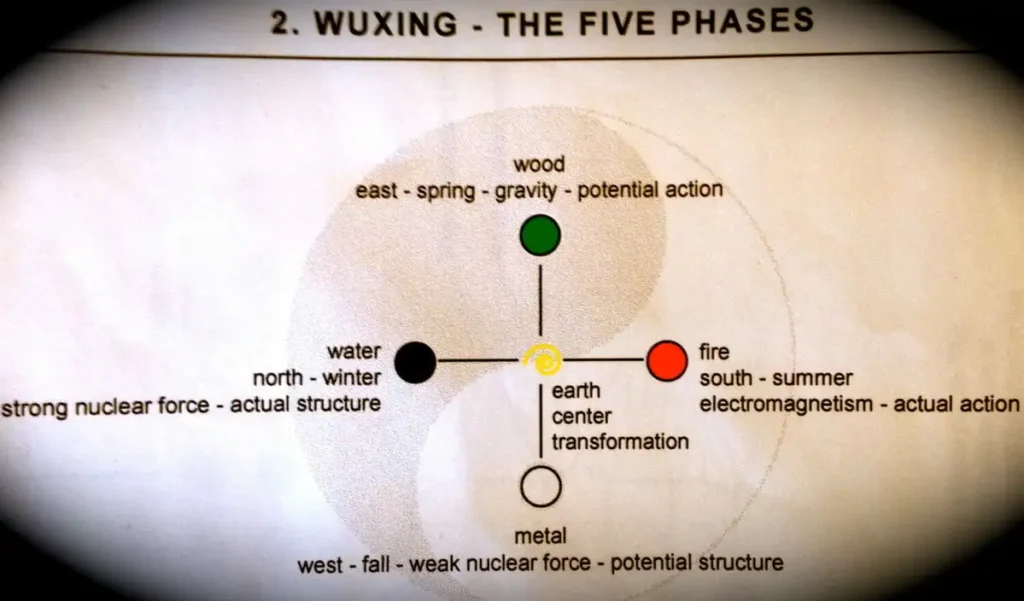
Metal, in Five Element theory, is the element of autumn. Not as metaphor. As precise functional mapping. The season when trees pull their energy downward and inward, when sap retreats toward the root, when the surface of living things contracts and what was generously extended through summer begins its long considered withdrawal. The Neijing’s chapter on seasonal correspondence describes this direction explicitly: the qi of autumn descends, the lungs govern the skin and body hair, the pores close, the exterior hardens just enough to protect what is now consolidating inside. A living system preparing not for death but for discernment — learning, at the cellular level, what to keep and what to release.
The lung and the large intestine form the paired organs of Metal. Their pairing is not arbitrary anatomy. The lung receives — it takes in what the world offers with every breath, extracts what is useful, and passes the rest downward. The large intestine completes the circuit, releasing what has been fully processed, what the body has extracted all value from and no longer needs to hold. Receive and release. Intake and elimination. The same gesture performed at two different registers of the body’s relationship with what is not-self. Unschuld makes the point with precision: Chinese medicine is not interested in the lung as a sack of tissue. It is interested in the lung as the site where self and world negotiate their boundary, breath by breath, fifty thousand times a day.
The emotion assigned to Metal is grief. And this is where the system achieves something almost brutal in its accuracy. Grief is not a dysfunction. It is the appropriate response to loss — to the necessary releasing of what was once held. The person who cannot grieve cannot fully release. The person who cannot release accumulates. The lung that cannot let go becomes congested, contracted, defended past the point of function. Classical commentators on the Neijing noted that chronic unexpressed grief injures the lung — not as poetic license but as clinical observation stretching across centuries of practice. The relationship is structural. Grief is the emotion of the autumn gesture: acknowledgment that something is over, that the cycle has moved, that clinging now would be a form of violence against the natural order of things.
What the West misread as mysticism was in fact a systems epistemology of extraordinary sophistication. The correspondences — season, organ, emotion, direction, color, sound, taste — are not decorative. They are a diagnostic grammar. When a practitioner working within this tradition speaks of Metal imbalance, they are reading a constellation: the quality of the breath, the skin, the capacity for grief, the ability to receive nourishment and to eliminate what is exhausted. Every element of that constellation belongs to the same functional logic. Nothing is symbolic in the way Western readers assumed. It is all, in the fullest sense, physiological — if you are willing to expand your definition of physiology to include the life a body lives inside a season, inside a grief, inside the thousand daily decisions about what to let in and what to finally, cleanly, let go.

Grief as Intelligence, Not Malfunction
There is a moment most people recognize but rarely name: the friend who loses someone and, three weeks later, is already back at their desk, already apologizing for “still being a bit off,” already performing the recovery before it has had any chance to begin. The grief has not gone anywhere. It has simply gone inward, and the body has accepted the tenant.
Elisabeth Kübler-Ross published her foundational work in 1969, and what she documented was not a theory of stages so much as a cartography of intelligence. The dying patients she sat with were not malfunctioning. They were doing something precise: they were processing the dissolution of a particular form of existence, renegotiating what belonged to them and what had to be released. The emotion was not a symptom of the crisis. It was the crisis being metabolized. What she could not have fully anticipated was how aggressively the surrounding culture would refuse to participate in that metabolism, would stand at the door of the grieving person and quietly demand that they finish sooner.
A man sits in a house that used to belong to his father. He has kept all the furniture exactly as it was. Not out of love, exactly, but because moving anything feels like a confession he is not ready to make. He opens the window every morning and closes it every evening and somewhere in his chest there is a pressure he has learned to ignore, a tightness just below the collarbones that he attributes to posture, to stress, to not exercising enough. He has not cried in eleven months. He does not know this is costing him anything. He does not know that what he cannot release is accumulating like sediment in tissue.
Peter Levine, whose decades of work on somatic trauma produced “Waking the Tiger” in 1997, described the body’s relationship to unprocessed experience in terms that Chinese medicine would recognize immediately: the organism does not forget what the mind refuses to feel. The sensation that was interrupted, the breath that was held, the contraction that never released, they do not dissolve with time. They reorganize. They find a home in the fascia, the diaphragm, the mucous membranes of the respiratory tract. The lungs, in the Metal framework, govern not just oxygenation but the rhythm of reception and release — the inhale that takes in the world, the exhale that surrenders it. When grief has nowhere to go, that rhythm arrests at the inhale. The body perpetually receives and cannot let go. The skin, which in Metal physiology acts as a second lung, a permeable boundary between self and environment, loses its precision. It either becomes hypersensitive, reactive to everything, or it thickens, numbs, stops registering what touches it.
The sociologist Tony Walter, writing on the sociology of grief in the 1990s, observed that modern Western cultures had systematically dismantled the communal infrastructure of mourning — the wakes, the prescribed mourning periods, the visible markers that told the community “this person is in transition.” What replaced them was a private, accelerated, largely silent process that the grieving individual was expected to complete without inconveniencing the productivity of those around them. The cost of this dismantling is not abstract. Immunological research has consistently shown that bereaved individuals demonstrate measurable suppression of natural killer cell activity in the months following significant loss, the very cells that patrol the body’s borders and identify what does not belong.
The large intestine, Metal’s paired organ, holds the function of final discernment: what the body has extracted everything useful from, it must release without negotiation. When the culture teaches that holding on is dignity and letting go is weakness, the body learns the same grammar. And what cannot be excreted does not simply wait.
The Lung as a Political Organ: Breathing, Borders, and the Right to Say No

There is a kind of person you have probably met, or perhaps been, who apologizes for taking up space in a room they were invited into. Who laughs a little too quickly at a joke made at their expense. Who, when someone steps too close, steps back rather than holding ground — and does this so automatically, so fluently, that they have long since stopped recognizing it as a choice. The stepping back looks like grace. It has been mistaken for grace for years.
Wilhelm Reich understood this in 1933, working from the wreckage of a Europe that was learning, politically and biologically, what happens when entire populations are trained to suppress their own aliveness. His concept of character armor — the chronic muscular tensions that accumulate in the body as a response to environments that punish authentic expression — was not a metaphor. He meant it literally. The chest that does not fully expand. The diaphragm that brakes the breath before it completes itself. The shoulders that curl inward as if preemptively apologizing for the volume of air the body has dared to claim. Reich saw in these patterns not neurosis but history — the sediment of every moment a person learned that their full breath was an imposition.
Judith Butler, writing decades later in a very different register, arrived at a related territory from a different direction. Her analysis of precarious life — of whose existence is recognized as grievable, whose body is understood to have borders worth defending — maps almost exactly onto what Chinese medicine has always known about Wei Qi. Defensive energy. The capacity the lung generates and circulates at the surface of the body, at the boundary between self and world. In classical texts this energy is described as fierce, mobile, difficult to control — the body’s first and most instinctive assertion that there is a line here, and it is mine. Butler’s question is a political one: which bodies are socially permitted to generate that line? Which bodies are culturally enforced into permeability, trained to absorb rather than deflect, to receive rather than establish terms?
The answer is not difficult to trace. It runs through gender, through race, through class, through every system that has ever needed certain people to remain available — emotionally, physically, productively available — without the inconvenient interruption of their own limits. A woman who watched her mother never finish a sentence without checking whether it was welcome. A man whose earliest lesson was that showing distress was more dangerous than holding it indefinitely inside the body’s locked rooms. A child who learned, with impressive efficiency, that the fastest way to safety was to become less — less loud, less present, less demanding of air.
This is what the lung registers. Not abstractly, not symbolically, but immunologically. The Wei Qi that fails to circulate at the surface of the body is not a poetic failure. It is the immune system’s actual diminishment. The person who cannot say no — who has never been permitted to say no without consequences that outweighed the cost of compliance — develops, reliably, the physiology of someone whose borders are chronically breached. The skin that erupts. The respiratory tract that cannot distinguish between what belongs inside and what should be turned away. The grief that has no seasonal container, no autumn to move through, because the emotion was never allowed its full arc in the first place.
Someone is walking through a city in autumn, collar turned up, moving with the kind of controlled efficiency that looks like competence and is actually a form of constant vigilance. They breathe in shallow increments. They have been breathing in shallow increments for so long they believe this is simply how breathing works. They have never felt the bottom of their own lungs.
Autumn Practices and the Discipline of Contraction
There is a moment, sometime in mid-October, when a person finds themselves going to bed earlier without quite deciding to. The light disappears sooner and the body, without consulting the mind, simply begins to follow it. No resolution, no intention. Just a quiet capitulation to something older than habit. Most people barely notice it. They attribute it to tiredness, to the shortened day, to nothing in particular. But in systems of medicine that have been watching human bodies move through seasons for several thousand years, this small surrender is not incidental. It is the beginning of a discipline.
The logic of autumn practice in classical Chinese medicine is the logic of contraction itself. Not reduction as deprivation, not silence as absence, but both as forms of gathering — the same movement a tree makes when it pulls its sap inward before winter, concentrating what matters, releasing what cannot survive the cold. Early sleep belongs to this logic. So do the white and pungent foods — daikon, pear, ginger, onion — that traditional texts associate with the Lung and the opening of the respiratory passages. So does the breathing practice of conscious, extended exhalation, which is not merely a relaxation technique but a training of the body’s capacity to let go completely before it inhales again. These are not wellness tips extracted from an ancient manual. They are a re-education of a system that has, through months of expansion, forgotten how to come back to itself.
Gaston Bachelard, writing in The Poetics of Space in 1958, described the fundamental human drama as the negotiation between inside and outside — not as a philosophical abstraction but as a lived, almost architectural sensation. He understood that the boundary between self and world is not a fixed line but a dynamic threshold that must be maintained through attention, through what he called the phenomenology of inhabited space. When that threshold collapses — when we can no longer feel where we end and the demands of the world begin — the organism loses something essential. The Lung, in the framework we have been tracing across these pages, is precisely that threshold. Its capacity to defend natural boundaries is not metaphorical. It is the somatic reality Bachelard was circling when he wrote about the intimacy of enclosed space, about how a room that keeps the cold outside makes interiority possible at all.
There is a scene that comes to mind — a woman, somewhere in middle age, who stops answering a particular message. Not dramatically. She composes no final response, delivers no explanation. She simply reads the words on her screen, sets the phone face-down on the table, and returns to what she was doing. The gesture is almost invisible. To someone watching, nothing has happened. But something has closed, quietly and completely, in the way a door closes when the weather changes and the wood swells just enough to seal what was previously left slightly ajar. This is the precise gesture the Metal element governs — not the grand refusal, not the declared boundary, but the imperceptible act of self-definition that requires no audience and offers no performance. The body already knew before the mind formulated anything. The hand set the phone down before the decision was fully conscious.
This is the question autumn poses, and it is not a comfortable one. What does it mean to release something not because you are finished with it, not because the feeling has dissolved or the attachment has grown cold, but because the season has shifted, and somewhere beneath the ongoing argument the mind is still conducting with itself, the body has already begun to exhale.
A vision curated by a filmmaker, not an algorithm
In this video I explain our vision
🍂 Ancient Wisdom of Energy, Breath, and Vital Defense
The Metal Element and its relationship with autumn invites us to explore deeper principles of vital energy, boundaries, and the body’s invisible architecture. These articles extend the conversation into the broader landscape of Chinese medicine, energetic circulation, and the subtle forces that sustain life. Each path leads further into the maze of ancient knowledge waiting to be rediscovered.
Vital Breath: if Your Qi is Blocked, Weak, or Scattered
When Qi becomes blocked, weak, or scattered, the body loses its capacity to defend itself and maintain coherent form — a theme deeply resonant with the Metal Element’s function of holding boundaries. This article examines the different qualities of disturbed vital breath and how they manifest as physical and emotional vulnerability. Understanding Qi disruption is essential groundwork for anyone exploring the lungs’ protective role in autumn.
GO TO THE SELECTION: Vital Breath: if Your Qi is Blocked, Weak, or Scattered
Zheng Qi: How to Nourish Upright Energy to Protect Against External Pathogens
Zheng Qi, or Upright Energy, is the body’s innermost shield against external pathogens — a concept that maps perfectly onto the Metal Element’s defensive Wei Qi that circulates at the body’s surface. This article explores how nourishing this upright vitality becomes the foundation of true immune resilience in Chinese medicine. Without strong Zheng Qi, no boundary, however well-drawn, can hold against seasonal assault.
GO TO THE SELECTION: Zheng Qi: How to Nourish Upright Energy to Protect Against External Pathogens
The Organ Clock: Why Every Organ Has Its Time of Peak and Low Energy
The Organ Clock reveals that the lungs hold their peak energetic power in the early morning hours between 3 and 5 AM, making their rhythm inseparable from the seasonal cycle of Metal and autumn. This article maps how each organ rises and falls through the daily arc of time, offering a practical window into why certain symptoms appear at specific hours. Aligning daily life with this living clock is one of the most elegant expressions of Metal’s principle of sacred order.
GO TO THE SELECTION: The Organ Clock: Why Every Organ Has Its Time of Peak and Low Energy
The 12 Energetic Channels: The Secret Map of Meridians in Body
The twelve meridians form the invisible rivers through which Qi, blood, and vital information travel — and the Lung meridian stands as one of the most sovereign channels in this hidden geography. This article traces the secret map of energetic pathways that Chinese medicine has charted for millennia, illuminating how physical symptoms are often expressions of deeper channel imbalances. For anyone drawn to the Metal Element, understanding the meridian system transforms abstract philosophy into living, breathable anatomy.
GO TO THE SELECTION: The 12 Energetic Channels: The Secret Map of Meridians in Body
Discover the Cinema That Breathes Beyond Boundaries
If these explorations of invisible energy, vital breath, and ancient wisdom resonate with you, Indiecinema streaming offers a curated selection of independent films that dare to ask the same deep questions about life, the body, and the unseen forces that shape us. Step beyond the mainstream and discover cinema that nourishes the spirit as profoundly as any ancient teaching.
👉 EXPLORE THE CATALOG: Watch Indie Films in Streaming
A vision curated by a filmmaker, not an algorithm
In this video I explain our vision

