
The Body That Stops Mid-Sentence
You are standing in the middle of a sentence you have said a thousand times before, and something stops. Not fatigue, not distraction, not the sudden intrusion of a louder thought. Something else. A kind of interior failing, as if the current that was carrying you through the moment has simply cut out, the way a river doesn’t announce a drought — it just narrows, slows, and one day you look down and the stones are showing. You finish the sentence because your mouth knows how. But you weren’t in it. Something that should have been moving wasn’t.

Most people file this under stress, under sleep deprivation, under the ambient noise of a life that asks too much. They reach for coffee or silence or a weekend that never quite restores them. And then it happens again — mid-task, mid-breath, mid-laugh even — and they begin to understand, without having the language for it, that what is missing is not rest. What is missing is something more like current. More like flow. The felt sense of being, for lack of a better word, alive in the particular way that aliveness announces itself: as momentum, as warmth moving through a body that knows where it is going.
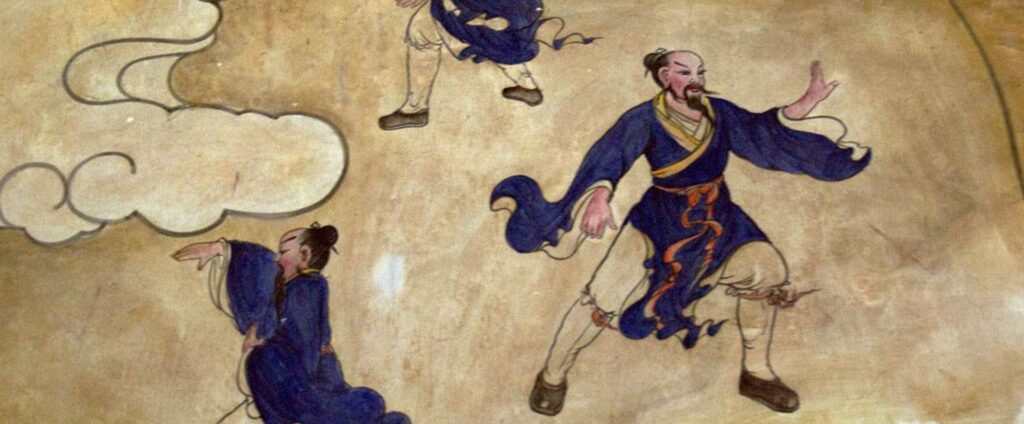
The Chinese called it Qi. They had been observing it for at least two thousand years before the West developed its first nervous system theory, mapping it not as metaphor but as physiological reality, tracing the channels through which it moved with the same empirical seriousness that later centuries would bring to arterial anatomy. The Huangdi Neijing, the foundational classical text of Chinese medicine compiled no later than the second century BCE, describes Qi not as spirit floating above the body but as the animating substance within it — the difference between a body that functions and a body that merely persists. When Qi flows, there is no pain, no obstruction, no that nameless stopping. When it doesn’t, something in the organism registers the interruption before the mind has words for it.
This is not mysticism dressed in ancient costume. Wilhelm Reich, working in Vienna in the 1930s, identified what he called orgone energy — a life force that moved through healthy bodies in waves and became blocked in neurotic ones, manifesting as muscular armoring, as the body’s learned habit of holding itself against its own aliveness. His conclusions were controversial, his later career catastrophic, but the core observation was identical to what Chinese physicians had been documenting for millennia: that vitality is not a fixed quantity stored in the body but a quality of movement through it. Henri Bergson, writing his élan vital into the philosophical vocabulary of the early twentieth century, was reaching toward the same recognition from a different direction entirely — that life is not a thing but a tendency, not a noun but a verb that the body either conjugates or doesn’t.
There was a man, once, sitting across a table from someone he loved, watching her speak, and realizing with absolute clarity that he could not hear her. Not because of noise. Because something inside him had gone quiet in a way that no amount of attention could override. He looked like he was present. He had learned, over years, to perform presence with some precision. But the current wasn’t running. The aliveness that should have been reaching toward hers was sitting somewhere behind his sternum, contained, dammed, radiating nothing outward and receiving nothing in.
That is Qi blockage. Not a diagnosis you read about. A condition you recognize.
What the Ancients Knew That Physiology Forgot
There is a scene that anyone who has ever been truly exhausted will recognize without needing to be told its name. A man sits at a kitchen table in the early hours of the morning. He is not crying. He is not thinking. He is simply present in his body in the way a stone is present in a field — inert, heavy, occupying space without animating it. His wife walks past him and he does not look up. Not because he doesn’t love her. Because something in him has stopped moving. The breath is there, technically. The heart beats. But whatever was supposed to circulate through him has gone somewhere he cannot reach, and he knows it, and he has no language for it, and so he says nothing, and she says nothing, and the morning comes anyway.
The physicians who compiled the Huangdi Neijing around the second century BCE were not mystics in the way modernity uses that word as a dismissal. They were observers of pattern. What they documented across its two canonical texts, the Suwen and the Lingshu, was a system in which life was not a property of matter but a quality of movement. Qi was not a metaphor for vitality. It was vitality itself understood as circulation — something that could be full or depleted, free-flowing or obstructed, harmonized or scattered across the surface of a person like water that has lost its channel. The body in this framework was not a machine to be repaired when broken. It was a landscape to be read. Stagnation was illness before illness had a name you could put on a chart.
What is astonishing, if you sit with it long enough, is not that this knowledge existed but that it was systematically abandoned. Not disproven. Abandoned. Modernity did not look at the body and find the Neijing wrong. It looked at the body and decided to stop asking the questions the Neijing was answering. The anatomical revolution of the sixteenth century, with Vesalius dissecting cadavers in Padua with a precision that had never been attempted, produced knowledge of extraordinary value. It also produced a way of seeing the body that treated aliveness as incidental to structure. You could map every nerve and still miss the man at the kitchen table entirely.
Wilhelm Reich arrived at his own version of this problem from the inside of Western medicine itself. Working in Vienna in the 1920s, trained by Freud, he began noticing something that the talking cure kept stepping around: the body remembered what the mind had learned to ignore. His 1927 work on the function of the orgasm was not, despite what the title suggests to contemporary ears, primarily about sexuality. It was about the capacity of the organism to surrender to its own energy — to allow something to move through it without bracing against the movement. What he called character armoring was the chronic muscular tension through which a person holds their psychological history in their flesh. The shoulders that never fully drop. The jaw that is always slightly clenched. The chest that breathes shallowly because at some point deep breathing felt dangerous, felt like it might release something uncontrollable, and so the body made a decision and kept it.
A woman stands in a corridor outside a hospital room. She has been composed for hours. She breathes in a specific way — measured, controlled, just enough. Her hands are folded in front of her. And you can see, if you know how to look, that she is not being strong. She is being armored. The Neijing would have recognized her immediately. Reich would have recognized her. What she is holding in the careful architecture of her posture is a grief so old it has become structural, become her, become the very way her body organizes itself against the world.

Blockage: The Armor We Call Identity
There is a man you have met. He sits with his shoulders pulled slightly forward, jaw set, voice measured and controlled. He has been described, many times, by many people, as dependable. Solid. A rock. He does not cry at funerals. He does not flinch when the news is bad. He has organized his entire life around this posture, and he has mistaken the organization for himself.
This is not strength. This is a river that stopped moving so long ago it forgot it was ever water.
Peter Levine, in his 1997 work Waking the Tiger, observed something that should have rewritten everything we think we know about human behavior: trauma does not live primarily in memory. It lives in the body as incomplete movement. An animal that survives a predator attack will shake, tremble, discharge the frozen energy of the near-death experience, and return to grazing. The human animal, taught that shaking is weakness and trembling is breakdown, holds the charge inside. The muscles that contracted to protect the vital organs never fully release. The breath that shortened to silence during danger never fully deepens again. What accumulates is not a psychological wound in any abstract sense. It is a physical crystallization. Armor.
Bessel van der Kolk spent decades inside the neuroscience of this phenomenon, and what his research, consolidated in The Body Keeps the Score in 2014, demonstrated with clinical precision is that traumatic experience reorganizes the brain’s threat-detection systems in ways that keep the body perpetually braced. The prefrontal cortex, responsible for context and nuance, goes partially offline. The body becomes its own prison warden, scanning for danger in rooms where there is none, tightening against blows that are not coming. Van der Kolk documented this not as metaphor but as measurable neurological fact. The hyperactivated amygdala, the suppressed Broca’s area, the chronic elevation of stress hormones — these are structural realities, not poetic descriptions of sadness.
Classical Daoist medicine identified the same phenomenon through a different vocabulary, arriving at the same body. Stagnation — Qi that cannot move — is not merely discomfort in the Chinese medical tradition. It is considered the root condition from which disease eventually emerges. The Huangdi Neijing, the foundational classical text compiled across the Han dynasty, describes blockage as what happens when the natural circulation of vital force encounters obstruction and cannot pass through. The result is not emptiness but accumulation — pressure building behind the dam, organs working against themselves, the whole system distorted by a single point of rigidity.
There is a woman, living in a house that is too clean, with a schedule that never varies, who has not taken an unplanned day off in eleven years. She would describe herself as disciplined. Organized. She would say, with complete sincerity, that she simply prefers things a certain way. She does not recognize the fear underneath the preference. She does not recognize the enormous muscular effort it takes to maintain the appearance of calm. She has calcified around a single gesture of self-protection made decades ago, and she has named the calcification her personality.
This is what makes blockage so insidious as a condition. It does not feel like suffering. It feels like character. The armor does not announce itself as armor. It presents as composure, as competence, as the particular way you hold your face when things get difficult. Wilhelm Reich, who mapped the relationship between muscular rigidity and psychological defense as early as the 1930s in his concept of character armor, understood that the body does not simply express the psyche — it is the psyche, made dense and directional. What you call your identity may be, in significant part, a sedimentation of movements never completed.
The river is still there, somewhere under the rock.
Weakness and Scatter: The Two Other Ways to Disappear

Blockage gets all the attention because it is dramatic — the clenched jaw, the chest that cannot open, the life that has calcified into a single rigid posture. But there are two other ways the vital force fails, and they are quieter, which makes them more dangerous. You can run out. Or you can come apart.
The person who has run out does not look sick in any way that earns sympathy. They show up. They answer emails. They perform the gestures of participation so fluently that even they cannot always tell the difference between living and simulating it. A man sits at his kitchen table at seven in the morning, coffee going cold beside him, and cannot find a reason to stand up — not because he is depressed in any clinical sense he could name, but because something that used to push him forward from the inside has simply gone quiet. Classical Chinese medicine would recognize this immediately as Qi deficiency: not obstruction, but depletion, the reservoir drained below the threshold where movement becomes possible without enormous conscious effort. Every action costs more than it returns. The body still works. The personality still functions. But the animating principle behind both has been running on fumes for so long that the person has forgotten what it felt like to move through a day with any surplus.
Byung-Chul Han, writing in 2010, described this condition with a precision that felt almost clinical: the achievement society does not demand obedience, it demands self-optimization, and the violence of that demand is that it comes entirely from within. There is no external oppressor to resist. The exhausted person has simply internalized the imperative to perform until the performer collapses. Han called the result the burnout society — a civilization that produces depression not through prohibition but through excess, not by forbidding desire but by insisting that desire never rest. The number of people reporting chronic fatigue in industrialized nations had been rising steadily for decades before anyone thought to ask whether the culture itself was the pathogen. Qi deficiency, in this reading, is not a personal failure of resilience. It is the predictable physiological outcome of a system that monetizes attention and calls exhaustion ambition.
And then there is scatter, which is something else entirely, and which the digital age has perfected into an art form. The scattered person is not depleted in the way the deficient person is — they may feel urgently, even frantically energized — but their energy has lost the capacity to gather itself into a single coherent act. A woman opens a document to write something she has been meaning to write for months. Within four minutes she has checked two other applications, half-composed a message she did not send, and returned to the document to find that whatever had been pressing toward expression has dissolved back into the general noise. She is not lazy. She is not undisciplined in any moral sense. Her center — what Chinese medicine calls the Shen, the spirit that resides in the heart and governs the capacity for coherent intention — has been systematically dismantled by an environment designed to prevent it from settling anywhere long enough to cohere.
Han returned to this in 2013, describing the digital swarm as a medium that produces rage and reaction but destroys contemplation. Contemplation requires a self that can remain with something. Scatter makes that impossible. The Shen, disturbed, cannot anchor. Thoughts begin and do not complete. Projects accumulate in half-finished states that become their own source of low-grade shame. The person is everywhere their attention has been pulled, which means they are effectively nowhere — present in dozens of fragments, gathered in none.
The Current Beneath the Noise
Think back to that moment in the opening — the morning before the day had fully declared itself, the body still warm from sleep, the mind not yet armored. There was a second, perhaps only a second, when you were simply there. Not managing anything. Not performing readiness or composure or productivity. Just breathing inside your own life as though it fit you perfectly, the way water fits the shape it occupies without negotiating with it.
Most people have had this. Not often, but once or twice with enough intensity to leave a mark. The strange thing is not that it happened, but that it felt like recognition — as though you were returning to a register of existence you had always known and kept forgetting.
Zhuangzi called the condition wu wei, which is routinely mistranslated as “non-action” and thereby defanged of everything that makes it dangerous to the modern mind. It is not passivity. It is not withdrawal. It is the cessation of the chronic effortful overlay we place on every moment — the constant internal narration, the monitoring, the slight performance of being ourselves for an invisible audience. The cook in Zhuangzi’s famous passage does not stop cutting. He cuts with such total alignment between attention and action that the knife finds the natural spaces in the joint without force, without resistance, as though the animal opens itself to him. This is not mysticism. It is a precise description of what the body already knows how to do when the mind stops interrupting it.
Mihaly Csikszentmihalyi mapped this territory empirically in 1990, when he published his decade-spanning research on what he called flow — the state in which challenge and capacity meet so exactly that self-consciousness dissolves and time restructures itself. He interviewed thousands of people across cultures, professions, and socioeconomic backgrounds, and what emerged was not a portrait of peak performers or elite athletes. It was a portrait of ordinary people in unguarded moments: a welder who described his work as a kind of music, a woman in her seventies tending her garden, a man replaying a chess game in his memory while waiting for a bus. The common thread was not intensity but alignment. Something had stopped fighting something else.
There is a man in a small kitchen, late at night, making food for no one in particular, moving between counter and stove with a slowness that is not fatigue. His hands know where things are. He is not thinking about the food. He is not thinking about anything in the way that thinking usually announces itself. He is simply inside the action, and the action is enough, and the kitchen is the whole world, and the whole world is sufficient. It lasts maybe twenty minutes. Then a phone lights up on the table and it is gone.
What Qi describes, across all its divergent classical formulations, is precisely the conditions under which this becomes possible and the conditions under which it is annihilated. Scattered Qi cannot sustain it. Blocked Qi cannot reach it. Deficient Qi collapses before it arrives. And the culture we have constructed — the notification, the metric, the ambient urgency, the identity performed in real time for strangers, the body treated as a vehicle for output rather than a site of intelligence — reads, from this vantage point, less like a context in which Qi might sometimes struggle and more like a system precisely engineered to prevent the current from moving at all, leaving us to spend our lives chasing in extraordinary circumstances what was always meant to be ordinary.
A vision curated by a filmmaker, not an algorithm
In this video I explain our vision
🌬️ Paths of Invisible Energy and Hidden Forces
Qi, the vital breath that flows through all living things, connects us to a vast tradition of esoteric and spiritual inquiry. From Eastern medicine to Western mysticism, the question of invisible forces that animate existence has captivated seekers across centuries and cultures. These articles explore the most resonant threads of that ancient mystery.
The Dance of Yin and Yang: Harmony Between Opposing Forces
The interplay of Yin and Yang mirrors the fundamental tension within Qi itself — a vital energy that must remain in dynamic balance to sustain life and consciousness. When one force dominates the other, the flow becomes obstructed or scattered, echoing the very blockages described in traditional Qi philosophy. This article illuminates how opposing energies create harmony rather than conflict, a principle central to any deep understanding of vital breath.
GO TO THE SELECTION: The Dance of Yin and Yang: Harmony Between Opposing Forces
Anthroposophic Medicine: Healing the Body through the Spirit
Anthroposophic Medicine, as developed by Rudolf Steiner and his colleagues, proposes that true healing cannot occur without addressing the subtle energetic and spiritual dimensions of the human being. Its approach resonates deeply with Qi-based traditions, recognizing that physical illness often originates in disturbances of invisible life forces. Understanding this system offers a compelling Western parallel to the Eastern concept of vital breath and its blockages.
GO TO THE SELECTION: Anthroposophic Medicine: Healing the Body through the Spirit
Universal Consciousness
Universal Consciousness represents the vast ocean from which individual Qi emerges and into which it ultimately returns, forming the metaphysical backdrop of all energy-based spiritual traditions. The concept bridges Eastern and Western esoteric thought, suggesting that scattered or weakened vital energy is ultimately a disconnection from a greater unified field. This article invites reflection on how personal energetic health relates to the boundless intelligence of the cosmos.
GO TO THE SELECTION: Universal Consciousness
Spirituality: Movies to Watch
Cinema has long served as a vessel for exploring the invisible dimensions of human existence, including the spiritual currents that Qi traditions describe with such precision. Films about spirituality often capture the phenomenology of vital energy — its presence felt as aliveness, its absence as emptiness or disconnection. This curated selection of movies offers a meditative companion to anyone exploring the deeper landscapes of breath, spirit, and inner vitality.
GO TO THE SELECTION: Spirituality: Movies to Watch
Discover the Cinema of the Invisible on Indiecinema
If these themes of vital energy, spiritual inquiry, and hidden forces resonate with you, Indiecinema streaming is your gateway to independent films that dare to explore what mainstream cinema ignores. From meditative documentaries to visionary narratives, our catalog breathes life into the questions that matter most. Come and discover a cinema that nourishes the spirit.
👉 EXPLORE THE CATALOG: Watch Indie Films in Streaming
A vision curated by a filmmaker, not an algorithm
In this video I explain our vision

