
The Body That Forgets It Has a Map
You wake up tired. Not the kind of tired that sleep fixes — you had eight hours, maybe nine, and still there is this weight behind your sternum, this low electrical hum of exhaustion that sits just beneath the skin and refuses to be named. You go to the doctor. The bloodwork comes back clean. The scan shows nothing. The physician, kind enough, says the word “stress” with the practiced gentleness of someone who has run out of other vocabulary, and you leave with the distinct sensation of having been told that what you feel is not quite real.

This is where most people stop asking. They accept the invisible dismissal, fold the symptom back into the ordinary rhythms of their life, and learn to carry the weight as though it were simply who they are now.
But the body has not forgotten. It never does.
There is an architecture inside you that Western medicine largely refused to inherit. Not because it was disproven — the history here is far more ideological than empirical — but because it did not fit the cartography that Europe’s Enlightenment had decided was the only legitimate one. When René Descartes divided the world into measurable extension and immeasurable mind in the seventeenth century, he was not simply making a philosophical claim. He was drawing a border that would determine, for centuries, what counted as knowledge and what got quietly exiled into the category of superstition. The body became a machine. Anatomy became the cutting open of that machine to find its gears.
What did not survive this translation was an entire system — or rather, several systems across cultures that had been independently mapping the same invisible territory for thousands of years. The Chinese medical tradition, formalized in texts like the Huangdi Neijing, the Yellow Emperor’s Classic of Medicine, compiled somewhere around the second century BCE, described a network of twelve primary channels running through the body, carrying what they called qi — a word that resists translation precisely because English has no equivalent for a concept that was never considered abstract to begin with. Qi was not metaphor. It was the measurable fact of how a living body differs from a dead one: the current, the movement, the warmth that circulates and, when it stops circulating, produces exactly the kind of dull, located, persistent suffering that modern clinical language calls “stress” and then moves on.
The tension here is not between ancient and modern. It is between two different kinds of evidence. Michel Foucault, writing in The Birth of the Clinic in 1963, showed with devastating precision how the medical gaze that emerged in late eighteenth-century Europe was not a neutral improvement on what came before but a specific reorganization of power — one that decided the interior of the body was the only legitimate site of medical truth. Everything not visible through a scalpel or a stethoscope became epistemologically suspect. The meridian system was not studied and rejected. It was categorically excluded before the study could begin.
This matters not as historical grievance but as lived consequence. Because the person sitting across from a physician, describing a fatigue that moves from the right side of the neck down the shoulder and settles somewhere under the shoulder blade, is describing something with a precise location in a system that has been tracking that exact pathway for over two thousand years. The fact that no imaging technology currently visualized it does not make it fictional. It makes it unmapped — which is an entirely different problem.
The map exists. The body has been trying to read it to you in the only language it knows.
What the Yellow Emperor Knew That We Unlearned
There is a moment in the life of any serious student of medicine — Eastern or Western, it does not matter — when they first encounter a body that refuses to be explained by the maps they were handed. The patient presents without visible pathology. The scans return clean. And yet something is wrong, insistently, irrefutably wrong, and the person lying there knows it with the kind of certainty that precedes language. The practitioner’s hands move slowly across the surface of skin and muscle, not cutting, not measuring, not naming — reading. Like someone who learned to navigate by stars before anyone thought to draw a grid over the sky.
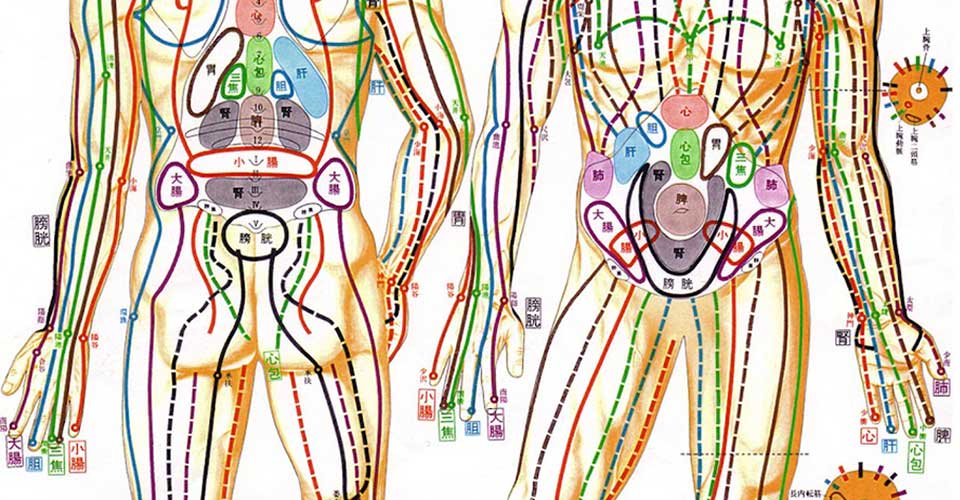
This is roughly what was already happening in China around the second century BCE, when the text known as the Huangdi Neijing — the Yellow Emperor’s Classic of Internal Medicine — was being compiled from older oral and written traditions into the foundational document of Chinese medical thought. It described, with extraordinary precision, a system of twelve primary channels running through the human body: pathways through which a vital force called qi circulated in continuous rhythm, connecting the surface to the interior, the organs to the extremities, the individual body to the larger patterns of season and climate and time. The channels were named for the organs they corresponded to — lung, large intestine, stomach, spleen, heart, small intestine, bladder, kidney, pericardium, triple warmer, gallbladder, liver — but they were never reducible to those organs. They described a functional landscape, a system of relationships rather than a collection of parts.
What is astonishing is not merely the age of this knowledge, though the Neijing predates Vesalius’s De Humani Corporis Fabrica by over sixteen centuries. What is astonishing is the epistemological difference — the entirely distinct question being asked. Western anatomy, as it developed through the Renaissance and into modernity, asked: what is the body made of? Chinese medicine, in the tradition the Neijing codified, asked: how does the body move? Not movement as mechanics, but movement as rhythm, as pattern, as the subtle alternation of fullness and emptiness that a trained practitioner could feel beneath their fingertips with enough attentiveness. Two civilizations. Two utterly different ways of deciding what counts as real.
Michel Foucault, in The Birth of the Clinic published in 1963, described how the emergence of modern Western medicine in the late eighteenth and early nineteenth centuries produced what he called “the medical gaze” — a particular way of looking at the body that made the visible, the measurable, and the anatomically localizable the only legitimate forms of knowledge. What could not be seen in a dissection, confirmed in a laboratory, or located in a specific tissue ceased to count as evidence. This was not a neutral advance in accuracy. It was a restructuring of what reality itself was permitted to contain. Everything that had previously been understood through pattern, through correspondence, through the body as a field of relationships rather than a map of organs, was reclassified — gradually, systematically — as superstition, metaphor, or error.
The healer reading a body like a landscape was not operating from ignorance. She was operating from a different epistemology, one that had accumulated millennia of clinical observation, refined through practice and recorded in texts that some of the most serious researchers in the history of science — from Joseph Needham to Paul Unschuld — have spent entire careers attempting to translate without diminishing. Needham’s Science and Civilisation in China, begun in 1954 and eventually spanning over twenty volumes, repeatedly encountered Chinese medical knowledge as something that did not fit comfortably into the Western narrative of progress from primitive to precise. It was precise. Just precise about something different.

Twelve Rivers Running Through You
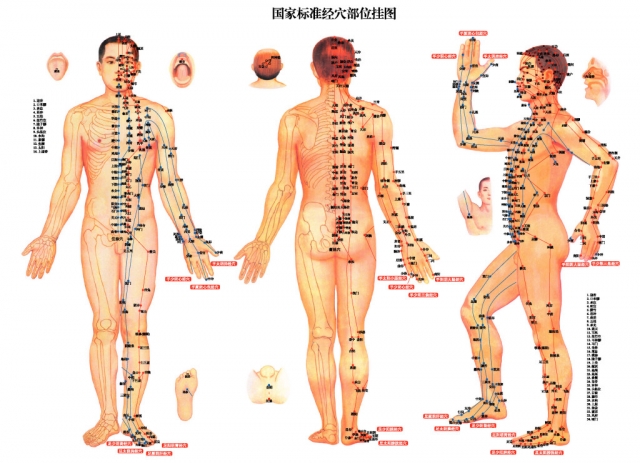
Consider the woman sitting at the kitchen table at four in the morning, unable to sleep, chest tight, breathing in shallow sips as though the air itself has become something she no longer trusts. She is not performing illness. Something in her has contracted, pulled inward, and if you traced the invisible architecture of what was happening beneath her skin, you would find the Lung channel carrying not just oxygen but grief — the emotion classical Chinese medicine has always assigned to it — running from the chest along the inner arm to the thumb, as though sorrow needs somewhere to go when it can no longer be contained in the torso.
The twelve primary meridians are not metaphors. They are functional pathways that Helene Langevin’s research at Harvard in 2002 began to give a structural basis, demonstrating that acupuncture points correspond with a striking eighty percent correlation to sites where connective tissue planes intersect — the fascial web that holds everything together and transmits mechanical signals across the body with a speed and coherence that has no purely nervous explanation. Robert O. Becker, in his landmark 1985 work The Body Electric, went further, mapping the body’s bioelectrical fields and arguing that a direct current system, largely ignored by conventional medicine, runs alongside the nervous system and governs processes of healing, regeneration, and energetic communication. The meridians, in this light, are not poetic invention. They are the roads along which that current travels.
The Large Intestine channel rises from the index finger, climbs the arm, crosses the shoulder, and ends beside the nostril. Its psychological domain is the capacity to release — not just waste, but attachment, what is finished, what must be let go. The man who cannot stop rehearsing an argument that ended three years ago lives in that channel’s tension. The Stomach channel descends the face and chest and thigh, and its disruption shows in someone who cannot digest experience, who swallows everything without processing it, who wakes hungry for something they cannot name. The Spleen channel, rising from the foot along the inner leg to the chest, governs thought — specifically the circular, consuming thought that wears the mind into exhaustion, the kind that produces the dull fatigue no amount of sleep repairs.
The Heart channel runs down the inner arm to the little finger, and its crises arrive as a sudden, terrifying vulnerability — the sense of being exposed without protection, which is why palpitations so often accompany emotional shock. The Small Intestine channel mirrors it on the outer arm, and its work is discernment, the separating of what nourishes from what does not. The Bladder channel, the longest in the system, descends the entire back and the back of the legs, carrying with it the weight of fear — chronic, low-grade, existential — that settles into the lumbar spine of someone who has spent years bracing for catastrophe.
The Kidney channel rises from the sole of the foot, and it holds the deepest reserves, the ancestral vitality that cannot be borrowed against indefinitely. The Pericardium channel protects the heart from intrusion. The Triple Warmer, a channel with no single organ equivalent, regulates the body’s thermal and immune responses — the system that decides, beneath consciousness, what is safe and what is threat. The Gallbladder channel traces the side of the body from the temple to the fourth toe, and its failure shows as the person who cannot make a decision, who stands paralyzed at every crossing. The Liver channel closes the circuit, rising from the foot along the inner leg to the chest, carrying the force of vision and direction — and when it is obstructed, that force turns inward as rage, as frustration, as the sense of a life that should be moving but is somehow, inexplicably, still.
The Trap of the Visible: Why We Only Trust What We Can Cut Open
There is a moment some people describe — not often, and usually only after something has cracked them open enough to admit it — where they realize they have been living entirely above the neck. Not metaphorically. Literally. Years of existing as a kind of floating intelligence, a consciousness ferried around by a body it never consulted, never listened to, never trusted. And then something small happens. A particular quality of light in late afternoon. A hand placed on the shoulder blade at precisely the right pressure. A low, resonant sound that seems to enter through the sternum rather than the ears. And something in the chest unlocks, or collapses, or both simultaneously — and the person stands there in the middle of an ordinary room, weeping without knowing why, suddenly aware that the body has been keeping records they never had access to.
This is not mysticism. This is the ordinary consequence of a very specific historical decision.
In 1637, René Descartes published his Discourse on the Method and effectively ratified a divorce that Western civilization had been slowly arranging for centuries. The body was res extensa — matter, extension, mechanism. The mind was res cogitans — thought, spirit, the seat of the real self. The split was enormously convenient. It allowed science to dissect cadavers without theological scandal, to treat flesh as machinery without ethical complication. What it cost, though, was the entire interior life of the body — its intelligence, its memory, its capacity to know things that the mind had not yet formulated.
The mechanization that followed was not simply intellectual. It was epistemological violence at a civilizational scale. Within a century of Descartes, the body had become something you took to an expert when it broke. The somatic traditions of China, India, Persia, and the indigenous Americas — systems that had spent thousands of years developing sophisticated maps of how energy, sensation, and meaning moved through living tissue — were reclassified not as alternative knowledge but as non-knowledge. As superstition. As the embarrassing childhood of a species that had now grown up.
Thomas Kuhn, writing in The Structure of Scientific Revolutions in 1962, gave us the vocabulary to understand what actually happens in these moments of reclassification. A paradigm, he argued, is not simply a theory. It is a social structure that determines what counts as a legitimate question. What cannot be asked within the dominant paradigm is not refuted — it is rendered invisible. The dismissal of meridian-based medicine was never primarily a scientific conclusion. It was a sociological one. The question was never seriously investigated on its own terms because the investigative tools themselves had been designed to find only what could be cut, stained, weighed, and photographed.
And so the person standing in that ordinary room, undone by a single touch, has no language for what just happened. They were never given one. They were given the language of pathology — anxiety, somatization, psychosomatic response — words that translate somatic intelligence back into mental categories, that return the body’s testimony to the jurisdiction of the mind, which will then decide whether to take it seriously.
What centuries of meridian theory had mapped was precisely this: that the body speaks in a grammar that precedes language, that sensation is a form of cognition, that the pathways along which feeling travels are as real and as structured as the pathways along which blood travels — even if they do not appear when you cut. The absence of visibility was never the same thing as the absence of existence. But we built an entire civilization on the assumption that it was.
Something Moves Before You Name It

There is a moment, familiar to almost everyone and named by almost no one, when something shifts in the chest before the thought arrives. You are sitting at a table, mid-conversation, and without any conscious trigger the sternum tightens, the breath shortens by a fraction, and the hands want to move somewhere they have no reason to go. Seconds later, the mind catches up and produces a label — anxiety, grief, recognition, dread — but the body was already there, already moving in its interior geography, already rearranging itself along pathways that do not wait for language to authorize them.
Maurice Merleau-Ponty spent the better part of his intellectual life trying to explain what this means. In the Phenomenology of Perception, published in 1945, he argued that the body is not an object the mind inhabits but the very medium through which the world becomes intelligible. Perception is not something that happens to a passive receiver. It is something the living body enacts, feels forward into, navigates before cognition assembles its tidy narrative. The body, he wrote, has its own intentionality, its own arc toward the world. It knows things the mind has not yet been told.
Candace Pert arrived at nearly the same territory from a different direction. In Molecules of Emotion, published in 1997, she documented how neuropeptides and their receptors — the biochemical infrastructure of feeling — are distributed not only in the brain but throughout the entire body, concentrated especially in the gut, the heart, the throat, the solar plexus. Emotion, she argued, is not a mental event with physical side effects. It is a whole-body phenomenon, a tide that moves through tissue and organ and nerve simultaneously. The gut does not metaphorically feel dread. It feels dread. The throat does not symbolically close with unexpressed grief. It closes.
A man sits in a waiting room before a conversation he has been avoiding for three months. He is not thinking about the conversation. He is reading a magazine. And yet something in the upper abdomen is already braced, already drawing inward, as if the tissue there knows the hour and has been preparing without his permission. He would not call it fear. He might not call it anything. But when he finally stands and walks toward the door, his movement carries the weight of what has already happened inside him, invisibly, in the channels the ancient maps drew along the midline and outward to the extremities.
A woman wakes at three in the morning with no memory of a dream and a sensation in the left side of her chest that she cannot name except to say that it is not pain and it is not nothing. She lies still and waits and eventually it passes, and she returns to sleep, and by morning she has almost forgotten it. But something was moving. Something was in transit.
This is what the meridian system, stripped of its metaphysical freight and read simply as cartography, insists upon: that the body has a geography of movement that precedes the mind’s categories, that the channels are not invented pathways but traced ones, drawn by practitioners who paid very close attention to where energy accumulated, stagnated, released, and transformed in bodies that were suffering or healing. The map did not create the territory. The territory was there first.
What remains genuinely open is the question of what changes when you begin to inhabit that map not as a belief or a practice reserved for treatment rooms, but as a living orientation to every ordinary hour — to notice what moves in the throat before you speak, what shifts in the gut before you decide, what tightens in the chest before you finally understand what you have been feeling all along.
A vision curated by a filmmaker, not an algorithm
In this video I explain our vision
🌿 Ancient Pathways: Energy, Body, and the Invisible Map
The meridians are not merely anatomical lines — they are living rivers of energy that have guided healers, mystics, and seekers for thousands of years. Understanding these channels opens a doorway into a broader tradition of subtle anatomy and energetic cosmology shared across cultures. The articles below explore the deepest roots of this invisible inner landscape.
Vital Breath: if Your Qi is Blocked, Weak, or Scattered
Qi, the vital breath that flows through the meridian system, is the very substance these twelve channels are designed to conduct. When that energy is blocked, weakened, or scattered across the body, the entire network of pathways falls out of balance. This article traces the nature of Qi and offers insight into how ancient traditions understood its cultivation and restoration.
GO TO THE SELECTION: Vital Breath: if Your Qi is Blocked, Weak, or Scattered
The Dance of Yin and Yang: Harmony Between Opposing Forces
The meridian system is itself a living diagram of Yin and Yang, with channels classified as either receptive or active, lunar or solar in their energetic character. The dance between these two opposing yet complementary forces governs every rhythm of health and disease within the body’s invisible architecture. This article illuminates how harmony between Yin and Yang remains the foundation of all classical energetic medicine.
GO TO THE SELECTION: The Dance of Yin and Yang: Harmony Between Opposing Forces
The Astral Plane and the Subtle Bodies: the Theosophical Map of Human Being
Theosophy developed its own intricate cartography of the human subtle body, mapping layers of consciousness that resonate strikingly with the meridian tradition of the East. The concept of etheric and astral bodies in Theosophical thought echoes the idea that physical health is inseparable from invisible energetic structures. This article offers a rich comparative lens through which to view the meridian map alongside Western esoteric anatomy.
GO TO THE SELECTION: The Astral Plane and the Subtle Bodies: the Theosophical Map of Human Being
Universal Consciousness
The meridians connect individual bodies to a vast web of universal life-force, suggesting that human energy is never truly isolated but always participating in a larger cosmic circuit. The concept of Universal Consciousness invites us to see the twelve channels not as private internal highways but as local expressions of an infinite energetic intelligence. This article explores how individual and universal consciousness interpenetrate in ways that ancient healers always took for granted.
GO TO THE SELECTION: Universal Consciousness
🎬 Discover the Cinema of Inner Worlds on Indiecinema
If these invisible maps of energy and consciousness have stirred something in you, Indiecinema streaming is the perfect place to continue the journey. Our curated selection of esoteric, spiritual, and visionary independent films brings these ancient themes to life through the most powerful medium of our time. Explore the full catalog on Indiecinema and let cinema become your next channel of discovery.
👉 EXPLORE THE CATALOG: Watch Indie Films in Streaming
A vision curated by a filmmaker, not an algorithm
In this video I explain our vision

