
The Wall That Speaks Before You Do
You see it before you understand it. Walking through Lower Manhattan at that hour when the city hasn’t quite decided to be awake yet, when the garbage trucks own the streets and the sodium lights flatten everything into the same dirty amber, your eye catches something on the side of a building that stops your body before your mind has processed why. Words. Not advertising, not a sign, not the institutional language of a city that addresses you only to redirect you or prohibit you. Something else. A declaration aimed at no one and everyone simultaneously, written at a height that required effort, required someone to be there in the dark with a purpose that the surrounding architecture was specifically designed to discourage.

This is how it begins. Not with a gallery opening, not with a review in a magazine, not with money changing hands in a room with good lighting. It begins with someone who has decided that the wall will carry their voice whether the wall consents or not.
Between 1977 and 1979, a tag appeared with increasing frequency across the streets of SoHo, Tribeca, and the East Village. SAMO. The letters were followed by cryptic, sometimes sardonic phrases — observations about consumerism, about religion commodified into lifestyle, about the particular spiritual numbness of people who believe they have escaped the system while remaining entirely inside it. SAMO as an end to playing art. SAMO as an alternative to god. The voice behind it belonged to a teenager who had grown up in Brooklyn, the son of a Haitian father and a Puerto Rican mother, who had been hit by a car at age seven and spent time in a hospital bed reading the anatomical reference book Gray’s Anatomy that his mother brought him — a book that would resurface, obsessively, in his imagery for the rest of his life.
But to understand what those letters meant on those walls, you have to understand what New York was in that moment, and what it had been deliberately made into. The fiscal crisis of 1975 had not simply arrived like a weather event. It was the culmination of decades of policy — of redlining that concentrated Black and Latino populations into specific neighborhoods, then systematically defunded those neighborhoods of services, infrastructure, and economic investment. Robert Moses had already spent thirty years reshaping the city in ways that treated certain populations as problems to be contained rather than citizens to be served. By the late 1970s, the South Bronx was burning — not metaphorically, but literally, with landlords torching their own buildings for insurance money while the fire department’s budget was being cut. Whole blocks of Brooklyn looked like photographs of postwar European cities. The city had essentially announced, through its budget allocations and its silences, that some lives were worth maintaining and others were acceptable losses.
The sociologist William Julius Wilson, writing in 1978 in The Declining Significance of Race, was tracking how economic restructuring was creating what he would later call the truly disadvantaged — those left entirely outside the formal economy, concentrated in urban spaces that the market and the state had jointly abandoned. He was describing, in the careful language of academic sociology, the same terrain that SAMO was annotating in spray paint with considerably less patience for euphemism.
When you write your name on a wall that belongs to a city that has decided you don’t fully belong to it, you are not committing vandalism in any meaningful sense of the word. You are contesting a prior act of erasure. The philosopher Charles Taylor would describe something adjacent to this in his work on recognition — the idea that identity requires acknowledgment, that to be systematically unseen is a form of violence, and that the demand to be seen is not vanity but something closer to a precondition for being human at all.
The wall speaks before you do because you have already been spoken about, categorized, budgeted away. The tag is the correction.
Don Barry: A Quixotic Exploration

Docufiction, Experimental, by Paul Smart, Mexico, 2026.
Don Barry: A Quixotic Exploration is a debut feature that places the biography of an eighty-year-old experimental filmmaker and artist, Barry Gerson, within the metanarrative of Miguel de Cervantes’ Don Quixote. Don Barry was filmed in the city of Guanajuato during the 51st edition of the Cervantino Festival, as well as during the vibrant Day of the Dead celebrations held in the city’s UNESCO-listed tunnels. The film honors the director’s long friendship with artist Barry Gerson, drawing inspiration from Cervantes’ Don Quixote. Paul Smart’s directorial choices create something new that celebrates life and goes beyond conventional storytelling. A search for magic in our real lives. A moving film about the meaning of life, art, and death. Not to be missed.
Paul Smart is a proud outsider filmmaker with a long history of film screenings. In the 1980s, he emerged in New York’s vibrant youth art scene, working in theater production and later filmmaking, before retreating to rural upstate New York, in the Catskill Mountains, where he made a living writing and screening independent films in old parish halls for rural audiences, many of whom had never seen a film.
LANGUAGE: English
SUBTITLES: Spanish, French, German, Portuguese
Born Into the Hierarchy of Skin
He was born on December 22, 1960, in Brooklyn, into a household that the American dream had promised to accommodate and then quietly refused. His father, Gerard, had come from Haiti carrying the particular ambition of men who believe that discipline and assimilation can purchase belonging. His mother, Matilde, was Puerto Rican, and she brought with her a sensibility that was more porous, more volatile, more willing to dissolve into beauty and then shatter. Between these two poles — the father’s rigidity and the mother’s fragility — Jean-Michel grew up inside a contradiction that the world outside never bothered to resolve. The contradiction simply was the world, for him.
Frantz Fanon wrote in 1952 that the Black man in a white society does not simply encounter racism as an external obstacle. He internalizes it. He is taught to look at himself through the eyes of those who have already decided what he is worth, and the result is not a wound that heals but a structural splitting, a permanent doubling of consciousness in which one part of you tries to live and the other part watches, translates, survives. Fanon called it the psychic violence of colonial existence, and he was precise about the mechanism: it does not announce itself as violence. It presents itself as civilization, as aspiration, as the reasonable terms of belonging. You do not feel the cut. You feel only the distance between who you are and who the world insists you must become to be legible.
Matilde began disappearing before Jean-Michel was old enough to name what he was losing. Her mental illness pulled her inward and then away entirely, into hospitalizations, into absence, into the specific grief of a child who learns very early that love is not a stable architecture. Gerard, left with the children, responded with the tools available to a Haitian immigrant father in a country that respected only surfaces: order, strictness, the performance of respectability. He moved the family to a better neighborhood in Brooklyn, then to Puerto Rico for a time, then back. Stability was something you manufactured through willpower and proper behavior, and Jean-Michel absorbed this lesson alongside its implicit corollary — that the chaos inside was something to be managed, hidden, ashamed of.
What does it do to a child, to grow up understanding that both halves of his inheritance are considered liabilities? The Haitian father who is too Black for one kind of America, the Puerto Rican mother who is too unstable for another. W.E.B. Du Bois had already described in 1903 the sensation of always looking at yourself through the tape measure of a world that finds you insufficient, but Du Bois was writing about a consciousness that could at least imagine wholeness as a destination. What Basquiat inherited was more tangled: a double foreignness, a hyphenated invisibility, a body that did not fit inside any single taxonomy of exclusion.
At seventeen, he left home after a fight with his father and ended up sleeping in cardboard boxes in Tompkins Square Park on the Lower East Side. He was not destroyed by this. He was clarified. The street did not introduce him to precarity — precarity had been the condition of his interior life since childhood. What the street did was make the metaphor literal. The hierarchy of skin, which had always been abstract enough to be deniable, became concrete in the specific coldness of a New York autumn night, in the specific invisibility of a young Black teenager sleeping in a box while the city moved around him with its tremendous indifference.
This is where childhood ends for certain people: not at an age but at a moment of recognition. The recognition that the world was not built with you in mind, that its defaults exclude you, that every door you open will require a key you were never handed.

The Canvas as Crime Scene
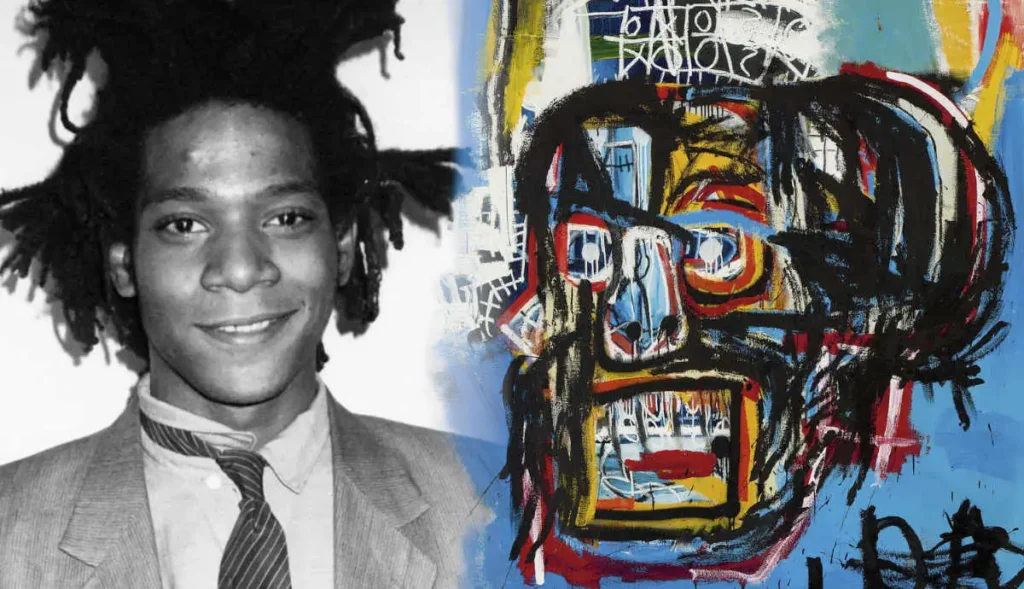
Look closely at the surface of the canvas and you will find something that does not belong in any gallery. There are words that have been written and then struck through, not erased but cancelled, left visible in their cancellation as if the act of crossing out were itself the confession. There are floating ribs, femurs, exposed tendons, skulls rendered with the clinical precision of a dissection manual and the fury of someone who has been dissected. There are Black figures whose skin has been removed not by violence but by knowledge, by the long Western habit of treating the Black body as a specimen available for study, a territory without a sovereign.
Foucault, in The Birth of the Clinic published in 1963, traced how modern medicine transformed the body into a legible object, a surface to be decoded by the institutional gaze of the physician. The clinic, he argued, became the space where power and knowledge fused into a single authoritative act: the examination. But Foucault’s analysis, brilliant and excavating as it was, largely left unspoken what historians of medicine like Harriet Washington would later document with devastating precision in Medical Apartheid in 2006 — that the Black body was not merely subject to the clinical gaze in the same way as the white body. It was preferentially available to it. It was the body most dissected without consent, most experimented upon without protection, most rendered as raw material for the advancement of a science that would then refuse to treat it as fully human.
He understood this not as history but as a living condition of his own body. In one painting, a Black figure in uniform stands at the canvas’s center, the word “hero” crossed out above him, the word “policeman” floating near him like an accusation. The uniform does not protect him. It performs his complicity in a system that views the body he inhabits as fundamentally suspect. The crossing-out is not vandalism; it is forensic. It refuses the language offered to him, refuses to let the word settle into innocence. The cancelled word remains visible because the lie remains operational.
In another work, the human form dissolves into its component anatomical parts — the ribcage, the exposed musculature, the labeled organs — presented simultaneously as medical diagram and as crime scene. The painting does not mourn this condition. It documents it. There is a difference, and it matters enormously. Mourning implies acceptance of loss. Documentation implies that someone must be held responsible.
The genius invoked in the title of a third painting is not celebrated. It is located, precisely and bitterly, in a geography of extraction. The Mississippi Delta — the land whose cotton built an economy, whose blues built a culture, whose labor built a nation — appears as the site where Black genius was discovered like a mineral deposit, useful to others, leaving the ground depleted. The word “undiscovered” is not innocent. It is the colonizer’s word, the word that erases prior existence, that transforms a living person into a resource awaiting European recognition.
Roland Barthes wrote in Camera Lucida in 1980 about the punctum, the detail in an image that wounds, that pierces the viewer without warning. The crossed-out words function exactly this way. They do not illustrate an argument. They puncture. They force you to look at what the language was trying to cover. Because testimony has this quality — it does not persuade through logic alone. It presents itself as a body, with weight and damage and irreversibility. It says: this happened, and the evidence is still here, and crossing out a word does not make the word disappear, it only makes the crossing visible, which may be the whole point.
Fame as a Second Colonization
There is a moment when the glass goes up. You do not hear it happen. One day you are painting in a basement, sleeping on the floor of a building that smells like turpentine and cold concrete, and then suddenly there are people watching you through a transparent wall, their faces arranged in the careful neutrality of appreciation, and you are still moving, still making marks, but something has shifted in the room that you cannot name yet. The watching has become structural. You are no longer a person who makes things. You are a thing being made.
The first solo show at Annina Nosei’s gallery in 1982 was celebrated as a discovery. He was twenty-one years old. The canvases sold before they dried. Collectors moved through the space with the focused hunger of people who had already decided to buy, the paintings almost incidental to the transaction, beautiful obstacles between money and its destination. Within three years his face appeared on the cover of The New York Times Magazine, a young Black man in a paint-splattered Armani suit, barefoot, holding a brush, the image so perfectly composed that it seemed designed by someone other than chance. And auction prices climbed past one million dollars while he was still alive, while he was still in the same rooms as these numbers, still breathing the same air as figures that had already transformed him into an asset class.
Guy Debord wrote in 1967 that modern society had replaced lived experience with its representation, that the spectacle was not a collection of images but a social relationship between people mediated by images. What he meant, though he could not have meant Basquiat specifically, was that the system does not destroy what threatens it. It frames it. It hangs it on a wall. It assigns it a value in currency and thereby neutralizes its capacity to destabilize anything. The painting that screamed SAMO against the corrupt art establishment became, through the very mechanism of the art establishment’s attention, a decorative confirmation of the establishment’s openness to screaming.
This is not a failure of vision on his part. It is the operational logic of the spectacle itself, which is indifferent to intention and feeds equally on critique and celebration, on rage and submission, provided both can be converted into image. The Black artist who painted teeth and skulls and anatomical diagrams annotated with the names of the systems that had always owned Black labor became, through accumulation of critical praise and auction records, a symbol of the very culture industry he was dissecting. His anatomy lessons became collectibles. His diagnoses became decor.
Think of standing outside that glass. You have come to see what everyone says you must see, and the work is extraordinary, the colors volcanic, the words embedded in paint like accusations that somehow survived being aestheticized. You will never touch it. Not because you are not allowed, though you are not allowed, but because the glass is not physical. It is economic. It is the distance between looking and owning, and owning is the only form of contact this world ratifies. The people who own these paintings do not live with a challenge on their walls. They live with a trophy. The difference is everything, and the difference is invisible from the outside.
Debord’s spectacle does not celebrate its subjects. It processes them. It takes the raw material of a life, a voice, a fury, and it runs that material through the mechanisms of visibility and valuation until what comes out the other end is consumable, reproducible, safe. The man who wrote TUXEDO and IDEAL and TOBACCO on his canvases, who circled words and crossed them out as if performing a trial in real time, was simultaneously being circled and crossed out by an economy that had found in him something it had been looking for without knowing it: a Black avant-garde it could own.
Warhol, Exploitation, and the Mirror That Flatters
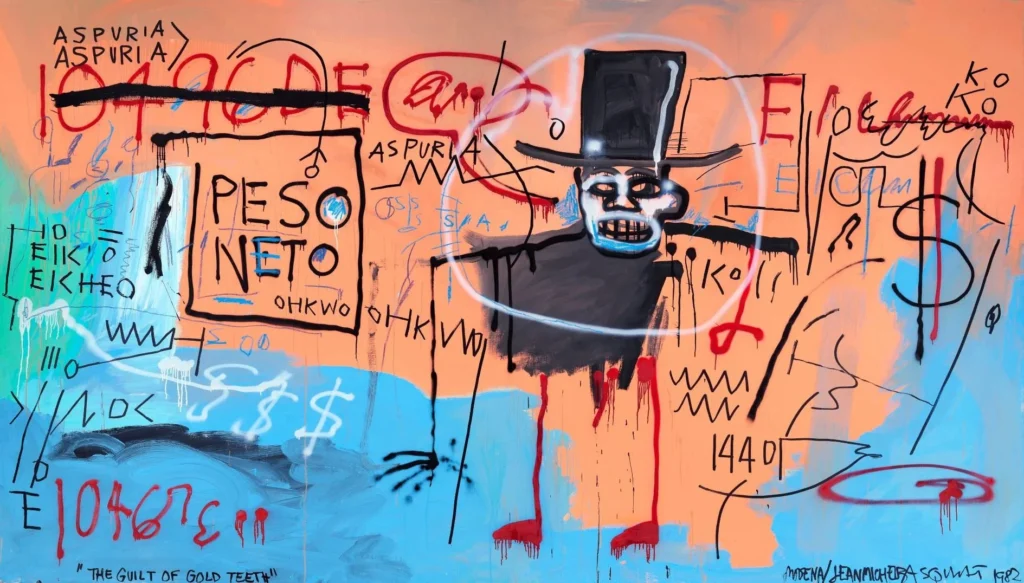
There is a photograph — not metaphorical, actual — in which the two of them stand side by side before a canvas they have made together, and you can see it immediately if you know what to look for: one man occupies the frame as though he built it, and the other stands slightly angled, as though still deciding whether he belongs in it. This is not a small thing. The geometry of who stands where, who leans in and who holds still, tells you everything about the architecture of a relationship that neither man was entirely honest about, possibly because honesty would have required dismantling something both of them needed.
They began working together in 1983. Basquiat was twenty-two and already mythologized, which is its own kind of trap — to be legendary before you have fully become yourself means that other people’s versions of you get there first. Warhol was fifty-five, post-relevance in the eyes of certain critics, looking for a renewed contact with the raw energy he had spent decades manufacturing into product. The collaboration was announced to the world as an encounter between equals, a crossing of generations, a dialogue. It was not a dialogue. It was something more complicated and more human than that — a mutual use, conducted with varying degrees of awareness on both sides.
What they made together was exhibited at the Tony Shafrazi Gallery in 1985. The critical response was largely dismissive, and the most brutal voice was Robert Hughes, who wrote that Basquiat was little more than “a career of being discovered” — implying that the work was secondary to the spectacle of the Black outsider being adopted by the white establishment. The cruelty of that formulation is in its partial truth. Hughes was wrong about the work, which contained genuine intellectual fury and formal intelligence that his framework couldn’t accommodate. But he had located something real about the structure surrounding the work: the way legibility, for a Black artist in that particular world, required the endorsement of whiteness to travel at full velocity. Warhol’s proximity was not incidental to Basquiat’s commercial ascent. It was load-bearing.
The philosopher Frantz Fanon wrote in Black Skin, White Masks in 1952 about the psychic cost of needing the colonizer’s gaze to see yourself, the way the mirror offered by dominant culture reflects you back distorted, and you begin to mistake the distortion for your face. Basquiat did not need Warhol to validate his talent — the talent preceded the relationship and would have existed without it. What Warhol provided was something more insidious: he made Basquiat legible to a market that would not have moved toward him otherwise, and in doing so, he became structurally necessary to Basquiat’s own self-image within that world. When you depend on someone else’s reflection to see yourself clearly, you don’t understand how much of your stability rests on their continued presence.
There is a scene that stays with you: two men in a large studio, painting on the same surface, not speaking, the silence between them neither hostile nor intimate but functional, like the silence of people who have learned to share space without exposing themselves. One of them works with the ease of a man who has never questioned his right to make things. The other works with an intensity that looks like joy from a distance and like something more pressurized up close — the intensity of a man who is always, at some level, proving something. And slowly, across months and canvases, the one who needs to prove something begins to disappear into the mythology of the one who doesn’t.
Warhol died in February 1987, following routine gallbladder surgery. Basquiat’s unraveling afterward was read as grief, and grief was part of it. But grief alone does not explain the particular shape of the collapse — the accelerating drug use, the isolation, the work growing increasingly fragmented and desperate. What was removed was not merely a friend. It was the mirror. And without it, Basquiat was left alone with a reflection he had never learned to generate entirely on his own terms.
A vision curated by a filmmaker, not an algorithm
In this video I explain our vision
The Iconography of the Dispossessed
There is a body on the canvas. Not metaphorically — literally, structurally, anatomically. Basquiat painted bodies the way a coroner photographs them: with clinical precision and barely contained rage, every organ labeled, every bone exposed, the skin peeled back not to celebrate the machine beneath but to show you what gets destroyed when the machine belongs to someone the world has already decided is worth less than the auction price written beside it.
In “Slave Auction” from 1982, the figures are reduced to commodity notation. Numbers float beside human forms the way lot numbers float beside livestock. This is not surrealism. This is accounting. Basquiat understood that the ledger was never closed, that the arithmetic of slavery did not end with emancipation but simply changed its notation system — from auction blocks to wage suppression, from chains to credit scores, from ownership to debt. The painting does not dramatize history as past. It presents it as a balance sheet still being calculated, with interest.
Saidiya Hartman, in “Scenes of Subjection” published in 1997, made an argument that cuts to the bone of what Basquiat was doing with these works. She wrote that Black suffering in America has historically been converted into spectacle — not as a failure of empathy but as a structural feature of how power maintains itself. The suffering of Black bodies has been made consumable, legible, even entertaining for white audiences, transforming violation into a kind of theater that ultimately reinforces the hierarchy it appears to document. To represent Black pain is already to risk participating in the mechanism Hartman describes. Basquiat knew this. The tension in his work is precisely the tension of the artist who cannot stay silent and cannot speak without being absorbed into the very system his silence was protecting him from.
“Per Capita” — the title itself a bureaucratic joke, the language of statistics applied to people who were never counted correctly — distributes its figures across the canvas like census data that forgot to include certain categories. The GDP of nations floats alongside bodies. The word “TOBACCO” appears, cotton’s chemical cousin, the cash crop cousin, the reminder that economies built on extraction do not simply reform. They rebrand.
Then there is the painting made in response to Michael Stewart‘s death in September 1983 — a young Black graffiti artist beaten into a coma by New York City transit police while being arrested for writing on a subway wall, dying thirteen days later. Stewart was twenty-five. Basquiat was twenty-two when it happened, already famous, already rich enough to be photographed for magazines, and still knew with perfect clarity that none of it made him structurally different from the man who died for the same act of mark-making that had launched Basquiat into galleries. The painting Basquiat made in response is stripped of the baroque density of his other work — two figures, a prone body, an officer, and the question written directly onto the surface: “It could have been me.” That sentence is not metaphor. It is legal brief, autopsy report, and testimony simultaneously.
Hartman asks what happens when the archive of Black suffering is housed in institutions built on the same logic that created the suffering. It is a question Basquiat could not have avoided had he tried. His paintings now hang in the same museums that were closed to him, collected by the same capital that the paintings anatomize, owned by the same class his figures hover above in chains and lot numbers. The crown he painted over and over — crude, three-pointed, drawn with the urgency of someone marking something before it disappears — was never a victory symbol. It was a target. It was the thing the world spends its energy trying to remove from a Black head, sometimes with paperwork, sometimes with a baton, sometimes with the slower violence of being told your marks on the wall are vandalism and not art, until someone decides they are worth millions, by which point the man who made them
The Body Under Surveillance, The Mind Under Pressure
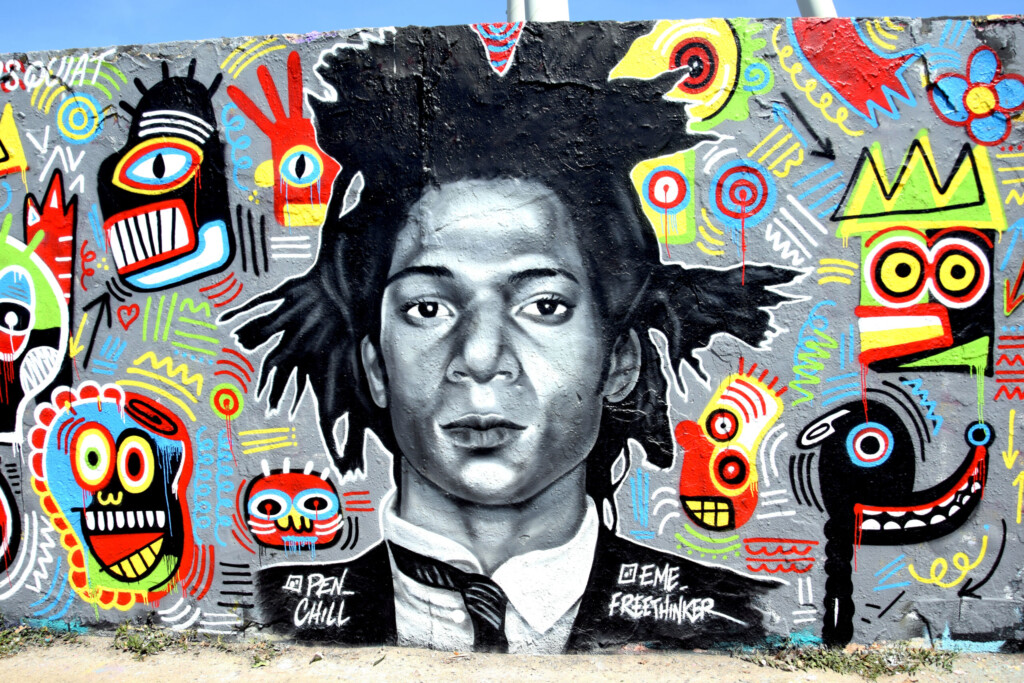
There is a kind of work that has nothing to do with creation. You have seen it, maybe lived it: someone bent over a surface at three in the morning, hands moving not from inspiration but from the terror of what stillness would bring. The motion itself is the point. As long as the brush moves, the hand marks, the body produces, the reckoning stays one room away. You are not making something. You are postponing something.
By 1986 the loft on Great Jones Street had become that kind of place. A five-story building in NoHo, large enough to swallow a person whole, and that is precisely what it did. The same space that was meant to be a studio became a fortress, then a cell. Friends who managed to get inside described a man surrounded by thousands of works, paintings stacked against every wall, drawings covering surfaces that had never been meant for drawing. Over a thousand pieces produced before the age of twenty-eight. That number is not a testament to genius. It is a symptom of a man who could not afford to stop.
The heroin had moved from the edges of his life to its center. What had once been a social fixture of the downtown scene had become something private and consuming, a daily negotiation with a dependency that grew in direct proportion to his public success. This is not a paradox. It is a pattern that bell hooks diagnosed with clinical precision in her essay “Eating the Other,” published in 1992 in her collection “Black Looks: Race and Representation.” Her argument is not comfortable and was never meant to be: dominant white culture, she writes, has a long history of consuming Black creativity as exotic product — absorbing the energy, the innovation, the rawness — while remaining structurally indifferent to the survival of the person producing it. The culture eats. The artist is eaten. The transaction is considered complete.
Basquiat had been consumed at a pace that would have broken anyone. By the mid-eighties he had been exhibited across Europe, collected by institutions and billionaires, celebrated in magazines that had previously ignored every Black artist who came before him. He had also been repeatedly framed as a primitive, a natural talent, a street discovery, language designed to separate the work from the mind producing it. You do not need to theorize this. You only need to read the reviews from the time: the consistent surprise that such sophistication could emerge from such a source. The sophistication was always granted as an exception. The source was always quietly held apart.
The isolation on Great Jones Street was not accidental. It had logic to it. The world outside had proven itself capable of adoring his work while remaining largely unable to see him as fully human. The market had assigned his canvases prices that climbed annually while his personal life contracted into a smaller and smaller radius. Warhol, one of the few genuine affections of those years, died in February 1987. The grief was real and went largely unwitnessed. After that, the loft became quieter, the nights longer, the work more desperate without being more joyful.
There is a moment — not in a film, not in a story, but in the kind of life that accumulates into tragedy without announcing itself — when a person crosses a threshold they cannot identify from the inside. The race against erasure that Basquiat had been running since he first wrote SAMO on a Houston Street wall had narrowed to a single corridor. The work continued. The body deteriorated. These were not separate phenomena. They were the same phenomenon.
On August 12, 1988, he was found in the Great Jones Street loft. A heroin overdose. He was twenty-seven years old, the number that has since become a grim statistical marker for artists destroyed at the edge of their own magnitude, as though the culture extracts exactly as much as it needs before releasing what it never actually intended to keep.
What the Market Buries, the Work Refuses
There is a painting hanging in a climate-controlled room somewhere, insured for more than the gross domestic product of several nations, and the people who file past it in orderly succession feel something they will later describe at dinner as profound. The canvas is covered in crowned skulls, in anatomical diagrams annotated with fury, in words that name systems of extraction and call them by their true name. The people nodding in front of it went to good schools. They mean well. And the painting, for its part, says absolutely nothing back to them that they are willing to hear.
In May 2017, a single canvas made in 1982 by a twenty-one-year-old Black man who had been sleeping on cardboard in SoHo less than four years earlier sold at Sotheby’s for one hundred and ten and a half million dollars. The buyer was Yusaku Maezawa, a Japanese billionaire who announced the purchase on Instagram with an exclamation point. Basquiat became, in that moment, the most expensive American artist ever sold at auction. The number was reported everywhere as a triumph. Triumph for whom was left, as usual, unasked.
Walter Benjamin understood this mechanism with a precision that feels almost surgical when applied here. In his 1935 essay on the work of art in the age of mechanical reproduction, he described the aura of an artwork as something inseparable from its specific existence in a specific place and time, from what he called its embeddedness in the fabric of tradition. What reproduction destroys is not the image but the demand the image makes. When the skull and the crown become a tote bag, a phone case, a retrospective poster sold in the museum gift shop for twenty-two dollars, what survives is the aesthetic surface, the recognizable gesture of rebellion, stripped of every nerve that once made it dangerous. The market does not destroy radical art by censoring it. It destroys it by loving it loudly, by making it beautiful, by charging admission.
The merchandise is everywhere now. The face, the crown, the handwriting that looks like it was written at speed because it was, because there was urgency, because time was being stolen from him in every direction simultaneously. That handwriting now appears on luxury collaborations and museum gift-shop prints, transformed from evidence into decoration. This is not coincidence. This is the system doing exactly what it does best, which is to metabolize its own critique until the critique becomes content.
What it means that a society can hang a painting about slavery on a wall and feel culturally enriched requires sitting with longer than most people are willing to sit. It means the painting has been neutralized without being refuted. It means the discomfort has been converted into cultural capital, which is a form of discomfort that costs nothing and demands nothing and changes nothing. The horror has been aestheticized, which is the oldest trick available to any civilization that wants to celebrate what it has not yet answered for.
And yet. This is the thing that resists easy burial. There is something in the actual paint, in the actual marks, in the density of what was put down on those surfaces in those years, that does not fully submit. You stand in front of one of the large works and the scale alone refuses your comfort. The figures look back. The words do not dissolve into pattern. The grief has not been domesticated no matter how many gift shops surround it, because grief at that pitch, made with that precision and that fury, retains a charge that reproduction can dilute but cannot fully extinguish. The price tag floats above the canvas like a number without a referent, unable to answer the question the painting is still asking, which is not about art at all, but about what was taken, and from whom, and whether the people standing in the climate-controlled room have ever once asked themselves which side of the painting they would have been on.
🎨 Art, Rebellion, and the Margins of Culture
Jean-Michel Basquiat’s life and works stand at the crossroads of street culture, raw expressionism, and radical social commentary. His art draws from the same restless energy that has driven countercultural movements across history and disciplines. These related articles illuminate the wider world of rebellion, subversion, and visionary thought that shaped the context in which Basquiat created.
Masterpieces of Rebellion and Counterculture Cinema
Basquiat emerged from the same underground spirit that fueled cinema’s most rebellious voices. This article explores masterpieces of counterculture film, tracing how artists across mediums challenged dominant narratives and reclaimed their own representation. Like Basquiat’s canvases, these films refuse to be silenced by the mainstream.
GO TO THE SELECTION: Masterpieces of Rebellion and Counterculture Cinema
The Avant-Garde Cinema: Movies to Watch
The avant-garde in cinema shares a kinship with Basquiat’s painterly aggression and his dismantling of aesthetic conventions. This piece surveys the landmark films that broke form, embraced chaos, and elevated the marginal to the monumental. It offers an essential visual and conceptual companion to understanding Basquiat’s own artistic revolution.
GO TO THE SELECTION: The Avant-Garde Cinema: Movies to Watch
Mass Social Homologation Today
Basquiat’s work was a direct confrontation with the forces of social homologation that erase individuality and flatten cultural identity. This article examines how mass conformity operates in contemporary society, stripping away difference in ways Basquiat spent his entire career resisting. Reading it alongside his biography deepens our understanding of why his voice remains so urgent.
GO TO THE SELECTION: Mass Social Homologation Today
The Unconscious and its Relationship With Cinema
Much of Basquiat’s imagery operates on the threshold between conscious statement and unconscious symbol, a terrain explored deeply in this article on the unconscious and its relationship with cinema. The language of dreams, repression, and primal imagery runs through both his work and the films analyzed here. Understanding the unconscious opens a richer reading of Basquiat’s layered visual world.
GO TO THE SELECTION: The Unconscious and its Relationship With Cinema
Discover Independent Cinema on Indiecinema
If Basquiat’s story inspires you to seek art that lives outside the mainstream, Indiecinema streaming is your destination. Explore a curated selection of independent, avant-garde, and documentary films that share his spirit of defiance, creativity, and authentic vision. Join Indiecinema and let the margins take center stage.
👉 EXPLORE THE CATALOG: Watch Indie Films in Streaming
A vision curated by a filmmaker, not an algorithm
In this video I explain our vision

