
The Wall as the Only Canvas That Does Not Lie
You are walking through the Lexington Avenue station at rush hour, the air thick with diesel and human friction, and something stops you. Not a voice, not a collision — something on the wall. A figure, white chalk on black paper, radiating lines from every joint as if the body itself is the source of all energy in the universe. You have not seen it before and yet it feels familiar in a way that bypasses memory entirely, landing somewhere older and more physical than recollection. You stand there for four seconds, maybe five, while the crowd splits around you like water around stone. You do not know yet that you are looking at something that will outlast the station, the decade, and most of the certainties you currently hold about what art is allowed to be.

Keith Haring arrived in New York City in 1978, twenty years old, from Kutztown, Pennsylvania, carrying the particular hunger of someone who has grown up somewhere culture passes through only as a rumor. He enrolled at the School of Visual Arts on East Twenty-Third Street, but the education that mattered happened underground. By 1980 he had identified something that most people registered only as negative space: the black paper panels that the Metropolitan Transportation Authority installed over expired advertisements while waiting for new ones to be purchased. They were not walls exactly, not canvases, not commissioned surfaces. They were absences. Haring understood absence as invitation.
He began drawing on them with white chalk, working fast, in stations across Manhattan, Brooklyn, and the Bronx. The drawings appeared at 42nd Street and Times Square, at Eighth Avenue, at Astor Place. Commuters encountered them without warning, without the mediation of a gallery card, without the permission that the art world normally requires before you are allowed to feel something. There was no price, no velvet rope, no institutional voice telling you the work was significant before your eyes had even settled on it. The significance arrived unannounced, which is the only way significance that actually matters ever arrives.
What Haring was doing was, of course, illegal. The MTA did not commission him. No curator had blessed the project. The establishment that decides which objects become art and which remain vandalism had not yet weighed in, and that lag — between the work existing and the institution acknowledging it — is where the entire question lives. Pierre Bourdieu spent much of his career mapping the machinery by which cultural legitimacy is produced and distributed, arguing in Distinction, published in 1979, that taste is never innocent, that it is always the sediment of class, access, and the slow accumulation of cultural capital. The subway wall bypassed all of it. It addressed everyone who passed through equally, which is to say radically, which is to say in a way that the white cube gallery in SoHo structurally cannot.
There is a man who spends his life building a reputation as a guardian of high culture, who speaks at length about the democratization of art while his gallery charges admission and his openings require knowing the right names. He is not a villain. He is a system expressing itself through a human body. Haring’s chalk figures were a counter-system expressing itself through the same city that produced him, on surfaces the city had temporarily abandoned to blankness. The choice of illegality was not a provocation for its own sake. It was a diagnostic instrument. It revealed, with the precision of a surgeon’s incision, that the line between art and vandalism is drawn not by beauty or intention but by property and permission.
And below every great city, the trains keep moving through the dark, and on certain walls, if you are quick enough, you can still catch something that was never meant to wait for your approval.
Don Barry: A Quixotic Exploration

Docufiction, Experimental, by Paul Smart, Mexico, 2026.
Don Barry: A Quixotic Exploration is a debut feature that places the biography of an eighty-year-old experimental filmmaker and artist, Barry Gerson, within the metanarrative of Miguel de Cervantes’ Don Quixote. Don Barry was filmed in the city of Guanajuato during the 51st edition of the Cervantino Festival, as well as during the vibrant Day of the Dead celebrations held in the city’s UNESCO-listed tunnels. The film honors the director’s long friendship with artist Barry Gerson, drawing inspiration from Cervantes’ Don Quixote. Paul Smart’s directorial choices create something new that celebrates life and goes beyond conventional storytelling. A search for magic in our real lives. A moving film about the meaning of life, art, and death. Not to be missed.
Paul Smart is a proud outsider filmmaker with a long history of film screenings. In the 1980s, he emerged in New York’s vibrant youth art scene, working in theater production and later filmmaking, before retreating to rural upstate New York, in the Catskill Mountains, where he made a living writing and screening independent films in old parish halls for rural audiences, many of whom had never seen a film.
LANGUAGE: English
SUBTITLES: Spanish, French, German, Portuguese
A Body in Motion, a City on Fire
You step off the subway at West 4th Street in 1979 and the city hits you before you even reach the turnstile. The smell of something burning that isn’t quite fire. Urine and ozone and a sweetness you can’t name. The walls are layered with tags so dense they form a second skin over the concrete, a palimpsest of names that nobody in power has ever bothered to learn. The platform lights flicker and hold and flicker again. Nobody flinches. This is just the texture of being here.
New York in those years was not a backdrop. It was a condition. Between 1975 and 1981, the city had shed nearly 300,000 manufacturing jobs, hemorrhaging entire economic strata into displacement and fury. The Bronx was literally burning — landlords torching their own buildings for insurance while families pulled what they could from the windows. The South Bronx lost forty percent of its housing stock in a decade. Jimmy Carter visited in 1977, stood in the rubble on Charlotte Street, and said nothing that anyone remembered afterward. What you remember instead is the rubble itself, its specific grammar of collapse, the way it said something true about who the city had decided to discard.
Sharon Zukin, in her 1982 study of the relationship between capital and urban space, traced precisely how cities do not simply decay — they are restructured, selectively abandoned, cleared for futures that exclude the people who built them. Loft Living documented the mechanisms by which artists became unwitting agents of gentrification, their presence in industrial spaces marking territory for the capital that would arrive behind them. But Zukin also saw something else: that culture in degraded urban space is never innocent decoration. It is a form of claim-making. It says: we were here. We made meaning here. Before you arrived with your intentions.
Keith Haring arrived in New York in 1978 from Kutztown, Pennsylvania, enrolled at the School of Visual Arts, and immediately began disappearing into the city’s underground arteries. His notebooks from this period read less like an art student’s sketchbook and more like field dispatches — observations so urgent they accumulate without pause. He wrote about the subways the way others write about cathedrals, not with reverence but with recognition. The darkness, the movement, the anonymous proximity of bodies. He understood instinctively that the subway was where the city told the truth about itself, where its social stratifications were compressed into something almost unbearable and almost intimate simultaneously.
The drawings he began making on unused black advertising panels in subway stations were not interventions in the art-world sense. They were replies. The city was speaking a language of erasure and he answered in a language of proliferation. Figures without faces but with emphatic bodies — crawling, dancing, radiating, being born, dying, copulating, worshipping, resisting. Thousands of people walked past them daily who would never enter a gallery. That was the point. Not accessibility as a virtue, not democratization as a brand strategy — something rawer than either. A refusal to accept that certain people don’t get to encounter something alive on their way to work.
And at the edges of all this, barely audible yet in 1980 and 1981, something was starting to murmur in the clubs, on the piers along the Hudson where men gathered in the dark, in the emergency rooms of St. Vincent’s and Beth Israel. A new pattern of illness that doctors were struggling to name and politicians were finding it convenient not to. The communities that moved through those piers, those clubs, those subway cars — the communities that Haring moved through and with and inside of — were already beginning to lose people. The loss was not yet legible as catastrophe. But bodies were already learning to read the signs.
Haring’s body in motion through that city was never neutral. His presence in those spaces, making those marks, was already a kind of testimony before he understood fully what he was testifying to.

The Radiant Child and the Question of Innocence
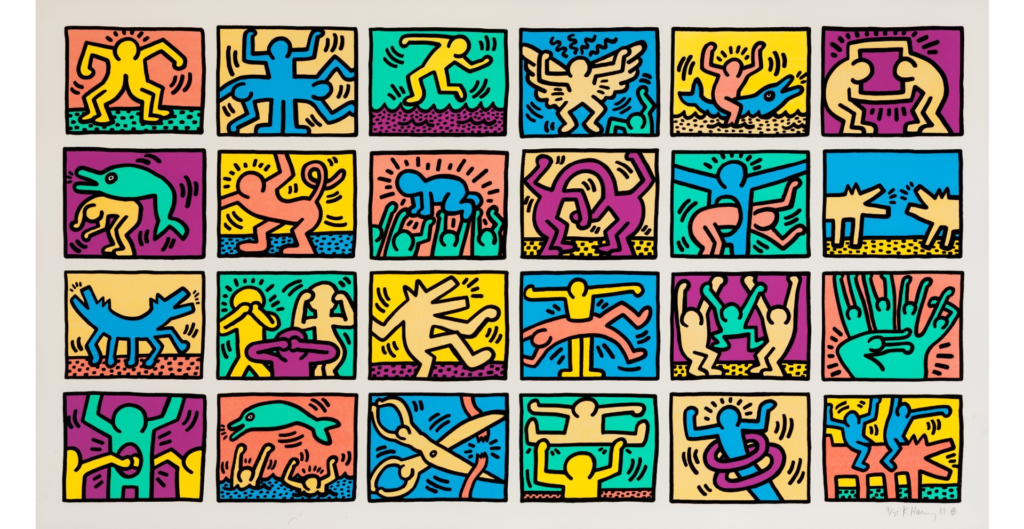
You stand in front of one of his images and something happens before your brain catches up. A small figure, outlined in black, surrounded by radiating lines as if the body itself is emitting heat or noise or pure insistence on existing. Your first instinct is to call it joyful. Innocent. A child’s drawing scaled up, democratized, plastered across subway stations and gallery walls alike. You are wrong, and the error is instructive.
The radiant baby was never about childhood. It was about a state of being that childhood merely approximates — pure presence, unmediated contact with the world before language starts filtering experience into the acceptable and the unspeakable. Gaston Bachelard, writing in his 1958 Poetics of Space, described the house of childhood not as a memory but as a container for being, a space we inhabit imaginatively long after the walls have ceased to exist. The images Haring made function the same way. They are not representations of innocence. They are architecture for feelings that have nowhere else to live.
A man returns to the street where he grew up. Not out of sentimentality, just proximity, an errand that brought him near. The building is already half-demolished. He watches the excavator take another bite out of the facade. He waits for grief to arrive and it doesn’t. What comes instead is something colder and stranger — a recognition that the place never held what he thought it held, that the container was always empty, that what he had been preserving in memory was not a home but a theory of himself that required a home as evidence. He watches the wall fall and feels, of all things, curiosity.
This is where D.W. Winnicott becomes essential. His concept of the transitional object, developed across his clinical writings of the 1950s, describes the thing a child holds between inner and outer reality — the blanket, the stuffed bear, the specific corner of a pillowcase. The object is neither fully internal nor fully external. It occupies the space where self and world have not yet been violently separated. Haring’s recurring symbols — the radiant baby, the barking dog, the crawling figure trailing lines of motion — are transitional objects for adult consciousness. They hold the membrane between what can be said and what can only be felt. They are not naive because their maker was simple. They are formally simple because the content they carry is almost unbearable.
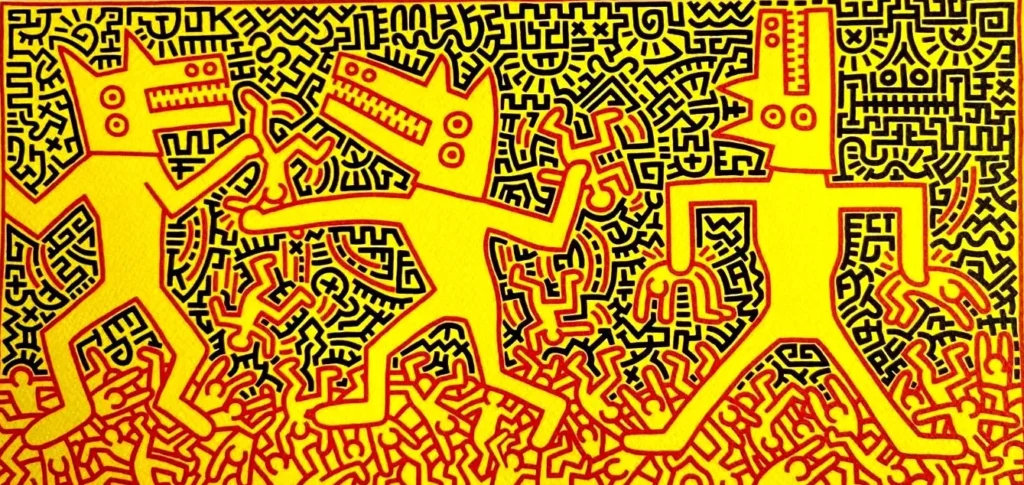
The barking dog is power made visible in its most stripped form. It is not a friendly animal. Its mouth is open, its lines are aggressive, it occupies space with the kind of territorial certainty that in adult social life gets translated into salary negotiations and casual racism and the architecture of whose body is allowed to move freely through which streets. Haring drew it again and again, the way you return to a question that never quite resolves. The crawling figure is not a baby. It is a human being on all fours, which means a human being stripped of the vertical claim to dignity, moving through a world that has refused them upright passage.
When Bachelard writes that we comfort ourselves by reliving memories of protection, he is identifying the very consolation that Haring’s work refuses to offer. The images look like protection. They look like the drawings taped to refrigerators, the symbols chalked on sidewalks by children who haven’t yet learned that the world will not stay drawn. But they were made by a man who watched his community die in real time, who knew what the radiating lines around a body could also mean — fever, contamination, the visual grammar of a body becoming its own emergency.
The man stands in the rubble-dust of his childhood street and understands, almost against his will, that he had needed the building to feel something he was never actually going to feel. The images that look most like innocence are the ones doing the most dangerous work.
Pop Shop and the Trap of Accessibility
The store opened on Spring Street in 1986 and sold T-shirts for twelve dollars. Magnets. Posters. Keychains bearing the crawling radiant baby, the barking dog, the dancing figures that had already covered subway walls and gallery canvases and the bodies of the sick and the dying. The art world reacted as if someone had defecated in the Louvre.
The accusation was immediate and largely unexamined: Haring had sold out. He had taken something sacred and made it cheap. He had crossed the invisible line that separates the artist from the merchant, the visionary from the vendor. What almost no one stopped to ask was who had drawn that line, and whose interests it protected.
Walter Benjamin, writing in 1935, understood that mechanical reproduction does not simply copy an artwork — it destroys what he called the aura, the quality of presence bound to an original object in a specific place and time. But Benjamin was not mourning this. He was watching it happen with something closer to revolutionary excitement, aware that the collapse of aura was also the collapse of the ritual function of art, its use as an instrument of cultural authority. When the image can be reproduced infinitely, the priest loses his monopoly on the sacred. Benjamin saw this as dangerous, yes, but also as genuinely emancipating. The critics who attacked the Pop Shop were, without knowing it, defending exactly the ritual authority Benjamin had hoped to dismantle.
Guy Debord would have been more suspicious. The spectacle, as he described it in 1967, is not simply advertising or commodity culture in the crude sense — it is the moment when lived experience is replaced by its representation, when the image becomes more real than the thing it depicts. A Haring print on a gallery wall costs three thousand dollars. A Haring print on a poster costs eight. If the image is the same, the difference is purely social — it is the price of belonging to a class that can afford the ritual. What the Pop Shop actually threatened was not art but exclusivity, and exclusivity has always been confused with quality by those who benefit from the confusion.
By 1986, the galleries selling Haring’s work were not serving the children of the South Bronx or the drag queens of the West Village or the teenagers who had first encountered his figures on the walls of subway stations. The collectors were overwhelmingly white, overwhelmingly affluent, overwhelmingly the same people who attended every other blue-chip opening in the same sixty-block radius of Manhattan. The Pop Shop changed the demographics of who could own the image, if not the painting. That is a real distinction and it deserves to be held clearly.
Yet Debord’s ghost lingers. Because there is a version of accessibility that is simply spectacle in a democratic disguise — a way of making people feel included in a system that has already extracted the meaning from what they are buying. The twelve-dollar T-shirt carries the image but not the urgency, not the particular fury of watching friends disappear from a disease the government refused to name. Something is reproduced and something is left behind. Benjamin knew this too, even as he celebrated the reproduction. He never claimed that mechanical copies were equivalent to originals — only that the difference between them revealed something about power rather than quality.
Haring himself insisted the Pop Shop was not a compromise but a continuation. He said it allowed him to reach the people he had always been making work for. He was probably right and probably also incomplete. Because the question is not whether the work reached more people — it did, measurably, undeniably — but what it meant to reach them through a cash register, inside a store with regular hours and a mailing list, in a neighborhood that was already becoming unaffordable to the very people whose energy had made it worth anything at all.
Andy, Jean-Michel, and the Mythology of Friendship
There is a kind of conversation that happens between people who love each other and are also, in some structural sense, using each other, where neither fact cancels the other and both are true at the same time, and you have probably been in a room where that particular silence lives. You know the texture of it. Someone is fading and the other person keeps talking about work, about the next show, about what the critics are saying, because to stop talking about work would be to admit what the body in the chair already knows.
That room existed. It existed in the particular geography of downtown Manhattan in the 1980s, where three men — Haring, Warhol, Basquiat — occupied a triangle so dense with mutual need and mutual projection that no one who has tried to narrate it cleanly has ever succeeded. They were friends. They were competitors. They were, in the terminology that Erving Goffman spent his career developing, performers in one another’s presence, each constructing a self that the others’ gaze made possible and also constrained. Goffman’s 1959 work on the presentation of self in everyday life argued that social interaction is not a transparent exchange of authentic selves but a managed performance, a staging, and that this is not a pathology but simply the condition of being a social creature. What makes the Haring-Warhol-Basquiat triangle so unnerving is that all three of them understood this intellectually and did it anyway with full force, because understanding the mechanism of a trap does not free you from it.
Warhol was older, established, the Factory already a myth that consumed younger artists as fuel. His friendship with Basquiat, and his warmer but less volatilized relationship with Haring, was genuine in the way that things can be genuine and also self-serving without contradiction. Eve Kosofsky Sedgwick, in her 1985 study Between Men, traced the structures by which male homosocial bonds are organized not simply around affection or rivalry but around the exchange of something — desire, status, symbolic capital — that flows through those relationships in ways the participants rarely name directly. The art world of that decade was a machine for exactly this kind of circulation. A young Black artist from Brooklyn with the face of a child and the vocabulary of a shaman could become, in the hands of the right white gallerist or the right older white artist, a commodity of cultural legitimacy, and the tragedy is that Basquiat knew this, painted it explicitly into his canvases, and remained inside the arrangement anyway. Haring watched this. He was inside it too, differently, with the particular vulnerability of someone who was white enough to be protected and queer enough to be endangered, whose work was legible to corporations but whose body was already carrying what would kill him.
The romantization of artistic brotherhood is one of art history’s most durable anesthetics. It converts structural inequality into personal warmth, makes the commercial transaction feel like spiritual kinship, and then, when one of the brothers dies too young, crystallizes everything into myth so that the exploitation becomes indistinguishable from the love. Basquiat died in 1988, at twenty-seven, the year after Warhol. Haring would follow in 1990. The speed with which all three left made the mythology almost inevitable, because the dead cannot correct the record, and the market, which had already turned their friendship into a brand, had every incentive to keep the image simple.
But the room with its difficult silence was not simple. Two men talking about the next show while one of them is disappearing is not a myth. It is the specific texture of love operating under conditions it was never designed to survive, and that is something Goffman’s frameworks can illuminate but cannot fully hold, because the grief was real even when the performance was also real, and those two things did not take turns.
A vision curated by a filmmaker, not an algorithm
In this video I explain our vision
The Diagnosis and the Decision to Paint Faster
You have gone through a dead person’s belongings before, or you know someone who has. There is always a moment — somewhere between the second and third box — when the rhythm of what you find changes. The objects from earlier years come slowly, spaced out, breathing. Then suddenly the density shifts. Notebooks filled to the last page. Letters answered the same day they arrived. Projects started and finished in spans of weeks. Canvases stacked three deep. It is as if the person reached a certain point and simply decided that time, from that moment forward, would be treated differently — not as something to be rationed but as something to be metabolized whole.
Keith Haring received his HIV-positive diagnosis in 1988. He was thirty years old.
Paul Virilio argued, with the kind of precision that feels almost cruel once you understand it, that every technology invents its own catastrophe. The ship invents the shipwreck. The airplane invents the crash. The railroad invents the derailment. The accident, for Virilio, is not external to the system — it is latent inside it from the very beginning, the hidden twin of every invention, waiting. In his 1977 work “Speed and Politics” and later in “The Accident of Art,” he pushed this further: speed itself is not neutral. Acceleration changes the nature of what is produced, what is perceived, what survives. To move faster is not simply to do more of the same thing. It is to enter a different ontological register entirely.
Haring had always worked fast. The subway drawings were timed to the transit police. The murals were completed before the wall dried. Speed was never a symptom for him — it was the grammar of his work, the visual language of a body in motion through a city that never stopped. But after 1988, something changed in the architecture of that speed. It was no longer the speed of someone running toward something. It was the speed of someone who had looked at the horizon and understood its actual distance.
In the two years between his diagnosis and his death in February 1990, he completed over fifty major works. He established the Keith Haring Foundation in 1989 with explicit intent — the legal and institutional machinery built while he could still build it. He traveled. He painted a chapel in Pisa. He produced the “Apocalypse” series, collaborating with William S. Burroughs. He designed, organized, distributed, created. The notebooks from that period are not frantic. That is the thing that unsettles people who expect breakdown. They are precise. Focused. The handwriting is clear.
Virilio’s accident was not destruction. It was revelation. The catastrophe reveals what was always structurally true about the system. What Haring’s diagnosis revealed was not mortality — he already knew about mortality, had watched friends die through the middle years of the decade as the epidemic carved through the community around him. What it revealed was the precise weight of a day. Not the sentimental weight, not the weight of the motivational poster. The actual gravitational pull of twenty-four hours when you are no longer permitted to assume the next twenty-four will arrive unchanged.
There is a difference between knowing you will die and knowing the approximate architecture of that dying. The first is philosophical. The second is operational. Haring shifted from one to the other in 1988, and the output was not grief made visible. It was something closer to what happens when a musician, told the concert will end in an hour, stops leaving spaces for improvisation and begins playing every note they have ever known.
The woman sorting through the boxes eventually reaches the last layer, the most recent things, and finds them almost unbearable not because they are sad but because they are so alive, so deliberately, almost aggressively alive, as if the person had decided that slowing down was the one form of surrender they refused to commit.
Silence Equals Death: Art as Political Infrastructure
There is a moment when a man with a brush stands in front of a wall that an entire government has decided represents the division of the world, and he paints on it anyway. Not as protest in the conventional sense — not with a sign or a slogan — but with bodies. Interlocking bodies, figures holding each other up, figures pressing against each other in configurations that refuse hierarchy. That wall in Berlin, in 1986, became for a few hours a surface belonging to no state, no ideology, no checkpoint. The figures he left on it did not argue. They demonstrated, in the oldest sense of the word: they showed.
Susan Sontag understood, with a precision that still cuts, that illness is never merely biological in the way a society narrates it. In Illness as Metaphor, published in 1978, and then in its essential companion AIDS and Its Metaphors a decade later, she traced how disease becomes a moral verdict — how the body that contracts the wrong illness is retrospectively constructed as having deserved it. AIDS, by 1989, had been embedded inside a language of contamination, deviance, and divine punishment so thoroughly that even the medical establishment struggled to speak about it without those undertones surfacing. The Reagan administration’s silence — which was not passive but active, a strategic withholding — operated precisely within this framework. To name AIDS was, in the dominant cultural logic, to implicate yourself in what was being called a lifestyle. The silence was not empty. It was load-bearing.
This is what ACT UP understood, and what Haring understood with a visceral directness that bypassed argument and went straight to the nervous system. The Silence=Death imagery — the pink triangle inverted, reclaimed from the Nazi concentration camps where gay men had worn it as a mark of extermination — was not a symbol. It was an accusation. Haring’s visual language, already developed across years of subway drawings and street interventions, was perfectly calibrated for this moment: bold enough to be read at speed, complex enough to accumulate meaning across repeated encounters. You did not need to read a manifesto. You needed only to see it, on a wall, on a body, on a button pinned to a jacket on the subway.
The Tuttomondo mural in Pisa, completed in 1989 on the exterior of the church of Sant’Antonio, was his last major public work, painted when he already knew his diagnosis. Thirty figures, each distinct, each in motion, each connected to the others through the logic of the composition rather than through any imposed narrative — a cosmology of mutual dependence rendered in the primary colors of a world that refuses to divide itself into the saved and the condemned. There is no hierarchy in that wall. There is no center. Everyone is moving, everyone is touching, and the touch is not contamination. It is the opposite of everything the dominant discourse about AIDS was constructing at that precise moment.
The murals painted in hospitals, in schools, in the pediatric wards where children with AIDS were warehoused by a society that preferred not to see them — these were not charitable gestures. They were acts of counter-archiving. They said: this happened, these bodies existed, this joy was real and is real, and no narrative of shame can retroactively unmake it. Haring was building, with paint and line, an alternative record of what the period actually contained — not the silence, not the shame spiral, not the metaphor of plague as punishment, but the fact of lives lived in full contact with other lives.
The South African apartheid paintings operated within the same logic: the body as political territory, color as argument, the refusal to aestheticize suffering in ways that allow the viewer to remain comfortable and therefore inert. Sontag wrote that the most powerful way to counter the metaphors of illness is not to interpret them but to render them visible as metaphors — to strip them of their pretended naturalness. Haring did not write this. He painted it.
What Remains When the Image Outlives the Body
He died on a February morning in 1990, thirty-one years old, and the images kept moving. That is the first and most unsettling fact. They did not pause, did not wait, did not fold themselves back into the silence from which they had emerged. The radiant baby kept crawling. The barking dog kept barking. The dancing figures kept their arms raised in that gesture that means either celebration or surrender, and which was always, in Haring’s world, both things at once.
You have seen it on someone’s forearm, on a stranger on the subway or in a café, the unmistakable thick black line, the simplified human figure mid-leap, and something happens in your chest that is difficult to name. Not quite recognition, not quite violation. Something that exists in the narrow space between the two. The image is exactly as he drew it, and yet it belongs entirely to someone he never met, someone who was perhaps a child when he died, someone who chose it from a flash sheet or found it on a screen and thought: yes, that one, that is the shape of something I need to carry. You watch that stranger walk away and you feel simultaneously that something has been honored and something has been taken, and you cannot say with certainty which feeling is more accurate, because both are true.
Roland Barthes, writing in Camera Lucida in 1980, described the punctum as the element in an image that pierces you, that rises from the scene and shoots out like an arrow to find you specifically. It is not what the photographer intended. It is not the studium, the cultural and learned meaning that an educated viewer extracts. The punctum is what wounds without permission, what lodges itself in you before your mind has time to construct a frame around it. Barthes wrote this book in grief, months after his mother’s death, trying to understand why certain images of her reached him in ways that others did not. What he discovered was that the most piercing images work precisely because they exceed the intentions of whoever made them.
This is what happens to Haring’s work now, decades after the body that made it stopped. While he lived, his images were inseparable from his biography, from the urgency of a man who knew he was dying and drew faster, who turned a diagnosis into a reason to produce more rather than less, who opened the Pop Shop in 1986 partly to make his images affordable to the people who had always been their audience rather than their buyers. His intentions were legible because he was there to articulate them, in interviews, in murals, in the sheer volume of work produced before the end. But intention dies with the body that held it. What remains is the image itself, unmoored, available, passing through hands and skins and gallery walls and children’s bedroom posters without asking permission from anyone.
The Keith Haring Foundation, established before his death precisely because he understood this problem, has spent more than three decades trying to honor his stated wishes, directing resources toward AIDS organizations and children’s causes, monitoring the use of his imagery with the vigilance of an institution that knows how quickly a radical image becomes a commodity. And yet the Foundation cannot own the punctum. It cannot legislate what happens in the chest of a stranger who sees a dancing figure and feels, before thinking, that something essential about being alive is contained in that shape.
The image is still being redrawn tonight, in cities he never visited, by hands that never knew him, for reasons he could never have anticipated, and the question of whether that is inheritance or theft, devotion or erasure, remains exactly as open as it was the morning the line first hit the wall.
🎨 Art, Rebellion, and the Language of the Streets
Keith Haring’s vivid imagery and radical spirit connect naturally to broader conversations about counterculture, the unconscious, and the transformative power of art. These articles explore the cultural and philosophical currents that shaped the world Haring inhabited and challenged.
Masterpieces of Rebellion and Counterculture Cinema
Keith Haring emerged from a generation of artists who used creativity as an act of defiance, and this exploration of rebellion in cinema captures the same raw energy. From punk to protest, the film movements covered here share Haring’s belief that art must confront power head-on. Understanding this context deepens our appreciation of why Haring’s work felt so urgently alive.
GO TO THE SELECTION: Masterpieces of Rebellion and Counterculture Cinema
The Unconscious and its Relationship With Cinema
Haring’s recurring symbols — barking dogs, radiant babies, dancing figures — speak a visual language rooted in instinct and the unconscious mind. This article examines how cinema has long served as a mirror to the deeper layers of the psyche, much as Haring’s murals did on subway walls and gallery canvases. Exploring the unconscious through image is a tradition that unites filmmakers and visual artists alike.
GO TO THE SELECTION: The Unconscious and its Relationship With Cinema
Mass Social Homologation Today
One of Haring’s most persistent themes was resistance to mass conformity and the flattening of individual identity in consumer society. This piece investigates how social homologation operates in contemporary culture, erasing difference in favor of marketable sameness — precisely what Haring’s bold, democratic art fought against. His work in public spaces was a direct challenge to the invisible walls of social normalization.
GO TO THE SELECTION: Mass Social Homologation Today
The Avant-Garde Cinema: Movies to Watch
Haring was deeply embedded in the avant-garde scene of 1980s New York, where visual art, performance, and experimental film overlapped constantly. This curated guide to avant-garde cinema reveals the same fearless experimentation and rejection of mainstream conventions that defined Haring’s artistic practice. Together, these works form a portrait of a creative era that refused to stand still.
GO TO THE SELECTION: The Avant-Garde Cinema: Movies to Watch
Discover the Art of Independent Cinema
If Keith Haring’s fearless creativity and boundary-breaking vision resonate with you, Indiecinema is the streaming platform where that same spirit lives on screen. Explore a world of independent, avant-garde, and visionary films that challenge, provoke, and inspire — just as Haring’s art did. Join Indiecinema and let the journey continue.
👉 EXPLORE THE CATALOG: Watch Indie Films in Streaming
A vision curated by a filmmaker, not an algorithm
In this video I explain our vision

