The Body That Falls Asleep and the World That Watches
You have stood in a room where someone was dying, or had just died, and you did not know where to put your hands. The body was still there — unmistakably the person you knew, and yet already something had shifted, some quality of presence had begun its withdrawal, and the air in the room felt thick with a silence that was not quite silence. Everyone else was doing the same thing you were doing: hovering, leaning slightly forward, arranging their faces into expressions that tried to bridge the unbridgeable distance between the living and the one who was leaving. Nobody knew the protocol. Nobody ever does. We have been dying for as long as we have been human, and we still do not know what to do with our hands.

This is where the Dormition begins. Not in theology, not in council chambers or doctrinal dispute, but in that exact room, with those exact hands, and that exact failure of posture. The Eastern Christian tradition named this moment — named it with extraordinary precision — when it depicted the falling asleep of the Virgin Mary. The Greek word is Koimesis, the Latin Dormitio: the sleep, the lying down, the threshold passage rendered not as death but as a form of profound rest. And the images that emerged from this naming, across more than a millennium of sacred art from Constantinople to Novgorod to Venice to Thessaloniki, show something that anyone who has kept a deathbed vigil will recognize before they can articulate why.
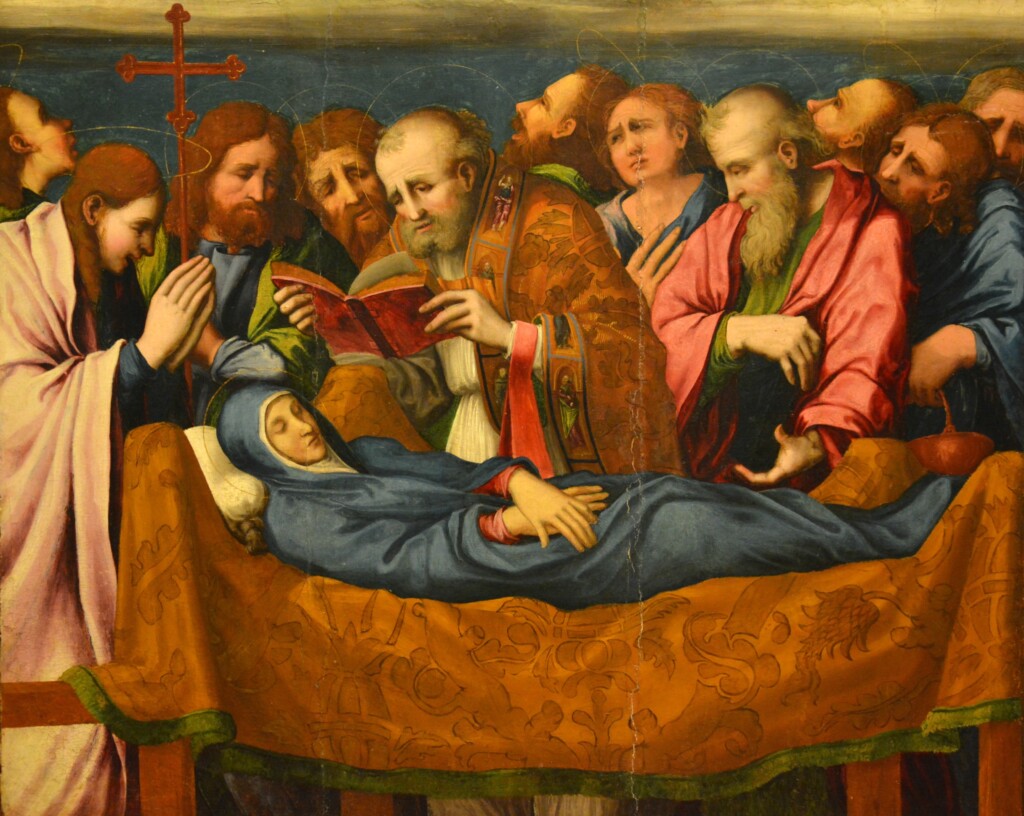
There is a bed at the center. On it lies a figure, horizontal, composed, the hands folded or the body straightened in that particular way that the dying take on — that involuntary majesty of the body finally released from the performance of being upright. Around the bed stand the apostles, and their faces carry exactly the expression you know: grief that cannot find its object, love that has nowhere to land, the terrible alertness of people who have come to witness something they do not have the instruments to witness. Some lean forward. Some turn slightly away. One covers his face. The composition is not decorative. It is documentary.
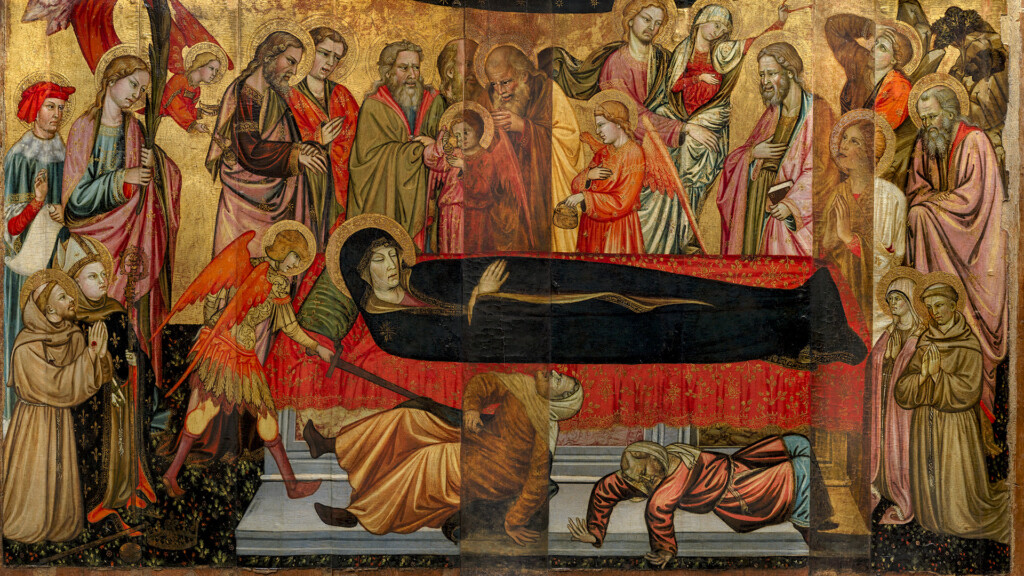
What the iconographic tradition understood — and what we have largely forgotten in our medicalized, privatized, institutionally sequestered relationship with death — is that the deathbed is a cosmic event. Not metaphorically cosmic. Literally: in the Dormition icons, the space above the bed opens, and a vertical axis descends from gold light, and Christ himself stands at the center holding an infant wrapped in white, which is his mother’s soul. Heaven and earth occupy the same pictorial space without apology. The apostles gathered below and the angels gathered above are witnessing the same event from different sides of the same membrane.
The theological premise underneath this image is not simple piety. It took centuries to consolidate. The Dormition feast was being celebrated in Jerusalem possibly as early as the fifth century, though its doctrinal scaffolding remained contested, shifting, never fully systematized in the way that Western Mariology would eventually attempt. What the Eastern tradition held onto, with a tenacity that resisted the Western impulse toward juridical clarity, was the image itself as the primary carrier of meaning. You looked at the icon. You stood before it the way you stand before a deathbed. You did not need the doctrine to feel the weight.
And this is the thing about the Dormition that keeps pulling you back toward it, even if you have no religious formation, even if you have spent your life at a careful distance from the claims of faith: it is the only image in the entire history of sacred art that takes the deathbed vigil seriously as a form of knowledge. Not as a moment to be survived or transcended or explained. As something that, if you look at it long enough, begins to tell you what you already knew.
Sleep as Euphemism, Sleep as Theology
There is a moment in grief when someone says “she passed” or “he’s gone” and you understand, viscerally, that language is doing something more than softening a blow. The euphemism is not cowardice. It is a claim. It says: the category you are reaching for does not quite fit what happened here.
The Greek word koimesis means, literally, a lying down to sleep. When the early Christian communities applied it to Mary’s end, they were not being sentimental. They were making a precise theological argument dressed in the most ordinary human experience imaginable. Everyone has fallen asleep. Everyone knows the specific surrender of it, the moment when the body releases its grip on wakefulness and crosses into something that resembles, from the outside, a small rehearsal of absence. To name Mary’s death koimesis was to insist that what looked like finality was structurally identical to that nightly crossing — not an ending but a threshold, and one the body itself already knows how to navigate.
This is not consolation. Consolation would say: don’t worry, it wasn’t really death. The theological claim is harder than that. It says: what you call death has already been redefined by what happened to one body in particular, and Mary’s passing must be understood inside that redefinition, not outside it. John of Damascus, writing in the eighth century in his three homilies on the Dormition, makes the logic explicit. Because Mary bore in her body the one who is the resurrection, her own body cannot be subject to the ordinary grammar of corruption. The claim is not that she was spared death’s approach but that death’s meaning has been altered from within, the way a word changes when the world it describes has changed.
What makes this theologically volatile is that canonical scripture says almost nothing. The New Testament closes without any account of Mary’s end. She appears in the upper room at Pentecost in Acts and then disappears from the text entirely. This silence is extraordinary given the narrative attention the tradition would eventually lavish on her. But the silence, as the patristic writers understood, was not a gap to be embarrassed by. It was a space that the tradition could inhabit, and the way a community inhabits a silence tells you everything about what it believes.
The earliest extended accounts of the Dormition appear in apocryphal texts circulating by the fifth and sixth centuries, some attributed to figures like pseudo-John or pseudo-Melito of Sardis, documents that were never canonical but were never entirely suppressed either. They describe the apostles gathered miraculously from the ends of the earth, a death that is also a falling asleep in the presence of Christ himself, and a body that does not decay. What these narratives are doing, beneath the legendary surface, is working out a problem that the resurrection of Christ had left open: if the body matters, if resurrection is bodily and not merely spiritual, then what happens to bodies before the general resurrection? Mary becomes the test case, the place where the tradition thinks through its own implications.
The theologian Karl Rahner, in his 1951 essay on the Assumption, argued that the definition of the dogma that year was not the imposition of a new doctrine but the explicit articulation of something latent in the earliest Christological convictions. If you believe what the creeds say about incarnation, you have already, without knowing it, committed yourself to something like the Dormition. The body is not incidental. The flesh that carried the Word is not a container to be discarded. To say koimesis rather than thanatos, sleep rather than death, is to say that this particular body’s story is not finished — and to leave open, uncomfortably, the question of what that might mean for yours.

The Image Before the Doctrine
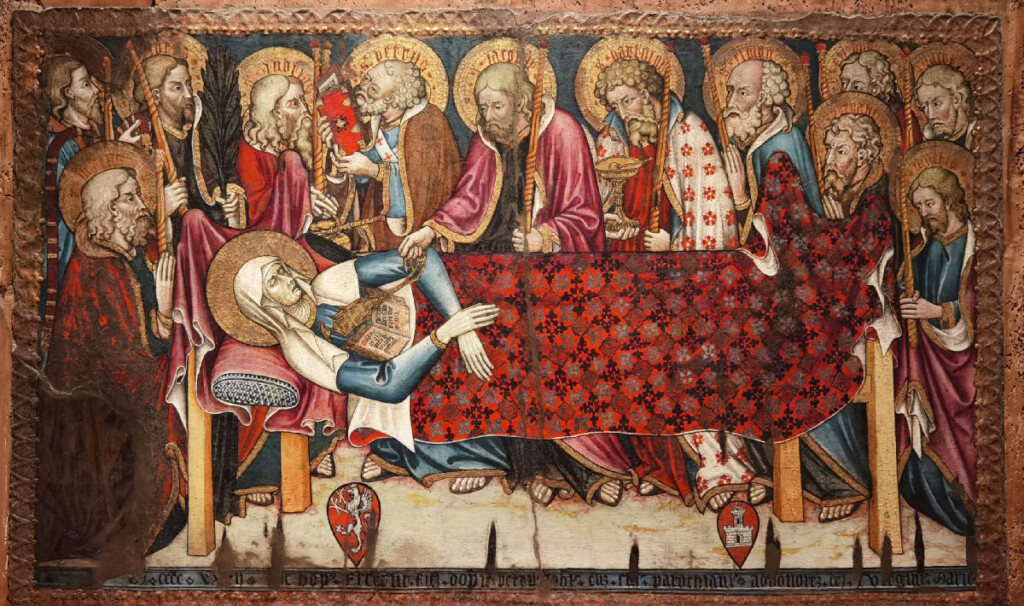
Before any council had assembled to deliberate, before any patriarch had drafted a formal position, the image already existed. Somewhere in a Syrian or Palestinian community in the sixth century, a craftsman laid tesserae or drew pigment across plaster and showed a woman lying horizontal, eyes closed, surrounded by grieving figures, with a luminous form rising from her body — a small swaddled shape held aloft, the soul rendered as a newborn. The theology was not yet written. The image had already decided.
This is how it works with the deepest cultural truths: the hands move before the mouth speaks. The women who dressed a body for burial in a village where no priest would arrive until the following morning already understood what later doctrine would spend centuries trying to articulate. They knew it in the weight of the limbs, in the specific care given to the position of the hands, in the way one woman would comb hair that would never be seen again by living eyes and do it carefully anyway, slowly, as though the gesture itself were the argument. The ritual preceded the permission. The meaning was already there, held in muscle and repetition, waiting for language to catch up.
The apocryphal texts known collectively as the Transitus Mariae — the Passing of Mary — circulated in multiple versions from at least the fifth and sixth centuries, in Greek, Latin, Syriac, Coptic, and Ethiopic manuscripts that scholars like Simon Claude Mimouni have traced with painstaking care across Mediterranean communities. These texts were not officially sanctioned. Pope Gelasius I, in his decree of approximately 494, listed several of them among the books not to be received — apocryphal, unauthorized, outside the canon. And yet they proliferated. They copied themselves across languages and liturgical traditions with the promiscuous energy of stories that answer a genuine human need. They told of the apostles gathered miraculously from distant lands, of a three-day interval, of the body carried to a garden, of the resurrection and assumption that followed. The Church had not approved this narrative. Communities were living it anyway.
What the iconographic tradition reveals — and this is what makes it philosophically uncomfortable to those who prefer institutions to precede their cultures — is that visual culture operated as a kind of unauthorized theology. Aby Warburg understood this: images carry what he called Pathosformeln, emotional formulae, affective patterns that survive across centuries and doctrinal revisions, lodging themselves in the nervous system of a civilization before any official body ratifies them. The image of the dying mother surrounded by her children, the body tended by devoted hands, the soul departing upward — these are not invented by Christianity. They arrive from somewhere older, and the tradition borrows them, reframes them, gives them new names without entirely changing their grammar.
The earliest surviving monumental depictions of the Dormition appear in the eighth and ninth centuries in Byzantine contexts, but they are clearly drawing on a visual vocabulary that was already established, already legible to audiences who recognized the type before they understood the specific theology. A congregation standing before a Dormition mosaic in a church they attended weekly did not need a catechist to explain what they were seeing. They had already seen it. They had performed it, in those rooms where a woman’s body was washed and wrapped and laid out while someone outside kept watch against the dark and someone else boiled water because that was what you did, because doing something was the only way to remain present to the unbearable fact of it.
The doctrine of the Assumption would not be formally defined until 1950, when Pius XII promulgated Munificentissimus Deus. The image was already fourteen centuries old. Which means the Church spent fourteen centuries ratifying what the faithful had always already known.
The Geometry of Grief: Reading the Icon
There is a moment when you stop seeing the icon and start feeling its geometry press against you. The eye moves, involuntarily, horizontally first — drawn along the pale, still body of Mary lying across the center of the composition like a sentence that has reached its period. She is dressed, prepared, utterly horizontal. And then something pulls the gaze upward, almost against your will, to the vertical figure of Christ standing directly behind her, rising from the center of her stillness like a counterargument. He holds something small and white, swaddled tightly, cradled in his arms. It takes a moment — sometimes longer than you expect — to understand what you are seeing.
That small figure is Mary’s soul.
Erwin Panofsky, in his 1939 Studies in Iconology, drew a distinction that remains one of the most useful instruments in the entire history of art: the difference between iconography, which identifies what is depicted, and iconology, which excavates what is meant — the deeper symbolic values, cultural assumptions, and theological convictions that a composition encodes without stating. The Dormition icon operates almost entirely at the iconological level. You can describe it accurately — a reclining woman, a standing man, a gathered crowd, a small wrapped figure — and still have said almost nothing about it. The meaning lives not in the elements but in their spatial relationships, in the geometry of who stands where, who holds what, which body is horizontal and which is vertical, which figure is large and which is small.
The apostles ring the bier in lamentation, their postures bent toward Mary with that particular grief that belongs to people who knew the person before they became significant. Peter stands at her head with a censer, Paul at her feet, others lean, some raise their hands in the gesture that Byzantine art reserved for mourning — a gesture so codified it functions almost as punctuation. But even in their grief, they are peripheral. The true axis of the icon is the vertical-horizontal cross formed by Mary’s body and Christ’s figure, and everything else orbits that intersection.
What that cross encodes is an inversion so precise it could only be intentional. Mary once held Christ, newly born, swaddled, small, dependent — the whole iconographic tradition of the Theotokos, the God-bearer, returns to that foundational image of a mother cradling the weight of the divine. Now Christ holds Mary, newly departed, her soul rendered as an infant in white cloth, small, received. The theological argument is made entirely through spatial rhyme. The composition does not explain the doctrine of Mary’s assumption into divine care; it demonstrates it by reversing the original image of care itself. Son becomes mother. Birth becomes death. Smallness migrates from one figure to the other across the span of an entire theological history.
This is what Panofsky meant when he argued that symbols carry intrinsic meaning that transcends the intentions of individual artists — meaning deposited by culture, by repetition, by the slow accumulation of theological decision. The artist who arranged Christ behind Mary’s bier was not inventing a metaphor. He was activating one that the entire tradition had been building since the first image of Mary holding the Christ child was pressed into gold or painted onto wood. The inversion works because the original image is already inside the viewer. You carry the Nativity when you enter the Dormition, and the icon knows this, and it uses your memory against your grief.
The horizontal body is also — and this cannot be accidental — a body at rest in the way bodies are at rest in sleep, not in the contortion of violent death. The Greek word koimesis means exactly this: a lying down, a settling, the posture of someone who has simply stopped being upright. The geometry insists on peace even as the apostles around it insist on loss, and the tension between those two insistences is where the icon actually lives.
Who Is Allowed to Die Like This
You have probably never had twelve people in the room when someone you loved died. Most deaths happen with one witness, or none. A corridor. A night shift nurse who checks the pulse and notes the time. The body is handled before the family arrives. The moment itself — the actual crossing — belongs to no one, is recorded by no one, passes without ceremony into a bureaucratic register of dates and causes. This is how most human beings have always died, and this is how most human beings will continue to die, and the tradition knows it, which is precisely why it constructed something so violently different for Mary.
Think about what the iconography actually describes. Apostles who had scattered across the known world — preaching in India, in Ethiopia, in the furthest reaches of Asia Minor — are lifted by clouds or carried by winds and deposited, simultaneously, at her bedside. The geography of the ancient world collapses so that no one who mattered would be absent. Christ himself descends. The room fills. The death, or the passage, becomes an event so densely witnessed that it functions almost as a coronation rather than a dissolution. This is not comfort. This is a statement about worth.
Philippe Ariès, in his monumental study published in 1977, traced across nearly a thousand years of Western European history the slow privatization of death — the way in which dying moved from a communal, public, almost theatrical act to something hidden, medicalized, and finally quarantined from social life entirely. In the medieval world he examined, the dying person was the center of a ritual in which family, neighbors, clergy, and community participated actively. The deathbed was a stage. But Ariès was careful to show that even this communal dying was never equally distributed. The architecture of attended death — who received last rites with full ceremony, whose body was processed through the streets, whose passing was commemorated in stone — followed with remarkable consistency the lines of social power. Lords died publicly. Servants died in corners. Women died, for the most part, unremarked, unless they were queens or saints or had produced enough sons to warrant a record.
Mary receives what almost no woman in the ancient world would have received: a witnessed death that is also a theology. Every apostle present is a claim. The gathering is not incidental to the scene — it is the scene. The sociologist David Kertzer, in his work on ritual and political power, argued that the function of ceremony is never merely symbolic but always constitutive: it does not represent importance, it creates it. The Dormition ceremony creates Mary’s importance by staging it as irreducibly collective, irrefutably witnessed. Her passing cannot be disputed, minimized, or forgotten because it was seen by everyone who mattered, and then seen again by everyone who painted it.
This is where the iconography becomes uncomfortable if you look at it long enough. The dignity constructed around Mary’s death is real, and it is moving, and it is also a dignity built partly through contrast with the unwitnessed deaths of everyone else. The power of the scene derives from its exceptionality. The apostles fly from the ends of the earth for her. They do not fly for the woman who died in the next village, or the child who did not survive the winter, or the man whose name no one thought to write down. Ariès documented that by the twelfth century, approximately half of all people in Western Europe died without access to a priest, let alone a ceremony. The theological imagination that produced the Dormition did not fail to notice ordinary death. It simply decided to show you something else.
And once you have seen it — once you have felt the warmth of that gathered room — it is very difficult to unsee what the warmth required.
A vision curated by a filmmaker, not an algorithm
In this video I explain our vision
The Assumption and Its Discontents: The Body Refused to Stay
There is a family standing at the edge of a cemetery in a village that no longer appears on any map, holding flowers they do not know what to do with. The grave has a stone, a name, two dates. But the body was never found. It dissolved somewhere into the mud of a river, or into the administrative silence of a camp, or simply into the chaos of a century that produced more unrecovered dead than any previous era in human history. The flowers hang in their hands. There is no place to put them that means anything. The absence beneath the earth is not peaceful — it is a wound the ground refuses to close.
This is the image that haunts the theological transition from Dormition to Assumption. The Dormition tradition, as we have seen, insisted that Mary died — that she crossed through mortality the way every human body must. But almost immediately, the tradition refused to leave her there. The body could not stay. It would not decompose, would not become anonymous matter, would not join the vast undifferentiated mass of the organic past. She was taken up, intact, the whole of her, body and soul together, into whatever comes after.
For centuries this remained a pious belief, warmly held, liturgically celebrated, theologically unresolved. The Eastern Church had never needed to define it precisely — the feast of the Dormition carries the Assumption within it as an implication, a natural continuation of the same breath. But the Western Church moved slowly, cautiously, through fifteen hundred years of theological argument about whether Mary died at all, whether her body suffered corruption, whether the taking up was bodily or merely spiritual. Then, on November 1, 1950, Pius XII issued Munificentissimus Deus, and the question was closed. The bodily Assumption of the Virgin Mary was declared dogma — the last Marian dogma ever defined, and one of only two infallible pronouncements made under the conditions established by the First Vatican Council.
The date is not incidental. Five years after the liberation of the concentration camps. Four years after Nuremberg. Two years after the formal establishment of the State of Israel on land soaked through with the memory of displacement. The twentieth century had done something to bodies that no previous theology had been fully forced to address: it had made their disappearance systematic, industrial, total. Bodies had been burned into ash and scattered. Bodies had been bulldozed into mass graves without names. Bodies had been rendered into statistics, into bureaucratic categories, into the raw material of ideological projects. The question of what happens to a body — of whether a body can be recovered, honored, kept — had become the most urgent moral question of the age.
To define, in that moment, that one body could not be abandoned — that one body was taken up whole, refused to become debris — is to make a claim that reads differently against that backdrop than it would have in the peaceful abstract of the Council of Trent. The philosopher Emmanuel Levinas, writing in the decades following the war, argued that ethics begins with the face of the other — that the fundamental moral act is to refuse to let another person become a thing, to insist on their irreducible particularity. The Assumption, read through Levinas rather than through scholastic theology, becomes something close to this: a refusal. A refusal to let one body become indistinguishable from the general catastrophe of matter.
That family at the empty grave is not a metaphor. They are every family who has ever stood over an absence that the earth could not fill. What the dogma of 1950 offers them is not consolation — it is a counter-claim, almost violent in its insistence: that a body matters enough to be kept. That one was.
Flesh as Argument: Mary’s Body Against the Gnostic Temptation
There is a moment in the story of a woman returning to her childhood home after decades away — she walks through rooms that no longer hold the furniture she remembers, stands in a kitchen where even the smell has changed, and feels the particular vertigo of a body asserting its presence in a place that has forgotten it. The body insists. It remembers angles and distances the mind has let go. This is the scandal that the entire iconographic tradition of the Dormition refuses to dissolve: matter remembers, matter matters, and no amount of spiritual elevation can make the flesh politely disappear.
The heresy that Christianity has spent two millennia fighting is not atheism. It is the far more seductive idea that the spiritual is real and the physical is not, that salvation means escape, that the body is a temporary embarrassment the soul endures before returning to its proper immateriality. Gnosticism named this impulse in the second century, but the impulse is older than any name and more durable than any refutation. It surfaces wherever people speak of the soul being freed at death, wherever the body is described as a cage or a shell, wherever transcendence is imagined as upward departure rather than downward transformation. It is, in Simone Weil’s phrasing, the gravitational pull of the spirit away from weight — and it feels, almost always, like elevation.
The Dormition and Assumption iconography exist as a sustained argument against exactly this. When theologians insisted, across centuries of controversy, that Mary’s body did not decay, did not remain in the tomb, was taken up whole and entire into heaven, they were not making a concession to popular piety. They were staking a claim about what salvation actually is. Caroline Walker Bynum, in her 1995 study of bodily resurrection in medieval Christian thought, demonstrated with extraordinary patience that the scholastic obsession with bodily continuity — with questions about whether resurrected bodies would include fingernails, whether the flesh of a cannibal’s victim would be restored to the victim or to the cannibal, whether adipose tissue counted as truly one’s own — was not theological eccentricity but a coherent and urgent insistence that personhood is inseparable from physical particularity. You are not saved from your body. You are saved in it, as it, through it.
Mary’s body in the iconographic tradition becomes the test case for this entire claim. If the Dormition showed only a soul rising while the body remained behind, it would be beautiful and orthodox enough by the standards of popular imagination. But the tradition refuses that comfort. The apostles gather not around an idea or a memory but around a specific body lying on a specific bed. Christ holds not a luminous abstraction but a small figure wrapped in cloth, a soul that is also a person that is also flesh. The theological insistence on bodily assumption — formalized as Roman Catholic dogma only in 1950 by Pius XII in Munificentissimus Deus, though present in Eastern theology for over a millennium before that — preserves something that dematerialized spirituality would quietly abandon: the conviction that what happened to Mary’s body is a statement about all bodies, including yours.
Bynum’s argument lands hardest here: medieval people were not embarrassed by the physical resurrection in the way modern Christians often are. They expected continuity, specificity, the return of what had been lost in its recognizable form. The salmon returning to its river does not become a different creature upstream. The woman in the changed kitchen still reaches instinctively for the cabinet that no longer holds the cups. The body insists on its own history.
The Apostles Who Arrived Too Late and the Ones Who Were Already There
There is always one who arrives after the moment has already sealed itself. The room has been arranged, the body has been prepared, the others have already wept and understood something in the weeping — and then you come through the door, and the silence you find is not the silence that precedes things but the silence that follows them. You are inside a conclusion you did not witness arriving.
Thomas, in the fuller versions of the dormition tradition, is the apostle who comes too late. The assumption has already occurred. The tomb, when he reaches it, is open and fragrant — filled, some accounts say, with flowers where the body should have been. What he receives instead is the girdle, the belt that Mary wore, lowered to him from the ascending figure as proof, as consolation, as something to hold when holding is all that remains. A strip of textile. A remnant of cloth where a body used to be. He does not get the event. He gets the evidence of the event, and he must rebuild the whole from this single thread.
This is not a minor variation in the legend. It is the truest psychological portrait in the entire iconographic program. Because you know this position. You have stood in it more times than you can count — arriving after the fact to every important thing, receiving only the residue of a meaning that completed itself before you were ready to receive it. A relationship that ended while you were still cataloguing its early warmth. A grief that had already done its deepest work in you before you named it grief. A faith, or its loss, that had finished reshaping your interior life before your conscious mind turned around to look.
The philosopher Hans-Georg Gadamer spent much of his life arguing that understanding is not a possession you acquire but an event that happens to you — that meaning arrives before interpretation, that you are always, in some fundamental sense, catching up to what you have already undergone. His “Truth and Method,” published in 1960, was misread for decades as a text about hermeneutics in the narrow sense, when it was really a phenomenology of the latecomer, a sustained meditation on the gap between experience and comprehension. You live first. You understand, if you are fortunate, much later, and the understanding never fully coincides with the living.
Thomas holds the girdle and must decide what to do with a proof he cannot verify against the event it supposedly documents. The cloth is real. The warmth may still be in it, or may not be. What he has is texture, not presence. And this is what the icon gives you when you stand in front of it with enough patience — not the event of the dormition itself, not access to the mystery at its center, but the residue it has left in the visual field. The gold background is not light. It is the trace of light. The apostles’ grief is not grief. It is the formal record of grief, pressed into pigment, preserved across centuries of hands that touched the surface hoping to touch something else.
Pier Paolo Pasolini once wrote that the sacred is not what transcends the human but what the human cannot exhaust — the thing that remains after every explanation has been attempted and the silence comes back fuller than before. The icon of the dormition is this kind of object. It outlasts its own interpretations. Every tradition that has gathered around it — the theological, the liturgical, the art historical, the devotional — has offered its reading and then found the image still waiting, still emitting something that the reading did not quite capture.
You arrive, as Thomas arrived, after the meaning has already gathered itself into a shape. And you hold what you are given — a length of cloth, a painted surface, a story with a gap at its center — and you know you have touched the edge of something real, even if the thing itself has already, quietly, gone.
🕊️ Sacred Images: Art, Faith, and Medieval Devotion
The Dormition of the Virgin stands at the crossroads of theology, narrative, and visual tradition, drawing on centuries of iconographic convention. To fully understand its meaning, one must explore the broader landscape of medieval sacred art, architecture, and symbolic language that shaped its representation across time and culture.
Medieval Art: History and Meaning
Medieval art is not merely decoration but a complex theological language designed to instruct, inspire, and move the faithful. From illuminated manuscripts to altarpieces, every image carried layers of doctrinal meaning that artists and patrons carefully constructed together. Understanding this visual grammar is essential for reading scenes like the Dormition with the depth they deserve.
GO TO THE SELECTION: Medieval Art: History and Meaning
Medieval Sculpture: History and Iconography
Medieval sculpture gave three-dimensional form to the great narratives of Christian devotion, including scenes from the life and death of the Virgin Mary. Carved tympana, capitals, and choir screens transformed stone into theology, making sacred stories visible to communities across Europe. The iconographic conventions developed in sculpture directly informed painted and mosaic representations of the Dormition.
GO TO THE SELECTION: Medieval Sculpture: History and Iconography
Gothic Cathedrals: History and Symbolism
Gothic cathedrals were conceived as total works of sacred art, where architecture, stained glass, and sculptural programs combined into a unified vision of the divine. The Virgin Mary held a central place in Gothic devotion, and scenes of her death and assumption were frequently depicted in portals and windows. These monumental settings gave the Dormition its most dramatic and theologically charged visual contexts.
GO TO THE SELECTION: Gothic Cathedrals: History and Symbolism
Romanesque Art: History and Characteristics
Romanesque art established many of the iconographic formulas that would shape Christian imagery for centuries, including early representations of the Virgin’s transition from earth to heaven. Its characteristic blend of Byzantine influence and Western narrative invention created a fertile ground for Marian iconography to flourish. Recognizing these roots helps trace how the Dormition scene evolved from its earliest pictorial forms into the elaborate compositions of later medieval art.
GO TO THE SELECTION: Romanesque Art: History and Characteristics
Cinema as Sacred Vision: Stream Independent Films on Indiecinema
If sacred imagery, symbolism, and the great questions of existence move you, Indiecinema’s streaming platform offers a curated selection of independent films that explore spirituality, meaning, and the invisible dimensions of human experience. Discover works that go beyond the mainstream, crafted by filmmakers who approach the world with the same depth and devotion as the medieval artists who gave shape to the Dormition.
👉 EXPLORE THE CATALOG: Watch Indie Films in Streaming
A vision curated by a filmmaker, not an algorithm
In this video I explain our vision