
The Stone That Speaks Before You Listen
You are standing in front of a wall that does not want you to pass. Not because it is locked, not because anyone has forbidden you entry, but because the stone itself — thick, low, rounded at every arch as though the building is bracing against something invisible — communicates a kind of refusal. The facade presses toward you slightly, or that is how it feels, the way a face pressed too close feels like a statement rather than a greeting. The carvings around the portal are not decorative in any sense you were trained to recognize. The figures are elongated, compressed, their limbs folded into the available space rather than arranged within it. Their eyes are enormous and fixed. They are looking at something you cannot see, or they are looking at you in a way that makes the distinction irrelevant.

This is not beauty in the sense that reassures. This is beauty in the older, more unsettling sense — the sense in which the sublime, as Edmund Burke argued in his 1757 Philosophical Enquiry, operates through astonishment rather than pleasure, through a confrontation with something that exceeds the comfortable scale of the human. You were probably taught, somewhere between a history textbook and a museum audio guide, that Romanesque art was a transitional phase. A rough draft. The centuries between the fall of Rome and the flowering of Gothic cathedrals, roughly spanning from the late tenth century through the twelfth, rendered as a kind of artistic adolescence — competent, sincere, but not yet arrived. You absorbed this without noticing, the way you absorb most of the hierarchies built into the language of culture.
It is worth pausing to ask who benefits from that story.
The assumption that Romanesque art is primitive, or merely preparatory, belongs to a much larger habit of reading history as a single arrow moving from darkness toward light, from crude toward refined, from less toward more. This is not a neutral description. It is a theology dressed in critical vocabulary. When Johann Joachim Winckelmann, writing in 1764 in his History of the Art of Antiquity, established the classical as the permanent measure of artistic achievement, he was not describing a universal standard. He was consecrating one. Everything before or outside that standard became, by definition, a deviation — either not yet arrived or already fallen away.
Romanesque stone does not fit that story, and the stone does not care.
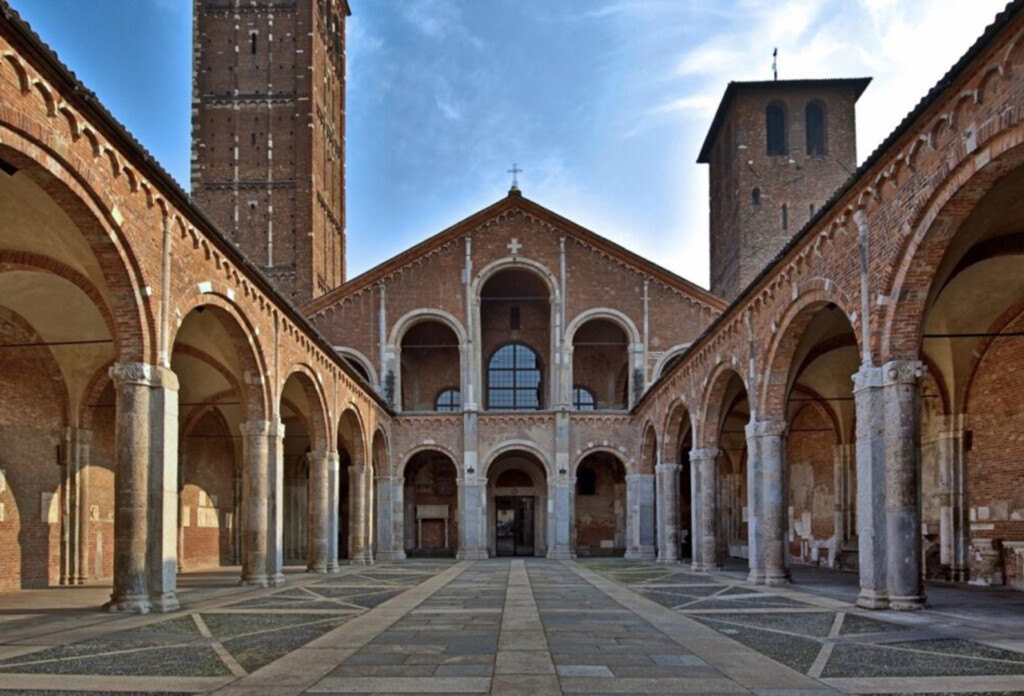
What the builders of Cluny, of Santiago de Compostela, of Sant’Ambrogio in Milan understood — and what we have systematically misread as limitation — was that weight itself is a theological argument. The barrel vault pressing down, the walls thickened to absorb the thrust, the windows small enough that light enters as event rather than condition: these are not engineering compromises. They are positions. The darkness inside a Romanesque nave is not the absence of Gothic luminosity. It is the presence of something else entirely — an insistence that the sacred is not transparent, not easily approached, not available on demand. The French historian Georges Duby, in his 1976 work The Age of the Cathedrals, noted that the Romanesque church was conceived as a fortress of the spirit precisely because the world outside it was experienced as genuinely threatening. The stone is not thick because the builders lacked confidence. The stone is thick because they had a very clear idea of what was on the other side of it.
The figures carved above the portal — the Christ in Majesty, the procession of saints, the grotesque creatures folded into the capitals — are not failed attempts at naturalism. They are successful attempts at something entirely different: the visualization of a cosmos in which the human body is not the measure of all things, but one element in a hierarchy that extends infinitely in both directions.
St. Mary of Vezzolano. The Restoration of the Jubé
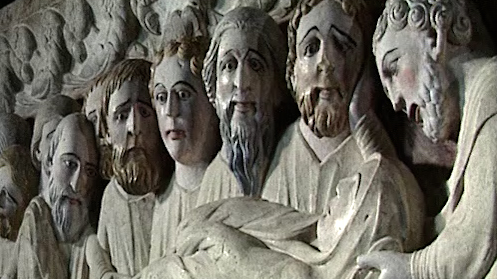
Documentary, by Fedele Aula, Italy, 1998.
In the heart of Monferrato, among silent hills and winding roads, stands the Canonica of Santa Maria di Vezzolano: a place where history, art, and spirituality have intertwined for nearly a thousand years. At the center of the narrative emerges the jubé, an extraordinary medieval rood screen that miraculously survived the dictates of the Counter-Reformation that had ordered its destruction. This rare structure, suspended between liturgical function and visual storytelling, becomes the guiding thread of the documentary: a “stone book” recounting the genealogy of Christ and the Dormitio Virginis, still preserving traces of its original colors.
Through the work of restorers, institutions, and volunteers, the film explores the delicate balance between conservation and enhancement, bringing new life to a work unique in the European landscape. The restoration of the jubé thus becomes not only a technical intervention, but a journey through memory, giving voice once more to a monument that has endured centuries, resisting time and human actions. Through testimonies, evocative imagery, and artistic details, the documentary invites viewers to rediscover Vezzolano as a “magical” place, where every stone tells a story and the past continues to dialogue with the present.
LANGUAGE: Italian
SUBTITLES: English, Spanish, French, German, Portuguese
Between Rome and Something Else Entirely
There is a particular kind of building that announces itself before you reach it. You are walking a road that has not changed its course in nine centuries, and the tower appears on the horizon with a weight that seems less architectural than geological, as if it grew from the ground the way a mountain does, without consultation. This is not confidence. This is something harder to name — a civilizational clenching, a people gripping stone because they had nothing else left to grip.
The Romanesque style emerges from the wreckage of the Carolingian project sometime around 1000 CE, which is to say it emerges from fear. The empire Charlemagne had stitched together by force and franchise had, by the late ninth century, come apart at every seam. Viking raids gutted the northern coasts. Magyar horsemen swept through the eastern plains. The administrative machinery that had kept learning, liturgy, and law in uneasy alignment had dissolved into a patchwork of competing local powers, each with its own armed men, its own grudges, its own precarious claim to legitimacy. What came after was not a world confidently building toward something. It was a world rebuilding from almost nothing, and the buildings it made carry that knowledge in every stone.
The geographers of this style tend to trace its earliest coherent expressions to Lombardy in the late tenth century, where master builders developed the vocabulary of the lombard band — shallow decorative arcading running beneath rooflines, pilaster strips dividing blank exterior walls — that would travel northward over the Alps and westward toward the Rhine with a speed that suggests not imitation but answer. When the monastery church of Saint Michael rose at Hildesheim under Bishop Bernward between 1010 and 1033, it was not adopting a foreign fashion. It was reaching for a structural logic that felt, however partially, like an answer to disorder. Ernst Gombrich observed in The Story of Art that the great Romanesque churches did not simply fill a liturgical need; they were statements about permanence addressed to communities that had recently experienced its opposite. This is a polite way of saying that people build massively when they are afraid.
The spread is not the map of an empire. It is the map of a network — pilgrimage roads, monastic affiliations, the slow movement of masons and abbots from one community to another. By 1050 the style is identifiable from Catalonia to Normandy. By 1100 it has reached the Iberian Peninsula in force, where Santiago de Compostela becomes both terminus and engine, drawing tens of thousands of pilgrims annually and generating, along the roads that feed into it, a chain of churches that share structural logic the way relay stations share a signal. The sociologist Robert A. Scott, writing in The Gothic Enterprise in 2003, notes that the pilgrimage economy was one of the most powerful forces shaping medieval built space, not as a matter of pure devotion but because movement generates demand and demand generates form. The Romanesque church on a pilgrimage route is partly a monument and partly an inn, partly a reliquary case and partly a crowd-management system.
What makes this anxiety visible in the stone is the very quality that later critics, trained on classical elegance or Gothic soaring, would call heaviness. The thick walls that cannot be read as anything but defensive. The small windows that admit light the way a besieged city admits supplies — sparingly, strategically. The rounded arch that does not aspire but presses down, redistributing weight onto mass. These are not failures of technical knowledge. By 1000 CE, European builders knew about wider openings, thinner membranes. They chose otherwise. The choice tells you something about what it felt like to be alive in that century, in those landscapes, under that particular quality of uncertainty.

The Pilgrim Road as Aesthetic Engine
You leave before dawn because the road is safer when it is cold and the bandits prefer to sleep. Your feet are already wrapped in cloth soaked in pig fat. You carry a document — a letter of safe conduct stamped by a bishop — because without it you can be arrested, robbed legally, pressed into labor by any lord whose land you cross. You are not on a spiritual journey in any sense a modern person would recognize. You are a debtor, or a penitent sentenced by an ecclesiastical court, or someone who made a vow during a fever and now must honor it or face consequences more immediate than divine punishment. You are walking to Santiago de Compostela because you had no other choice, and the road ahead of you is roughly eight hundred kilometers of mud, extortion, and infected blisters.
This is the engine that built one of the most coherent aesthetic systems in Western history.
The pilgrimage routes — and there were four principal French roads converging at the Pyrenees, documented in the Liber Sancti Jacobi compiled around 1140 — were not merely spiritual corridors. They were economic and logistical infrastructures that forced thousands of human bodies through the same sequence of towns, the same monastery guesthouses, the same market squares. Where bodies move in predictable patterns, money accumulates. Where money accumulates, stone gets cut. The abbeys that rose along the Via Turonensis and the Via Tolosana were not acts of piety floating free of material interest. They were investments, positioned to capture the traffic of penitents the way a toll bridge captures the traffic of merchants.
What emerged from this calculation was an architectural language of extraordinary consistency across distances that took weeks to traverse. The church at the beginning of the route and the church three provinces later shared proportions, shared sculptural grammars, shared solutions to the problem of how to move a crowd of frightened people through a sacred space without crushing them. The ambulatory — that corridor wrapping around the apse, allowing pilgrims to circulate past relics without interrupting the liturgy — appears in Santiago de Compostela and in Saint-Sernin in Toulouse and in Saint-Martin in Tours with a regularity that is not coincidence. It is a design solution that traveled on human feet.
The sociologist Émile Durkheim, writing in 1912 in The Elementary Forms of Religious Life, argued that collective ritual produces what he called collective effervescence — a genuine alteration of social reality through shared physical experience. He was writing about tribal ceremonies, but the mechanism he described applies with uncomfortable precision to the pilgrimage economy. The pilgrim arriving at a major shrine after weeks of walking was physiologically altered: sleep-deprived, malnourished, in genuine pain, emotionally raw. The tympanum above the portal — that carved stone field of judgment and glory positioned precisely at the threshold between outside and inside, between the world of mud and the world of light — was designed to hit a nervous system in exactly that condition. It was not decoration. It was a calculated instrument of overwhelming.
The figures who carved those tympana were themselves largely unfree men, or men operating under conditions of near-total economic dependency on ecclesiastical patrons. The pilgrim who knelt before the work and the craftsman who made it shared more than either would have been comfortable admitting. The aesthetic system that a later age would call Romanesque — that word invented only in the nineteenth century, applied retroactively to a period that had no such concept of itself — was assembled from the labor of people moving under compulsion through landscapes they did not own, toward destinations they had not chosen, building something magnificent that would outlast every name attached to it.
The road does not care who walks it. It only requires that someone does.
Fear Carved into Capital
You have stood in front of one of those carved stone portals — the kind that arch over a church entrance like a mouth preparing to speak — and felt something shift in your chest before you could name it. Not reverence, exactly. Something older and less comfortable. The figures pressing out of the stone are wrong in ways you cannot immediately catalogue: limbs too long, faces caught between human expression and something that precedes language, bodies twisted into postures that suggest both agony and a terrible intimacy with it. You stepped inside anyway. That is precisely what the image intended.
The tympanum was not decoration. The sculptural programs that began appearing across France, Spain, Italy, and the Iberian territories from roughly the late eleventh century onward — accelerating dramatically after Cluny and the network of monasteries it seeded across Europe — were calculated arrangements of terror and promise designed to work on a largely illiterate population the way a threshold works on the body: you cross it changed. The Last Judgment scenes that dominate so many of these portals, with Christ in majesty at the center and the damned contorted below and to the left, were not illustrations of theology. They were theology made visceral, made inescapable, made architectural. You could not enter the sacred space without first submitting to the image.
Michel Foucault, writing in Discipline and Punish in 1975, traced the history of power through its relationship to visibility. His central argument was not simply that power punishes, but that power performs — that it requires an audience, a witness, a subject who internalizes the spectacle until the spectacle becomes unnecessary, replaced by self-regulation. The Romanesque portal achieves exactly this internalization centuries before Bentham’s panopticon. The carved demon does not need to move. It does not need to speak. It needs only to be positioned where you cannot avoid it, at the precise moment when you are most permeable — crossing a threshold, leaving the ordinary world, about to ask something of the divine.
A man stands before one such capital, deep inside the nave where the light comes from narrow slits and falls at angles that seem less like illumination than like accusation. The capital shows a demon clutching a human soul, the soul rendered not in the abstracted way of later Gothic refinement but with a kind of horrible specificity — a face caught in the moment of recognition, eyes wide, mouth open in what might be a scream or might be the beginning of a word never finished. The man looks at it for a long time. Then something happens that he will not be able to explain later, even to himself: he recognizes the face. Not as his own face, literally. But as the face he makes when he knows he has done something he cannot take back. The stone carver, dead for nine centuries, somehow knew this face. Knew it well enough to cut it into limestone and leave it there, waiting.
This is not coincidence and it is not mysticism. The Romanesque sculptors — working within programs directed by abbots and bishops who were simultaneously spiritual authorities and political administrators — were producing images rooted in the most granular observation of human shame. They knew their congregation. They knew what guilt looked like from the outside because they lived inside the same system of surveillance, confession, and penance that produced it. Erwin Panofsky, in his foundational work on medieval iconography, argued that these images functioned within a shared symbolic language — but the language was not merely symbolic. It was coercive. It assumed a viewer already broken open by their own self-knowledge and applied pressure to exactly that fracture.
The column capitals in Romanesque cloisters carry this logic into the most intimate daily spaces — the places where monks walked in contemplation, where the sacred was meant to be most interior and most private. There, too, the carved figures press out of the stone: gluttons, fornicators, the proud cast down, the envious blinded by their own hunger. You cannot meditate your way past them.
Light Refused: The Architecture of Interiority
You step into the nave and the world outside ceases to exist. Not because the door has closed behind you, but because the stone itself has decided to absorb you. The walls are not surfaces — they are depths, sometimes more than a meter thick, and they do not separate inside from outside so much as they abolish the very concept of outside. The light that enters does so reluctantly, through apertures so narrow they seem designed less to admit illumination than to make you aware of how much has been refused. You do not see darkness here. You inhabit it.
This is not a failure of engineering. The builders of the eleventh and twelfth centuries understood weight, thrust, and compression with extraordinary precision. The barrel vault — that continuous semicircular ceiling pressing downward along the full length of the nave — was not chosen because nothing better existed. It was chosen because it produced a specific effect on the body moving beneath it. It bears down. It presses the skull slightly toward the earth. Erwin Panofsky, writing in 1951 in his Gothic Architecture and Scholasticism, noted that architectural form in the medieval period was never merely structural but always also symbolic — though even Panofsky did not press far enough into what the body actually felt before the mind had time to produce a symbol.
Maurice Merleau-Ponty came closer. In the Phenomenology of Perception, published in 1945, he argued that perception is never a passive reception of information but always already a bodily engagement — that we do not first see a space and then feel it, but that the feeling and the seeing are one continuous act performed by a creature made of flesh and nerves and spatial memory. The Romanesque interior does not address your intellect. It addresses the proprioceptive system that monitors where your limbs are, how much air surrounds you, whether you are prey or pilgrim. It recalibrates your sense of your own dimension by making you small — and the smallness is the point.
Think of moving through a corridor where the walls seem to breathe. The torchlight shifts and the stone moves with it, the shadows pooling in the carved recesses, the arch overhead repeating itself down the tunnel of the nave like a sentence that never quite ends. You do not walk faster to escape this. Something in the architecture has already slowed you. The weight in the walls transmits itself through the floor, through the soles of your feet, up into the hips and the chest. Merleau-Ponty would have recognized this as the lived body being rewritten by its environment — the body-schema, his term for the pre-conscious map each of us carries of our own physical extent, momentarily dissolved and replaced by the geometry of the building. You are not in the church. The church is briefly in you.
The narrow windows are the final argument. Romanesque builders were not ignorant of the possibility of larger openings — they had seen Roman basilicas, they understood the lintel and the clerestory. What they built instead were slits, splayed inward to distribute what little light entered across the widest possible surface of stone. The effect is not shadow but a kind of luminous ambiguity, a glow that seems to emerge from the wall rather than fall upon it. The sociologist David Le Breton, in his work on the anthropology of the senses, has described how cultures construct sensory environments that enforce particular modes of attention — environments that do not merely reflect a worldview but actively produce the subject capable of holding that view. The Romanesque interior produces a subject bent slightly inward, ears open, breath shortened, the ordinary noise of selfhood pressed briefly quiet by a ceiling that was never going to rise.
A vision curated by a filmmaker, not an algorithm
In this video I explain our vision
The Flat Figure and the Lie of Depth

There is a face you remember from childhood, painted on the wall of a church you were taken to before you could read. The eyes were enormous, fixed, and looking at nothing in the room while looking at everything in it. The body beneath them was wrong by every measure you would later learn — the torso too flat, the hands too large, the feet pointing downward like decorative elements rather than things that could ever touch the ground. You did not know then that you were supposed to find this primitive. You only knew it was watching you.
Western art history spent roughly four centuries constructing the case that Romanesque painting and mosaic were failures of skill rather than achievements of intent. The narrative required it. For the Renaissance project to appear as liberation, something had to play the role of captivity. Two-dimensionality became evidence of limitation. Hierarchical scaling — where Christ towers over apostles who tower over donors who tower over the merely local — became proof of a world that had not yet learned to see straight. The anti-naturalism, the gold grounds that refuse to pretend at sky, the drapery that falls according to symbolic logic rather than gravity: all of it filed under deficiency, under the long sleep before Giotto woke everything up.
Ernst Gombrich, in Art and Illusion published in 1960, offered something more honest. His argument about schema and correction — that all visual representation begins from inherited symbolic templates which artists then adjust toward perceived reality — quietly dismantled the hierarchy between flat and illusionistic art. The Romanesque painter was not trying to render depth and failing. The Romanesque painter was operating from a schema in which depth was epistemologically irrelevant, even misleading. What mattered was not where the body stood in space but what the body meant in the order of things. Gombrich’s insight, though he did not press it this far, implies that the choice against illusion was not ignorance. It was a position about truth.
Think about what illusionistic depth actually does. It persuades you that you are looking through the wall rather than at it. It recruits your perceptual system into a lie that feels like presence. The Romanesque surface refuses this entirely. It stays flat, announces itself as surface, as made thing, as sign rather than window. The gold background does not recede. It advances. It says: there is no space behind this because what we are showing you does not exist in space. It exists in meaning.
Someone you knew once described the most accurate portrait ever made of them as the one that made them look like a saint in a Byzantine mosaic. Not because it flattered them — it didn’t — but because it stripped away every attempt to soften, every calculated angle, every bit of pictorial diplomacy that normal portraiture uses to make the subject feel seen while actually making them feel managed. What remained was just the essential claim: this person exists, this person means something, here is the irreducible fact of their presence in the order of things. It was uncomfortable in the way that only honest things are uncomfortable. Most portraits try to make you like yourself. That one simply acknowledged you.
Meyer Schapiro, whose 1977 collected essays on Romanesque art remain among the most rigorous examinations of the period, argued that the expressive distortions of Romanesque figures were not failures of naturalism but a genuine visual language with its own internal coherence. The elongated limbs, the stylized folds, the eyes that register states rather than gazes — these are not approximations of something the artist could not quite achieve. They are precise instruments for saying something that accurate anatomy would obscure.
The question that the gold ground keeps pressing, if you stand in front of it long enough, is not whether it knew what it was doing. The question is whether you have been trained so thoroughly in the aesthetics of the convincing that you can no longer recognize the aesthetics of the true.
The Monastery as Total Institution and Its Discontents
There is a particular kind of person who has spent so long inside a single structure — a corporation, a marriage, a doctrine, a career — that they have ceased to experience it as a structure at all. The walls have become air. The rules have become nature. When someone asks them what they want, they answer with what the system wants, and they do not notice the substitution. This is not weakness. It is something more precise and more disturbing: it is the successful completion of institutional formation.
Erving Goffman, in his 1961 study Asylums, identified what he called the total institution — a place of residence and work where a large number of like-situated individuals, cut off from the wider society for an appreciable period of time, together lead an enclosed, formally administered round of life. The monastery was not his primary example, but it is perhaps his most illuminating one, because the Benedictine house was not merely an institution that happened to produce art. It was an institution whose every dimension — sleep schedules, dietary rules, the division of the day into canonical hours, the precise choreography of bodies through corridors and chapels — generated a specific kind of human interiority, and that interiority is the invisible material from which Romanesque art is made.
Think of what it means to wake before dawn every morning for decades, to move through the same stone passages, to chant the same texts in the same order, to never be alone and never truly be in company. The monk who illuminated a manuscript or carved a capital did not choose his subject matter, his compositional field, or his symbolic vocabulary. He was given all of this. What he chose — what the institution left him — was the intensity of his attention within those constraints. And so the art becomes obsessive in precisely the way that constrained attention becomes obsessive. The filled field, the refusal of empty space, the figures pressed against their borders as though the margin itself were a wall — this is not decorative preference. It is the signature of a mind that has learned to find infinitude within enclosure, because it has no other option.
The horror vacui that characterizes so much Romanesque surface decoration is often described as a stylistic trait, as though it were a choice made among other choices. It was not. It was the formal expression of a system that could not tolerate the unaccounted-for. Every inch of a tympanum, every column capital, every margin of a gospel book had to be filled because emptiness in that world was not aesthetic but theological — it was an absence of God, a lapse of vigilance, a gap in the armor of the sacred against the incursion of chaos. The monks who designed these programs were not making art in the modern sense of the word. They were performing a continuous act of enclosure against everything that lay outside.
What makes this so recognizable is that you have done something like it yourself. You have organized a life around a system — a profession, a faith, a relationship, a set of inherited assumptions about what success looks like — and at some point the system stopped being a means and became a horizon. You stopped asking whether the walls were necessary and began describing their texture as beauty. The monk illuminating his twelfth hour before the night office did not think of himself as enclosed. He thought of himself as located. The monastery was not a limitation. It was the world. And the art he made carried that conviction in every filled corner, every interlocking beast, every figure whose eyes do not look outward because there is no outward left to look toward — only the next page, the next capital, the next hour of a day that has been, in every detail, already decided.
What the Eleventh Century Knew That We Pretend to Have Forgotten
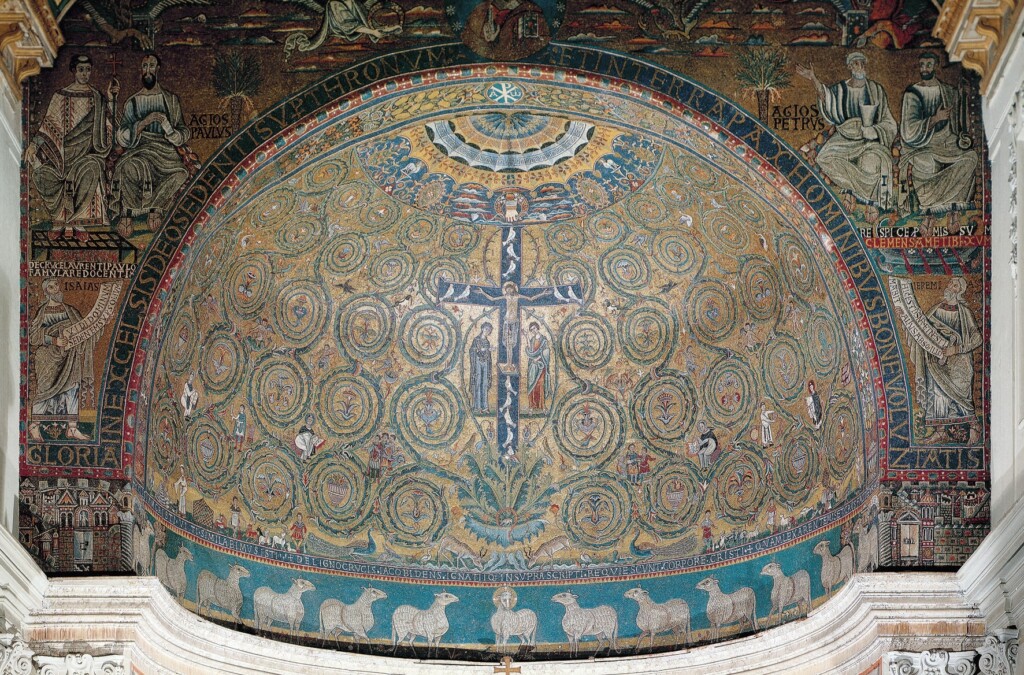
There is a tympanum you may have stood before without fully understanding why it unsettled you. The Christ at its center is enormous, geometric, radiating an authority that has nothing to do with warmth. Around him, the saved and the damned are sorted with the same calm efficiency a bureaucrat might use to file documents. The figures do not plead convincingly. They are too small, too stylized, too clearly destined. And you stood there, probably in the context of a guided tour or a holiday in France, and felt something you did not name — not awe exactly, not beauty exactly, but something closer to the recognition of your own insignificance rendered in stone with complete indifference to your feelings about it.
This is what the eleventh century knew. It knew that human beings are small. Not metaphorically, not as a philosophical position to be debated in a seminar, but as a structural fact encoded into every proportion, every hierarchy of scale, every compressed figure that bends its body to fit the architectural frame rather than demanding the frame accommodate it. The Romanesque artist did not celebrate the human form. He subordinated it. He used it as a unit of measurement against the infinite, and the infinite won, always, by design.
Ernst Gombrich observed that art history is inseparable from the history of what a given culture considers worth representing, which means it is equally a history of what that culture fears. The Romanesque did not fear death in the way we do, as an administrative inconvenience to be managed with euphemism and palliative sedation. It feared something worse: judgment. The possibility that existence itself would be weighed, found insufficient, and discarded. This is not a medieval superstition you can dismiss from the safety of secular modernity. It is a terror so fundamental that when it is removed from the cosmological register it simply migrates. It becomes the anxiety of not being enough — professionally, relationally, existentially. The weighing of souls never stopped. It changed accountants.
What the Romanesque built, then, was beauty out of this terror. Not beauty that transcended terror, not beauty that resolved it, but beauty that was made entirely of the same material. The monsters on the capitals were not decorative. They were ontological. They named something real about the experience of being conscious in a world that does not explain itself. Rudolf Otto, writing in 1917 in his analysis of the holy as the mysterium tremendum, described exactly the double register these images occupy: the sacred as simultaneously fascinating and annihilating, drawing you in and erasing you. The Romanesque sculptor did not need Otto’s vocabulary. He had already solved the formal problem Otto was still trying to name eight centuries later.
The discomfort you feel before these images is not, then, a matter of taste. It is not that Romanesque art is primitive, or crude, or that the artists lacked the technical refinement to do better. It is that they were doing something entirely different, something that naturalism and its descendants trained us to misread as failure. They were encoding a vision of the world in which the human being is not the measure of all things but merely one thing among many, caught between forces that predate it and will outlast it, given a brief and specific shape before dissolution.
Every civilization builds beauty out of something it cannot look at directly. Greece built it out of the terror of chaos and made order luminous. The Renaissance built it out of the terror of insignificance and made the individual enormous. We build it out of the terror of meaninglessness and call the result content, experience, aesthetic. The Romanesque simply had the unusual honesty to carve the terror itself into the stone, to make the monster the ornament, to let the weight of what cannot be controlled hold up the roof under which people knelt and tried, as people always have, to make peace with being alive.
🏛️ Art, Form, and History Across the Ages
Romanesque art did not emerge in a vacuum — it grew from centuries of aesthetic, spiritual, and philosophical traditions that shaped how human beings understood the world and expressed meaning through form. Exploring these related currents deepens our appreciation of the visual and intellectual heritage that surrounds medieval art.
Titian: Life and Works
Titian stands as one of the towering figures of Western painting, carrying forward the legacy of sacred and secular imagery that Romanesque art first began to systematize in stone and fresco. His mastery of color and composition reflects a continuous dialogue with the symbolic language rooted in the medieval tradition. Exploring his life and works illuminates how the visual grammar of earlier centuries evolved into the luminous complexity of the Renaissance.
GO TO THE SELECTION: Titian: Life and Works
Vanitas in Art: Symbolism and Meaning
The theme of Vanitas in art speaks directly to the spiritual preoccupations that animated Romanesque iconography, where mortality, salvation, and the transience of earthly life were central subjects carved into church portals and painted in manuscripts. Vanitas imagery inherited and transformed these medieval anxieties into a rich symbolic vocabulary that persisted for centuries. Understanding its history reveals the unbroken thread connecting Romanesque theology to later European artistic expression.
GO TO THE SELECTION: Vanitas in Art: Symbolism and Meaning
Memento Mori: History and Meaning
Memento Mori as an artistic and philosophical concept finds some of its deepest visual roots in the Romanesque period, when images of death and divine judgment adorned the walls of cathedrals as warnings and invitations to piety. The skull, the hourglass, and the skeletal figure all echo the eschatological urgency that Romanesque sculptors carved into tympanums across Europe. Tracing this history offers a profound lens through which to read the moral seriousness embedded in medieval art.
GO TO THE SELECTION: Memento Mori: History and Meaning
Alchemy in the Italian Renaissance
Alchemy in the Italian Renaissance was not born in isolation but drew heavily on the symbolic and cosmological frameworks that medieval culture, including Romanesque art, had encoded into sacred spaces and imagery. The Romanesque tradition translated theological mysteries into visual form, a practice that alchemical illustration would later adopt and elaborate with extraordinary complexity. Examining this connection reveals how the same spiritual hunger that built Romanesque basilicas also fueled the pursuit of hidden transformative knowledge.
GO TO THE SELECTION: Alchemy in the Italian Renaissance
Discover Art and Vision on Indiecinema
If these journeys through art history and symbolic culture have stirred your curiosity, Indiecinema streaming is the place to continue your exploration through film. Our curated catalog of independent and auteur cinema offers rare documentaries, visionary features, and thought-provoking works that speak directly to the themes you love. Join us and let cinema become your next portal into meaning.
👉 EXPLORE THE CATALOG: Watch Indie Films in Streaming
A vision curated by a filmmaker, not an algorithm
In this video I explain our vision

