
Stone That Watches Back
You step through the portal and something watches you. Not metaphorically. The sensation is immediate, almost somatic — a pressure behind the sternum, a slight involuntary straightening of the spine. Dozens of figures crowd the stone above you, ranked in concentric arches, their eyes carved open and fixed at angles that follow movement, that seem to track the particular slouch of your guilt. You have not yet looked up properly. You have not yet had time to identify a single figure or read a single theological program. And yet you are already arranging yourself, already performing something — contrition, reverence, smallness. The stone has already done its work before you crossed the threshold.

This is not an aesthetic experience. Or rather, it is not only that, and calling it aesthetic is precisely the way we have domesticated something that was designed to be far more violent. Medieval sculptural programs, particularly those concentrated at the great portals of twelfth and thirteenth century cathedrals, were among the most sophisticated instruments of ideological formation ever constructed in Western history. They were not decoration in any sense we comfortably use that word. They were a total system — visual, spatial, narrative, theological — engineered with extraordinary precision to produce a specific kind of human subject: one who understood themselves as perpetually observed, perpetually insufficient, and dependent on an institutional mediator between their soul and its judgment.
The historian Georges Duby, writing in the 1970s and collecting decades of research into what would become his essential works on medieval society, argued that the great building programs of the Romanesque and Gothic periods cannot be separated from the power structures that funded and directed them. The cathedral is not a house of prayer in the simple devotional sense. It is a statement of cosmological authority made permanent in stone, situated at the center of urban life precisely so that its grammar of figures and hierarchies could function as the daily visual environment of an entire population. You did not visit the cathedral and then leave to live your real life. The cathedral was the frame inside which real life occurred.
What Duby’s structural analysis leaves only partially explored is the phenomenological dimension — what it actually felt like to be a body moving through that space, illiterate in the textual sense but profoundly literate in the visual language those figures spoke. The French medievalist Jean-Claude Schmitt, in his work on gesture and image in the medieval West, developed this further: the carved figures were not illustrations of theological propositions. They were themselves theological acts, performing doctrinal positions through posture, attribute, and spatial relation. The gesture of a saint’s hand was not a representation of holiness. It was a demonstration of it, and a demand that the viewer’s own body respond in kind.
This is the dimension that art history has tended to neutralize. When we enter a museum and stand before a tympanum removed from its portal context, mounted on a white wall with a placard beside it, we have already lost the most important thing. We have converted an instrument of subjective formation into an object of aesthetic contemplation. We have, in the precise sense, defused it. What was designed to produce a kind of controlled terror — the terror of the Last Judgment rendered at a scale that overwhelmed individual perception, pressed into the very threshold you could not avoid crossing — becomes instead an occasion for noting the elegance of drapery folds or the sophistication of compositional arrangement.
The figures are still there, though. And the strange truth, the thing that a purely historical approach struggles to accommodate, is that the mechanisms those sculptures encoded have not entirely ceased to function. They were not aimed at a medieval body. They were aimed at the structure of human attention itself, at the part of perception that responds to being watched before it responds to anything else.
St. Mary of Vezzolano. The Restoration of the Jubé
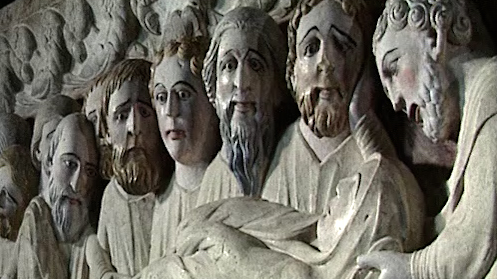
Documentary, by Fedele Aula, Italy, 1998.
In the heart of Monferrato, among silent hills and winding roads, stands the Canonica of Santa Maria di Vezzolano: a place where history, art, and spirituality have intertwined for nearly a thousand years. At the center of the narrative emerges the jubé, an extraordinary medieval rood screen that miraculously survived the dictates of the Counter-Reformation that had ordered its destruction. This rare structure, suspended between liturgical function and visual storytelling, becomes the guiding thread of the documentary: a “stone book” recounting the genealogy of Christ and the Dormitio Virginis, still preserving traces of its original colors.
Through the work of restorers, institutions, and volunteers, the film explores the delicate balance between conservation and enhancement, bringing new life to a work unique in the European landscape. The restoration of the jubé thus becomes not only a technical intervention, but a journey through memory, giving voice once more to a monument that has endured centuries, resisting time and human actions. Through testimonies, evocative imagery, and artistic details, the documentary invites viewers to rediscover Vezzolano as a “magical” place, where every stone tells a story and the past continues to dialogue with the present.
LANGUAGE: Italian
SUBTITLES: English, Spanish, French, German, Portuguese
The Grammar of Sacred Terror
You walk under the tympanum and something happens before thought does. The stone presses down on you — not metaphorically, not poetically, but with a weight that registers somewhere below the ribcage, in the part of the body that still knows how to be afraid. The figures writhing above the entrance are not decorations. They are instructions.
This is precisely the calculation that drives the great Romanesque programs of the eleventh and twelfth centuries. At Vézelay, the central portal erupts with a Christ whose elongated fingers seem to discharge power like current, rays of divine energy streaming toward the apostles, the nations, the monstrous peoples at the margins — dog-headed men, giants, the earless who listen through their mouths. At Moissac, the south portal Christ in Majesty sits surrounded by the tetramorphs and the twenty-four elders of the Apocalypse in a compression of visionary intensity so dense it feels less like stone and more like pressure. These are not illustrations of scripture. They are environments engineered to produce a specific physiological response in a specific kind of body: the illiterate body, the peasant body, the body that cannot read Latin and never will.
Gislebertus, working at Autun around 1130, understood this with a precision that would be called cynical if we applied contemporary vocabulary to his vocation. The Last Judgment he carved across the western tympanum is among the most controlled acts of visual rhetoric in Western history. On the left, the saved rise with an almost bureaucratic calm. On the right, the damned are seized, weighed, dragged, compressed into configurations of agony that the body recognizes before the eyes have finished looking. A pair of enormous hands clamps down on a human skull. Figures are swallowed headfirst into the mouths of beasts. The scale is not naturalistic but psychological — the demons are large because fear makes threats large, the saved are small because salvation, historically, has always been presented as the narrower door. At the bottom of the tympanum, Gislebertus left his name: Gislebertus hoc fecit. This artist made this. Not an act of humility. An act of authorship over an architecture of dread.
Michel Foucault argued in Discipline and Punish, published in 1975, that the modern prison was not primarily a place of punishment but a machine of visibility — a structure designed so that the watched body internalizes surveillance and begins to police itself. The panopticon’s genius was not that the guard was always watching but that the prisoner could never know when he was not. What Foucault traced through Bentham’s blueprints and the bureaucratic apparatus of the eighteenth and nineteenth centuries was, however, a logic that Gislebertus and his patrons had already deployed in stone six centuries earlier. The tympanum is a panopticon in reverse: instead of the observer hidden at the center, the judgment is displayed at the threshold, inescapable, public, and operative every time a body passes beneath it. You cannot enter the church without submitting to its gaze. You cannot leave without carrying its images inside you. The Church did not need guards because it had carved the guard into the architecture.
The bodies depicted are suffering in ways that map precisely onto the bodies of those who viewed them — hunger, compression, the helplessness of being seized by a force larger than yourself. This is not coincidence. The artists who executed these programs, working under the directive intelligence of abbots and bishops who understood power as few institutions before or since have understood it, were translating the actual vulnerabilities of twelfth-century peasant life into eschatological imagery. You already knew starvation. Now you knew what it prefigured. The stone did not invent the terror. It organized it, gave it a frame, and hung that frame above every door through which you had to pass.

Who Commissioned the Saints
You walk into a Romanesque church and your eyes go immediately upward, to the tympanum above the portal, to the Christ in Majesty surrounded by angels and apostles, to the saints arranged in the archivolts like a celestial court frozen mid-gesture. You feel something that resembles awe, and that feeling is not accidental. It was engineered. The man who paid for that stone was not thinking about your soul. He was thinking about his land, his lineage, his enemies at the next valley over.
Georges Duby spent decades excavating this truth, most systematically in his 1978 work The Three Orders: Feudal Society Imagined, where he demonstrated that the tripartite division of medieval society into those who pray, those who fight, and those who work was not a description of social reality but a justification of it. A theology of hierarchy, dressed as cosmology. What Duby understood, and what most visitors to Vézelay or Autun still do not, is that this ideology needed a physical address. It needed walls. It needed stone faces that people could look at and internalize as natural, eternal, God-given. The sculptural programs of great abbeys and cathedrals were the infrastructure of that internalization.
The abbot who commissioned a portal was commissioning an argument. When Abbot Suger rebuilt Saint-Denis in the 1130s and 1140s, he left behind his own writings explaining what he was doing — and even in his own account, the spiritual and the political are indistinguishable. Light theology and royal legitimacy move together through the same corridors. The kings of France appear in the portal statues as column figures, their bodies elongated into architectural elements, literally becoming part of the structure that holds the building up. This is not metaphor. This is the literal, material claim that the monarchy is load-bearing.
Think about what it meant for a feudal lord to fund the sculpting of a Last Judgment above a church entrance. Every serf, every tenant farmer, every debtor who passed through that portal did so beneath a stone image of divine reckoning in which the saved ascended toward figures who resembled, in their regalia and their posture, the very class that owned the surrounding fields. The damned in those tympana are almost always depicted with the attributes of disorder: nakedness, contortion, the physical markers of the low-born. The saved stand upright, clothed, arranged. Order and elevation look exactly like the feudal hierarchy. This is not coincidence and it is not unconscious.
The bishops understood the medium with particular sophistication. Episcopal patronage of sculptural programs at cathedral portals was a form of urban statecraft. A bishop was not merely a spiritual authority but a landlord, a judge, a military power in many cases, and his cathedral stood at the center of a city whose economic life he regulated. The saints he chose to feature, the miracles he chose to depict in the archivolts, the specific martyrologies carved into the capitals — all of this was selection, and selection is always political. To emphasize one saint over another was to align with one faction, one pilgrimage route, one set of regional interests over competing ones. Hagiography carved in stone is foreign policy.
There is a moment — it happens in a particular kind of low afternoon light, in a particular kind of nave — when a figure on a capital seems to look back at you with something almost like recognition. A bishop carved in the twelfth century, his hand raised in the gesture of blessing, his eyes open and direct in the way that Byzantine flatness sometimes achieves. You have the uncanny sense that he knows exactly what he is doing there. That he is not blessing the faithful. That he is watching the door, counting who enters and who does not, recording which bodies bow and which dare to walk upright into his house.
The Body as Heresy
There is a moment you probably know without knowing you know it. You catch your reflection somewhere unexpected — a dark shop window, the black mirror of a turned-off screen — and for a fraction of a second before recognition settles, what you see strikes you as wrong. Too much. The body looks excessive, embarrassing, almost grotesque. The feeling passes in an instant, but it was there, and it was not accidental. That flash of self-revulsion has a history far longer than your own life. It was carved into stone before your ancestors could read.
The medieval sculptural body is not a failed attempt at naturalism. This is the first lie to discard. The elongated limbs, the tormented postures, the faces twisted into expressions that hover between ecstasy and agony — none of this represents ignorance of classical proportion. Roman sculpture was everywhere in medieval Europe, its lessons available to anyone with eyes. The choice to depart from the human form as it actually stands and moves was theological, not technical. The body in Romanesque and Gothic stone is deliberately wrong because the flesh itself was understood as the site of wrongness, the location where the soul’s dignity had been compromised since Eden. To carve a body accurately would have been, in a precise sense, to honor it. And honoring it was the one thing the iconographic program could not afford.
Nietzsche, writing in 1887 in the second essay of On the Genealogy of Morals, identified what he called the internalization of the human animal — the historical moment when external violence turned inward, when the instincts that could no longer discharge outward began consuming the creature from within, producing what he named the bad conscience, the soul as the cruelty turned against the self. He was describing a psychological structure, but he might as well have been describing the tympanum at Vézelay or the tortured saints of any Gothic portal. The stone bodies are not representations of real people. They are representations of what real people were supposed to feel about themselves.
This is not metaphor. Between roughly 1050 and 1350, the period of Romanesque and early Gothic sculptural explosion across France, Germany, Spain and England, the Church produced a visual environment of unparalleled psychological density. The cathedrals at Chartres, Reims and Bourges alone contain thousands of carved figures, each participating in an iconographic vocabulary that placed the human body in an explicit hierarchy: above it, the immaterial and divine; below it, the demonic and animal; and the body itself caught in between, marked by its own weight, its own desires, its own tendency toward the earth. The elongation is not aesthetic preference. It is aspiration made literal — stone flesh straining upward away from what it is.
A man stands in a corridor that feels like a memory, looking at his own hands as though he has never seen them before, as though something in them repels him without his being able to say why. He is not mad. He has simply absorbed, through generations of images and liturgy and architecture, the information that the body is a liability, a debt, a problem to be managed. The medieval Church did not need to tell people this directly. The portal told them before they entered. The capitals told them while they prayed. The crucifixion told them that salvation itself required the maximum possible spectacle of bodily destruction.
What Nietzsche understood, and what takes longer to feel in the bones than to understand in the mind, is that this structure does not dissolve when the theology that generated it loses its grip. The shame outlives the doctrine. You catch yourself in a dark window and something tightens in the chest, something learned before language, encoded in stone eight centuries before you were born, still doing its work.
Gothic Verticality and the Politics of the Gaze
There is a particular kind of walking that happens in cities built around cathedrals, a posture so internalized it survives centuries after the buildings that produced it. You have felt it yourself, perhaps without naming it: the slight backward tilt of the head, the eyes drawn upward not by choice but by a pull that precedes intention. The body adjusts. The neck extends. Whatever was happening at street level — the argument between two merchants, the child falling, the beggar’s extended hand — recedes below the threshold of attention. The stones above demand priority.
This is not metaphor. It is the residue of a deliberate architectural and sculptural program that began reshaping the relationship between the human eye and the vertical axis somewhere in the middle of the twelfth century, accelerating through the workshops of Chartres, Reims, and the façades of Paris with a systematic intensity that no individual master could have orchestrated alone. What was being constructed was not merely a building or a decorative program but a hierarchy of vision, a cognitive architecture that determined where the gaze was permitted to rest and where it was made to travel.
Erwin Panofsky, in his 1951 Gothic Architecture and Scholasticism, proposed something that many of his contemporaries found uncomfortably reductive but which the material evidence consistently supports: that the formal logic of Gothic construction was not the product of aesthetic evolution but of the same scholastic mental habit that produced the Summa Theologiae. The principle was manifestatio, the duty of making visible the hierarchical structure of things. Clarity, distinction, and the subordination of the part to the whole — these were not design principles borrowed from philosophy. They were the same principles, operating simultaneously across two apparently different domains because they emerged from the same educational formation, the same cathedral schools where architects, theologians, and sculptors circulated together. Panofsky was precise about the geography and the chronology: within a hundred mile radius of Paris, between roughly 1130 and 1270, the convergence was demonstrably tight enough to constitute a genuine causal relationship.
What this means for the sculpture is everything. The columnar figures of Chartres’s Royal Portal, carved around 1145, do not stand. They ascend. Their bodies are elongated beyond anatomical plausibility, limbs pressed close, drapery falling in vertical striations that continue the upward movement of the columns they inhabit. These figures are not representing people. They are demonstrating a direction. The eye that reads them starts at the base, is refused any horizontal pause, and is carried upward through the tympanum toward the figure of Christ in majesty. The journey is mandatory. The destination is predetermined.
By the time the Reims workshop produced its famous Visitation figures in the first half of the thirteenth century, something had technically loosened — the bodies became more classical, the weight shifts more naturalistic, the gazes more interior — but the vertical architecture of meaning remained structurally intact. The softening was cosmetic. The hierarchy was unaltered. What changed was the delivery mechanism, not the message.
Think of a woman moving through a dense street, her eyes perpetually angled upward and to the side, never quite descending to meet anyone at the level where transactions between equals occur. She is not distracted. She has simply been trained. The training happened before she could name it, before she had any occasion to refuse it. The gaze directed upward is a gaze removed from the horizontal — from the face of the person beside you, from the ground where the poor are sitting, from the plane where political life actually occurs. The cathedral did not simply invite people to look at God. It habituated them to not looking at each other. That distinction is not incidental to the power of medieval institutions.
A vision curated by a filmmaker, not an algorithm
In this video I explain our vision
Iconography as Controlled Hallucination
You are standing in front of a cathedral portal and you cannot move. Not because of beauty, though beauty is there. Because something is looking back at you. The carved creatures along the archivolt — part lion, part eagle, part something that has no name in any living language — are arranged with a precision that feels almost aggressive. Nothing here is decorative. Everything means something, and the terror is that you do not know what.
This is precisely the point. The medieval iconographic system was not a vocabulary anyone could simply pick up. It was a closed semiotic universe, architecturally designed to require a translator. The Bestiary creatures carved into corbels and misericords — the pelican tearing open its own breast to feed its young with blood, the basilisk whose gaze kills, the unicorn that only a virgin could tame — were not illustrations of nature. They were a second nature, a counter-reality built from symbolic correspondences that had been accumulating since the patristic era. Umberto Eco, in his 1959 study of medieval aesthetics, traced how beauty itself in this period was never autonomous but always allegorical, always pointing through the visible toward an invisible order that organized and validated everything seen. The beautiful stone was beautiful because it participated in a hierarchy of Being that descended from the divine. Unreadable without that framework, the object was merely strange.
Roland Barthes identified myth as a system that naturalizes what is historical, that makes the contingent appear inevitable and eternal. Medieval iconography operated precisely this way, but at a scale and with an institutional machinery that the modern advertising image can only approximate. The Wheel of Fortune, carved repeatedly across the great programs of Romanesque and Gothic sculpture, showed figures rising and falling along a turning circle, a king ascending, a king falling headlong, a figure broken at the bottom. The wheel was everywhere. And the lesson it communicated — that worldly power is vanity, that only spiritual orientation toward the vertical axis could save you from the horizontal spin — required no verbal explanation if you had been properly catechized. If you had not, you saw a circle with people on it, and the entire moral architecture simply did not exist for you. You were outside the code.
The psychomachia scenes, drawn ultimately from Prudentius’s late fourth-century allegorical poem of the same name, visualized the war between virtues and vices as literal combat between armored female figures. Pride thrown from her horse, Humility standing over her with a raised blade. These were not metaphors that required decoding in the modern sense, where metaphor is understood as literary ornament. They were ontological claims. The battle was real. It was happening inside you, at this moment, whether you could read the image or not. But only those who could read it correctly — who knew which figure was which, who understood the stakes of the combat, who could locate themselves within the narrative — belonged to what the community organized itself around. Literacy here was not a cognitive skill. It was a condition of membership in the community of the saved.
This is what Barthes understood about myth and what the medieval Church understood about images long before semiotics gave it a name. Control the code and you control the real. You do not need to forbid experience. You simply make experience illegible without your mediation. The illiterate peasant standing before the Last Judgment tympanum at Autun, carved between roughly 1120 and 1135, did not need to read Latin to feel the terror of the damned being weighed and dragged. But to understand why some were saved and others weren’t, to place oneself correctly in that cosmological drama, to know which behaviors guaranteed which outcome — for that, you needed the priest. The image made the stakes visceral. The Church held the interpretive key.
The Margins Where Reality Lived
Flip the hinged wooden seat of a choir stall upward and you find, carved into the bracket meant to support a standing monk during the endless hours of the Divine Office, a fox dressed in episcopal robes delivering a sermon to a congregation of geese. The geese look attentive. The fox looks satisfied. Nobody who carved this, nobody who sat above it for decades of canonical hours, believed for a single moment that it was accidental or transgressive. It was simply true, rendered in oak, hidden in plain sight beneath the very seat of sacred routine.
These misericords — the name itself comes from the Latin for mercy, a small mercy granted to aging bodies — run through the choir stalls of virtually every major Gothic cathedral and collegiate church in northern Europe. At Exeter, at Beverley, at the Cathédrale Saint-Étienne in Auxerre, the undersides of liturgical furniture sprout creatures that have no business existing near an altar: a mermaid combing her hair with grotesque vanity, a man bent double being beaten by his wife, a pair of wrestlers locked in combat that suggests neither prayer nor allegorical meaning. The stonework along the upper margins of nave walls offers the same confession in a different medium. Gargoyles were functional — waterspouts, technically — but the decision to make them writhe and gape and mock was not functional. It was something else entirely.
Mikhail Bakhtin, working through the long shadow of Stalinist censorship in the 1930s and finally publishing his analysis of Rabelais in 1965, identified in the grotesque body a specific cultural logic he called the carnivalesque: the temporary inversion of hierarchies, the licensed feast of what is normally forbidden, the body in all its lower functions raised momentarily above the spiritual, the learned, the official. His argument, though built from Renaissance literature, describes something the medieval stone carvers understood centuries before anyone named it. The carnivalesque was not a crack in the system. It was load-bearing.
There is a moment backstage before a performance when the actors, still in costume, speak to each other in a register that has no equivalent on the stage. The language is cruder, faster, more honest. Someone makes a joke about the audience that would destroy the illusion if spoken aloud beyond the curtain. The hierarchy collapses for twenty minutes. And then the curtain rises, and the hierarchy is restored with greater force precisely because it was briefly suspended. What happened backstage did not weaken the performance. It made the performance possible.
The defecating monk carved into the margin of a psalter, the hybrid creature with a human face and the body of something that should not exist, the woman riding her husband like a horse while he crawls on all fours — these are not rebellions the Church failed to suppress. They are rebellions the Church required. A system that demands total submission to vertical authority across every waking hour of every day generates pressures that must discharge somewhere. The margins were the designated discharge point, architecturally planned, theologically understood, institutionally maintained. The Church did not tolerate the carnivalesque. The Church manufactured it.
What Bakhtin missed, or perhaps what his own historical moment prevented him from seeing clearly, is that the safety valve does not merely release pressure. It also teaches the body where pressure is permitted to exist. Every monk who laughed at the fox-bishop on his misericord learned in the same moment that his laughter had a proper place, a proper scale, a proper duration. The joke ended when the Office began. The margin was always already framed by the text it surrounded. The grotesque gargoyle spat water away from the cathedral walls and kept the stone dry. It performed its absurdity in perfect service to the structure it appeared to mock.
The confession, in other words, was always controlled. The margins knew their place.
What the Stone Has Never Stopped Saying
You walk past it every day without stopping. A figure on a plinth, three meters tall, looking out over the square with an expression you have never been able to read clearly — not quite compassion, not quite judgment, somewhere in the unnerving territory between the two. Pigeons land on the outstretched hand. Children eat sandwiches at its base. And yet something in the geometry of the space insists that you are smaller than you should be, that your passage through this plaza is somehow being witnessed and measured by something that does not blink.
This is not a new feeling. It is, in fact, one of the oldest manufactured feelings in the Western world, and the stone figures of medieval cathedrals were among its most sophisticated instruments. The tympanum Christ in majesty, the column saints with their flattened bodies pressed into architectural service, the writhing damned arranged below the elect in careful gradations of torment — none of this was decoration. It was a technology of presence, designed to make the body standing before it register its own diminishment as something natural, even deserved.
David Freedberg, in The Power of Images published in 1989, argued with uncomfortable directness that the history of image theory has consistently underestimated how images actually work on people. Not symbolically, not intellectually — physically. The arousal, the fear, the impulse to kneel or to strike or to weep. Freedberg traced these responses across centuries and cultures and found them remarkably stable, which means that all the sophisticated apparatus of art historical analysis, all the iconographic programs and theological frameworks and patronage structures, sit on top of something far more primitive and far more persistent: the animal conviction that the image is alive, that it sees, that it has some claim on the body standing before it.
The Baroque did not abandon this mechanism. It amplified it. The martyrdom scenes that fill seventeenth-century Roman churches take the medieval grammar of the suffering body and push it into a register of almost unbearable physical specificity — the arrows entering flesh at precise angles, the neck stretched back in an ecstasy indistinguishable from agony, the stone itself appearing to sweat with exertion. A man carries the limp weight of a woman’s body down a spiral staircase as if she has just died in his arms, his face set in grief so particular it seems remembered rather than imagined. You are not looking at doctrine. You are watching someone die, and the architecture frames your watching as devotion.
Colonial monument programs understood this perfectly. The bronze and stone figures erected across Latin America, across Africa, across Southeast Asia in the nineteenth century did not merely commemorate. They installed a gaze. They placed specific bodies in positions of verticality and command over spaces where other bodies were meant to move horizontally, in labor, in transit, in submission. The iconographic logic is identical to the Last Judgment portal: above and below, the saved and the damned, the ones who watch and the ones who are watched. The theology has been replaced by a civic vocabulary, but the spatial grammar is the same grammar that medieval sculptors inherited from Roman triumphal arches and passed forward through every subsequent regime that needed stone to do the work of persuasion.
What Freedberg’s argument forces us to confront is that we have not developed a genuinely different relationship to carved images of power. We have developed more sophisticated ways of talking about them, more refined vocabularies of critique and contextualization, more elaborate institutional frameworks for deciding which figures deserve removal and which deserve protection. But the body standing in the plaza still responds before the mind does. The space still makes you small before you have decided to let it.
And so the question that remains — the one that no amount of iconographic literacy quite dissolves — is what it means that we are still building in stone, still carving faces that look down from above, still designing the floors of public space to remind the human body how far it has to fall.
🏛️ Stone, Faith, and Form: The Art of the Middle Ages
Medieval sculpture does not exist in isolation — it emerges from a rich web of architectural traditions, theological ideas, and visual languages that shaped the entire medieval world. Exploring the broader context of Romanesque art and architecture helps illuminate why stone figures were carved the way they were, and what they meant to those who encountered them.
Romanesque Architecture: History and Main Examples
Romanesque architecture provided the physical framework within which medieval sculpture found its most powerful expression — portals, capitals, and tympana became stages for carved narratives of salvation and judgment. Understanding the structural logic of Romanesque churches, from their thick walls to their rounded arches, is essential to grasping why sculpture was placed where it was and how it communicated with its audience. This article traces the history and major examples of a building tradition that was inseparable from its sculptural decoration.
GO TO THE SELECTION: Romanesque Architecture: History and Main Examples
Romanesque Art: History and Characteristics
Romanesque art as a whole established the visual conventions and symbolic vocabulary that medieval sculptors inherited and transformed across centuries. From the elongated figures of manuscript illumination to the hieratic poses of carved saints, Romanesque aesthetics reflected a theological worldview in which beauty served devotion. This article explores the history and defining characteristics of one of the most spiritually intense artistic movements in Western history.
GO TO THE SELECTION: Romanesque Art: History and Characteristics
Vanitas in Art: Symbolism and Meaning
The vanitas tradition — with its skulls, hourglasses, and wilting flowers — has deep roots in the medieval Christian imagination, where the memento mori was carved directly into stone as a warning to the living. Medieval sculpture frequently depicted death, judgment, and the transience of earthly life, making vanitas symbolism a natural companion to any study of sacred iconography. This article examines how the theme of vanity and mortality has been rendered across centuries of Western art.
GO TO THE SELECTION: Vanitas in Art: Symbolism and Meaning
Memento Mori: History and Meaning
The memento mori — the reminder that all must die — was one of the most persistent iconographic programs of medieval sacred art, carved into church walls, tombs, and cathedral façades as a constant spiritual admonition. From grinning skulls on funerary monuments to the Dance of Death reliefs, medieval sculptors encoded mortality into stone with extraordinary sophistication. This article traces the history and meaning of one of the most enduring symbolic traditions in Western visual culture.
GO TO THE SELECTION: Memento Mori: History and Meaning
Discover Independent Cinema on Indiecinema
If images carved in stone can carry centuries of meaning, imagine what moving images can do. On Indiecinema streaming you will find a carefully curated selection of independent films that explore art, history, spirituality, and the human condition with the same depth and intention. Step beyond the mainstream and discover cinema that truly endures.
👉 EXPLORE THE CATALOG: Watch Indie Films in Streaming
A vision curated by a filmmaker, not an algorithm
In this video I explain our vision

