
The Crack in the Fresco
Your fingertip finds the edge before your eyes do. There is a hairline fracture running diagonally across the plaster, almost invisible in the flat light of the scaffold lamp, and when you press gently — not enough to damage, just enough to feel — the surface gives a fraction of a millimeter that it should not give. Beneath the pigment, beneath the arriccio layer that some anonymous craftsman smoothed into place six centuries ago, something has shifted. Something has let go.

This is the moment that no training fully prepares you for. Not the beauty of the thing, which you expected. Not the age, which you can calculate. It is the fragility that arrives as a physical shock, the sensation that what stands between you and total loss is approximately the thickness of an eggshell, and that the eggshell has already begun to fail. Restorers describe this feeling with a vocabulary borrowed from medicine and sometimes from grief. They speak of stabilization, of consolidation, of arresting deterioration. What they mean, underneath all that clinical language, is: we are trying to keep something alive that technically died centuries ago, and we are not entirely sure we have the right to decide what it looked like when it was living.
The plaster is cold against your finger. The pigment above the crack shows the hem of a robe, crimson once, now a brownish ochre where oxidation has completed its slow work. Below the crack: nothing. A gap the width of a coin, filled with the grey dust of former surface. And the question that surfaces before any technical question, before any consideration of lime mortars or consolidants or reversibility protocols, is deceptively simple and completely unanswerable: what exactly are you saving?
Walter Benjamin wrote in 1936 that the work of art in the age of mechanical reproduction loses its aura, that singular, unrepeatable presence he called the here and now of the original. What Benjamin could not have anticipated — or perhaps quietly understood — is that the original itself is never singular. Every restoration is a conversation between at least three temporal points: the moment of creation, the moment of damage, and the present moment of intervention. These three moments do not agree. They have different values, different politics, different aesthetics. They are, in the deepest sense, different civilizations pressing their hands against the same surface.
The history of cultural heritage restoration is, at its core, the history of that disagreement made material. When Eugène Viollet-le-Duc rebuilt the medieval fortifications of Carcassonne in the mid-nineteenth century — between 1853 and his death in 1879, he transformed an accumulated ruin into something that had never existed in quite that form — he was not lying, exactly. He was expressing a theory of the past so confident it became architectural. He believed a restored monument should be returned not to a specific historical moment but to a complete state that may never have existed at any given moment. The phrase is his own, from his Dictionnaire raisonné de l’architecture française, and it is either one of the most honest confessions in the history of restoration or one of the most frightening, depending on where you press your finger.
The crack in the fresco does not ask for your opinion. It simply continues, slowly, in the dark, when you are not there. Calcium carbonate migrates, humidity cycles through the wall’s interior, the building settles imperceptibly under its own weight and the weight of everything that has happened to it. The deterioration is not dramatic. It is patient in a way that makes human urgency feel slightly absurd.
And yet you are here, on the scaffold, in the cold light, with your instruments and your training and your theories about what this surface meant and what it should mean. You are here, pressing gently, feeling the surface yield, deciding.
What We Mean When We Say ‘Original’
You walk through the front door of a house you have not entered in twenty years, and something in your chest collapses quietly. The walls are the wrong color. The staircase has been widened. The smell — that particular mixture of old wood and something you could never name — is gone, replaced by fresh paint and the faint chemical sweetness of new flooring. Nothing is broken. Everything is ruined.
This is the experience that restoration claims to prevent, and yet it is also, paradoxically, the experience that restoration most reliably produces. The moment we begin recovering something, we begin losing it in a different way. The original does not wait for us, preserved in amber, patient and intact. It has been moving the entire time we were away.
Walter Benjamin understood this with an almost painful precision. In 1935, writing in the shadow of a Europe already lurching toward catastrophe, he argued that what a work of art possesses — what he called its aura — is inseparable from its presence in time and space, from the singular accumulation of its existence. The aura is not a quality you can photograph or measure. It is the trace of everything the object has survived, the weight of its specific history pressing against you when you stand before it. When you reproduce something, even faithfully, you do not copy the aura. You sever it. And restoration, which is reproduction by other means, performs the same severance with greater ceremony.
The question that follows is uncomfortable: when a conservator in Florence spends three years repainting the lacunae of a fifteenth-century altarpiece, matching pigments and brushstrokes with extraordinary discipline, what exactly has been returned to the world? Not the original hand. Not the original light in which the painter worked, or the theological conviction animating that hand, or the specific quality of linseed oil pressed in a particular Umbrian mill in 1472. What has been returned is a sophisticated argument about what the original probably looked like — an interpretation dressed in the grammar of the original, wearing its clothes without sharing its body.
Umberto Eco spent much of his intellectual life mapping this territory. His theory of interpretation, developed across works from Opera Aperta in 1962 to The Limits of Interpretation in 1990, insists that no text — and by extension no object, no building, no cultural artifact — carries a single, stable, recoverable meaning. Every encounter with a work is a negotiation between what was made and who is doing the looking, in what century, with what assumptions coiled invisibly in the muscles of their perception. The original intention of the maker is not a locked room we can finally open with the right key. It is a horizon we approach and approach and never reach.
This does not make restoration meaningless. It makes the mythology surrounding it dangerous. The danger is the confident use of the word original as though it names something retrievable, something waiting intact on the other side of damage and time. That man standing in his renovated childhood home is not being irrational when he feels loss in the presence of improvement. He is perceiving something true: that the original was never a fixed object but a living relationship between the thing and its moment, between the space and the body that knew it. Restore the walls to their 1987 color and you still cannot restore 1987.
Every civilization that has ever undertaken large-scale restoration has had to construct, first, a story about what the original was. Rome excavating its own ruins in the Renaissance. France rebuilding after the Revolution. The twentieth century’s vast project of postwar reconstruction across a flattened Europe. Each of these moments required an act of imagination masquerading as an act of recovery. The past was not found. It was written, again, by hands that believed they were only copying.

The History We Chose to Restore
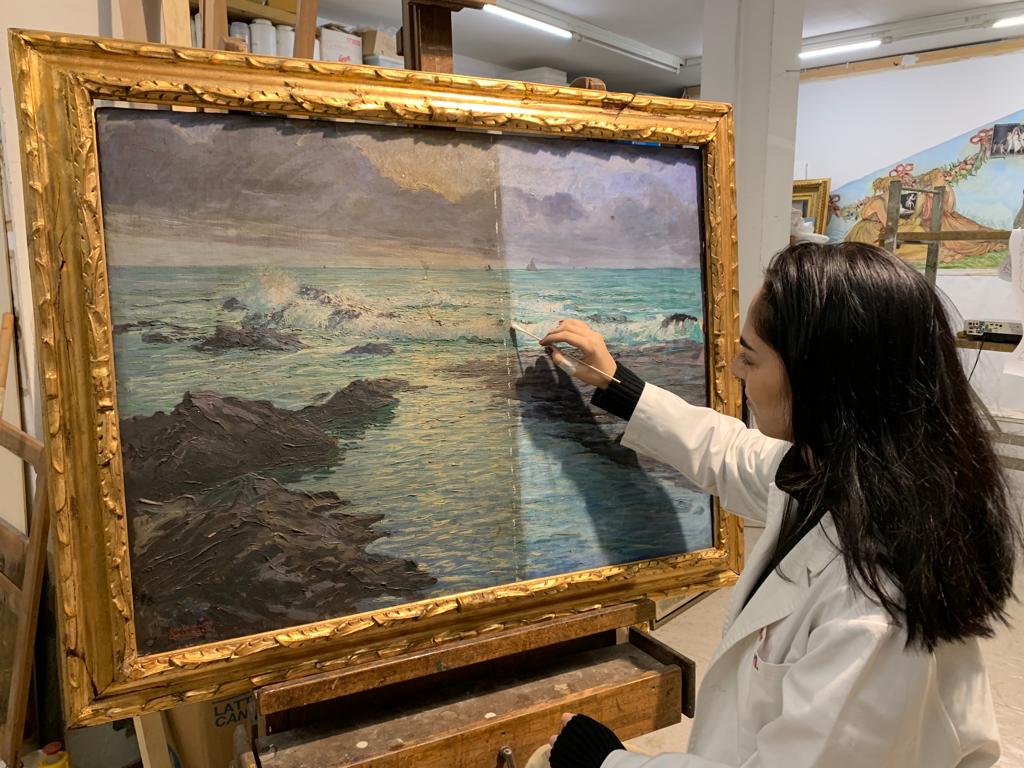
You walk through a city center rebuilt after the bombs stopped falling, and everything is clean. The cobblestones fit together with suspicious precision. The facades carry their ornamental detail without a single crack. The church at the end of the square has the correct number of windows in the correct positions, and the bell tower rises to the height documented in a photograph taken sometime before 1939. You feel, walking there, the strange uncanny sensation of touching something that has been touched too much — a surface so restored it has become a kind of lie told in stone.
This is not accident. It is policy.
Every decision to restore a building, a monument, a district, a landscape carries inside it a prior decision about which version of that place deserves to exist. James Marston Fitch, whose 1982 work Historic Preservation remains one of the foundational texts in the field, understood this with uncomfortable clarity. Restoration, he argued, is never neutral recovery. It is selection. You choose a date, a style, a political moment you wish to make permanent, and you bury everything that came before and after it under a coat of fresh mortar. The past you reconstruct is always the past someone preferred. The past no one preferred disappears quietly, without announcement, without obituary.
The UNESCO World Heritage framework, established in 1972 through the Convention Concerning the Protection of the World Cultural and Natural Heritage, now encompasses more than 1,100 sites across the globe. The language of that convention is seductive in its universalism: it speaks of outstanding universal value, of humanity’s shared inheritance, of an obligation to future generations. But universalism, as a rhetorical gesture, has always been the most efficient camouflage for particular interests. When a site receives World Heritage designation, the question of whose heritage, managed according to whose values, interpreted through whose historical consciousness, tends to dissolve into the prestige of the designation itself. The listing does not ask uncomfortable questions. It consecrates answers that were already decided.
A city reconstructed with postwar urgency and nationalist longing does not simply rebuild what was destroyed. It performs an argument about continuity, about the unbroken thread of a people’s identity, about which century and which aesthetic represented the truest version of who they always were. The layers underneath — the Ottoman courtyard absorbed into a Baroque palace, the medieval Jewish quarter whose street grid survived under a Fascist administration, the industrial scar that told the story of how ordinary people actually lived — those layers become obstacles rather than evidence. Restoration removes them not with hostility but with enthusiasm. With civic pride. With international funding and expert committees and the warm approval of institutions devoted to preservation.
The philosopher Paul Connerton, in his 2009 analysis of forgetting as a social practice, identified what he called prescriptive forgetting — the kind that is not imposed through censorship or destruction but achieved through the official production of a clean, legible, approved past. The restored city is perhaps the most complete physical expression of prescriptive forgetting that modern civilization has constructed. You do not burn the inconvenient archive. You simply build over it so handsomely that no one thinks to ask what is underneath.
What gets restored is what was already considered worth keeping by those with the authority to decide. That authority has rarely been distributed evenly. The architectural historian Françoise Choay noted in The Allegory of Heritage, published in 1982, that the very concept of the historic monument emerged in Europe as a tool for constructing national identity — which means it emerged as a tool for constructing national exclusions just as efficiently. The monument dignifies. It also, by existing, determines what does not deserve to be dignified.
You run your hand along the perfectly reconstructed facade and feel something you cannot immediately name.
Hands That Decide What Survives
You are sitting in a room with fluorescent lighting and a projector that keeps losing focus. Someone has printed the agenda on paper so thin it nearly tears when you pick it up. There is coffee, bad coffee, and a man at the head of the table who has never once touched the stone he is about to make a decision about. He clicks through slides — elevation drawings, cost estimates, a photograph of the medieval tower in question taken on an overcast Tuesday — and then the vote happens. Hands go up. The tower will be partially reconstructed, the eroded upper section rebuilt in matching limestone, the gaps filled. Seven hands. Three abstentions. The meeting is over in forty minutes and someone suggests lunch.
What just happened in that room is not bureaucratic routine. It is an act of sovereign violence over time itself. The men who raised their hands did not merely approve a construction project. They decided what the past will look like to every human being who walks past that tower for the next three hundred years. They authored a reality that will be mistaken for history. And they did it before the coffee got cold.
Alois Riegl, writing in Vienna in 1903 in Der moderne Denkmalkultus, made a distinction that should have made those meetings permanently uncomfortable but instead was largely absorbed into professional discourse and quietly defused. He separated what he called age value from historical value. Age value is the thing you feel when you look at a weathered surface and understand, without being told, that time has passed — the cracks, the biological staining, the asymmetries that accumulate without anyone’s permission. Historical value is something else: the document, the record, the object as evidence of a specific moment, a specific intention. Riegl understood that these two values are not only different but structurally in tension. The moment you restore a monument to recover its historical value, you begin destroying its age value. You make it readable and simultaneously make it false.
The Venice Charter of 1964, drafted by an international congress of architects and specialists and eventually adopted by ICOMOS, tried to institutionalize a solution to this tension. Its ninth article stated that restoration must stop where conjecture begins. It insisted on the distinction between the original material and any addition, demanded that new interventions be recognizable without being conspicuous, and explicitly prohibited reconstruction based on analogy. It was a serious document, written by people who had watched Europe spend the postwar decades rebuilding bombed cities from memory and imagination and calling the result heritage. The Charter was a technical instrument but also a philosophical argument: that authenticity resides in material, not in appearance.
And yet the committees kept voting. Because the Charter, however rigorous, could not resolve the deeper problem that Riegl had already named: that these two values appeal to entirely different human faculties and different social needs. A population does not grieve the loss of age value the way it grieves the loss of recognizable form. People want to see the tower as it was. They want the skyline legible, the identity intact, the wound closed. Politicians understand this with perfect instinctive clarity. So do developers. The specialist in the room knows the Charter by heart and still raises her hand because the funding is tied to the reconstruction and the funding is the only reason the tower still stands at all.
There is a scene — call it a memory, call it something witnessed — where a woman walks slowly around a partially restored Roman wall, running her fingertips along the point where ancient brick ends and new brick begins. The join is almost invisible. She pauses there for a long time, not admiring the craftsmanship but disturbed by something she cannot name. She is feeling Riegl’s problem in her hand. She just doesn’t have the vocabulary yet, and the committee never gave her one.
Techniques as Ideology
There is a moment in the work of a stone conservator — hands dusted white, kneeling before a medieval wall painting — when she stops. She has the pigment mixed, the brush ready, and she chooses instead to leave a line. A thin, deliberate seam where the original plaster ends and the new consolidation begins. Not because she lacks the skill to hide it. Precisely because she has it.
That choice is not technical. It is a declaration of belief about what the past is allowed to be.
For most of the nineteenth century, that belief ran in the opposite direction entirely. Eugène Viollet-le-Duc, the French architect who rebuilt Carcassonne, restored Notre-Dame de Paris, and left his hand on dozens of medieval monuments across France, operated from a conviction that restoration meant completion. Not repair. Not conservation. Completion of something that, in his view, had only been interrupted by the incompetence of time. His famous formulation from the Dictionnaire raisonné de l’architecture française, published between 1854 and 1868, states it without apology: to restore a building is to re-establish it in a complete state that may never have existed at any given moment. He was not confused about what he was doing. He understood that he was finishing what the original builders had left unfinished, correcting what they had gotten wrong, and doing so with nineteenth-century industrial precision. The gothic towers he added to Carcassonne were based partly on northern French examples from regions with snow — geographically absurd for the Mediterranean south, but stylistically coherent with his idea of what a medieval fortress should look like. History as it ought to have been, rendered in stone.
The politics inside this are not subtle once you look. Viollet-le-Duc’s restorations rose during the Second Empire and the Third Republic, periods in which France was aggressively building a national identity. Medieval architecture became proof of French civilization’s deep root system, and any gap in that continuity was an embarrassment to be patched. The restorer was not an archaeologist. He was a nationalist with a trowel. What John Ruskin understood, writing against this entire tradition in The Seven Lamps of Architecture in 1849, was that the destruction of a building’s authentic surface is a form of lying — and more than that, a form of theft from the people who will never be able to see the real thing. Ruskin called restoration “a destruction accompanied by a false description.” He preferred beautiful ruins to perfect forgeries.
The philosophical break that eventually institutionalized Ruskin’s moral instinct came through the Italian art historian and critic Cesare Brandi, whose Teoria del Restauro, published in 1963, reframed the entire problem. For Brandi, the work of art exists in two dimensions simultaneously: its material reality and its historical transmission. Any intervention that pretends the damage never occurred destroys the second dimension entirely. It falsifies not just the object but the relationship between the object and time. The principle of minimum intervention — do only what is necessary, and mark clearly what is new — is not timidity or lack of ambition. It is, in Brandi’s framework, an ethical act: an acknowledgment that the restorer is a guest in someone else’s continuity, not its author.
The seam that conservator left on the wall is, in this light, a form of honesty that costs something. It resists the deep human impulse to make things whole again, to erase evidence of damage as though damage itself were shameful. But damage is information. The crack tells you how the building moved. The missing fresco section tells you what happened in that room. To eliminate the evidence is to perform a kind of institutional forgetting — comfortable, aesthetically unified, and false in exactly the way that official histories tend to be false: not through lies exactly, but through the violent smoothing of inconvenient edges.
A vision curated by a filmmaker, not an algorithm
In this video I explain our vision
What Burns and What We Mourn
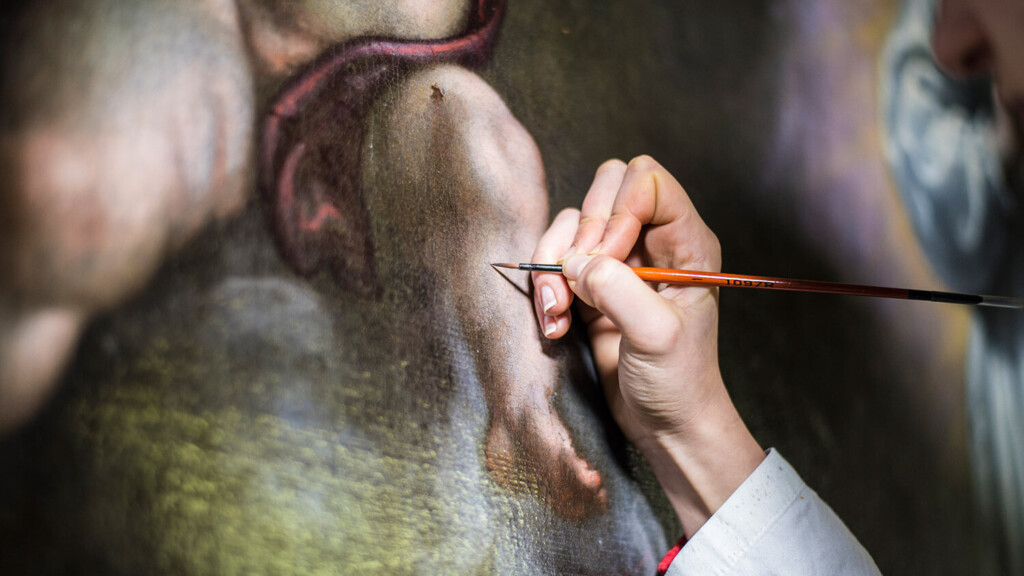
The morning after the spire fell, people wept in the streets of cities they had never visited. Photographs of the burning roof spread across every screen simultaneously, and something collective contracted in the chest of the watching world — a grief that felt personal, immediate, almost bodily. You probably remember where you were. That specific quality of shared loss, the way it gathered strangers into a single community of mourning, is worth pausing on. Not to diminish what was lost, but to ask what the architecture of that grief reveals about everything it quietly excluded.
Four years earlier, in the Syrian desert, systematic demolition had reduced some of the most extraordinary Roman-era structures on earth to rubble. The Temple of Bel, the Arch of Triumph, the Tower of Elahbel — monuments that had stood through fifteen centuries of empires and invasions were methodically detonated. International statements were issued. A hashtag circulated. Then the news cycle moved on. And further back still, in March 2001, two colossal figures carved into the sandstone cliffs of the Bamiyan valley — one of them fifty-three meters tall, both of them dating to the sixth century — were destroyed over the course of several weeks. The process was documented, announced in advance, internationally condemned. And yet the mourning that followed, real as it was, never achieved the same gravitational pull, the same sense of collective civilizational wound.
David Lowenthal argued in 1985 that the past is not simply recovered but constructed — that what we choose to preserve, mourn, or restore is always a projection of present identity backward onto time. Heritage, in his analysis, is less about the thing itself than about what the thing authorizes us to claim about ourselves. This is not cynicism. It is the structural condition of memory operating at civilizational scale. The question it opens is uncomfortable: when Notre-Dame burned, whose identity was confirmed by the grief? And when Palmyra was erased, whose identity was considered too peripheral, too geographically remote, too culturally other to generate the same response?
Frantz Fanon understood this mechanism with surgical clarity. Writing in the early 1960s, he described how colonial systems did not merely extract resources from occupied territories — they systematically devalued and destroyed the cultural frameworks of colonized peoples, precisely because those frameworks were the substrate of resistance, dignity, and coherent selfhood. The destruction of culture was never incidental; it was the method. And crucially, it was rendered invisible by the same hierarchies that made European heritage legible as universal and non-European heritage legible as regional, ethnic, particular — interesting perhaps, but not foundational to the shared story of humanity.
This hierarchy did not dissolve when formal colonial structures were dismantled. It migrated into institutions, funding structures, media attention, and the emotional grammar of global response. A medieval cathedral in the center of Paris activates an entire Western cultural inheritance — literature, religion, art history, tourism, collective identity. Its burning is felt as a wound to something that considers itself universal. A Buddhist monument in Afghanistan or a Roman city in Syria sits, in this same inherited grammar, at the margins of what counts as the world’s patrimony, however ancient, however irreplaceable. The grief is permitted but not mandated.
What burns and what we mourn are not the same inventory. They never have been. And what we mourn tells us less about the objective value of what was lost than about the invisible map we carry of whose past deserves a future. The reconstruction funds for Notre-Dame surpassed one billion euros within days. Pledges for Palmyra moved slowly, partially, contingent on security, on politics, on the quieter calculus of which ruins are worth the cost of remembering. The stones are equally old. The silence around some of them is not.
The Restorer’s Impossible Ethics
She has spent thirty years with the same face. The same almond eyes rendered in egg tempera, the same gilded halo wearing thin at the edges where centuries of candle smoke settled like a second skin. Every morning she adjusts her lamp, leans in, and continues. She knows the painter’s hesitations better than she knows her own — the place where his brush trembled slightly at the jawline, the spot he returned to twice because the shadow wasn’t right the first time. She knows his failures with an intimacy no living person can share. And one morning, without drama, without announcement, she understands something she cannot unfeel: the altarpiece is no longer entirely his. It has passed, incrementally, through her hands. Her decisions about what to consolidate, what to leave, what chromatic register to use in the areas of loss — these are not neutral acts. They are a voice speaking over another voice, however quietly, however carefully. She has not saved the painting so much as she has co-authored it.
This is not a confession of failure. It is the ethical center of the entire enterprise, and almost no one says it out loud.
Paul Ricoeur, in his 1990 work Oneself as Another, develops what he calls narrative identity — the idea that a self is not a fixed substance but a story told and retold, each retelling reshaping what came before. Identity is not what you are, he argues, but the coherence you construct across time through interpretation. What Ricoeur describes for persons applies with uncomfortable precision to objects. An altarpiece is not simply pigment and wood. It is an accumulation of interpretations — every restoration, every cleaning, every decision to leave a pentimento visible or to conceal it — and each of those interpretations becomes part of what the object is. There is no original beneath the layers that sits waiting, pure and intact, to be recovered. There is only the layered story, and you are now one of its authors.
Susan Sontag, in Regarding the Pain of Others, published in 2003, examines how images of suffering are consumed, mediated, transformed by the act of looking. Her central unsettling argument is that to photograph pain is already to alter it, to frame it within an aesthetic that risks converting anguish into contemplation. The same logic, transposed, cuts through the restoration studio. To preserve is already to interpret. The restorer’s gaze is not passive. It selects, evaluates, decides what matters and what doesn’t, what belongs to the work’s essential identity and what is merely the accident of time. And every one of those micro-decisions carries the weight of the restorer’s own history, training, aesthetic formation, even the particular morning light in the studio.
The ethical impossibility is structural, not personal. It is not that she has been careless or arrogant. It is that the position itself contains a contradiction that cannot be resolved: you must intervene to preserve, and every intervention is a departure from what was. The restorer who does nothing watches the object die. The restorer who acts watches something else emerge. Both outcomes represent a loss, and the professional training, the international charters, the peer review — none of these dissolve the contradiction. They manage it, frame it, give it a vocabulary. They do not make it disappear.
What she is trying to save, in the end, may not be the altarpiece at all. It may be something closer to the act of caring itself — the thirty years of bent attention, of choosing this work over everything else, of making oneself a custodian of something older and stranger than oneself. The object becomes the occasion for a relationship. And relationships always change what they touch.
Which means the question she cannot answer, and cannot stop asking, is whether what she has preserved is for the painter, for the future, or for herself.
The Ruin That Refuses to Be Fixed
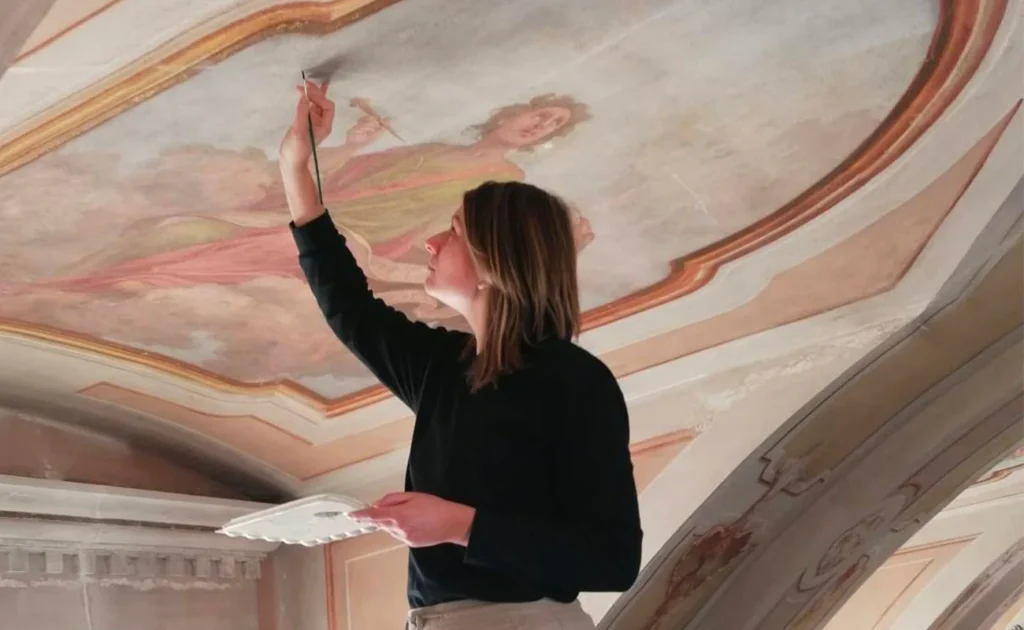
There is a wall in a city you have visited, or will visit, where the plaster has fallen away in a shape that looks almost deliberate, almost chosen. You stand in front of it longer than you expected to. Something in the damage holds you. Not nostalgia, not pity — something closer to recognition, as if the wall is finally saying something true that it could not say when it was whole.
Georg Simmel understood this in 1911, when he wrote his essay on the ruin and arrived at a conclusion that the entire restoration industry has been quietly ignoring ever since. The ruin, he argued, is not a building in decline. It is a building that has achieved a new form of completeness. Nature and human intention have met in the broken surface and produced something that neither could have made alone. The crack is not an interruption of meaning. The crack is where meaning finally breaks through.
This is not a comfortable idea to carry into a conversation about heritage restoration. It does not fund easily. It does not photograph well in grant applications. But it refuses to leave.
You have seen a man return to the house where his father died — the house sold, the walls repainted, the garden replanted — and stand at the threshold unable to enter, because the place has been restored into a stranger. The damage was his inheritance. The damage was the only honest record of what had happened there. Someone had cleaned it away with the best of intentions, and now there was nothing left to mourn, which meant there was nothing left at all.
This is what Simmel’s argument touches when it lands on lived experience rather than aesthetics. The ruin is not a failure of care. It is, sometimes, the only form in which a thing can remain honest. John Ruskin, writing in The Seven Lamps of Architecture in 1849, already sensed this when he insisted that the greatest glory of a building is not in its stones, but in the age written into them. He was fighting against the Victorian restorers who were smoothing medieval churches back into a speculative idea of their original perfection — erasing six centuries of genuine life in favor of a theory about what life should have looked like. Ruskin lost, mostly. The smoothing continued.
A woman sits in what was once a bombed building, now partially reconstructed, partially left open to the sky. The project was designed by an architect who made the deliberate decision not to close the wound. The exposed masonry, the gap where the roof once was — these are not failures of the restoration. They are its most rigorous achievement, the one moment where the building is allowed to tell the truth about what happened to it.
Walter Benjamin, in his Theses on the Philosophy of History written in 1940, argued that to articulate the past historically does not mean to recognize it as it actually was, but to seize hold of a memory as it flashes up in a moment of danger. The ruin flashes. The perfectly restored surface does not. There is a kind of historical honesty that only damage can carry, a testimony that repair, however skilled, inevitably smooths into silence.
The conservator who stands before an irreparably fractured fresco — one that no technique can reassemble without lying about what happened — knows this feeling. The choice to leave the fracture visible is not a defeat. It is, perhaps, the most rigorous ethical act in the entire discipline: the refusal to substitute comfort for truth, the decision to let the thing remain in its broken form because the breaking is now, inseparably, part of what the thing is.
The crack is not where the meaning escaped. The crack is where it stayed.
🏛️ Restoring the Past: Art, Memory, and Sacred Spaces
Cultural heritage restoration is never merely a technical endeavor — it is a dialogue between past and present, demanding deep knowledge of history, artistic tradition, and material culture. To fully appreciate the methods and challenges of restoration, one must understand the original contexts in which these works and buildings were created. The articles below illuminate the artistic and architectural worlds that restoration seeks to preserve.
Medieval Abbeys and Monasteries: History and Architecture
Medieval abbeys and monasteries represent some of the most complex architectural ensembles that restoration specialists encounter, blending structural challenges with the need to preserve liturgical and artistic integrity. Understanding their historical development — from early Benedictine foundations to the great Gothic expansions — is essential for any responsible conservation project. This article offers a thorough guide to their architecture, symbolism, and historical significance.
GO TO THE SELECTION: Medieval Abbeys and Monasteries: History and Architecture
Romanesque Architecture: History and Main Examples
Romanesque architecture forms one of the foundational chapters of European building history, and its massive stone walls, semicircular arches, and sculptural programs pose unique challenges for restorers. Grasping the constructive logic and regional variations of this style is indispensable for any conservation work on medieval structures. This article surveys the main examples and principles that define the Romanesque aesthetic across the continent.
GO TO THE SELECTION: Romanesque Architecture: History and Main Examples
Medieval Sculpture: History and Iconography
Medieval sculpture is among the most vulnerable and iconographically complex heritage to restore, requiring restorers to be fluent in the visual language of saints, allegories, and theological narratives carved in stone. A misreading of iconographic programs can lead to irreversible errors during intervention. This article traces the history and symbolic meaning of medieval sculptural traditions, providing essential context for culturally informed restoration practice.
GO TO THE SELECTION: Medieval Sculpture: History and Iconography
Gothic Cathedrals: History and Symbolism
Gothic cathedrals stand as the supreme test of heritage restoration, combining soaring structural engineering with intricate stained glass, carved stone, and layered historical significance. Each intervention must balance authenticity with the building’s living religious and civic function. This article explores the history and rich symbolism embedded in Gothic cathedral design, offering a vital framework for understanding what is at stake when restorers approach these monumental works.
GO TO THE SELECTION: Gothic Cathedrals: History and Symbolism
Discover Art and History Through Independent Cinema
If these themes of cultural memory, art, and history resonate with you, Indiecinema streaming offers a carefully curated selection of independent and documentary films that bring heritage, architecture, and artistic traditions to life on screen. Explore stories that mainstream platforms rarely tell, from the hidden worlds of restoration to the living pulse of historical cultures. Visit Indiecinema and let independent cinema deepen your understanding of the past.
👉 EXPLORE THE CATALOG: Watch Indie Films in Streaming
A vision curated by a filmmaker, not an algorithm
In this video I explain our vision

