
The Weight of Stone You Never Questioned
You walk in and something changes in your chest. Not metaphorically — physically. The ceiling is low, or at least it feels low, even when the vault rises several meters above you. The walls are thick enough to swallow sound, to absorb light, to make the air inside feel categorically different from the air outside. You came in from a bright afternoon and now you are standing in something that has weight, that presses, that makes your body aware of its own smallness not through grandeur but through density. This is not the soaring vertigo of a Gothic cathedral reaching upward toward an absent God. This is something older, closer to the ground, closer to the earth that the foundation stones were cut from. The building does not invite you to look up and dissolve. It invites you — if invite is even the right word — to stay put, to be still, to understand that you are inside something that was here before your great-great-grandmother was born and will be here long after every person you have ever loved is forgotten.

The instinct, when you feel this, is to call it primitive. The word surfaces almost automatically, conditioned by centuries of art history that arranged the medieval centuries into a tidy narrative of progress: Romanesque as rough draft, Gothic as the refined version, Renaissance as the moment Europe finally woke up. You have absorbed this hierarchy without anyone ever explicitly teaching it to you. It lives in the way museum labels phrase things, in the way documentary voiceovers slow down to linger on a Gothic rose window while moving briskly past a Romanesque apse as though it were merely an embarrassing adolescent phase in the biography of Western civilization.
But standing inside one of these buildings, the body knows better than the hierarchy. The body does not experience thickness as failure. It does not register the rounded arch as an incomplete solution awaiting the pointed arch’s correction. What the body registers is intention — massive, coherent, almost geological intention. These walls were not made thick because the builders lacked the engineering sophistication to make them thinner. They were made thick because thickness was the point. The load-bearing logic of Romanesque construction, with its barrel vaults transferring enormous lateral thrust directly into walls that had to be substantial enough to absorb it, represented not a limitation but a choice about what a sacred building should feel like when you inhabit it. A choice about the relationship between human fragility and divine permanence.
Giorgio Agamben, writing about the temporal structure of ruins, describes how certain objects carry within them a layered time that refuses to be absorbed into the present — they remain stubbornly historical in the most unsettling sense, not as relics to be studied but as presences to be reckoned with. A Romanesque church operates exactly this way. It does not communicate the past to you. It makes you inhabit the past alongside it, without explanation, without translation.
The term Romanesque itself is historically late — it was coined in the early nineteenth century, around 1818 or 1819, by the French archaeologist Charles de Gerville, who used it to describe the degraded Latin he believed these buildings represented in stone. Degraded. The etymology of the label carries the prejudice built into it from the very beginning. De Gerville was looking at structures built primarily between the ninth and twelfth centuries and seeing them through the lens of a man convinced that history moved in one direction: upward, toward refinement, toward light. He could not feel what you feel standing inside one of these buildings on a Tuesday afternoon with no one else around and the stone pressing its cold, indifferent authority into the space behind your sternum.
The question is not whether he was wrong about the architecture. The question is why the wrongness has lasted so long, and what it has cost us to keep believing it.
St. Mary of Vezzolano. The Restoration of the Jubé
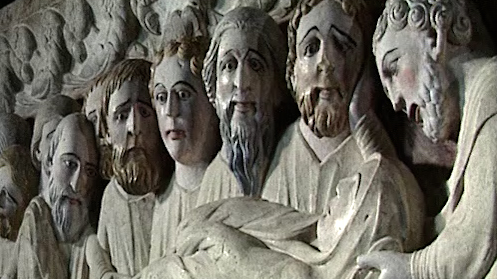
Documentary, by Fedele Aula, Italy, 1998.
In the heart of Monferrato, among silent hills and winding roads, stands the Canonica of Santa Maria di Vezzolano: a place where history, art, and spirituality have intertwined for nearly a thousand years. At the center of the narrative emerges the jubé, an extraordinary medieval rood screen that miraculously survived the dictates of the Counter-Reformation that had ordered its destruction. This rare structure, suspended between liturgical function and visual storytelling, becomes the guiding thread of the documentary: a “stone book” recounting the genealogy of Christ and the Dormitio Virginis, still preserving traces of its original colors.
Through the work of restorers, institutions, and volunteers, the film explores the delicate balance between conservation and enhancement, bringing new life to a work unique in the European landscape. The restoration of the jubé thus becomes not only a technical intervention, but a journey through memory, giving voice once more to a monument that has endured centuries, resisting time and human actions. Through testimonies, evocative imagery, and artistic details, the documentary invites viewers to rediscover Vezzolano as a “magical” place, where every stone tells a story and the past continues to dialogue with the present.
LANGUAGE: Italian
SUBTITLES: English, Spanish, French, German, Portuguese
A Europe That Did Not Know It Was Europe Yet
There is a moment, somewhere around the year 1003 or 1004, when a monk in Burgundy looks up from his manuscript and realizes the world did not end. This is not a small thing. For decades, perhaps longer, the arithmetic of apocalypse had been running quietly beneath every act of daily life — the year one thousand as a threshold, a wall, a door that might open onto nothing. It did not. And what follows that non-event is one of the strangest creative explosions in Western history: an entire continent begins, almost simultaneously, to build in stone.
The historian Raoul Glaber, writing in the 1040s, described it with a phrase that has never quite lost its force. He said that the world was shaking off its old rags and clothing itself in a white mantle of churches. He was not speaking metaphorically. Between approximately 1000 and 1150 CE, the number of major ecclesiastical building campaigns across what we now call France, Spain, Italy, Germany, and England was staggering — hundreds of abbeys, cathedrals, and pilgrimage churches constructed or entirely rebuilt in a period of roughly five generations. The scale is difficult to hold in the mind until you remember what preceded it.
What preceded it was fragmentation so severe it barely deserves the word civilization. The Carolingian project — Charlemagne’s vision of a unified Christian empire administered through literacy, standardized liturgy, and centralized power — had collapsed within a generation of his death in 814. What remained was a patchwork of competing lordships, Viking incursions along every navigable river, Magyar raids pushing deep into the Frankish heartland, Saracen pressures along Mediterranean coasts. There were no reliable roads, no common currency worth trusting, no political entity large enough to guarantee anything across more than a few valleys. The concept of Europe existed as a theological aspiration, not a geographical or political reality.
Into this vacuum, monasticism moved with extraordinary organizational intelligence. The Benedictine reform centered at Cluny, founded in 910 in southern Burgundy, became the nervous system of a continent that had no other nervous system. At its height, the Cluniac network comprised over a thousand dependent houses stretched from Portugal to Poland. This was not simply religious expansion — it was the creation of an infrastructure of trust, hospitality, and shared cultural practice across territories that shared nothing else. The pilgrim routes to Santiago de Compostela, to Rome, to the shrines of southern France, were essentially Cluniac highways. And every major stopping point on those routes demanded a church capable of holding the bodies, the fears, and the expectations of thousands of travelers annually.
The architecture that emerged from these conditions was not chosen from a catalogue of styles. It grew directly from the problem of building something permanent in a world that had repeatedly demonstrated the impermanence of everything. The round arch, the thick wall, the heavy pier — these were not aesthetic preferences but structural answers to a specific anxiety. Stone vaulting replaced timber roofs not because it was more beautiful but because timber burned, and timber roofs had burned over and over again, taking with them the relics, the manuscripts, the accumulated sacred gravity of generations. When you build in the Romanesque mode, you are building against forgetting.
The sociologist Émile Durkheim, writing nearly nine centuries later about collective effervescence — the phenomenon whereby shared ritual generates a social energy greater than the sum of its individual participants — might have been describing exactly what was happening across these pilgrim routes and monastic networks. The stone was not just material. It was the physical residue of a collective decision to continue, to insist, to assert that something built by human hands could outlast the particular darkness of any given century.
And darkness there was, in abundance, still.

The Lie of the Primitive
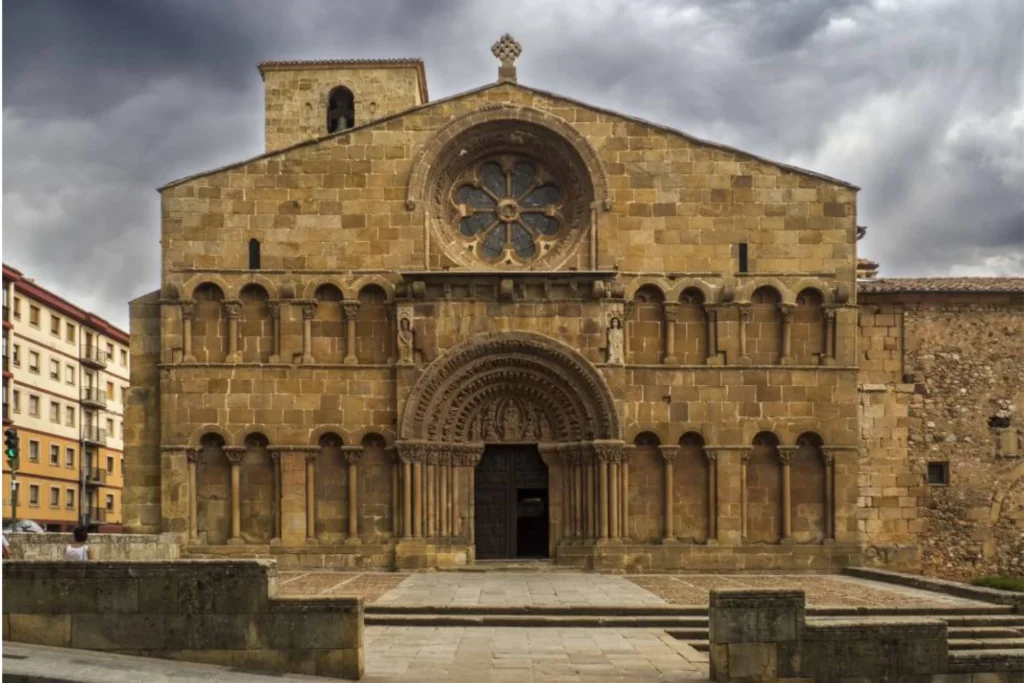
You have probably stood in front of a Romanesque church and felt something you did not know how to name — a heaviness that was not oppressive, a silence that was not empty, a thickness of wall that seemed less like construction and more like geological fact. And then someone, a guidebook, a tour guide, a professor, offered you the word that was supposed to explain it: primitive. As if naming it were the same as understanding it, and as if understanding it required diminishing it first.
The word Romanesque was coined in the early nineteenth century, most often attributed to the French archaeologist Charles de Gerville, who used it around 1818 to describe the architecture of the early medieval centuries in Western Europe. What he meant by it was not neutral description. He meant degraded Latin, corrupted Roman, the awkward stammering of builders who had inherited a great tradition and did not quite know what to do with it. The etymology was meant to work the same way the word Romance does when applied to languages — to indicate derivation, yes, but also distance, decline, the long shadow of something that was once better. It was a taxonomic gesture that contained within itself a verdict.
This verdict was never innocent. Erwin Panofsky, in his 1951 study Gothic Architecture and Scholasticism, demonstrated with surgical precision how the emergence of the Gothic style in the twelfth and thirteenth centuries was not simply an aesthetic development but an ideological one — a visual embodiment of the scholastic method, of its drive toward transparency, toward the articulation of structure, toward light as theological argument. The Gothic cathedral, in Panofsky’s reading, was the stone equivalent of Aquinas’s Summa: everything made visible, everything hierarchized, every force shown openly at work. This was a profound insight. But the shadow of that insight fell backward across everything that came before it, and what had been different became, almost automatically, deficient.
Historiography does this with remarkable consistency. It finds its hero — the Gothic, the Renaissance, the Enlightenment — and then retroactively organizes all preceding history as preparation, as necessary but imperfect steps toward the arrival of the true form. The Romanesque became the rough draft. The thick walls that were once expressions of a specific structural logic, of a cosmology in which enclosure was sacred, in which the boundary between the human world and what lay beyond it was architectural fact, were reread as the sign of ignorance, of builders who did not yet know how to do what Gothic builders would later do. As if the pointed arch were the goal that all human aspiration had been blindly reaching for.
Think of a man who spends thirty years building something with his hands and then watches a younger generation declare his method obsolete. The thing he built still stands. It still holds weight. But the conversation has already moved on, and what was once skill is now merely the evidence of limitation. This is not description. It is politics by other means.
Aesthetic hierarchies are never neutral, and Panofsky himself understood this, even if he did not always resist the hierarchy he was mapping. The very language we use to speak about medieval architecture carries its conclusions pre-installed. To call something Romanesque is already to have decided where it sits in the story, already to have framed it as transitional, as the uncomfortable adolescence between the Roman grandeur it supposedly echoed and the Gothic maturity it supposedly announced. The builders who dressed stone at Cluny or cut the capitals at Vézelay were not transitioning toward anything. They were answering the questions their own world was asking, in the only material language capable of holding those questions still long enough to contemplate them.
What gets lost when we inherit someone else’s taxonomy is the ability to see what was actually there before the verdict arrived.
What the Round Arch Actually Means
You step through the door and something happens to your body before your mind has time to interpret it. The ceiling presses down, not aggressively, but with intention. The walls are not simply thick — they are present, breathing with a density that makes you aware of your own smallness in a way that feels neither cruel nor accidental. The light arrives through openings so narrow that it enters as event rather than fact, a diagonal shaft that cuts across the stone floor and disappears before reaching the opposite wall. You are not liberated by this space. You are held by it.
This is not a failure of engineering. The round arch, the barrel vault, the wall that could swallow a grown adult standing sideways — none of these represent the Romanesque builder’s inability to do otherwise. They represent a theology made physical, a cosmology pressed into limestone and sandstone and mortar with the same deliberate intention that a philosopher presses a thought into language. The builders of the eleventh and twelfth centuries knew exactly what they were doing, and what they were doing was constructing the experience of approaching the divine as something that costs the body something.
Rudolf Otto, in his 1917 work Das Heilige, described the sacred as the mysterium tremendum et fascinans — the mystery that simultaneously terrifies and attracts, that makes the human creature feel its own contingency before something wholly other. What Otto described in philosophical language, the Romanesque builder translated into cubic meters of stone. The compression you feel is not metaphorical. The architecture manufactures tremendum in the nervous system. You cannot stand in the nave of a fully intact Romanesque church and feel expansive. The space will not allow it.
There is a scene that stays with you — a man walking through a corridor so thick with stone that the sound of the outside world simply stops. Not fades. Stops. He pauses, turns back toward the entrance as if checking that the world is still there, and then continues forward into the dimness. The moment is not dramatic. It is physiological. The architecture has already made its argument before he has taken five steps.
This is what separates Romanesque intention from what came immediately after. The Gothic impulse, arriving in the Île-de-France in the mid-twelfth century with Abbot Suger’s reconstruction of Saint-Denis, sought to dissolve the wall, to replace mass with light, to make the boundary between the earthly and the divine as thin and transparent as possible. Suger believed, drawing on the Neoplatonic mysticism of Pseudo-Dionysius the Areopagite, that material beauty could lift the soul toward the immaterial. Light was the medium of that ascent. But the Romanesque mind did not want ascent. It wanted descent. It wanted the soul pressed downward into its own weight, made conscious of the flesh it inhabited, made to earn the encounter with the sacred through the very resistance of the building.
Erwin Panofsky, in Gothic Architecture and Scholasticism from 1951, identified a structural homology between the Gothic cathedral and the ordered clarity of scholastic philosophy — both systems attempting to make totality legible, to reconcile apparent contradictions into a luminous whole. What he left implicit is the inverse: Romanesque architecture is homologous with a theology of hiddenness, of deus absconditus, of the God who withdraws rather than reveals. The thick wall is not ignorance. It is apophasis made stone. It says: what is on the other side of this cannot be seen directly. You must approach through darkness. You must feel the pressure before you feel the grace.
The small window does not fail to illuminate. It chooses what to illuminate. That choice is the entire argument.
Santiago, Cluny, Speyer — The Buildings That Rewrote Power
There is a moment when you stand inside a space so vast that your body registers it before your mind does. Something in the chest shifts. The scale is not decorative — it is argumentative. It is saying something to you that has nothing to do with beauty and everything to do with who is in charge.
The Abbey of Cluny, at its peak in the early twelfth century, stretched over 187 meters of consecrated ground, making it the longest building in Christendom, a record it would hold until Saint Peter’s Basilica in Rome absorbed it into historical footnote four centuries later. But to measure Cluny in meters is to miss the point entirely. Cluny was the headquarters of a reform movement that had spent two hundred years dismantling the idea that secular lords could appoint abbots and bishops, that sacred office was something a king could hand out like land. The building did not illustrate this argument. The building was the argument. Its five naves, its double transepts, its forest of sculpted capitals — all of it constituted a spatial claim that the spiritual order answered to Rome and to no one else. When the sociologist Max Weber wrote about the routinization of charisma, about how prophetic energy hardens into institutional structure, he might have been describing in abstraction what Cluny enacted in stone.
The struggle between papal and imperial authority — what historians call the Investiture Controversy, which convulsed Europe between roughly 1076 and 1122 — was not a theological debate conducted in manuscripts. It was a war fought in marble and mortar as much as in armies. The Imperial Cathedral of Speyer, begun under Conrad II in 1030 and expanded by Henry IV into one of the most ambitious building projects of the medieval world, planted a counter-claim in the Rhine valley. Henry IV, the emperor who famously stood barefoot in the snow at Canossa in 1077, waiting for Pope Gregory VII to lift his excommunication, understood that humiliation demands a monument. The crypt at Speyer, with its extraordinary groin vaulting and its row of imperial tombs, was not a burial chamber in any ordinary sense. It was a dynastic statement, a reminder cut in sandstone that the Holy Roman Empire had its own sacred lineage, its own consecration, its own theological gravity that did not depend on papal approval to exist.
And then there is the road. The pilgrimage routes to Santiago de Compostela were, among other things, an infrastructure project that tied together the political geography of Christian Europe. The Cathedral of Santiago, rebuilt and expanded through the eleventh and twelfth centuries into the great Romanesque edifice that still anchors the city, was the western terminus of this network. But pilgrimage is never merely devotion. The historian R.I. Moore, in his work on the formation of a persecuting society in medieval Europe, showed how the institutional church of this period was actively constructing a unified Christian identity through precisely these kinds of spatial practices — shared routes, shared shrines, shared architectural vocabularies. Santiago was intelligible to a pilgrim from Burgundy or from Saxony because they had already passed through dozens of smaller churches built in variations of the same language. The architecture was not regional. It was ideological.
What these three buildings share is not a style in the art-historical sense. What they share is an understanding, brutal and sophisticated at once, that space produces subjects. That the person who walks through a door framed in a certain way, whose eye is led upward by a certain proportion of column to vault, who feels their own smallness measured against a certain nave length — that person is being shaped. Michel Foucault, long before anyone applied his thinking to medieval stone, described how architecture functions as a technology of power, organizing bodies in relation to authority. The Romanesque builders did not need to read Foucault. They already knew.
A vision curated by a filmmaker, not an algorithm
In this video I explain our vision
The Body Inside the Stone
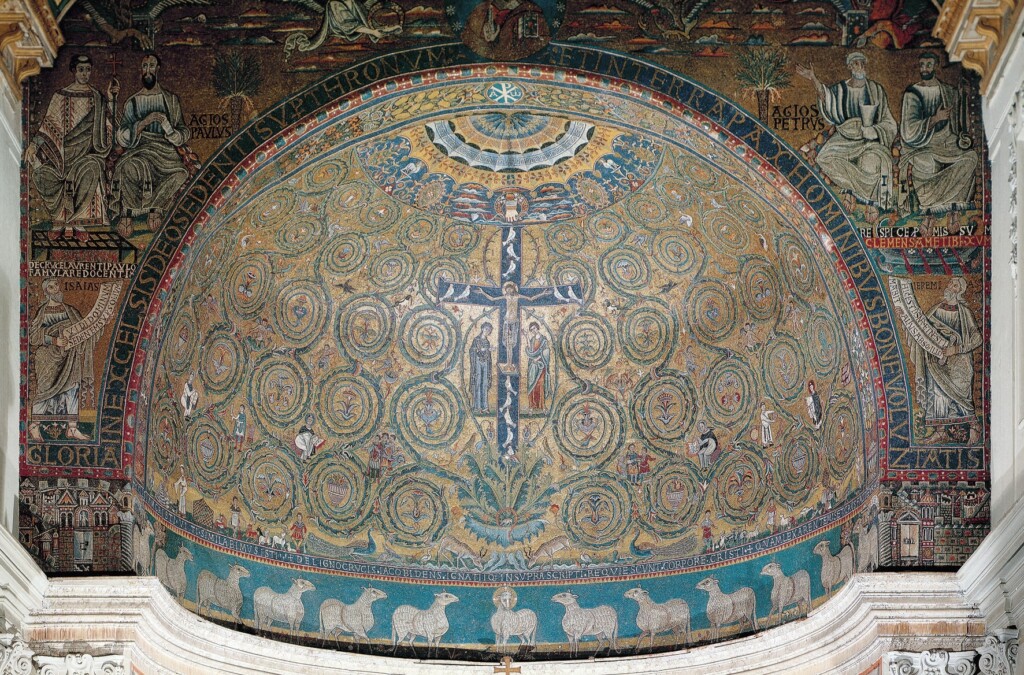
You walk into the narthex and something looks back at you. Not metaphorically. The stone faces carved above the door are not decorating the entrance — they are judging it. The mouths stretch too wide. The eyes do not blink because they have never blinked. The bodies writhe in configurations that the human spine cannot achieve, limbs folding backward over themselves, figures swallowed whole by creatures that are themselves being swallowed. You have not yet crossed the threshold and you are already being evaluated.
This is not an accident of style. It is a technology.
Georges Duby, in his landmark work on medieval society and visual culture, argued that the church in the eleventh and twelfth centuries wielded image as an instrument of social order with a precision that no written edict could match. In a world where the overwhelming majority of the population could not read Latin, and many could not read anything at all, the carved portal was the sermon, the law, the threat, and the promise compressed into a single surface that you had to pass beneath every time you entered the sacred space. Duby understood that fear was not incidental to medieval governance — it was structural. The grotesque figures on the capitals and tympana were not folk imagination running wild. They were commissioned, approved, theologically supervised expressions of what awaited those who deviated from the prescribed order.
The tympanum at the center of a Romanesque facade functions like a compressed trial. Christ in majesty sits at the apex, impassive, neither welcoming nor rejecting — simply presiding. Below him the saved and the damned are sorted with a bureaucratic finality that makes the scene somehow more disturbing than if it were violent. There is a man being weighed on a scale, his soul measured against his sins, and the demon pressing down on the wrong side wears an expression not of malice but of satisfaction, as though this is simply accurate accounting. The horror is administrative.
Descend from the tympanum to the capitals inside the nave and the logic intensifies. A man is shown mid-transformation, half-human and half-beast, his face still recognizably a face but his hands already claws. He is looking at you. The sculptor did not give him a direction to look — he chose yours. This is the sensation that certain carved interiors never let go of: the feeling that the building has already read you before you opened your mouth, that the stone knows something about you that you are still in the process of admitting. You came here to pray but the architecture has already classified you.
The misericords — those small carved ledges on the underside of choir seats, visible only when the seat is lifted — contain a different register of this language. Hidden from the congregation, accessible only to the clergy who used them to lean against during long offices, they show acrobats, hybrid animals, domestic scenes of unexpected intimacy, women spinning, men fighting over nothing, figures bent into pure ornamental impossibility. It is as though the building has a secret body, a private anatomy that speaks differently when the public gaze is removed. Even here, in the hidden fold, the stone does not rest.
The psychoanalyst Julia Kristeva, writing on abjection in 1980, described the experience of encountering that which threatens the boundary between self and dissolution — the face that is almost human, the body that is almost whole. The Romanesque capital is a sustained meditation on that almost. The figures are not monsters in the clean folkloric sense. They are recognitions. They show you what the flesh does when it is not controlled, what the social body looks like when its hierarchies collapse, what you might become if the structure holding you together were removed.
The building is not trying to comfort you. It is trying to make sure you understand what comfort costs.
The Pilgrim’s Road as Infrastructure of Belief
You leave before dawn. The road is cold, the pack is heavy, and somewhere ahead — days ahead, weeks ahead — there is a church that will redeem you. This is not metaphor. This is the operating logic of an entire civilization, the biomechanical fuel that built half of medieval Europe in stone.
The pilgrimage routes were not spiritual byproducts of an already-existing architecture. They were the architecture’s reason for existing. The Camino de Santiago, the Via Francigena threading down from Canterbury through the Alpine passes into Rome, the routes converging on Jerusalem — these were not roads that happened to pass churches. They were nervous systems, and the churches were the synaptic nodes through which belief, commerce, and political power conducted their signals simultaneously. To separate these functions is a modern convenience that would have bewildered any twelfth-century abbot who understood perfectly well that a reliquary attracting pilgrims was also attracting revenue, that a hospice attached to a monastery was also a territorial claim, that a sculpted tympanum over a portal was infrastructure as surely as any bridge.
The historian Adriaan Hendrik Bredero, examining the expansion of Cluny’s monastic network in the eleventh century, traced how the Burgundian abbey’s influence spread precisely along pilgrimage corridors, each daughter house functioning as both spiritual station and economic relay point. By 1100, the Cluniac network encompassed more than a thousand monasteries, and their architecture was not accidental in its consistency — the barrel vault repeated, the ambulatory with radiating chapels repeated, the sculptural program repeated — because pilgrims needed to recognize what they were entering. Recognition itself was ideological. To walk through a portal that looked like the portal you had walked through two hundred miles back was to feel that you belonged to something larger than your village, larger than your feudal lord’s jurisdiction. It was the manufacturing of a supranational identity before the concept existed to name itself.
A man walks into a church along the way and finds himself in a space so precisely calibrated to his exhaustion and his hope that he weeps without understanding why. The nave is long, the light is channeled from high clerestory windows into specific pools, the acoustic resonance of chanting transforms the air into something almost solid. This was not accidental design. The Romanesque architects — working without the word “architect,” without formal training as we conceive it — were choreographers of emotional states. The pilgrimage church at Conques, with its severe tympanum depicting the Last Judgment in graphic anatomical detail over the western entrance, was placed there for a specific purpose: to catch the pilgrim at the moment of arrival, when physical depletion had stripped away psychological defense, and to press the full weight of cosmic consequence into that unguarded moment. Terror and relief, simultaneously. You have arrived, and you may yet be damned.
Victor Turner, whose anthropological work on liminality and pilgrimage in the 1970s remains indispensable, argued that the pilgrim occupies a threshold condition — stripped of social identity, suspended between ordinary life and sacred destination — that makes them extraordinarily susceptible to communitas, to a sense of undifferentiated human solidarity. The Romanesque route exploited this susceptibility with architectural precision. The sequence of spaces, the controlled revelation of the nave after the compressed darkness of the narthex, the sudden expansion of the apse — these were not aesthetic choices in any modern decorative sense. They were manipulations of consciousness, applied to bodies already made porous by weeks of walking.
And the commerce was never hidden. Markets clustered around pilgrimage churches the way water clusters around stone. The relics drew the faithful, the faithful drew the merchants, the merchants drew the roads, the roads drew more churches. Santiago de Compostela by the twelfth century was one of the most economically significant destinations in the Western world, and the architecture that greeted arriving pilgrims was built partly by the coin they carried in their exhausted hands.
What Survived and What We Chose to Preserve
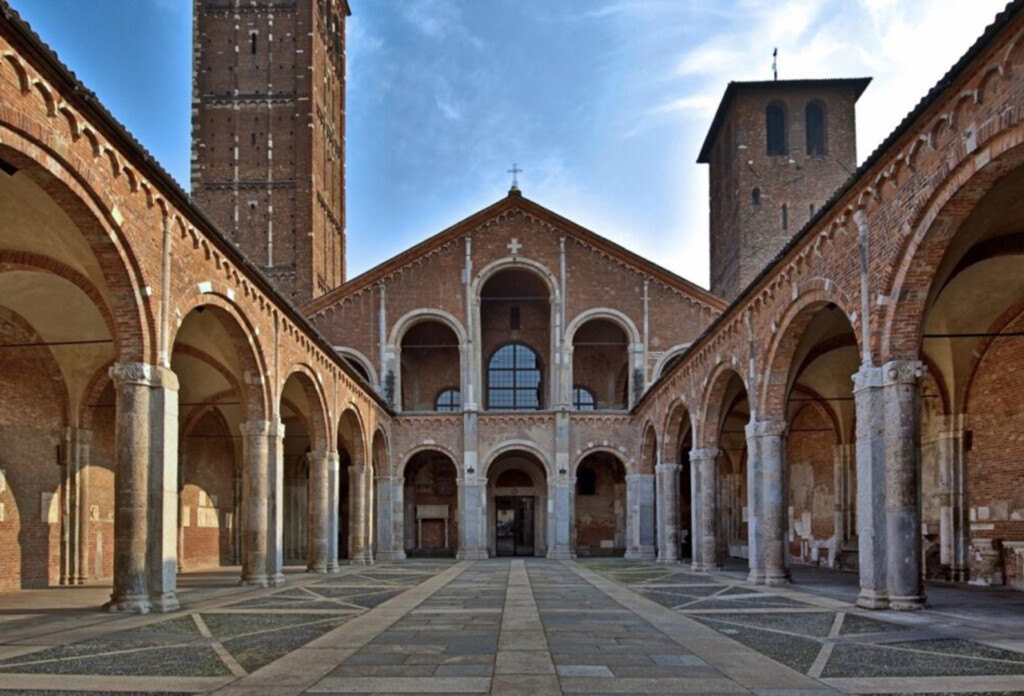
There is a cathedral you have walked through, touched the cold stone of, believed in as ancient. And it is ancient — except for the parts that are not, except for the spire added in 1879, the capitals recarved by craftsmen following drawings made in Paris, the mortar joints that are slightly too regular, slightly too clean, the whole thing breathing with a precision that the twelfth century, with its asymmetries and improvisations and structural accidents, never actually possessed. You were not deceived in bad faith. You were handed a memory that someone else had already curated, compressed, and decided was more true than the ruin it replaced.
Eugène Viollet-le-Duc, who restored Notre-Dame de Paris beginning in 1844 and spent decades reconstructing medieval structures across France, was explicit about his method in a way that should unsettle anyone who has since stood inside one of his projects. In his Dictionnaire raisonné de l’architecture française, published between 1854 and 1868, he wrote that to restore a building is not to maintain it, repair it, or rebuild it — it is to reestablish it in a complete state that may never have existed at any given moment. He said this without apology. He understood that restoration was not archaeology. It was argument.
The nineteenth century needed the Middle Ages the way a new nation needs founding myths. France, Germany, England — all of them, in the decades following the Napoleonic upheavals and the accelerating violence of industrialization — reached backward toward Romanesque and Gothic stone as evidence of continuous identity, organic nationhood, spiritual depth that could not be manufactured in a factory. John Ruskin had argued in The Stones of Venice, published in 1851, that the irregularities of medieval craftsmanship were the fingerprints of free labor, of souls expressing themselves in stone. What Ruskin could not quite admit, and what the restoration projects made structurally visible, was that this vision of the medieval past was being produced in the present, by people with urgent political needs and extraordinary technical confidence.
What we call Romanesque architecture today is therefore, in part, a nineteenth-century category. The term itself was coined in the early 1800s by the French archaeologist Charles de Gerville, who used it to describe the debased Latinity of pre-Gothic stone construction — already a value judgment embedded in a name. By the time the discipline of art history had consolidated the concept, it had absorbed decades of nationalist restoration, selective preservation, and deliberate emphasis. The round arch, the thick wall, the barrel vault: these became icons of something essential and primal, when in fact they had been part of a much messier, more contingent, more regionally varied practice that did not know it was Romanesque and did not build toward posterity’s categories.
There is a man who returns to a village he left as a child and finds the church exactly as he remembered it — which means he finds it as it was when he was eight, which means he finds his own memory, not the building. The restoration did the same thing, but collectively. It returned a civilization to the building it had imagined, not the building that had stood. And the stone accepted it, as stone always does, indifferently.
The philosopher Paul Connerton, in How Societies Remember published in 1989, argued that memory is not stored in minds but performed in bodies and inscribed in places — that the past is not recalled but re-enacted. What happens then when the place itself has been rewritten? When the performance of memory is conducted in a theater that was rebuilt to specification?
You are standing in front of something that is genuinely old, and genuinely altered, and you cannot fully separate those two facts, which means you are always, in some irreducible measure, looking not at what was built but at what each successive century decided it needed that building to have been.
🏛️ Stone, Art, and History: The Medieval World
Romanesque architecture does not exist in isolation — it emerges from a rich cultural and artistic tapestry that shaped medieval Europe. Exploring the arts, philosophies, and traditions surrounding this period deepens our understanding of the stones, arches, and sacred spaces that defined an era.
Romanesque Art: History and Characteristics
Romanesque art and Romanesque architecture are inseparable companions, sharing the same visual language of solemnity, symbolism, and spiritual weight. This article traces the historical roots and defining characteristics of Romanesque art, from illuminated manuscripts to monumental sculpture adorning church facades. Understanding this artistic tradition is essential for anyone wishing to grasp the full meaning of the architectural forms that housed it.
GO TO THE SELECTION: Romanesque Art: History and Characteristics
Titian: Life and Works
Titian stands as one of the great bridges between the medieval world and the Italian Renaissance, a period that transformed the visual arts across Europe just as Romanesque traditions were giving way to Gothic innovation. His masterful use of color and light redefined painting and reflected the broader cultural shifts reshaping architecture and urban space. Exploring his life and works offers a compelling contrast to the austere grandeur of Romanesque building.
GO TO THE SELECTION: Titian: Life and Works
Memento Mori: History and Meaning
The Memento Mori tradition permeated medieval culture, and Romanesque sacred architecture was itself a built meditation on mortality, eternity, and divine judgment. From carved tympana depicting the Last Judgment to the dim, cave-like interiors of Romanesque churches, death and transcendence were ever-present themes. This article explores the history and meaning of Memento Mori, illuminating the spiritual mindset that made such architecture so deeply resonant.
GO TO THE SELECTION: Memento Mori: History and Meaning
Vanitas in Art: Symbolism and Meaning
Vanitas imagery flourished in the same sacred and intellectual environment that gave rise to Romanesque artistic programs, reflecting a medieval obsession with the transience of earthly life and the permanence of the divine. The symbolic language of skulls, hourglasses, and withering flowers finds its architectural counterpart in the heavy, earth-bound forms of Romanesque chapels and abbeys. This article unpacks the rich symbolism of Vanitas in art, connecting it to the broader spiritual vision of the medieval period.
GO TO THE SELECTION: Vanitas in Art: Symbolism and Meaning
Discover Independent Cinema on Indiecinema
If these journeys through art, architecture, and history have stirred your curiosity, Indiecinema streaming is your next destination. Our curated catalog of independent and auteur films explores beauty, culture, and the human condition with the same depth and passion. Stream now and let cinema open new worlds for you.
👉 EXPLORE THE CATALOG: Watch Indie Films in Streaming
A vision curated by a filmmaker, not an algorithm
In this video I explain our vision

