
The Screen That Watches Back
You catch your own face in a dark monitor and for a fraction of a second you do not recognize yourself. The screen is off, or nearly off, and the reflection comes back wrong — flattened, slightly delayed, robbed of the warmth you imagine your face carries. It lasts less than a heartbeat, that estrangement, and then the familiar self reassembles and you move on. But something happened in that gap. Something that most people spend considerable energy not thinking about.

We live inside images now with the same unreflective ease with which we breathe recycled air in office buildings. The screens are on the walls, in our pockets, on the desk, mounted above the bar, embedded in the back of the seat in front of us on the plane. They are on when no one is watching. They run their loops of news and weather and advertisement and security feed whether or not a human eye ever lands on them, and the cumulative effect of all that unattended emission is a kind of low hum beneath ordinary consciousness — not quite noise, not quite silence, something that changed the texture of being alive sometime in the second half of the twentieth century and has been accelerating ever since. Marshall McLuhan wrote in 1964, in Understanding Media, that the medium is the message — meaning not that content is irrelevant but that the form of transmission reshapes the nervous system of whoever inhabits it, regardless of what the transmission contains. Most people who quote McLuhan have never fully reckoned with how physical his claim was. He was not talking about culture in the abstract. He was talking about your body, your perception, the specific neurological reorganization that happens when you spend hours inside an electronic environment rather than a typographic one.
Nam June Paik understood this before almost anyone else in the art world. Not as a theoretical position. As a material fact he could stack, wire, solder, and install in a room. Born in Seoul in 1932, trained in music and aesthetics in Tokyo and then in Freiburg and Munich, he arrived in the early 1960s at the center of the Fluxus movement in Germany and New York carrying a peculiar combination of obsessions: John Cage‘s ideas about chance and noise, the Buddhist concept of time as something other than linear progression, and a ferocious intuition that the television set was not a window onto the world but a sculptural object, a piece of furniture that happened to emit light and carry ideology. Where other artists of his generation painted the television, photographed it, made it the subject of critique from a comfortable critical distance, Paik opened its chassis and put his hands inside.
His first major solo exhibition, in 1963 at the Galerie Parnass in Wuppertal, placed thirteen altered television sets in various rooms of a private house. The sets were modified so that their images bent, looped, distorted, and misbehaved. Magnets disrupted the cathode ray. The signal was interrupted and redirected. Visitors moved through domestic space — rooms that looked like rooms — and found the central object of postwar domesticity turned against itself, made strange, stripped of its pacifying function. There was no comfortable place to stand and observe. The work did not hang on a wall. It surrounded you. The feedback was not metaphorical. If you moved, the image moved. You were inside the circuit.
This is what Paik built that no theorist had yet managed to build: an environment in which the condition of being watched by the machine you are watching was not a concept but an experience you could not exit by closing the book. Walter Benjamin had written about the loss of aura in the age of mechanical reproduction, but Benjamin’s analysis remained on the page. Paik put you in the room where the aura had been replaced by signal, and he left the door open just enough that you could not pretend the room was somewhere else.
The Mirror and the Rascal
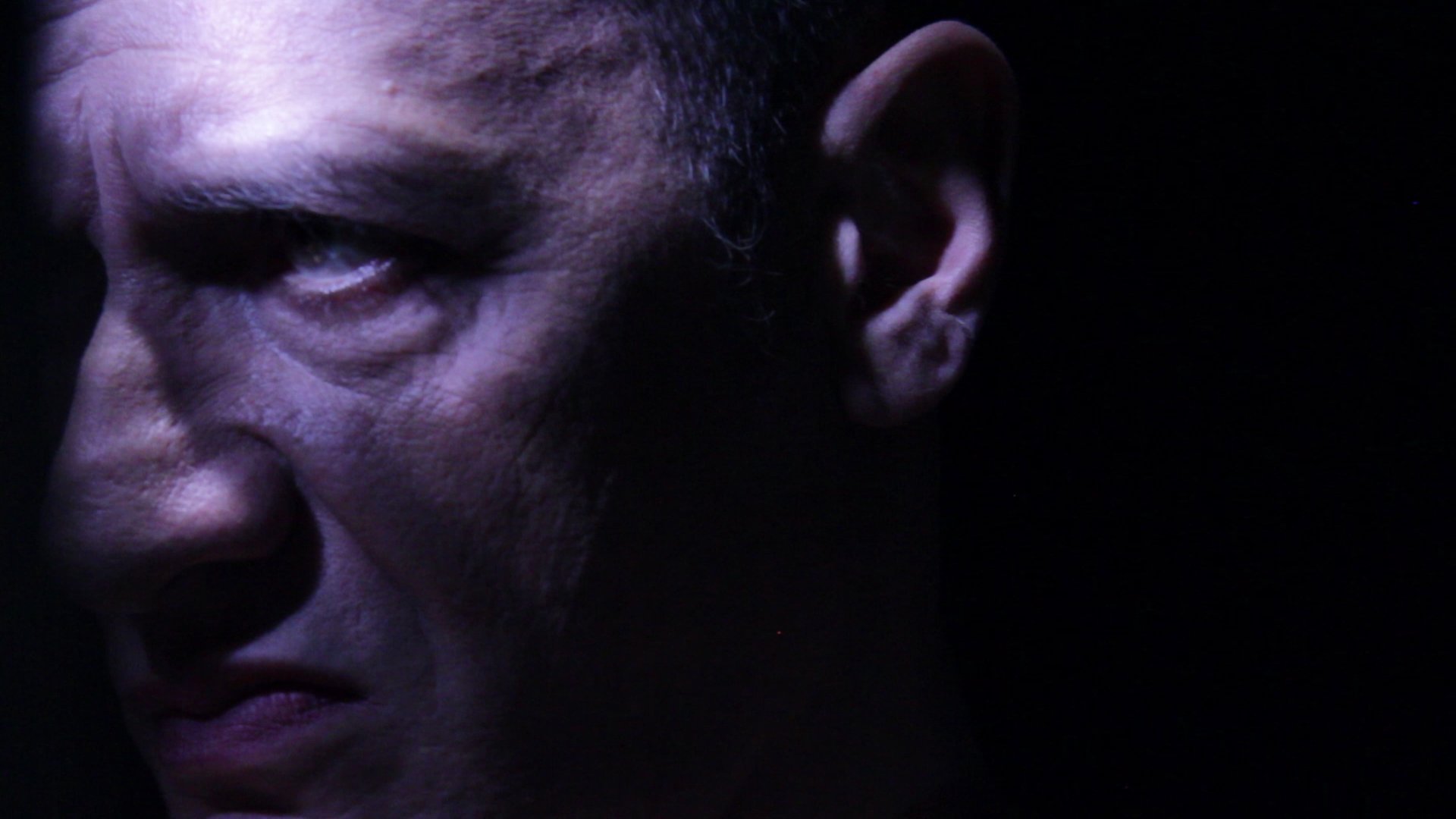
Drama film, by Valerio De Filippis, Italy, 2019.
The mirror and the rascal is an experimental film based on the tragedy "Richard III" by William Shakespeare. It tells the delirium of contemporary power in an author's reinterpretation of cinema, video art and music. The protagonist, Richard Duke of Gloucester, brother of King Edward IV, through a long series of crimes eliminates all the obstacles that stand between him and the throne of England.
Valerio de Filippis, a well-known painter who has been following his research path for a long time, investigating the relationship between light, corporeality and the psyche. The mirror and the rogue and the cinematographic equivalent of Valerio De Filippis' painting, his figurative style is in fact very recognizable looking at his paintings. But cinema is a new way where the artist can also be involved as an actor and performer, with an original mix between acting and singing. Staging the dark side of the human soul, the film is a surreal and disturbing interpretation of a great classic. The director says: "The first suggestion was musical: I was interested in transforming the text of Shakespeare's tragedy Richard III into notes. I love cinema and at a certain point I felt that the time had come to combine research on the image of painting to my love for cinema and music. When the film is finished I realize that I have remained faithful to painting: every frame of the film appears to me like a painting: the same light, the same colors, the same atmosphere ". The mirror and the rascal is a kind of psychoanalytic session that the painter does while hiding behind the mask of Richard III. Behind this ferocious and unscrupulous character we find a path of self-analysis by De Filippis, who is mainly interested in the more violent and turbid aspects. An experimental film in which, with great courage, the author gets involved completely, fragmenting the images in an unconventional montage, which is at the same time a flow of consciousness and spectacle.
LANGUAGE: English
SUBTITLES: Italian
A Body Born Between Frequencies
He was born in Seoul in 1932 into a family of textile merchants, which means he was born into fabric, into pattern, into the logic of things woven together from separate threads. That detail matters more than it might seem. The household was prosperous, educated, oriented toward the West in the way that certain Korean families of that era had learned to be — cautiously, strategically, with one eye always on the door. And the door, when it finally had to be used, opened onto flight.
The Korean War arrived and the family left. This is the biographical fact that most accounts treat as background, as context, as the before-picture that explains the after. But displacement is never background. It is the very medium through which a certain kind of consciousness learns to think. When you are twelve years old and the city you were born in becomes a city you must escape, something happens to your relationship with stability that no amount of later comfort can entirely undo. You learn, at a level beneath argument, that the ground is not to be trusted. That signal can become static without warning. That what appears continuous is always, in fact, interrupted.
The family moved through Hong Kong, then settled in Japan. Paik enrolled at the University of Tokyo, where he studied music and aesthetics, writing his thesis on Arnold Schoenberg — a choice that reveals everything. Schoenberg had done to Western musical tradition what a controlled demolition does to a building: he had exposed the structure by destroying the surface. The twelve-tone method was not chaos; it was a different kind of order, one that refused the consolation of resolution, that made dissonance the ground rather than the deviation. A young man who had already lived through the collapse of one world finding his intellectual home in a composer who had systematically dismantled the rules of another — there is nothing accidental in that alignment.
Walter Benjamin wrote, in the notes toward his unfinished Arcades Project, that the dialectical image is not a product of gradual development but of collision — a sudden flash in which two historically distant moments strike against each other and produce, in that impact, a truth that neither could contain alone. Benjamin was writing about Paris, about iron and glass and the phantasmagoria of commodity culture, but the structure of his thought applies with an almost uncanny precision to what was forming inside the young Paik. His mind had been made by collisions: Korean tradition and Japanese occupation, Eastern sensibility and Western harmony, the silence of displacement and the noise of a world rebuilding itself from rubble. He was not confused by these collisions. He was constituted by them.
In 1956 he moved to Germany, first to Munich and then to Cologne, to continue his studies in music history and pursue the new electronic possibilities gathering at the edges of the European avant-garde. And then, in Darmstadt in 1958, at the International Summer Courses for New Music, he encountered John Cage. What happened in that encounter has been described in many ways, but the simplest description is also the most accurate: one interrupted signal met another. Cage had arrived at silence through a completely different route — through Zen, through chance operations, through the deliberate evacuation of compositional will — but the destination rhymed with everything Paik had been carrying since Seoul. Silence not as absence but as the fullest possible presence. Noise not as failure but as information. The gap between notes as meaningful as the notes themselves.
The young man standing in that lecture hall in Darmstadt had already spent twenty-six years being shaped by forces that did not cohere. He had been educated in discontinuity before anyone gave him a language for it. What Cage offered was not a revelation so much as a recognition — the sudden, vertiginous sensation of seeing your own nervous system described from the outside.

Cage, Fluxus, and the Art of Deliberately Breaking Things
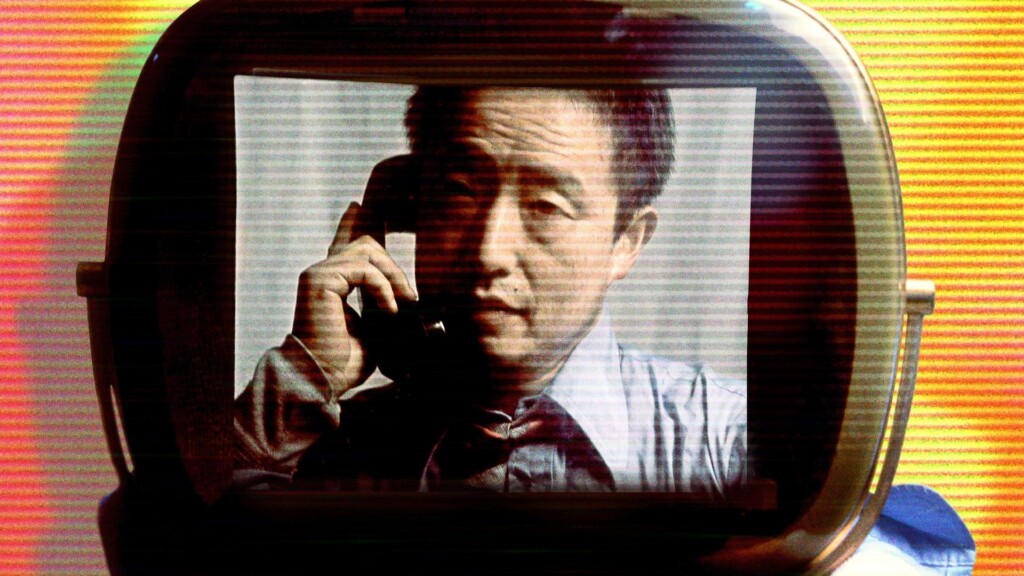
There is a moment, somewhere in the middle of an ordinary afternoon, when you realize that the object in front of you has stopped being what it was supposed to be. Not broken, exactly. Just suddenly, irreversibly strange. A telephone that no one answers. A door that opens onto a wall. You stand there holding the function of the thing in your hand, and the thing itself refuses to participate.
This is roughly what happened to Paik when he encountered John Cage’s lectures at the Darmstadt summer courses in 1958. Not an influence. An epistemic rupture. The difference matters enormously, because influence implies continuity — a river feeding another river — while rupture implies that the ground itself gives way. Cage was not teaching composition. He was dismantling the conditions under which composition was possible, pulling the floor out from under the very idea that music required intention, hierarchy, resolution. His 1952 piece 4’33” had already made the argument with the bluntness of a hammer: silence is not the absence of music, it is the revelation that music was never the point. What you hear when no one plays is not nothing. It is everything you were ignoring.
Paik did not become Cage’s disciple. He became someone who understood that the hammer could be used on other things.
By the early 1960s, he was performing actions that could not quite be called concerts, or art, or theater, but that occupied some feverish space between all three. He would approach a piano with a saw, or his bare hands, or simply the full weight of his body, and reduce it to something that could no longer be played. Watch what that does to an audience. The piano is the most domesticated of Western instruments, the furniture of bourgeois aspiration, the object over which children suffer and parents project. To destroy it in front of people is not vandalism. It is surgery without anesthetic on a shared cultural assumption. The instrument’s silence afterward is not the same silence as Cage’s. It is louder, angrier, and somehow more honest.
He would also walk through rooms with scissors, cutting the ties off the necks of men in suits. Small, precise, intimate. The tie, that absurd strip of cloth that signals seriousness and submission simultaneously, severed in a single clean motion. There is footage of a man watching his own tie fall, and on his face you can see the exact moment when he doesn’t know whether to laugh or to be furious, and in that gap — that half-second of suspended social reflex — something genuinely free occurs. Allan Kaprow, theorizing the happening in the late 1950s and formalized in his 1966 book Assemblages, Environments and Happenings, described this kind of event as art that eradicates the membrane between life and aesthetic experience. Not art about life. Not art representing life. Art that is so thoroughly embedded in the material of the ordinary that the spectator cannot locate the frame, cannot find the edge where the performance ends and Tuesday begins.
A man watches his tie being cut. A woman sitting in a concert hall hears nothing for four minutes and thirty-three seconds and cannot decide if she has been cheated or given something. Someone walks into a room where a piano has been reduced to splinters and feels, inexplicably, relieved.
This is what Fluxus understood that almost no one else was willing to admit: the rituals that organize daily life are not neutral. They are instructions. And instructions can be interrupted. The genius of interruption is not chaos — it is the brief, dazzling visibility of the structure that was always there, operating silently, before someone arrived with scissors.
Television as the Enemy You Must Seduce
There is a particular quality of light that a television set throws into a dark room — not quite illumination, not quite shadow, but something in between that makes the face watching it look emptied out. You have seen that face. You may have worn it. It belongs to no one in particular and to almost everyone. A man sits in front of a screen broadcasting static or game shows or the evening news, and his jaw has gone slack, his hands have stopped moving, and whatever he was thinking about twenty minutes ago has completely dissolved. He is not watching. He is being watched over, the way a patient is watched over. The screen has taken custody of him.
Paik understood this before he had language for it, which is perhaps why he chose to answer it not with language but with magnets. In March of 1963, in a small gallery in Wuppertal, Germany, he arranged thirteen television sets and subjected each of them to magnetic interference. The broadcast signal — the official transmission, the authorized image of the world — was bent, folded, torn into chromatic spirals and visual noise that no network had sanctioned and no advertiser had paid for. The sets still hummed with their original electricity. They were still, technically, televisions. But what they showed was something else entirely: the medium’s own nervous system exposed, its internal logic made visible and strange.
What Paik was demonstrating physically — with his hands, with hardware, with the crude authority of magnetism — Marshall McLuhan would attempt to articulate theoretically one year later in Understanding Media, published in 1964. The medium is the message. Not the content, not the program, not the news anchor’s carefully modulated voice. The medium itself. The box in the corner of the room was already doing something to you before a single image appeared on it, was already restructuring your perception, your sense of time, your relationship to authority and to spectacle. Paik knew this not as an academic proposition but as a material fact he could hold in his hands, distort, and place in a gallery for people to walk around.
The paradox that animated his entire relationship with television was this: he loved it and he did not trust it. He loved its electricity, its color, its capacity to reach millions of people simultaneously, the democratic vulgarity of it — the fact that it sat in living rooms and kitchens, that it required no education to operate, that it was already everywhere. He did not trust it for exactly the same reasons. The thing that made television powerful was the thing that made it dangerous, and Paik had no interest in choosing one side of that equation. He wanted to live inside the contradiction, to work from within it.
There is a moment — one of those scenes that feel less like film and more like a documentary of the species — in which a woman cannot turn away from a screen even as everything around her is disintegrating. Her attention is not pleasure. It is not even interest. It is closer to obligation, or to the particular paralysis that comes when something has promised meaning so many times that you no longer remember whether it ever delivered. She keeps watching. The screen keeps promising. The transaction never completes, but neither party walks away.
This is what Paik was interrupting in Wuppertal. Not television as entertainment, not television as information, but television as the primary site of suspended desire — the screen that holds your attention by never quite satisfying it, that sells you the feeling of connection while quietly dismantling your capacity to connect with anything that doesn’t glow. His thirteen sets, warped and singing with magnetic distortion, were not an attack. They were a seduction in reverse: showing the medium what it looked like when someone refused to let it lie.
Robot Human, Human Robot
There is a moment you recognize if you have ever been through a breakup that followed a script. You said the right things. You cried at the appropriate intervals. You even felt something, or believed you did, and yet somewhere behind your sternum there was a small, cold observer watching you perform grief as though grief were a procedure you had been trained to execute. The sentences came out correctly ordered. The pauses landed where pauses should land. And afterward you sat in your car and wondered who had been speaking.
Paik built his first robot in 1964, and it walked like that feeling made metal. K-456 was a radio-controlled, twenty-channel contraption assembled from motors, solenoids, wire, and salvaged electronics, capable of walking, defecating beans, and broadcasting the voice of John F. Kennedy through a speaker embedded in its chest. It moved through the streets of New York with the lurching sincerity of something trying very hard to seem alive. In 1982, Paik staged what he called the First Accident of the Twenty-First Century, in which K-456 was deliberately struck by a car on West Broadway. A robot hit by a vehicle that did not know it was hitting a robot. No one could say exactly who was the machine.
Norbert Wiener had spent the previous decades trying to make people understand what they were building. His 1948 work Cybernetics, and then the more publicly addressed The Human Use of Human Beings in 1950, laid out with precise and unsettling clarity the logic of feedback systems, the way information loops back through a mechanism to correct or amplify its own behavior. Wiener was not afraid of technology. He was afraid of the specific human tendency to create systems that learn faster than the humans who created them and then to trust those systems with decisions that carry moral weight. The danger, he wrote, was not the robot uprising of science fiction. The danger was subtler: it was the moment a feedback loop becomes a substitute for judgment, and no one inside the loop notices the substitution has occurred.
The robots Paik built from television sets and radios across the 1960s and 1970s were not warnings. They were mirrors. Each one assembled from the detritus of broadcast culture, stacked monitors for heads and torsos, antennae for limbs, the accumulated hardware of a civilization that had decided the highest form of presence was transmission. A family of them existed, named and arranged like relatives at a reunion, each one humming with the residual signal of everything that had passed through its components before Paik reassembled them into this new, slightly horrifying kinship. You looked at them and felt the category error landing somewhere behind your eyes. They were not trying to be human. They were built from the machines humans had used to represent themselves, which meant they were already portraits.
Charlotte Moorman understood this with her body before she could have theorized it. In 1969, she performed wearing a brassiere made of two small television monitors, each screen live, each one broadcasting whatever signal Paik had routed through the circuit connecting her chest to the transmitter. She played cello. She was not a metaphor. She was a broadcast antenna in the literal sense, the human body functioning as both the medium and the message, her flesh integrated into the electronic network not symbolically but through actual wire and actual signal. Marshall McLuhan’s formulation had by then become a slogan repeated without thinking. Moorman enacted it as a physical fact. What the audience saw was a woman. What the woman was doing was becoming infrastructure.
And the cello played on through all of it, the notes going out into the same air as the television signal, both of them equally physical, equally temporary, equally mistaken for something they were not.
A vision curated by a filmmaker, not an algorithm
In this video I explain our vision
Satellite, Globe, Signal: The World as One Hallucination

On New Year’s Day, 1984, somewhere between midnight and the first pale hours of a year that carried the weight of Orwell’s prophetic number, a signal traveled from New York to Paris to Seoul and back again, live, unedited, irreversible. Twenty-five million people watched. They watched a cellist perform in a French studio while a Korean dancer moved in real time on the other side of the planet, while a poet in Manhattan read into a camera that fed into all of it simultaneously. No one had done this before. Not like this. Not with the explicit intention that the medium itself was the message, that the satellite was not a delivery mechanism but a philosophical statement about what human beings could, in theory, become to one another.
Paik called it Good Morning, Mr. Orwell, and the title was a direct provocation: the technology that Orwell’s nightmare had weaponized into surveillance and control, Paik wanted to reclaim as communion. The telescreen becomes a handshake. Big Brother becomes a baroque, chaotic carnival of international artists refusing to be categorized. The year 1984 arrives and the dystopia does not. Or so the broadcast seemed to announce.
What he was building, conceptually, was what he would later name the electronic superhighway — a network of instantaneous connection that would compress geography into simultaneity, that would make the distance between Seoul and Paris not a journey but a blink. He imagined it as liberation. He had spent his career understanding that television was not neutral, that the screen was not a window but a condition, and still — or perhaps because of this — he believed the infrastructure could be redirected, that the signal could carry something other than what the market wanted it to carry.
There is a kind of vertigo that comes from watching two people separated by an ocean speak to each other in real time, a vertigo that is not wonder but its uncanny double. You have felt it. The face on the screen is present and absent simultaneously, intimate and unreachable in the same gesture. The philosopher Byung-Chul Han, writing decades after Paik’s broadcast but describing a condition Paik helped inaugurate, speaks of transparency as a form of violence — the elimination of distance that produces not closeness but a kind of exhausted proximity, a world where everything is visible and nothing is truly seen. Paik wanted the signal to open the world. What arrived instead was the world as infinite scroll.
Shoshana Zuboff‘s analysis of surveillance capitalism, developed most rigorously in her 2019 work, identifies the precise mechanism by which the electronic superhighway became something other than what its utopians imagined. The network did not simply connect — it observed, extracted, predicted, and sold. Every click, every pause, every moment of attention became raw material for behavioral modification at scale. The architecture Paik celebrated as horizontal and democratic revealed itself to be vertical and extractive. The satellite that carried his carnival of international artists became the same infrastructure that carries your location data to servers you will never see, that maps your desires before you have consciously formed them.
This is not anachronistic criticism of a man who could not have known. It is the shadow that his optimism cast forward without turning to look. Paik understood the screen as a site of struggle. He understood that television had already colonized consciousness and that the artist’s task was to jam the signal, to interrupt the hypnosis. But the electronic superhighway he envisioned as liberation required a politics he did not provide — required, in fact, a theory of power that his aesthetic sensibility kept at arm’s length.
The twenty-five million who watched that New Year’s broadcast were connected for the duration of a transmission. And then the signal ended, and each of them returned to their separate rooms, their separate nations, their separate frequencies.
The Electronic Superhighway and Its Exits
You arrive somewhere you have never been and recognize everything. The street corner, the skyline, the particular quality of late afternoon light falling across a certain kind of building — you have seen all of this before, processed it, filed it, moved on. The place exists for you already as a completed image, and your physical presence there now feels less like discovery than like confirmation. You are not traveling. You are verifying.
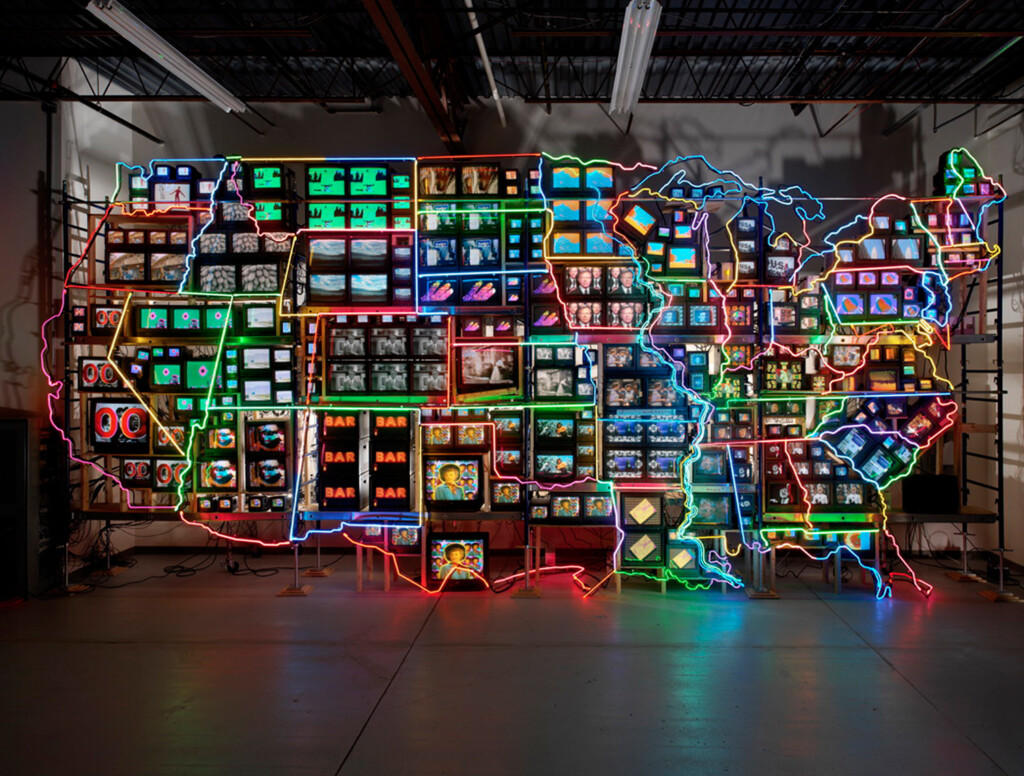
This is the condition that a man spent three years and 336 television sets trying to make visible.
The installation stretches nearly fifteen meters across a wall. Neon tubing outlines the borders of each state in the colors of roadside Americana — the garish, buzzing palette of motels and diners and signs that promise everything and mean nothing. Inside each neon border, monitors flash the images that the culture has decided each place is: alligators and orange groves for Florida, cowboys and red dust for Oklahoma, the relentless postcard perfection of Hawaiian sunsets, the northern wilderness of Alaska rendered as pure white silence punctuated by animals moving through snow. Forty-nine channels of America dreaming itself into existence, or perhaps dreaming itself out of it. The sum is 1995, but the logic is much older.
Guy Debord wrote in 1967 that the spectacle is not a collection of images but a social relation between people mediated by images — which sounds abstract until you are standing in front of a wall of televisions showing you America and you realize you feel nothing that resembles surprise. Debord’s argument in “The Society of the Spectacle” was not that images lie but that they have replaced the territory they were supposed to represent, and that this replacement happened so gradually and so completely that most people cannot locate the moment of loss. The map precedes the territory. The image outlives and outweighs the place.
What Paik built was a monument and an autopsy simultaneously. The neon is celebratory, almost carnivalesque — the visual language of abundance and festivity — and yet what it frames is a kind of death, the death of the unmediated encounter with a place. Each state exists in its televisual clichés with an accuracy that is more disturbing than any distortion could be. The clichés are not wrong. They are simply all that remains after decades of mediation have filtered out everything that cannot be broadcast, packaged, transmitted, consumed. What gets lost is precisely what cannot survive the process of becoming an image: the friction, the smell, the particular kind of boredom that belongs to a specific geography, the things that resist becoming content.
There is a scene — somewhere, in someone’s life — of a man sitting across from the woman he loves in a restaurant he has been to a hundred times in films and photographs, and he cannot feel the moment because he is simultaneously inside it and watching it from the position the camera always occupies. The real and its representation have collapsed into each other so completely that authentic experience requires a kind of grief for the image’s dominance before it can begin. This is not nostalgia for a pre-media world. It is something more precise: the recognition that the screen has not simply added a layer over reality but has reorganized reality’s furniture, moved everything slightly, so that nothing sits where it used to and yet nothing appears to have changed.
Paik was Korean-born, perpetually displaced, someone for whom America was always already mediated before it was ever inhabited. Perhaps that position — outside the image looking in, then inside it and still somehow looking — gave him the particular clarity to build something that most American artists of his generation could not see clearly enough to construct. You cannot diagram the water you are swimming in. He was never quite swimming.
The 336 screens continue to flash. Somewhere, someone is landing in a city they already know.
Stroke, Silence, and the Last Signal
In 1996, the most restless body in contemporary art stopped moving the way it had always moved. The stroke came without announcement, as strokes do, and what it left behind was a man who had spent five decades rearranging the physical world — soldering, hammering, dragging television sets across floors, wiring entire rooms into nervous systems — now confined to a wheelchair, his left side partially paralyzed, his hands no longer able to build what his mind continued to generate at the same relentless velocity. There is something almost structurally cruel about this, though cruelty implies intention and the body has none. It simply stops, or partially stops, and the person inside must negotiate with whatever remains.
What remained was considerable. Paik continued to work. The retrospectives accumulated around him in the years after the stroke — major surveys in New York, in Wolfsburg, in Seoul — and there was something strange about watching an archive assemble itself around a living person, as though the institution had already decided where the story ended while the man himself had not. He directed collaborators, issued instructions, approved new configurations of old works. The Guggenheim filled with his robots and his televisions in 2000, and he was there, present, watching the screens flicker through decades of accumulated signal. An artist who had made movement and simultaneity his entire argument now occupied a fixed point in space, and from that fixed point he kept arguing.
The philosopher Maurice Merleau-Ponty spent years insisting, most powerfully in his 1945 Phenomenology of Perception, that consciousness is not housed in the brain but distributed across the body, that we think with our hands as much as with our minds, that perception is always already motor, always already reaching toward the world. Paik had lived this before reading it, which is perhaps the only honest way to live a philosophical idea. And when the body contracted, when the reach became limited, the question his entire career had been building toward became suddenly impossible to avoid in the abstract: had any of it worked? Had the television set, rewired and repositioned and multiplied a thousand times, actually done anything to the consciousness that watched it?
You already know the answer, even if you resist saying it clearly. The average person in 2006, the year Paik died, was spending more hours in front of screens than any previous generation in recorded history. By some measures the number had already crossed four hours daily for adults in developed nations, and it would only climb. The screens had proliferated exactly as Paik predicted — they were everywhere, they were personal, they fit in pockets, they followed people into bedrooms and bathrooms and the brief remaining spaces that had once been private. But the liberation he had imagined, the expanded consciousness, the viewer who becomes author, the passive body that wakes into participation — that had not arrived at scale. What had arrived was fragmentation. The sense of watching everything and absorbing nothing. The feeling, familiar to anyone honest enough to name it, of having spent three hours in front of a screen and emerged somehow emptier than before.
A man sits in a room filled with forty-nine monitors, each one playing a different image, and he weeps, though he cannot say exactly why. The images are not sad. The images are simply relentless, and relentlessness, it turns out, has its own particular grief. Paik knew this room. He built it. He built it as a provocation, not a prescription, and the difference between those two things is the entire question — the question he carried through five decades of work, through the stroke, through the wheelchair, through the retrospectives assembling around him like a monument he had not yet finished arguing with, the signal still moving through the circuits, unresolved, alive.
🎥 Art, Technology, and the Avant-Garde Mind
Nam June Paik’s revolutionary fusion of art and technology did not emerge in a vacuum — it grew from a rich soil of avant-garde experimentation, media critique, and radical aesthetics. These articles explore the broader intellectual and artistic universe that shaped and surrounded his visionary practice.
The Relationship Between Painting and Cinema: History and Theory
The dialogue between painting and cinema forms one of the most fertile territories in modern art history, and it is precisely within this tension that video art found its footing. Nam June Paik himself challenged the boundaries between the static image and moving media, making the history of this relationship essential context for understanding his work. This article traces the theoretical and historical threads connecting visual art to the cinematic apparatus.
GO TO THE SELECTION: The Relationship Between Painting and Cinema: History and Theory
The Avant-Garde Cinema: Movies to Watch
The avant-garde cinema movement shares deep roots with the video art revolution that Paik helped ignite, both rejecting mainstream narrative in favor of sensory and conceptual provocation. This curated guide to avant-garde films opens a window onto the experimental traditions that influenced and intersected with Paik’s multimedia installations. Discovering these films means understanding the visual language that Paik both inherited and radically transformed.
GO TO THE SELECTION: The Avant-Garde Cinema: Movies to Watch
New York Underground of the 1980s: Art and Culture
New York in the 1980s was one of the most electrically charged cultural environments of the twentieth century, producing artists who, like Paik, used unconventional materials and spaces to challenge the art establishment. This article immerses readers in the underground scene that nurtured figures such as Basquiat and Haring, whose energy resonated with Paik’s own downtown New York presence. Understanding this cultural ecosystem illuminates the social and artistic context in which video art gained its radical edge.
GO TO THE SELECTION: New York Underground of the 1980s: Art and Culture
The Unconscious and its Relationship With Cinema
Paik’s video installations often functioned as mirrors of the unconscious, transforming television sets into dreamlike portals that confounded rational perception. This article explores the profound relationship between cinema and the unconscious mind, drawing on psychoanalytic theory to reveal how moving images speak directly to hidden layers of human experience. Reading it alongside Paik’s work opens new interpretive dimensions for understanding why his art feels simultaneously disorienting and deeply familiar.
GO TO THE SELECTION: The Unconscious and its Relationship With Cinema
Explore the Edges of Cinema on Indiecinema
If Nam June Paik’s boundary-dissolving vision has sparked your curiosity, Indiecinema is the streaming destination where that spirit lives on. Discover a carefully curated selection of independent, experimental, and avant-garde films that challenge, provoke, and inspire — exactly as Paik would have wanted.
👉 EXPLORE THE CATALOG: Watch Indie Films in Streaming
A vision curated by a filmmaker, not an algorithm
In this video I explain our vision

