
The Candle You Cannot Stop Looking At
There is a moment, usually late at night, when a single candle in an otherwise dark room stops being a candle. You are not looking at it so much as being held by it. The flame does not move the way objects move — it moves the way thought moves, continuously becoming something slightly different from what it was a second ago, never quite repeatable, never quite still. You were supposed to be doing something else. You no longer remember what. The rest of the room has become irrelevant. What is happening to you in that moment is not aesthetic pleasure. It is something older and less comfortable than that. Something that has no clean name in any modern language, though every ancient one made an attempt.

This is not a metaphor. This is what painting has always known about you, long before you knew it about yourself.
The history of light in painting is not the history of technique, though it is often taught that way — as a sequence of innovations, a march from the flat gold grounds of Byzantine icon makers toward the perspectival mastery of the Renaissance, toward the atmospheric dissolution of the Impressionists. That story is accurate in the way that a skeleton is accurate: it tells you the structure and nothing of the living tissue. The real history of light in painting is a history of what human beings have needed light to mean. It is a history of argument — about divinity, about the legitimacy of power, about who deserves to be seen and who must remain in shadow, about whether truth is something that arrives from outside us or something we generate in the darkness of our own interior. Every major decision a painter makes about where to place a light source is a theological claim dressed in the language of aesthetics.
Consider the scene: a woman sits at a rough wooden table, her hands wrapped around a clay cup, the only illumination coming from a candle set slightly behind and to her left. Her face is half-caught, half-dissolved. The shadow on her right cheek is not empty — it is the presence of everything the light has decided not to reveal. The painter has made a choice that a theologian would recognize immediately: some truths are available and some are withheld, and the withholding is not failure but design. This structure, this logic of the partially illuminated, runs through centuries of Western painting like a load-bearing wall that most people walk past without noticing it holds up the ceiling.
Gaston Bachelard, writing in The Psychoanalysis of Fire in 1938, argued that fire — and by extension, the flame, the candle, the single burning point in darkness — produces in the observer a specific quality of reverie that is fundamentally different from any other form of attention. It is not the passive reception of an image. It is what he called a “solitary wakefulness,” a state in which the self becomes both more concentrated and more porous. You are most yourself in front of a flame, and simultaneously most available to be unmade by it. This is not poetry. Bachelard was mapping something structural about human cognition, something that painters had been exploiting for centuries before the vocabulary of psychology existed to describe it.
The painters knew. They knew that if they could reproduce that arrested quality, that specific texture of being held against your will by a light source, they could deliver the viewer into a state of receptivity that no argument, no sermon, no political treatise could reach. Light in painting was never decoration. Decoration is what you add after meaning has been established. Light was the mechanism of meaning itself. It determined what existed and what did not, who was worthy of visibility and who was absorbed into the surrounding dark, whether the world was a place of divine emanation or of human struggle against an indifferent surrounding void.
That question — still open, still unresolved — is what you feel when the candle holds you at midnight and you forget what you were supposed to be doing.
The Mirror and the Rascal
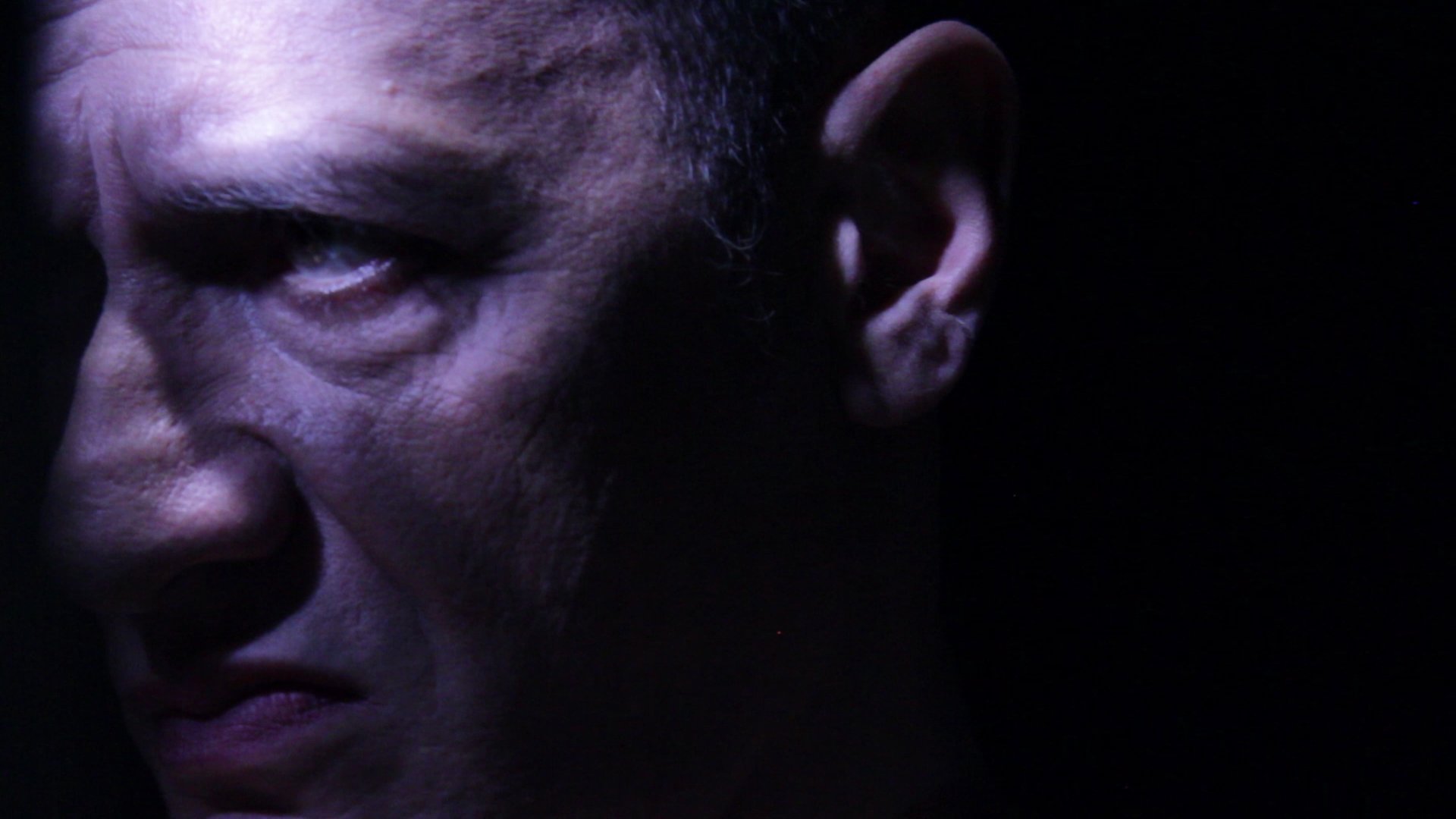
Drama film, by Valerio De Filippis, Italy, 2019.
The mirror and the rascal is an experimental film based on the tragedy "Richard III" by William Shakespeare. It tells the delirium of contemporary power in an author's reinterpretation of cinema, video art and music. The protagonist, Richard Duke of Gloucester, brother of King Edward IV, through a long series of crimes eliminates all the obstacles that stand between him and the throne of England.
Valerio de Filippis, a well-known painter who has been following his research path for a long time, investigating the relationship between light, corporeality and the psyche. The mirror and the rogue and the cinematographic equivalent of Valerio De Filippis' painting, his figurative style is in fact very recognizable looking at his paintings. But cinema is a new way where the artist can also be involved as an actor and performer, with an original mix between acting and singing. Staging the dark side of the human soul, the film is a surreal and disturbing interpretation of a great classic. The director says: "The first suggestion was musical: I was interested in transforming the text of Shakespeare's tragedy Richard III into notes. I love cinema and at a certain point I felt that the time had come to combine research on the image of painting to my love for cinema and music. When the film is finished I realize that I have remained faithful to painting: every frame of the film appears to me like a painting: the same light, the same colors, the same atmosphere ". The mirror and the rascal is a kind of psychoanalytic session that the painter does while hiding behind the mask of Richard III. Behind this ferocious and unscrupulous character we find a path of self-analysis by De Filippis, who is mainly interested in the more violent and turbid aspects. An experimental film in which, with great courage, the author gets involved completely, fragmenting the images in an unconventional montage, which is at the same time a flow of consciousness and spectacle.
LANGUAGE: English
SUBTITLES: Italian
When God Lived in the Gold Leaf
There is a moment when you walk into a space so saturated with gold that your eyes cannot find shadow anywhere, and something happens to your body before your mind can intervene. Not wonder, exactly. Something closer to submission. The gold does not shine the way a lamp shines or the way a window lets in afternoon. It glows from within, directionless, sourceless, and you understand without being told that you are not supposed to ask where the light comes from. You are supposed to receive it.
This is precisely what Byzantine iconographers understood, and what most modern viewers, trained to admire their work as aesthetic achievement, fundamentally misread. The gold ground of a Byzantine icon is not a background. It is not a decorative choice or a stylistic convention. It is a theological statement about the nature of reality itself, rendered in beaten metal. When a craftsman in a Constantinople workshop in the ninth or tenth century applied gold leaf to the surface behind a holy figure, he was not embellishing. He was abolishing. He was erasing the world of contingent, directional, earthly light and replacing it with something that had no source because it needed none. It was the light before light, the emanation that preceded the sun.
Mircea Eliade, writing in The Sacred and the Profane in 1957, described hierophany as the act by which something sacred manifests itself, erupts into ordinary space and makes it irreducible to anything else. The sacred does not decorate profane space. It ruptures it. What Eliade understood, and what the Byzantine theological tradition had been practicing for centuries before anyone named it philosophically, is that certain forms of visual construction are not representations of the holy. They are the holy, inserted into matter. The gold ground is hierophany made permanent, a rupture in the fabric of ordinary seeing that cannot be patched back over.
A man carries a lantern through corridors of a palace where every surface is gilded, every vault covered in mosaic, and the light he holds in his hand is absurd, redundant, almost offensive, because the walls themselves emit something that makes his small flame look like an act of doubt. He moves through spaces that do not need him to illuminate them. The light here is not serving human purposes. It is asserting divine ones. He is moving through a theological argument.
This is the critical distinction that separates medieval luminosity from everything that came before and after. Greek and Roman art played extensively with shadow, with modeled light that implies a source, a sun outside the frame, a torch somewhere to the left. That directionality is profoundly human. It places the viewer in a world governed by physics, by position, by time of day. Byzantine art refuses this entirely. The scholar Otto Demus, in his foundational study Byzantine Mosaic Decoration from 1947, noted that the gold ground creates what he called an “iconic present,” a temporal suspension in which the image does not exist in history but outside it. The gold makes time impossible. And when time is impossible, causality is impossible. And when causality is impossible, you cannot ask who put the light there or why it falls as it does, because it does not fall. It simply is.
This was not an innocent choice. It was a political one, in the deepest sense of that word. The emperor in Byzantine iconography is frequently depicted with the same gold ground as Christ and the saints, the same sourceless luminosity surrounding his image. Carl Schmitt argued in Political Theology, as early as 1922, that all significant concepts of the modern theory of the state are secularized theological concepts. The Byzantine tradition proves the reverse is also true: theological concepts were always already political ones. The gold that signified divine presence also signified unchallengeable power. You do not argue with sourceless light. You do not find its switch and turn it off. You either accept it as the nature of reality or you find yourself outside reality entirely, which is another way of saying you find yourself outside the social order, the empire, the world as constructed and maintained by those who controlled the workshops, the mosaicists, the gold.
A woman kneels before an image and cannot see her own shadow anywhere in the room.

Caravaggio’s Knife
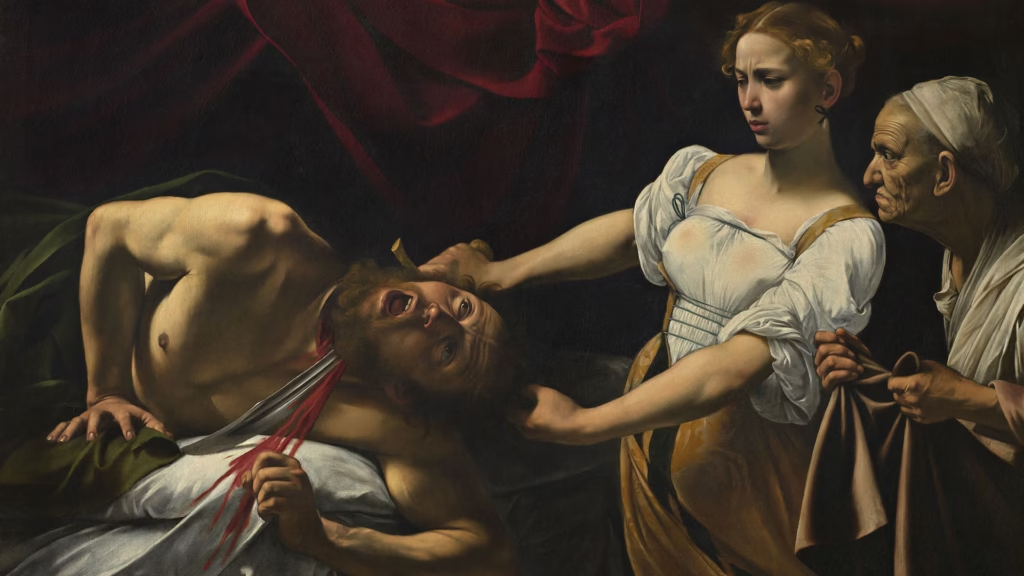
There is a moment you know from experience, not from reading about it, when a light comes on in a room you thought you understood. Not a gradual brightening but a sudden, lateral slash of illumination that catches things you were not supposed to see: the expression on someone’s face before they composed it, the object left where it should not be, the evidence of a life that does not match the story being told. That moment is not cinematic. It is ancient. It is the visual grammar Caravaggio invented, or rather excavated, from somewhere underneath the surface of polite representation.
Around 1600, something tore open in European painting. It was not a refinement. It was not the next logical step in the development of Renaissance luminosity. The light that begins arriving in Caravaggio’s canvases comes from outside the known world of the picture, from a source never shown, never explained, never sanctified by theological convention. It strikes from the upper left like a blade, and what it reveals is not the radiant flesh of idealized figures but dirty fingernails, cracked heels, the worn calluses of men who work with their hands. The apostles look like laborers because they were laborers. The angels look uncomfortable because divinity, rendered this way, offers no comfort.
Michel Foucault, writing about the archaeology of visibility in his 1966 work The Order of Things, argued that every episteme produces its own regime of what can be seen and what must remain invisible. Representation is never innocent. It is always an agreement, negotiated silently, about what counts as real, what deserves to appear, what must be kept in shadow to preserve the coherence of the social order. Caravaggio did not simply change how light behaved in painting. He violated the agreement. He exposed what the agreement had been hiding.
Walter Benjamin understood something adjacent to this when he wrote, in his 1935 essay The Work of Art in the Age of Mechanical Reproduction, about the aura — that quality of distance and untouchability that sacred and high art had always maintained. The aura is not a mystical property. It is a social technology. It keeps the viewer at the correct distance, in the correct posture, inside the correct relationship of deference. What Caravaggio’s tenebrism does is collapse that distance violently. The light does not invite contemplation. It forces confrontation. You are not standing before a sacred image in a state of reverent elevation. You are in the room. The room is dark. Something has just been revealed.
Think of a scene where someone carries a lantern into a cellar and discovers that the walls are covered in evidence of something long denied. There is no grace in that moment. The shadows retreating are not decorative. They are the architecture of concealment, and the light is not beautiful, it is simply merciless. This is what Caravaggio understood that his predecessors, for all their technical brilliance, refused to understand: that light, used honestly, is not a gift. It is a demand.
The social rupture was immediate and documented. His first version of Saint Matthew and the Angel was rejected by the church that commissioned it. The saint’s crossed bare legs, the dirty foot thrust toward the viewer, the angel gripping his hand like a carpenter guiding a novice — all of it was unacceptable. Not because it was technically deficient but because it was too accurate. Holiness rendered in this light ceased to function as consolation and began functioning as exposure. The gap between what the institution proclaimed and what the bodies it claimed to represent actually looked like became, suddenly, visible.
Pierre Bourdieu would later formalize this as the logic of symbolic capital — the way aesthetic choices always encode social positions, and the way disrupting aesthetic convention disrupts the hierarchies those conventions silently maintain. But Caravaggio did not need the theory. He had the knife, and the angle of the light, and the patience to wait until the moment when the face, caught unaware, could no longer pretend.
Vermeer’s Window and the Lie of the Ordinary
There is a particular kind of morning light you have probably stood inside without naming it. It comes through a single window, falls across a table, catches the edge of a glass or the fold of cloth, and for a moment the room feels like it means something. Like the arrangement was intentional. Like someone composed it. That feeling is not accidental. It was built for you, slowly, over centuries, until it became so deep inside your perception that you no longer notice you are inside a construction.
Jan Vermeer worked in Delft in the 1660s and 1670s, producing perhaps forty-five paintings in his lifetime, almost all of them variations on the same architecture of feeling: a room, a window on the left, a figure — usually a woman — caught in the act of reading, pouring, weighing, waiting. The light arrives from outside but never takes you outside. It illuminates the interior and keeps you there. Svetlana Alpers, in her 1983 study The Art of Describing, argued that Dutch painting of this period was not simply a depiction of the world but a particular technology of seeing, one that mapped, measured and possessed its subjects rather than narrating them. The Dutch image, she wrote, was an image of surfaces, of things knowable through their visible properties. But what Alpers names as epistemology is also, if you press it, politics. To frame a woman by a window and fill her with light is not to liberate her. It is to locate her precisely.
Simon Schama, in The Embarrassment of Riches published in 1987, reconstructed the moral architecture of the Dutch Golden Age interior with almost anthropological care. The home in seventeenth-century Dutch culture was not a private retreat from the world. It was the world’s proof of itself. Cleanliness, order, the careful management of light and threshold — these were not domestic habits but civic and theological statements. The bourgeois interior was a moral universe with walls. And the woman inside it, luminous and contained, was simultaneously its inhabitant and its evidence. She demonstrated, by her very posture in the light, that virtue was real and visible and located in the management of domestic space.
You have seen this composition somewhere else entirely. A woman stands at a window in a small apartment, the street noise rising from below, and she does not move. The light defines her from one side, leaves the other half in shadow. She is not looking at you. She is looking at the space between inside and outside, which is to say she is looking at exactly the condition she is in, without being able to name it. The frame — the literal frame of the window — organizes her. Someone watching her from across the room would call it beautiful. What it is, is a structure. The light is real. The beauty is real. The enclosure is also real, and it is the thing no one mentions.
Vermeer understood, at some level that may not have been entirely conscious, that light could function as both gift and argument. To bathe a figure in warmth is to make the space she inhabits feel chosen, sanctified, correct. The ideology does not announce itself. It arrives as luminosity. Alpers was right that Dutch art described rather than narrated, but description is never innocent — every act of careful observation contains a hierarchy of what deserves to be seen and what remains outside the frame, unnamed, unlit, unworthy of the window.
The woman reading a letter in the yellow morning light is not simply a woman reading a letter. She is the proof that this room, this life, this arrangement of furniture and obligation and glass light is sufficient. The letter she holds might say anything. It might be asking her to leave. But the light that falls across her hands holds her there, in the painting, in the room, in the argument that the domestic is sacred and that the sacred, by definition, does not require escape.
Impressionism Was a Nervous Breakdown
There is a moment, familiar to anyone who has stood too long in afternoon sun, when the world stops being legible. The outlines of things — a wall, a face, the edge of a building — begin to breathe, to soften at their borders, and suddenly you are not sure whether you are seeing the thing or the light that surrounds it. This is not a poetic experience. It is mildly terrifying. The categories by which you have been navigating the world — solid, separate, nameable — turn out to be provisional agreements, not facts.
Claude Monet spent two years returning to the same spot in front of the Rouen Cathedral, between 1892 and 1894, producing thirty paintings of the same façade under different conditions of light. This is usually presented as a triumph of observation, as evidence of an almost scientific dedication to the real. But look at what actually happened across those thirty canvases: the cathedral dissolves. The stone does not accumulate detail; it loses it. By the time Monet reaches the fog series, the façade is barely distinguishable from the atmosphere surrounding it. The building has not moved. The painter has simply admitted, canvas by canvas, that light does not clarify. It erodes. What he painted, ultimately, was not Rouen Cathedral. He painted the impossibility of painting Rouen Cathedral.
Henri Bergson, writing in 1889 in his Time and Free Will and developing the argument throughout Matter and Memory in 1896, proposed that Western thought had committed a fundamental error by treating time as a series of frozen instants — as though experience were a film strip, each frame separable from the next. What he called durée, lived duration, is precisely the opposite: a continuous flow in which moments interpenetrate, in which the past is never over because it is still pressing into the present. Monet’s serial method was, without intending it to be, a philosophical demonstration of this argument. The thirty Rouen Cathedrals cannot be reduced to one authoritative image precisely because duration refuses to be stilled. Each canvas is a different cathedral not because the building changed, but because perception is never instantaneous. You are always arriving at the thing while the thing is already becoming something else.
This is what makes Impressionism not a liberation but a crisis. Think of a man who has spent a decade certain about his life — his marriage, his place in the world, the meaning of his daily routines — and who then, under some unfamiliar quality of light in a foreign city, a particular slant of afternoon that he cannot name, suddenly cannot locate the version of himself that made those certainties feel solid. He is standing in plain sight, in ordinary streets, and the familiar self has slipped somewhere he cannot find it. The brightness is not comforting. It is the medium of dissolution.
Maurice Merleau-Ponty, in his Phenomenology of Perception published in 1945, argued that we do not perceive the world as detached observers receiving data. The body is the site of perception; the flesh is already implicated in what it sees. This means that vision is never neutral, never purely informational. When light changes, the perceiving body changes with it. This is why over-bright or shifting light produces something closer to vertigo than to insight. You feel it in the body before you understand it in the mind — the slight nausea of certainty undone, the sensation of grasping for an edge that keeps moving.
What the Impressionists discovered, and could not fully name, was that the tradition they inherited — the tradition of fixed form, stable outline, light as the servant of clear representation — had been a polite fiction. A way of pretending that the eye could hold the world still long enough to own it. The dissolution of solid form in Impressionist painting is not a stylistic choice. It is a confession. Western painting, at that moment, admitted that it had been lying about what seeing actually is, and the admission arrived not as a philosophical proposition but as color bleeding past its edges on canvas, as a cathedral that the more carefully you looked at it, the less
A vision curated by a filmmaker, not an algorithm
In this video I explain our vision
The Screen Is the New Sun and It Is Burning Us
You look at your own face in the dark reflection of a phone screen before the interface lights up, and for a fraction of a second you see something closer to the truth than anything the fully illuminated version will show you. Then the screen floods on, and you disappear into your own brightness.
This is where the entire history of light in painting has been quietly heading. Not toward enlightenment in any spiritual sense, but toward this: a civilization so saturated with manufactured luminosity that darkness has become not a mystery to enter but a technical malfunction to correct. The painters who wrestled with shadow — who understood that what is withheld from light is not lost but preserved, held in a different kind of attention — were working in a tradition that the present moment has not surpassed but simply abandoned without noticing.
Byung-Chul Han, in his 2012 work “The Transparency Society,” identifies the pathology with surgical precision: a culture that equates visibility with truth, exposure with authenticity, and light with virtue has not liberated itself but has merely exchanged one form of coercion for another. The demand to be seen, to be legible, to emit rather than absorb, is not freedom. It is a new architecture of control built entirely from luminosity. When everything must be illuminated, shadow becomes not chiaroscuro but suspicion.
Guy Debord understood the infrastructure of this long before the smartphone existed. The spectacle he described in 1967 was never primarily about images. It was about the reorganization of social life around the logic of visibility — who produces light, who is bathed in it, who is rendered invisible by it, and who is simply blinded. The surveillance floodlight that bleaches a face into anonymity and the golden hour filter that renders a plate of food incandescent with false warmth are not opposites. They are the same gesture applied to different surfaces.
Think of a man sitting in a room where every wall is a screen, every screen showing a version of himself he did not choose, light pouring in from directions that have no source in nature, and the uncanny sensation that being watched and being seen are not the same experience at all. That vertigo is not metaphorical. It is the precise condition of existing in a world where the history of light has been privatized and turned into a delivery mechanism for attention economics. The great painters knew that to paint light was to make a theological and political argument simultaneously. Caravaggio’s shadows protected his subjects as much as they dramatized them. Rembrandt’s pools of warmth were selective precisely because he understood that indiscriminate illumination is not generosity but erasure.
The Instagram-optimized golden hour is, in this sense, the final perversion of a tradition that once knew how to reverence the specific angle at which late afternoon sun enters a modest room and changes everything it touches. Now that angle is reproduced algorithmically, stripped of its contingency, its once-ness, its fidelity to a particular place and skin and breath. It becomes a filter. A mood. A product.
And the cinema projector beam that cuts through a darkened theater — that last surviving ritual where a community agrees to enter darkness together and receive light from a single source they did not manufacture — even that is being gradually replaced by the private glow of a screen held six inches from the face, alone, in a room that is never quite dark enough to allow the full surrender that revelation requires.
The history of light in painting is also, finally, the history of who gets to decide what is worth illuminating and who must remain in the peripheral dark that no one has been paid to render visible. Every era has answered that question according to its own hierarchies of power and desire. Ours answers it through the logic of engagement metrics, platform architecture, and the monetization of attention — which means the answer has never been more total, more invisible as a choice, or more mistaken for nature itself.
✨ Light, Symbol, and the Gaze Through Art
Light has never been merely a physical phenomenon in the history of art — it is a theological argument, a philosophical stance, and an emotional language. From Byzantine gold grounds to Caravaggio’s chiaroscuro, the way painters handle illumination reveals entire worldviews. These articles explore the artistic and spiritual territories most intimately connected to the symbolism of light in painting.
Caravaggio: Life and Works
Caravaggio revolutionized Western painting by transforming light into a dramatic moral force, pulling figures from absolute darkness with an almost violent luminosity. His tenebrism was not merely a stylistic choice but a theological statement about grace, sin, and the sudden intervention of the divine. Understanding Caravaggio is essential for grasping how light in painting became a carrier of psychological and spiritual meaning.
GO TO THE SELECTION: Caravaggio: Life and Works
Baroque Art: History and Characteristics
Baroque art as a whole developed an unprecedented obsession with the interplay of light and shadow, using illumination to generate movement, emotion, and spiritual awe in the viewer. From Rubens to Rembrandt, Baroque painters deployed light as a narrative instrument capable of evoking the presence of God or the weight of human suffering. This article provides the historical and aesthetic framework within which light became painting’s most powerful symbolic tool.
GO TO THE SELECTION: Baroque Art: History and Characteristics
Christian Iconography: History and Symbolism
Christian iconography established the foundational codes through which light was interpreted as divine presence, sanctity, and transcendence in Western art for over a millennium. The golden halo, the radiant mandorla, and the luminous angel all belong to a precise visual theology that painters inherited and transformed across centuries. Exploring these symbols is indispensable for reading the deeper meaning behind the use of light in religious painting.
GO TO THE SELECTION: Christian Iconography: History and Symbolism
Erwin Panofsky: Life and Iconology
Erwin Panofsky’s iconological method gave art historians the tools to decode the layers of meaning hidden beneath visual forms, including the symbolic use of light in painting across different eras and cultures. His distinction between iconography and iconology invites us to ask not just what light represents, but why a particular culture needed it to represent that meaning at that historical moment. Panofsky’s approach remains one of the most rigorous frameworks for interpreting the spiritual and philosophical dimensions of pictorial light.
GO TO THE SELECTION: Erwin Panofsky: Life and Iconology
Discover the Language of Light on Indiecinema
If the symbolism of light in painting has sparked your curiosity, Indiecinema is the streaming platform where that curiosity finds its cinematic home. From avant-garde visual essays to deeply spiritual documentaries, Indiecinema gathers independent films that explore art, beauty, and the invisible forces shaping human experience. Join us and let the light guide you further.
👉 EXPLORE THE CATALOG: Watch Indie Films in Streaming
A vision curated by a filmmaker, not an algorithm
In this video I explain our vision

