
The Wound Before the Canvas
You are standing in front of a painting and something is wrong. Not wrong in any way you can name immediately — the light is fine, the room is not too cold, you slept well enough — but your chest has tightened and your breathing has shifted without your permission. The figure before you is enormous, contorted, reaching toward something outside the frame with a desperation that feels almost embarrassing to witness. The shadows are not decorative. They are structural, architectural, load-bearing in some way you cannot explain with the vocabulary you have. You step back. The painting follows you.

This is not aesthetic pleasure. This is something older and less negotiable.
What you are feeling is not accidental. It was calculated, rehearsed across decades of theological panic and political reorganization, refined by painters who understood that the body processes certain kinds of visual information before the conscious mind has any say in the matter. The tightness in your chest is not a response to beauty. It is a response to engineering — specific, historically located, ideologically motivated engineering that began in earnest in the second half of the sixteenth century and did not release its grip on European visual culture for well over a hundred years.
The Baroque did not emerge from inspiration. It emerged from crisis.
In 1545, the Catholic Church opened the Council of Trent in response to a Protestant Reformation that had spent twenty years dismantling the institutional monopoly on spiritual meaning that Rome had held since Constantine. The Council would not close until 1563, and what came out of it was not merely doctrinal clarification. It was a theory of perception as a weapon. The Church fathers understood, with a sophistication that secular culture would not rediscover until the twentieth century’s attention economy, that belief is not primarily an intellectual act. It is a somatic one. You do not reason your way into faith. You feel it, in the gut, in the sternum, in the involuntary contraction of muscles you did not know you were holding tense.
The decree on sacred images issued in the Council’s final session was brief but its implications were vast. Art was to move the faithful. Not instruct them, not merely represent theological narratives, but pierce them — penetrate their emotional defenses and deposit something irreversible on the other side. The word the theologians used was compunction, from the Latin compungere, to puncture. Art as wound. The canvas as instrument of productive injury.
What followed over the next century and a half was the most deliberate, coordinated aesthetic program in Western history. The painters and architects and sculptors who would become the Baroque masters were not free agents expressing inner visions. They were operatives inside a project of reconquest — cultural, spiritual, political — and the techniques they developed, the violent diagonals, the suffocating darkness interrupted by inexplicable light, the faces twisted between agony and rapture, the bodies that refuse the dignity of stillness, were not stylistic preferences. They were functional specifications.
Georg Wilhelm Friedrich Hegel, in his Lectures on Aesthetics delivered in Berlin in the 1820s and published posthumously in 1835, described the history of art as the progressive externalization of spirit, each age finding the forms that correspond to its inner necessity. The Baroque, on this reading, is not excess for its own sake. It is the precise external form of a specific historical interior — an interior defined by rupture, by the terror of losing doctrinal coherence, by the urgent need to make people feel something true before they had time to think something heterodox.
You stepped back from the painting. The painting followed you. That is not metaphor. That is the mechanism working exactly as intended, across four centuries of distance, in a room with climate control and a gift shop downstairs.
The Church Needed a Weapon
Imagine walking into a church in Rome sometime around 1600. You have not come seeking beauty. You have come because not coming carries consequences you prefer not to test. But the moment you cross the threshold, something happens to you that has nothing to do with faith and everything to do with engineering. The ceiling is not a ceiling. It breaks open into a painted sky where saints spiral upward through clouds that look more solid than the stone beneath your feet. Light enters from a hidden source, striking a gilded altar at an angle that seems less like architecture and more like divine intervention timed for your arrival. Your body reacts before your mind can form a question. This is not accident. This is policy.
The Council of Trent, which met in three grueling phases between 1545 and 1563, did not produce a theology of beauty. It produced a strategy. The Protestant Reformation had made a devastating argument: the institutional Church was corrupt, its rituals empty theater, its images idolatry dressed in gold. What Luther and Calvin had understood, and what terrified Rome, was that once you teach people to read the Bible for themselves, once you hand them the right to interpret, you have surrendered the monopoly on meaning. The response from Trent was not to simplify or to reason. It was to overwhelm.
Erwin Panofsky, whose iconological method trained generations of art historians to read images as systems of embedded meaning rather than decorative surfaces, understood that the choice of visual vocabulary in religious art was never innocent. Every gesture, every attribute, every compositional decision carried doctrinal weight. What Baroque painters and architects deployed after Trent was not a style in the aesthetic sense. It was a controlled vocabulary designed to produce specific psychological states in specific populations. The luminous body of a martyr twisting in ecstasy, the dramatic foreshortening that pulls your gaze inward and upward, the theatrical staging of miraculous events as though witnessed through a window onto something happening right now — none of this is expression. It is instruction delivered through sensation rather than language.
Michel Foucault‘s analysis of power reminds us that the most effective systems of control are those that do not announce themselves as control. What Discipline and Punish maps across prisons and hospitals and schools applies with unsettling precision to the Counter-Reformation church interior: the arrangement of space produces subjects. You do not walk into a Baroque nave and remain who you were. The architecture redistributes your attention, your posture, your emotional availability. By the time a sermon begins, the room has already done most of the work.
The target audience was not the already faithful. The Church had largely lost the theologians. What remained, and what needed to be held, was the mass of people whose relationship to religion was physical and habitual, rooted in ritual and image rather than doctrine. These were the minds contaminated, from Rome’s perspective, by the slow leak of Protestant rationalism — the growing suspicion that the man behind the altar was just a man, that the miracle was just a story, that the gold was just melted metal. Against this suspicion, argument was insufficient. What you needed was something that bypassed argument entirely, that hit the nervous system before the skeptical mind could organize its defenses.
A woman kneels in a chapel and looks up at a figure collapsing in divine rapture, marble rendered so soft it seems to breathe, light falling from above onto a face expressing something between agony and pleasure that has no name in ordinary experience. She does not reason her way back to faith. She is returned to it through her body. That is the weapon. That is the whole point. And it worked with a precision that no amount of theological debate could have achieved, because it was never really about what you believed.

Caravaggio‘s Dirty Feet
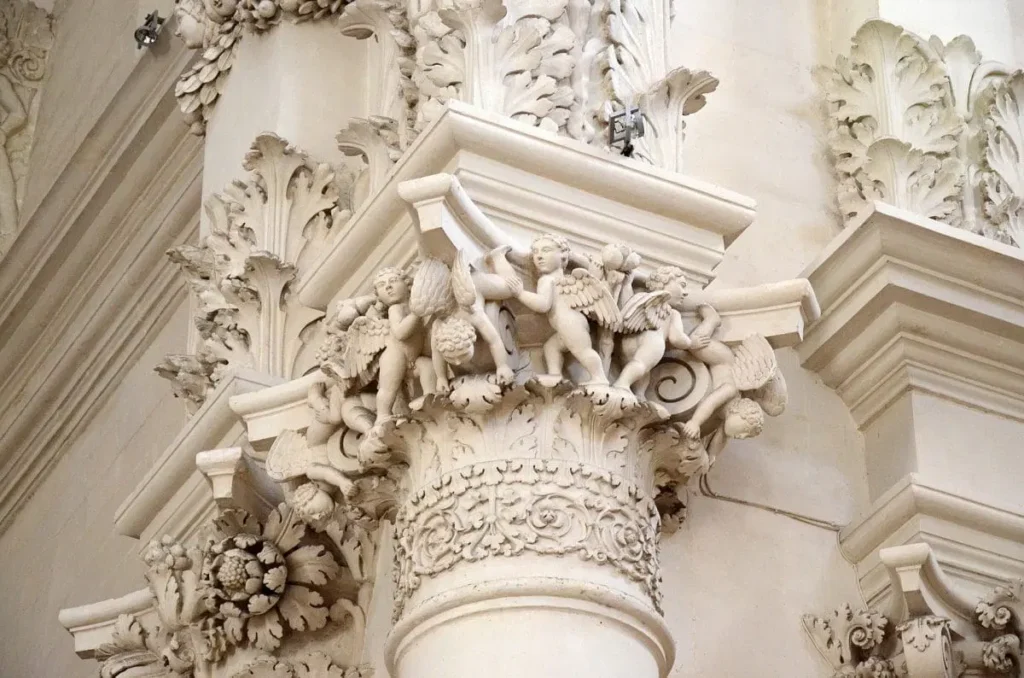
You have seen those feet before. Not in a museum, not in a church — on the bus, on a construction site, in the kitchen of someone who has been standing for twelve hours. Cracked heels, darkened soles, the kind of grime that does not wash out in one sitting. The feet of someone who works the earth rather than inherits it. And then one day you stand in front of a canvas where those exact feet belong to a saint, extended toward you with almost aggressive intimacy, and something in your chest does something unexpected.
Caravaggio painted the poor the way the poor actually looked. Not ennobled, not idealized, not lifted into the soft geometry of Renaissance grace. The Virgin Mary with swollen ankles. The apostles with hands like leather, knuckles enlarged from decades of net-pulling or stone-cutting. Saint Matthew as a man who looks genuinely alarmed that God has chosen him, because men like him are never chosen for anything good. The Church authorities who commissioned these works frequently rejected them. The Death of the Virgin was refused because the model looked too much like a drowned woman — which she was, a woman pulled from the Tiber. The Madonna di Loreto caused outrage because the pilgrims kneeling before her had dirty feet, and Caravaggio had painted those feet in the foreground, insisting you look at them before you look at her face.
This is where Arnold Hauser becomes indispensable. In his monumental Social History of Art, published in 1951, Hauser argued that the Baroque style was not a spontaneous spiritual flowering but a calculated instrument of the Counter-Reformation. The Council of Trent, concluded in 1563, had identified clearly that the Protestant challenge was partly a challenge of distance — the Church had made God too abstract, too Latin, too architectural, too far away. The response was not to democratize the institution. The response was to democratize the imagery while keeping the institution entirely intact. Make the peasant feel seen in the painting so he does not question who owns the building that houses it.
This distinction matters more than it might appear. There is a profound difference between being represented and being included. Caravaggio‘s dirty feet gave the laborer the shock of recognition — that electric, almost physical sensation of seeing yourself where you never expected to exist. But recognition is not power. It is, in fact, one of the most effective mechanisms of pacification ever devised. You recognize yourself in the image, you feel that the Church sees you, you feel belonging, and in that belonging you stop asking who controls the land, who collects the tithe, who decides which prayers are correct. The emotional transaction is completed before the political question can even form.
Hauser called this seduction rather than reform, and the word is precise. Seduction works by making you feel desired. It does not transfer any actual authority to you. The Baroque altarpiece said to the illiterate farmer: look, God has feet like yours, God’s mother has your mother’s exhaustion in her face. It said nothing about the structure that required your exhaustion in the first place.
What Caravaggio himself understood about this transaction is harder to say. He was not a man of ideological projects. He was a man of violent immediacy, of tavern brawls, of a papal pardon requested after a killing, of a life that moved between genius and catastrophe with no apparent awareness that these were different registers. His realism may have been instinct rather than argument. But instinct, when it serves a system, serves it just as efficiently as intention. The flesh he painted with such pitiless accuracy was real flesh. The use that flesh was put to — the theological, political, emotional use — was someone else’s calculation entirely.
Light as Ideology
You have sat under a lamp like that. Maybe not in an interrogation room, maybe just in a kitchen at two in the morning when someone needed the truth from you and pulled a single overhead bulb into the space between your faces. Half of you disappeared. Your left cheek, your temple, the corner of your mouth where the hesitation lives — all of it swallowed by dark. The person across from you could only see what the light chose to give them. And that, precisely, is not a coincidence of interior decoration. That is an epistemology.
The painters of the seventeenth century understood something that philosophy would take another three hundred years to articulate fully: that illumination is never neutral. Light does not reveal. Light selects. When a figure emerges from absolute black — and in the most radical tenebrism it is absolute, a darkness with no ambient softening, no twilight, no gradation — the painter has already made a theological and political decision about what constitutes reality. The darkness is not the absence of the scene. The darkness is the scene’s argument.
Walter Benjamin, assembling his unfinished monument to capitalist spectacle in the Passagen-Werk through the 1930s, kept returning to the idea that illumination functions as ideology precisely because it presents itself as mere visibility. To light something is to claim it as self-evident. The lit object appears to need no justification, no framing, no editorial choice. It simply is, and you simply see it. Benjamin understood that this naturalization of selective visibility is among the oldest instruments of power. The arcade, for him, was a space where commodity culture staged its phantasmagoria under artificial light, making desire feel like perception. Baroque chiaroscuro does this with the sacred, and later with the secular, three centuries before the shopping gallery was invented.
Think of a man in a chair, a lamp angled at his face from slightly above, his interrogator standing in the surrounding darkness. The man’s face is divided almost surgically: one side fully exposed, every pore, every bead of sweat, the involuntary tightening around the eye — and the other side simply gone, not in shadow but in erasure. The person asking the questions has chosen what to see. They have also chosen, by where they placed themselves, to remain unseeable. Power is always in the dark half of the frame. This is not a modern invention. Caravaggio knew it before there were electric lamps or police procedurals. The technique called tenebrism — from the Italian tenebroso, obscure, murky — was never purely aesthetic. It was a theory of how knowledge gets constructed and distributed.
The Baroque period emerges in roughly the 1590s and burns through the seventeenth century and into the early eighteenth, and the violence of its light is inseparable from the violence of its historical moment. The Counter-Reformation needed an art that did not reason but overwhelmed. Chiaroscuro is the visual equivalent of a verdict delivered before the trial. You do not argue with the lit figure emerging from darkness. You believe it, or you feel the inadequacy of your disbelief. The Church had learned, painfully, that doctrine alone could not hold a population that had seen other doctrines. It needed something that bypassed argument. It needed the body’s response to sudden light in darkness, which is older than language and harder to refuse.
What is visible is holy. What is hidden is either corrupt or too sacred to be seen directly. Both exclusions serve the same function: they keep the viewer from asking what exists in the dark half of the frame. And the dark half of the frame is always larger than the lit portion. In every Baroque composition, the shadow occupies more space than the light. That arithmetic is not accidental.
The Body as Argument
You have watched someone you love in a moment they did not know you were watching. Maybe they were reading, or laughing at something private, or simply standing at a window with their back to you. And something in your chest moved before you could name it, before any thought arrived to explain or contain it. Your body responded to their vulnerability the way it responds to music — not through judgment, not through choice, but through an involuntary opening that felt, in the same instant, both intimate and slightly unbearable. You felt moved. You also felt, somewhere beneath that, the faint discomfort of having been moved without your consent.
This is precisely the mechanism that the sculptors and architects of the seventeenth century were engineering in marble and gilded wood and concealed light sources. Not metaphorically. Literally. A woman lies on a cloud, her body collapsed inward in a posture that any contemporary observer would recognize — the head thrown back, the mouth slightly parted, the robes gathered in folds that seem less like cloth than like the visible record of a convulsion. An angel stands beside her, holding a golden arrow. The expression on her face is impossible to classify as either suffering or pleasure, which is precisely the point, because the entire composition is constructed around the theological argument that the distinction does not hold. Above her, hidden from direct view, a skylight pours real light onto gilded rods suspended behind the figures, so that the illumination appears to come from within the scene itself, from some source outside ordinary nature. The bodies in the marble seem not to be observed but to be radiating.
Georges Bataille wrote, in his 1957 study “Erotism: Death and Sensuality,” that the experience of the sacred and the experience of erotic dissolution are structurally identical — both involve what he called “the dissolution of constituted forms,” a temporary rupture in the boundary between self and world that the rational mind cannot accommodate without anxiety. He was not making a provocative claim for its own sake. He was describing something that religious institutions had understood intuitively for centuries and that secular modernity had made very difficult to say plainly: that the body does not experience transcendence differently from the way it experiences desire. The nervous system does not file them in separate drawers. The shudder is the same shudder.
What neuroscience would eventually articulate through Antonio Damasio’s work on somatic markers — his 1994 “Descartes’ Error” and the research that followed — is that the body produces responses in advance of conscious processing. Emotion is not a commentary on experience. It precedes cognition and shapes what cognition is even able to see. The seventeenth century had no vocabulary for mirror neurons or limbic system activation, but the artists working within the Baroque tradition were effectively applying that knowledge through observation. They knew that if you placed a human body in a posture of extreme vulnerability or ecstatic surrender, and surrounded it with light and height and the physical disorientation of curved space, then the body of the viewer would respond before the viewer’s theology could intervene to supervise that response. The proof of the divine was not being offered to the intellect. It was being delivered to the musculature.
This is what distinguishes Baroque sculpture from mere decoration, and also from propaganda in the crude sense. Propaganda addresses the mind through symbols. What was happening here was more intimate and considerably less polite — it was the deliberate manufacture of involuntary experience, the construction of an encounter in which you feel something you did not decide to feel, and then find yourself standing inside that feeling, already changed, looking for a reason that came after the fact.
A vision curated by a filmmaker, not an algorithm
In this video I explain our vision
Rubens, Velázquez and the Politics of the Flesh
You are standing in a room, looking at a painting, and you realize with a slow and disorienting certainty that the figure in that painting is looking back at you. Not at the wall behind you, not past your shoulder. At you, specifically, as if you arrived late to a scene already in progress and your entrance has been noted.
This is not a metaphor for aesthetic pleasure. This is the precise structure of power that the court painter was required, contractually and existentially, to embed inside the painted surface. The canvas was never a neutral record of what existed. It was an argument about who had the right to exist in a particular way, with a particular weight, in a particular light.
Peter Paul Rubens understood this with the clarity of someone who was also a diplomat. Between 1622 and 1625 he produced the twenty-four-painting cycle commissioned by Marie de’ Medici for the Luxembourg Palace, a project of such political audacity that it dressed a widowed queen’s struggle for regency in the costume of classical mythology. The bodies in those paintings are not merely large. They are arguments. The flesh presses against the frame, overflows decorum, insists on itself with a physical rhetoric that Rubens deployed as consciously as a lawyer deploying precedent. Michel Foucault, writing in Discipline and Punish in 1975, identified power as something that operates not through repression but through production — it produces bodies, gestures, desires, visibility. Rubens’s canvases are power producing bodies in real time. Every roll of skin, every foreshortened limb, every cascade of fabric is a political statement dressed as sensory abundance.
The Spanish context produced something colder and more vertiginous. A man stands in a large studio, brush in hand, pausing at a canvas whose face is turned away from us. Around him, a young princess, her attendants, a dog, a dwarf, a dimly visible doorway through which a figure pauses mid-step. On the far wall, half-dissolved in shadow, a mirror reflects two faces that should not logically be visible from where we stand. The painter is painting us. Or painting whoever we have become by standing in this spot. The geometry of the gaze folds back on itself so completely that Jonathan Brown, in his 1986 study of the painter, described it as a meditation on the nature of representation itself. But representation is never innocent of its institutional context, and the institutional context here was the court of Philip IV, a monarchy in slow fiscal collapse maintaining its dignity through the aggressive production of images.
Foucault returned to this specific painting in The Order of Things, published in 1966, using it as the opening through which to interrogate the classical episteme’s relationship between the seeing subject and the seen world. His reading is precise and disturbing: the painting makes visible the very mechanism it uses to construct visibility. The royal couple appears only as a reflection, displaced, uncertain, perhaps a projection of the painter’s imagination or perhaps of ours. Power is present but unlocatable. It is everywhere the gaze travels and nowhere it lands.
This is what distinguishes the Northern and Southern Baroque not as aesthetic preference but as political theology. Rubens’s allegories declare power openly, wrap it in gold and muscle and divine endorsement. The Spanish painter performs something more unsettling: he reveals that the watcher and the watched are exchangeable roles, that surveillance operates through the very act of looking that you believed was your own free choice. You thought you were examining the painting. The painting has been examining you since before you entered.
The court painter was never a servant to power the way a footman serves dinner. He was the mechanism through which power became legible to itself, through which a dynasty confirmed its own reflection and found it, if not beautiful, then at least undeniable.
What the Theatrum Mundi Conceals
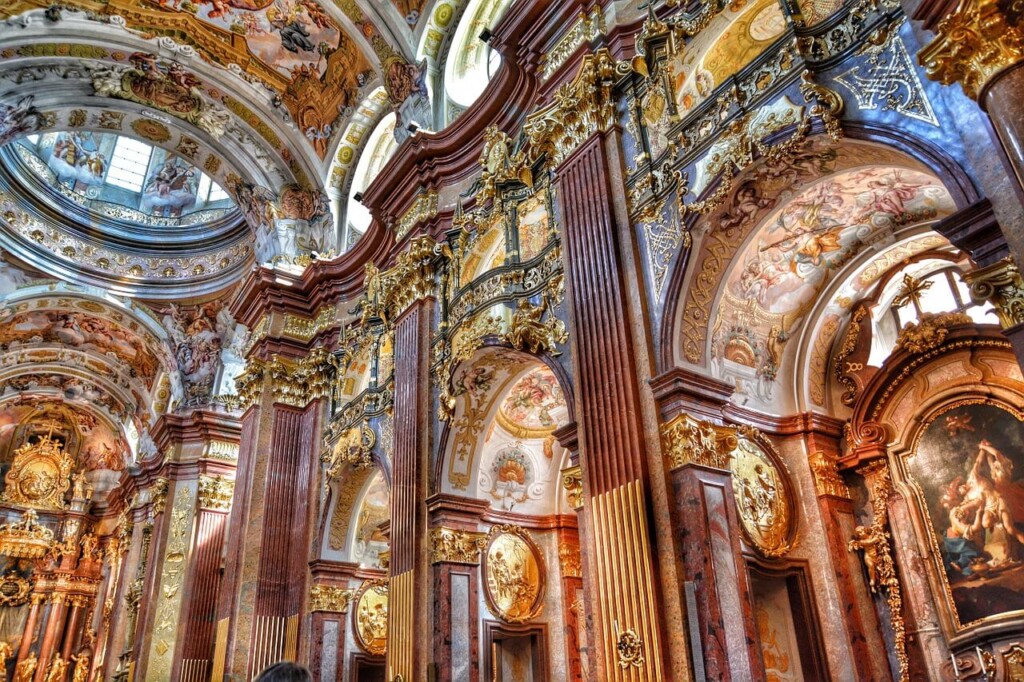
You are sitting in a church, any church built between 1620 and 1700, and the ceiling is doing something to you that you cannot immediately name. It is not simply beautiful. It is insistent. The painted figures above you are not resting in their frame — they are tumbling out of it, gesturing toward you, caught mid-flight in a drama that has no clear beginning and no visible end. The architecture itself seems uncertain whether it is solid or whether it is merely performing solidity. And then, gradually, you understand that this is precisely the point. You are not meant to simply look. You are meant to forget that looking and believing are different activities.
The theatrum mundi — the world as theater — is one of those ideas that sounds like a liberation and functions as a lock. The metaphor has ancient roots, appearing in Plato, resurging in the Stoics, threading through medieval Christianity, but it is in the Baroque period that it stops being a philosophical provocation and becomes something far more operative: an aesthetic policy, a governing principle of how power arranges perception. José Antonio Maravall, in his 1975 study of the cultural logic underlying this period, was precise about what was actually happening beneath the ornament. The Baroque, he argued, was not a spontaneous artistic flowering but a directed culture — directed by monarchies, by the Church, by the aristocratic orders — toward specific social ends. Illusion was not a consequence of the style. It was the instrument.
What Maravall identified with uncomfortable clarity was that the theatrum mundi concept, in its Baroque deployment, performed a very specific ideological operation. If all of existence is theater — if kings and beggars alike are merely players in a cosmic drama scripted by divine providence — then the particular arrangement of those players carries no special moral weight. The hierarchy is not a human construction subject to human revision. It is simply the role distribution of a play none of us wrote. To question the social order is, within this logic, as absurd as an actor stopping mid-scene to renegotiate the plot. The instability that was genuinely everywhere in the seventeenth century — wars of religion, economic crises, peasant revolts, the slow collapse of feudal certainties — is absorbed into a metaphysics of impermanence that makes every instability feel equivalent, and therefore makes no particular instability a sufficient reason to act.
There is a scene that stays with you. A man stands in an enormous hall, surrounded by mirrors that multiply him infinitely in every direction. He raises his hand and a thousand hands rise. He turns, and the thousand versions of him turn with him, each one slightly delayed, slightly wrong, until he can no longer identify which reflection is performing and which one is real. The horror of the moment is not the loss of self. It is the sudden recognition that this confusion has been engineered — that someone built the mirrors, someone calculated the angles, someone decided that this particular disorientation would be useful. The Baroque interior works exactly this way. Its infinite regress of illusions, its trompe-l’oeil heavens and theatrical altars, are not invitations to metaphysical wonder. They are instructions. They teach the body to experience grandeur as natural, complexity as inevitable, and the distance between itself and power as simply the way things appear in the performance of being alive.
Maravall was not making a cynical argument, or not only that. He was tracking the way a style of feeling gets manufactured into something that feels like truth. By 1975, with European fascism not even thirty years in the past, the question of how aesthetic overwhelming cooperates with political quietism was not academic. The Baroque churches had been built to produce a specific response in specific bodies: awe indistinguishable from submission, beauty indistinguishable from authority. That these two things kept being confused was not an accident of sensibility.
You Still Live Inside It
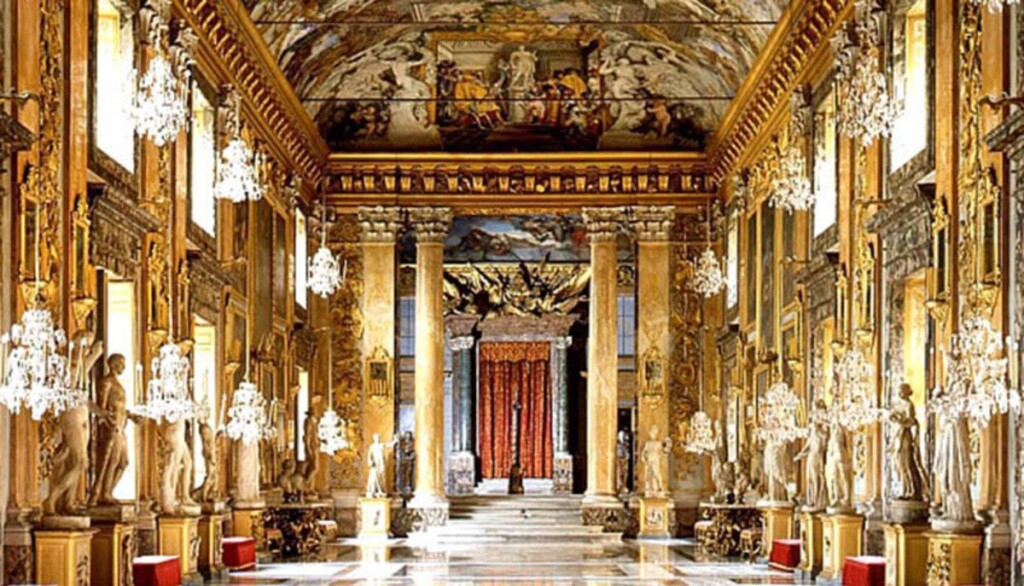
You are doing it right now, probably. The screen glowing, the thumb moving in that particular rhythm that is not quite searching and not quite resting — a continuous intake of images that arrive already saturated, already staged, already lit from below like altars. A video of a sunset over a coastline you will never visit, color-graded into something more golden than gold has ever been. A political figure caught in a moment of deliberate spontaneity, jaw set, light falling across the face at an angle that took three assistants to arrange. A product suspended in darkness, radiating its own luminescence, promising not utility but transformation. You scroll past all of it and feel, simultaneously, very small and somehow addressed personally, as though the vastness of what you are seeing has been engineered to find you specifically.
This is not a new technology. It is a new address for a very old grammar.
The core operations of the Baroque — the overwhelming of rational distance through sensory accumulation, the use of light to consecrate and darkness to threaten, the body caught at the precise instant of maximum emotional yield, the deliberate confusion of the personal and the universal — did not vanish when the seventeenth century ended. They migrated. They found new hosts. Walter Benjamin understood something essential about this when he wrote in 1935 about the artwork in the age of mechanical reproduction, arguing that what changes with technology is not the desire for aura but its production method. The Baroque manufactured aura through marble and gilded ceilings and the controlled acoustics of cathedrals. Contemporary spectacle manufactures it through compression algorithms and curated feeds and the science of the thumb-stopping image. The emotional architecture is identical. Only the building materials have changed.
Think of the moment a man sits in a dark room watching a figure on a screen move through a devastated landscape carrying a candle, walking toward something that may or may not be salvation, and the silence is so absolute and the image so total that he feels his own smallness as something almost sacred. That feeling — that particular combination of annihilation and elevation — was precisely what Bernini was engineering in Rome in 1652. The viewer was meant to be undone. The undoing was the point. Erasure of the self was not a side effect of the Baroque experience; it was the product being sold.
Guy Debord wrote in 1967 that the spectacle is not a collection of images but a social relation between people mediated by images. What the Baroque understood three centuries before Debord named it is that social relations are most effectively mediated when the images in question produce states of overwhelming feeling — awe, fear, desire, gratitude — that precede and preempt critical thought. You cannot analyze what has already made you gasp. The gasp is the mechanism. It does not matter whether the gasp is produced by a painted ceiling in a Roman church or by a sixty-second video designed by a team of behavioral psychologists to maximize what the industry calls engagement. The neurological event is the same. The political function is the same.
A woman scrolls past an image of suffering — vast, beautifully composed, the light doing exactly what light in a Caravaggio does — and feels moved. She feels genuinely moved. She shares the image. She has participated in something. She has, for a moment, been both witness and congregation, both individual and crowd. What she cannot easily see, because the feeling itself blocks the view, is whether the movement inside her is a response to the reality of another person’s pain or a response to the image’s skilled manipulation of the visual codes that her nervous system has learned, across a lifetime of images, to associate with significance.
And the terrible, open, unresolvable question is whether there is actually a difference between those two things, or whether being genuinely moved has always, in every century, been indistinguishable from being masterfully handled.
🎨 Art, Style & Aesthetic Vision Through the Ages
Baroque art did not emerge in a vacuum — it grew from the fertile soil of earlier Western artistic traditions, absorbing and transforming medieval spirituality, Renaissance humanism, and the bold stylistic experiments of the preceding centuries. Exploring the movements and masters that came before and alongside Baroque reveals how deeply interconnected the history of Western art truly is.
Romanesque Art: History and Characteristics
Romanesque Art laid the foundations for centuries of European artistic development, establishing a visual language rooted in sacred symbolism, monumental forms, and expressive figuration. Understanding its characteristics — from the heavy stone reliefs to the hieratic representation of holy figures — helps illuminate how later styles like Baroque inherited and dramatically transformed these visual conventions. The contrast between Romanesque restraint and Baroque theatricality is one of the most illuminating journeys in Western art history.
GO TO THE SELECTION: Romanesque Art: History and Characteristics
Romanesque Architecture: History and Main Examples
Romanesque Architecture, with its thick walls, rounded arches, and dimly lit interiors, created a spatial experience of divine mystery that would echo through centuries of European sacred art. Tracing its main examples — from French pilgrimage churches to Italian basilicas — reveals how architecture itself became a theological statement long before the Baroque age turned entire interiors into immersive theatrical spectacles. The evolution from Romanesque sobriety to Baroque exuberance tells the story of how the Church used space and beauty to speak to the faithful.
GO TO THE SELECTION: Romanesque Architecture: History and Main Examples
Titian: Life and Works
Titian stands as one of the supreme bridges between Renaissance harmony and the dramatic intensity that would define Baroque painting. His mastery of color, light, and sensuous form directly influenced artists like Caravaggio and Rubens, who pushed his innovations toward the raw emotional power at the heart of the Baroque aesthetic. Studying Titian’s life and works is essential for understanding how the visual revolution of the seventeenth century was rooted in the genius of Venice.
GO TO THE SELECTION: Titian: Life and Works
Goya’s Black Paintings: Meaning and Analysis
Goya’s Black Paintings represent one of art history’s most haunting turning points, where the grandeur of Baroque tradition dissolves into something far darker and more psychologically raw. Painted directly onto the walls of his private home in the final years of his life, these works mark the exhaustion of classical idealism and the birth of a modern sensibility unafraid of terror and madness. Exploring their meaning and analysis offers a profound meditation on what happens when an artist raised within a Baroque and Rococo world turns his gaze inward.
GO TO THE SELECTION: Goya’s Black Paintings: Meaning and Analysis
Discover Art and Vision on Indiecinema
If these artistic journeys have sparked your curiosity, Indiecinema is the streaming platform where visual culture comes alive — from documentary films exploring the great masters to avant-garde cinema that carries the spirit of aesthetic rebellion into the present. Dive into our catalog and let independent cinema open new windows onto art, history, and the human imagination.
👉 EXPLORE THE CATALOG: Watch Indie Films in Streaming
A vision curated by a filmmaker, not an algorithm
In this video I explain our vision

