
The Image Before the Word
You are standing in a side aisle of an old church — not because you sought it out, but because you ducked in from the rain, or because someone told you the bathroom was through that door, or because your feet simply stopped without asking permission. The light inside is wrong in a way you cannot immediately name. Then you see it: a window, and through it the afternoon sun is doing something to the glass that turns a man’s blue robe into a frequency rather than a color, and the gold leaf behind the figure’s head is not shining so much as humming, and before any thought has formed in your mind, before you have decided anything about faith or history or aesthetics, something in your chest has already responded. You did not choose this. It happened to you.

This is precisely what Christian iconography was designed to do. Not to inform. Not to illustrate. To arrest.
The distinction matters enormously, and collapsing it has cost us our ability to understand what these images actually are. We tend to look at a medieval altarpiece or a Byzantine mosaic and see, charitably, beautiful craft — or less charitably, propaganda for an institution whose history we know too well to romanticize. What we almost never do is allow ourselves to acknowledge that these objects were engineered with extraordinary sophistication to do something to a human nervous system. To bypass the gatekeeping function of language and reason and land directly in the body, in the place where terror and love and recognition live before words get there.
The theologian Hans Belting spent much of his scholarly life tracking what he called the era “before art” — the long period, roughly from late antiquity through the medieval centuries, during which images were not considered artistic objects in the modern sense but living presences, agents in the world. His monumental study Likeness and Presence, published in 1990, argues that the image of Christ or the Virgin was understood to carry within it something of the sacred person depicted. People did not look at these images the way we look at paintings. They spoke to them, wept before them, carried them into battle, dressed them in cloth, attributed miracles to them. The image was not a representation. It was a site of encounter.
This distinction — between representation and presence — is not naïve superstition that the modern mind has correctly outgrown. It points to something genuinely real about how images function neurologically and psychologically, something that the entire apparatus of rational critique is poorly equipped to address. The neuroscientist Antonio Damasio, building on decades of research into patients with specific brain lesions, demonstrated in Descartes’ Error that emotion is not the enemy of rational thought but its necessary foundation — that human beings who lose the capacity for emotional response lose, simultaneously, the capacity for coherent decision-making. Images reach the emotional layer first. They always have. The makers of Christian iconography understood this with a precision that most contemporary communication theorists would envy.
A man kneels before a painted icon in a dimly lit room. His forehead touches the wood. He is not a simple man — he has read, argued, doubted. But here, in this posture, none of that architecture is available to him. Something older than his education is operating. This is not a failure of critical thinking. This is critical thinking’s honest acknowledgment of its own limits, pressed against the face of an image that was made, with full deliberate intent, to reach the part of him that critical thinking cannot govern.
The history of Christian iconography is, at its core, the history of that technology — its invention, its refinement, its political weaponization, its suppression, and its survival in forms we no longer recognize as what they actually are.
A History Written in Paint and Blood
There is a room beneath the ground where the dead were painted as if they were still alive. In the catacombs outside Rome, carved into tufa stone along the Via Appia and the Via Nomentana, communities of early Christians buried their dead between the second and third centuries and covered the walls with images — fish, bread, a shepherd carrying a lamb across his shoulders, a woman with arms raised in prayer. These were not decorations. They were arguments. Every figure scratched or brushed onto those damp walls was a claim about who owned the meaning of the world, made by people who could be executed for making it.
The visual culture of Christianity did not begin in triumph. It began in concealment and borrowed language. The earliest Christian images were deliberately ambiguous, drawn from pagan repertoires so that a Roman soldier glancing down a corridor would see a familiar pastoral scene, not sedition. The figure of the Good Shepherd is formally identical to Hermes Criophoros, the god carrying a ram. The borrowing was not syncretism; it was camouflage. Images always carry a second text beneath their surface, and in those tunnels the second text was survival.
Constantine’s Edict of Milan in 313 CE did not simply grant tolerance. It detonated the conditions for an entirely new relationship between sacred imagery and political power. Within decades, the modest house churches of persecuted minorities were replaced by imperial basilicas — architectural forms lifted directly from Roman civic administration, now consecrated to a different authority. The mosaics that began covering their apses in the fourth and fifth centuries spoke a language of gold and hierarchy that any Roman citizen would have instantly recognized as the language of the state. Christ appears enthroned in the manner of an emperor, surrounded by apostles arranged like senators. The theological message and the political message were identical: there is one ruler, and order flows from him downward. Eusebius of Caesarea, writing his Ecclesiastical History around 313 CE, understood perfectly well that Constantine’s conversion had not separated the church from power but fused them into a single instrument.
The fusion was never stable. Images provoked fury almost from the moment they proliferated. In 726 CE, the Byzantine Emperor Leo III ordered the removal of a prominent icon of Christ from the Chalke Gate in Constantinople, and the soldier sent to carry out the order was killed by a crowd of women who pulled him from his ladder. This was the opening of a controversy that would tear the Byzantine world apart for more than a century. The Iconoclast Controversy was simultaneously a theological dispute about the nature of Christ, a political struggle between emperors and monks, and a conflict over who controlled the visual environment of the empire. The Second Council of Nicaea in 787 CE temporarily restored icon veneration, defining the crucial distinction between latria, worship due to God alone, and proskynesis, the veneration offered to images as windows onto the sacred. But the controversy reignited and was only definitively resolved in 843 CE, in the event still celebrated in Eastern Orthodoxy as the Triumph of Orthodoxy.
What the Iconoclast Controversy reveals, when you follow it past the theological vocabulary, is that Christian images were never merely spiritual aids. They were mechanisms of authority. To control which images were permitted in a church was to control what version of reality the community was permitted to inhabit. The bishops and emperors who fought over icons were fighting over something far more fundamental than aesthetics: they were fighting over who possessed the right to make the visible world mean something. Every council that ruled on imagery was ruling on power. The paint and the politics were always the same substance.

The Semiotics of the Sacred
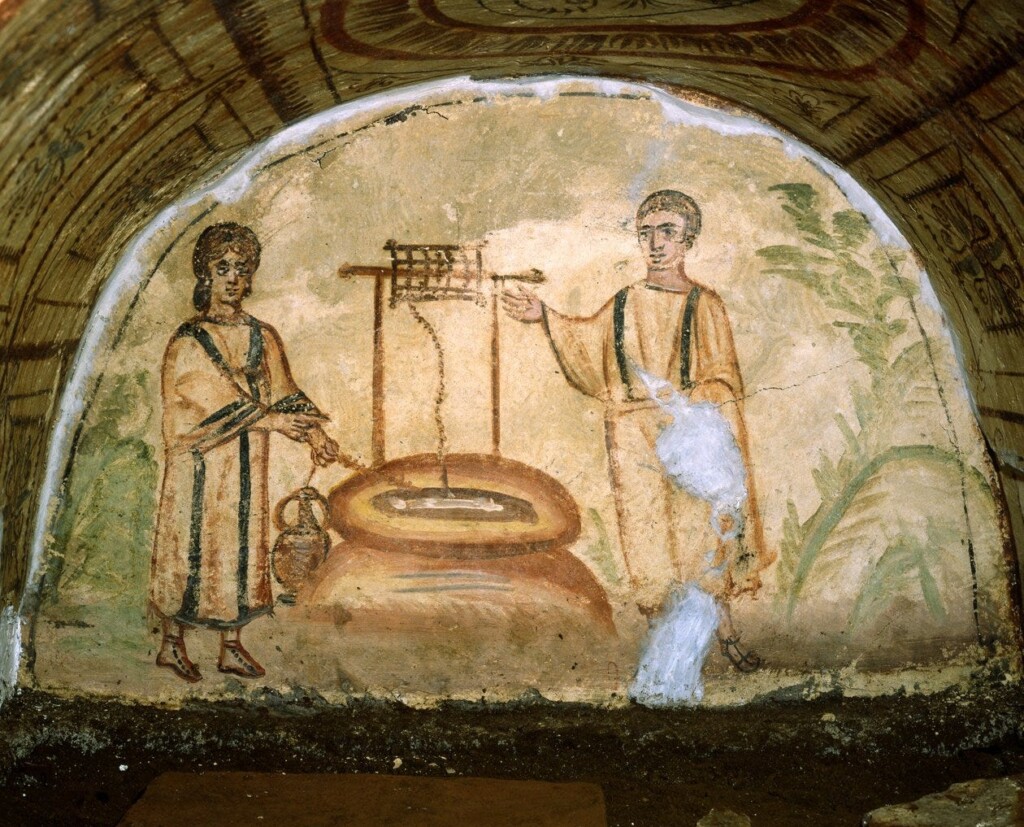
You have seen it a thousand times without ever really looking at it. The hand raised with two fingers extended and the thumb folded inward, the gesture frozen in gold leaf above an altar or pressed into the corner of a mosaic, presiding over everything below it with an authority that feels ancient, inevitable, natural. You do not question what it means because the meaning arrives before the question does. That is precisely the point.
Umberto Eco, in his 1976 work “A Theory of Semiotics,” argued that every sign system operates through a kind of cultural arbitrariness that hardens over time into apparent necessity. What begins as a convention chosen from among several possible conventions eventually presents itself as the only conceivable option. The raised blessing hand of Byzantine iconographic tradition did not emerge from nature. It was selected, refined, standardized, and then repeated across centuries until the repetition itself became the argument for its truth. The gesture now carries theological weight not because of what it inherently means but because of how thoroughly it has colonized the visual imagination of the faithful.
Ernst Gombrich, in “Symbolic Images” published in 1972, pushed this further by demonstrating that symbolic conventions in religious art are never passive containers for pre-existing meanings. They actively shape what the viewer is capable of perceiving and feeling. The halo, that disk of gold or light surrounding the head of a sacred figure, was borrowed from Roman solar iconography, from the radiant crowns placed on emperors and sun gods, and then systematically transferred onto Christ, the Virgin, the apostles, until the association between luminous crown and divine authority felt not like a borrowing but like a revelation. What Gombrich understood was that the symbol teaches the eye what to desire.
The fish, the ichthys, works differently. It began as a covert signal, a scratched mark in stone or dirt between people who could not speak openly, its Greek letters spelling out “Jesus Christ, Son of God, Savior” in an acronym that only the initiated could decode. There is something almost clandestine and electric about that original function, a secret grammar shared among people for whom belief carried real physical danger. But that clandestine energy did not disappear when Christianity became the official religion of the Roman Empire in 380 CE under Theodosius I. It was preserved, crystallized, and then redeployed as a mark of belonging that still whispers of exclusivity even when plastered on the back of millions of suburban automobiles. The symbol retained its psychological charge precisely because it retained the ghost of its original danger.
The lamb standing with a banner or bleeding into a chalice operates through a different psychological mechanism altogether. It reaches into something pre-Christian, pre-literate, the visceral human response to an innocent animal led to slaughter, and loads it with sacrificial theology. The image works because it bypasses rational evaluation. You feel the lamb before you think the doctrine. This is not accidental. The mandorla, that almond-shaped aureole of light that encloses the ascending or enthroned Christ, geometrizes transcendence, giving the infinite a precise and repeatable outline. It tells the viewer that the sacred has a shape, and that shape is this one, and that you are now inside the grammar of a world where such shapes carry ultimate meaning.
What Eco called the “semantic universe” of a culture is never neutral territory. It is a structured field where certain meanings are made easy, almost automatic, and others are made difficult or invisible. The symbolic grammar of Christian iconography did not simply record a theology. It produced the conditions under which that theology could feel self-evident, could arrive in the nervous system before the mind had any chance to evaluate its claims.
When God Had a Face
You have looked at your own face long enough to stop seeing it. That is what happens with any image that becomes sacred — repetition transforms recognition into blindness, and what began as a radical act of representation flattens into the merely familiar. But the first time someone drew a human face and said this is God, that was not familiarity. That was an act of theological violence, beautiful and audacious and deeply strange.
The earliest Christians did not do it. They drew fish, anchors, bread, a lamb. The divine could be suggested, encoded, approached through metaphor — but not shown. The prohibition inherited from Jewish tradition ran deep: you do not make an image of the absolute. And then, gradually, they did. A young man appears in the catacombs of Rome, smooth-faced and curly-haired, more Apollo than anything else. No beard, no crown of thorns, no age in the eyes. A shepherd carrying something on his shoulders. The figure of Christ in third and fourth century art looks nothing like the icon that would come to dominate the imagination of two thousand years — because the image was still being invented, still searching for itself.
There is a moment that returns in many lives: standing before a mirror after something has shifted irrevocably, and not quite recognizing the face looking back. Not because it has changed, but because you have. The features are the same. The eyes, the jaw, the particular way the light catches the left side. And yet something on the other side of the glass seems to belong to someone you are still becoming. This is what iconographic history did with the face of Christ across six centuries. The image kept looking at itself and kept finding something different.
By the time Byzantine theology had crystallized around the figure of the Pantocrator — that stern, frontal, all-seeing face that dominates the apses of Greek Orthodox churches — the transformation was complete. The beardless youth had become the Ruler of All, one hand raised in blessing, one holding the book of judgment. The eyes do not invite. They assess. David Freedberg, in his landmark study The Power of Images published in 1989, argued that the relationship between viewer and sacred image is never merely aesthetic — it is physiological, almost compulsive. People flinch before certain images. They avert their eyes, they weep, they feel accused. The Pantocrator was designed for exactly this effect: to make the body respond before the mind could intervene.
And then came the Sistine ceiling, painted between 1508 and 1512, and the entire logic shifted again. The God reaching toward Adam is old but not ancient, muscular but not inhuman, wrapped in fabric that moves like weather. He has a white beard and an expression that is simultaneously exhausted and urgent. He looks, unmistakably, like a man who has done a great deal of work and is not finished. Freedberg’s insight cuts here with particular sharpness: when you give God a specific face, you are not merely illustrating theology. You are claiming that the divine can be caught inside human features, that the infinite has a jaw, a brow, a recognizable gaze.
What gets lost in that claim is the original terror. To say God looks like this is also to say God looks like us — and embedded inside that statement is a political history as much as a theological one. The faces of God in Western art are predominantly those of powerful men from specific Mediterranean and Northern European traditions. The universality claimed by the image was always, in practice, a particular face representing itself as universal. The smooth-cheeked Roman shepherd and the Byzantine judge and the aging creator on the chapel ceiling are all someone’s idea of what divinity should resemble.
The mirror never shows everything. That is the point of mirrors, and of sacred images too.
Mary, the Symbol That Absorbed Everything
You have seen her in a thousand churches before you ever learned her name. She stands there — or sits, or kneels over a body — draped in a blue so specific, so imperial, that it does not read as a color chosen for beauty but as a color claimed from somewhere else entirely. That blue came directly from the pigment reserved for Roman imperial portraits, lapis lazuli ground into ultramarine, worth more per gram than gold throughout the medieval period. It was not assigned to Mary because she was humble. It was assigned to her because the Church understood, with cold institutional precision, that the way you absorb a rival is not to destroy her but to wear her face.
There is a woman standing in a doorway, watching a procession pass. Men carry a painted image of the Madonna through a village street, and the woman watches with an expression that cannot quite be called devotion — it is older than devotion, more private, something that lives below the words she would use in confession. She recognizes something in that image that the priest’s homily has never explained. She is right to recognize it. She has no language for what she knows.
Marina Warner, in her 1976 study Alone of All Her Sex, documented with archaeological patience how the iconographic program of the Virgin Mary was constructed not from scriptural necessity but from cultural absorption. The crescent moon beneath Mary’s feet in the image of the Immaculate Conception is not Christian in origin — it belongs to Isis, to Artemis, to Diana, to a long lineage of lunar goddesses whose power over cycles, tides, and female bodies the Church needed to neutralize without destroying. You do not neutralize a symbol by erasing it. You neutralize it by placing it beneath your figure’s feet, making the old power into a footstool for the new orthodoxy.
The Black Madonnas complicate this further, because they refuse the neutralization. Scattered across Europe — Czestochowa, Montserrat, Loreto — their dark faces have generated centuries of uncomfortable theological explanation, scholars arguing over oxidized varnish and smoke damage when the more honest answer sits in the pre-Christian dark goddesses of earth and fertility whose shrines occupied those same hills long before a church was built over them. The body of scholarship has moved, however reluctantly, toward acknowledging what the women who walked barefoot to those shrines already knew in their feet: this is older than the name they gave her.
And then there is the Pietà — Mary holding the dead Christ across her lap, the most formally perfect translation of grief into stone that Western sculpture produced. But the pose is not original to Christian iconography. It belongs to Isis holding Osiris. The mourning goddess cradling the murdered god, the mother who does not weep but simply holds, is a structure of religious feeling so ancient it predates the civilizations that formalized it. Michelangelo rendered it in marble with such mastery that the image became definitively Christian in the cultural imagination. The earlier author was written out, the way earlier authors always are.
What was accomplished through this iconographic program was described by Warner as a process of simultaneous exaltation and confinement: Mary is elevated to Queen of Heaven, intercessor, co-redemptrix in popular theology, the face that generations of women have turned to in extremity — and in the same gesture, her only approved qualities are virginity, obedience, and maternal sacrifice. The worship is total. The model is impossible. Every quality that makes her divine is a quality that disqualifies the woman praying to her from ever approaching that divinity. She is worshipped precisely as a woman could never be, and she is used to define what a woman must be.
The woman in the doorway is still watching. The procession has passed. She has not moved.
A vision curated by a filmmaker, not an algorithm
In this video I explain our vision
The Saints as a Distributed Network of Control
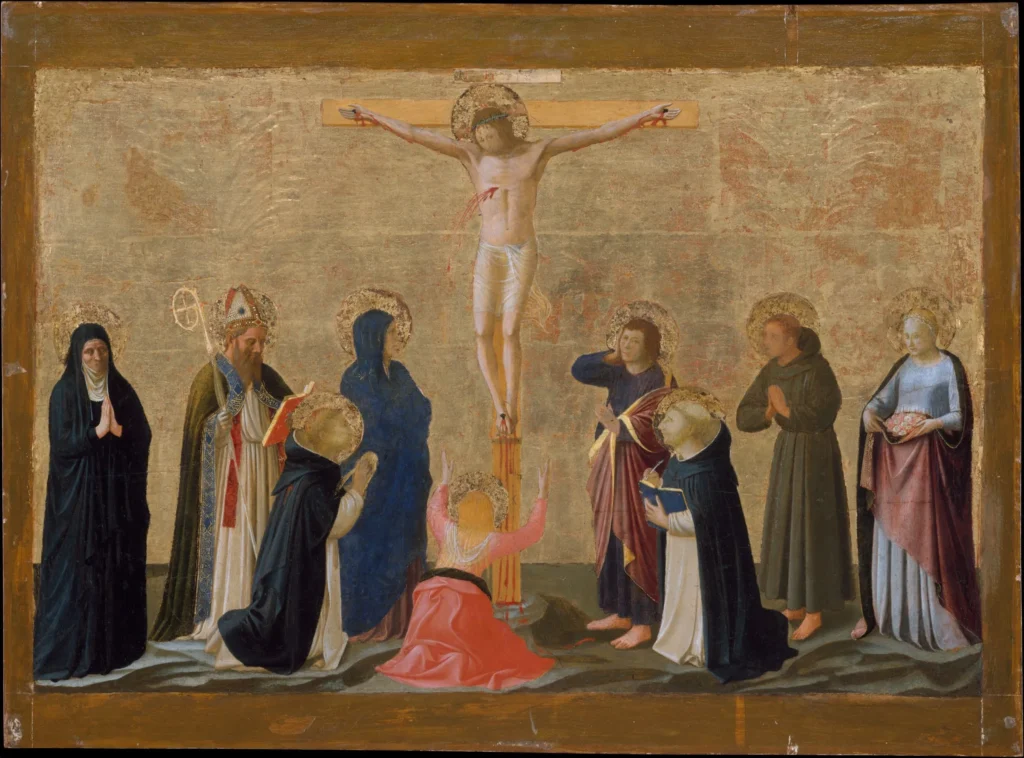
You have seen it without knowing what you were seeing. A crowd gathered before a glass case, a silver reliquary shaped like a forearm, the faithful pressing forward to touch it through a grille worn smooth by centuries of hands. The priest does not need to explain anything. The body part does the work.
Peter Brown, in his landmark 1981 study of the cult of the saints, identified something that art historians had long circled without naming directly: the saint is not primarily a spiritual figure but a territorial one. The saint’s power, Brown argued, was inseparable from the saint’s presence — not metaphorical presence, but physical, localized, anchored to a specific place, a specific relic, a specific image. Patrocinium was the Roman word for it: the relationship between a powerful patron and those who sought protection by clustering near them. The Church did not abolish this logic. It sanctified it.
The iconographic system that emerged from this logic is extraordinarily precise. Every saint carries an attribute — a wheel, a grid, a pair of eyes on a plate — and those attributes are almost never symbols of grace. They are instruments of torture, the specific tools used to destroy the body that now intercedes for you. Sebastian pierced with arrows. Lawrence on his gridiron. Agatha holding her severed breasts on a platter with the calm expression of someone offering bread. The image of suffering is not incidental to the devotion. It is the mechanism of it. You are asked to venerate the wound, to identify with the broken body, to find in its destruction the promise of your own salvation. The theological argument is that suffering redeems. The social argument, which Brown traces with meticulous care, is that this logic made suffering legible, even desirable, certainly endurable.
There is a scene in a small Sicilian village during a patronal festa, and it has the quality of something very old trying to continue existing. Men carry a massive gilded statue through streets too narrow for it, their shoulders bleeding where the wooden frame cuts in, their faces locked in an expression that is not quite pain and not quite ecstasy but something that sits between them like a third emotion with no name. Women throw flower petals from windows. The priest chants into a microphone. Everyone knows exactly where to stand, exactly when to weep, exactly how much money to pin to the saint’s robe. The saint is the map of the community. The saint’s image tells you who belongs and who does not, who has paid their devotional dues and who has not, whose family name appears on which chapel wall. Religion here is cartography.
This is what the iconography of saints actually encodes. The localized cult image — the Black Madonna of this valley, the protector of that fishermen’s guild, the patron of weavers in this particular city — is a system for organizing territory, loyalty, and social compliance far more granular than any central ecclesiastical authority could achieve alone. Rome could not be everywhere. The saint could be. Brown estimated that by the fifth century the landscape of the Latin West was already saturated with shrines, each one functioning as a node in a network that simultaneously provided community cohesion, resolved disputes through divine arbitration, and enforced a specific moral economy.
The tortured body in the painting does double work. It inspires genuine devotion, real tenderness, the authentic human response to witnessing suffering. And at the same time it trains the eye and the will toward a particular understanding of what bodies are for. Bodies are for endurance. Bodies are for offering. The body that suffers beautifully, that does not resist, that transforms agony into serenity — this body is the body the image asks you to become. Not with words. With paint.
The Reformation’s War on the Eye
You walk into a church that was built in the twelfth century and you notice immediately that something is wrong. The walls are too clean. The plaster is too white, too even, too deliberate. There is a blankness that is not emptiness — it is erasure. Beneath that whitewash, if you were to scrape even gently, you would find the ghost of a face, an angel’s wing, the hem of a robe rendered in red ochre and gold leaf by hands that believed visibility was itself a form of prayer.
What happened to those walls happened with extraordinary speed and with the force of theological conviction. In Zurich in 1523, in Basel in 1529, in cities across the Low Countries, England, Scotland, and the German territories through the following decades, Protestant reformers and their followers entered sacred spaces and began dismantling centuries of accumulated Christian imagery. Altarpieces were carried out and burned. Statues were beheaded. Stained glass was smashed. The reformers called it purification. What they were actually doing was waging a visual war so total in its ambition that the historian Carlos Eire, in his 1986 study War Against the Idols, described it not as a reaction against art but as an assault on an entire metaphysics — a systematic attempt to destroy the belief that the divine could be approached through material form.
Think of what it looks like when a system decides to erase its own past through images. A man walks through a corridor with a bucket and a brush, and behind him the faces disappear. There is something almost surgical in the efficiency of it — no rage, no particular emotion, just the steady application of white over color, the methodical burial of meaning. The terrifying thing is not the violence. It is the calm. The calm of people who are absolutely certain they are right.
Calvin’s position was unambiguous: images in worship were not merely unnecessary, they were an active corruption of the soul. In the Institutes of the Christian Religion, published in its definitive form in 1559, he argued that the human mind was a perpetual factory of idols, and that the Church had fed this tendency rather than correcting it. Gregory the Great’s ancient defense of images — that they served as scripture for the illiterate — Calvin dismissed as a later theological convenience, a rationalization built after the fact to protect a practice that had no genuine apostolic foundation. The image, for Calvin, did not elevate the mind toward God. It stopped the mind there, on the surface, on the wood and the paint, on the human face falsely wearing the divine.
What Eire shows with uncomfortable clarity is that this argument was not simply about theology. It was about power. To control what a population sees in its sacred spaces is to control what it believes, what it fears, what it asks for when it kneels. The Catholic Church had built an empire of looking. The Reformers did not dismantle that empire. They replaced it. The whitewashed wall was not a neutral surface. It was a different instruction. Where the painted Christ had said look here, feel this, remember this moment, the bare wall said: look nowhere, feel nothing you cannot verify with the Word, remember only what can be read.
And yet something persisted. The hunger for the visible did not disappear because the walls were white. It migrated. It moved into printed illustrations, into domestic devotional objects kept hidden, into the elaborate mental images that Protestant preachers paradoxically constructed through their sermons — painting with words what they had forbidden painting with hands. The eye cannot be legislated out of devotion. It finds its images even in their absence, conjuring them from the very emptiness that was meant to silence them.
The Icon in the Age of Its Mechanical Reproduction
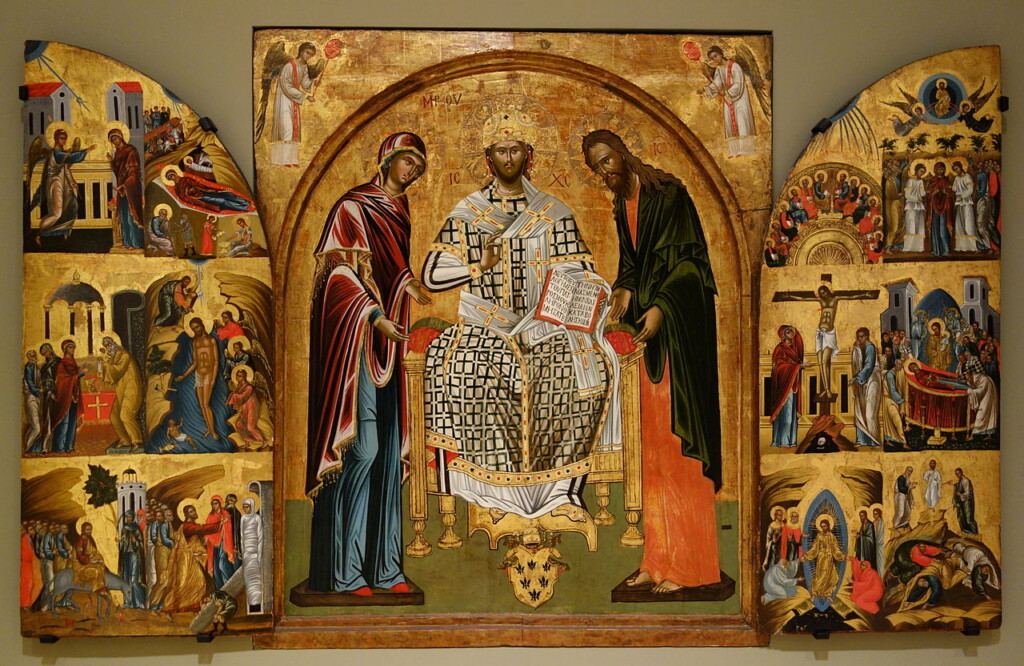
You have seen the image a thousand times without ever stopping to see it. A halo rendered in backlit gold floats above a tech company’s newest product launch. A figure with arms outstretched, silhouetted against an apocalyptic sky, anchors a political campaign poster in a midwestern American city. A grieving mother lifts her dead son’s body in a posture so perfectly triangulated, so achingly familiar in its geometry, that something in you responds before your mind has the chance to ask why. You have been trained to feel this. The training began centuries before you were born.
Walter Benjamin understood, in 1935, that the moment an image could be reproduced infinitely, something in its core changed forever. His essay on mechanical reproduction was not merely a meditation on technology. It was a diagnosis of a spiritual catastrophe dressed in the clothes of progress. What he called the “aura” — that unrepeatable presence, the sense that a sacred image exists here and nowhere else, that it carries within it the accumulated weight of every gaze that has ever fallen upon it — this aura, Benjamin argued, withers under reproduction. The copy does not carry the original’s gravity. And yet we live now in a civilization built almost entirely on copies of copies, on images whose originals most people will never see and whose sacred charge has been systematically harvested, stripped of its theological context, and repackaged as aesthetic power in the service of entirely secular ends.
Consider what happens in a room where a man stands before a television broadcasting the news, and behind the anchor’s head, framed in the screen’s perfect rectangle, hangs a reproduction of a Byzantine Christ. Nobody in the room comments on it. Nobody finds it strange. The image has become wallpaper, a texture of cultural authority, a signal of seriousness and weight, entirely emptied of the demand it once made on the viewer — the demand to kneel, to tremble, to change. This is the mutation Benjamin could not have fully anticipated: not the destruction of sacred imagery, but its zombification. The form persists. The obligation it carried has been surgically removed.
Roland Barthes, writing in Mythologies in 1957, described myth as a second-order semiological system — a process by which history is drained from a sign, leaving only its shape, which then becomes available to carry entirely new meanings presented as natural and inevitable. Christian iconography has undergone exactly this mythological transformation at industrial scale. The Pietà becomes a war photograph. The Annunciation becomes a perfume advertisement. The crown of thorns becomes a rock star’s album cover. Each borrowing depends for its emotional force on the sacred charge it extracts from the original, while simultaneously insisting it owes nothing to that original, that it is merely using a powerful visual structure.
Sociologist David Morgan, in his 1998 study Visual Piety, documented how mass-produced sacred images in American Protestant households throughout the twentieth century quietly redefined what devotion meant — shifting it from liturgical participation toward private emotional consumption, from communal practice toward individualized aesthetic experience. The image, reproduced and distributed by the millions, became something you could own rather than something that owned you. This is the final inversion: the icon, which once commanded the believer’s total surrender, has become a commodity whose power the consumer believes they control.
And yet. In a film whose images have settled into cultural memory without most viewers knowing precisely why, a man enters a ruined church, walks through water that covers the floor to his knees, and lights a candle with the trembling concentration of someone for whom this gesture is the last remaining act of meaning in a world that has otherwise gone entirely dark. Whatever he believes or does not believe, his hands remember what belief once required of a body. The image does not explain itself. It simply holds the question open, burning at the center of the wreckage, asking whether the ghost and the body were ever truly separate things.
✝️ Symbols, Stones, and Sacred Meaning
Christian iconography did not emerge in a vacuum — it grew from a rich soil of medieval art, sacred architecture, and ancient symbolic tradition. The articles below explore the world from which Christian visual language was born, tracing symbols across stone, fresco, and sacred space.
Medieval Art: History and Meaning
Medieval art is the broad canvas upon which Christian iconography painted its most enduring symbols. This article traces how religious meaning was encoded into form, color, and composition across centuries of European artistic production, revealing the visual theology that shaped an entire civilization.
GO TO THE SELECTION: Medieval Art: History and Meaning
Medieval Sculpture: History and Iconography
Medieval sculpture transformed theological doctrine into tangible stone, giving physical presence to saints, angels, and biblical narratives. This article examines how sculptors across the Romanesque and Gothic periods used iconographic conventions to communicate sacred stories to largely illiterate congregations.
GO TO THE SELECTION: Medieval Sculpture: History and Iconography
Gothic Cathedrals: History and Symbolism
Gothic cathedrals are perhaps the most complete expression of Christian iconography in architectural form, where every rose window, portal, and flying buttress carried symbolic weight. This article explores how light, geometry, and narrative imagery fused into a unified sacred language in the great churches of medieval Europe.
GO TO THE SELECTION: Gothic Cathedrals: History and Symbolism
Romanesque Art: History and Characteristics
Romanesque art laid the foundational visual grammar that Christian iconography would develop throughout the Middle Ages and beyond. This article surveys how Romanesque artists synthesized Byzantine influence, early Christian symbolism, and local traditions into a powerful and austere sacred aesthetic.
GO TO THE SELECTION: Romanesque Art: History and Characteristics
🎬 Discover Sacred and Symbolic Stories on Indiecinema
If images, symbols, and the search for meaning move you, Indiecinema streaming is your next destination. Explore an independent cinema that dares to ask the same profound questions that sacred art has posed for centuries — from the spiritual to the visionary, from the contemplative to the radical.
👉 EXPLORE THE CATALOG: Watch Indie Films in Streaming
A vision curated by a filmmaker, not an algorithm
In this video I explain our vision

