
The Face in the Window
It happens in a fraction of a second, but you have lived inside that fraction your whole life without knowing it. You are walking past a darkened shop window in the early evening, mind elsewhere, and something catches the corner of your eye — a figure, slightly hunched, moving at your pace, wearing what you think might be your coat. There is a split second, genuinely unmeasured and genuinely strange, where you do not know who that is. The figure is familiar in the way a half-remembered dream is familiar: close enough to trigger recognition, far enough away that recognition has not yet snapped shut. And then it does. Of course it does. The delay collapses, the image resolves, and you think nothing more of it — perhaps feel a flicker of embarrassment, adjust your posture reflexively, walk on.

But something happened in that gap. Something that philosophy and psychology have circled for over a century without ever quite making you feel it in the body the way that moment felt it. What happened was not a malfunction. It was not tiredness or distraction producing a glitch in an otherwise reliable system. What happened was the truth surfacing, briefly and accidentally, before the machinery of the self rushed in to cover it over again.
The self you carry with such confidence — the one with opinions and memories and a name and a characteristic way of holding a coffee cup — is not primary. It is a construction built on top of a more fundamental estrangement, one that began before you had language to name it, before you had concepts to organize it, in the earliest months of a life you cannot remember and have never stopped living inside. Jacques Lacan called this the mirror stage, and he introduced it formally to the International Psychoanalytic Association in Marienbad in 1936, though the version that entered the theoretical canon most forcefully appeared in his 1949 paper, later collected in Écrits, published in 1966 — a book that changed the direction of psychoanalysis, literary theory, feminist thought, and film studies simultaneously, and was described by one of his contemporaries as the most difficult text in the French language since Mallarmé. Neither compliment was entirely uncomplicated.
What Lacan was describing, in that dense and deliberately resistant prose, was something deceptively simple: between six and eighteen months of age, a human infant encounters its own reflection and does something no other animal does in quite the same way. It identifies with the image. It takes that coherent, unified, spatially bounded figure in the mirror as itself, and in doing so, it steps into a fundamental misrecognition that will organize its entire psychic life from that moment forward. The French word Lacan used was méconnaissance — not simply misrecognition but a knowing-wrongly that is also a kind of not-knowing, a structural blindness built into the very act of seeing yourself at all.
Because the image in the mirror is a lie, and you believe it completely, every day, without interruption. It presents you as whole, bounded, coherent, stable. It gives you edges. And the infant, whose actual embodied experience is one of fragmentation — of uncoordinated limbs, of needs that arrive before the capacity to satisfy them, of a body that does not yet know where it ends and the world begins — seizes on that image with what Lacan describes as jubilation. Finally, there is a shape. Finally, something has edges. The tragedy, which is also the foundation of everything you will ever think about yourself, is that the shape is outside. It is other. It is, in the most precise sense, not you — it is an image you have adopted as you, and the distance between the two will never fully close.
That split-second hesitation in front of the shop window is not a glitch. It is the seam showing. The gap between the image and whatever is looking at it opened before you had words, and it has never closed, and on some level you have spent your entire conscious life papering over it with varying degrees of success.
The Mirror and the Rascal
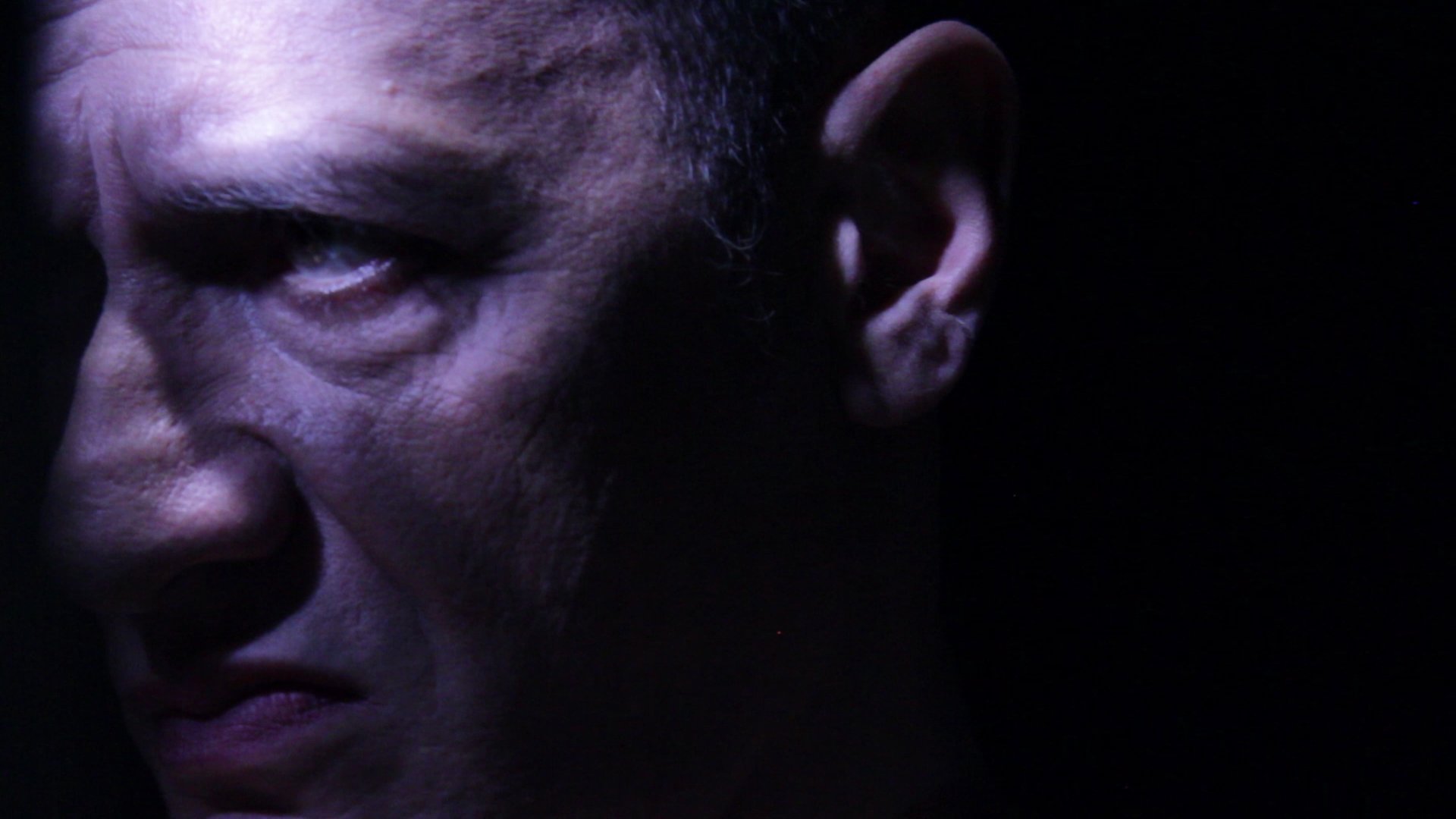
Drama film, by Valerio De Filippis, Italy, 2019.
The mirror and the rascal is an experimental film based on the tragedy "Richard III" by William Shakespeare. It tells the delirium of contemporary power in an author's reinterpretation of cinema, video art and music. The protagonist, Richard Duke of Gloucester, brother of King Edward IV, through a long series of crimes eliminates all the obstacles that stand between him and the throne of England.
Valerio de Filippis, a well-known painter who has been following his research path for a long time, investigating the relationship between light, corporeality and the psyche. The mirror and the rogue and the cinematographic equivalent of Valerio De Filippis' painting, his figurative style is in fact very recognizable looking at his paintings. But cinema is a new way where the artist can also be involved as an actor and performer, with an original mix between acting and singing. Staging the dark side of the human soul, the film is a surreal and disturbing interpretation of a great classic. The director says: "The first suggestion was musical: I was interested in transforming the text of Shakespeare's tragedy Richard III into notes. I love cinema and at a certain point I felt that the time had come to combine research on the image of painting to my love for cinema and music. When the film is finished I realize that I have remained faithful to painting: every frame of the film appears to me like a painting: the same light, the same colors, the same atmosphere ". The mirror and the rascal is a kind of psychoanalytic session that the painter does while hiding behind the mask of Richard III. Behind this ferocious and unscrupulous character we find a path of self-analysis by De Filippis, who is mainly interested in the more violent and turbid aspects. An experimental film in which, with great courage, the author gets involved completely, fragmenting the images in an unconventional montage, which is at the same time a flow of consciousness and spectacle.
LANGUAGE: English
SUBTITLES: Italian
1936 and the Birth of a Fracture
Something breaks in 1936 that no one notices breaking. Lacan stands before the International Psychoanalytic Association in Marienbad and delivers what will become one of the most consequential theoretical gestures of the twentieth century. Ernest Jones, presiding, cuts him off before he finishes. The congress moves on. The idea survives anyway, the way fractures survive inside bones — invisible, load-bearing, changing everything about how the structure holds weight.
What Lacan was trying to say, and what he would formalize thirteen years later in the 1949 essay “The Mirror Stage as Formative of the I Function,” published in the Écrits of 1966, is deceptively simple on its surface and vertiginous underneath. Between the ages of six and eighteen months, an infant encounters its reflection — in a mirror, in the gaze of a parent, in any surface that returns an image — and performs an act of jubilant recognition. The infant sees a form. Whole, bounded, upright, coherent. It responds with something that looks like joy, like relief. And in that moment, it becomes a self.
Except that is precisely where the horror enters, quietly, through the side door. Because the infant who looks at that reflection and thinks I has not yet achieved the motor coordination that the image implies. The body is still fragmented, still unreliable, still a collection of sensations without architecture. What the infant identifies with is not itself but a picture of itself — exteriorized, frozen, belonging already to the domain of appearances rather than lived experience. The self is not discovered. It is confiscated. It is handed over, wholesale, to an image that arrives from outside and that the infant swallows as though it were the most intimate truth.
Lacan calls this méconnaissance, misrecognition, and the word does not mean simple error. It means a structural condition of not-knowing that masquerades as knowing, a blindness that presents itself as clarity. You do not misrecognize yourself in the mirror once, at eighteen months, and then correct the mistake as you mature. The misrecognition is the foundation. Everything you subsequently build as identity, as self-concept, as the coherent narrative you tell about who you are — it rests on that original substitution of image for being.
This is the thing that cannot be metabolized easily, the thing that makes Lacan so persistently uncomfortable to read even when you think you have understood him. He is not offering a developmental stage that you pass through on the way to something more solid. He is describing the permanent architecture of subjectivity. The I, for Lacan, is always already alienated, always the echo of an exterior form that was never truly yours. What you call your inner life is organized around a borrowed outline.
There is a man, a father, who holds his small daughter up to a bathroom mirror every morning before work. She is fourteen months old. She looks at the glass, looks at him, looks back at the glass, and laughs. He laughs too. He thinks he is teaching her something. He thinks the lesson is: that is you. And in the deep structural sense, he is right, except the lesson is also: you are that, meaning you are outside yourself, meaning the place you will spend your life trying to return to was never yours to begin with.
Freud gave us the unconscious as a cellar — dark, full of things we pushed down. Lacan takes that architecture and turns it inside out. The unconscious, for Lacan, is not beneath the surface. It is structured like a language, as he will say famously in his 1953 Rome Discourse, meaning it operates through the same mechanisms of substitution and displacement, the same sliding of signifiers, the same fundamental gap between what is said and what is meant. And it begins here, in this mirror, in this jubilation, in this moment when a fragment of flesh looks at a coherent image and decides, incorrectly and irrevocably, that this is what I am.
The fracture that nobody noticed in 1936 runs through every reflection you have ever trusted.

The Image That Precedes You
She has been standing in front of the bathroom mirror for eleven minutes. You know this because she counted, the way you count things when you are trying to hold the world still. She is not applying makeup. She is not checking her teeth or smoothing her hair. She is looking at the face that looks back, tilting her head slightly to the right, then to the left, as though a different angle might finally reveal something definitive, some fixed point of reference that confirms: yes, this is the one. This is the real one. But the mirror offers nothing of the kind. Every time she settles into one expression, the reflection seems to have arrived there a half-second before her, as though it were the original and she the copy.
This is not vanity. This is terror dressed as routine.
Lacan called the register in which this happens the Imaginary, and he meant something precise by it, not fantasy in the colloquial sense, not daydream or delusion, but the entire domain of images, likenesses, doubles and rivalries through which the ego is constituted. The Imaginary is the register of the mirror stage itself, the space where the six-month-old child seizes upon a unified image and declares, wrongly but irrevocably, that this is me. What the woman in the bathroom is experiencing is not a failure of that process but its faithful continuation. She is still doing what she was trained to do at the beginning of psychic life: looking for a coherent self in a surface that cannot provide one.
Lacan named this fundamental error méconnaissance, misrecognition. Not ignorance in the simple sense, not a mistake that corrects itself with more information, but a structural distortion built into the very act of seeing oneself. The image you identify with is always already ahead of you, always already more unified, more stable, more complete than the turbulent and fragmented thing that produces it. You identify with a fiction and then spend your life defending that fiction against the evidence of your own experience. The ego, Lacan wrote in the Écrits, is “a succession of alienating identifications.” You are never catching up to yourself. You are always arriving where your image has already been.
Then consider someone watching a recording. Security footage, the kind with the grey-green cast and the slightly accelerated movement of the ordinary. He has been given access to the tape for a mundane administrative reason, and he watches himself walk through a public space, coat moving, arms swinging, and he does not recognize the gait. He knows intellectually that it is him. The timestamp, the coat, the location are all confirmed. But the way that figure moves through the crowd is foreign to him, belongs to someone else, some other person who has been inhabiting his body without his knowledge. He feels a cold, specific unease, like finding a handprint in a room you have never entered.
This is méconnaissance reversed. Usually you mistake the reflection for yourself. Here you mistake yourself for a stranger. Both errors are the same error. Both demonstrate that the image and the subject are never identical, that there is always a gap, and that the gap is not a problem to be solved but the condition of what we call a self.
Louis Althusser understood this and extended it outward in a single devastating move. In his 1970 essay on ideology and ideological state apparatuses, he described the mechanism he called interpellation: the way ideology “recruits” subjects by hailing them, by calling out, and the subject turns around. That turning, Althusser argued, is the founding gesture of subjection. You recognize yourself in the call, and in recognizing yourself you become the subject ideology needs you to be. The mirror logic that Lacan traced in the nursery, Althusser located in every institution, every school, every church, every advertisement that addresses you by saying: you, yes you, the one who wants to be seen.
The woman is still at the mirror. The man rewinds the tape and watches himself enter the frame again.
The Other Who Builds You
There is no such thing as a private mirror. You understand this the moment you catch yourself adjusting your expression even when alone, smoothing something in your face that no one is there to see, performing a composure for an audience that evacuated the room hours ago. The performance does not stop because the witnesses left. It never started because they were present. It started because, from the very beginning, there was always already another set of eyes inside the mirror before yours ever reached it.
Donald Winnicott, writing in 1967 in his essay on the mirror-role of mother and family in child development, made an observation so quiet it almost sounds like common sense: the first mirror a child looks into is the mother’s face. Not glass, not reflection, but a human face that responds, that brightens or dims, that confirms or withholds. What the infant sees there is not the mother’s interior life but a reflection of itself, refracted through another person’s nervous system, another person’s history, another person’s fear and desire. The face that smiles back is never neutral. It is always already interpreting you, shaping what you will believe yourself to be before you have the neurology to question it.
Lacan knew this too, but he drew a darker consequence. Where Winnicott held onto the possibility of a good-enough mirror, a face responsive enough to let something authentic pass through, Lacan saw the structural problem: the image that comes back to you from any other is never yours. It belongs to them. It is organized by their language, their desire, their lack. The mother’s gaze does not simply reflect the child; it inscribes the child into a symbolic order that predates both of them. By the time you recognize yourself in any face turned toward you, you are already speaking a language you did not choose, performing an identity that was waiting for you like a costume laid out on the bed.
Sartre, in Being and Nothingness, called this the condition of being-for-others: the discovery that you exist in someone else’s world as an object, that their look turns your fluid subjectivity into a thing with edges and a fixed meaning. What Sartre described as a crisis — the shameful solidification of the self under the gaze — Lacan understood as the founding condition. You do not begin as a subject who is later caught by the other’s look. You begin as a reflection in that look. The subject is the residue of being seen.
A man rehearses an argument in an empty kitchen. He rehearses it with full emotional conviction, his voice rising at the right moments, his gestures landing with appropriate weight, building a case for someone who left three hours ago and will not return until evening. He is not simply preparing. He is, in some sense, already inside the argument, already performing it for the invisible presence of the other whose judgment he has internalized so completely that the other need not be present to exercise authority over him. This is not neurosis. This is the ordinary structure of the self as Lacan described it. The other is not a person you occasionally encounter. The other is the permanent inhabitant of your interiority, the squatter who arrived before you did.
The social gaze works the same way at scale. The cultural image of what a body should look like, what a voice should sound like, what ambition should resemble — these are not external pressures applied to a pre-formed self. They are the material out of which the self is constructed. By the time you experience them as constraint, they have already done their foundational work. The discomfort you feel when you fail to match the image is not the friction between you and the world. It is the friction between two versions of you that both arrived from outside, competing for the position of the real one.
Winnicott wanted to rehabilitate the mirror, to imagine a face responsive enough to let the child through. But perhaps the question is not whether the mirror can be made good enough. Perhaps the question is what survives the mirroring that was never, strictly speaking, a reflection at all.
Instagram, the Ego Ideal, and the Permanent Audition
There is a specific kind of silence that descends after you post a photograph of yourself and the notifications do not come. Not the silence of a room without people, but the silence of a mirror that refuses to reflect. You posted it at what the algorithm supposedly favors, you framed it carefully, you chose the version where the light landed correctly on your face — the version where you looked, most precisely, like the person you are trying to convince yourself you are. And now the silence sits on your chest like something clinical.
This is not vanity. Or rather, vanity is the least interesting thing happening here. What is actually occurring is the mirror stage running at industrial frequency, the infant’s desperate search for the coherent image now crowd-sourced across three billion active users and optimized by engineers whose job is to make the need feel infinite. The selfie is not a new form of narcissism. It is Lacan’s founding moment of the ego — that seizure of a unified image to substitute for an inner experience of fragmentation — repeated daily, hourly, by adults who believe they have long since moved past such primitive needs.
Guy Debord wrote in 1967, in the third thesis of his central work, that in societies where modern conditions of production prevail, all of life presents itself as an immense accumulation of spectacles, and that everything that was directly lived has moved away into a representation. He was describing television and advertising and the pacification of post-war consumer society, but he was also, without knowing it, describing the exact psychic architecture of what would come sixty years later. The representation no longer competes with lived experience. It has replaced the territory so completely that returning to direct experience feels like a technical malfunction.
Byung-Chul Han, writing in 2012 in his study of transparency as a political and psychological ideology, identified something that Debord’s generation could not quite name: the compulsion to make oneself visible is no longer imposed from outside. It has been internalized so deeply that it presents itself as desire, as authentic self-expression, as liberation. The subject no longer needs surveillance. The subject performs surveillance on themselves, willingly, continuously, and calls it identity. Han describes a society in which the compulsion to communicate produces a kind of psychic exhaustion, a burnout of the self that has no private remainder to rest in. What he is describing, in the vocabulary of transparency and positivity, is méconnaissance at scale — the misrecognition not as an early developmental accident but as the permanent operating condition of the contemporary psyche.
There is a man who arranges his entire apartment as a set, who films himself from angles he has rehearsed, who has constructed a version of his life so thoroughly mediated that when something genuinely affects him — grief, joy, the particular quality of an afternoon — his first impulse is to ask whether it is writable, postable, legible to others. And when he tries to feel it without the frame of its future representation, he cannot locate it. The feeling dissolves before he can hold it. He is not performing for others. He is performing for himself, because himself, without the performance, no longer has a stable address.
This is the Lacanian ego ideal made algorithmic. The Ideal-I — that image of mastery and coherence which the mirror first offered, which the symbolic order subsequently populates with social norms, parental projections, cultural types — has found its most precise technical instrument in the platform that shows you, in real time, how legible your image is to the crowd. Every like is a mirror confirming the reflection. Every silence is the mirror going dark. And the infant, never having grown out of that originary dependence on external confirmation of its own existence, refreshes the screen again, waiting for the world to tell it who it is.
The audition never closes. There is no role that, once won, ends the need to keep auditioning. The stage has been extended to encompass every waking hour, and the casting directors are everyone and no one, an algorithm that has no face and no satisfaction threshold.
A vision curated by a filmmaker, not an algorithm
In this video I explain our vision
The Crack That Cannot Be Closed
There is a moment, and you have lived it, when you catch your reflection somewhere unexpected — a shop window, a phone screen going dark, the mirror in someone else’s bathroom — and for a fraction of a second you do not recognize yourself. Not because anything is wrong with your face. Because the face is simply there, staring back, and you cannot locate yourself behind it. The recognition comes a beat too late, like an echo arriving after the sound has already passed through you.
This is not a perceptual glitch. This is the structure of the self made briefly visible.
Lacan spent decades insisting on something that comfort and social necessity conspire to hide: the subject is not a unified thing that occasionally fragments under stress. It was never unified to begin with. What you call your identity is a performance staged for a mirror that was installed before you had any say in the matter. The image you took on — smooth, coherent, recognizable — was always a fiction, and a necessary one, but a fiction nonetheless. The “I” that speaks is not the same as the “I” that is spoken about, and neither of them is the thing that falls silent when language stops.
There is a scene that stays with you long after you first encounter it: a man stands in a crowded room at what should be the pinnacle of everything he worked for, and he cannot feel it. He watches himself shake hands, accept congratulations, smile at the right moments. He sees himself performing the role of a man who has arrived, and the performance is flawless, and inside it there is nothing but a cold, observing distance. He is watching himself live. The watcher and the watched are separated by a gap that no achievement can close, because the gap was not created by failure — it was there before the first attempt.
Jacques-Alain Miller, editing Lacan’s seminars posthumously, kept returning to this formulation: the subject of the unconscious is precisely what falls between the signifiers, what cannot be captured in any statement, what flees the moment representation tries to fix it. Every time you say “I,” you are pointing at something that has already moved. The word lands on the image, not on you.
The philosopher Paul Ricoeur distinguished between idem-identity — the sameness of substance, what persists through time — and ipse-identity — the selfhood that promises itself, the one who keeps a word. But Lacan would press further back than Ricoeur’s framework allows, into the place before the promise, before the narrative coherence, into the raw split between the organism and the image it must adopt to enter the world of others. This is not a wound you sustained. It is the wound that made you possible.
There is another scene: a woman removes her makeup late at night, slowly, in front of a mirror, and watches her face become unfamiliar. Not uglier. Just less legible. The mask comes off and underneath it is not a truer face — it is simply the same uncertainty wearing less decoration. She leans closer, as if proximity might solve it, as if the mirror might eventually yield something definitive. It does not. It gives her only more surface, more reflection, more of the question.
The self you perform for the world, the self the world reflects back to you, the self you believe yourself to be when no one is watching — these are not three versions of the same thing. They are three separate constructions in permanent, unresolvable tension, each one claiming authority over the others, none of them winning. The mirror stage does not end when childhood ends. It loops continuously, each new relationship a fresh surface, each fresh surface a new demand to cohere, to be recognizable, to confirm the image that was never really yours.
And so the question that has no comfortable answer is not who you really are beneath the image, but whether there was ever a you available to look — or whether what you have always called looking was itself only another reflection, watching itself, in a room lined entirely with mirrors.
🪞 Mirrors of the Self: Identity, Psyche, and Desire
Jacques Lacan’s Mirror Stage opens a labyrinth of questions about selfhood, desire, and the fragmented subject. These related articles trace the philosophical and psychological threads that weave through Lacanian thought, from the depths of the unconscious to the politics of power and identity.
The Unconscious and its Relationship With Cinema
Cinema has always been haunted by the unconscious, functioning as a screen onto which repressed desires and fears are projected. This article explores how psychoanalytic theory — from Freud to Lacan — has shaped the way we understand spectatorship, identification, and the gaze in film. The relationship between the cinematic apparatus and the mirror stage is particularly illuminating for anyone seeking to understand how images construct the subject.
GO TO THE SELECTION: The Unconscious and its Relationship With Cinema
The Psychology of Power: History and Theory
The psychology of power is inseparable from the Lacanian concept of the Other — the symbolic authority that shapes desire and subjectivity from the outside. This article traces how thinkers from Nietzsche to Foucault have theorized domination, submission, and the internalization of authority. Understanding power through a psychoanalytic lens reveals how the ego itself is constituted in relation to forces that exceed it.
GO TO THE SELECTION: The Psychology of Power: History and Theory
Simone de Beauvoir: Life and Philosophical Thought
Simone de Beauvoir‘s existentialist feminism resonates deeply with Lacan’s insight that identity is never self-given but always mediated through the look of the Other. Her groundbreaking analysis of how woman is constructed as object rather than subject anticipates many of the tensions explored in Lacanian theory. Reading Beauvoir alongside Lacan illuminates the gendered dimensions of misrecognition and the mirror dynamic.
GO TO THE SELECTION: Simone de Beauvoir: Life and Philosophical Thought
Jungian Individuation and the Great Work
Carl Gustav Jung‘s concept of individuation — the process of integrating the unconscious into a coherent self — offers a fascinating counterpoint to Lacan’s insistence on the irreducibly split subject. This article examines how Jungian psychology uses alchemical symbolism to map the inner journey of transformation and wholeness. Comparing Jung and Lacan reveals two radically different visions of what it means to become who one is.
GO TO THE SELECTION: Jungian Individuation and the Great Work
Discover Cinema That Reflects the Depths of the Self
If these ideas about the mirror, the gaze, and the fractured self have stirred something in you, Indiecinema is the streaming platform where cinema becomes philosophy. Explore a curated selection of independent and avant-garde films that dare to look beyond the surface — because the most profound screens are the ones that reflect back what we cannot yet name.
👉 EXPLORE THE CATALOG: Watch Indie Films in Streaming
A vision curated by a filmmaker, not an algorithm
In this video I explain our vision

